
The Nobel Prize in Physics for 2024 was awarded to American scientist John Hopfield and British-Canadian scientist Jeffrey Hinton, Azernews reports.
Day: October 8, 2024
On October 8, the European Parliament held debates on “The Democratic Backsliding and Threats to Political Pluralism in Georgia.” MEPs discussed the upcoming elections in Georgia, the anti-democratic actions and anti-EU rhetoric of the ruling party and the need to adopt a resolution in support of Georgian democracy before the elections. The vote on this resolution will take place tomorrow.
The debates were opened by the Vice President of the European Commission for Values and Transparency, Věra Jourová. She stated: “On the 26 of October over 3 million Georgian will cast their vote to elect a new Parliament. This Parliamentary election are pivotal for Georgia’s EU path. They will also be a critical test for Georgia’s democracy. Last December when Georgia was granted EU candidate status, we hoped this would be a strong incentive for the government to undertake significant reforms achieve opening EU accession negotiations. Instead the recent months the government authorities have proposed laws that have moved the country away from this goal. Despite massive protests the foreign influence law, which stifles civil society and media organizations was reintroduced and adopted. Other proposals that discriminate against and stigmatize the LGBTQI community and weaken the independence of state institutions have also been put forward. At the same time, the anti-EU rhetoric has grown louder.”
Vice President Jourová also thanked the European Parliament for voicing its concerns about Georgia and the government’s “unprecedented anti-democratic actions”, and categorically underlined that the widespread disinformation about the EU’s attempt to open a “second front” in Georgia or Georgia’s Ukrainization is “unacceptable” and only harms EU-Georgian relations. She said that GD’s promise to ban opposition parties contradicts Georgia’s goal of EU integration and expressed hope that Georgians would return to the EU path, promising that the EU would support this process.
MEP Rasa Juknevičienė emphasized in her address that “the European Parliament sends a clear message to Bidzina Ivanishvili and his collaborators in the party: membership of the EU is incompatible with their politics. You can’t be pro-European and pro-Kremlin at the same time.” The same messages were shared by the opposers of the GD politics. Several MEPs pointed out that Georgia can’t be both pro-EU and pro-Kremlin/Putinist.
She, along with MEPs Petras Auštrevičius, Raphaël Glucksmann and others called on the Georgian government to release the former President Mikheil Saakashvili from prison, and expressed support for Georgia’s EU integration and democratic development.
Several MEPs, including Sven Mikser and Markéta Gregorová stressed that the candidate status granted to Georgia by the EU can be withdrawn, with other options such as stopping visa liberalization and individual sanctions on the table if Georgia continues on its current path.
Although the general theme of the debates was criticism of Georgian Dream’s policies, there were a number of MEPs who defended the ruling party. French MEP Thierry Mariani accused NGOs of trying to “destabilize democracy” in Georgia, saying that millions have been spent on NGOs for years, but “this form of interference doesn’t seem to bother anyone” in the EU, which in his opinion means that the EU applies double standards. He said that Georgians don’t want orders from Moscow or advice from Brussels.
Slovakian MEP Milan Mazurek congratulated Georgia for passing the anti-LGBTQ propaganda law, saying that Georgia was protecting its children from “rainbow nonsense” and that the EU must let democratic states make their own decisions. Similar message was voiced by German MEP Hans Neuhoff as well. Meanwhile, Spanish MEP Nacho Sánchez Amor questioned the timing of the resolution, asking if its adoption would interfere in the electoral process.
Also Read:
Young diaspora ambassador
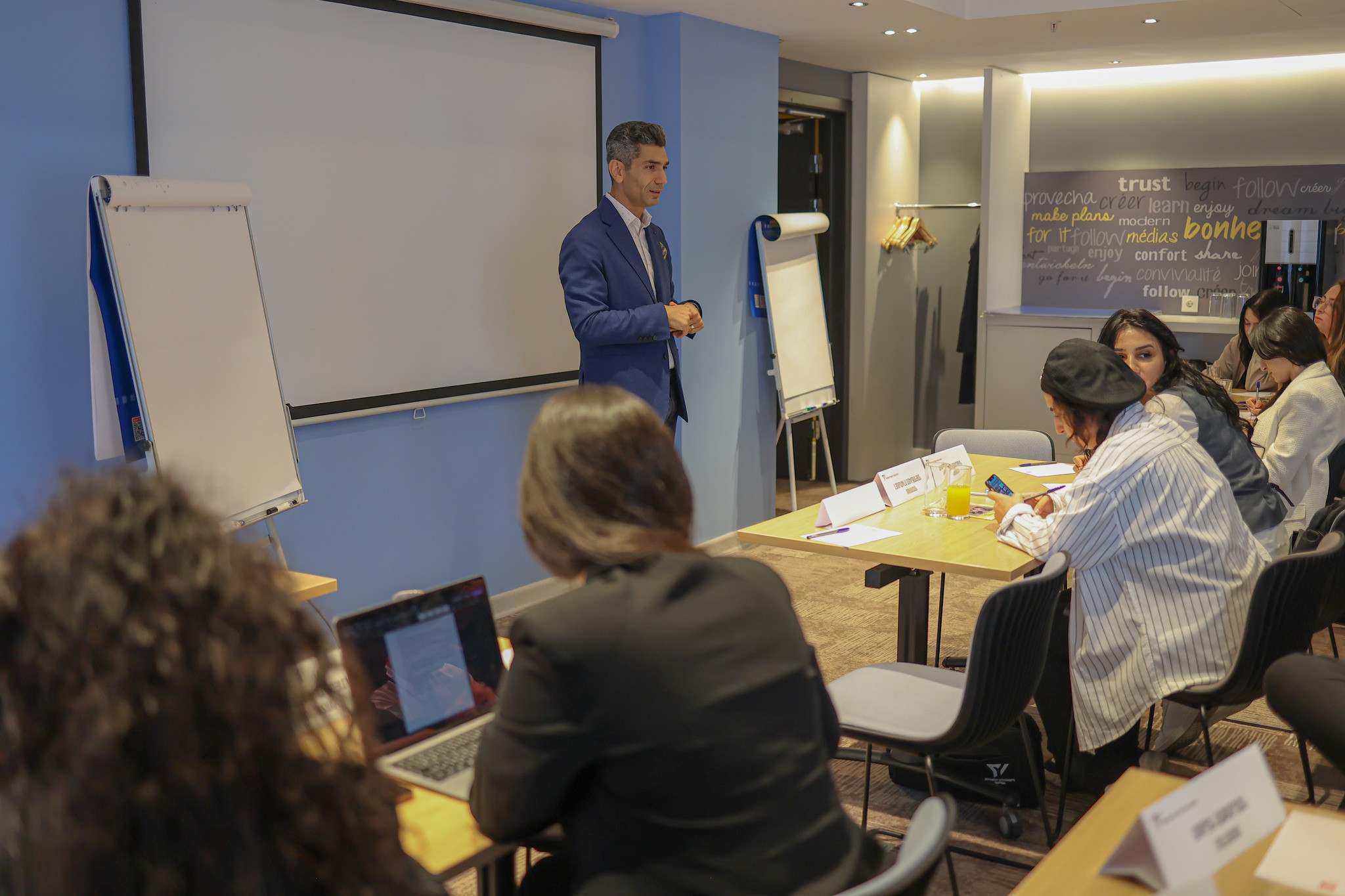
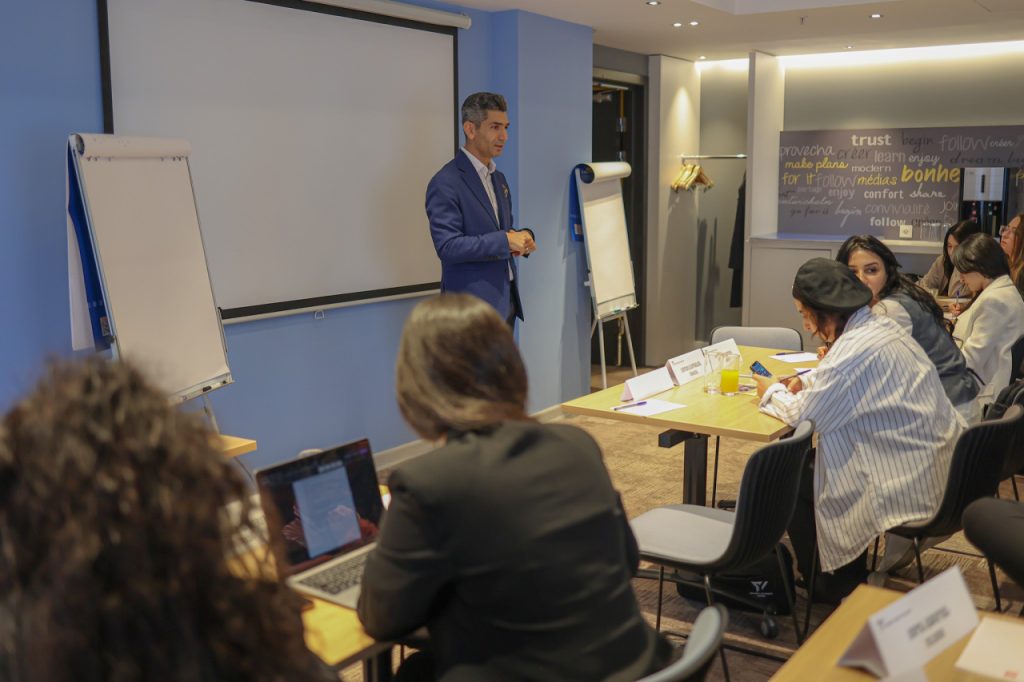
Twenty-eight young people, representatives of the Armenian diaspora from various countries around the world, took part in training sessions in Armenia as part of the “Young diaspora ambassador” program. Now in its fourth year, the program is organized by the office of the chief commissioner for diaspora affairs of Armenia.
The project brought together young adults aged 20 to 35 from 18 different countries. Following the training sessions held in Armenia, they will implement their individual projects in the countries where they reside.
They will have opportunities to work together, and, if needed, Armenian embassies in their countries will provide support. At the end of the course, participants told journalists that they are “ready to fully leverage their potential to carry out ambitious projects and contribute to strengthening the ties between their communities and their homeland.”
- Diaspora Armenians in Armenia’s civil service – sharing knowledge and skills with homeland
- Leaving the US for Armenia – four different but similar stories
The program is designed to last one year
The program is designed to last one year. The “young diaspora ambassador” program, which included 15 days of training, will run through August 2025. This time, participants include Armenians from Russia, Belarus, France, Germany, Sweden, Lithuania, Latvia, Poland, Czech Republic, Romania, the Netherlands, the United Kingdom, Georgia, Iran, Australia, the United States, Syria, and China.
According to the office of the chief commissioner for diaspora affairs, the program aims to:
- provide young people with an understanding of the political, social, economic, and other challenges facing Armenia,
- support their involvement in the life of their communities,
- promote cooperation between young people from various diaspora communities and Armenia by fostering new knowledge, skills, connections, and opportunities for experience exchange.
Zareh Sinanyan, the chief commissioner for diaspora affairs, added that another goal is to create “a network of active young Armenian diaspora members.” He expressed hope that the program’s participants will become partners with his office across various countries.
Throughout the year, participants will take part in lectures, workshops, and visits to scientific, educational, and cultural centers, as well as a range of events across Armenia, including in regional areas.
“It’s important to see beyond what’s happening in Yerevan”
Diana Khojayan, who came from the Czech Republic, is the first Armenian to become a member of the Brno city council, where she serves on the legal affairs committee. She was particularly interested in the leadership courses and lectures on repatriation and the challenges faced by Armenian diaspora communities. She expressed appreciation for the opportunity to participate in events and meetings held both in the capital and in the regions:
“For us, it’s important to see beyond what’s happening in Yerevan. It’s incredibly valuable to engage with peers and understand the issues that concern young people not only in the capital but also in other regions.”
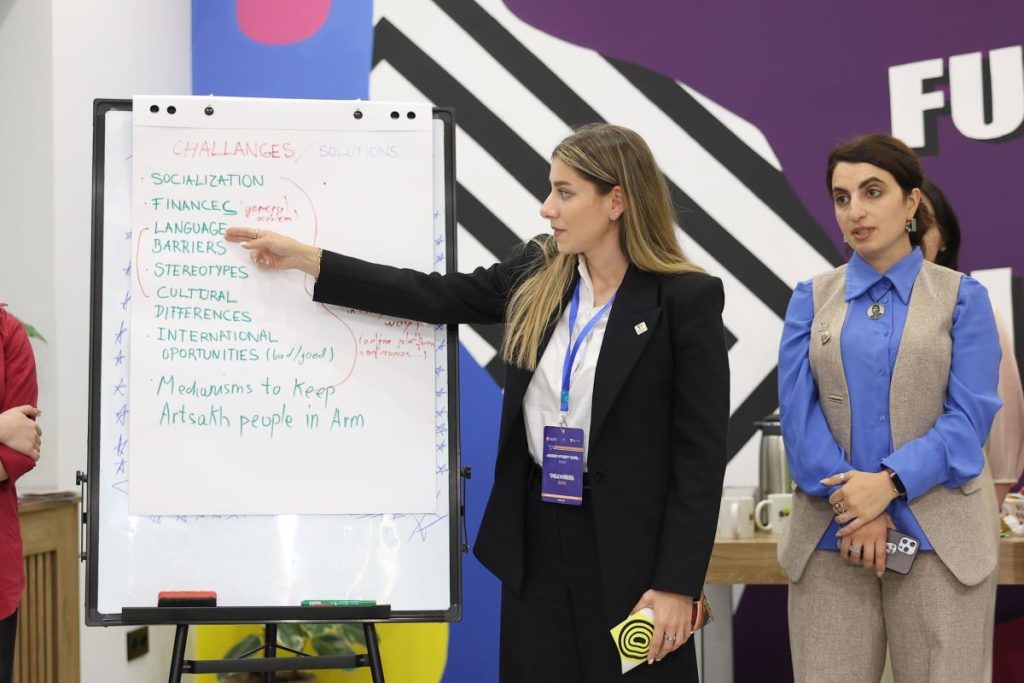
The participant from the Czech Republic has already outlined her individual action plan. She intends to establish an Armenian online school, aiming to foster a sense of unity among Armenians living in the Czech Republic.
Diana also represents the local Armenian organization “Nairi”:
“Together with other organization members, we will organize engaging events to strengthen Armenian-Czech relations and create opportunities for cultural exchange. It’s important for Czechs to have a better understanding of our potential.”
Additionally, she plans to invite members of the municipal council from the Armenian city of Charentsavan to Brno. She believes it would be beneficial for them to meet their Czech counterparts and draw from their experiences to inform their work.

“I want to create an association that unites compatriots”
Silva Sahakyan came from the French city of Harfleur. A lawyer by profession, she earned her bachelor’s degree from the University of Grenoble and then pursued her master’s studies at universities in Berlin and Lyon. According to Silva, Armenians living abroad and those residing in Armenia often have very different perspectives on many issues.
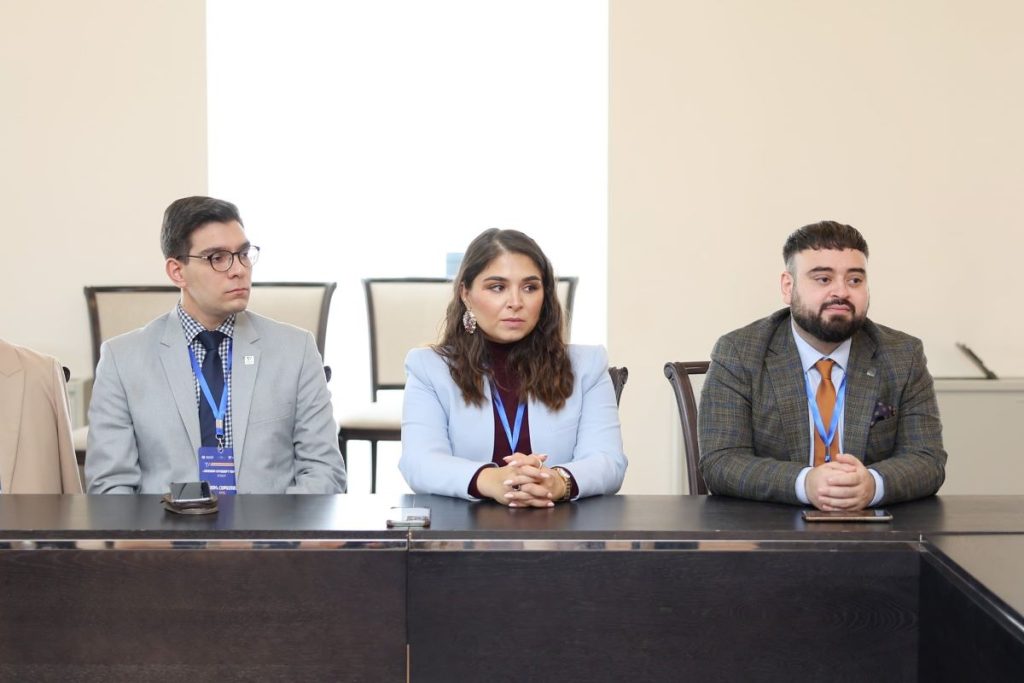
Silva believes that the courses in which she and other program participants took part provided them with insights into their potential and how they can be beneficial to their homeland and community.
According to Silva, the Armenian youth in the diaspora possess significant potential and are willing to engage in ambitious projects.
She notes that the Armenian community in France is large and influential, and both the authorities and ordinary citizens hold a positive view of Armenians and appreciate their contributions to the country:
“We do not need to introduce ourselves to the local society; that is not an issue. However, we need to create a unified association that brings together local Armenians. I will dedicate all my efforts to establishing a common, pan-Armenian union focused on preserving identity away from our homeland.”
The project participant from France regrets that some young Armenians living in the country do not have a sufficient command of the Armenian language. This, she points out, applies to the fifth generation of Armenians who settled in France in the early 20th century:
“They need to feel that they are welcome back home, that they can contribute to Armenia with their knowledge.”
Follow us – Twitter | Facebook | Instagram
Young diaspora ambassador
Georgian Dream’s Party Platform
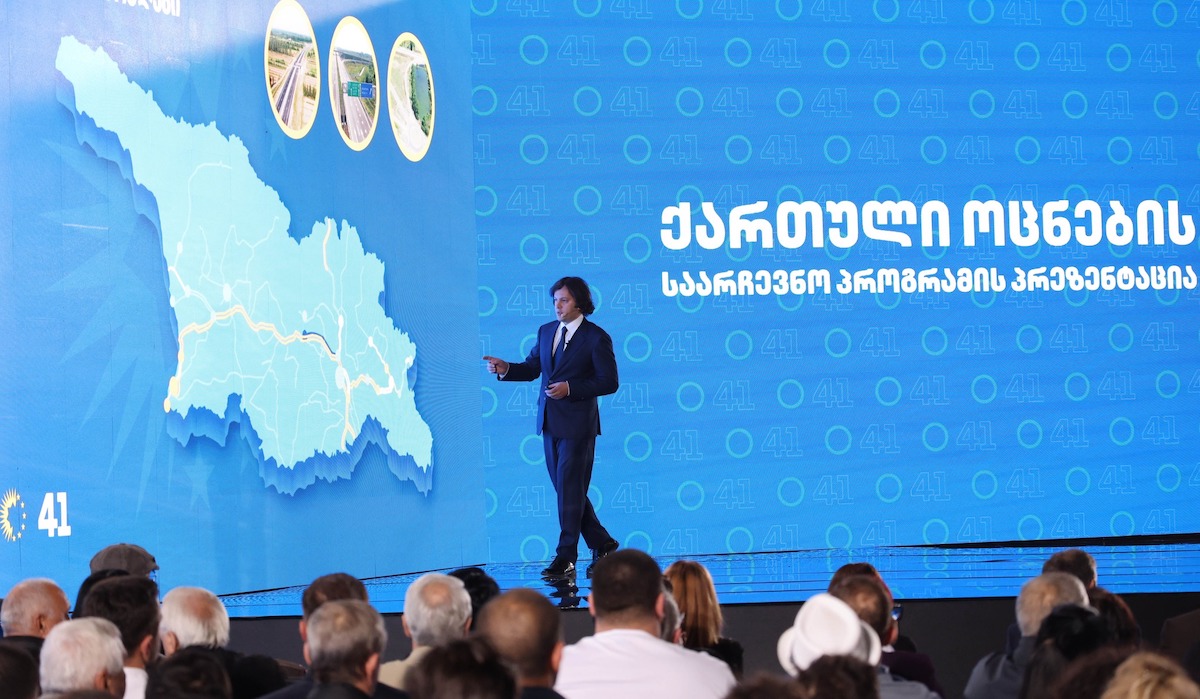
Georgian Prime Minister Irakli Kobakhidze unveiled the party platform for the ruling party of Georgia, Georgian Dream.
Notably absent from the hour-long event were party founder Bidzina Ivanishvili and chairman Irakli Garibashvili.
While discussing various sectors—including the economy, healthcare, and tourism—Kobakhidze drew comparisons to the state of affairs in 2012. This is before Georgian Dream came to power.
The party plans to fulfill most of its current promises by 2028.
Key points of Georgian Dream’s election campaign
Economy:
- By 2028, Georgia’s economy is expected to reach at least 130 billion lari (approximately $47 billion), with the national budget surpassing 50 billion lari (around $18 billion).
“We have halved unemployment compared to the 2012 level. Our ambitious yet achievable goal is to reduce it to four percent, which is below the European average,” Kobakhidze added.
Infrastructure:
- A four-lane highway connecting Tbilisi and Batumi will open in 2025. Work will also begin on the Batumi-Sarpi highway project.
- Highways connecting to the borders of Azerbaijan and Armenia will be completed.
- Construction will soon start on a port in Anaklia, expected to welcome its first ships in 2029.
- A new international airport in Vaziani, near Tbilisi, will be built to accommodate 18 million passengers annually.
Agriculture:
- Four billion lari (about $1.5 billion) will be invested in agriculture by 2028.
Energy
- By 2030, Georgia aims to achieve full energy independence and self-sufficiency. According to Kobakhidze, 63 hydropower plants, two thermal power plants, and one wind power station have been constructed over the past 12 years.
Salaries, Pensions, Healthcare
- If elected, Georgian Dream promises to raise salaries for kindergarten teachers, as well as for staff at art and sports schools.
“In recent years, we have ensured a ten percent increase in wages, and this growth will continue into next year. In addition to the standard increase, starting January 1, 2025, we plan to raise salaries for kindergarten workers by 100 lari (about $36), and the same applies to employees of art and sports schools,” Kobakhidze said.
- Pensions will also increase. The Prime Minister noted that “economic growth allows us to raise pensions to 350/450 lari (about $128-164).”
- A new republican hospital will “definitely be built” in the near future.
Education
- Plans are in place to significantly expand the Kutaisi International University founded by Bidzina Ivanishvili, increasing its student body to 20,000.
- A new campus of Tbilisi State University will be constructed between Tbilisi and Rustavi.
Culture and Sports
- Georgian Dream promises to allocate 30 million lari (about $11 million) from the state budget to support artists and cultural figures if victorious.
- Funding for sports will increase, with two billion lari (about $730 million) set aside for sports infrastructure.
- A new stadium with a capacity of 70,000 people will be built in Tbilisi “to host the Champions League by 2028.” The stadium will be fully equipped for both football and rugby, as well as concerts.
Defense
- Georgian Dream pledges to develop the national military industry and enhance support for military and police personnel: approximately 1,000 police officers will receive apartments in a new building, and a “military town” for over 1,000 servicemen will be established.
Foreign Policy
- According to Kobakhidze, “resetting relations with the U.S. and the European Union, alongside a pragmatic policy toward Russia and a peaceful resolution of conflict,” are essential steps for foreign policy.
- The Prime Minister emphasized that the most critical national task is to restore relations with the U.S. and the EU. “It is crucial for us to consider the current state of our relationships. We are confident that next year, following the conclusion of the war in Ukraine, appropriate steps will be taken to facilitate this reset,” Kobakhidze stated.
- European integration remains a top foreign policy priority, with Georgia aiming to be fully prepared for EU membership by 2030.
- Strengthening cooperation with NATO is also on the agenda.
- Deepening the strategic partnership with China is deemed important from both economic and political perspectives.
- The party plans to fulfill 90 percent of its commitments under the Association Agreement and the Deep and Comprehensive Free Trade Agreement by 2028.
Parties are prohibited from forming electoral blocs, and the only way for them to participate jointly in the elections is by creating a unified electoral list.
Parliamentary elections in Georgia are scheduled for October 26. Deputies will be elected solely through a proportional representation system, with mandates distributed among parties that surpass the five percent threshold.
Georgian Dream’s Party Platform
