– MEDIA: Hashem Safieddine to replace Hasan Nasrullah
 The South Caucasus News - SouthCaucasusNews.com
https://t.co/kvztWaB6sx
Endless interest of the #West, and especially the #UnitedStates , in the #SouthCaucasus is no longer a secret to anyone. After the collapse of the #SovietUnion, the USA, which tried to penetrate the region, created new means of leverage for it.#usaid— AzerNews (@AzerNewsAz) September 28, 2024

Edison Research’s pre-election poll in Georgia
The research company Edison Research has published the results of its latest public opinion poll in Georgia. When asked, “Which party would you vote for if parliamentary elections were held today?” 32% of respondents named the ruling party, “Georgian Dream,” while 20% chose its main competitor, the opposition “National Movement.”
The poll was conducted on behalf of the Georgian TV channel “Formula” from September 10 to 22 across the country.
A total of 1,200 eligible voters aged 18 and older were surveyed using direct research methods.
The margin of error for the poll is +/- 2.8% across Georgia, with a 95% confidence interval.
Regarding other parties and political alliances, the votes were distributed as follows:
When asked, “Do you support Bidzina Ivanishvili’s statement that the previous Georgian government initiated the 2008 war and that the country should apologize to the Ossetians for this?” 85% of respondents said they do not support it.
As a reminder, parliamentary elections in Georgia will take place in just one month, on October 26, 2024.
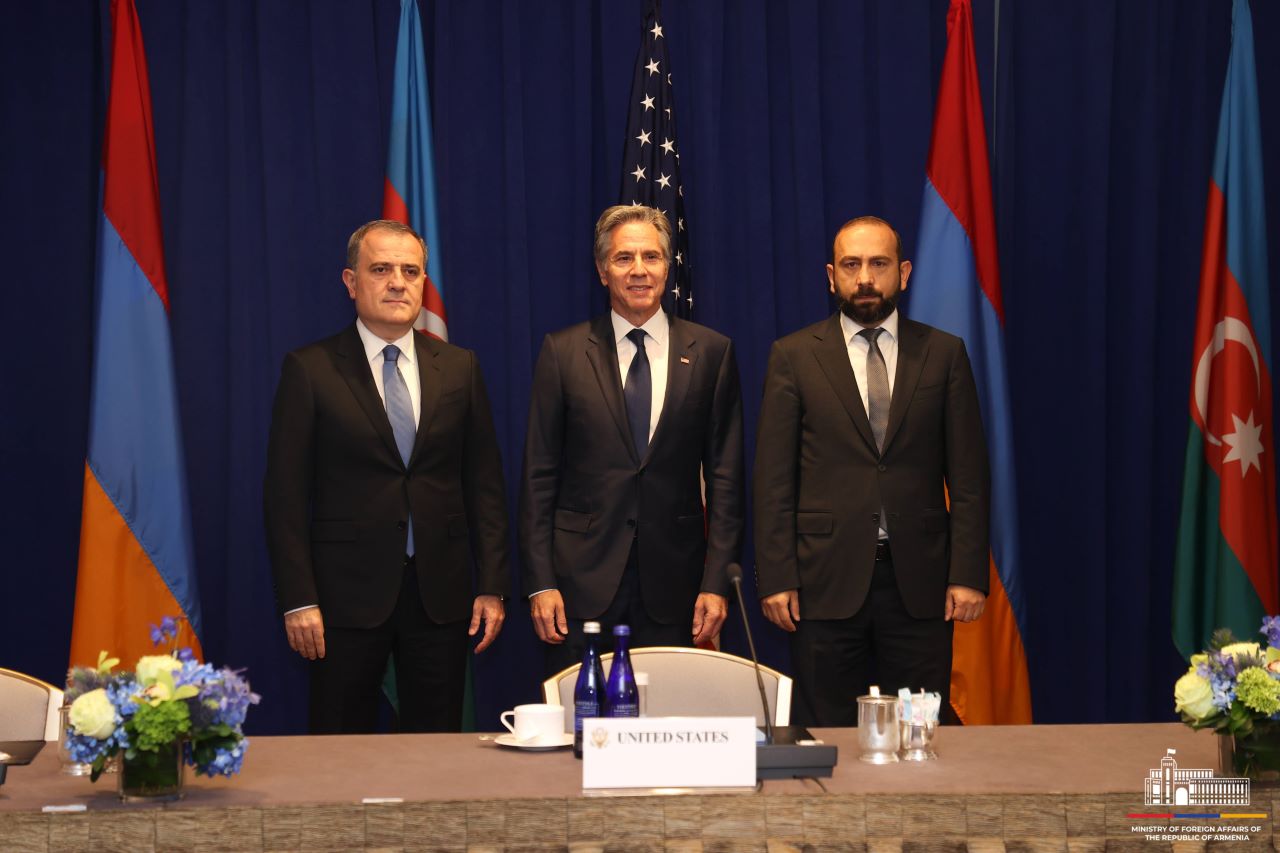
Blinken-Mirzoyan-Bayramov meeting in New York
A meeting of the foreign ministers of Armenia and Azerbaijan took place in New York, facilitated by U.S. Secretary of State Antony Blinken. According to an official statement, the parties agreed to “make additional efforts to conclude a treaty on the establishment of peace and intergovernmental relations as soon as possible.”
No further details from the meeting have been disclosed. In response to journalists’ questions during a traditional briefing, State Department spokesperson Matthew Miller made a similar statement, noting that Blinken urged both countries to “continue efforts toward the prompt completion of the agreement.”
Political analyst Robert Gevondyan told JAMnews that no significant results were achieved during the New York meeting. He believes that for the U.S., signing a peace treaty between Armenia and Azerbaijan before the presidential elections is not a priority: “Such an intention in the U.S. today is less likely than it was before Biden exited the election race.”
Armenian prime minister Nikol Pashinyan, speaking at the 79th session of the UN General Assembly, stated that peace with Azerbaijan is close, and “all we need to do is reach out and take it.” At the same time, he emphasized that both Azerbaijan and Armenia find it difficult to arrive at a final decision since “each has its own truth.”
He said that the parties have already agreed upon and signed “the first bilateral legal agreement,” which regulates the joint work of the commissions on border delimitation:
“It is now legally confirmed that both countries have no territorial claims against each other.“
In Pashinyan’s view, it is time to take the next step and sign an agreement on the establishment of peace and intergovernmental relations. The prime minister reiterated that Yerevan is “ready to do this right now.”
To “seize this historic opportunity and avoid the danger of reaching an impasse,” he has once again proposed signing a document based on the provisions already agreed upon:
“In the case of Armenia and Azerbaijan, the agreed articles of the draft peace agreement effectively contain provisions for peace, for the absence of territorial claims against each other, and for not making such claims in the future, as well as provisions for establishing diplomatic relations and creating a joint commission to monitor the implementation of the peace agreement, provisions for non-interference in each other’s internal affairs, for refraining from the use of force and threats of force, and other important provisions.”
Pashinyan once again emphasized that Armenia’s constitution contains no territorial claims against Azerbaijan. “We can provide detailed written evidence of this to all our interested international partners. Moreover, it is the constitution of Azerbaijan that contains territorial claims against the Republic of Armenia. We can present written arguments on this matter to all our interested international partners.”
The prime minister also pointed out to those present that Yerevan does not consider Azerbaijan’s constitution an obstacle to signing a peace treaty based on the already agreed provisions. Pashinyan explained that the draft of this document addresses this issue itself. It includes the following provision:
“Neither party may invoke the provisions of its domestic legislation as a justification for failing to fulfill this agreement.“
At the beginning of September, Armenia submitted the tenth package to the Azerbaijani side, which is its version of the draft peace treaty. Nikol Pashinyan stated that Yerevan proposed signing a document with already agreed-upon points, leaving unresolved issues for the future. Azerbaijan deemed this unacceptable. However, both sides declare that nearly 80 percent of the text of the agreement has already been agreed upon.
Baku has regularly stated that the main obstacle to signing a peace treaty with Armenia is the country’s constitution. The issue arises from a reference in the document to the Declaration of Independence, which mentions the joint resolution of the Supreme Council of the Armenian SSR and the National Council of Nagorno-Karabakh dated December 1, 1989, “On the Reunification of the Armenian SSR and Nagorno-Karabakh.” Yerevan considers amending the constitution to be an internal matter.
Political analyst Robert Gevondyan recalls Azerbaijan’s position that a peace treaty cannot be signed until all its provisions are agreed upon. This issue was also discussed during the meeting of foreign ministers, the expert suggests.
“The phrase ‘additional efforts’ in the statement from the meeting in New York indicates the need to continue working in two directions. The first involves reaching an agreement on the unresolved issues as soon as possible, which is quite challenging. The second direction is to persuade Azerbaijan to sign the already agreed-upon parts.”
Gevondyan believes that if the U.S. exerts pressure on Baku, the signing of a peace treaty with the agreed points could become a reality before the presidential elections.
On the other hand, he notes that after Joe Biden exits the election race, signing the Armenian-Azerbaijani document will no longer be a priority for the U.S.:
“If a decision is made in the U.S. regarding the necessity of concluding this agreement before the presidential elections, they have the tools to compel Azerbaijan to take this step.”
According to the political analyst, even a hint from Washington about potential economic pressure on Baku could be sufficient:
“If Washington presents specific examples of the economic challenges Azerbaijan might face, that would be enough for Baku to agree to make concessions.”
The tools for pressure, as the analyst mentions, include the relationships between U.S. officials and Azerbaijan. Just like two years ago, “during the Azerbaijani military invasion of Armenian territory in September 2022, a single call from the U.S. was enough to immediately halt the war,” the political analyst states.
When asked what Armenia could gain from signing a document that does not mention Nagorno-Karabakh, lacks details on border delimitation, and does not address the unblocking of regional communications, Gevondyan responded:
“The peace treaty will enshrine certain approaches agreed upon between Armenia and Azerbaijan that will align with Armenia’s interests. Pashinyan revealed some details of the document from the UN podium: the establishment of diplomatic relations, mutual recognition of territorial integrity, the exclusion of threats of force and the use of force, and the creation of a joint commission to monitor the implementation of the agreement. All these points serve as tools to reduce the likelihood of escalation and military provocations at the border.”