Categories
South Caucasus News

Danger Ahead: Why Antisemitism Is Likely To Grow – OpEd


Danger Ahead: Why Antisemitism Is Likely To Grow – OpEd

By Barry Brownstein 

Let us be wary of the soothing narrative that downplays the seriousness of growing antisemitism. The belief that Jew hate will diminish once the Israel-Hamas war concludes may be misguided.

As I go about my daily life, antisemitism is still a thing of the past. Not so on college campuses and in some cities.Like Elon Musk, I am shocked by the exposure of rampant Jew hatred.

Last November, when our local farmer was closing for the season, he asked about our holiday plans. The farmer’s jaw dropped when my wife mentioned celebrating Hanukah and Christmas. Curious, he asked, “Which one of you is Jewish?” We’ve known this farmer for thirty years, and the question never arose. Why would it? He is an honest, hard-working man engaged in commerce, paying no attention to the superficial characteristics of his customers.

The market rewards those who have genuine empathy for their customers. Empathetic entrepreneurs can put themselves in their customers’ place and consider how to best serve them. The market process, backed by the rule of law, facilitates empathy and respect for others and a peaceful and prosperous society.

So why do I say antisemitism is likely to grow? The more removed we are from the bonds and affections that commerce creates, the more room for primitive hatred to occupy our minds.

Intellectuals teaching a toxic mixture of identity politics, critical race theory, and Marxism have hijacked our educational and other institutions. “Liberatory Ethnic Studies (LES)” which make use of “Marxist and Maoist-based liberatory model[s]”are being taught in some K-12 classrooms.WhatHelen Pluckrose and James Lindsay callthe “caste system of social justice” labels Jews oppressors because of their economic success.

In his bookMarxism,Thomas Sowell points out Marx lived as an intellectual without “responsibility” for his livelihood and the “social consequences” of his “vision.” Sowell explains today’s “Intellectuals enjoy a similar insulation from the consequences of being wrong, in a way that no businessman, or military leader, or engineer or even athletic coach can.”

In his bookIntellectuals, the late historian Paul Johnson describes Marx as a man with a “childish attitude” who “borrowed money heedlessly, spent it, then was invariably astounded and angry when the heavily discounted bills, plus interest, became due.”

Marx was a nasty hater who “resented the smallest criticism” and was subject to “huge bursts of rage.” Johnson explains, “Central to his anger and frustration, and lying perhaps at the very roots of his hatred for the capitalist system, was his grotesque incompetence in handling money.” Johnson informs us that Marx’s mother “is credited with the bitter wish that ‘Karl would accumulate capital instead of just writing about it’.”

Marx’s fantasies of Jews and capitalists exploiting others over money were a projection of his own exploitation of his family over money. Projection occurs when we attempt to hurl our moral failings and psychological trash onto others.

Marx was locked into projection. Refusing to “pursue a career” Marx hounded his family for “handouts.” Habituated to ransacking family, Marx saw his own behavior in others, writing there is always “a handful of Jews to ransack pockets.”

InOn the Jewish Question, Marx wrote, “What is the worldly religion of the Jew? Huckstering. What is his worldly God?… Money is the jealous god of Israel, in face of which no other god may exist.”

Of Marx, Johnson writes, “His entire theory of class is rooted in anti-Semitism.”

In his classic Russian novel,Life and Fate, Vasily Grossman observed that antisemitism was a “mirror for the failings of individuals.” He added, “Tell me what you accuse the Jews of — I’ll tell you what you’re guilty of.”

Antisemites portray Jews in the most monstrous ways because seeing Jews as vile justifies their own failings.

Marx was not merely a Jew hater. He was a hater. His antisemitism was part of a larger pattern.

InThe Road to Serfdom, F. A. Hayek pointed out Marx expressed views about Czechs and Poles later expressed by the Nazis.Marx wrote of the Balkansthat it had “the misfortune to be inhabited by a conglomerate of different races and nationalities, of which it is hard to say which is the least fit for progress and civilization.”

Hayek explored why “the enemy, whether he be internal, like the ‘Jew’ or the ‘kulak,’ or external, seems to be an indispensable requisite in the armory of a totalitarian leader.” Of Germany and Austria, Hayek wrote, “the Jew had come to be regarded as the representative of capitalism.”

Marx wrotethat “we find every tyrant backed by a Jew.” Marx reversed cause and effect. Tyrants need to oppress Jews.

Hayek further observed, “It seems to be almost a law of human nature that it is easier for people to agree on a negative program — on the hatred of an enemy, on the envy of those better off — than on any positive task.” Hatred of capitalism or hatred of Jews, for those who need to hate, it’s all the same.

Hayek added, “The contrast between the ‘we’ and the ‘they,’ the common fight against those outside the group, seems to be an essential ingredient in any creed which will solidly knit together a group for common action.”

Those who do not want to take responsibility for their choices gravitate to mass movements that promise to alleviate the consequences they face for their poor decisions. Should it come as a surprise that Marxist ideas helped to fuel communism, one of the most destructive mass movements in history?

Should we be surprised that the current eruption of antisemitism is concentrated on college campuses where anti-capitalism sentiment is the norm?

Today, on college campuses, “we” and “they” thinking seems to be a major part of the current curriculum. It’s assumed, if you can’t make something of your life it’s because “they” have stopped you. Historically, Jews have tragically found the unwarranted role of “they” thrust on them.

Today, college professors and administrators spare students from being exposed to ideas other than their own. Marx never wanted to face the consequences of his low emotional and moral intelligence. How many college students, like Marx, do not want to face challenges to their low emotional and moral intelligence?

Illiberal forces always need a “they.” Even in countries without a Jewish population, Jews are still the “they.” Ayaan Hirsi Ali grew up in Somalia where there were no Jews. Regardless, asshe explained in theWall Street Journal,

When I was a little girl, my mom often lost her temper with my brother, with the grocer or with a neighbor. She would scream or curse under her breath “Yahud!” followed by a description of the hostility, ignominy or despicable behavior of the subject of her wrath. It wasn’t just my mother; grown-ups around me exclaimed “Yahud!” the way Americans use the F-word. I was made to understand that Jews — Yahud — were all bad. No one took any trouble to build a rational framework around the idea — hardly necessary, since there were no Jews around.

Somalia is a closed society; closed societies are doomed to failure until critical inquiry from within is welcome.

Students pass through our educational system trained to have minds closed to rigorous exploration of ideas. Failure is a certainty when ideas are not challenged, and there must be a “they” to blame for failure. For antisemites and anti-capitalists, Jews are the shared object of hatred. Jews are used to account for failed plans generated by flawed ideas. As long as illiberal curriculums dominate our educational systems, both hatreds will grow.

  • About the author: Barry Brownstein is professor emeritus of economics and leadership at the University of Baltimore. He is the author of The Inner-Work of Leadership, and his essays have appeared in publications such as the Foundation for Economic Education and Intellectual Takeout.
  • Source: This article was published by AIER

Categories
South Caucasus News

Do People Want Precious Freedom? – OpEd


Do People Want Precious Freedom? – OpEd

Hope Peace Children Silhouette Cheers Positive Outlook

That most perspicacious of social theorists, Zymunt Bauman – on whose work I have drawn before (see for examplehere) – has raised a question that has become even more relevant today than when he first posed it inLiquid Modernity(2000, p. 16-22; see alsohere). In a nutshell, Bauman wondered about freedom – do people really want to be free? Can they bear the challenges and responsibilities of being free? Here he approaches this question from a specific angle, that of ‘liberation,’ which is sometimes the prerequisite of being free (p. 18-19):

Is liberation a blessing, or a curse? A curse disguised as blessing, or a blessing feared as curse? Such questions were to haunt thinking people through most of the modern era which put ‘liberation’ on the top of the agenda of political reform, and ‘freedom’ at the top of its list of values – once it had become abundantly clear that freedom was slow to arrive while those meant to enjoy it were reluctant to welcome it. Two kinds of answer were given. The first cast doubt on the readiness of ‘ordinary folks’ for freedom. As the American writer Herbert Sebastian Agar put it (in A Time for Greatness, 1942), ‘The truth that makes men free is for the most part the truth which men prefer not to hear.’ The second inclined to accept that men have a point when they cast doubt on the benefits which the freedoms on offer are likely to bring them.

To drive his point home, Bauman (p. 18) alludes to an apocryphal (sardonic) version of the episode in Homer’sOdyssey, where Odysseus’ men have been turned into swine by the sorceress, Circe. In this satirical account by Lion Feuchtwanger, who evidently wanted to make a point about the ‘unbearable lightness of liberty’ (with acknowledgement toMilan Kundera), the sailors-turned-hogs live a porcine life of blissful disregard for human worries and responsibilities, until Odysseus manages to discover herbs with properties that would reverse the spell, thus restoring their human form. When informed of this by their leader, the pigs – instead of eagerly awaiting the administering of the cure – take off in flight with an astonishing speed. When Odysseus finally manages to catch one of the fugitive hogs and restore its humanity, instead of the anticipated gratitude for being returned to his proper nature, in Feuchtwanger’s version of the tale the sailor turns on his supposed liberator with unrestrained fury (p. 18):

So you are back, you rascal, you busybody? Again you want to nag us and pester, again you wish to expose our bodies to dangers and force our hearts to take ever new decisions? I was so happy, I could wallow in the mud and bask in the sunshine, I could gobble and guzzle, grunt and squeak, and be free from meditations and doubts: ‘What am I to do, this or that?’ Why did you come?! To fling me back into that hateful life I led before?‘”

Today this parodic version of an episode from Homer’s epic rings particularly true, specifically regarding the reluctance of the majority of people in the world to face the truth (admittedly carefully hidden from them by the legacy media), that we find ourselves in the middle of the biggest attempt at aglobalpower grab in history – the first one, in fact, that was capable of being applied to the world in its global entirety, given the present technological means to do so.

These did not exist previously – neither Alexander the Great, nor the Roman Empire, nor Napoleon had the technical means at their disposal to focus their admittedly prodigious attempts to conquer the world or the globe as a whole, and the military might behindAdolf Hitler’squest for world power was matched, if not surpassed, by that of the Allied Forces. The sheer, almost incomprehensible, scale of the current, attemptedcoupis therefore probably a significant factor in people’s unwillingness to accept that it is occurring – that much one has to grant.

So what does this have to do with freedom, or rather, reluctance to accept the responsibilities and risks that come with embracing one’s originary freedom (that is, freedom potentially given at the origin of our coming into being)? The crucial point is this: while I don’t want to open a can of worms constituted by the debate on ‘free will’ – except to say that I am on the side of those who insist that wedohave free will (as amply demonstrated by the fact that, against all biological inclinations, individuals sometimes decide to go on a hunger strike to demonstrate their insistence on a firmly-held principle, and do sometimes die as a result) – as Bauman’s citation of Feuchtwanger parody of Homer, above, shows, such freedom to choose sometimes frightens us: ‘What am I to do, this or that?’

The saddening truth is that, like the twice-fictional Homeric swine, people would generally rather prefer to remain in their comfort zone, head in the proverbial sand, than to face the mere possibility that they should choose, even chooseurgently, toact, because our very ability to exercise our freedom is at stake.

This was brought home forcibly a few weeks ago in the town where we live, when a debate about ‘chemtrails,’ which regularly appear in the sky above the town, erupted on the town’s social media chat group, and at one point a participant candidly admitted that he preferred not to pay attention to these disturbing phenomena because they only ‘upset’ him. There you have it – like the swine in the retelling of Homer’s Circe story by Feuchtwanger, who would rather remain in their condition of porcine bliss than be restored to the burdensome human condition, people today would rather remain uninformed, even if it poses the risk of possibly losing the freedoms they still enjoy.

We are in Lisbon, Portugal, for a conference on ‘Diversity,’ and here, too, the manner in which difficulties and apparent threats emanating from the globalist cabal’s heinous plans involving a totalitarian world government are studiously ignored, is palpable.

Case in point: my own presentation was a poststructuralist critique of the untenability of the concept of ‘diversity’ (conspicuously promoted everywhere today, for example in the notion of gender fluidity), for as long as it lacks a sustaining ontological underpinning, demonstrating that diverse entities are actually distinguishable in terms of universalistic concepts of identity. In plain language, to over-emphasise ‘diversity,’ as has been the case lately, and which this conference contributes to (ironically, given that the aegis under which it is organised is ‘Common Ground’!), is to preclude the ability toidentifyhow diverse entities differ from one another. How so?

Think of it this way. The ancient Greek philosophers,HeraclitusandParmenides, set up this ontological game that we are still playing today – the one involving difference and sameness. Heraclitus claimed that ‘All is flux,’ while Parmenides argued that nothing changes. Put differently, for Heraclitus incessantbecoming(change, difference) reigned supreme, while for Parmenides onlybeingor permanence was real – change was illusory. (I won’t go into the way that Plato and Aristotle, after them, incorporated being and becoming into their respective thought systems in distinctive fashion.)

Fast forward to the present, where themodernand thepostmodernvie with each other as explanatory principles for how society works: the modern, by and large, emphasisesbeingas the essential momentwithin all becoming(for example inVirginia Woolf’s novels, where she uncovers and literarily articulates the sustaining element within all the change surrounding us). By contrast the postmodern cuts being adrift and declares that there isonlybecoming. Which is right?

The modern is closer to the paradoxical truth (than the postmodern), which is best captured by poststructuralist thought (for example that ofJacques LacanandJacques Derrida, among others), which can be summed up by stating that we grasp the nature of things, including human subjects, best by showing how being and becoming are intertwined, or work together. Lacan, for instance, shows that we can understand a human being as an amalgam of three ‘registers:’ the ‘real,’ the ‘imaginary,’ and the ‘symbolic.’

The ‘real’ is that in us which we cannot symbolise in language (for example the unpredictable ways in which we may act under circumstances that we have not experienced: you may turn out to be a monster, or perhaps a saint). Theimaginaryis the register of images, in which you are inscribed as a particular (identifiably distinct, different) self or ego, while thesymbolicis the universalistic register of language, which enables different selves to communicate.

In a nutshell, Lacan gives us a theory that explainsbeingas well asbecoming(unlike the postmodern, whichonlyrecognises becoming): as a self or ego at theimaginarylevel, we are distinct (that is different) from other selves, while language (thesymbolic) allows us to articulate that difference in universally comprehensible concepts, which are translatable from one language to the next.Becomingis therefore inscribed in the differential relationship among distinct selves in theimaginary, andbeingas well as becomingare registered in thesymbolic: we can talk about our differences (becoming) in a comprehensible manner (the universal).

The point of this explanatory detour (forgive me for that) is to lay the groundwork for saying that ‘diversity’ – the theme of the conference we are attending – belongs squarely in the category of (postmodern)becoming; it can only account for unmitigated difference, but cannot account foridentity, which is necessarily articulated in language at the level where the particularistic imaginary overlaps with the universalistic symbolic (which can therefore articulatedifferenceas well assameness).

Example: I am a man (universal); my name is Bert Olivier (particular, as well asuniversal); I live in South Africa at such and such a place, and at such and such a time (particularas well asuniversal). Hence, one needs a theory of human subjectivity like Lacan’s to do justice to our differences as well as our ‘sameness’ as human beings. If you only stress ‘diversity,’ you have the difference, without the sameness (the universalistic linguistic means to grasp either).

What does this digression on a conference dedicated to the topic of ‘diversity’ from a Lacanian perspective have to do with the topic of this article; to wit, the question of whether people want to be free? It may seem like a long shot, but it is in fact related through the conspicuous manner in which the mere choice of ‘diversity’ as the overarching theme for the conference neatly ignores the undeniably pressing – in truth,urgent– need to provide multinational platforms (such as the conference) for an open, critical discussion of the factors that are endangering the very possibility of such conferences in the future. These factors – thevarious waysin which the New World Order is planning to control all of humanity in the not-too-distant future, including 15-minute cities and CBDCs, as well as vaccine passports and the like – are patently ignored.

The reason why I decided to talk about the theoretical shortcomings of ‘diversity’ at the conference was to open up a debate about ‘identity,’ which a one-sided affirmation of ‘diversity’ cannot account for (as shown above), and which permeates all the attempts to undermine people’s sense of identity through, among other things, the ‘woke’ movement and all its ramifications – something which falls within the scope of the globalist neo-fascists’ programme of totalitarian control. It is so much easier to control people who have lost their sense of identity than those who still experience who they are on a daily basis.

Not that identity is cast in stone – as shown earlier through a discussion of Lacan’s theory, it accommodates both sameness (being) and change (becoming). The paradoxical truth about a human being is that (except in pathological cases such as schizophrenics) we remain the person we are whilealsochanging throughout life, so that we can greet an old friend after years of not seeing them, with the remark: ‘Good heavens, Jill, I hardly recognise you; you have changed so much!’ But the fact that you recognise her manifests the paradox: she is still Jill, despite the changes on her part – in looks as well as life experience.

Circling back to the question of human freedom, then, it seems to me that, judging by the theme of the conference on ‘diversity,’ the fact is that, by and large, topics that may ‘rock the boat’ of (perhaps tacit) conformity and compliance were conspicuously avoided, and this, I believe, is a clear sign that Bauman’s point, when discussing Feuchtwanger’s satirical employment of Homer’s narrative about Odysseus and Circe, who transmogrified his men into swine, is still as applicable today as it was then (at the end of the 20th century). By and large, people do not seem to want to be free, given the burden of choice and (possibly inescapable) action it would impose on them. 


Categories
South Caucasus News

Deference To Joe Biden From Bernie Sanders Has Become Nonsensical – OpEd


Deference To Joe Biden From Bernie Sanders Has Become Nonsensical – OpEd

Bernie Sanders. Photo Credit: Gage Skidmore, Wikimedia Commons

By Norman Solomon*

I love Bernie Sanders. By most measures, he’s the greatest senator in the last 50 years. I was very glad to be a Sanders delegate to the 2016 and 2020 Democratic National Conventions. But when Bernie screws up, his progressive base should say so.

That happened during the first months of Israel’s war on Gaza that began last October. Initially, Bernie sounded equivocal as Israeli forces engaged in mass murder. After several weeks of carnage, antiwar activistsoccupiedhis D.C. office to demand support for a ceasefire. Some werearrestedfor their civil disobedience.

Bernie gradually changed his position and became a fierce critic of Israel, denouncing it for horrific large-scale crimes against Palestinian civilians and challenging the shipment of weapons to the Israeli military. There’s no telling if the public pressure from progressives hastened his shift to strongly oppose Israel’s genocidal war. But that pressure was necessary.

Unfortunately, after President Biden’s debate debacle on June 27, Bernie did not weigh in against the gaslighting maneuvers by the White House and the Biden campaign. In fact, Bernie aided them by downplaying the importance of what had happened on the debate stage.

Since then, Bernie has encouraged the illusion that Biden now has the capacity to be an effective candidate against Donald Trump. Equally problematic has been the implicit pretense that Biden could be up to the job as president until January 2029.

Such evasion not only dodges the reality that Biden was inept and sometimes incoherent during the debate. Since then, much stunning information has come to light, illuminating how badly Biden’s mental capacities have diminished.

“In the weeks and months before President Biden’s politically devastating performance on the debate stage in Atlanta, several current and former officials and others who encountered him behind closed doors noticed that he increasingly appeared confused or listless, or would lose the thread of conversations,”theNew York Timesreportedon July 2.

But on July 3 and again on July 5,emailfrom Bernie to supporters told them: “President Biden said today that he is staying in the race, and I take him at his word.”

However, taking Biden “at his word” is beside the point. As the party’s nominee, Biden woulddrag downmany Democratic candidates with him while making it easy for Donald Trump to win the presidency again.

“A presidential election is not a Grammy Award…”

The problem isn’t only what Bernie has been telling people on his email list. He has also been putting out important messages to the broader public via mass media—in the process sending positive signals to Biden and his top aides while they gauge whether to continue the Biden 2024 campaign.

And Bernie is talking directly with the president. Biden “has spoken to me in recent days,” Bernie said on Sunday during aninterviewon the CBS programFace the Nation. It’s very likely that what Bernie told Biden was consistent with what he told the Associated Press, whichreportedon July 2 that Sanders “does not want Biden to step aside.”

The AP quoted Bernie as saying: “A presidential election is not a Grammy Award contest for the best singer or entertainer. It’s about who has the best policies that impact our lives.”

But Biden’s inability to clearly advocate for popular policies—or to effectively refute lies and demagogic statements from Donald Trump—is not like a failure to be “the best singer or entertainer.” The president’s glaring inabilities amount to huge failures as a candidate and as a leader.

It’s well known that Bernie Sanders has personal warmth toward Joe Biden. But, given the enormity of what is at stake, personal ties should not get in the way of realizing what ought to be crystal clear: Every day that goes by with Joe Biden as the presumptive Democratic nominee will work to the further advantage of Trump and his extremist right-wing forces.

“I’m going to do everything I can to see that Biden gets reelected,”Bernie told the Associated Press. But at this juncture, that’s the wrong vow. What we really need to hear from Bernie Sanders is a pledge to do everything he can to see that Trump is defeated—and that means replacing Biden with someone who has a better chance of getting the job done.

  • Norman Solomon is the national director of RootsAction.org and executive director of the Institute for Public Accuracy. He is the author of many books including War Made Easy. His latest book, War Made Invisible: How America Hides the Human Toll of Its Military Machine, was published in 2023 by The New Press.

Categories
South Caucasus News

What The Iranian People Want And Don’t Want – OpEd


What The Iranian People Want And Don’t Want – OpEd

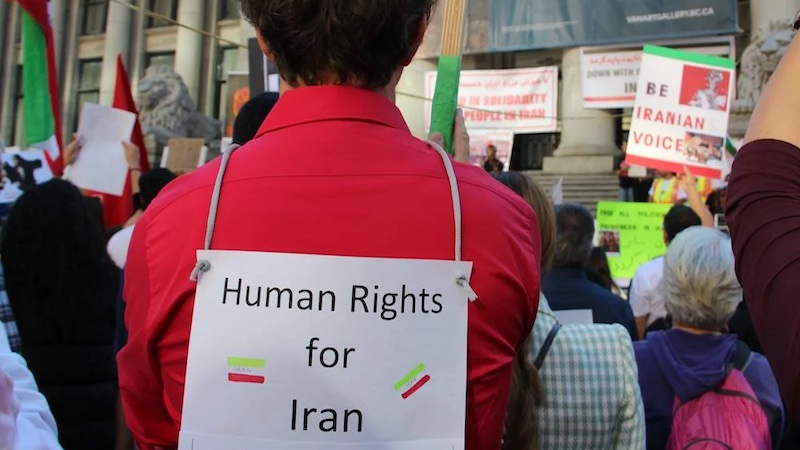
human rights iran protest demonstration

Within the span of a week, the world saw two very contrasting picture of the Iranian people and their desires. On the one hand were the first and second round of the Iranian regime’s sham presidential elections, held on June 28 and July 5, which were met with an unprecedented boycott by the Iranian people. And on the other hand was the Free Iran 2024 World Summit, held on June 29–July 1 in France and Germany, which was welcomed by Iranians across the world and supported by politician, jurists, and activists.

What we don’t want

On June 28, at the ballot box, Iranian regime supreme leader Ali Khamenei, once again begged the people to participate in the elections, saying, “People should not hesitate to participate in the elections. The survival, strength, dignity, and reputation of the Islamic Republic in the world depend on the people’s presence.” A few days earlier, he had reiterated the connection between the elections and the future of his regime in a different way, stating, “If high participation is observed in these elections, it will bring pride to the Islamic Republic.”

However, on the election day, the Iranian people completely boycotted Khamenei’s show. From the early morning hours, reporters from Simay-e Azadi monitored polling stations and broadcasted the news of empty polling stations to the world.

On June 29, Iran Watch news website quoted Ali Rabiei, a security official and promoter of one of the candidates, as saying, “The decline in participation compared to 2021 shows that the lower and middle classes are fed up.” Abbas Ahmad Akhoundi, Minister of Housing in former president Hassan Rouhani’s tenure (2013-2021), wrote on Twitter, “Sixty percent of eligible voters did not participate in the elections. Their message was clear.”

Heshmatollah Falahatpisheh, the former head of the security commission of Majlis (parliament), considered the low turnout natural and said, “The low participation level did not surprise me!”

Hesamodin Ashna, Rouhani’s advisor, said, “When for 35 years you have constantly hammered that the president is powerless, why do you expect high participation?” Even religious scholars raised their voices, noting that despite all the regime’s efforts, the people “did not accept” and rejected it.

The situation escalated to the point where the state-run Farhikhtegan newspaper by highlighting fear of the “danger” of an uprising and the “super crisis” of the regime caused by the younger generation, wrote, “I warn that intergenerational trauma, communication breakdown, public opinion inversion, the spread of criticism to indifference and even resentment in Generation Z, distrust or insufficient trust and hope, and economic problems are the super dangers facing the country; if ignored or not addressed, they will turn into super crises in the near future.”

According to reports by the network of the PMOI,88% of eligible voters boycotted the electionsand refused to cast a ballot in favor of any of the candidates. This was, in fact, a referendum on the regime in its entirety, and the people definitively voted “no” to the regime.

The regime engaged in extensive efforts to rally people to the polling stations for the second round of the elections, which was held one week later on July 5.

Khamenei, who had decided to restore his regime’s “honor” and cover up his double defeat in the second round by inflating the number of participants through fraud and figure manipulation, shamelessly began laying the groundwork at the start of the voting and claimed that this time the level of “people’s enthusiasm and interest” would be higher than before.

However, this time around, the boycott was even more humiliating, with91% of the people refusing to votefor the regime’s candidates.

What we want

In 1979, the people of Iran knew they did not want the shah dictatorship. But they did not know what they wanted instead, and there was no national solidarity for a democratic republic based on the separation of religion and state. Ruhollah Khomeini exploited this atmosphere of ambiguity and confusion and, with backdoor deals, stole the people’s revolution.

But now, after nearly half a century of suffering and torment, this has relatively occurred: A pioneering organization and a popular resistance exist as an alternative, which has both international recognition and a clear, declared program.

An alternative that, just one day after the decisive boycott of the regime’s sham election, demonstrated 20,000 instances of the people’s desires with video messages from PMOI Resistance Units, sent from inside Iran with high risks to their safety and lives. Their unanimous message was that the people of Iran want regime change and support a democratic republic.

The presence of dozens of personalities, parliamentarians, politicians, and former leaders at the great resistance gathering in Paris demonstrated the recognition and credibility of the regime’s alternative.

The large demonstration in Berlin also revealed another positive aspect of the Iranian people’s demands.

The future of Iran

Unlike in the past, when every social change and even the greatest revolutions in Iran were hijacked and suppressed due to the lack of a competent leading body, this time the Iranian people, at the peak of their awareness and after several nationwide uprisings, know both what they want and what they don’t want.

In practice, they also have a pioneering organization consisting of thousands of professional members, with a clear and declared program that has an answer for every question and has outlined a clear vision in every field; a program for the future of Iran that dozens and hundreds of prominent political and legal figures have endorsed, including the Free Iran 2024 World Summit:

“The Iranian people are engaged in a struggle for democratic change, and we, all of us, should support them in that aim,” said David Jones, Former Minister and Member of the UK House of Commons, at Summit. “The future of Iran must be determined by the people of Iran who very clearly want a Democratic Republic, and that will only be achieved through an organized democratic resistance movement exemplified by Madam Rajavi and the NCRI.”

John Bercow, Former Speaker of the UK House of Commons, said, “The philosophy and the intended policy program of the National Council of Resistance of Iran is one of the most eloquent, articulate, and comprehensive statements of an alternative that any democrat could wish to see.”


Categories
South Caucasus News

Georgia aims to become regional education leader in South Caucasus, through UCL collaboration – University College London


Georgia aims to become regional education leader in South Caucasus, through UCL collaboration  University College London

Categories
South Caucasus News

Senator Bob Menendez ‘showered’ in bribery payments, feds say in corruption trial closings – Courthouse News Service


Senator Bob Menendez ‘showered’ in bribery payments, feds say in corruption trial closings  Courthouse News Service

Categories
South Caucasus News

Sen. Bob Menendez “put his power up for sale,” prosecutors say in closing arguments of bribery trial – CBS News


Sen. Bob Menendez “put his power up for sale,” prosecutors say in closing arguments of bribery trial  CBS News

Categories
South Caucasus News

Prosecutor tells jury in closing arguments that Sen. Bob Menendez put power ‘up for sale’ – KFDM-TV News


Prosecutor tells jury in closing arguments that Sen. Bob Menendez put power ‘up for sale’  KFDM-TV News

Categories
South Caucasus News

Senator Menendez ‘Sold the Power of His Office,’ Prosecutor Says – The New York Times


Senator Menendez ‘Sold the Power of His Office,’ Prosecutor Says  The New York Times

Categories
South Caucasus News

N.J. Sen. Bob Menendez ‘put his power up for sale’: prosecutors – New York Daily News


N.J. Sen. Bob Menendez ‘put his power up for sale’: prosecutors  New York Daily News