

Day: July 8, 2024

By Daniel Johnson
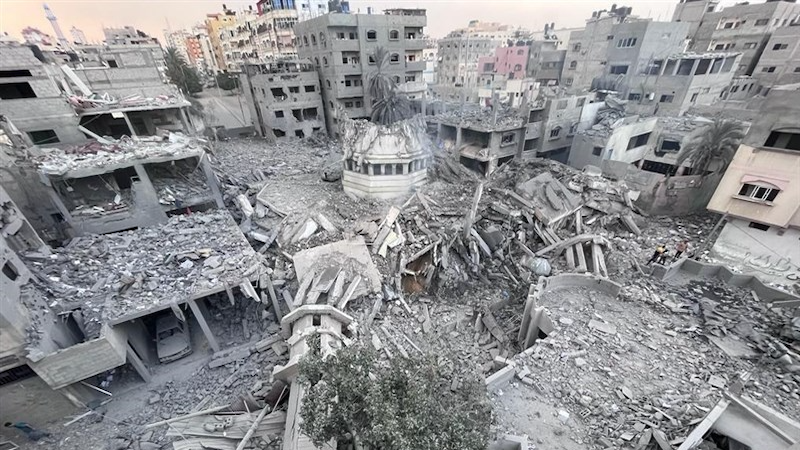
The war in Gaza passed the nine-month mark on Sunday with humanitarians left assessing the damage of a fresh Israeli airstrike on a UN school.
“Another day. Another month. Another school hit,” said Philippe Lazzarini, head of UNRWA, the largest aid agency in Gaza, in a post on X, formerly Twitter, after a school in Nuseirat, central Gaza, was “hit by the Israeli Forces” on Saturday. It was home to nearly 2,000 people forcibly displaced by the hostilities, the UNRWA Commissioner-General said, adding that dozens of casualties had been reported.
The development comes as ceasefire and hostage-release talks were reportedly due to resume in coming days. Repeated previous efforts to make headway have foundered, despite sustained international pressure from Member States with influence on both sides.
Success in negotiations this week will depend on satisfying Hamas’s call for a permanent end to the fighting and intense Israeli airstrikes which have flattened vast areas of the enclave, and the Israeli Government’s stated war aim of destroying Hamas’s military capability after the group attacked multiple targets in southern Israel on 7 October, killing around 1,250 people and capturing more than 250 hostages.
All eyes on Lebanon-Israel border
To date, tens of thousands of Palestinians have been killed, according to the Gazan health authorities and latest data from UNRWA indicates that at least 520 people sheltering in the UN agency’s shelters have been killed and at least 1,602 injured since the start of the war.
In a regular situation update, the UN aid coordination office, OCHA, reported that up to 1.9 million people in Gaza have been uprooted by the war, including some displaced “nine or 10 times”. Previous estimates were 1.7 million but this was before the Israeli operation in Rafah in early May, which led to additional displacements from Rafah and other parts across the Gaza Strip.
The renewed push for an end to the war comes amid daily exchanges of fire between Lebanese militants, Israel, and key Hamas ally, Hezbollah, across the UN-monitored Blue Line separating them.
On Sunday, the Lebanon-based group claimed responsibility for a reported drone strike on Mount Hermon in the Israeli-occupied Syrian Golan Heights. Hezbollah has said that it will halt operations only when the war in Gaza ends.
“The gradual expansion in the scope and scale of the confrontations well beyond the Blue Line significantly raises the risk of miscalculation and further deterioration of an already alarming situation,” the UN Interim Force in Lebanon (UNIFIL) told UN News, ahead of the latest escalation.
Citing latest OCHA data, the UN force said that nearly 97,000 people have been displaced from southern Lebanon because of the ongoing hostilities as of 25 June; more than 1,800 casualties have been reported including 435 deaths of whom 97 were civilians. “A political and diplomatic solution is the only viable long-term solution,” it insisted.
Probe ongoing
Responding to the school strike and Israeli military claims that it had been used by Palestinian armed groups, UNRWA’s chief Mr. Lazzarini said that he took the allegations “very seriously.
“It is exactly why I have repeatedly called for independent investigations to ascertain the facts and identify those responsible for attacks on UN premises or their misuse”, he said – a reference to an ongoing UN office investigation into Israeli assertions that 12 UNRWA staff were involved in the 7 October Hamas-led attacks.
Eight UNRWA staff remain under investigation by the UN’s internal oversight body, OIOS; to date, it has suspended three other cases citing insufficient evidence from the Israeli authorities and closed one case because Israel had not provided any supporting evidence, it has been reported.
“Nine months on this brutal war, I call once again for a ceasefire under which people in Gaza and Israel would finally get respite and protection and all hostages would be immediately released,” Mr. Lazzarini said.
“The longer this war goes on, the deeper the rift will become, & the more suffering people will endure.”
By Jim Garamone
For 75 years, the North Atlantic Treaty Organization has been a force for peace that stared down the Soviet Union, prevented a larger war in the Balkans, joined in the fight against international terrorism and even now stands ready to defend all NATO territory from Russian aggression.
NATO remains a vital and crucial alliance, and leaders of political parties on both sides of the Atlantic agree that NATO must be deemed one of the most successful collective defense alliances in history.
The alliance grew out of the experiences of the 20th century when great power wars killed more than 100 million people. Western leaders put in place an international order to prevent that sort of cataclysm from happening again. Part of that order was NATO—a collective defense alliance.
President Joe Biden called NATO “the greatest military alliance in the history of the world.” Since NATO’s founding, U.S. officials of both political parties have credited the alliance with contributing to the security, prosperity and liberty of Americans — and the world.
And polling this year by the Pew Research Center shows that, though roughly two-thirds of Americans hold a favorable view of NATO — still, that means a third of Americans hold unfavorable opinions about the alliance — a 4% increase since 2023.
This growing increase in isolationist sentiment in the United States is disturbing to leaders of the NATO nations.
Isolationism has a long history in the United States. In 1796, President George Washington wrote in his farewell address that “It is our true policy to steer clear of permanent alliance with any portion of the foreign world.” He said this even though Washington probably knew better than most Americans that without an alliance with France in the American revolution, Britain would have won.
When the United States entered World War I in April 1917, it fought as an “associated” power alongside France and the United Kingdom. The associated power label still left some distance between the U.S. and any entangling alliance.
After the war, American isolationism in the 1920s and 1930s, in part, laid the groundwork for a far more destructive war.
During World War II, the U.S. was a full ally, alongside the U.K., the Soviet Union, China, France and many others.
That war was so horrific, and the weapons created so destructive, that there was vast support for collective defense. A total of 420,000 Americans were killed in World War II, with many, many more wounded. And the U.S. was fortunate compared to other Allies. The Soviet Union lost up to 25 million and the U.K. — with less than a third of the U.S. population — lost 450,900. Overall, officials estimate that 3% of the Earth’s population died in World War II.
Moving forward, the development of atomic weapons meant those casualties would look small if the great powers were to go to war again.
The alliance may seem inevitable. But, as Biden said in remarks commemorating NATO’s 75th anniversary, this success didn’t happen by accident, nor was it inevitable.
Candy vs. Communism
NATO came into being with the signing of the Washington Treaty on April 9, 1949. The original members of the alliance were Belgium, Canada, Denmark, France, Iceland, Italy, Luxembourg, the Netherlands, Norway, Portugal, the U.K. and the U.S.
Even as Western leaders signed the treaty, U.S. and allied aircrews were winning the first battle of the Cold War: The Berlin Airlift.
At the end of World War II, the victorious Allied powers administered Germany — with the Americans in the South, the British to the North, the French in the Southwest and the Soviets in the East.
Berlin was a special case. Each of the four powers had a sector in the former Nazi capital, which was deep inside the Soviet quarter. On June 24, 1948, the Soviets cut off allied ground, rail and river routes into the city.
The allies — primarily the U.S. — answered with a massive airlift called Operation Vittles that supplied the city of more than 2 million people with food, milk, medical supplies and coal. Aircraft landed with metronome-like regularity. Logisticians loaded and unloaded the aircraft with metronomic precision. The operation delivered more than 2.3 million tons of supplies on more than 277,000 flights into the besieged city through September 1949.
The flights brought in more than just necessities. Air crews noticed children would gather to watch the planes land. One pilot, Air Force 1st Lt. Gail Halvorsen, attached parachutes to Hershey bars and launched them to the children. He became known as “the Candy Bomber.” The gesture gave heart to Berliners of all ages. And it highlighted the difference between the two systems. While the Soviets wouldn’t let milk for babies through a blockade, the Americans were dropping candy bars to children.
Article 5
The key to the Washington Treaty is Article 5, which pledges a collective response to an attack on any single member.
It goes like this, “The Parties agree that an armed attack against one or more of them in Europe or North America shall be considered an attack against them all and consequently they agree that, if such an armed attack occurs, each of them, in exercise of the right of individual or collective self-defense recognized by Article 51 of the Charter of the United Nations, will assist the Party or Parties so attacked by taking forthwith, individually and in concert with the other Parties, such action as it deems necessary, including the use of armed force.”
The treaty never mentions the Soviet Union, but there was little doubt who was the threat. NATO’s first secretary general — Britain’s Lord Ismay — said the alliance’s purpose was “to keep the Soviet Union out, the Americans in, and the Germans down.”
The alliance became a true deterrent to the Soviet Union. Proof of that came in 1955, when the Soviet Union created the Warsaw Pact. This was a forced pact of captive nations in the Soviet orbit formed in response to NATO.
NATO stood united when the Soviets crushed a rebellion in Hungary in 1956, when they erected the Berlin Wall in 1961, and when they crushed the democratic movement in Czechoslovakia in 1968.
While the Soviet Union denigrated NATO, claiming nations would do better for themselves in the Soviet orbit, the alliance continued to grow. In 1952, Greece and Turkey joined, and in 1955, West Germany. Spain joined in 1982.
This solidarity worked. The fall of the Berlin Wall in 1989 shredded the Iron Curtain. Three years later the Soviet Union itself imploded, and the nations of Eastern and Central Europe were free to choose their own courses. A total of 14 former communist nations — from Albania to Slovenia — hurried to join NATO.
Shared Democratic Values
NATO is more than a simple alliance of 32 nations. NATO countries share similar world views. “Today, we once more reaffirm that our shared democratic values — and our willingness to stand up for them — is what makes NATO the greatest military alliance in the history of the world,” Biden said in March as he welcomed NATO’s newest member, Sweden, into the alliance. “It is what draws nations to our cause. It is what underpins our unity.”
NATO is not just the largest peacetime military alliance in the world, it is integral to American interests and well-being.
“Generation after generation, the United States and our fellow allies have chosen to come together to stand up for freedom and push back against aggression — knowing we are stronger, and the world is safer, when we do,” Biden said in a statement celebrating the 75th anniversary of NATO’s founding.
Relevant Today
Russian President Vladimir Putin’s invasion of Ukraine in February 2022 highlighted NATO’s importance. “Almost two years after Putin’s unprovoked invasion of Ukraine — the most serious threat to transatlantic security in decades — NATO has grown stronger and more united than ever,” Secretary of Defense Lloyd J. Austin III said following a meeting of defense ministers at NATO headquarters in Brussels this February.
If Putin is successful and Russia is able to conquer a neighboring nation — forcefully deposing a freely elected government — then other neighboring nations may be endangered. “Putin is not going to stop at Ukraine,” President Biden said alongside French President Emmanuel Macron after talks in Paris, June 8. “All of Europe will be threatened, we are not going to let that happen.”
The European NATO allies are aware of the dangers posed by Putin’s expansionist tendencies. In 2014, when Russia first invaded Ukraine and occupied Crimea, only three NATO member states had achieved the alliance’s goal of 2% of gross domestic product devoted to defense. This year, 24 nations are expected to at least make the 2% level and many nations are taking that percentage of expenditures as the floor, not the ceiling for defense appropriations. Last year saw the ninth consecutive rise in European and Canadian defense spending. And in 2024, NATO members in Europe will invest a total of $470 billion in defense.
So, what makes NATO worthwhile to the United States? After all, at 1.3 million active-duty service members, almost 770,000 reservists and a $800 billion budget, the U.S. has the largest, best-funded military in NATO.
On the other hand, Russia has roughly 1.15 million active-duty personnel and another 800,000 reservists.
But the alliance is about more than how many troops any one nation can bring to the fight.
NATO’s members have a collective defense budget that’s north of $1.2 trillion. NATO nations share advanced training, tactics, equipment and often, weapons platforms. There are also NATO’s overflight agreements, basing arrangements, intelligence-sharing protocols, common command structures and day-to-day familiarity with each other. Critically, NATO can maintain and sustain its forces.
And about those troop numbers: The 32 NATO nations together have about 3,368,000 active-duty personnel, and each NATO nation has its own reserve forces, along with some paramilitary formations. This is deterrence in the flesh.
NATO Around the World
The alliance is addressing more than just threats from Russia. NATO has reached out to nations such as Australia, New Zealand and Japan as it watches moves by China in the Asia-Pacific, as well as in Africa and, increasingly, the Arctic. NATO has a program to work with Mediterranean nations. The alliance is addressing cyber threats and the moral use of artificial intelligence.
The Cold War wasn’t won by political parties, but by all Americans and all citizens of NATO countries. The unity of the alliance was important to ending the Cold War, but so was American leadership and will, as U.S. presidents from Bill Clinton to George W. Bush to Joe Biden said.
The alliance has had widespread U.S. support since its founding in 1949. But there are calls for isolationism — of America going it alone. In an interconnected world, this isn’t possible.
The only time NATO invoked Article 5 of the Washington Treaty was when terrorists attacked the U.S. on Sept. 11, 2001. NATO personnel fought and died alongside American forces in Afghanistan.
Secretary Austin has noted that America’s greatest asymmetric advantage over any competitor is its network of allies and partners. NATO is the jewel in the crown.
“Our allies magnify our strength and expand our security,” Austin said in Brussels. “America’s network of allies and partners worldwide — built and sustained by wise administrations of both parties in the decades since the nightmare of World War II — remains a core strategic strength that no rival can match — and that none should doubt.”
Iran’s new president is Azerbaijani
“Azerbaijan expects more active development of relations with Iran after the inauguration of the new president,” said Azerbaijan’s foreign minister, Jeyhun Bayramov.
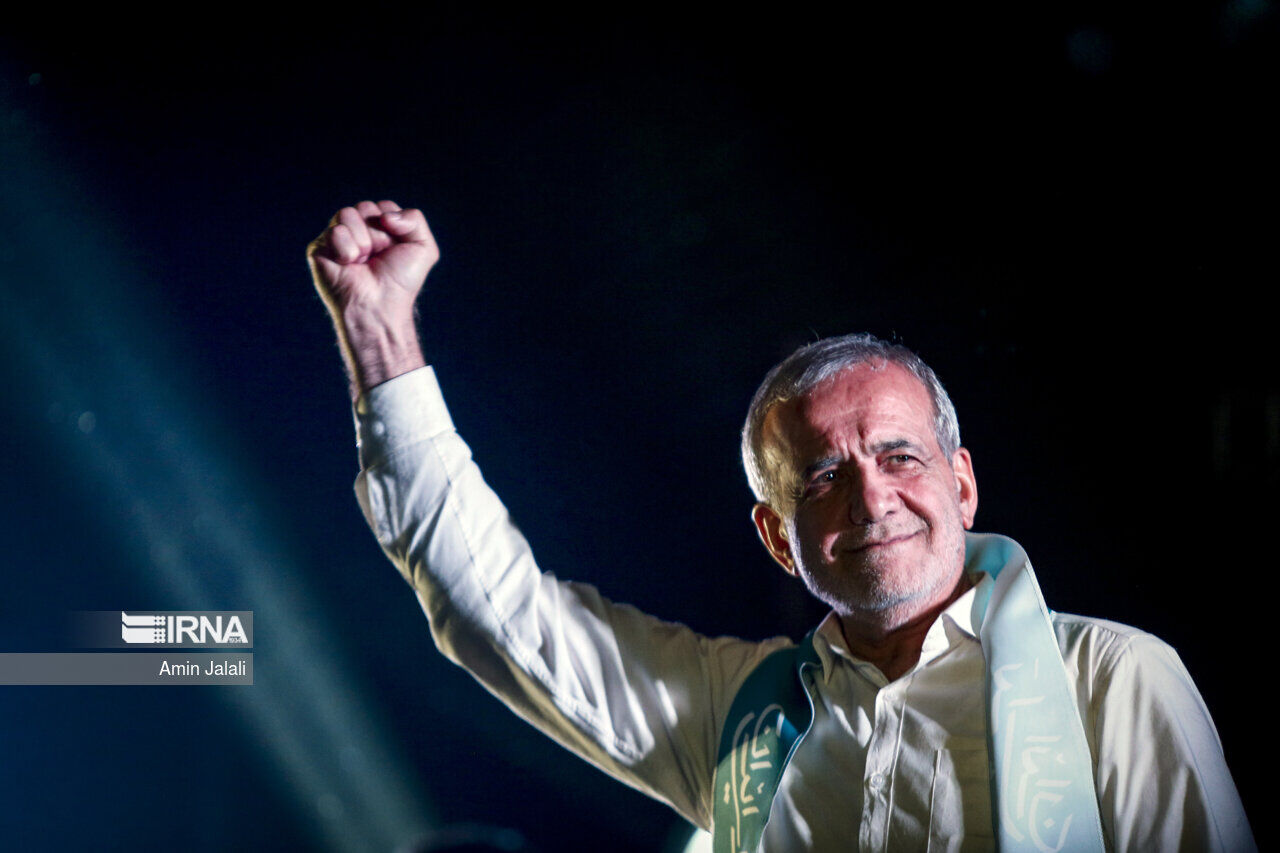
On July 5, in the second round of Iran’s presidential elections, the representative of the “reformist wing” of Iran’s political elite, ethnic Azerbaijani Masoud Pezeshkian, won.
- The US has indefinitely postponed joint military exercises with Georgia
- Is the South Caucasus in Trump’s plans? A view from Baku
- “This is just the beginning”: Armenia will receive 10 million euros from the European Peace Facility
“A new president has been elected in Iran, and the president of Azerbaijan has congratulated him. We are interested in implementing previously agreed projects between Azerbaijan and Iran,” said the minister.
According to him, Azerbaijan is keen on developing relations with Iran.
“There are historical ties between our countries. We have a program with a future outlook. We believe that relations will develop,” Bayramov said.
The previous president, Ebrahim Raisi, along with the foreign minister and other officials, tragically died on May 19 in a helicopter crash in the mountains of northern Iran. The incident occurred shortly after the aircraft took off from Iran following a meeting at the border with Azerbaijani resident Ilham Aliyev.
Iran at a сrossroads
Mehman Aliyev, head of the ASTNA analytical center, believes that Tehran has taken a decisive step towards potential transformation with the election of Masoud Pezeshkian, a prominent figure of Iran’s liberal elite.
“Pezeshkian’s victory in the presidential elections, where he was the only reformist among six candidates, marks a significant shift in political life. The election results, with a higher voter turnout of 49.8% and 53.6% of votes in favor of Pezeshkian compared to the ultra-conservative Saeed Jalili, reflect a conscious desire for change among the Iranian population,” he wrote in his analytical article.
In his opinion, Pezeshkian’s triumph can be seen as a turning point for a country grappling with numerous internal and external issues:
“International isolation of Iran, economic decline, internal discontent, and escalating tensions with Israel create a complex backdrop for Pezeshkian’s leadership.”
In his victory speech, Pezeshkian called for unity and collective efforts: “Dear people of Iran, the elections are over, and this is just the beginning of our work. The difficult path ahead will not be paved without your support, empathy, and trust. I extend my hand to you and pledge my honor that I will not leave you alone on this journey,” he said.
Azerbaijani student sentenced to 2 years in prison in Iran
According to his mother, Farid Safarli was sentenced without him being given a chance to speak

Dialogue with Iran’s opponents
“Pezeshkian’s calls for dialogue with Iran’s adversaries, particularly concerning the nuclear program, highlight his pragmatic approach to addressing the country’s internal issues.
He articulated this position during presidential debates before the second round of voting, emphasizing the need to resolve Iran’s global confrontations to effectively tackle domestic problems: ‘The main question is the future: do we want to resolve our issues with the world or not? I believe we must break the deadlock to solve the country’s problems,’ he said in one of his speeches.”
“The death of Amini is our fault!”
“An experienced politician and a qualified cardiologist, Pezeshkian served as minister of health under reformist president Mohammad Khatami. His political career has been marked by a firm stance against the suppression of pro-democracy protests in 2009 and the brutal police actions following the death of Mahsa Amini in 2022.
Amini’s death in police custody, allegedly for violating the Islamic Republic’s strict dress code for women, sparked mass protests. Pezeshkian openly criticized the state’s harsh response, attributing blame to various social sectors, including himself: ‘This is our fault. We want to impose religious faith by force. It is scientifically impossible. I bear part of the blame, respected religious figures and mosques bear part of the blame, and the (Iranian) broadcasting authority bears part of the blame.’
Pezeshkian’s inclusive rhetoric, positioning himself as a candidate for all Iranians regardless of political or religious affiliation, has resonated widely. His success in the elections signals not only the public’s hope for reforms but also the elite’s recognition of the need for a new direction to avoid confrontation with the West and attract vital investments.”

Azerbaijani factor
“The Azerbaijani factor, historically underestimated, has become prominent with Pezeshkian’s victory. Unlike many Iranian Azerbaijanis who covertly identify as Turks, Pezeshkian openly embraces this identity – ‘I am a Turk,’ a stance that challenges traditional Perso-centric narratives. His election carries significant symbolic weight, recalling the Turkic roots and influence in Iran’s history, particularly its greatness during the Safavid period under the Turkic Shah Ismail Khatai.
Recognizing Azerbaijanis as an integral part of Iran’s socio-political structure is not just a nod to history but a reflection of their ongoing influence in various societal sectors. Pezeshkian’s presidency may well herald a new phase of Persian-Turkic synthesis that has long underpinned Iran’s statehood. This synthesis, now tinged with liberal tones, promises a recalibrated approach both domestically and internationally, offering a glimmer of hope for a nation at the crossroads of change,” concluded Mehman Aliyev.
Iran’s new president is Azerbaijani