Categories
South Caucasus News

Iran Says US Diplomatic Channels Remain Open


Iran Says US Diplomatic Channels Remain Open

Flags of Iran and United States

The diplomatic channels between Iran and the United States remain open as the process of negotiations is proceeding, Iranian Foreign Ministry Spokesperson Nasser Kanaani said.

Asked about the question of talks between Iran and the US, which was mooted intelevised debates ahead of the recent presidential election, Kanaani said at a press conference on Monday that the issue has definite mechanisms.

“The diplomatic channels between Iran and the US are open and the process of negotiations is in progress. Its details will be published in due time,” the spokesman said.

He stated that the Foreign Ministry has been doing its utmost to protect the Iranian nation’s rights.

Kanaani noted that the outgoing administration of President Ebrahim Raisi, who passed away in a helicopter crash on May 19, will act within the framework of the determined mechanisms until the last day of its term.

Asked about Iranian President-Elect Masoud Pezeshkian’s campaign pledge of removal of sanctions, Kanaani said every deal has two sides, but in any case,Iran will employ its full capacities to safeguard the national interests.

Highlighting Iran’s rational foreign policy and its interaction with other states on the basis of prudence and dignity, he said Iran’s accession to multilateral mechanisms and cooperation with various countries will strengthen the country’s bargaining power in diplomatic negotiations.

The next administration will also utilizeall elements to fulfill the national interests of Iran and take advantage of its achievements, Kanaani added.

After the death of President Raisi in May, Pezeshkian became one of six final candidates singled out by the Constitutional Council from 80 applicants seeking the presidency.

He won the highest number of votes in the first round of the presidential election on June 28 and faced off the runner-up, Saeed Jalili, in the runoff election on July 5.

The physician-turned-politician won the runoff by garnering 53.66% of the votes.

His new administration, the 14th one after the victory of the Islamic Revolution in 1979, will hold office for four years.


Categories
South Caucasus News

Braiding Community Values With Science Is Key To Ecosystem Restoration


Braiding Community Values With Science Is Key To Ecosystem Restoration

A pika (a small mammal)-expelling ritual at a grassland restoration site on the Qinghai-Tibetan Plateau in the northwest of China. CREDIT: Li Li

Up on the “roof of the world”, one of the world’s largest ecosystem restoration projects is taking place. The Qinghai-Tibetan Plateau (QTP) in westernChina is the world’s highest plateau and covers a land area roughly five times the size of France.

Home to thousands of rare plants and wildlife and the source of water for more than 2.5 billion people, this vital ecosystem is under threat.

The region’s grassland is degrading due to climate change and intense livestock grazing. Government initiatives to restore biodiversity and fertility to the soil are underway, but the lack of engagement from local communities is one of the main causes of failed projects.

A research team comprising local Tibetans and academics from the UK and China has lived among and studied two pastoral communities on the QTP for decades, investigating local attitudes and values to grassland restoration.

The team’s recent findings, published in the journal People and Nature, demonstrate that local community members are indispensable partners in enhancing community engagement in repairing damaged ecosystems and achieving long-term success.

Some active and influential members within local communities serve as “brokers” of information and partnerships, communicating with other members about new techniques, like grassland replanting, in ways that align with local cultural views and values.

Huxuan Dai, lead author and PhD student at Xi’an Jiaotong-Liverpool University (XJTLU), China, and the University of Liverpool, UK, says, “Top-down restoration strategies often rely on narratives dominated by scientific knowledge, which can ignore or fail to respond to local concerns.

“Understanding a community’s value system and fundamental views of environmental change is a first step in our efforts to facilitate community engagement in ecological restoration projects.

“Policymakers and funders of restoration projects should draw lessons from this study and develop strategies to engage local communities better and improve the long-term sustainability of restoration activities and other community-involved environmental management initiatives,” says Dai.

Changing the narrative

To understand the attitudes and participation in grassland restoration practices, the researchers interviewed local pastoralists and looked at the success of community initiatives.

The study revealed eight types of pastoralists with a spectrum of attitudes toward grassland restoration within two QTP communities, Nyanze and Kouta (pseudonyms).

Of these, they found the group in the Nyanze community labelled Active Agents promoted the highest level of community engagement in grassland replanting. Most of this group are secular or religious elites in the community, such as village leaders, educated young people and Buddhist monks, with 90.9% not considering themselves to be low-income.

“The Active Agents intentionally integrated the novel grassland restoration measures with local worldviews and values. They created new inclusive narratives that make grassland restoration culturally acceptable and aligned with local values. This increased community participation in the restoration efforts,” Dai says.

Dai explains that excluding local values during discussions about new restoration techniques, may result in some pastoralists concluding: “Herders don’t do cultivating” and “By replanting, you need to plough the land, which may kill worms underground; killing isa bad behaviour in Buddhism.”

Instead, local people can offer a different interpretation of these techniques that takes into account local perspectives and values.

Dai says: “Value-inclusive narratives connect replanting withthelocal Buddhist value of showing compassion towards all living beings. For example, ‘replanting iscreating a world for all beings since they would not survive if the grassland were degraded. It means providing a home for them if you restore it.’

“This value-based approach responds to the local people’s connections with their land and culture and promotes sustainable ecosystem management practices at high altitudes,” she says.

Beyond research

Aside from the scientific significance of the project, the research team was motivated by their own observations and experiences of the effects of grassland degradation on the Qinghai-Tibetan Plateau and their interactions with its people.

Dr Li Li, the corresponding author of the study, explains: “The research team is made up of locals and researchers; Mr Trachung Balzang and Mr Golog Drugkyab are Tibetans born in this area who have witnessed great changes in the grasslands. They have dedicated decades to protecting their homeland and love for this land.

“We have all lived in this area of the QTP, made friends with the local people, and care about the place and its people. We have gained insights about life and the world and been inspired by them. Hence, with the attachment to this land, the research team wishes to promote the long-term effectiveness of grassland restoration efforts,” Dr Li says.

The next steps in the research will focus on how communities can gain knowledge about grassland restoration through adaptive management and how knowledge dissemination can lead to transformative change at a regional level.


Categories
South Caucasus News

Principles Of Origami Used To Position Sensors Inside 3D-Bioprinted Tissues


Principles Of Origami Used To Position Sensors Inside 3D-Bioprinted Tissues

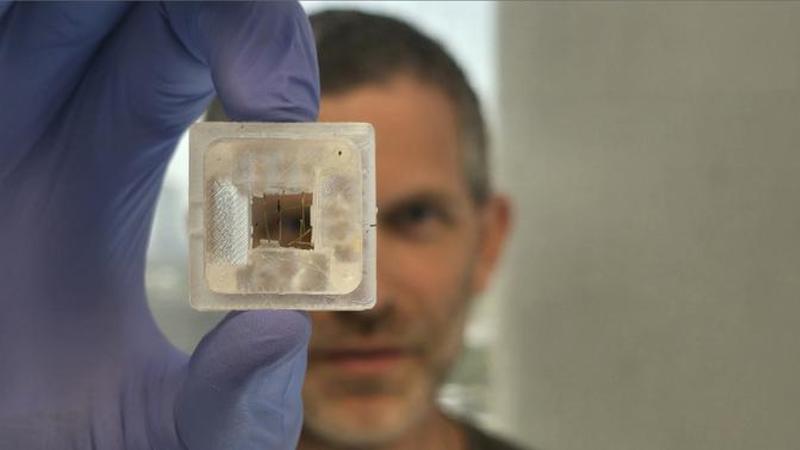
Prof. Ben Maoz Holding the 3D Origami Platform. CREDIT: Tel Aviv University

Researchers at Tel Aviv University relied on principles of origami, the Japanese art of paperfolding, to develop an original and innovative solution for a problem that has been troubling researchers worldwide: positioning sensors inside 3D-bioprinted tissue models. Instead of bioprinting tissue over the sensors (found to be impracticable) they design and produce an origami-inspired structure that folds around the fabricated tissue, allowing the insertion of sensors into precisely pre-defined locations.

The study was a joint effort of researchers from several units at TAU:  the School of Neurobiology, Biochemistry and Biophysics, the Koum Center for Nanoscience and Nanotechnology, the Department of Biomedical Engineering, the Sagol Center for Regenerative Medicine, the Sagol School of Neuroscience and the Drimmer-Fischler Family Stem Cell Core Laboratory for Regenerative Medicine. The researchers are: Noam Rahav, Adi Soffer, Prof. Ben Maoz, Prof. Uri Ashery, Denise Marrero, Emma Glickman, Megane Beldjilali-Labro, Yakey Yaffe, Keshet Tadmor, and Yael Leichtmann-Bardoogo. The paper was published in the leading scientific journal Advanced Science.

Prof. Maoz explains: “The use of 3D-bioprinters to print biological tissue models for research is already widespread. In existing technologies, the printer head moves back and forth, printing layer upon layer of the required tissue. This method, however, has a significant drawback: The tissue cannot be bioprinted over a set of sensors needed to provide information about its inner cells, because in the process of printing the printer head breaks the sensors. We propose a new approach to the complex problem: origami.”

The innovation is based on an original synergy between science with art. Using CAD (Computer Aided Design) software the researchers design a multi-sensing structure customized for a specific tissue model – inspired by origami paperfolding. This structure incorporates various sensors for monitoring the electrical activity or resistance of cells in precisely chosen locations within the tissue. The computer model is used to manufacture a physical structure which is then folded around the bioprinted tissue – so that each sensor is inserted into its predefined position inside the tissue. The TAU team has named their novel platform MSOP – Multi-Sensor Origami Platform.

The new method’s effectiveness was demonstrated on 3D-bioprinted brain tissues, with the inserted sensors recording neuronal electrical activity. The researchers emphasize, however, that the system is both modular and versatile: it can place any number and any type of sensors in any chosen position within any type of 3D-bioprinted tissue model, as well as in tissues grown artificially in the lab such as brain organoids – small spheres of neurons simulating the human brain.

Prof. Maoz adds: “For experiments with bioprinted brain tissue, we demonstrated an additional advantage of our platform: the option for adding a layer that simulates the natural blood-brain barrier (BBB) – a cell layer protecting the brain from undesirable substances carried in the blood, which unfortunately also blocks certain medications intended for brain diseases. The layer we add consists of human BBB cells, enabling us to measure their electrical resistance which indicates their permeability to various medications.”

The researchers summarize: “In this study, we created an ‘out-of-the-box’ synergy between scientific research and art. We developed a novel method inspired by origami paperfolding, enabling the insertion of sensors into precisely predefined locations within 3D-bioprinted tissue models, to detect and record cell activity and communication between cells. This new technology is an important step forward for biological research.”


Categories
South Caucasus News

Defense for Bob Menendez rests without New Jersey senator testifying – WesternSlopeNow


Defense for Bob Menendez rests without New Jersey senator testifying  WesternSlopeNow

Categories
Audio Review - South Caucasus News

Biden to meet new British PM Starmer on Wednesday


WASHINGTON — U.S. President Joe Biden will hold his first face-to-face talks with Britain’s new Prime Minister Keir Starmer at the White House on Wednesday, the White House said Monday. 

Biden also will host an event Thursday with Ukrainian President Volodymyr Zelenskyy at the NATO summit, which is taking place this week in Washington, national security adviser John Kirby told reporters. 

Biden plans to “underscore the importance of continuing to strengthen the special relationship between the United States and the United Kingdom” in his meeting with Starmer, White House spokesperson Karine Jean-Pierre said in a statement. 

She said the two leaders would have the opportunity to discuss U.S.-U.K. cooperation across a range of issues from Ukraine to the Israel-Hamas war, and ensuring that Iran does not obtain nuclear weapons, as well as confronting Iranian-backed Houthi threats to commercial shipping. 

The leaders also will discuss furthering cooperation in areas such as protecting advanced technologies and developing climate and clean energy solutions.


Categories
Audio Review - South Caucasus News

Gambia lawmakers back recommendations to maintain female genital mutilation ban


Dakar, Senegal — Gambian lawmakers adopted recommendations Monday for the country to maintain its ban on female genital mutilation ahead of a vote later this month on whether to decriminalize the practice.

Female genital mutilation (FGM) has been outlawed in Gambia since 2015, but the deeply rooted cultural practice remains widespread in the West African nation and the first convictions last year fueled a backlash against the law.

After a heated debate Monday, the recommendations contained in a report by the joint health and gender committee passed the full house sitting, with 35 lawmakers voting in favor of adopting the report, 17 against and two abstentions.

A final vote on the bill on whether to decriminalize FGM is currently set for July 24.

If parliament approves it, Gambia would become the first country to reverse a ban on FGM. It passed its second reading in March with only five out of 53 lawmakers voting against it and one abstaining.

After the second reading, the joint committee carried out a national public consultation with religious and traditional leaders, doctors, victims, civil society groups and circumcisers among others.

Its conclusions, presented Monday, described all forms of FGM as a “traumatic form of torture” and “discrimination against women.”

“Repealing the law would be a significant setback for the Gambia,” said Amadou Camara, the lawmaker who read out the report.

The first FGM conviction last August — of three women found guilty of cutting eight infant girls — sparked outrage and prompted independent lawmaker Almaneh Gibba to table the repeal bill in March.

Gibba and his backers, who include influential religious leaders, say the ban violates citizens’ rights to practice their culture and religion in the Muslim-majority country. Many Islamic scholars dispute this argument.

The World Health Organization says FGM has no health benefits and can lead to excessive bleeding, shock, psychological problems and even death.


Categories
Audio Review - South Caucasus News

Iran’s president-elect reaffirms policy toward Israel 


Categories
South Caucasus News

Biden to meet new British PM Starmer on Wednesday


WASHINGTON — U.S. President Joe Biden will hold his first face-to-face talks with Britain’s new Prime Minister Keir Starmer at the White House on Wednesday, the White House said Monday. 

Biden also will host an event Thursday with Ukrainian President Volodymyr Zelenskyy at the NATO summit, which is taking place this week in Washington, national security adviser John Kirby told reporters. 

Biden plans to “underscore the importance of continuing to strengthen the special relationship between the United States and the United Kingdom” in his meeting with Starmer, White House spokesperson Karine Jean-Pierre said in a statement. 

She said the two leaders would have the opportunity to discuss U.S.-U.K. cooperation across a range of issues from Ukraine to the Israel-Hamas war, and ensuring that Iran does not obtain nuclear weapons, as well as confronting Iranian-backed Houthi threats to commercial shipping. 

The leaders also will discuss furthering cooperation in areas such as protecting advanced technologies and developing climate and clean energy solutions.


Categories
South Caucasus News

Gambia lawmakers back recommendations to maintain female genital mutilation ban


Dakar, Senegal — Gambian lawmakers adopted recommendations Monday for the country to maintain its ban on female genital mutilation ahead of a vote later this month on whether to decriminalize the practice.

Female genital mutilation (FGM) has been outlawed in Gambia since 2015, but the deeply rooted cultural practice remains widespread in the West African nation and the first convictions last year fueled a backlash against the law.

After a heated debate Monday, the recommendations contained in a report by the joint health and gender committee passed the full house sitting, with 35 lawmakers voting in favor of adopting the report, 17 against and two abstentions.

A final vote on the bill on whether to decriminalize FGM is currently set for July 24.

If parliament approves it, Gambia would become the first country to reverse a ban on FGM. It passed its second reading in March with only five out of 53 lawmakers voting against it and one abstaining.

After the second reading, the joint committee carried out a national public consultation with religious and traditional leaders, doctors, victims, civil society groups and circumcisers among others.

Its conclusions, presented Monday, described all forms of FGM as a “traumatic form of torture” and “discrimination against women.”

“Repealing the law would be a significant setback for the Gambia,” said Amadou Camara, the lawmaker who read out the report.

The first FGM conviction last August — of three women found guilty of cutting eight infant girls — sparked outrage and prompted independent lawmaker Almaneh Gibba to table the repeal bill in March.

Gibba and his backers, who include influential religious leaders, say the ban violates citizens’ rights to practice their culture and religion in the Muslim-majority country. Many Islamic scholars dispute this argument.

The World Health Organization says FGM has no health benefits and can lead to excessive bleeding, shock, psychological problems and even death.


Categories
South Caucasus News

Iran’s president-elect reaffirms policy toward Israel