NPR News: 07-06-2024 11AM EDT
Learn more about sponsor message choices: podcastchoices.com/adchoices
 The South Caucasus News - SouthCaucasusNews.com
Learn more about sponsor message choices: podcastchoices.com/adchoices
A day earlier the 226-meter stretch of dam breached at Dongting Lake in Hunan province, with 5,700 residents relocated, China Central Television reported.
More than 2,300 rescue personnel were working to build a second line of defense, with footage showing excavators piling boulders into barriers and being resupplied by trucks.
No one had been harmed as of early Saturday, reports said.
Earlier footage showed a wave of water surging through a breach in the dike past several overturned lorries, along with large stretches of half-submerged houses and fields in the surrounding area.
On Saturday afternoon the Ministry of Water Resources said it would also inspect dams on Poyang lake, China’s largest freshwater lake, in southeastern China, as well as embankments along the lower reaches of the Yangtze River.
Heavy rainfall pounded parts Hunan province earlier this week, causing the Miluo River in Pingjiang county to swell to its highest in 70 years.
Local authorities responded by activating the maximum emergency response level. State media showed large parts of towns waterlogged and stranded people being rescued on boats.
A day earlier the 226-meter stretch of dam breached at Dongting Lake in Hunan province, with 5,700 residents relocated, China Central Television reported.
More than 2,300 rescue personnel were working to build a second line of defense, with footage showing excavators piling boulders into barriers and being resupplied by trucks.
No one had been harmed as of early Saturday, reports said.
Earlier footage showed a wave of water surging through a breach in the dike past several overturned lorries, along with large stretches of half-submerged houses and fields in the surrounding area.
On Saturday afternoon the Ministry of Water Resources said it would also inspect dams on Poyang lake, China’s largest freshwater lake, in southeastern China, as well as embankments along the lower reaches of the Yangtze River.
Heavy rainfall pounded parts Hunan province earlier this week, causing the Miluo River in Pingjiang county to swell to its highest in 70 years.
Local authorities responded by activating the maximum emergency response level. State media showed large parts of towns waterlogged and stranded people being rescued on boats.
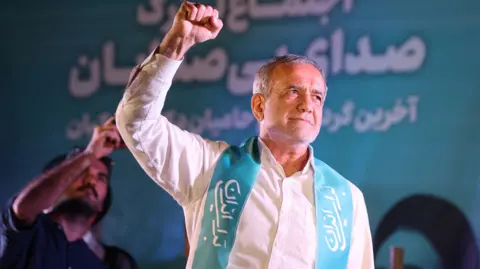 Former heart surgeon Dr Masoud Pezeshkian has been described as a wildcard candidate
Reformist Masoud Pezeshkian has been elected as Iran’s new president, beating his hardline conservative rival Saeed Jalili, the BBC reports.
The vote was declared in Dr Pezeshkian’s favour after he secured 53.3% of the more than 30 million votes counted. Mr Jalili polled at 44.3%.
The run-off came after no candidate secured a majority in the first round of the election on 28 June, which saw a historically low voter turnout of 40%.
The election was called after Iran’s previous president Ebrahim Raisi was killed in a helicopter crash in May, in which seven others also died.
The leaders of China, India and Russia have all congratulated Dr Pezeshkian on his victory.
Even before the final results were declared by Iran’s interior ministry, Dr Pezeshkian’s supporters had taken to the streets in Tehran and a number of other cities to celebrate.
Videos posted on social media showed mostly young people dancing and waving the signature green flag of his campaign, while passing cars sounded their horns.
Dr Pezeshkian, a 71-year-old heart surgeon and member of the Iranian parliament, is critical of Iran’s notorious morality police and caused a stir after promising “unity and cohesion”, as well as an end to Iran’s “isolation” from the world.
He has also called for “constructive negotiations” with Western powers over a renewal of the faltering 2015 nuclear deal in which Iran agreed to curb its nuclear programme in return for an easing of Western sanctions.
His rival, Saeed Jalili, favours the status quo. The former nuclear negotiator enjoys strong support amongst Iran’s most religious communities.
Mr Jalili is known for his hardline anti-Western stance and opposition to restoring the nuclear deal, which he says crossed Iran’s “red lines”.
Turnout in the latest round of voting was 50% – higher than the first round last week, when the turnout was the lowest since the Islamic revolution in 1979 amid widespread discontent, but still considerably low.
Widespread discontent meant that millions of people boycotted the elections.
Lack of choice in the candidates, dominated by Islamic hard liners, and the impossibility of real change as long as the supreme leader tightly controls policies added to their frustration.
Some people who did not vote in the first round were persuaded to cast their ballot for Dr Pezeshkian this time round to prevent Mr Jalili from becoming the president.
They feared that if he won, Iran would be heading for more confrontation with the outside world and that he would bring Iran more sanctions and further isolation.

In order to stand, both candidates had to make it through a vetting process run by the Guardian Council, a body made up of 12 clerics and jurists that hold significant power in Iran.
That process saw 74 other candidates removed from the race, including several women.
The Guardian Council has previously been criticised by human rights groups for disqualifying candidates who are not loyal enough to the regime.
After years of civil unrest – culminating in anti-regime protests that shook the country in 2022-23 – many young and middle-class Iranians deeply mistrust the establishment and have previously refused to vote.
On Iranian social media, the Persian hashtag “traitorous minority” went viral, urging people not to vote for either of the candidates and calling anyone who did a “traitor”.
But Supreme Leader Ayatollah Ali Khamenei has rejected suggestions that the low turnout represents a rejection of his rule.
“There are reasons [behind the low turnout] and politicians and sociologists will examine them, but if anyone thinks that those who did not vote are against the establishment, they are plainly wrong,” he said.
In a rare move, he acknowledged that some Iranians do not accept the current regime. “We listen to them and we know what they are saying and it is not like they are hidden and not seen,” Mr Khamenei said.