Categories
South Caucasus News

Far-Right Surge Or Status Quo? Understanding The 2024 European Elections – OpEd


Far-Right Surge Or Status Quo? Understanding The 2024 European Elections – OpEd

european flag map

Last month’s European Parliament elections did not bring about the ultimate breakthrough of the far right as some had feared. They are gaining influence though, especially because the lines between them and forces in the political center are blurring. Consequently, we will have to look to the left to stop their surge.

Between June 6 and 9, residents of the European Union (EU)went to the pollsto elect a new European Parliament. There were fears in advance of a breakthrough by the far right, which was not surprising given the recent electoral successes of extreme nationalist, conservative, and elitist parties, often with xenophobic tendencies and fascist roots or inspiration.

Six of the 27 EU countries—Italy, Finland, Slovakia, Hungary, Croatia, and the Czech Republic—have far-right parties in government. Sweden’s minority government relies on the support of the nationalist Sweden Democrats, the second-largest force in Parliament.

In the Netherlands, the Partij voor de Vrijheid (PVV) of Geert Wilders won 37 seats in the 150-seat Parliament after a campaign filled with xenophobia and anti-Islam sentiment. His parliamentary group is much larger than those of the red/green alliance of European Commissioner Frans Timmermans and the liberals of former Prime Minister Mark Rutte, who won 24 and 25 seats respectively. At the time of the European elections, Wilders was busy forming the most right-wing government in his country’s recent history.

The Netherlands is a relatively small country, but the surge of the extreme right caused concern in the large countries of Europe as well. In Italy, Giorgia Meloni’s Fratelli d’Italia, a party that traces its roots back to the fascist movement of Benito Mussolini, has been in power since October 2022. In France, the Rassemblement National of Marine Le Pentopped the pre-election polls, while the AfD, Alternative für Deutschland, the extreme right force in Germany consistentlyscored better in opinion pollsthan any of the three governing parties.

This Europe-wide success of far-right parties was indeed confirmed by theEuropean election results. The party of Italian Prime Minister Giorgia Meloni won more than 28 percent of the national vote. In France, Marine Le Pen’s Rassemblement National was the party of preference for almost one in three voters, humiliating President Emmanuel Macron’s Renaissance party, which garnered only half as many votes. In Germany, the AfD won almost 16 percent. This might be less spectacular than the Italian and French extreme right, but it’s still better than each of the three members of the current traffic light coalition: the Social Democrats, the Greens, and the Liberal Party.

But has the European Parliament indeed been taken over by the extreme right? Not really.

Their electoral successes in a number of countries is undeniable, as the examples of Italy, France, and Germany have already illustrated. The surge of the far right has beenat the expense of traditional centrist parties. In the European Parliament, the Greens and Liberals lost about one-fourth of their seats each. The Social Democrats seem to remain stable, though, losing only four seats.

But the center-rightEuropean People’s Party (EPP) Groupis even growing and remains by far the largest group in the European Parliament. Together, these four traditional political groups still have a majority in the European Parliament.

Besides, although the extreme right parties did make progress in the June 2024 elections, they are hopelessly divided among themselves on key issues such as economic policy, foreign relations, and EU integration. For example, while some advocate for complete withdrawal from the EU, others support renegotiating membership terms.

As a result of these divisions, there are two parliamentary groups that contain far-right parties. On the one hand, there is the right-nationalistEuropean Conservatives and Reformists, dominated by the Fratelli d’Italia and Poland’s Prawo i Sprawiedliwość (PiS) Party. On the other hand, there’s the far-rightIdentity and Democracy Group, whose members include France’s National Rally but also the Austrian Freiheitliche Partei Österreichs and Geert Wilders’s PVV. The AfD was a member of this group until it was expelled weeks before the European elections following a series of scandals.

And then, there are a number of far-right parties that do not belong to any of those parliamentary groups because they are not deemed acceptable or have already been expelled. Hungary’s Fidesz party became the largest among them when they quit the center-right European People’s Party in 2021. There’s also a whole range of smaller parties. The AfD joined their ranks just recently, as it is unaffiliated to any parliamentary group.

There are two reasons, therefore, why the extreme right is not able to dominate the European Parliament. On the one hand, the centrist parties, and especially the EPP Group, remain relatively strong. Besides, the far-right groups are too divided among themselves to become dominant.

The fear of a takeover of European mainstream politics by fringe, extreme right parties seems to be unfounded, at least for now. Nevertheless the influence of the extreme right is growing undeniably. The real danger might come from the blurring of the lines between mainstream parties and the far right.

We have seen recently how extreme right parties have started to emulatecenter-right partiesin exchange for a seat at the table, especially if they can join the government. Interestingly, Giorgia Meloni’s party is the only one of the three major Italian far-right parties that is unequivocallyin favor of NATO and support to Ukraine. Once in government, she became an outspoken supporter of military support. Geert Wilders, from his side, was ready to swallow much of his extreme party program in exchange for his ascension to government. The French Rassemblement National is also undergoing rebranding, and rallies with slick firebrand Jordan Bardella do not resemble the nostalgic National Front meetings of Jean-Marie Le Pen, the party’s founder.

This is not the only way the lines between the mainstream and the extreme right have become blurred. The center-right is also moving slowly but surely to the right. The shift of center-right parties towards the right can be seen inthe EU’s new migration pact, defended by European Commission president Ursula von der Leyen, which includes measures originally championed by the far right such as tougher deterrence through border control and stricter asylum procedures. Likewise, it also reinforces the extreme right’s framing of migration as a threat to European values. The real danger, therefore, might not be that of a takeover of European politics by extreme-right parties but of the alliance between the old center-right with the ‘new’, supposedly more moderate, extreme right.

The only remedy to the rise of the extreme right is therefore to be sought not in the center but to the left of the political spectrum. The left is positioned to counter the far right because of its commitment to inclusive and egalitarian policies, which directly oppose the exclusionary and nationalist rhetoric of the far right.

Unfortunately, the left is also divided and is missing a clear strategy. There is the new phenomenon of Bündnis Sahra Wagenknecht in Germany, which is combining restrictive proposals on immigration with a more progressive economic program, although with 6.2 percent in the European Parliamentary elections they scored less than anticipated. La France Insoumise (France), the Kommounistikó Kómma Elládas (Greece), and Partij van de Arbeid van België / Parti du Travail de Belgique (Belgium) scored well, winning the support of some 10 percent of their countries’ electorate. The left is showing resilience in other countries as well. Eventually, it’s these parties and the social movements they are rooted in that will have to provide an answer to the rise of the far right in Europe.

  • About the author: Wim De Ceukelaire is a health and social justice activist and member of the global steering council of the People’s Health Movement. He is the co-author of the second edition of The Struggle for Health: Medicine and the Politics of Underdevelopmentwith David Sanders and Barbara Hutton.
  • Source: This article was produced by Globetrotter.
Categories
South Caucasus News

EPP, Socialists, Liberals Finalize Wishlists For Von Der Leyen’s Second Term


EPP, Socialists, Liberals Finalize Wishlists For Von Der Leyen’s Second Term

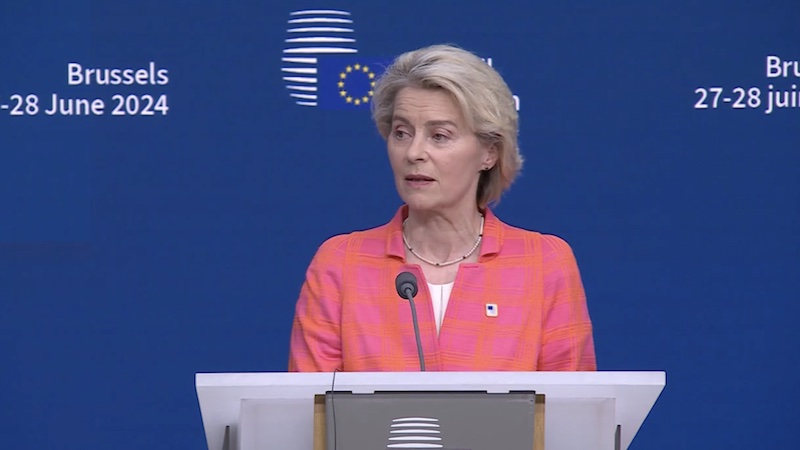
President of the European Commission Ursula von der Leyen. Photo Credit: EU Commission video screenshot

(EurActiv) — The three EU Parliament groups of the centrist majority diverge on some key policy issues for the next mandate, according to draft action plans seen by Euractiv, the basis for their talks with Ursula von der Leyen as she seeks support to win a second mandate as Commission president.

The centre-right EPP, the Socialists and Democrats (S&D), and the liberal Renew Europe group are drafting their own wish lists for the 2024-2019 EU term this week, with the final versions expected to come out on Thursday (4 July).

These wish lists will be the basis for the three groups to negotiate with von der Leyen, and among themselves starting next week, once the EPP group comes back from a retreat in Cascais, Portugal.

These priorities reflect what each political group expects from the next European Commission’s term and — more specifically — its future president,most likely Ursula von der Leyen.

Some of the groups’ priorities are close onfarmers’ rights and the next moves to develop the bloc’s defence industry,but diverging on key issues around how to bring more financial resources to the EU, or the fate of the combustion engine ban, according to the draft priorities seen by Euractiv.

Even though EPP-affiliated Ursula von de Leyen counts on the three-group platform for her re-election, shewill still have to take into accounttheir policy requests and balance them out. The same will matter when presenting draft legislation over the next five years.

Drawing from her own party priorities, the demands of Socialists and Liberals, and other potential partners, von der Leyen will develop a policy programme — the so-called “political guidelines” — ahead of her confirmation vote, expected during the first plenary in Strasbourg on 18 July.

She is also currently reaching out to other political groups, including the Greens – as Euractiv reported – and will continue to do so in a bid to secure the required 361 votes in the European Parliament.

Von der Leyen will be visiting The Left group on 15-16 July, according to sources, but the group’s co-chair Manon Aubry told reporters on Wednesday they will “vote against” and “fight against” von der Leyen and her coalition.

Agriculture: all in against large buyers

While the three groups have divergent interests in agricultural policy, particularly regarding sustainability ambitions, they all advocate for fair remuneration for farmers and addressing unfair trading practices.

The EPP, S&D, and Renew Europe are calling for a revision of unfair trading practices directive (UTP), which bans certain abusive behaviours by large buyers against farmers.

The Commission had previously admitted that the rules do not protect farmers from the few large companies dominating the food and retail industry.

On the sustainability front, Renew and S&D are seeking to revive the contentious proposals to reduce pesticide use and create a legislative framework for sustainable food systems – a goal absent from the EPP’s priorities.

Energy, Environment, Transport

The three groups all want a greater focus on energy security of supply, and all reaffirm their commitment to the EU’s 2030 and 2050 climate targets. However, the EPP and Renew emphasisethe industrial opportunities of the energy transition, while S&D focus on mitigating associated social costs.

Conflict points remain: The EPP wishes to revisit the de facto 2035 ban on new combustion engine cars, while S&D says car CO2 standards should remain in place. Similarly, the EPP wants theDeforestation Regulationto be postponed, while S&D describe the law as an achievement “that must remain in place”.

Economy

The S&D action plan, as expected, differs widely from its centre-right counterpart, as it steps up calls for guaranteeing a central role for public EU-level investments and a tax on the wealthy. In particular, it calls for a “social clause” to be attached to all EU spending, in stark contrast with the competitiveness “conditionality”called for by the EPP.

Like the EPP, Renew places competitiveness front and centre of their draft action plan, with a strong emphasis on cutting red tape and harmonising rules across the EU. Like the S&D, however, Renew calls for the EU to introduce new “own resources” to finance spending at the European level.

Foreign policy and defence

While the three groups clearly emphasise the importance of security and defence for the next term, they differ on how to fund such endeavours and the EU’s role in joint procurement, with the Liberals pushing for a ‘buy European first’ principle.

All three emphasise the support to Ukraine as a key element of their foreign policy agenda and more multilateralism on the global stage.

On the EU’s institutional set-up, Renew spells out the clearest expectations by asking that “all EU competences in the field of foreign affairs should be fully aligned to support our global priorities” and for the EU’s top diplomat to be able to “coordinate the work of (…) relevant Commissioners”.

The Socialists, on the other hand, stress that “Eastern border regions need support”, in a referenceto recent proposalsto beef up security in Europe’s East.

Almost absent Technology

Tech doesn’t feature prominently in any of the party manifestos, in line with what institutions have been saying for the past few months. After a flurry of legislation in the previous mandate, the focus for tech policy should now be on implementation.

EPP and Renew’s calls for better enforcement and simplifying regulation are particularly relevant in this area.

Migration: in or out third countries?

On the question of migration, both Renew and S&D underscore a humane approach to the EU’s migration policy, with new legal pathways to ensure that skilled labour reaches the continent and reject any externalisation of asylum processes.

Conversely, the EPP seeks new migration deals with Mali, Niger, Chad, Nigeria, and Ethiopia, as well as new legislation to bump up returns.Both Renew and EPP call for the strengthening of Frontex, the EU’s border agency.


Categories
South Caucasus News

UK Voters Poised To Land A Blow Against Populism – OpEd


UK Voters Poised To Land A Blow Against Populism – OpEd

United Kingdom flag

By Mohamed Chebaro

The UK is expected to experience a new beginning this week. Keir Starmer, the leader of the Labour Party, who is often seen as “uncharismatic,” bordering even on “boring” as far as a large chunk of the electorate is concerned, is likely to become the new prime minister and will form the new UK government following Thursday’s general election.

As a result, Britain and its people will, after 14 years of being governed by a right-leaning Conservative Party dominated by populist rhetoric, get the change they have been craving. If nothing else, they will be led by a serious person, one who is willing to serve and is ready to put the country before himself and his political party, as he has often repeated.

This would be quite refreshing for the British electorate after the many years of chaos under the Conservative Party, its austerity, its Brexit built on lies and its toxic, self-serving politics that have eroded trust in politicians, the system and even democracy.

Yet, be warned, the UK, like its neighbors on the European continent and across the Atlantic, will not be immune from a resurgence of populism or the far right for long. Amid economic stagnation, depleted state finances and the country’s borrowing being maxed out, while the demands of the people continue to grow, any government could find itself unable to please those who elected it. That is why it is imperative for the next government to try to end the “conspiracy of silence,” as no one has been talking about Brexit, taxation or the true cost of governing a country, funding its welfare state and meeting the aspirations of its people in the months preceding the election.

Politics is brutal, as Starmer surely knows, and he has to walk a very fine line to keep those who elected him on board. By breaking that conspiracy of silence, through telling people the truth, he might quickly fall out of favor compared to those populists and far-right firebrands who are always willing to offer people various fantasies and tell them what they want to hear.

It is here that the future of democracy may hang. How many of us would be willing to pay more tax in order to pay for essential services? How many Brits are ready to admit that Brexit delivered a bad blow to the economy? And how many are capable of trimming their expectations to make ends meet?

No one will envy Starmer, as he is likely to inherit a country with a long and urgent to-do list. Will he and his team be able to shrewdly find the money to stabilize the ship, redress some government failures, shorten hospital queues, find new doctors and new nurses, improve dilapidated schools, reform the justice system and hire more police officers? Will he be able to lessen the burden on struggling families as a result of the cost-of-living crisis, reform the immigration system, broker a new deal with the EU, Britain’s closest trading partner, and still manage to ensure the security of the nation in an ever more volatile world? This is a tall order to expect from any leader.

But Starmer has put himself forward and claims to be the man to bring about the changes that are needed. The question will be: is the electorate ready to play ball? UK society has, for decades, been living beyond its means. Public debt is slowly approaching the 100 percent of gross domestic product mark, although France fares even worse at above 110 percent of GDP. These are highs that nations could reach in times of conflict, for example, when meeting the burden of financing a war. But those debt levels are expected to rise even further if the state is to continue to deliver for a demographic that is aging, living longer and demanding more from the welfare state.

Instead, most people — and not just in the UK — have forgotten how to sacrifice today in order to build a better tomorrow. Selfish individualism is replacing the commonality that made the UK tick and prosper in the past. Building railways — such as the now watered-down HS2 project, the high-speed rail network that was supposed to link north and south — remains vital if the UK is to grow more in a decade or two. Investing in education and training should be high on the politicians’ agenda, so that the nation can be self-sufficient instead of relying on foreign nurses and doctors.

Building and maintaining a nation state requires tough choices, both by politicians and the people. Over the past decade, Britain has been entertained by its politicians and the crowd has been equally guilty for applauding them instead of holding them to account.

Labour has promised to change all that and to bring decency back into politics, but is the electorate ready to give the party a chance and equally to learn to live within its means, relearning how to sacrifice today for a better tomorrow? I am not sure.

Thursday’s election is likely to produce a new leadership, a new government and a new chance to rebuild state and society after the battering years of Conservative governments. The new government is likely to occupy the center ground again, in a world that is lurching further right everyday, from France to the US. A serious, sober form of government led by Starmer — unlike the theatrics Britain has been used to under the Tories — could offer a chance to fix the many broken wheels in politics, the economy and society, despite the adversities that could plague the demarches of the new government both domestically and internationally.

  • Mohamed Chebaro is a British-Lebanese journalist with more than 25 years of experience covering war, terrorism, defense, current affairs and diplomacy. He is also a media consultant and trainer.

Categories
South Caucasus News

Robert Reich: Fearmongering? – OpEd


Robert Reich: Fearmongering? – OpEd

Robert Reich

I’ve been going over Chief Justice John Roberts’s presidential immunity decision, trying to understand the distinction it sets out between “official” acts of a president, which are immune from prosecution, and “unofficial” acts, which are not immune. And I wanted to share with you a particularly troubling aspect.

Having served in the Justice Department soon after Richard Nixon sought to use the department to go after the people on his “enemies list,” I was struck by Roberts’s assertion that a “president may discuss potential investigations and prosecutions with his Attorney General and other Justice Department officials …” and that “the Attorney General, as head of the Justice Department, acts as the President’s ‘chief law enforcement officer’ who ‘provides vital assistance to [him]…”

Since Nixon, the Justice Department has been careful to keep the president and the White House strictly out of decisions over whom to prosecute. But Roberts’s language would immunize Trump from criminal prosecution, were he to become president again and seek to use the Justice Department to prosecute his enemies — exactly what dictators do.

In her dissent, Justice Sonia Sotomayor wrote that “The Republican appointed-majority in this opinion has … opened the door to a President exercising wide dictatorial powers without any ultimate legal accountability for his actions.”

In his opinion for the majority, Chief Justice John Roberts accused Sotomayor and the two other Democratic-appointed justices who joined her in dissent of “fearmongering on the basis of extreme hypotheticals….”

But is this really fearmongering? Trump has repeatedly called for the imprisonment of his political opponents, often singling out members of the January 6 committee.

Over the weekend, Trump circulated two posts on his social media website that presumably reflect his thinking.

One singled out Liz Cheney, the former Wyoming congresswoman, and called for her to be prosecuted by a type of military tribunal reserved for enemy combatants and war criminals, which would strip Cheney of her right to due process. “Elizabeth Lynne Cheney is guilty of treason,” the post said. “Retruth if you want televised military tribunals.”

The other post included photos of 15 former and current elected officials that said, in all-capital letters, “they should be going to jail on Monday not Steve Bannon!” The list included President Biden, Vice President Kamala Harris, Senators Mitch McConnell and Chuck Schumer and former Vice President Mike Pence, and members of the House committee that investigated the January 6, 2021, attack on the Capitol, including Ms. Cheney and the former Illinois Congressman Adam Kinzinger, another Republican, and the Democratic Representatives Adam Schiff, Jamie Raskin, Pete Aguilar, Zoe Lofgren, and Bennie Thompson, who chaired the committee.

The posts were still up on Trump’s Truth Social profile Monday afternoon.

Liz Cheney responded with her own social media post, saying “Donald — This is the type of thing that demonstrates yet again that you are not a stable adult — and are not fit for office.”

The Trump campaign responded to Cheney with a statement claiming that “Liz Cheney and the sham January 6th committee banned key witnesses, shielded important evidence, and destroyed documents” related to their investigation.

I don’t believe Sotomayor and her fellow dissenters from Monday’s opinion were engaging in fearmongering on the basis of extreme hypotheticals. Do you?


Categories
South Caucasus News

The Ultra-Right Is Governing Argentina: Who Is Javier Milei And What Is He Doing? – OpEd


The Ultra-Right Is Governing Argentina: Who Is Javier Milei And What Is He Doing? – OpEd

Argentina's Javier Milei. Photo Credit: Vox España via Wikimedia Commons

On December 10, 2023, Javier Milei was elected president of Argentina with 55.6 percent of the vote. The eccentric president has attracted global attention for his outrageous media style, his extreme ideas like “blowing up” the Central Bank of Argentina, and a mixture of messianism and mysticism with religion andcanine esotericism. Beyond the media show, Milei represents a radical shift in a country governed by progressivism during the last twenty years—Néstor Kirchner (2003-2007), Cristina Fernández de Kirchner (2007-2015), and Alberto Fernández (2019-2023)—except for the interval of Mauricio Macri (2015-2019), when it was clear that the institutions of the public (for health care, for education, and more) were considered to be inviolable.

Javier Milei’s public appearance began as a commentator on differenttelevision programs. He was one of the promoters of the protests against the mandatory isolation imposed during the pandemic, alleging the restriction of individual freedoms, and based on his popularity in social media, he waselected national deputyin the legislative elections of 2021 for his party “La Libertad Avanza” (Liberty Moves Forward). In 2023, with a strong erosion of the ruling party due to a dragging and poorly managed economic crisis, and an alliance with the conservative right “Juntos por el Cambio” (Together for change), he became President of the country.

Javier Milei defines himself as an anarcho-capitalist and a disciple of the Austrian economic school. What does this mean? Contrary to global practices of economic protectionism, Milei proposes unrestricted market freedom. He also proposes it not only as a foreign trade policy but also as a domestic policy.

Based onMurray Rothbard’s philosophy, Milei considers the state an illicit association that appropriates taxpayers’ money to sustain the privileges of the “political caste.” He believes in the market as the “natural” regulator of life in society and, therefore, public ownership and administration of services as an aberration. For instance, he believes public education and public health should not exist. This philosophy vindicates the “Law of Talion,” or an “eye for an eye,” as a valid practice of justice.

From this perspective, he intends to position himself as one of the leaders of the global ultraright that discussescombating“cultural Marxism.” This is the way in which they characterize progress for rights, women, sexual diversity, migrants, and those excluded from the system in general. Milei also adopts adenialist position with respect to climate changeand the scientific evidence for it.

From Political Philosophy to Government Practice

From his role as economic columnist, and presidential candidate, Milei promised the end of inflation, which averaged 8.6 percent monthly in Argentina in 2023 until Milei took office, and the dollarization of the economy.

Since he took office, as part of his economic policy, he has caused a devaluation of more than 100 percent of the local currency and embarked on a strong deregulation of economic activity, which implied an increase in the prices of basic goods and services. Additionally, as administrator of the state’s resources, he slowed down investment in public works andcut expensesat all functional levels.

These measures provoked a great redistribution of income from the working class to the sectors that live off the economic and financial income it produces as well as big businessmen. They also created an economic recession that equals and in some sectors exceeds the levels reached during the COVID-19 pandemic.

In this context, the government celebrates that inflation has been reduced monthly since it took office (from 25.5 percent in December caused by the devaluation to 4.2 percent in May), and boasts of a fiscal surplus (which hides the actual debt of the country). But the purchasing power of the minimum salary (considering a total basic food basket) was 30 percent, poverty reached55 percentof the population in the first quarter of 2024 (with an increase of approximately 11 percent in the first 3 months of government), and an increase in the unemployment rate is expected due to the magnitude of the recession and the layoffs that have already taken place.

This economic arrogance is spread from the executive power to the rest of the powers of the state, especially toward the legislature and the federal governments; such arrogance pressures and extorts the institutions of the state so that whatever decrees and laws are proposed by the executive have to be approved without discussion. Given the impossibility of such power to the executive, it had to negotiate with its political allies and give them ambassadorships in exchange for their support.

The official discourse and public policy persecute and target thefreedom of the press, the institutions of national culture, those rights that guarantee thelives of women who have been raped, those laws that promote non-discrimination in terms ofsexual orientationand xenophobia, and institutions such as public universities,social movements, and human rights organizations.

Milei’s foreign policy is torn between the attempt to obtain dollars to maintain its anti-inflationary policy and itsultrarightideological positioning. For instance, it exaggerates positions against China but later renegotiatesa swap. Itdefends the state of Israelfrom charges against the genocide Israel is perpetrating in Palestine, but always from behind the cloak of the Western empire.

How Long Will It Last?

One of the most heard phrases in Argentina, once Milei entered the presidential ballotage, was “He is not going to do everything he says.” This phrase served both to justify voting for him and to protect the voters emotionally from the disaster that would follow if he won the presidency. However, Milei is doing quite a lot of what he said.

The other most frequently heard phrase is “How long will it last?” Although the politically correct answer is “four years” as in every democratically elected government in Argentina since the reestablishment of democracy in 1983, the economic and social crises experienced do not leave room for such an accurate answer and even less so with the application of policies so extremely detrimental to the majority.

If we look at his economic plan and review Argentina’s history, we can find similarities with two recent historical moments. The first is Carlos Menem’s government (which for Milei was the best in Argentina’s history) and the second is Fernando De la Rúa’s government.

Menem’s government (1989-1999) applied structural changes at the economic level (neoliberalism). It had a boom moment (which allowed Menem to be reelected) by curbing inflation achieved by the exchange rate parity with the dollar. This was sustained at the beginning of the policies of privatizations of services and public goods as well as of foreign indebtedness. However, it resulted in the closing of many national companies and industries and an increase in unemployment that exceeded 20 percent at the end of his second term in office.

De la Rúa’s government (1999-2001) followed the policies of Menem’s government. Although it entered power to carry out a “radical” change, it ended up in multiple debt renegotiations with the World Bank and the IMF. This resulted in strong fiscal adjustment programs and increasing poverty levels. De la Rúa ended his term of office declaring a state of siege, resigning, and leaving the Government House by helicopter.

Within this framework, Milei has begun to implement an economic plan that reduces inflation and reactivates economic activity as Menem did if he obtains new IMF loans, privatizes companies, and obtains dollars to liquefy Argentina’s banking system; such policies will have similar consequences in terms of economic activity, employment, and poverty in a shorter period of time. Or, if he does not manage to access the necessary funds in dollars, he will have to rely on ever greater economic adjustment and repression with a government closer to that of De la Rúa. Helicopters should be on standby.

For the time being, for six months the streets of the City of Buenos Aires and the central squares of all the provinces of the country have been theepicenter of constant mobilizationsagainst the policies applied and the laws promoted by the government. Among the government’s adherents, though, the situation continues to be justified under arguments such as “We are in bad shape, but we are doing well,” “We have to let it govern,” and “Who did you want to vote for?” Those who still support Javier Milei cling to the fall in the inflation rate, but the latest polls also reflecta fall in his positive image, especially in the provinces of the interior of the country where Milei received strong support to reach the presidency.

  • About the author: Lucia Converti holds a BA in Economics and a Master’s degree in Latin American Social Studies from the University of Buenos Aires. She has worked as a researcher in several social and geopolitical research institutes.
  • Source: This article was produced by Globetrotter.

Categories
South Caucasus News

Volume of contacts between Moscow and Baku is large: Putin – 1Lurer


Volume of contacts between Moscow and Baku is large: Putin  1Lurer

Categories
South Caucasus News

PID – PID


PID  PID

Categories
South Caucasus News

Xi says China, Azerbaijan upgrade bilateral relations to strategic partnership – bastillepost.com


Xi says China, Azerbaijan upgrade bilateral relations to strategic partnership  bastillepost.com

Categories
Audio Review - South Caucasus News

@mikenov: news.google.com/rss/articles/C…


https://t.co/Ck7rp4fEXY

— Michael Novakhov (@mikenov) July 3, 2024


Categories
Audio Review - South Caucasus News

@mikenov: news.google.com/rss/articles/C…


https://t.co/f0kfkmwtxT

— Michael Novakhov (@mikenov) July 3, 2024