
Day: July 2, 2024
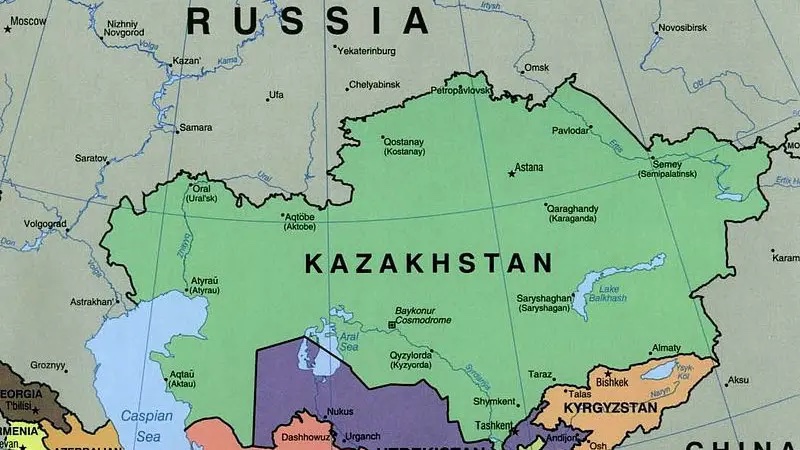
During the call, which is said to have been carried out by Russian pranksters who use the aliases ‘Vovan and Lexus’ and in which David Cameron is shown talking on his mobile, the British Foreign Secretary is heard saying: “Kazakhstan are convinced that Putin wants a slice of the north of Kazakhstan”.
A spokesperson for Britain’s Foreign Office said in a statement, “… We made public the fact that this call happened weeks ago, to do the right thing and make sure others were warned of the risk at the earliest opportunity. The foreign secretary understood this was a private call with a Ukrainian politician [ex-President Poroshenko]”.
David Cameron is “regretting his mistake”, the British Foreign Office said in the statement. Thus, it turns out that words about Kazakhstan being convinced that “Putin wants a slice of the north of Kazakhstan” were actually spoken during that call.
Such a view can be construed as a factual reflection of the viewpoint of the international community on the underpinning of the situation between Russia and Kazakhstan amid the war in Ukraine. But the question is how much does it reflect the actual state of things in the context of this matter.
For example, in a recent interview with Vasil Golovanov, Dmitro Gordon, a prominent Ukrainian journalist, interviewer, and politician, while commenting on the expansionist public speech by State Duma Deputy Speaker Pyotr Tolstoy concerning Kazakhstan, suggested that the leader of Kazakhstan Kassym-Jomart Tokayev would do well to keep in mind the words of the Russian MP when meeting with the Kremlin master, Vladimir Putin.
In his speech the Russian MP holding a high-ranking position within the legislative branch in Russia, who is also known as having been the head of the Russian delegations to the Parliamentary Assemblies of both the OSCE and the Council of Europe, said that Russia ‘will cease to exist’, if Moscow loses the war in Ukraine. He further stressed if Russia does not ‘close the topic’ of Ukraine, there would be problems ‘with Kazakhstan’, and with some other post-Soviet countries.
The Duma Vice-Speaker continued: “Look at what is happening today in Kazakhstan in terms of building a certain Kazakh state. Look at what kind of national mythology is blooming there regarding independence, regarding the transition to the Latin alphabet”. Pyotr Tolstoy added: “They forgot Alma-Ata (Almaty) is the former city of Verny, our Russian Cossack fortress”.
It would seem, this should have led to a wave of indignation among not only the Kazakhstani journalistic community but also the socio-political groups in Kazakhstan. But it appears that in fact the above words of Tolstoy induced stronger reactions from outside the country, and even in Russia, rather than in Kazakhstan itself. The journalists and public figures from Ukraine, Azerbaijan, and Turkey did not fail to begin protecting Kazakhstan and the ethnic Kazakhs against the verbal attacks and territorial claims by Russian MP. They expressed their views explicitly and without concerning themselves about what others might think of their words. Pyotr Tolstoy, according to Anatoly Nesmiyan, a Russian writer and publicist, “described the Kazakh statehood extremely contemptuously as ‘a certain Kazakh state”.
In Kazakhstan itself, meanwhile, the major media outlets, as far as can be judged, were limited to publishing information reports about Pyotr Tolstoy’s interview with Komsomol’skaya Pravda-Radio and asking Kazakh MPs to provide comments on the verbal attacks and territorial claims by Russian MP. The latter ones also seemed to be tending to keep a low profile in this case. Commenting to journalists on May 30, Kazakh Senate Chairman Maulen Ashimbayev asked them ‘not to aggravate’ the situation, stating, “In my view, this is the opinion of a private person and does not express the official opinion of the State Duma”.
Here is how Zerkalo.az, an Azerbaijani media outlet, characterizes Astana’s official reaction to the words of Pyotr Tolstoy: “I don’t know whether official Kazakhstan will respond to the crazy [verbal] attacks of Pyotr Tolstoy, at least so far there has been no reaction from the country’s Foreign Ministry. But then a completely toothless comment appeared in the press from one of the deputies of the Kazakh parliament, Murat Abenov, who very diplomatically and in a soft form commented on the scandalous words of the Russian Vice-Speaker, describing them merely “thoughtless ones”… Tengrinews quotes Abenov as saying, “I would like to call on my Russian colleagues, representing the multi-ethnic people of Russia, to care about the friendship and cooperation between the two neighboring countries. We do not want Kazakhstan-Russia friendship to be derailed by such irresponsible statements”.
Zerkalo.az goes on to say: “Excuse me, but what kind of friendship of peoples and state interests are there in a State where the ruler himself openly declares rights to neighboring countries and dreams of reviving the USSR by any means”. According to the Azerbaijani media outlet, the expressions ‘narrow-eyed people’, ‘black-assed people’, and ‘sheep’ accompany all Muslims in the Russian state. Here, however, it is necessary to clarify: the expression ‘narrow-eyed ones’ is usually applied by the Russians to the ethnic Kazakhs and their kind but in no case to the Azerbaijanis and other people of Caucasian origin.
Anyway, those verbal attacks and territorial claims by the Russian MP did not cause any meaningful discussion in the media and among active members of the social and political community in Kazakhstan. One may wonder why things happened the way they did. The matter here is that it is obviously difficult for an outsider to understand the underpinnings of what is happening in the social and political life of Kazakhstan. With the West and its allies being somewhat new to the undercurrents of Russian-Kazakh controversies, rather ignorant to the complex clandestine history within the relationship between Russian power and Kazakh elites, and without any specific knowledge of how Russian reflexive control works in the Kazakh media sphere and among the nation’s social and political communities, probably it’s not always easy for their observers and experts focusing on Central Asia to discover the true explanation for these or those relevant events and developments.
What can one say in this regard about the Western authors of, say, the Diplomat, an international online news magazine actively covering Kazakhstani events and developments, if even Vitaly Portnikov, a Ukrainian journalist and political expert, who is well-versed in political developments across the former Soviet sphere, sometimes surprises with his unawareness of the Kazakhs’ actual sentiments towards neighboring great powers? Here’s what he said while answering the question ‘Is Russia planning an attack on other countries after this war, for example, on Kazakhstan or Georgia?’: Should this happen, Kazakhstan ‘will count on China’s support’.
Had Vitaly Portnikov been able to read the press in the Kazakh language, he would probably have been aware of the fallacy of such an opinion.
A centuries-old, symbolic depiction of South Korea, as is well known, portrays it as a shrimp between two whales, China and Japan. There is a Korean proverb that states: “When whales fight, a shrimp’s back is broken”. Both notions may be seen by the Kazakhs as equally attributable to their way of thinking and country. There is a Kazakh proverb that states: “When two bulls fight, a fly is killed”. And Kazakhstan, being sandwiched between Russia and China, might be feeling the way similar to that experienced by Korea. Some people may probably think such a suggestion is an exaggeration.
Anyway, here are some pieces of evidence so that one can judge for oneself how believable that is. The Abai online media outlet, in an analytical piece entitled “Chinese sites: Balkhash is our land…”, citing the relevant sources, reported that “the Chinese media are tirelessly trying to show our vast steppe east of Lake Balkhash on maps as a part of their country”. It then quoted some Chinese source (on Baidu, July 29th, 2023) as saying: “In the past, it was called Ibo hai and it was the place where our people lived in the northwest. In the mid and late 19th century it was forcibly taken away by the Russian Empire…”.
Globalnews.kz, in an article entitled “Does China lay claim to Balkhash? Kazakhstan is urged to appeal to the UN” which represents an overview of the above analytical piece, said: “While Kazakhstan is making concessions, China is tirelessly trying to take away the vast steppe east of Lake Balkhash”. It then quoted the same Chinese source (on Baidu, July 29th, 2023) as saying: “If we want this territory back, we must first rely on historical and political factors to accurately study [the situation with] Balkhash, as times change and so does national sovereignty. We are engaged in serious negotiations about rights and interests”.
So, if we are to believe even some of the above, it seems that the Chinese kind of lay claim to the territory of Kazakhstan east of Lake Balkhash, or, in other words, up to Lake Balkhash.
Now let’s see what the lands in Kazakhstan Russian expansionists are laying claim to… Yes, you’ve guessed them correctly. They are laying claim to almost the whole rest of the Kazakhstani territory that lies north and west of Lake Balkhash. Below are some proof of that.
Here is an article by Oleg Maslov and Alexander Prudnik, well-known Russian political experts, entitled ‘Kazakhstan at the beginning of the 21st century is like Poland before 1939. Partition of Kazakhstan, or the new Molotov-Ribbentrop plan’ and appeared on Polit.nnov.ru back in 2007. It said: “The crucial question today is about where the line of division of Kazakhstan between Russia and China will be drawn. It is extremely important for China to have access to the Caspian Sea, so one can predict that the new border between Russia and China will pass along the Emba River at the 47th parallel north. The partition of Kazakhstan along the Emba River and at the 48th parallel north is unacceptable for Russia because of Baikonur [cosmodrome]. Other, more flexible partition configurations are possible as well. Everything depends on mutual agreements between the leaderships of China and Russia”.
Yes, it’s been a long time since the appearance of the above article. However, it would be naive to believe that its authors have been the only ones with this attitude towards the future of Kazakhstan. Anyway, their idea has fallen on fertile ground and taken good root in Russia. Here is a more recent example of this. Eadaily, in an article by Albert Hakobyan (Urumov) entitled ‘Who did give the go-ahead for the “the Russian question” to be finally resolved’, said: “The main strategic task [for Kazakhstan] set by Tokayev is as follows: “We must ensure the territorial integrity of Kazakhstan through the completion of the construction of a mono-ethnic state”. In other words: “We are getting away from Moscow!”… So, there are two options for Russia. The first is to move the actual State border of the Russian Federation moving southward [at the expense of Kazakhstan] as far as possible – along the line: ‘Balkhash – Baikonur – Bekdash’. The second is to federalize Kazakhstan through the creation of two super-regions – ‘the Northern’ and ‘the South’ along the line ‘Ural – Ishim – Irtysh”.
As you can see, Baikonur is mentioned in that case, too. What’s next? A rather direct has been State Duma deputy Mikhail Delyagin, when speaking on this matter: “Unless Northern Kazakhstan, along with Central and Western Kazakhstan, rejoins their Homeland [Russia] as a result of the upcoming events, it will be … well, like ditching Donbas [non-admission of the Donetsk People’s Republic and the Luhansk People’s Republic to Russia]”. In other words, he is exactly laying claim to almost the rest of the Kazakhstani territory that lies north and west of Lake Balkhash.
There are a lot of such statements lately, and they are appearing regularly in the Russian media. There seem to be some projects behind all this, developed by the Russian strategists, which provide Moscow’s interference in Kazakhstan’s territories.
In light of all the foregoing, the question is, what is to expect from the future?
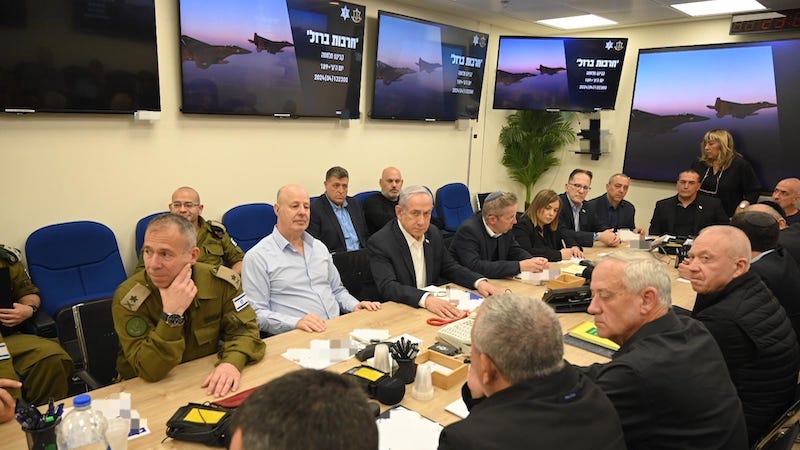
Israel never learns from its mistakes. What Prime Minister Benjamin Netanyahu is trying to implement in Gaza is a poor copy of previous strategies used by other Israeli leaders. If these strategies had succeeded, Israel would not be in this position.
The main reason for Netanyahu’s lack of clarity about his real objectives in Gaza is that neither he nor his generals can determine the outcome of their futile war on the Strip — a war that has already killed tens of thousands of innocent civilians.
And no matter how hard he tries, Netanyahu will not be able to reproduce the past.
Following the Israelioccupationof Gaza, the West Bank and East Jerusalem in June 1967, Israeli politicians and generals saw eye to eye on many things. The government wanted to translate its astounding military victory against Arab armies into a permanent occupation. The army wanted to use the newly acquired territories to create “buffer zones,” “security corridors” and the like to strangulate the Palestinians even further.
Both the government and the military found the establishment of new colonies to be the perfect answer to their shared vision. Indeed, today’s illegal settlements were originallyplannedas part of two massive security corridors projected by then-Labor Minister Yigal Allon.
The Allon Plan was predicated on several elements. Among other ideas and designs, it called for the building of one security corridor along the Jordan River and another along the so-called Green Line, Israel’s pre-1967 borders. The new demarcations were meant to expand Israel’s borders — which were never defined to begin with — thus providing Israel with greater strategic depth. This plan was the original annexation scheme; it wasresurrectedby Netanyahu in 2019 and is now beingadvancedby Finance Minister Bezalel Smotrich.
Netanyahu is also sorting through previous governments’ archives in the hope of finding a solution to his disastrous war in Gaza. Here, too, the Allon Plan is relevant.
In 1971, Israeli general Ariel Sharonattemptedto implement Allon’s idea regarding complete control over Gaza, but with his own unique touch. He invented what became known as Sharon’s “five fingers.” This was a reference to the military zones and colonies that were meant to divide the Gaza Strip into sections and to separate the southern city of Rafah from the Sinai region.
To achieve this, thousands of Palestinian homes weredestroyedthroughout Gaza, particularly in the north. As for the south, thousands of Palestinian families, mostly Bedouin tribespeople, were ethnically cleansed to the Sinai desert.
Sharon’s plan, which was an extension of Allon’s, was never fully implemented, though many aspects of it were carried out at the expense of the Palestinians, whose resistance continued for many years. It is that resistance, expressed through the collective defiance of the population of the Strip, which later forced Sharon, then the prime minister, to abandon Gaza altogether. He called his 2005 military redeployment and subsequent siege on Gaza the “disengagement plan.”
The relatively new plan, which Netanyahu rejected at the time but is now trying to revive, seemed to be the rational answer to Israel’s unsuccessful occupation of Gaza. After 38 years of military occupation, the experienced Israeli general, known to Palestinians as “the bulldozer,” realized that Gaza simply cannot be subdued, let alone governed.
Instead of learning from Sharon’s experience, Netanyahu appears to be repeating the original mistake.
Though Netanyahu has revealed few details about his future plan for Gaza, he has spoken often of retaining “security control” over the Strip, as well as the West Bank. Israel will “maintain operational freedom of action in the entire Gaza Strip,” he said in February.
Since then, his army has been constructing what seems set to be a long-term military presence in central Gaza, known as theNetzarim Corridor— a large “finger” of military routes and encampments that splits Gaza into two. Netzarim, named after a former settlement southwest of Gaza City that was evacuated in 2005, also gives Israel control of the area’s two main highways, Salah Al-Din Road and the coastal Al-Rashid Street.
The Philadelphi Corridor, located between Rafah and the Egyptian border, wasoccupiedby Israel on May 7. It is meant to be another “finger.” Additional “buffer zones” already exist in all of Gaza’s border regions, with the aim of fully suffocating Gaza and giving Israel total control over aid.
However, Netanyahu’s plan is doomed to fail.
The circumstances of the 1967 Israeli occupation of Gaza were entirely different to what is taking place now. The former was an outcome of a major Arab defeat, while the latter is an outcome of Israel’s military and intelligence failures.
Moreover, the regional circumstances are working in Palestine’s favor and the global knowledge of Israel’s ongoing genocide in Gaza makes a permanent war nearly impossible.
Another important point to keep in mind is that the current generation of Gazans is empowered and fearless. Its ongoing resistance is a reflection of a popular reawakening throughout Palestine.
Finally, the Israeli unity that followed the 1967 war is nowhere to be found, as Israel is today divided along many fault lines.
It behooves Netanyahu to revisit his foolish decision to maintain a permanent presence in Gaza, as defeating Gaza is proving to be an impossible task, even for the far superior military of his country.

None of the Prophets sent by Allah to spread imageless monotheism were able to establish an ongoing monotheistic community prior to the descendants of Prophet Abraham. The Prophet that tried the hardest and the longest was Prophet Noah. God had warned Prophet Noah that almost all of his efforts would not be long-lasting.
“They said, “O Noah, you have argued with us, and argued a great deal. Now bring upon us what you threaten us with if you are truthful. He (Prophet Noah) said, “It is God who will bring it upon you, if He wills, and you will not be able to escape. My advice will not benefit you, much as I may want to advise you, if God desires to confound you. He is your Lord, and to Him you will be returned. Or do they say, “He made it up?” Say, “If I made it up, upon me falls my crime, and I am innocent of the crimes you commit. And it was revealed to Noah: “None of your people will believe, except those who have already believed, so do not grieve over what they do.” (Qur’an 11:32-36)
Prophet Noah was fortunate that unlike many others of Allah’s Prophets; he was not killed by the polytheist idol worshippers. The leaders of the tribes and nations said, “Do not give up your gods; do not give up Wadd, nor Souwa, nor Yaghoos, and Yaooq, and Nassr. They have misled many, so do not increase the wrongdoers except in confusion. Because of their wrongs, they were drowned, and were hurled into an oven fire pot. They did not find any helpers apart from God. Noah said, “My Lord, do not leave of the unbelievers a single dweller on earth. If You leave them, they will mislead your servants, and breed only (more) wicked unbelievers.” (Qur’an 71:23-27)
The oven fire pot is best avoided by Jews, Christians and Muslims who “Hold firmly to the rope of Allah all together and do not become divided. And remember the favor of Allah upon you – when you were enemies and He brought your hearts together and you became, by His favor, brothers. And you were on the edge of a pit of the Fire, and He saved you from it. Thus does Allah make clear to you His verses that you may be guided.” (3:103)
The Prophet Isaiah said: “Listen to me, you who pursue righteousness, you who seek the Lord: look to the rock from which you were hewn,and to the quarry from which you were dug. Look to Abraham your father and to Sarah who bore you; for he [Abraham] was only one when I called him,that I might bless him and multiply him. (Isaiah 51:1-2) and the Qur’an states: “You have an excellent example to follow in Abraham.” (60:4) and “Follow the way of Abraham as people of pure faith.” (3:95)
Most people in the world have learned of Prophet Abraham, not by reading a book of Jewish history or religion, but by listening to and reading from the Christian Bible or the Muslim Qur’an. This unique and amazing situation is a reflection of a promise made to Prophet Abraham more than 36 centuries ago, and recorded in both the Torah and the Qur’an.
“I swear (says God) because you did this – not withholding your son, your favorite one, I will bestow My blessing on you and make your descendants as numerous as the stars in the sky and the sand on the seashore; and your descendants shall seize the gates of their foes. All the nations of the earth shall bless themselves by your descendants, because you have obeyed My command.” (Genesis 22:16-18) and “Indeed, We chose him (Abraham) as one pure and most distinguished in the world, and he is surely among the righteous in the Hereafter”. (Qur’an 2:130)
Prophet Isaiah also said: But you, Israel, my servant, Jacob, whom I have chosen,are the offspring of Abraham, my friend;” (Isaiah 41:8) So the biological offspring of Prophet Abraham (the Banu Israel) became the first ongoing monotheistic community when God rescued them from Egyptian oppression; and made an ongoing covenant with them at Mount Sinai. Prophet Abraham was not born a Jew, but his descendants from his grandson Jacob/Israel became the Banu Israel—Jewish People.
Prophet Abraham was the first person called a “Hebrew” in the Hebrew Bible (Genesis 14:13). Hebrew probably comes from the verb to go over a boundary, like the Euphrates or Jordan river, or to be a migrant. Ten generations later the Philistines in Canaan used the term “Hebrews” to refer to the 12 tribes of Israel: “Philistine commanders asked, “What about these Hebrews?” (1 Samuel 29:3); and Prophet Jonah identified himself to non-Jewish sailors as “a Hebrew” (Jonah 1:9).
The Qur’an states in Surah 3:67: “He (Abraham) was not Yahuudiyyaun, “a Jew”, nor Nasraaniyyaan, “a Christian”, but rather a Haniifaam-Muslimaan, “a monotheistic Hebrew believer submitting (Islam) to the one imageless God who created all space and time; who made Prophet Abraham’sdescendants into a great multitude of monotheistscalled the People of Israel-Banu Israel.
None of the Messengers prior to Prophet Abraham were able to establish an ongoing monotheistic community that lasted. “And when there came to them a Messenger from Allah, confirming what was with them, a party of the people who were given the Book threw away the Book of Allah behind their backs, as if they did not know it!” (Qur’an 2:101)
And “Those who disbelieve are steeped in arrogance and defiance. How many generations have We destroyed before them? They cried out when it was too late to escape. And they marveled that a warner had come to them from among them. The disbelievers said, “This is a lying magician.” “Did he turn all the gods into one God? This is something strange.” The notables among them announced: “Go on, and hold fast to your gods. This is something planned. We never heard of this in the former faith. This is nothing but a fabrication. (Qur’an 38:2-7)
For the next 1200+ years Banu Israel was the only ongoing monotheistic community in the world. Unlike the other monotheistic communities that rose and fell during those centuries; most, but not all of Banu Israel remained loyal to the covenant God made with them.
The Hebrew Bible views a binary picture of humanity, with the Jewish people in covenant with the one God on one side, and the idolatrous polytheist nations of the world on the other. However the rabbis of the talmudic period-approximately 200 to 600 CE took one aspect of the biblical narrative that does not fit into this neat binary universe. While the Bible portrays strangers as isolated individuals in Jewish society, the Talmud expanded the aspect of the stranger and conceptualized it into a broad legal and moral category.
Based on the covenant God makes with Prophet Noah and his descendants (Genesis 9:8-17), the Babylonian Talmud (Avodah Zarah 64b) interpreted the stranger to be all gentiles who accept the seven Noahide commandments constituting the basic laws of morality:
1-The positive injunction to set up courts that justly enforce social laws
2- the prohibition of blasphemy, i.e. intolerance of worshipping the one God.
3- the prohibition of idolatry
4- the prohibitions of grave sexual immorality, such as incest and adultery
5- the prohibition of murder
6- the prohibition of theft
7- the prohibition of eating the limb of a live animal, a paradigm for cruelty.
All non-Jews who accept these laws of civilization have residency rights in a Jewish religious polity.
As a result, the talmudic tradition split the gentile world into two sub-categories: immoral persons who reject the Noahide commandments and to whom tolerance is generally not extended, and gentiles who accept the laws of the Noahide covenant who are regarded positively, whom Jews are obligated to protect and sustain.
Thus, classical Judaism subscribed to a double covenant theory: Jews have the Torah covenant of 613 commandments and all gentiles have a Prophet Noah covenant of seven Noahide mitzvot, each covenant being valid for its respective adherents.
The great sage Rabbi Moses Maimonides maintains that six of the prohibitions were given to Prophet Adam, and after the flood Prophet Noah was given the additional obligation not to eat the blood or a limb from a living animal.
jared kushner and trump’s campaign – Google Search https://t.co/qqeGGiU8bm
–https://t.co/D101pqNoZ7
–https://t.co/O3GEO7zkje
–https://t.co/rbC4zaZGo1— Michael Novakhov (@mikenov) July 2, 2024
jared kushner and trump’s campaign – Google Search https://t.co/qqeGGiU8bm
–https://t.co/D101pqNoZ7
–https://t.co/O3GEO7zkje
–https://t.co/rbC4zaZGo1— Michael Novakhov (@mikenov) July 2, 2024
It was around 1 a.m. on July 1 when large crowds quietly poured into the streets of Tbilisi – an unusual occurrence for a Monday morning. There was no noise, only faint murmurs exchanged with weary looks. Slowly, cars started to move, and slowly, their horns began to break the silence of the night. National flags now appeared from open car windows, followed by the heads of passengers who had something to say but were still searching for the right words. Then finally, one young man found it: “Ara Ushaaavs!” – waving the flag, he cried out from the window the Georgian phrase for “it’s okay/never mind”, and everyone knew what he meant.
Minutes earlier, the Georgian national football team suffered a heartwrenching 4-1 defeat to Spain, ending its fairytale debut journey at EURO2024 after captivating international audiences, dominating various group stage rankings, and miraculously making it to the knockout stage. The loss to the championship favorites was expected but no less disappointing, especially since Georgia was the one to open the score.
Still, the honking of horns and the chants of fans that night grew louder, mixed with the sounds of fireworks, and the country realized that the end of the miracle still only meant one thing: the miracle had happened.
Here is Nini and the Dispatch newsletter, promising that this will be our last column on football this summer… well, probably.
Georgians play football the way Georgians live: always on the defensive, always fending off more powerful attackers, always in an unequal battle, but still waiting for a small chance, a tiny piece of freedom to show their best talents. Has it always been like this? Yes and no. Growing up in Georgia in the 1990s and 2000s, everyone loved to play football, anywhere from village fields to city streets, and everyone loved it when it was done beautifully: if you wanted to be the neighborhood favorite, you were expected to be a good dribbler. Just trust your author, who was there herself, passionate about kicking the ball, but apparently born with the wrong sex for those times. Yet it wasn’t just me who was restricted from being her own person back then – it was everyone.
It was a time when the country was recovering from seven decades of Soviet rule, followed by years of turmoil and civil war. To be yourself meant to be either a victim or, worse, an aggressor. Succumbing to trauma and economic hardship, some simply stopped trying. Others tried too hard – to be better, to break through the confines of geography and reach out to the wider world, a longing that has kept Georgians awake at night and left the outsiders struggling to make sense of. But this urge to be accepted by the outside world – especially the West – also brought confusion about what to give up and what to keep. The confusion was widespread, creating creative blockages in everything from the arts to sports, from politics to communications.
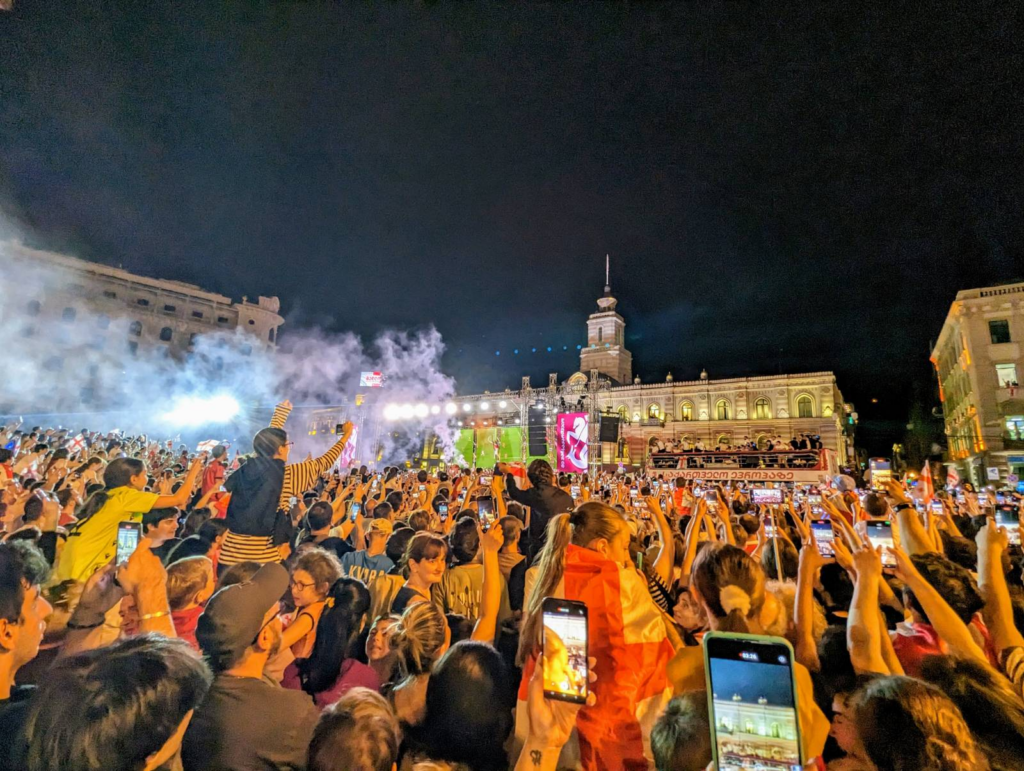 Thousands hit the streets on July 2 in Tbilisi to welcome the national team after an impressive debut at Euros. Photo: Nini Gabritchidze
And that confusion may have been one of many things that have plagued Georgian football over the years: for decades, the constant disappointments led many of us to believe that football, quite simply, was not our thing. (The popular riff “Rugby is Our Game”, for example, implied that football, apparently, was not. In rugby, at least, Georgians were thriving and winning.)
The memories of older fans claiming to have witnessed the nation’s football prowess didn’t help. Still, it was hard to let go: what better way to reinvent yourself globally than through the most popular team sport that combines athleticism, creativity, and intelligence? The desire was there, and it was only a matter of time before the missing pieces came together: confidence, the readiness to set long-term goals, and the ability to play as a team. And as we would later find out, it wasn’t just our lack of effort – the world outside was not the fairest place to live, either.
‘Freedom is My Signature’
Things started to change when Georgian player Khvicha Kvaratskhelia joined Italy’s Serie A club Napoli and became the league’s best player in his debut season. It was, however, not his goals or assists that had the whole of Georgia glued to the screens; rather, the way he played and dribbled brought back football as we knew it. “Freedom is my signature,” he would later tell the New York Times. That freedom was also what won him an international following, but more importantly, it inspired Georgians – in and out of sports – that they could add hard work to their personality and still make it.
But Kvaratskhelia’s case also confirmed that luck is another key factor when you come from a country like Georgia. “He’s just a Georgian, he’s not Brazilian. It’s less glamorous,” Georgia’s head coach Willy Sagnol once quoted skeptical foreign football officials who’d refuse Kvaratskhelia’s European transfers.
The change also came as people in other areas slowly began to let go of their constraints and return to their old selves – partly as past traumas began to heal and partly as increased interaction with the outside world helped Georgians see themselves more clearly. Younger people began to boldly rediscover forgotten gems of their country’s culture. This, in turn, inspired more unique forms of self-expression that started to make a difference in social and political life.
This year’s football success was the best illustration – and culmination – of all these changes. The national team’s style of play showed that you can take this game of self-expression even further, and learn to show your character not only in those short counter-attacks but also in protracted periods of self-defense. The insane stretches of goalkeeper Giorgi Mamardashvili proved that you can be permanently besieged, tormented, and still be able to fly. The great support and cheers that Georgia received from its Caucasian neighbors meant that the struggle was not ours alone. And while ruling party propagandists tried to link this reinvention to their illiberal “sovereignty” discourse, the real lessons could be the opposite: that you can perfectly be yourself without preventing others from being themselves, be out there and contribute, not lose.
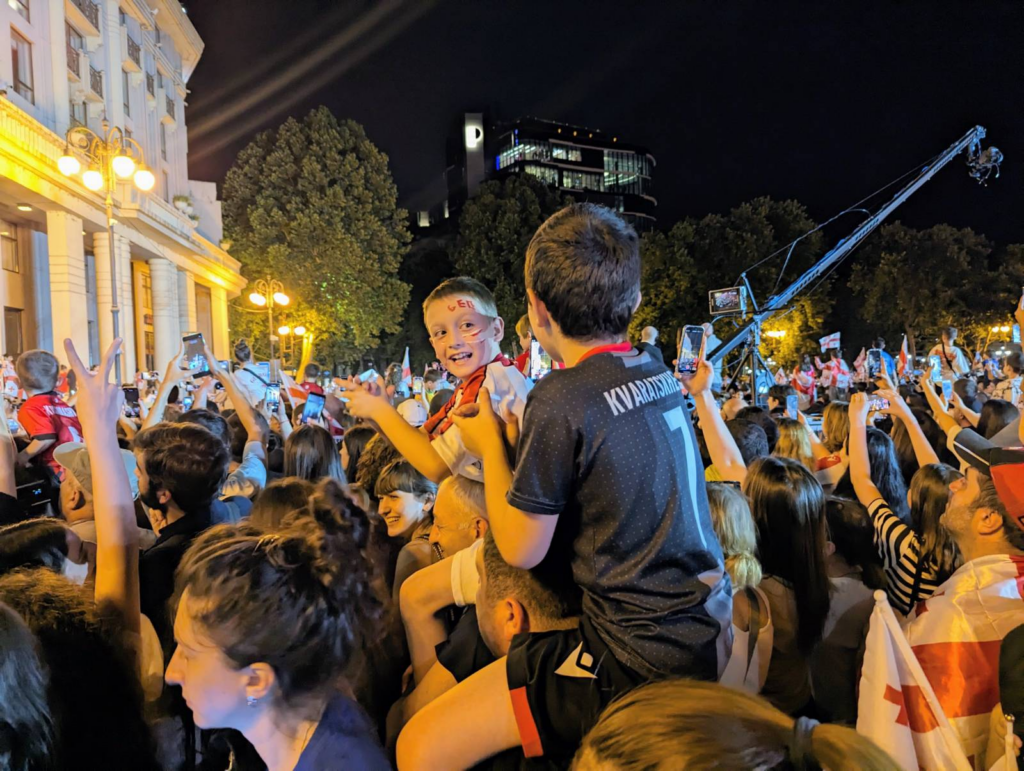 Thousands hit the streets on July 2 in Tbilisi to welcome the national team after an impressive debut at Euros. Photo: Nini Gabritchidze
I’m Seen, Therefore I Am
The days between Euro 2024 matches were happy ones. Everywhere you went – on the street, in the office, on public transport – all you saw were beaming faces staring at phone screens. That’s what you do too: you see the social media post of a popular international platform praising Georgia’s performance; you instinctively rush to the comments section and check out foreign reactions, but you don’t stand a chance: your entire country is already there, including dozens of your Facebook friends who got there before you, left a few unsolicited national flag emojis, and reminded aspiring social media managers that whenever you need engagement, you call us, Georgians. Then you move on to the next football post the Facebook algorithm has ready for you, and then to the next: there’s nothing else on your newsfeed these days anyway.
Are we overdoing it? Is this obsession for international attention just an expression of underlying inhibitions and unfulfilled ambitions? Who even gives their team a heroes’ welcome simply because they made it to the knockouts? At first glance, it might indeed appear as too much. Yet in reality, what Georgia and Georgian fans want is something very natural, simple, and legitimate: they want to be seen.
It was around 1 a.m. on July 1 when large crowds quietly poured into the streets of Tbilisi – an unusual occurrence for a Monday morning. There was no noise, only faint murmurs exchanged with weary looks. Slowly, cars started to move, and slowly, their horns began to break the silence of the night. National flags now appeared from open car windows, followed by the heads of passengers who had something to say but were still searching for the right words. Then finally, one young man found it: “Ara Ushaaavs!” – waving the flag, he cried out from the window the Georgian phrase for “it’s okay/never mind”, and everyone knew what he meant.
Minutes earlier, the Georgian national football team suffered a heartwrenching 4-1 defeat to Spain, ending its fairytale debut journey at EURO2024 after captivating international audiences, dominating various group stage rankings, and miraculously making it to the knockout stage. The loss to the championship favorites was expected but no less disappointing, especially since Georgia was the one to open the score.
Still, the honking of horns and the chants of fans that night grew louder, mixed with the sounds of fireworks, and the country realized that the end of the miracle still only meant one thing: the miracle had happened.
Here is Nini and the Dispatch newsletter, promising that this will be our last column on football this summer… well, probably.
Georgians play football the way Georgians live: always on the defensive, always fending off more powerful attackers, always in an unequal battle, but still waiting for a small chance, a tiny piece of freedom to show their best talents. Has it always been like this? Yes and no. Growing up in Georgia in the 1990s and 2000s, everyone loved to play football, anywhere from village fields to city streets, and everyone loved it when it was done beautifully: if you wanted to be the neighborhood favorite, you were expected to be a good dribbler. Just trust your author, who was there herself, passionate about kicking the ball, but apparently born with the wrong sex for those times. Yet it wasn’t just me who was restricted from being her own person back then – it was everyone.
It was a time when the country was recovering from seven decades of Soviet rule, followed by years of turmoil and civil war. To be yourself meant to be either a victim or, worse, an aggressor. Succumbing to trauma and economic hardship, some simply stopped trying. Others tried too hard – to be better, to break through the confines of geography and reach out to the wider world, a longing that has kept Georgians awake at night and left the outsiders struggling to make sense of. But this urge to be accepted by the outside world – especially the West – also brought confusion about what to give up and what to keep. The confusion was widespread, creating creative blockages in everything from the arts to sports, from politics to communications.
Thousands hit the streets on July 2 in Tbilisi to welcome the national team after an impressive debut at Euros. Photo: Nini Gabritchidze
And that confusion may have been one of many things that have plagued Georgian football over the years: for decades, the constant disappointments led many of us to believe that football, quite simply, was not our thing. (The popular riff “Rugby is Our Game”, for example, implied that football, apparently, was not. In rugby, at least, Georgians were thriving and winning.)
The memories of older fans claiming to have witnessed the nation’s football prowess didn’t help. Still, it was hard to let go: what better way to reinvent yourself globally than through the most popular team sport that combines athleticism, creativity, and intelligence? The desire was there, and it was only a matter of time before the missing pieces came together: confidence, the readiness to set long-term goals, and the ability to play as a team. And as we would later find out, it wasn’t just our lack of effort – the world outside was not the fairest place to live, either.
‘Freedom is My Signature’
Things started to change when Georgian player Khvicha Kvaratskhelia joined Italy’s Serie A club Napoli and became the league’s best player in his debut season. It was, however, not his goals or assists that had the whole of Georgia glued to the screens; rather, the way he played and dribbled brought back football as we knew it. “Freedom is my signature,” he would later tell the New York Times. That freedom was also what won him an international following, but more importantly, it inspired Georgians – in and out of sports – that they could add hard work to their personality and still make it.
But Kvaratskhelia’s case also confirmed that luck is another key factor when you come from a country like Georgia. “He’s just a Georgian, he’s not Brazilian. It’s less glamorous,” Georgia’s head coach Willy Sagnol once quoted skeptical foreign football officials who’d refuse Kvaratskhelia’s European transfers.
The change also came as people in other areas slowly began to let go of their constraints and return to their old selves – partly as past traumas began to heal and partly as increased interaction with the outside world helped Georgians see themselves more clearly. Younger people began to boldly rediscover forgotten gems of their country’s culture. This, in turn, inspired more unique forms of self-expression that started to make a difference in social and political life.
This year’s football success was the best illustration – and culmination – of all these changes. The national team’s style of play showed that you can take this game of self-expression even further, and learn to show your character not only in those short counter-attacks but also in protracted periods of self-defense. The insane stretches of goalkeeper Giorgi Mamardashvili proved that you can be permanently besieged, tormented, and still be able to fly. The great support and cheers that Georgia received from its Caucasian neighbors meant that the struggle was not ours alone. And while ruling party propagandists tried to link this reinvention to their illiberal “sovereignty” discourse, the real lessons could be the opposite: that you can perfectly be yourself without preventing others from being themselves, be out there and contribute, not lose.
Thousands hit the streets on July 2 in Tbilisi to welcome the national team after an impressive debut at Euros. Photo: Nini Gabritchidze
I’m Seen, Therefore I Am
The days between Euro 2024 matches were happy ones. Everywhere you went – on the street, in the office, on public transport – all you saw were beaming faces staring at phone screens. That’s what you do too: you see the social media post of a popular international platform praising Georgia’s performance; you instinctively rush to the comments section and check out foreign reactions, but you don’t stand a chance: your entire country is already there, including dozens of your Facebook friends who got there before you, left a few unsolicited national flag emojis, and reminded aspiring social media managers that whenever you need engagement, you call us, Georgians. Then you move on to the next football post the Facebook algorithm has ready for you, and then to the next: there’s nothing else on your newsfeed these days anyway.
Are we overdoing it? Is this obsession for international attention just an expression of underlying inhibitions and unfulfilled ambitions? Who even gives their team a heroes’ welcome simply because they made it to the knockouts? At first glance, it might indeed appear as too much. Yet in reality, what Georgia and Georgian fans want is something very natural, simple, and legitimate: they want to be seen.