NPR News: 07-02-2024 8PM EDT
Learn more about sponsor message choices: podcastchoices.com/adchoices
 The South Caucasus News - SouthCaucasusNews.com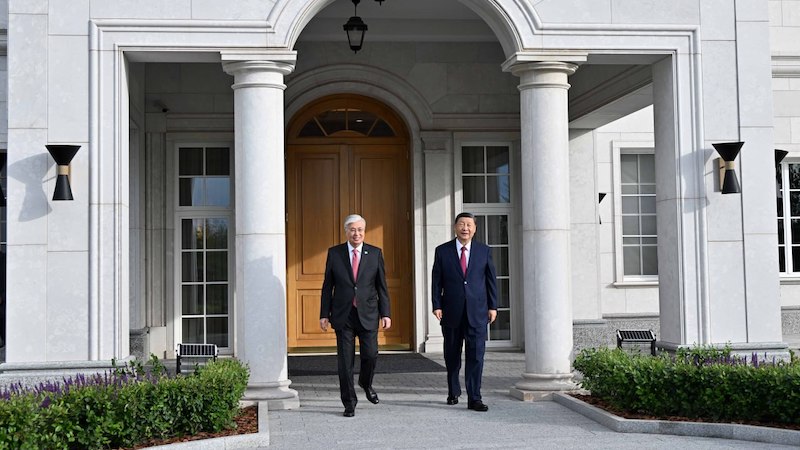
By RFA Mandarin and Uyghar and Alim Seytoff for RFA Uyghur
Chinese President Xi Jinping arrived in Kazakhstan on Tuesday morning for the 24th annual meeting of the Shanghai Cooperation Organization, a group created by Beijing and Moscow to manage their shared – and competing – geopolitical interests in Central Asia.
Xi touched down in the Kazakh capital of Astana ahead of four days of meetings with leaders of the five primary Central Asian nations – Kazakhstan, Kyrgyzstan, Tajikistan, Turkmenistan, and Uzbekistan – as well as periphery members Russia, Iran, India and Pakistan.
Russian President Vladimir Putin will also attend this week’s meetings, withplans to meet with Xiprivately for talks. He will also meet with Turkish President Recep Tayyip Erdogan, who will be in attendance as a “dialogue partner” of the regional grouping.
Chinese Foreign Ministry spokesperson Hua Chunying said Xi’s trip comes as China assumes the rotating presidency of the regional group this year, and that Xi will also pay official state visits to Kazakhstan and Tajikistan during the trip.
“China believes that this summit will consolidate more consensus among all parties, chart a new chapter of cooperation, and make positive contributions to promoting security, stability, development, revitalization,” Hua said at a press briefing on Monday.
Established in 2001 by China and Russia, this year’s summit is expected to focus on the economy, trade and energy, but Russia’s invasion of Ukraine and its ramifications will also be on the table.
Central Asia has long been put forward by international relations strategists as a reason that Moscow and Beijing may never be able to forge long-term geopolitical bonds, with any friendship between the two nations said to benot able to withstanda rivalry over the region.
However, with Russia’s growing economic and diplomatic reliance on its eastern neighbor amid its invasion of Ukraine, Moscow appears to have put its interests in Central Asia on the backburner for now.
Rushan Abbas, executive director of the U.S.-based Campaign for Uyghurs, said that this year’s meeting of the Shanghai Cooperation Organization comes as China cuts massive diplomatic in-roads into what was once indisputably Russia’s sphere of influence.
“Following Russia’s invasion of Ukraine, China has been aggressively marching into Central Asia, once a Russian backyard, and strengthening its political and economic relations with Kazakhstan, Uzbekistan and Kyrgyzstan,” Abbas told Radio Free Asia.
“These countries, fearing a similar fate like Ukraine, are also increasingly taking a pro-China position,” she said.
China has long aimed to expand its influence in Central Asia but had been tied back by the region’s lasting cultural and political ties to Moscow given its former life in the Soviet Union, said Anders Corr, the principal of the New York-based political risk firm Corr Analytics.
The region has “gas, many minerals, and inexpensive labor,” he said. But it’s not only that: “China sees it as semi-strategic,” Corr explained, because it could allow rail links and oil-and-gas pipelines to Europe.
For the Central Asian nations, meanwhile, the biggest draw of closer relations with China would be access to its vast market as Russia’s war economy creates future trade opportunities with their former patron.
But Corr said there may be another element at play, with the former Soviet republics looking wearily at Moscow’s plans for Ukraine.
“They may also be trying to use China as a counterweight against Russia in order to solidify their independence – there may be an element of that,” he said. “They may be thinking that somehow getting closer to China will give them a way to keep Russia at bay.”
Putin will be playing defense while in Astana, as he is probably displeased by Beijing’s growing influence.
“Putin very badly wants to maintain and strengthen his links to those five countries,” said William Duiker, a former U.S. diplomat and now professor emeritus of East Asian studies at Pennsylvania State University.
“There is absolutely no doubt that there is an element of geopolitical competition and rivalry going on between Moscow and Beijing in this region,” he said. “Anything that happens in that area related to either of these countries is primarily related to the geopolitical situation.”
But while Putin’s main attentions are focussed on Ukraine, he added, Beijing will be focussed on securing the construction of a key railroad through Central Asia that would link China to the edges of Europe and allow trade to flow there without permission of the Russians.
“If completed, this would bypass Russia and go through the Central Asian states, the Caucasus, Turkey, and to the Aegean Sea,” he said, referring to an eastern Mediterranean bay.
“Chinese leaders see this as an important alternative route for goods going to Europe, especially if their current route through Siberia becomes problematic.”
For Abbas of the Campaign for Uyghurs, though, the growing ties between China and the Turkic nations of Central Asia are a concern for Uyghurs facing genocide in China, many of whom in the past have looked west to escape Beijing’s grip and religious persecution.
The warming ties were leading to China “exporting its repressive policies and tightening its grip on the Uyghur population living in these nations,” she said, including those who have escaped China.
“It is crucial for the U.S.-led free world to pay close attention to Central Asia,” Abbas said, “and not allow China to corrupt and coerce these countries to support its authoritarian form of governance.”
By Jason Gutierrez
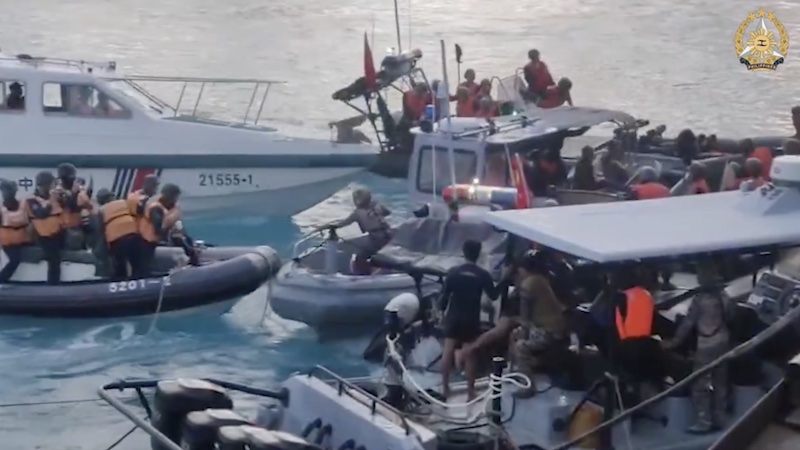
Manila and Beijing agreed to “de-escalate tensions” in the South China Sea following atense standofflast month at a disputed shoal, Philippine officials said Tuesday after both sides held bilateral talks on the waterway.
Foreign Affairs Undersecretary Ma. Theresa Lazaro met with Chinese Vice Foreign Minister Chen Xiaodong behind closed doors in Manila for the 9th Bilateral Consultation Mechanism on the South China Sea (BCM), the Philippine Department of Foreign Affairs said in a statement.
The two sides “had a frank and constructive discussion on the situation in the South China Sea,” the statement said, adding that both “affirmed their commitment to de-escalate tensions without prejudice to their respective positions.”
Lazaro, however, told Chen that Manila would remain “relentless in protecting its interests and upholding its sovereignty, sovereign rights and jurisdiction in the West Philippine Sea,” the statement said, using Manila’s name for South China Sea waters within the Philippines’ exclusive economic zone.
Both sides “affirmed their commitment to de-escalate tensions without prejudice to their respective positions,” the statement also said.
Lazaro and Chen, who headed their respective delegations at the talks in Makati, Manila’s financial district, committed to implementing a “maritime communication mechanism” between their countries’ coast guards and to form a joint committee to discusssuch incidents, according to the statement.
It gave no further details on this point, and the two senior diplomats did not hold a joint press conference after their meeting. Similar agreements in the past to set up a South China Sea “hotline” to quickly address bilateral problems as they arise have not been effective.
“There was substantial progress on developing measures to manage the situation at sea, but significant differences remain,” the statement said.
The talks in Manila followed adramatic standoffbetween Filipino servicemen and Chinese coast guard personnel at Second Thomas (Ayungin) Shoal on June 17, during which a Philippine navy sailor lost a finger.
Last week, Washington’s envoy to Manila, MaryKay Carlson, said that international support for the Philippines was growing in the wake of the incident at Ayungin.
U.S. President Joe Biden has stressed that the South China Sea should be “free and open” where local fishermen can ply their trade free from “coercion” from other countries, Carlson told the East-West Media Conference in Manila on June 26.
“With like-minded partners and all who support the rule of law, we urge [China] to cease harassment of Philippine vessels lawfully operating in the Philippine exclusive economic zones, to halt its disruption to states’ sovereign rights to explore, utilize, conserve, and manage natural resources in their territories and EEZs,” the American ambassador said.
Meanwhile on Tuesday, China reiterated its position that Manila’s resupply missions to a Philippine military outpost at the shoal violate its jurisdiction, despitethe reefbeing located within the Philippines’ exclusive economic zone.
“The root cause of the current situation is that the Philippines infringed on China’s rights and made deliberate provocations,” Mao Ning, the Chinese foreign ministry spokeswoman,saidduring a news conference.
“The Philippines needs to stop those infringement activities and provocations at once, and return as soon as possible to the track of resolving differences through dialogue and consultation.”
By Ken Bredemeier
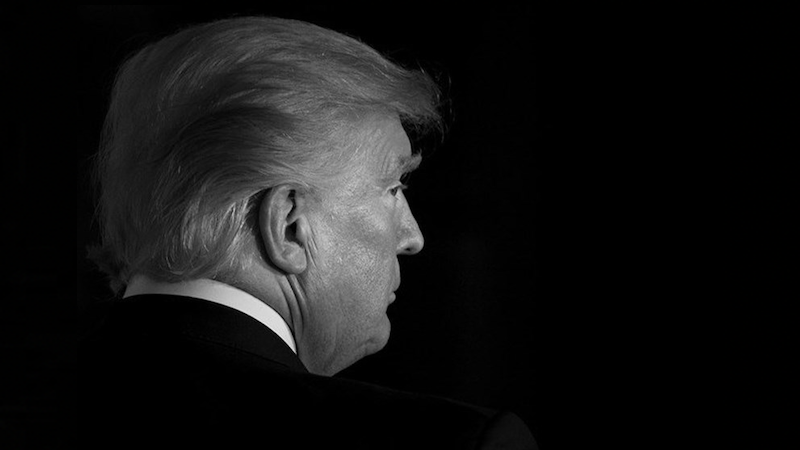
A New York judge on Tuesday delayed the sentencing of former President Donald Trump in his felony criminal case so that the judge can consider whether a new U.S. Supreme Court ruling might require him to overturn the conviction.
Judge Juan Merchan was to sentence Trump on July 11 for his conviction on 34 charges that he illegally tried to influence the outcome of his successful 2016 presidential campaign by falsifying business records to hide a $130,000 hush money payment to a porn star to silence her claim — denied by Trump — that they had a one-night tryst in 2006. Merchan has rescheduled the sentencing for September 18.
On Monday, the U.S. Supreme Court ruled that Trump could not be charged with offenses related to his official actions as president although he could face prosecution for unofficial acts. The high court ruling centered on Trump’s actions in late 2020 and early 2021, when he is alleged to have illegally tried to upend his 2020 reelection loss.
Almost the entirety of the testimony in the New York hush money case centered on Trump’s actions as he campaigned for the presidency in 2015 and 2016, before he won the election eight years ago, and in the ensuing weeks before he took office.
But one key scene recounted at the trial occurred later, when erstwhile Trump lawyer and political fixer Michael Cohen testified that he and Trump met at the White House in February 2017, shortly after Trump assumed the presidency.
Cohen said he and Trump discussed how Cohen would be reimbursed for the hush money he had paid porn actress Stormy Daniels to keep voters from learning about her alleged affair with Trump just ahead of the November 2016 voting. Cohen subsequently was paid back in monthly installments throughout 2017.
Trump’s lawyers claim that because of the White House meeting, Trump’s conviction should be overturned, in accordance with the new Supreme Court ruling.
“At the very least, we deserve a new trial,” Trump lawyer Will Scharf told CNN.
Prosecutor Joshua Steinglass told New York Supreme Court Justice Juan Merchan in a letter Tuesday that although prosecutors “believe the defendant’s arguments to be without merit,” they did not object to delaying the scheduled sentencing.
Trump’s lawyers asked to have until July 10 to file their request to overturn the verdict, while Steinglass asked that prosecutors have until July 24 to respond.

By Joseph Clark
Secretary of Defense Lloyd J. Austin III previewed a new military assistance package for Ukraine Tuesday as he met with Ukrainian Defense Minister Rustem Umerov at the Pentagon.
The package, valued at more than $2.3 billion, includes additional air defense interceptors and other critical munitions.
The air defense capabilities will be delivered to Ukraine’s front lines under an accelerated timeline enabled by the Pentagon’s recent announcement that it would resequence deliveries and some foreign military sales to other allies and partners to ensure Ukraine has what it needs at a critical point in the war.
“Ukraine is in a tough fight and has been ever since the start of [Russian President Vladimir] Putin’s reckless war of choice,” Austin said. “The Kremlin continues to intensify its bombardment of your cities and civilians. But I continue to be impressed by the skill of your forces, and your troops continue to fend off Russia’s attacks with grit, ingenuity and courage.”
The secretary underscored the United States’ resolve in assisting Ukraine in the face of these challenges.
“Make no mistake, Ukraine is not alone,” Austin said. “The United States will never waver, and our support alongside some 50 allies and partners will continue to provide the critical capabilities that Ukraine needs to push back Russian aggression today and to deter Russian aggression tomorrow.”
The two leaders met as NATO allies prepare for next week’s summit of member states in Washington.
Austin said the allies will take steps “to build a bridge for NATO membership for Ukraine” during the summit. The alliance marks its 75th anniversary this year.
The allies are also expected to formalize further steps to meet Ukraine’s long-term defense requirements.
NATO Secretary General Jens Stoltenberg said last month the group has agreed to a plan for how NATO will lead the coordination of future security assistance and training for Ukraine’s armed forces.
The effort will involve nearly 700 NATO personnel and partner countries, who will oversee training for the Ukrainian armed forces at facilities in allied countries. The alliance will also plan and coordinate security assistance for Ukraine, manage the transfer and repair of equipment, and support the long-term development of Ukraine’s armed forces.
“These efforts do not make NATO party to the conflict,” Stoltenberg said following a meeting of NATO defense ministers in Brussels in June. “But they will enhance our support to Ukraine to uphold its right to self-defense.”
Today’s meeting follows the signing of a 10-year bilateral security agreement by President Joe Biden and Ukrainian President Volodymyr Zelenskyy to address Ukraine’s security needs into the future.
Austin said that agreement, which was signed during the Group of Seven summit in Italy last month, further reflects the United States’ “strong and enduring support for Ukraine.”
“I look forward to discussing more ways to meet Ukraine’s immediate security needs and to build a future force to ward off more Russian aggression,” Austin said.

By David Vergun
The National Defense Strategy places a primary focus on the need to strengthen U.S. military deterrence against China and defeat it if necessary.
The Marine Corps implemented its “Force Design” strategy six years ago to address that challenge.
Commandant of the Marine Corps Gen. Eric Smith discussed the progress that has been made in force design and some of the challenges at an event at the Brookings Institution, a nonprofit policy and governance research group in Washington.
Threats from Beijing include its stated goal of seizing Taiwan, if necessary, as well as building military outposts on tiny islands in the South China Sea that do not belong to China.
The importance of allies and partners in the first island chain nearest to the Asian mainland are important to controlling the sea lanes in this contentious environment, he said. The first island chain includes Japan, the Philippines, Papua New Guinea and Australia.
Force design includes making Marines more mobile and less of a target, while increasing the range, precision and lethality of their weapons, Smith said.
For example, the Marine Corps got rid of all its tanks, which would not be useful in a war with China. Long-range fires — such as artillery, loitering munitions and rocket-assisted projectiles —along with unmanned aerial systems like the MQ-9A Reaper would play a big role in a conflict, he said. Radar and sensors would also be important.
The Marine Corps’ air capability is modernizing, as well, with the F-35B Lightning II fighter jet, the CH-53K King Stallion helicopter, and the MV-22 Osprey all performing well, he said.
As for amphibious ships to transport Marines and their equipment, a minimum of 31 are needed, he said. That’s the number needed to produce three, amphibious-ready groups for Marine expeditionary units: one on the East Coast of the U.S., one on the West Coast of the U.S. and one in Okinawa, Japan.
A lot of money can be saved in building these vessels on a multiship, multiyear procurement, he said. Shipbuilders need to be employed, or they will go elsewhere to work.
Another thing that needs to be increased is munitions production, Smith said. Again, workers need to stay employed, or they’ll find jobs elsewhere.
Joint All-Domain Command and Control development is also important for connecting sensors with shooters and shooters with each other, he said.
Advances in autonomy and machine learning will also play an increasingly important role in force design.