Categories
Audio Review - South Caucasus News

Reality Is Not A Social Construct – OpEd


Reality Is Not A Social Construct – OpEd

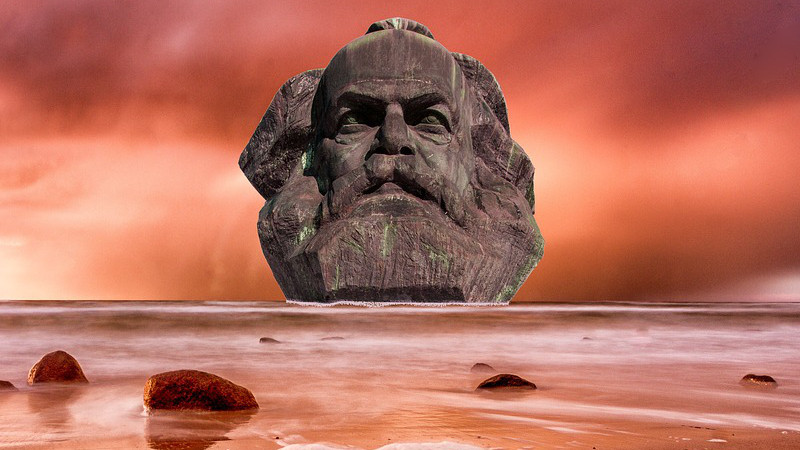
Karl Marx Sea Fantasy Composing Beach Landscape

By Wanjiru Njoya

Human behavior is, to a large extent, socially constructed. People often act based on social norms, expectations, or habits rather than by attempting to ascertain the nature of reality itself. In that context, it is true to say that people’s perceptions of reality are socially constructed, as;explained;by the Thomas theorem:

Another way of looking at this concept is through W.I. Thomas’s notable Thomas theorem which states, “If men define situations as real, they are real in their consequences” (Thomas and Thomas 1928). That is, people’s behavior can be determined by their subjective construction of reality rather than by objective reality.

In “Praxeology: The Methodology of Austrian Economics,” Murray Rothbard defines praxeology as “the logical implications of the universal formal fact that people act, that they employ means to try to attain chosen ends.” People attempt to make decisions based on their best evaluation of the reality of the situation. If we have a good grasp of that reality, our decisions are likely to lead toward our goals; a weak grasp of reality is likely to yield disastrous decisions. Rothbard observes that “all that praxeology asserts is that the individual actor adopts goals and believes,;whether erroneously or correctly, that he can arrive at them by the employment of certain means” (emphasis added). Our perception of reality may be erroneous or correct. When we fall into error, we do our best to review and correct our perception of reality in order to make better decisions in the future. This commonsense principle is reflected in the popular slogan;FAFO: “FAFO is an acronym for ‘eff around and find out.’ It’s a cheeky way to tell people that if they play with fire, they might get burned—or to announce that they already have been.”

The commonsense view that our decisions are influenced by cultural and social norms is often overstated to convey the mistaken idea that there is no such thing as objective reality: reality itself is a social construct that depends on how you perceive or define it. This partly reflects a form of recklessness—abandoning the effort to investigate or distinguish true from false—sometimes because inquiry is deemed too costly and sometimes from a desire to avoid interpersonal or intergroup conflict by proclaiming that everyone is correct. It suits the egalitarian ethos of our time to declare that everyone has the right answer. I have “my truth,” and you have yours. In;mathematics, teachers have been urged to be inclusive by teaching pupils that there are no right or wrong answers.

White supremacy culture shows up in math classrooms when the focus is on getting the “right” answer. . . . The concept of mathematics being purely objective is unequivocally false, and teaching it is even much less so. Upholding the idea that there are always right and wrong answers perpetuates objectivity as well as fear of open conflict.

If everyone has different subjective perceptions of reality and it is not clear whose perceptions are correct and whose are erroneous, it often seems easiest to aver that nobody is right or wrong. If all “realities” are personally and socially constructed, then each person gets to choose his own reality, and everyone is a winner. Thus, we must accept that if anyone says he is a woman because he feels like a woman, then that is his reality. He really;is;a woman.

This idea that reality is a social construct prevails in public discourse and all fields of academic inquiry. Further, the fact that subjective perceptions of reality are influenced by factors such as a person’s intelligence, culture, and life experiences leads many to the mistaken conclusion that there is nothing self-evident in the world. Everything is up for debate, and the best we can do is to describe our personal “lived experiences.”

Hence comes the nostrum “do not believe your lying eyes”—after all, I may claim to see something different from what you see, and therefore, you should not believe anything exists just because you see it right there in front of you. Perceptions could be mistaken; therefore, nobody knows what is real. It would take decades of empirical peer-reviewed academic study to discover what is real.

For example, for all you know, you might not be a man but just a butterfly dreaming that you are a man. What proof do you have that you are not a butterfly? What credentials qualify you to distinguish between a;man and a butterfly?

A story tells that Zhuang Zhou once dreamed he was a butterfly, flitting and fluttering around, happy, and doing as he pleased. As a butterfly, he did not know he was Zhuang Zhou. All of a sudden, he awoke and found he was Zhuang Zhou, solid and unmistakably human. But then he did not know whether he was Zhuang Zhou dreaming he was a butterfly or a butterfly dreaming he was Zhuang Zhou.

Ultimately, Zhuang Zhou must accept the evidence of his own eyes as it is not possible for a sane person persistently to lie to himself. As Rothbard observes:

Of course, a person may say that he denies the existence of self-evident principles or other established truths of the real world, but this mere saying has no epistemological validity. As Toohey pointed out, “A man may say anything he pleases, but he cannot;think;or;do;anything he pleases. He may say he saw a round square, but he cannot;think;he saw a round square. He may say, if he likes, that he saw a horse riding astride its own back, but we shall know what to think of him if he says it.”

Those who are currently embarked upon empirical studies to prove the existence of the ninety-nine different sexes and genders have already mapped out the;spectrum:

The sex designation of your brain and body may not be as black and white as scientists have believed it to be. Instead gender may fall somewhere on a gray scale. Scientists are trying to unravel the complex biological breakdowns of gender, and as they learn more, it’s becoming more apparent there aren’t just men and women among us.

A scientific analysis of what is a woman titled “White matter microstructure in female to male transsexuals before cross-sex hormonal treatment. A diffusion tensor imaging study” informs us that “the white matter microstructure pattern in untreated FtM [female to male] transsexuals is closer to the pattern of subjects who share their gender identity (males) than those who share their biological sex (females). Our results provide evidence for an inherent difference in the brain structure of FtM transsexuals.”

This explains why Justice Ketanji Jackson, when asked “What is a woman?” replied that she is not a biologist and thus could not answer the question. If a justice of the Supreme Court publicly asserts that she does not know what a woman is, the implication is that this is a question best left to the credentialed experts.

The aim of “reality is a social construct” ideologues is to persuade ordinary people that they cannot know or understand reality without immersing themselves in top-level academic study that, conveniently, is currently under the tight control of socialists. For example, you cannot know or understand the meaning of justice until you have devoted years to studying the work of the expert on justice, John Rawls. When Rawls’s;A Theory of Justice;was published, Ayn Rand observed:

Let me say that I have not read and do not intend to read that book. .;.;. Is;A Theory of Justice;likely to be widely read? No. Is it likely to be influential? Yes—precisely for that reason. .;.;. if you want to propagate an outrageously evil idea (based on traditionally accepted doctrines), your conclusion must be brazenly clear, but your proof unintelligible. Your proof must be so tangled a mess that it will paralyze a reader’s critical faculty—a mess of evasions, equivocations, obfuscations, circumlocutions, non sequiturs, endless sentences leading nowhere, irrelevant side issues, clauses, sub-clauses and sub-sub-clauses, a meticulously lengthy proving of the obvious, and big chunks of the arbitrary thrown in as self-evident, erudite references to sciences, to pseudo-sciences, to the never-to-be-sciences, to the untraceable and the approval—all of it resting on a zero: the absence of definitions.

The same may be said of many great works that are treated as the unofficial mark of credibility for anyone who wants to comment on current affairs or political events. You must study John Maynard Keynes to discover whether there is inflation and, if so, whether inflation is good for you—do not just believe your lying wallet. You must study all eight volumes of the United Nations Educational, Scientific, and Cultural Organization’s;General History of Africa;before you can comment on whether socialism will work in Africa and study Karl Marx’s;Das Kapital;to form an opinion on whether communism will work in Africa if it is “done properly.”

While the complexity of science is self-evident, and acquiring a comprehensive understanding of any discipline requires many years of study, it does not follow that human beings cannot know or understand reality until a credentialed expert informs them of the “correct” view of the facts. Moreover, as David Gordon illustrates in his;essay;“Butler, Butt Out,” expert theorists who deny the existence of objective principles often lead their readers up the garden path:

It is often quite difficult to understand what she is saying. Here is a sample passage, by no means the most obscure in the book: “A phantasmatic sliding—what [Jacques] Lacan calls;glissement—happens amid the kinds of arguments considered above. Are they even arguments? Or must we see the way that the syntax of the phantasm orders, and derails, the sequence of an argument?”

Faced with prose of this kind, the familiar words of Juvenal come to mind:;Difficile est satiram non scribere.

  • About the author: Dr. Wanjiru Njoya is a Scholar-in-Residence for the Mises Institute. She is the author of Economic Freedom and Social Justice (Palgrave Macmillan, 2021), Redressing Historical Injustice (Palgrave Macmillan, 2023, with David Gordon) and “A Critique of Equality Legislation in Liberal Market Economies” (Journal of Libertarian Studies, 2021).
  • Source: This article was published by the Mises Institute

Categories
Audio Review - South Caucasus News

After Dagestani Attacks, Moscow Seen Increasing Repression Of Muslim Dissidents – OpEd


After Dagestani Attacks, Moscow Seen Increasing Repression Of Muslim Dissidents – OpEd

Scene of terrorist attack in Daghestan. Photo Credit: Tasnim News Agency

The terrorist attacks in Dagestan, the result of the lack of consolidation among the peoples of Russia and a clear failure by Moscow’s security services, will further “marginalize and endanger Russia’s Muslims, leading to expanded repression of Muslim dissidents, Leyla Latypova says.

And what is especially worrisome, the Moscow Times journalist who writes a new weekly column for that paper on ethnic and regional issues and who is herself a Muslim, many Russian liberals will not stand up for these new victims of Kremlin repression (themoscowtimes.com/2024/06/25/attacks-in-dagestan-will-marginalize-and-endanger-russias-muslims-further-a85511).

Contrary to Kremlin claims, the attacks in Derbent and Makhachkala happened precisely because of “the lack of consolidation among the Russian populace.” Many seem oblivious to the fact that “opposition to the war in Ukraine is not the only source of deep divisions among Russian nationals.” They differ in their assessment of many things including history.

“For some in Russia,” Latypova continues, “Muslims and ethnic minorities are becoming useful scapegoats for channeling frustration and anger fueled by the war in Ukraine, bearing collective responsibility for tragedies that should rather be blamed on the ineffectiveness of the Russian government.”

 Latypova continues: “As an Indigenous Muslim woman, I look at this trend with great worry; but what concerns me most is knowing that Sunday’s attacks will give the Kremlin and Russia’s security services even more freedom to repress Muslim dissidents” and that this expanding form of repression will not be condemned by Russians, “even the most liberal ones.”


Categories
Audio Review - South Caucasus News

Navigating The Terror Threat: Russia And India In Afghanistan – Analysis


Navigating The Terror Threat: Russia And India In Afghanistan – Analysis

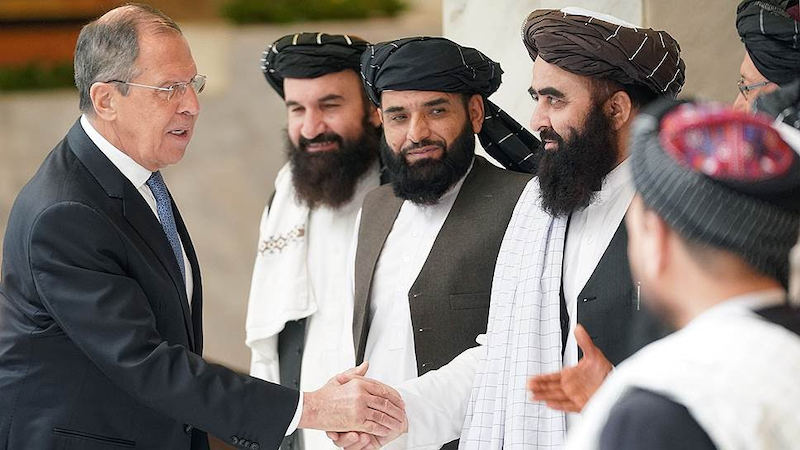
File photo of Russia's Foreign Minister Sergey Lavrov meeting with Afghanistan's Taliban Leaders. Photo Credit: Russia's Ministry of Foreign Affairs

By Shivam Shekhawat and Rajoli Siddharth Jayaprakash

Since the terror attack at the Crocus city centre in Moscow, allegedly by the Islamic State of Khorasan Province (ISKP), in March 2024, Moscow has intensified efforts to prevent Afghanistan’s resurgence as a terror haven. One way of doing this, as Russian actions suggest is greater engagement with the Taliban.

Recently, the Russian Ministry of Foreign Affairs and the Ministry of Justice sent a proposal to President Vladimir Putin to remove the group from the list of terror organisations where it has been listed since 2003. Given that India and Russia cooperate on terrorism emanating from Afghanistan, it is important to understand the new developments in Afghanistan and India-Russia cooperation on counterterrorism. 

Securing their interests

Russia’s decision to remove the Taliban from its terror list, while not sudden, is viewed as a ‘limited risk’ scenario. While falling short of recognition, with the group still under the UN Security Council sanctions, Moscow’s decision aims to gain leverage with the Taliban-run Islamic Emirate. Since the fall of Kabul, Russia has engaged with the Taliban—its diplomats stayed back and its embassy remained open.

Moscow also accredited a Taliban-appointed diplomat in August 2022 and accepted a military attaché in February this year. It invited the group for the Moscow Format consultations in 2021 and 2022 and the St Petersburg International Economic Forum twice, in 2022 and 2024. The country’s special envoy recently also hinted at Kabul’s possible inclusion in the Shanghai Cooperation Organisation (SCO), subject to its recognition.  

In its 2023 Concept of Foreign Policy, Russia articulated its long-term aim to;integrate;Afghanistan into the Eurasian;space;for cooperation. There is, thus, also a strong geoeconomic factor behind Moscow’s overtures to the Taliban and the group’s removal from the terror list is expected to facilitate bilateral economic ties. Projects like the Uzbekistan-Afghanistan-Pakistan railroad and the Afghan sector of the Turkmenistan-Afghanistan-Pakistan-India gas can promote economic activity in Afghanistan, lead to improved regional connectivity, and enhance border infrastructure to check terrorist infiltration. For Moscow, a stable Afghanistan is seen as a firewall to prevent the spread of terrorism to Central Asia, and eventually into Russia.

India has a technical team stationed at its embassy in Kabul since June 2022. New Delhi’s engagement with the group has also increased, with Indian officials meeting IEA’s Acting FM in March 2024 to discuss the provision of aid and the use of Chabahar by Afghan traders. The Afghanistan Chamber of Commerce and Investment also held an online meeting with the Indian ports Global Limited to discuss the;port’s use by traders;from the country. Taliban-appointed diplomats have not been formally accredited by India although, the Afghan Republic-era Ambassador and the consul general of Mumbai have resigned.;

While highlighting the need for the Taliban to uphold women and minorities’ rights and establish an inclusive government, India has asserted that Afghanistan shouldn’t be used as a haven for terrorist groups, placing the onus to counter the threat on the Taliban.; It sees both—anti-India terror groups like the Lashkar-e-Taiba (LeT) and Jaish-e-Mohammad (JeM) and transnational groups—as a major threat to its security and strategic interests. For India, fears about the presence of LeT and JeM in Afghanistan and their ability to destabilise Jammu and Kashmir have been a preeminent concern. The 13th;report of the Analytical Support and Sanctions Monitoring Team mentioned that the JeM maintains training camps in Afghanistan, with some of them under the direct control of the Taliban and that the LeT provided finance and training support to the Taliban’s operations. For New Delhi, stability in Afghanistan is also important for its outreach to the Central Asian Republics.;

A Haven for terrorism?

The past two and a half years of the Islamic Emirate’s rule in Afghanistan have revealed the failure of the commitments made in the Doha agreement to prevent the use of Afghanistan as a haven and a springboard for coordinating transnational terror attacks. The UN Analytical Support and Sanctions Monitoring Team’s January 2024 report highlighted the close relationship between Al Qaeda and the Taliban.

Al Qaeda also called on the group’s supporters from all over the world to migrate to Afghanistan and emulate the practices of the Taliban to launch a collective struggle against the ‘Western’ and the ‘Zionist’ forces. The group now has a presence in 10 of the 34 provinces and has opened new training camps, madrasas and safe houses in the country. While the Taliban enjoys a cordial relationship with some groups, including Al Qaeda, the increase in the strength of groups like the ISKP poses a significant challenge to their hold on power as well as to the overall security of the region. 

Thus, many in the international community see establishing some sort of engagement with the Taliban as necessary to counter this threat. Moscow’s proposal to remove the Taliban from the proscribed list is also seen as an incremental step to have more space to manoeuvre. But whether the Taliban is capable and willing to effectively establish control over these terror groups is still anybody’s guess. The ISKP is putting a renewed emphasis on South and Central Asia, expanding its outreach to these regions. The group has criticised the;Taliban’s engagement with India with;some instances of both the ISKP and Al Qaeda commenting on the internal developments in New Delhi.;

India’s cooperation with Russia is seen as providing New Delhi a;gateway;to engage with the Taliban. India’s meetings with some members of the Emirate last year are seen to be fructifying because of Russian assistance. Last month, Zamir Kabulov, Russia’s Special Envoy to Afghanistan, visited India at New Delhi’s invitation. The timing of the visit—in the aftermath of the attack in Moscow—indicated both Moscow and India’s shared concerns about the terror threat.;

In the aftermath of the US withdrawal from Afghanistan, the trifecta of Iran, Russia, and China stepped up their engagement in the country, united with the mutual aim of keeping the US out of the region. Even though the US publicly refrains from seeing Afghanistan as a platform for strategic competition with Russia, the latter views it that way. Last month, Moscow and Beijing reaffirmed their resolve to prevent any attempts by the US or NATO to set up military infrastructure in the country and committed to increase cooperation in Afghanistan.

As discussed above, both India and Russia share common concerns in the country which provides them space to work together through both bilateral and multilateral channels. Experts deem the importance of the SCO- Regional Anti-Terrorist Structure (SCO-RATS) framework—to counter the terror threat in Afghanistan, by allowing for the sharing of information about certain groups and individuals inimical to the member countries’ interests, tackling drug smuggling, conducting joint anti-terrorist exercises, etc.—as an important means to enhance cooperation. 

However, while India engages in a few initiatives led by Russia and is a member of the SCO, Russia, China, Iran, and Pakistan engage through groupings which exclude India. Their engagement with the group is also distinct from that of New Delhi, which is relatively more cognisant of balancing its commitment towards the interests of the Afghan people with its own strategic interests. Despite these differences, New Delhi must work with Russia to have a stake in how the security situation develops in the country.;

Taliban’s counter-insurgency role

The Taliban has refrained from acknowledging the full extent of the threat from the ISKP, with its senior leaders;downplaying;it in public meetings and denying any need for external;support. As per the UN, the Taliban’s priority is majorly managing the internal threat the ISKP poses to their power rather than looking at the group’s external actions. The Taliban increased its counter-insurgency efforts in February last year but the reduction in the number of attacks by the ISKP was not because of the effectiveness of the Taliban’s counter-terror capabilities but probably because of the ISKP’s own strategy shift.;

Meanwhile, the Taliban has also failed to address China’s concerns about the presence of the Turkestan Islamic Party (also called the ETIM) on its border or the TTP’s unceasing attacks in Pakistan. While in the initial months, Russia did appreciate the Taliban’s efforts at countering the ISKP it has highlighted that the group will have to do more. There were reports about the perpetrators of the attack in Iran and Türkiye receiving their training in Afghanistan. The close links between the Haqqani network and the ISKP are seen as one of the reasons why the group has failed to counter ISKP’s growth.;

Conclusion

Taliban’s reluctance or inability to deal with Afghan-based terror outfits for public posturing has now led to the international community increasing its engagement to pre-empt the instability that could arise in a situation where the Emirate is unable to manage the different groups. But greater engagement risks granting legitimacy to the group, even as there is no surety of any tangible counter-terrorism measures taken by Kabul and any movement towards implementation of promises of broad basing governance and women’s rights and freedom.;

So far, China, Russia, Iran, Türkiye and others have been attempting to fill the vacuum caused by the sudden and chaotic withdrawal of the US from Afghanistan in 2021. For India, while certain differences with Russia on the degree of engagement with the group and the latter’s growing bonhomie with China will persist, it will continue to maintain the momentum of its cooperation, to keep its foot in the game, as the two share mutual concerns security-related and economic stability concerns in the country.;


About the authors:

  • Shivam Shekhawat is a Junior Fellow at the Observer Research Foundation.
  • Rajoli Siddharth Jayaprakash is a Research Assistant at the Observer Research Foundation.

Source: This article was published by the Observer Research Foundation.


Categories
Audio Review - South Caucasus News

China’s Economic Conundrum Under Xi Jinping – Analysis


China’s Economic Conundrum Under Xi Jinping – Analysis

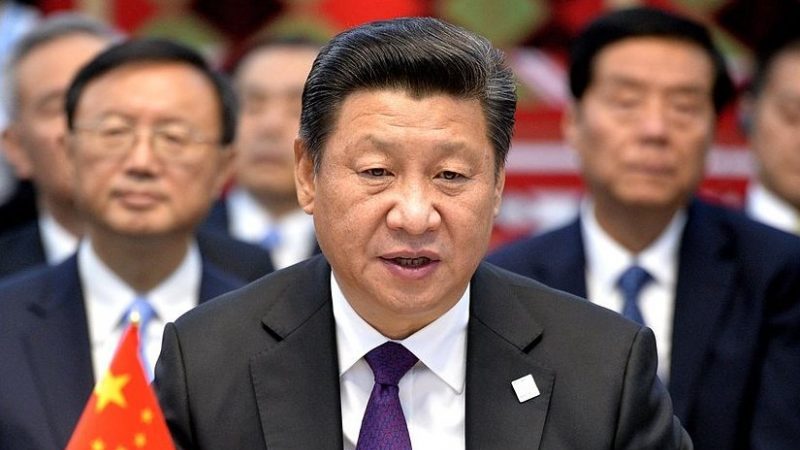
China's Xi Jinping. Photo Credit: Kremlin.ru, Wikipedia Commons.

By Seong-hyon Lee

China’s economic predicament is rooted in a struggling real estate sector and a strategy predicated on a shift towards high-tech industries. President Xi Jinping’s prioritisation of national security and scepticism of market forces is exacerbating the problem and leading to tensions between political will and economic imperatives.

China’s troubled real estate sector once accounted for an impressive;30 per cent;of national GDP. Its;peak in 2018;gave way to a sharp downturn — which, further aggravated by the COVID-19 pandemic, today functions at approximately;half of its former capacity.;This decline has left a big mark on China’s economic fabric, with property sales;plummeting by 20.5 per cent;in the first two months of 2024.

Historically, real estate was not just a financial powerhouse but also a catalyst for ancillary sectors, driving employment in construction, stimulating retail development and boosting banking through loans. This relationship fostered a dynamic cycle of economic expansion.

But as China transitions towards a middle class society, Xi’s administration is steering away from this growth model. The government’s ‘Three Red Lines’ policy — designed to mitigate substantial risks among the many property developers with mounting debt — was a lukewarm response that led to reduced residential investment. The policy indicates Xi’s pivot towards more technologically advanced industries,;such as AI, big data, bioengineering, semiconductors and quantum computing.

This shift fits into a broader agenda to reposition the Chinese economy towards high-tech industries, mirroring global economic trends that favour scientific innovation and smart technology. Most importantly, it aims to secure a win in the US–China rivalry.

Xi’s;prioritisation of national security;over economic flexibility complicates this transition. His deep-seated scepticism of market forces, shaped by the experience of;corruption and ideological deviations;during former president Hu Jintao’s administration, continues to influence economic policy. His cautious approach has placed increased scrutiny and;limitations on major tech firms, reflecting a strategy of;economic statecraft;that favours firm state control over market-driven growth.

The government’s;preference for bolstering state-owned enterprises;at the expense of the private sector — which has been a cradle of innovation and economic vitality — is a decisive political stance. But bureaucratic state-owned enterprises cannot yield the same successes as a thriving entrepreneurial sector when it comes to innovating in cutting-edge technology. Xi’s approach dampens entrepreneurial spirit and curbs the private sector’s capacity to innovate and compete globally. Already there has been a noticeable shift in career aspirations among the young, who now;gravitate towards government jobs;in search of stability rather than pursuing entrepreneurship.

Despite;5.3 per cent GDP growth;in the first quarter of 2024, the International Monetary Fund suggests that China’s economic rebound could take several years and become;a medium-term slowdown. The;once robust manufacturing sector;— though showing signs of revival — cannot fully offset the substantial downturn in real estate. While China excels in producing solar panels, wind energy and electric vehicles, its success is drawing unwanted attention from Western competition policy analysts and attracting import restrictions. Consequently, China risks developing manufacturing bottlenecks.

Meanwhile, consumer confidence;remains subdued. Retail sales growth slowed to;2.3 per centyear-on-year in April 2024, a drop from 3.1 per cent in March. This deceleration in consumer spending underscores the economic uncertainties and the persistent negative wealth effects stemming from the real estate market downturn.

The government faces a dilemma. It must reignite growth without reverting to outdated methods that won’t solve the nation’s problems today. Yet Xi is so determined to keep political control that he is stifling entrepreneurship. Hence, the challenge lies not only in supporting Xi’s new economic prescription — ‘new productive forces’ — which is independent of the real estate sector but also in implementing it swiftly enough to yield results. This is crucial to ensure a V-shaped recovery and prevent a recession.

This scenario is a significant test for Xi’s ideological framework, which champions a Marxist-socialist model over Western capitalist paradigms. Xi’s push for ‘common prosperity’ seeks to alleviate income inequalities aggravated by decades of disparate economic growth. Former Chinese leader Deng Xiaoping permitted this disparity to optimise economic reform and opening-up. Xi’s focus on income equality and regional equity marks a pivotal shift back to state-led initiatives.

Some analysts in;both China;and;the United States;argue that China’s economic situation is not as dire as is sometimes suggested. But while the Chinese government announced several measures to stabilise the property sector in May 2024, the lack of precedents for China’s stance raises doubts about its feasibility under current policy strategies. For Xi, implementing these policies will require a balance of political fortitude and economic acumen that is historically rare.

The intertwining of governance, ideology and market dynamics under Xi presents a landscape where political decisions profoundly influence economic outcomes. The challenge lies in executing a balanced strategy that fosters economic vitality while adhering to ideological commitments.

China, renowned for its economic resilience, faces a narrowing window of opportunity to recover from its significant economic setbacks. China must regain momentum before it misses its opportunity for economic rejuvenation.

  • About the author: Dr Seong-Hyon Lee is Visiting Scholar at the Harvard University Asia Center and Senior Fellow at the George H. W. Bush Foundation for U.S.–China Relations.
  • Source: This article was published by East Asia Forum

Categories
(@mikenov) / Twitter

@SvobodaRadio: RT by @mikenov: Руслан Сулейманов: По совокупности причин “Исламское государство” стремится предъявить счет Москве. А у Вилаят Хорасан как филиала “ИГИЛ” есть немало претензий к России прежде всего за то, что она сотрудничает с талибами, это для них злейшие враги. smarturl.click/B6Xyw


Categories
(@mikenov) / Twitter

@SvobodaRadio: RT by @mikenov: Руслан Сулейманов: По совокупности причин “Исламское государство” стремится предъявить счет Москве. А у Вилаят Хорасан как филиала “ИГИЛ” есть немало претензий к России прежде всего за то, что она сотрудничает с талибами, это для них злейшие враги. smarturl.click/B6Xyw


Categories
South Caucasus News

Как в Грузии обучают активных граждан быть наблюдателями на выборах 2024 года


«Всех, кто хочет внести вклад в аполитичное, беспристрастное наблюдение за выборами, приглашаем принять участие в бесплатных обучающих курсах», — примерно так начинается объявление о наборе в команду для контроля над выборами 2024 года. Именно в октябре в Грузии пройдут выборы, на которых у общества появится окно возможностей для смены существующего режима под руководством миллиардера Бидзины […]

Categories
Audio Review - South Caucasus News

@mikenov: x.com/haaretzcom/sta… Send them to police Gaza! Disband the ugly, pseudo-religious, Nazi, fascist, demented sect of the so called Orthodox Judaism, including all its “ultras”. Those Polish peasants, recruited by Abwehr have nothing to do with the ancient Hebrews and their…


https://t.co/owgV7VJBtp
Send them to police Gaza!
Disband the ugly, pseudo-religious, Nazi, fascist, demented sect of the so called Orthodox Judaism, including all its “ultras”.
Those Polish peasants, recruited by Abwehr have nothing to do with the ancient Hebrews and their… https://t.co/XukEHBklPS pic.twitter.com/OQwiMn6cEq

— Michael Novakhov (@mikenov) June 30, 2024


Categories
Audio Review - South Caucasus News

@mikenov: x.com/mikenov/status… Disband the “Orthodox” idiots, money changers, hypocrites, and liars! #NewsAndTimes #Times #World #USA #POTUS #DOJ #FBI #CIA #DIA #ODNI #Israel #Mossad #Netanyahu #Ukraine #NewAbwehr #OSINT #Putin #Russia #GRU #Путин, #Россия #SouthCaucasus #Bloggers…


https://t.co/Jd72CUnK5e
Disband the “Orthodox” idiots, money changers, hypocrites, and liars!#NewsAndTimes #Times #World #USA #POTUS #DOJ #FBI #CIA #DIA #ODNI#Israel #Mossad #Netanyahu#Ukraine #NewAbwehr #OSINT#Putin #Russia #GRU #Путин, #Россия #SouthCaucasus #Bloggershttps://t.co/3o4HBmVjQo

— Michael Novakhov (@mikenov) June 30, 2024


Categories
Audio Review - South Caucasus News

@haaretzcom: RT by @mikenov: Ultra-Orthodox take to Israel’s streets, clash with police over conscription to military haaretz.com/israel-news/20…


Ultra-Orthodox take to Israel’s streets, clash with police over conscription to militaryhttps://t.co/pzPaVBsfTp

— Haaretz.com (@haaretzcom) June 30, 2024