
Categories
South Caucasus News

India-Iran Makeover Dovetails Into Iran’s Ties With Russia – OpEd


India-Iran Makeover Dovetails Into Iran’s Ties With Russia – OpEd

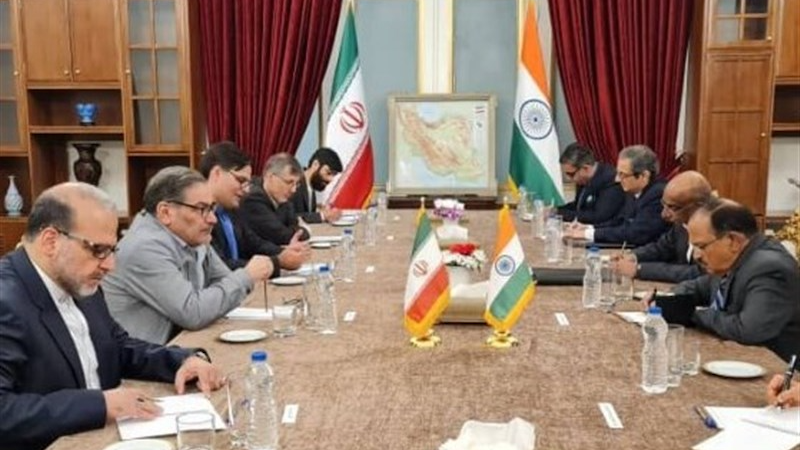
Officials from Iran and India meet. Photo Credit: Tasnim News Agency

There is enormous appreciation among Iranian intellectuals, diplomats and politicians regarding Prime Minister Narendra Modi’s stellar support for their country’s membership of the BRICS grouping. Modi;played a key role;to navigate Iran’s membership purposively at the BRICS Summit in Johannesburg last August.

The Russian President Vladimir Putin couldn’t be present at Johannesburg. But Prime Minister Narendra Modi attended the summit in person, rubbishing the malicious rumours and canards to the contrary orchestrated by the western media. The Anglo-Saxon game plan was ;to somehow get Iran’s membership question deferred to an indefinite future. ;;

The defining moment was a;phone call;from the Iranian President late Ibrahim Raisi to Modi in the week before the summit meeting. However, the ground for the last-minute flurry of diplomatic activity was prepared in the preceding weeks by the National Security Advisor Ajit Doval when he attended the meeting of BRICS national security advisors in Johannesburg in late July, just weeks prior to the summit to review security and economic cooperation.

Doval held;separate “working meetings”;with his Russian and Iranian counterparts — Nikolai Patrushev and;;Ali-Akbar Ahmadian respectively.;The NSAs discussed Iran’s BRICS membership issue as a core vector of the Johannesburg summit.

Ahmadian and Doval’s talking points covered the whole spectrum of Iran-India relations ;and an ambitious agenda to deepen the ties across the board in fields ranging from transportation, energy and banking to counter-terrorism.;

The two NSAs agreed that the Chabahar Port project, which is the anchor sheet of Modi’s hugely ambitious vision for India’s regional policies,;stands to gain from Iran’s BRICS membership, even as the Moscow-led International North-South Transportation Corridor is steadily coming into operation.;

Tehran visualises that in the downstream of Chabahar Port, Indian trade and industry can and should enter the hinterland in a big way via trade, investments and project exports. The Iranian side feels that Chabahar has the potential to elevate India’s partnership with Iran to an altogether higher strategic level.;;

Significantly, the makeover in India-Iran ties also dovetails into a paradigm shift under way in the two countries’ respective relations with Russia. Iran and Russia;signed a memorandum;this week in Tehran to turn Iran into “a regional gas hub.” Gazprom CEO Alexey Miller personally attended the signing ceremony, testifying to the highest importance the Kremlin attaches to the futuristic project.;

The Russian intention is to enter the Iranian market in the northern Caspian region through Soviet era pipelines from the Caucasus and Central Asia and to participate in the development of the Iranian gas industry, the construction of gas pipelines, LNG projects and mining projects. Gazprom is interested in organising swap supplies to third countries and a number of LNG projects in the south of Iran are being considered, according to a;report in Kommersant newspaper, for tapping the South Asian market.;

Now, the big picture is not complete without factoring in that Moscow and Tehran are also in the cusp of a historic transformative breakthrough in their relationship with the;Russia-Iran comprehensive cooperation treaty;that has been under negotiation since 2022 ready for signature no sooner than the new government in Tehran settles down. Setting aside protocol, Putin had a;telephone conversation on Wednesday with Iran’s Acting President Mohammad Mokhber — their second such conversation in the past fortnight. (here;and;here)

At any rate, Doval at his meeting with his Iranian counterpart at Johannesburg assured him that Iran’s accession to BRICS;would expand the grouping’s economic and political capacities. Doval was quoted as saying that New Delhi would use “every means and opportunity at its disposal to facilitate Iran’s accession” to the BRICS grouping.;

The Indian readout of the;phone conversation;between Modi and Raisi just four days before the Johannesburg summit highlighted that “The two leaders reiterated their commitment to further strengthen bilateral cooperation including to realise the full potential of Chabahar Port as a connectivity hub. The two leaders also discussed cooperation at multilateral forums including expansion of BRICS and looked forward to their meeting on the margins of forthcoming BRICS summit in South Africa.”

How far these positive impulses will be carried forward at Modi’s one-on-one discussions with Putin during his forthcoming two-day visit to Moscow on July 8 remains to be seen. Russia and Iran together own more than 60 percent of global gas reserves, and the expectation in Tehran is that the two countries’ energy deal in the making will facilitate the formation of “an energy balance in the region” — as Iran’s Oil Minister Javad Owji put it. Without doubt, Russia and Iran can be the most reliable suppliers of natural gas for the Indian market over the next several decades and strengthen India’s energy security through this century.

A holistic picture will be incomplete without casting an eye on the upcoming BRICS Summit as well. After all, Russia and Iran are under US sanctions. The crux of the matter is that the BRICS Summit in October in Kazan under Putin’s chairmanship will be focused on the creation of a new payment system for the member countries. Different variants are under consideration — the use of stablecoins (cryptocurrency tokens pegged to assets like gold), a platform to link the central banks’ digital currency systems, and the integration of national systems for financial messaging.;

At a;media briefing in Moscow;on Thursday, Deputy Foreign Minister Sergey Ryabkov said BRICS countries are “actively and evenly pursuing initiatives” in all the 3 above-mentioned areas.;;Ryabkov said the political momentum is “crucial here,” and added, “Perhaps there won’t be any decisions (at the Kazan summit) that completely revolutionise everything, and that may not be necessary in such a sensitive area where gradual progress is often best. However, there will be tangible outcomes and I’m pleased that all member states, including those who recently joined on January 1 share our common understanding and vision of the steps needed to move forward.”;

Modi had built a good rapport with Raisi who was due to visit India later this year. The importance of picking up the threads with Raisi’s successor cannot but be stressed. Perhaps, an early visit by Doval to Tehran is timely.;

By the way, Afghan situation is also causing concern to Iran and Russia as there are growing signs of a consolidation of Islamic State-Khorasan in the northern regions of Afghanistan with the active support of the CIA. In response, Moscow intends to remove the Taliban from its list of terrorist organisations and strengthen cooperation in counter-terrorism with the authorities in Kabul.; ; ;

Categories
South Caucasus News

Ukraine Military Situation: Russian Forces Maintain Offensive Combat Operations Along Multiple Fronts – Analysis


Ukraine Military Situation: Russian Forces Maintain Offensive Combat Operations Along Multiple Fronts – Analysis

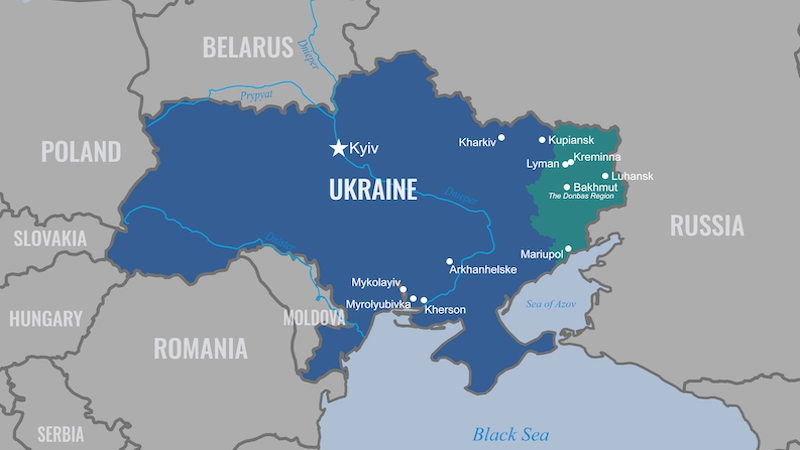
Map of Ukraine. Credit: DOD

By Can Kasapoğlui

1.;Battlefield Assessment

Russian forces maintained offensive combat operations along multiple axes. In eastern and northeastern Ukraine, Russian units assaulted areas near Bakhmut and in the outer rings of Kharkiv, and;secured;marginal advances in ground attacks around Chasiv Yar and Avdiivka. In southern Ukraine, the Kremlin’s forces scaled up offensive action around;Kamianske;in Zaporizhzhia Oblast.

Fierce battles raged on the Kharkiv axis, particularly near Vovchansk.;Moscow continued to send;inadequately equipped troops to their death in large numbers in northeastern Ukraine, where the Ukrainian Armed Forces are enveloping and isolating the invading servicemen. Several sources confirm that Ukrainian units;trapped;and captured hundreds of Russian soldiers attempting a river crossing near the PJSC Volchansky Chemical Plant.

Moscow has increased its use of glide bombs to advance its multifront push. This tactic has allowed Russian forces to conduct more expansive ground operations and accelerate the destruction and depopulation of critical;urban combat zones, a long-standing Kremlin strategy since its wars in Chechnya in the 1990s. Last week Moscow targeted a three-story building in Kharkiv with;a FAB-3000;glide bomb from a Sukhoi-34 fighter-bomber, the first documented employment of the munition in Ukraine. This giant weapon, which;weighs over;three tons, lacks the aerodynamics and precision of smaller smart munitions but has a massive kill radius that makes it a formidable asset.

Last, the Ukrainian military continued to unleash Army Tactical Missile System (ATACMS) salvos upon occupied Crimea.

2.;Kim Jong Un and Vladimir Putin Cement a Strategic Partnership Framework

Last week Russian President Vladimir Putin flew to Pyongyang to ink a strategic partnership treaty with his North Korean counterpart, Kim Jong Un. News outlets reported that the agreement committed both parties to;providing military assistance;to the other in the event either country is attacked.

While the medium- to long-term implications of this defense pact are still unclear, it has undoubtedly strengthened relations between Russia and North Korea at a time when Pyongyang is already providing Moscow with millions of artillery shells and a number of tactical ballistic missiles. Some have suggested that Putin used his visit to North Korea to;renew orders;for critical materiel, including ammunition and 152mm artillery shells.

3.;Ukraine’s Western Allies Boost Aid to Kyiv and Consider Further Increases

Western countries are increasing assistance to Kyiv to bolster Ukraine’s ability to fight Russian aggression. The Summit on Peace in Ukraine, held last week in Switzerland, focused on laying out a roadmap to end;the Russian invasion.

An increasing number of Western allies are also taking more concrete steps and ramping up military assistance to Ukraine. Several allied countries, including;the Netherlands;and;Romania, agreed to transfer Patriot strategic air and missile defense systems to Kyiv to bolster its air defenses.

Ukrainian news outlets also reported that the United States is;considering closing;all open orders for Patriots and redirecting its available systems to Kyiv. At the recent Eurosatory defense exhibition in Paris, several manufacturers of ammunition and artillery shells;called on the European Union to rapidly boost its industrial capacity so that it can meet the target set by the Act Supporting Ammunition Production (ASAP), which aims to provide Ukraine with two million shells per year by the end of 2025.

The burgeoning defense ties between Russia and North Korea have also encouraged South Korea to consider revising its restrictions on military aid to Ukraine, which thus far has been;limited to;nonlethal equipment. A change of perspective in Seoul could help turn the tide in Ukraine. South Korea has resources, such as 105mm howitzer rounds, that Kyiv desperately needs. According to its own assessments, South Korea has a reserve of approximately;3.5 million;105mm howitzer rounds; releasing even a fraction of this stockpile would greatly assist Ukraine.

4.;Iran’s Arash Loitering Munitions Enter the Fight

Citing;posts;on Russian social media and Iranian announcements, several news outlets claimed this week that the Kremlin has ordered Arash kamikaze drones from Tehran. Ukrainian reports confirm that Iranian instructors have previously trained Russian operators in Iran on how to use these drones. Russia’s mixed strike packages will;now include;advanced Arash loitering munitions, developed by Tehran to;target cities in Israel, in addition to Shahed drones.

Visual evidence suggests that Russia used the Arash-1 or Arash-2 in a recent aerial attack around the Ukrainian city of;Mykolaiv. The Arash-2 is the more sophisticated variant of the drone, with a reported range of 1,200 miles and a destructive warhead. Along with carrying out high-precision strike missions, the Arash-2 can conduct reconnaissance operations to help long-range ballistic missiles locate targets. Its active guidance qualities, including a secure communications link with its operator, make the Arash-2 a dangerous precision strike asset.

  • About the author: Can Kasapoğlui is a Senior Fellow at Hudson Institute
  • Source: This article was published by the Hudson Institute

Categories
South Caucasus News

To Beat Populism, The EU Must Get Strategic On Trade – Analysis


To Beat Populism, The EU Must Get Strategic On Trade – Analysis

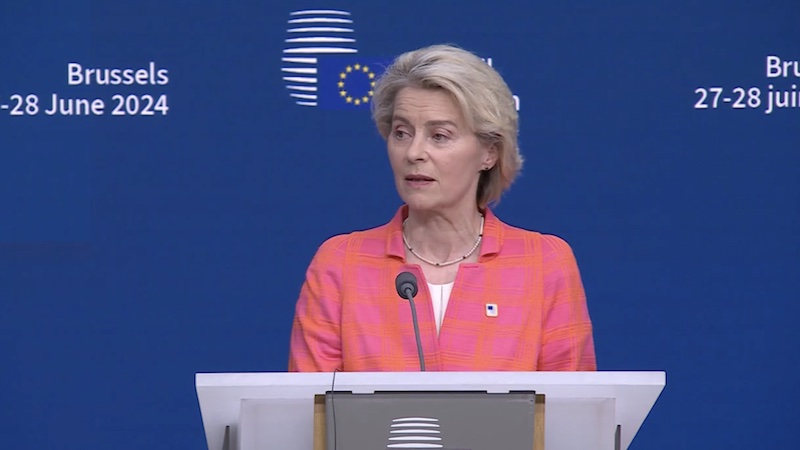
President of the European Commission Ursula von der Leyen. Photo Credit: EU Commission video screenshot

By Noel Clehane

While the EU’s center has;held;in the face of the far-right advance, the European elections notably;confirmed;the pre-vote predictions of its twin heavyweights. Less than two weeks earlier, French President Emmanuel Macron;carried out;Paris’s first state visit to Berlin in nearly a quarter-century, seeking to rekindle the Franco-German engine at the heart of European integration and urging Europeans to “wake up” to curb populism’s democratic threat. Although the far-right faired particularly well in both countries – prompting Macron to call a shock;snap election;– ;their leaders’ vision for Europe remains equally poignant.

In a joint;Financial Times;editorial, Macron and German Chancellor Olaf Scholz outline this European awakening, prescribing an enhanced Single Market paired with ramped up EU innovation and investment to bolster the bloc’s sovereignty amid rising geopolitical tensions and global competition. Encouragingly – given protectionism’s return to fashion – they avoid pitting competitiveness and trade against each other, calling instead for a ‘robust, open and sustainable” approach that “allows fair trade agreements and promotes EU interests.”

By leveraging an ambitious and coherent external economic agenda, including trade policy, the EU can fuel competitiveness, diversify supply chains and accelerate its twin green-digital transitions in a way that delivers for its citizens and SMEs, addresses the roots of populism’s resurgence, and supports the growth of Europe’s global partners.

Changing winds in Brussels

Encouragingly, this sentiment ran throughout a recent;speech;in Brussels by Sabine Weyand, Director-General of DG Trade at the European Commission. Yet maintaining a nuanced, constructive position on international trade will be no easy task in the new EU mandate.

Despite the center-right EPP’s better-than-anticipated performance at the ballot box, the European Parliament’s (EP) center of gravity is still shifting to the right, with centrist and liberal groupings;losing influence;to the European Conservatives and Reformists (ECR) group and others further to the right. Considering Marine Le Pen’s;recent overture, the ECR could theoretically join forces with the far-right Identity and Democracy (ID), a political earthquake that could thwart Commission President Ursula von der Leyen’s;manoeuvring;to prop up a waning majority.

The elections’ top issues offer valuable insight into the roots of this changing balance of power, with EU citizens;expressing;the fight against poverty as their main electoral priority in the EP’s last Eurobarometer survey before the vote. After a years-long cost-of-living crisis fuelled by Covid-19 and the consequences of Russia’s invasion of Ukraine, Europeans are justifiably fed up with the status quo and looking for answers to their daily problems.

The return of European protectionism?

Following a time-tested playbook, Europe’s populist parties have successfully cashed in on public frustration and sentiments of abandonment by an out-of-touch elite. This battle has most notably played out in the agricultural arena, with the far-right surfing the;wave of farmers’ protests, namely by scapegoating Brussels bureaucrats and the Green Deal agenda that has marked the outgoing term.

Desperate to hang on to the vital farming vote, the center-right has tried to outdo the far-right by sabotaging key Green Deal files, nearly managing to bury a watered-down;Nature Restoration Law. What’s more, farmers’ anger over burdensome EU environmental regulations have been exacerbated by concerns over unfair competition from agricultural imports, leading to a mounting political demonization of ‘free trade.’

Beyond agriculture, the EU’s leading players are gathering together strategic industries;spanning;a range of clean energy and next-gen technologies under a ‘Europe First’ agenda – exemplified by Macron’s calls for a ‘Buy European’ strategy. As POLITICO has rightly;observed, a right-leaning European Parliament could direct the bloc down a warped version of this path, potentially generating “conflicts…over an EU push to reduce dependency on other parts of the world,” and deepening the free trade backlash.

This may bring the EU into even greater conflict with its trading partners as it simultaneously seeks to foster international cooperation on sustainability through the TSD Chapters of its Free Trade Agreements and through its unilateral instruments such as CBAM and CSDDD.

Overcoming false dilemmas

This deeply polarized debate requires a heavy dose of nuance. European firms and policymakers have well-grounded fears over unfair competition from third countries not playing by the same rules, as well as excessive dependencies in the European bloc’s critical supply chains.

The EU must absolutely take measures to drive forwards its competitiveness and reindustrialization efforts, including by doubling down on investment in the domestic production of low-carbon energy and critical minerals. However, as Wind Europe’s Christoph Zipf recently;noted, “Europe is not energy-rich like the U.S. and cannot afford to inhouse all manufacturing.”

Reminding that the bloc’s;Net-Zero Industry Act;includes a strong focus on diversifying suppliers rather than banning trade – in a similar fashion to the;Critical Raw Materials Act;– Zipf highlights that the EU will need to continue importing to deliver its green-digital transition. Europe must therefore avoid the false promise of protectionism, largely based on an ideological aversion to global trade and which threatens the EU’s long-term economic ambitions and resilience.

Brussels must instead advance a well-designed trade and investment strategy with European citizens and businesses at its the heart, securing the bloc’s supply chains and spurring growth in third-country partners. Any necessary de-risking measures will have inevitable costs to efficiency but that is the price to be paid to replace globally efficient but fragile supply chains with globally trusted ones.

Opportunities on the horizon

In this endeavor, the EU should look towards fast-growing markets with the values and assets needed for strong, balanced economic partnerships. The EU’s;third-largest;foreign trading partner, the;Association of Southeast Asian Nations;(ASEAN) already offers significant potential for expanded economic cooperation.

Recent years have seen;strong progress;in EU-ASEAN relations, with bilateral trade now exceeding;€270 billion;and Brussels sealing free trade deals with Vietnam and Singapore. More deals are in the works, with;Thailand;hoping to finalize an agreement with the EU by next year; previously stalled;EU-Philippines;talks set to resume in March; and critical mineral powerhouse;Indonesia;remaining optimistic about an agreement in the near future.

Moreover, both sides intend for these bilateral agreements to pave the way for an eventual;EU-ASEAN free trade agreement, a development which European businesses consistently highlight as an essential element of optimizing trade and investment with and within ASEAN.

As well as striving for ambitious FTAs with a range of partners, the EU will also have to work hard to promote and protect the EU’s interests with its largest trading partners, including the US and China, which present different challenges.

Beyond trade, strategic EU investment projects, for example the;Port of Lumut development;in Perak, Malaysia and the;digital economy package;for the Philippines, provide promising avenues for deepening ties. Both initiatives notably fall under the EU’s;Global Gateway;strategy, through which Brussels has committed;€10 billion;for connectivity projects in ASEAN by 2027. Large amounts are also earmarked for other parts of the developing world. Encouragingly, both the EU and ASEAN recently;bolstered;their Global Gateway partnership, notably orienting investments towards mutual green and digital growth.

To maximize its impact moving forward, Brussels should implement a more coordinated Global Gateway approach, particularly by centralizing its administration, targeting strategic transport corridors and using it to coordinate other mechanisms like the;Just Energy Transition Partnerships, already launched with Indonesia and Vietnam, which allow the EU to maintain high trade standards and protect domestic industries while fueling fair green growth overseas.

Through this proactive and coherent approach, the EU can drive resilient, sustainable growth across the bloc in the new term, restoring faith in its democracy while shielding its economic agenda from simplistic and misguided solutions.

  • The views expressed in this article belong to the author(s) alone and do not necessarily reflect those of Geopoliticalmonitor.com.

Categories
South Caucasus News

It’s Darkest Before Dawn – OpEd


It’s Darkest Before Dawn – OpEd

argue politics disagree united states flag

It’s been a painful four years watching the experts, backed by power, dismantle all the foundations of the good life, and yet not be held accountable for the results.;

The astonishing debate scene between Trump and Biden makes the point and leaves us with a strange new reality. The facade at the top has cracked in full view of the entire planet. The problems in evidence have been there for years and yet no establishment voices have revealed them. It’s been the opposite actually. Talk about Biden’s issues has been deemed disinformation. 

Indeed, a message sent to Brownstone’s own Google Group before the debate concerning Biden’s prospects in the debate was deleted by Google. That’s never happened in 20 years of my experience with this platform. The near-monopolist on search deleted as a speech violation what the whole world would know is true later that evening.;

Indeed, vast numbers of people know the truth. But no official sources will tell the fullness of it, even as the opportunity and venues in which the truth can be told are shrinking daily.;

We are increasingly watching public life as a fabulistic theater. It only holds our attention because we wonder how much truth the elites are going to allow to be leaked and why.;

And this new system is toying with the core of expectations for the future. Are we doomed or will we come back from the brink? There is darkness before dawn but just how dark must it become before we see the signs of hope?;

For example, from the Supreme Court this week we received terrible news (free speech on the Internet is nearly at an end) but also good news (the administrative state cannot do whatever it wants and the reigning political party cannot jail its political opponents on spurious grounds).;

Therefore, on the one hand, as the empire ends and the darkness in the West descends ever further, we will hear ever less about it, much less openly discuss the cause. On the other hand, the expert class that is tearing apart the good life now faces some problematic barriers to their unmitigated power.;

In that sense, the Trump/Biden debate last night had all the elements we needed to understand the moment. It was a completely different experience from any ever seen on TV. It’s not just that Biden fell apart last night. It’s that the experience revealed what’s been true for a very long time and has not been reported. It’s been censored. That’s a further blow to the whole credibility of the media.;

Then the world woke up in the aftermath to the whole of the establishment media, which only 24 hours earlier said that talk of Biden’s decline was misinformation, now saying that Biden absolutely must be replaced on the Democratic ticket, otherwise Trump will win the election. It happened that fast. Then, only a few hours later, the Biden campaign and his minions have said absolutely;not: he will go the full distance.;

It all raises the big questions. Was the debate scheduled so early, before the conventions and nominations, precisely to let Biden fail on his own so he could be replaced? If so, that is very cruel. Or was this not foreseen and now we see authentic reactions from a whole class of media and intellectual elites who are panicked about the future?;

Was this a planned crash and burn or an inadvertent collapse? And what happens when there is such a huge divergence of strategy within the ruling class structure?

To be sure, there is an element of fakery about the whole drama. Elon Musk said it plainly, as is his way: “They’re just talking puppets. It was a setup for a switch.”

Alex Berenson offered;this;reaction to the June 27th debate between Trump and Biden: “This reminds me of the last days of the Soviet Union. Everyone knew it was over, someone close to the top just had to be the first to say so, and then the collapse was both inevitable and immediate.”

The strangeness and tragedy of last night’s content were intensified by the oddly clinical and bloodless staging: mics and technology on timers, no audience, and robotic questions read by expressionless professionals. It was a real-life mockumentary of two octogenarians navigating an AI world, with the system rigged to make a sadly non-functioning elderly person (a stand-in no different from Chernenko or Brezhnev) seem vaguely functional.;

Even that did not work.;

The scene also recalled the ethos and aesthetic of lockdowns. It was performance without audience, content without authenticity, digits flowing across screens that seemed to have nothing to do with normal life. It was a clinical performance in which the patient died.;

The Covid response did come up last night, with Trump finally conceding, not in those words but by implication, that it was what doomed his first term. He must feel tremendous bitterness about the whole thing but he still dares not speak about what happened in any detail.;

It was also interesting that Trump said he doesn’t get enough credit for the good he did in 2020. In saying that, and probably for the first time, he said nothing praiseworthy about the vaccine itself but rather highlighted “the therapeutics.”;

His comments on the vaccine were limited to condemning the mandates.;

If nothing else, Trump reads the room well. It seems like the vaccine narrative (mRNA saved society from vast death) is not sticking, even if industry spokesmen will keep saying that for years to come.;

Notice how the CNN reporters got zero traction with the “climate change” line of questioning. Trump wisely stuck with the need for clean water and air. Biden mumbled something about an existential crisis. But none of it went anywhere, and this is mostly because no one much cares.;

And this makes sense. When the economy is decaying rapidly, households cannot pay their bills, the insurers and tax collectors are grabbing any excess wealth in sight, even high-end professionals pack sack lunches rather than pay restaurant prices, and lifespans in the US are in precipitous decline due to chronic disease, it’s hard to get people exercised about yet another invisible enemy with an uncertain cause and sketchy solution of dismantling what remains of prosperity.;

In another corner, we had the “real debate” with Robert F. Kennedy, Jr., watched by 5.5 million people. That’s a huge audience but an audience with no real hooks into the machinery that runs the political system. In his own response, he was warm, humble, truth-telling, and human. Agree or disagree, he was talking about things that matter. And he clearly has faith that the system can be fixed, while others are not so sure.;

The entire RFK experience on debate night was relegated to a sideshow. He began his run for the presidency with the assumption that there was enough decency remaining in the political system to grant him a fair shot. The Democratic National Committee said absolutely not. They gave him no opportunity at all even to challenge Biden for the nomination, despite what everyone already knew about Biden’s physical and mental condition.;

Not willing to give up his ideals, he decided on an independent run. In the US political system, every such effort runs headlong into Duverger’s law. This states that any election in which a winner takes all will always default to two choices. This is due to strategic voting in which people vote not for what they favor but against that which they fear the most. What independent runs in the American system do is introduce the possibility of vote-splitting of the person who would otherwise be the winner.;

The election of 1912 is the classic case. William Howard Taft garnered the Republican nomination. Annoyed and determined to reclaim the presidency, Theodore Roosevelt, who had served as president from 1901 to 1909, formed the Bull Moose (Progressive) Party and gained a substantial portion of the popular vote but not enough to win.;

This threw the election to the least favorite: Woodrow Wilson, a member of the Ivy aristocracy with essentially insane ideas with zero popular support. Wilson pushed the income tax, the direct election of the Senate (thus eliminating the bicameral system), he ratified the Federal Reserve, and got the US embroiled in the Great War, which meant censorship and the Espionage Act.;

This was the turning point in which the old Constitution was replaced by a new one, all due to an electoral dispute and the only truly substantial third-party presidential run in US history.;

What will be the effect of this RFK run? Can he win? Despite all predictions to the contrary, there might be a chance. But if he does not, from whom will he draw the most votes? Trump or whoever is going to replace Biden? And what if we end up with someone like Gavin Newsom, who was the leader among the worst of the Covid totalitarians who has driven a stake into the heart of the California economy?

This disaster scenario is not entirely out of the question.;

Another consideration is that Elon is correct that none of this matters. The elected portion of government has been reduced to nothing but a veneer to be sanded down and changed from time to time, whereas the substance of government consists of its;deep, middle, and shallow layers;that operate without any public control at all. And their functioning is in the process of being reformed with artificial intelligence replacing human control.;

In this case, the strange debate last night might be a foreshadowing of our future reality. It’s technology, performance, and dispensable actors moving within a system that is beyond anyone’s actual control. Is this inevitable? Is there anything that can be done to stop it? Such questions are beyond my capacity but I do highly recommend Tom Harrington’s;reflection;on the decline and fall of the Spanish Empire.;

Brownstone Institute was founded with a sense that we needed sanctuary for ideas in very hard times, but we certainly could not have anticipated how quickly the darkness would descend, much less the depths to which every feature of public life would fall. This disaster was made by human hands; its perpetuation will be achieved by AI.;

Is there no hope? Of course there is. Just this morning, the day after the debate disaster and two days following the court’s terrible decision on free speech, a central pillar of administrative totalitarianism was toppled by the court. The so-called Chevron Deference is over. Finally, we have some clarity on what agencies can and cannot do at their own discretion. It’s a big win, but about 1% of what is necessary to regain rights and liberties.;

America can come back but how and when? That is what remains unknown. But this much is known: the high-end strata of experts who have long had a free hand in structuring our lives now stands discredited. Even more devastating, humiliation is now added to the mix. 


Categories
(@mikenov) / Twitter

@mikenov: When hacker mastermind Gery Shalon flipped, US law enforcement considered it a win. But new evidence shows he may have built a massive new fraud empire in Europe while working with the FBI in New York bloomberg.com/news/features/… via @BW


Categories
(@mikenov) / Twitter

@mikenov: When hacker mastermind Gery Shalon flipped, US law enforcement considered it a win. But new evidence shows he may have built a massive new fraud empire in Europe while working with the FBI in New York bloomberg.com/news/features/… via @BW


Categories
(@mikenov) / Twitter

@mikenov: When hacker mastermind Gery Shalon flipped, US law enforcement considered it a win. But new evidence shows he may have built a massive new fraud empire in Europe while working with the FBI in New York bloomberg.com/news/features/… via @BW


Categories
(@mikenov) / Twitter

@mikenov: When hacker mastermind Gery Shalon flipped, US law enforcement considered it a win. But new evidence shows he may have built a massive new fraud empire in Europe while working with the FBI in New York bloomberg.com/news/features/… via @BW


Categories
South Caucasus News

NPR News: 06-29-2024 3PM EDT


NPR News: 06-29-2024 3PM EDT

Learn more about sponsor message choices: podcastchoices.com/adchoices

NPR Privacy Policy


Categories
South Caucasus News

Antonio Guterres to visit Central Asian countries


UN Secretary General António Guterres is embarking on a tour of Central Asia on June 29, Azernews ​reports.