
Prosecutors in Sen. Bob Menendez’s bribery trial are done presenting their case. The defense is next MSN
Day: June 28, 2024
This was quite a week in the annals of freedom of the press.
Julian Assange, the founder of the whistleblower organization Wikileaks, after being hounded by the US with the help of its sycophantic allies in the governments of the UK, Sweden, Ecuador and, most shamefully, his native Australia, for 14 years since his Wikileaks organization obtained and released; documents proving systemic war crimes by the US in Iraq and Afghanistan, has been freed. He spent the last 14 years fighting efforts by the US to lock him up oar execute 9or even to assassinate him ,spending 12 of those years in the hell of confinement in a British maximum security prison and earlier seven years as an asylum seeker trapped in the Ecuadoran Embassy in London.
His asylum ended and his imprisonment in Belmarsh began when the leftist president who had granted him asylum from British authorities who wanted to hand him over to the US for prosecution as a spy, lost an election and was replaced by a right-wing president who cancelled his asylum and called in the London Metropolitan Police, who dragged him out of the embassy and into solitary confinement in Belmarsh Prison pending extradition to the US.
Over the seven years he was trapped in the little embassy, or left alone in a tiny cell in hellish Belmarsh, his supporters — initially a handful of journalists and his family — a father, a half-brother and father and attorneys in Britain and the US, and one attorney, Sara Gonzalez Devant, who later bore; him two sons who have never met him except in captivity worked to build a movement to defend and free him.
It was a tough struggle. The US and UK media organizations that benefitted from his Wikileaks organization’s documentation of US war crimes, including the gun-sight video of a US helicopter gunship slaughtering, amidst audible mocking laughter,; 11 unarmed Iraqis including two local Reuters journalists, and from other scoops Wikileaks; received from whistleblowers, largely turned on him when he was being pursued by US prosecutors.
Typically these same news organizations, when covering his case, would repeat in their articles about him (almost as if pasting in pre-set;macro;paragraphs”),; the false accusation that he was wanted by Swedish prosecutors for allegedly “raping” two women in Sweden. They also would routinely include in such stories gratuitous quotes from politicians smearing his character and even from fellow journalists questioning his claim to be one of them, along with grudging acknowledgement that the US charge of espionage against him was a threat to press freedom,
But truth gradually prevailed and pressure kept building: in Britain against his being extradited and against the US obsession with pursuing the case against him, and in Australia for the government in Canberra to end its years of submissive and callous acceptance of the abuse of an Aussie citizen by a US government out for revenge. This international movement to free Assange grew larger and more vocal when a new Labour government replaced the prior conservative one in Australia and Labor PM Anthony Albanese openly called on President Biden to end the case against his countryman Assange.
In the end it was this slowly and painstakingly developed international movement to free Assange that compelled the Biden administration to offer Assange a deal. He and his attorneys were reportedly told that the US would agree to his; freedom if he would plead guilty to one felony count of theft of US military secrets (the evidence of war crimes), and a sentence of five years, which would be satisfied by crediting the over five years he had spent being held in Belmarsh Prison without conviction of anything but denied bail while fighting the US’s extradition effort.
Much is being made now, of course, by US officials of that guilty plea, but it is important that what Assange was facing if he were extradited to a court in Washington DC. With an indictment on 17 felony counts under the 1917 Espionage Act an one felony count of; encouraging hackers and of helping NSA whistleblower Edward Snowden to escape to Russia, the total prison term if convicted on all those counts would have run to 175 years’ jail time served consecutively.
The urgency of the US plea deal offer, which apparently came as a something of a surprise to Assange and his defense team, had to do with the reality that the US was facing of his possible escape from their trap:; That became at least a possibility when, after many rejections, two UK High Court Judges last year overruled a 2022 British Supreme Court decision denying Assange the right to challenge his extradition. Unconvinced by US promises that he would receive a fair trial in a US court (promises that were hedged by the US DOJ’s acknowledgement that the US Supreme Court would in fact be the final arbiter of whether, for example, Assange could avail himself of the Constitution’s First Amendment right of Free Speech and a Free Press — a Supreme Court packed with originalist justices who support the national security state. The two High Court judges were preparing to review his arguments against extradition later this month.
There’s no telling how they would have ruled of course, but the Washington nightmare of his walking free in Britain was more than Biden, AG Merrick Garland and the US national security agencies pressing for a lengthy jail sentence in the US, could tolerate. They needed at least the fig leaf of a guilty plea.
To understand why Assange, who is about to turn 53, after being effectively incarcerated for nearly a quarter of his life, simply for doing what investigative journalists do, revealing the truth about government crimes, it’s important to know what he was facing if he didn’t accept the Biden deal and then lost his last appeal of the extradition order that had already been approved in a UK court.
Let me explain.
In the self-appointed “Land of the Free and Home of the Brave” United States, those of us who as journalists cover legal issues know that American justice is not blind like the statue in many courts of the woman “Justice” blindfolded and holding up a scale in one hand and a sword in the other.. Neither is it fair. Worse yet, it routinely punishes those who demand; their Constitutional right to a jury trial for doing so applying the stiffest of penalties should they end up being convicted.
The safest bet in an American court under such circumstances is to “cop a plea,”; meaning to take the advice of one’s lawyer or; public defender: typically to plead guilty to a lesser charge and accept a lesser penalty. or if that proves unacceptable to the judge and prosecution, agree to plead guilty as charged in return for a lesser penalty. This harsh reality has led to a large number of people in prison for crimes they did not commit, but that they pleaded guilty to out of necessity and lack of funds to hire a lawyer or to appeal a wrongful conviction.
That’s why for instance, of the 71,954 defendants facing criminal federal charges in the US fiscal year 2022, only 1669 opted to go to trial, according to a;Pew Research report.; That is; just 2.3% of all those facing felony or serious misdemeanor charges that year. Of those few who boldly requested a trial before a jury or a district court judge, only a handful — 290 or 0.4% of those charged, were acquitted. The other 1379 who had their cases tried were convicted, and because they insisted on a trial they had a right to, likely were slapped with lengthy or maximum sentences. Of the rest of those who didn’t have their cases adjudicated, 89.5% or 64.434 just pleaded guilty hoping for a lighter sentence. Another 8.2%, or 5900 defendants, had their cases tossed out, usually for lack of sufficient evidence.
Given this sorry record, which is depressingly typical of how the federal courts operate year in and year out in the US, it’s understandable why Wikileaks founder Julian Assange, who finally escaped over 12 years of terrible torture at the hands of the US government and a supine British government, agreed to cop a plea.
Assange and his British counsellors also probably knew also about an investigative report published last year in the Italian newspaper La Repubblica, summarized later in a British publication called;The Pen, which located copies of at least some of the long-missing or destroyed emails between Swedish prosecutors and Britain’s Crown Prosecution Service concerning the effort by a politically connected and CIA-linked prosecutor in Stockholm and the CPS, which at the time in 2013 was headed by none other than Barrister Keir Starmer. He’s the man widely expected to become Britain’s new Prime Minister if, as polls suggest, his Labour Party wins an outright majority and a six-year term as Prime Minister in the July 4 Parliamentary elections.
Starmer’s correspondence suggests it was his office that was pressing reluctant Swedish officials to; keep insisting on trying to extradite Assange to Sweden to face questioning there about allegations of sexual abuse accusations by two Swedish women, and who advised them to reject offers by Assange and his attorneys to respond to their questions if they came to London and met with him. There had long been a question of why, Swedish prosecutor Marianne Ny, from; 2010 to 2016, unable to question Assange in Sweden, refused a standing; offer from his lawyers to travel to the UK and question him where he was holed up in the Ecuadoran embassy.
As the Italian newspaper;Il Facto Quotidiano; explains, “No one understood why Swedish prosecutor Marianne Ny did not want to travel to London to question Julian Assange and determine whether to charge him or not. It was our FOIA investigation that allowed unearthing the reason: It was the British authorities at the Crown Prosecution Service…who advised the Swedish prosecutors not to question Assange in London.”; The magazine learned that all of the email correspondence by CPS officer Paul Close’s, who did most of the communicating with Ny was mysteriously wiped when he left the agency in 2014.
Starmer, who has been strangely silent about Assange’s plea deal with the US and his escape from British detention, was in charge of the CPS from 2008 through 2013 and during those years when the office was handling communications regarding Assange with the Swedish prosecutor and was Close’s boss, appears to have been a key agent in Assange’s unconscionable torment. That would clearly have made Assange and his defense team keen to get him out of Britain and out of the news cycle before;Keir “our national security always comes first” Starmer;were to enter 10 Downing Street as the UK’s Prime Minister.
The deal offered by the Biden Administration’s “Justice Department” was tough one. It required that in return for agreeing to plead guilty to one of the 17 felony charges of violating the US Espionage Act and being sentenced to five years in prison, a punishment which would be met by counting the over five years he has spent in solitary confinement in Britain’s dank and oppressive Belmarsh Prison fighting a US extradition petition, Assange would be able to fly home to his native Australia a free man.
Behind the scenes, one can see that the Biden administration, like the Trump and Obama administrations before it, has been vigorously doing the bidding of the US National Security State —the CIA,, the FBI, NSA; and the Pentagon — in pursuing a major espionage case against Assange, the founder of Wikileaks, He and his organization had hugely embarrassed those agencies and the US government agencies over the years with the release of documents proving that the US was guilty of; systemic and massive war crimes in Iraq and Afghanistan, was spying on the leaders of allies in NATO, and and Assange had also also helped NSA leaker Edward Snowden, another arch enemy of the national security state, to escape to Russia.
The US media happily ran page-one banner-headlined stories and videos of the US war crimes exposed by Assange and his Wikileaks organization. But then, when he was being indicted and hounded by the US government and was fighting his extradition to the US from a jail cell in Britain, those same media organizations just as happily stabbed him in the back, quoting slimy US politicians like former Trump VP Mike Pence claiming that his releases “put US personnel at risk.”; (In fact the US, in its arguments in British courts seeking an extradition order, never could present a single case of a US soldier or CIA agent being put at risk, injured or killed because of a Wikileaks story or purloined document. ; Like the Swedish “rape charges,”; all the smearing of Assange was and remains lies.
Establishment journalists too, in Britain and the US, have been guilty of shamelessly piling on in the tarring of Assange even as others of their colleagues, most of them outside of the mainstream news organizations, have heroically worked to debunk the lies.
The bottom line is that Assange in his struggle for freedom, has been heroically defending the freedom of all journalists and publishers around the world to speak truth to power.; The indictment of Assange, a foreigner working outside the US, was nonetheless pursued by three presidents including Obama (whose Justice Department drew up a sealed indictment, but never acted on it),; Trump, whose Justice picked it up and activated it in 2019, and Biden, who pressed forward with the effort to extradite Assange and have him face the Trump Justice Department’s indictment. All three presidents have sought to expand the reach of the already controversial Espionage Act; to include; journalists of any nationality operating anywhere in the world.
From its first use in the days of WWI, when the Espionage Act was passed to enable the government to arrest immigrants (usually anti-war leftists) on supposed spying charges, the act has morphed fairly recently under those three feckless presidents into a tool to go after not just alleged spies, but whistleblowers and the journalists who rely on them.; Going after Assange just expanded its reach globally.
Some desk-bound pundits to whom the notion of challenging state abuse of power would never occur, are claiming that Assange, by copping a guilty plea, sold out his media colleagues.; Nothing could be further from the truth.; First of all, Constitutional scholars say that a plea bargain creates no new legal precedent in the federal or state courts of the US. Only an appellate court ruling of a Supreme Court ruling has such significance on future cases.; (That’s not to say that just seeing what the US government and its willing puppet states in Europe are willing to do to those who do expose its crimes isn’t going to deter many from following in Assange’s footsteps.)
But in any case, no one who has not spent more than twelve years in enforced confinement has any right to criticize Assange for availing himself of the chance to get out of jail, to avoid the horror of a prosecution in the US legal system, and to join his family, including his two children, whom he has never met except in captivity.
As a fellow journalist, I can only congratulate him for his courage, to wish him well as he gets used to freedom again, and to salute all those who have worked for his freedom.
As my friend, colleague and fellow journalist Ron Ridenour, a US journalist/activist who has long ago abandoned his native US to live in Denmark, and who years ago cashed in his retirement savings and sent it all to Assange’s defense fund (he also reports giving $1000 to a;Crowdfunder campaign;to fund to repay the cost of the private jet Assange had to charter at a cost of hundreds of thousands of dollars to safely fly to his court hearing in Saipan in the Northern Marianas and on to the safety of Australia), says, “ I think Assange’s freedom is a huge victory. We the people all came together — not so much in the US, but in Europe and England and around the world. It shows that when a good number of people are willing to get together in the early morning in a cold rain we can make good things happen!” (In less than a week the fund had collected £441,793, close to the target goal of £520,000, a powerful demonstration of the support for Assange.)
Ridenour adds, “It’s a disappointment that the great journalist John Pilger, who tirelessly fought for Julian’s freedom, and Dan Ellsberg, and Center for Constitutional Rights President Michael Ratner, didn’t live to see this day.”
I think a headline on the BBC the day Assange walked out of a US district court in Saipan with the judge telling him he was “a free man” was on target,; Referring to the years before PM Albanese called for his release, when Australian leader after Australian leader ignored Assange’s plight at the hands of the US, including even Labour PM Julia Gillard, who pointedly refused to lift a finger to help her persecuted countryman it read:
Australia turned its back on;Assange,;Time made him a martyr.
The only thing wrong with the story topper is it ought to have said:
Australia turned its back on him, Britain tortured him at the request of US prosecutors, and America betrayed its own First and Fifth Amendments. Time made Assange a martyr.

The Indian Air Force (IAF) has put forward a proposal to the government to acquire 10 TAPAS drones. These drones are developed indigenously in India. According to defence officials, the plan is for the IAF to receive six of these drones, while the remaining four will be allocated to the Indian Navy. This move by the IAF represents a significant effort to bolster India’s indigenous capabilities when it comes to unmanned aerial vehicles for surveillance purposes.
By acquiring these TAPAS drones, the armed forces are showing their commitment to utilizing domestic defence technology to fulfil their operational requirements.
The armed forces’ decision to purchase TAPAS drones, even with some performance limitations, reflects commendable vision and a strong sense of duty. The IAF will take the lead in bringing in and acquiring TAPAS drones for the defence forces. The Defence Ministry is expected to review this plan soon. But, right now, only the IAF and the Indian Navy are planning to buy these drones.
Indigenously Developed Drones
Classified as medium-altitude long-endurance (MALE) drones, the TAPAS drones have been indigenously developed by the Defence Research and Development Organisation (DRDO). They will be manufactured by a group of companies, including Bharat Electronics Limited (BEL) and Hindustan Aeronautics Limited (HAL).
The Tactical Airborne Platform for Aerial Surveillance Beyond Horizon-201 (TAPAS BH-201), previously called Rustom-II, is being developed to fulfil surveillance needs similar to those of the General Atomics MQ-1 Predator. The IAF currently uses Israeli-made drones, including the Searcher, Heron Mark-1 and Mark-2 models. It also plans to add American Predator MQ-9B drones as part of a joint purchase with the other military branches.
Adding six homegrown TAPAS drones will enhance unmanned surveillance on both the northern and western borders. The IAF strongly supports the ‘Make in India’ initiative in defence, having ordered—or planning to order—180 LCA Mark 1A jets and 156 LCH attack helicopters worth around ₹1.6 lakh crore.
The Indian Navy plans to use the TAPAS drones for maritime surveillance. These drones are expected to be delivered quickly, with the first one ready for deployment within 24 months of contract signing. DRDO is still working on the TAPAS project to improve its performance.
TAPAS Drones Face Challenges
‘Tapas’, which means ‘heat’ in Hindi, represents the drone’s ability to tackle enemy threats. The Aeronautical Development Establishment (ADE) laboratory in Chitradurga, near Bengaluru, has performed over 200 tests on the TAPAS drone. The 200th test was observed by a combined team from the army, air force and navy.
The initial deadline for the DRDO’s TAPAS project was August 2016. However, various problems led to delays. The drone’s weight rose to a heavy 2,850 kg instead of the planned 1,800 kg and there were issues with the imported engine and payload. These challenges caused multiple delays and increased the project’s cost to ₹1,786 crore.
The TAPAS drones have faced challenges in meeting the Joint Services Qualitative Requirements, which specify that a MALE drone should fly continuously at 30,000 feet for over 24 hours. In tests, however, the TAPAS drones managed to reach an altitude of 28,000 feet and sustain flight for over 18 hours.
Enhancing TAPAS Drone Capabilities
The current efforts to improve and develop the TAPAS drones aim to fix performance issues and meet the tough standards needed for modern warfare. Working together, DRDO, BEL and HAL are key players in making this happen.
Despite the hurdles, the recent orders mark an important achievement for the TAPAS programme. These orders offer practical experience and help boost India’s knowledge in creating homegrown drones. The progress of the TAPAS programme will be monitored carefully because it may lead to future improvements in drone technology in India.
By Dalia Al-Aqidi
The presidential debate between Joe Biden and Donald Trump has left an indelible mark on the political landscape, stirring a mix of disappointment, shock, and concern. It was disheartening to witness the leader of the US struggling to articulate his thoughts clearly.
The debate’s agenda was broad, encompassing critical issues such as abortion rights, immigration policies, and international relations with Ukraine and the Middle East.
From the outset, Biden’s performance was uneven. At 81, his halting speech and occasional raspy voice, attributed by his campaign to a cold, did little to inspire confidence and refueled existing concerns about his age and his ability to serve another term.
Trump himself is 78, and the debate brought to the forefront the age and health of both candidates. Never before have two contenders for the White House been so old, which did not go unnoticed by the public.
Biden’s struggle to deliver his points coherently contrasted sharply with Trump’s more aggressive and clear-cut approach, which was a focal point for viewers and pundits alike. Vice President Kamala Harris tried to mitigate the fallout by defending Biden’s performance. She acknowledged that her boss had a slow start but emphasized his strong finish, arguing that he demonstrated a clear commitment to substantive issues over stylistic concerns. Harris pointed to the president’s broader record in office as evidence of his capability and dedication to the American people.
However, the public’s reaction was swift and telling. A snap poll suggested that 67 percent of viewers believed Trump outperformed Biden, a significant shift from pre-debate expectations when only 55 percent believed Trump would do better, and 57 percent expressed a lack of confidence in Biden’s ability to lead the country compared with 44 percent for Trump. These numbers reflect a stark reality: the debate shifted the focus from policy issues to concerns about Biden’s personal fitness for office.
The implications for the Democratic Party are profound. The debate has exacerbated internal tensions and brought to the surface the challenges of its candidate. There is no straightforward mechanism within the Democratic National Committee’s rules to replace an incumbent president on the ticket. Any move to replace Biden would require opening the nominating process at the convention, a scenario fraught with political risks and complexities.
Prominent Democrats are already feeling the pressure. Reports have emerged of top Democrats urging Biden to reconsider his re-election bid; and many House Democrats are privately expressing the need for a new nominee. This internal discord is a testament to the deepening concerns about his ability to secure a second term.
As the most obvious successor, Kamala Harris faces her own challenges. Her current approval rating of 38 percent raises questions about her viability as a candidate against Trump. This adds another layer of complexity to the Democrat dilemma. The party must navigate these turbulent waters carefully to avoid further detachment from its base and to present a unified front in the election.
California Governor Gavin Newsom has publicly dismissed speculation about replacing his leader, emphasizing party unity and support for the president. Other names have been circulating, such as those of Illinois Governor J.B. Pritzker and Michigan Governor Gretchen Whitmer. The urgent need for a decisive strategy is palpable behind the scenes. The Democrats must act swiftly and judiciously to address these growing concerns and prepare for all possible scenarios.
The debate’s impact extends beyond the Democratic Party. It has also galvanized Republican supporters and reinforced their confidence in Trump. Republicans seized on Biden’s faltering performance as a rallying point, further complicating the Democratic Party’s path forward.
Furthermore, it exposed a broader issue within American politics: the increasing emphasis on the age and health of candidates. This is not confined to Biden and Trump, but reflects a growing trend in which voters scrutinize their leaders’ physical and mental fitness. This shift in focus from policy to personal capability is a significant departure from traditional political evaluations and indicates a new era in voter expectations.
Additionally, the role of the media in shaping public perception cannot be overlooked. Liberal-leaning media outlets have been critical of Biden’s performance, which has contributed to the growing unease within the Democrats. The media’s portrayal of the debate and its aftermath plays a crucial role in influencing public opinion and, ultimately, voter behavior. In light of these developments, the Democrats face a daunting task. Replacing Biden would involve complex logistical and political challenges. Opening the nominating process at the convention would be unprecedented and could lead to a fractious and divisive outcome. The party must carefully weigh the risks and benefits to avoid destabilizing its electoral prospects.
Moving forward, the party’s strategy must be clear and compelling to reassure both its base and the broader electorate. The election is fast approaching, and the Democrats’ ability to present a robust and unified front will be crucial in determining the outcome.
Convincing Biden to step aside would be daunting, but ensuring the party’s strength and unity heading into the election is necessary. By preparing thoroughly for a smooth transition and rallying behind a new candidate, the Democrats can bolster their already slim chance of maintaining control of the White House. The time for strategic action is now, and the stakes could not be higher.
- Dalia Al-Aqidi is executive director at the American Center for Counter Extremism.
By Théo Bourgery-Gonse
(EurActiv) — French voters go to the polls this Sunday (30 June) for the first round of snap legislative elections – but the country’s two-round first-past-the-post system makes projections complex and political tactics numerous, ultimately benefiting the surging far-right.
On 9 June, President Emmanuel Macron announced he would;dissolve the National Assembly;by calling snap legislative elections – a constitutional prerogative only he can use – after his Ensemble centrist coalition received a trouncing from the far-right Rassemblement national (RN), following the European Elections.
France has a semi-presidential system. The president has been elected by direct universal suffrage since 1965. Legislative elections are also held by direct universal suffrage.
The prime minister is appointed by the president, but usually comes from a political party belonging to the majority in the National Assembly. The president and prime minister can therefore belong to two different parties.
A fractured political scene
The dissolution of the National Assembly announced by Macron sent shockwaves across the country, with the political landscape experiencing a dramatic reshaping within days.
The conservative Les Républicains;split in two, with party chief Eric Ciotti opting for a coalition with the RN, in a unilateral move that most party officials condemned. A wide ‘far-right union’ with fringe party Reconquête!;failed at the last minute, seeing most of Eric Zemmour’s allies expelled.
Meanwhile, left-wing movements, severely divided during the EU campaign, managed within hours of the Assembly’s dissolution to;rally together;as a new ‘Front populaire’ coalition – a move Macron’s advisors and political strategists;failed to see coming.
As for the centre, it is all but certain Macron’s coalition will crumble, with over half of the seats expected to be lost. Macron is so unpopular that candidates have taken him off their campaign posters and pamphlets.
This new tripartite split significantly blurs voting strategies in light of the election’s two-round system. This makes accurate polling close to impossible and begs the question of how much the cordon sanitaire, a traditional agreement to keep the far right at bay, will hold.
How it all works
Unlike European elections, which follow a proportional voting system, French presidential and legislative elections are based on a two-round first-past-the-post system.
In essence, the first two candidates that come on top in the first round on Sunday (30 June) automatically make it to the second round. Moreover, candidates who secure at least 12.5% of the vote share of those;registered;– and not, as is often the case, of those;who actually cast a vote;– also make it through.
Voters then must decide which of the two top candidates wins in the second round on Sunday (7 July).
This system has significant repercussions on political outcomes and voting behaviours.
Political analysts will keep a close eye on participation rates: The higher the voter turnout, the more likely that more than two candidates meet the 12.5% threshold – a situation known in French as ‘triangulaires’.
Pollsters estimate participation rates this time around could soar to 65%, way above 2022’s 47.5% turnout – creating more;triangulaires;than ever.
This makes it all the harder to stop the far-right from winning in the second round – as votes of those who do not support RN might be split between two candidates (Macron and the left), thus making the RN candidate more likely to win – and raises doubts if the;cordon sanitaire;will survive.
What to expect next week
Political strategies will play a crucial role since a number of issues will come into play.
Should there be a three-candidate face-off – a distinct possibility in dozens, if not hundreds, of constituencies, the question arises of whether one of the anti-RN candidates should drop out of the race, so the anti-RN vote can rally behind a single candidate at the cost of some voters’ preferences?
Such tactical voting has been used in the UK, between Liberal Democrats and Labour, to hold off the Conservatives.
Another issue for voters of the left and Macron’s camp is: If their candidate does not make it to the second round, should they redirect their vote to the other anti-RN candidate to block the far right?
And most importantly: Will leading politicians give clear indications on who to vote for in the second round?
Legislative elections amount to a series of 577 local elections, which follow their own electoral logic rather than party lines.
Recent polls show a confusing picture of what the National Assembly could look like because voting behaviour ahead of the second round is hard to anticipate.
However, some possibilities are being floated already.
Up to 220 leading left-leaning political and civil society figures – including former Macron ministers – signed a letter published in;Le Monde;on Tuesday (25 June) for “democratic forces” to “agree to prevent the RN from getting an absolute majority at the National Assembly”.
This could mean that, in triangulaires where the left coalition came third after the centre and the far right, the left-wing candidates could be asked to stand down and redistribute their votes to Macron’s camp in the name of the ‘Republican front’.
But this does not appear to be the obvious choice for all:
In instances where there will be a left vs far-right face-off, media reports suggest Macron may call on his voters to block both, as candidates from the far-left La France insoumise, part of the ‘Front populaire’, are judged by some to be against the French state and too lax in combating antisemitism within its own ranks following the Hamas terrorist attacks in Israel.
In the name of fighting against “extremes” and equating the RN with the left coalition, this would weaken the;cordon sanitaire;altogether and encourage voters to sit out the second round, warned some political analysts.
On the sidelines of the European summit in Brussels, Macron promised “great clarity” in his voting instructions for the second round in the event of a duel between the RN and the left.
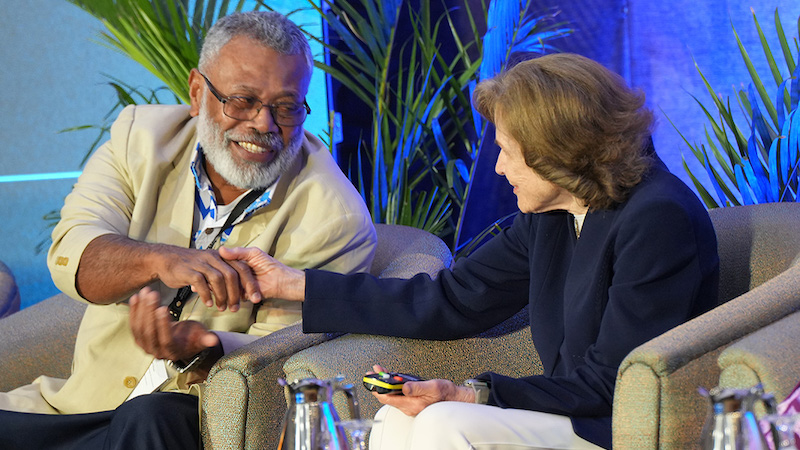
In a world grappling with escalating climate crises, the way forward can include both modern scientific knowledge and traditional wisdom, according to several expert speakers who took the stage this week at the 2024;East-West Center International Media Conference;during several sessions devoted to “New Climate Perspectives.” The presenters, including world-renowned oceanographer and explorer Sylvia Earle, urged the audience of more than 400 journalists and media professionals from 30 countries to explore holistic solutions that include affected communities and to hold everyone to account, even those pursuing alternative energies to fossil fuels.
In a video message, Nainoa Thompson, leader of the Hawai’i-based;Polynesian Voyaging Society, told the group that it is vital to integrate actionable science and data with “not just Indigenous knowledge, but the practices, the views, and the values that Indigenous people have learned over thousands of years of taking care of one’s place,” he said. “It’s the definition of stewardship.”
Joeli Veitayaki, a strategic adviser at;Blue Prosperity Fiji, noted that Indigenous peoples of the Pacific have long practiced sustainable methods of living that conserve natural resources. Today, community-led initiatives remain strong in Fiji, where the country’s “largest marine assessment undertaken in over the last hundred years” was just completed, Veitayaki said, and momentum is building around reclaiming beaches and replanting mangroves, among other projects. “We are using a combination of Indigenous and traditional knowledge and science-based methods to adapt to the existential threat that is affecting all aspects of our lives,” he said.
The Ocean’s vital role
Such efforts are crucial, since only three percent of the world’s oceans are considered fully protected from exploitation, said Earle, the founder of Mission Blue, an organization that is working to build a worldwide network of protected marine areas called “Hope Spots.” She detailed how the ocean plays a crucial role in maintaining the earth’s climate through what is called “blue carbon,” a term coined to convey the fact that more than half of all biological carbon kept out of Earth’s atmosphere is captured by living organisms in the sea.
Pollution, habitat destruction, overfishing, deep sea mining, and other harmful practices are degrading natural ecosystems in the water and, in turn, on land, she told the journalists. “Are we going to protect what remains of the natural fabric of life that keeps earth habitable? Or are we going to sacrifice it to developments like deep sea mining that are questionable in terms of whether we really need to do this for future prosperity?” she asked.
Earle pointed out that “humans have become the greatest predators of nature that there has ever been. What we’re putting into the ocean, as well as what we’re taking out of it, is having a magnified impact on those cycles of life.” Still, she remained optimistic that new technologies will lead to creative solutions to protect the planet. “This is our time, and as we have pointed out, the future is really with the next generation,” she said.
Green energy isn’t always ‘clean’
One facet of climate reporting that is often overlooked, according to Joan Carling, the executive director of Indigenous Peoples Rights International based in Baguio, Philippines, is the fact that a global push to shift to renewable energy has the potential to do more harm than good, particularly in areas where Indigenous peoples’ land is exploited. “Journalists can also play a crucial role by conducting more in-depth investigative reporting on the abuses and injustices faced by Indigenous peoples in the name of climate action,” Carling said. “This includes uncovering land grabs, forced evictions, environmental degradation, and human rights violations perpetrated by corporations and state authorities.”
Certain renewable energy projects may require the mining of metals and rare-earth minerals, which poses huge ecological challenges as well as a human cost, she said, criticizing hydropower and liquid natural gas projects in particular for displacing people from their homes and degrading land in Indigenous territories. These kinds of projects are often approved without the local population’s informed consent, she noted.
More funding needs to be directed to proven community-based renewable energy projects that involve Indigenous communities so they may have a greater sense of ownership, Carling said: “What we need to do is look for other options … and there are other options that have already been proven, like bio-gas or community-based solar and renewable micro-hydro projects. These are the ones that have actually worked on the ground, if only they are supported.”
An Air Force veteran released classified national defense information about aircraft and weapons to unauthorized individuals- the DOJ said he was indicted by a federal grand jury in Pensacola. #doj #florida #airforce #espionage #nationaldefense https://t.co/otGHth6ayt
— Robert Morton (@Robert4787) June 29, 2024
24 hours later:
1. Donald Trump remains a lawless, un-American psychopath.
2. Keeping Trump out of the White House is the ONLY thing that matters.
3. Joe Biden must do some immediate soul searching to determine if HE’S the one who can beat Trump. Because what happened last…
— Joe Walsh (@WalshFreedom) June 29, 2024