Categories
South Caucasus News

“Random successes”: Azerbaijani cinema today


This article was originally published on the JAMNews website on the 19th of June 2024.

Since gaining independence, Azerbaijan’s cinema has been trying to find its path, but it hasn’t been very successful so far,” says film critic Haji Safarov about the current state of modern Azerbaijani cinema.

Before the early 1990s, cinema in Azerbaijan, like in other Soviet republics, was controlled by Moscow. Film production was centrally managed, and the entire industry was state-funded. The collapse of the Soviet Union led to the downfall of the film industry.

Afterward, Azerbaijani cinema went through a long period of decline. Like many other sectors, the film industry experienced chaos and uncertainty for many years.

So, what has changed in our cinema during the years of independence? How much has Azerbaijan’s film industry been able to develop?

Film critic and creator of the channel “Film aç” (“Turn on the Film”) with a wide audience on social media, Haji Safarov, spoke to JAMnews about the challenges facing modern Azerbaijani cinema.

Film critic Haji Safarov. Photo from personal archive

“Currently, Azerbaijan is attempting to build its film industry, albeit very slowly. Why do I say ‘slowly’? Because in countries like Azerbaijan, where the film market is relatively small, the film industry cannot be developed solely through a free market. State support is necessary.

In this case, changes in Azerbaijan’s Ministry of Culture over the past few years and a general negative attitude towards the cinema sector have further delayed this entire process. For example, much time was spent on establishing the Azerbaijan Republic Film Agency, and there was hope that everything would improve thereafter. However, after its establishment, it became clear that we hadn’t fully formed the operational mechanisms, so it will take several more years to see results,” Safarov explains.

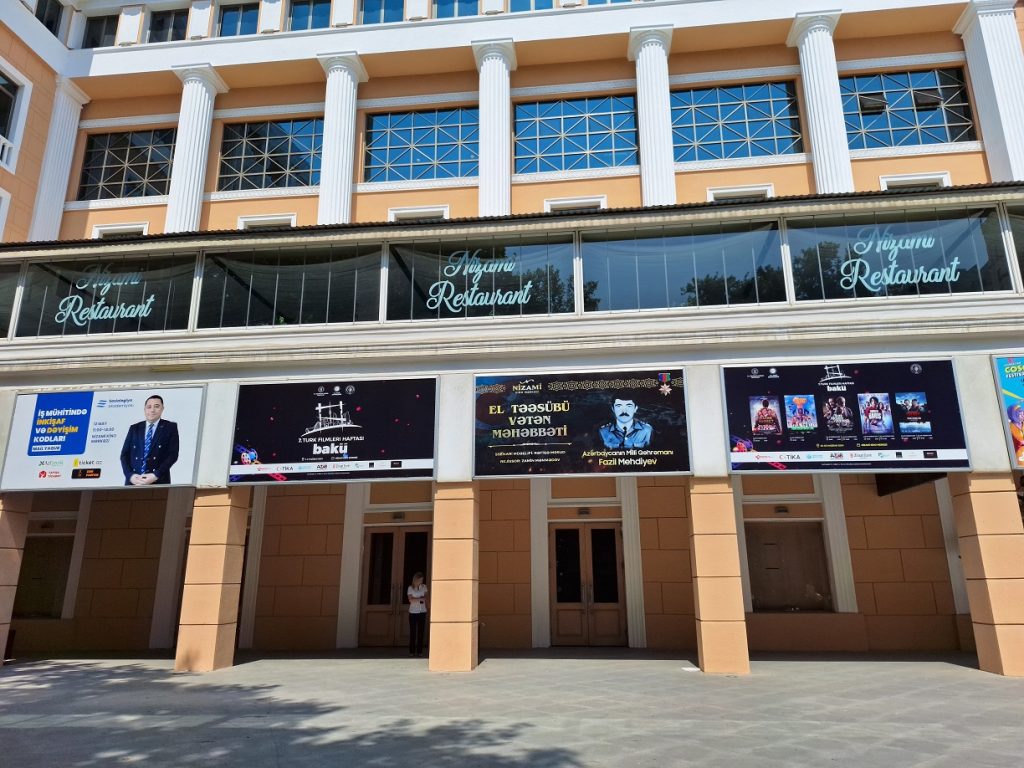
Currently, Azerbaijan has two private cinema chains operating – ‘Park Cinema’ and ‘Cinema Plus’. There is also the ‘Nizami Cinema Center’, which has existed since Soviet times, renovated and modernized to contemporary standards in 2011.

Nizami Cinema Center, which has been around since Soviet times, was renovated and modernized to contemporary standards in 2011. Photo by Fatima Movlamli / JAMnews.

During the first three months of 2024, these cinemas screened 12 domestic films.

According to State Statistics Committee data, out of 560 films shown in the country’s cinemas in 2022, only 60 were domestic productions. In last year’s statistics, this number did not exceed 40.

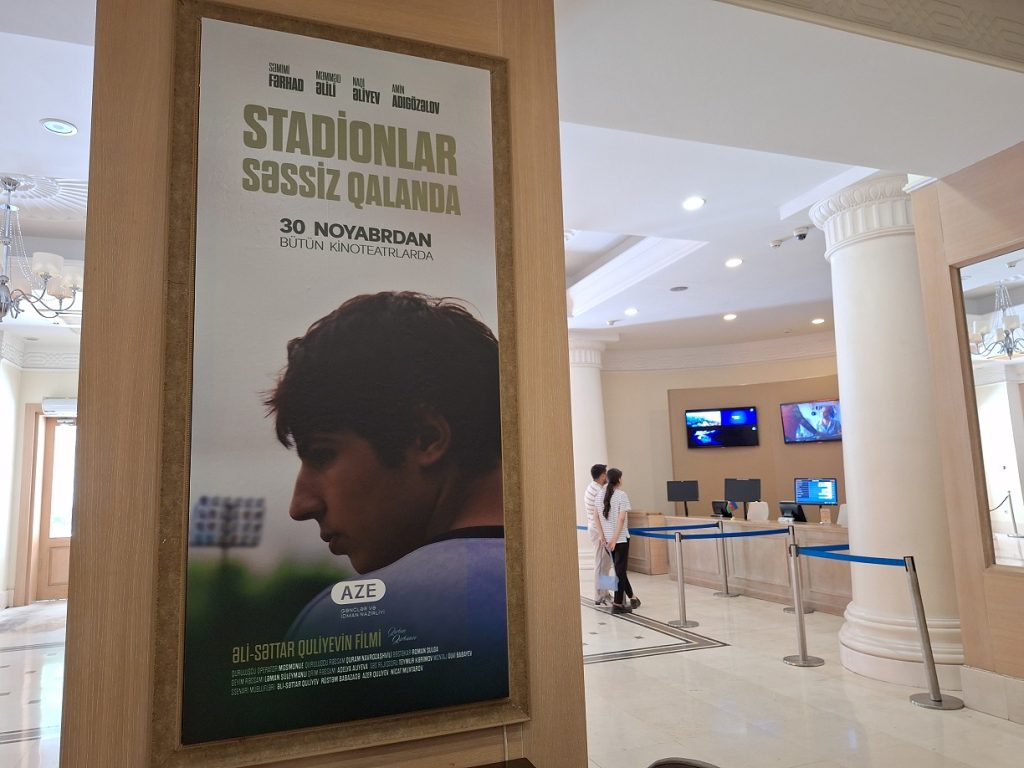
Poster of the film “When the Stadiums Fall Silent” by Azerbaijani director Ali-Sattar Guliyev. Photo: Fatima Movlamli / JAMnews

Haji Safarov attributes this to weak communication between the audience and the film industry.

Of course, local films are shown in cinemas. But not every film that is made can make it to the big screen. Cinemas may choose not to screen certain films if they don’t see audience interest. So, one of the reasons is related to the disconnect between the audience and the film industry. When these relationships are established correctly, when films generate interest among viewers, any result can be achieved,” says Safarov.

State support and censorship

Almost every year, a certain amount of money from Azerbaijan’s state budget is allocated to the film industry. For example, according to a decree signed by president Ilham Aliyev in 2019, five million manats (about $3 million) were allocated from the President’s Reserve Fund to the Ministry of Culture to ensure the implementation of projects related to state-commissioned film production, support for film production, and the creativity of young filmmakers.

In 2022, by decree of the country’s head, provisions were made for the activities of the Azerbaijan Republic Film Agency, with its statutory fund of 100,000 manats (about $58,800) to be formed from the state budget.

Does state support lead to censorship?

“International experience shows that in any country interested in developing its film industry, there is some form of state support. Even in the USA, there is support through tax incentives for filming in certain states or refunds on expenditures.

In Europe, the system is structured in a way where budgets are allocated through various tenders and grant competitions to filmmakers to produce new films. However, the key principle is that regardless of financial support, the state should not interfere in the creative process.

In Azerbaijan, all films are fully funded by the state, which inevitably leads to certain issues. By financing films entirely, the government sometimes sees itself entitled to influence their content, which can result in censorship in the creative process,” explains the film critic.

Haji Safarov believes that state support for the film industry is crucial because this sector requires significant funding. In this regard, he considers the European experience ideal:

“The state allocates a certain amount for part of the work, and producers try to find the remaining funds themselves. After production, the film recoups its costs through screenings in cinemas.”

“Cinema industry in Azerbaijan is not entirely free”

Haji Safarov points out bureaucratic forms of censorship:

“It wouldn’t be accurate to say that the film industry in Azerbaijan is free. However, it’s also incorrect to speak of complete censorship because our censorship mechanism is not well-structured. For example, independent individuals can make films on any topic they want. But here, bureaucratic obstacles sometimes arise, such as with filming on the streets.

To proceed smoothly, you need permission from several government bodies. When working with a team of more than five people, this inevitably attracts attention, and employees of various government agencies start asking questions like ‘Who are you and what are you filming here?’

However, international practice has a unified system where you submit an application with your film’s topic and promptly receive all necessary permissions.

In our country, for example, if you plan to film in Surakhani district in Baku, you’ll need permission from the executive authority of Surakhani district, the executive authority of Baku city, the Ministry of Internal Affairs, the district police department where the filming will take place, and so on,” explains Safarov.

He adds that sometimes obtaining these permissions takes a long time, which increases filmmakers’ expenses. If a film director plans to start shooting in two weeks, the entire crew cancels their other work from that date. But if permissions are not obtained by then, filming delays occur, and consequently, the crew has to pay fees for days when no actual work is done. This further reduces the already limited budget.

Few successes of local cinema

Some films and series produced in Azerbaijan in recent years have been successful not only among local audiences but also internationally. Haji Safarov considers these works, created by independent artists, as “accidental successes” of Azerbaijani cinema. This is because these successes do not progress along a continuous and increasing line.

“For instance, Elvin Adigezel’s film ‘Bilasuvar’ was selected to participate in the Busan International Film Festival, ‘Inner Island’ (‘Daxildəki ada’) for the Sarajevo Film Festival, and Hilal Baydarov’s film ‘When Persimmons Ripen’ (‘Xurmalar yetişən vaxt’) received awards at two major festivals. In other words, good films are made, albeit sporadically. Among the young generation, there are those whose projects are selected for many prestigious programs and supported, they may not be well-known to the masses, but the film community knows them.

Some series broadcasted on Public Television are also enjoying success. The recently aired series ‘Alatava’ was received with great interest. This, in itself, is an achievement.”

The film “Tar Barrel” (“Zəhər tuluğu”) by Taleh Yuzbekov was also highly successful in cinemas.

But these successes are not consistent. A person makes a film, and then for 10 years cannot do anything. Simply no opportunity.

So, of course, there are good films, but it’s just the success of a few films, not a consistent and sustainable success of the industry.”

In Azerbaijan, artists often complain about small fees and salaries. Actors, directors, screenwriters, and everyone else in the film industry claim that their work is not properly valued. This problem forces many talented individuals with high creative potential to seek additional income in show business and even the “wedding business.”

“You definitely have to do something else to earn extra money.

In short, people working in this industry are not rolling in clover. They do this work mostly out of love for cinema,” says Safarov.

However, according to the film critic, it can be said that Azerbaijani cinema has been moving in a positive direction since the 1990s, but this cannot be considered a sufficiently good result:

“Azerbaijani cinema needs the political will of the state that will be interested in developing this sphere. At the same time, people working in the film industry must focus on a common goal, work diligently for the greater good. For this, first and foremost, they must set aside their disagreements and put forward common demands so that political will can take action.”

The post “Random successes”: Azerbaijani cinema today appeared first on MEYDAN.TV.

Categories
Audio Review - South Caucasus News

Opposition Member Recognized as Aggrieved Two Months After Being Beaten During Protests


Irakli-Kupradze.png

On June 26, Irakli Kupradze, Secretary General of the opposition party Lelo for Georgia, was recognized as an aggrieved party more than two months after he was beaten by police during protests against the foreign agents law.

The opposition politician was detained during the peaceful protest on April 16. He accused riot police of politically motivated brutality and said that he was severely beaten during and after the detention.

The Special Investigation Service opened an investigation under Article 333 of the Criminal Code, which deals with the use of force or a weapon in abuse of official authority. According to the politician’s lawyer, Irakli Kupradze was subjected to physical violence by the police, which he says is evident from the video footage. However, the footage does not identify the police officer who beat him.

“These special forces must be punished. It is impossible to imagine their presence in law enforcement. The fact that sadists work in law enforcement [would be] against the interests of the state,” Kupradze said.

During the protests against the foreign agents law and after its subsequent adoption, many opposition politicians, members of civil society, activists, and ordinary citizens were battered by law enforcement or by the alleged government-paid “titushky”. Many of those detained during the protests also reported physical abuse by the police. In some cases, no investigation has been opened.

Also Read:


Categories
South Caucasus News

Opposition Member Recognized as Aggrieved Two Months After Being Beaten During Protests


Irakli-Kupradze.png

On June 26, Irakli Kupradze, Secretary General of the opposition party Lelo for Georgia, was recognized as an aggrieved party more than two months after he was beaten by police during protests against the foreign agents law.

The opposition politician was detained during the peaceful protest on April 16. He accused riot police of politically motivated brutality and said that he was severely beaten during and after the detention.

The Special Investigation Service opened an investigation under Article 333 of the Criminal Code, which deals with the use of force or a weapon in abuse of official authority. According to the politician’s lawyer, Irakli Kupradze was subjected to physical violence by the police, which he says is evident from the video footage. However, the footage does not identify the police officer who beat him.

“These special forces must be punished. It is impossible to imagine their presence in law enforcement. The fact that sadists work in law enforcement [would be] against the interests of the state,” Kupradze said.

During the protests against the foreign agents law and after its subsequent adoption, many opposition politicians, members of civil society, activists, and ordinary citizens were battered by law enforcement or by the alleged government-paid “titushky”. Many of those detained during the protests also reported physical abuse by the police. In some cases, no investigation has been opened.

Also Read:


Categories
South Caucasus News

В Азербайджанской Армии состоялся цикл мероприятий – ВИДЕО


В Азербайджанской Армии состоялся цикл мероприятий – ВИДЕО

По случаю Дня Вооруженных сил в войсках, объединениях, соединениях и воинских частях, в Отдельной общевойсковой армии, а также в специальных военно-учебных заведениях Азербайджанской Армии состоялся цикл мероприятий.
На мероприятиях сначала минутой молчания была почтена память Общенационального лидера азербайджанского народа Гейдара Алиева и шехидов, отдавших жизнь во имя суверенитета и территориальной целостности Азербайджана. Был исполнен Государственный гимн Азербайджанской Республики.
В ходе мероприятий было рассказано об истории образования Вооруженных Сил Азербайджанской Республики, о славном пути, пройденном нашей армией. Было отмечено, что благодаря беспрецедентным заслугам Общенационального лидера в области армейского строительства, равно как и во всех остальных областях, была создана регулярная армия, управляемая по принципу единого командования.
Под мудрым и дальновидным руководством Победоносного Верховного Главнокомандующего Ильхама Алиева сформирована высокобоеспособная армия. В Отечественной войне наша отважная армия за короткий срок уничтожила большую часть военной техники и значительное количество живой силы противника, освободила наши земли от оккупации и подарила нашему народу радость победы.
В соответствии с планом в воинских частях были организованы занятия по общественно-политической подготовке, «круглые столы», конференции, экскурсии в музеи, в том числе выставки книг, фотографий и рисунков, были продемонстрированы документальные и художественные фильмы, в рамках проекта «Письмо солдату» были направлены письма защитникам Отечества. Также были посещены могилы наших шехидов и проведены встречи с их семьями.
На праздничных мероприятиях были представлены концертные программы с участием солистов Армейского идеологического и культурного центра имени Ази Асланова, Идеологического и культурного центра Гянджинского гарнизона, деятелей культуры и искусства, коллективов районных отделов культуры.
На мероприятиях была награждена группа военнослужащих, отличившихся на службе.
День Вооруженных Сил торжественно отмечался и в представительствах Азербайджанской Республики за рубежом.

В Азербайджанской Армии состоялся цикл мероприятий – ВИДЕО


Categories
South Caucasus News

Azerbaijan Army holds a series of events – VIDEO


Azerbaijan Army holds a series of events – VIDEO

On the occasion of 26 June – Armed Forces Day, several events were held in the types of troops, Army Corps, formations, military units, Combined Arms Army and special educational institutions of the Azerbaijan Army.
At the events, the memory of the National Leader Heydar Aliyev and Shehids (Martyrs), who sacrificed their lives for the sovereignty and territorial integrity of Azerbaijan, was honored with observing a minute of silence. The National Anthem of the Republic of Azerbaijan was performed.
The events discussed the history of the establishment of the Azerbaijan Armed Forces and the glorious path of the Army. It was noted that, in all fields, including the field of army development, thanks to the unparalleled services of the Great Leader, a regular army managed by the principle of unified command was created. Today, under the wise and far-sighted leadership of the Supreme Commander-in-Chief of the Azerbaijani Army, Mr. Ilham Aliyev, an army with high combat capabilities has been formed. As a result of this, the brave Azerbaijan Army in the Patriotic War destroyed a large part of the enemy’s military equipment and a large number of manpower in a short period of time, liberating Azerbaijani lands from occupation and giving the nation the joy of victory.
According to the plan, socio-political training classes, roundtable discussions, conferences, museum excursions, including book, photo and painting exhibitions were organized in the military units, documentary and feature films were shown, letters to the defenders of the Motherland within the framework of the “Letter to the Soldier” project addressed. The graves of our Martyrs were also visited and meetings were held with their families.
Concert programs were presented with the participation of the Army Ideological and Cultural Center named after Hazi Aslanov, the Ideological and Cultural Center of Ganja Garrison, as well as representatives of culture and art, collectives of regional cultural departments.
A group of distinguished military personnel were awarded at the events.
26 June – Armed Forces Day was also solemnly celebrated in foreign representations of the Republic of Azerbaijan.

Azerbaijan Army holds a series of events – VIDEO


Categories
South Caucasus News

Azerbaijani FM meets with Deputy Minister of Foreign Affairs of Italy – Trend News Agency


Azerbaijani FM meets with Deputy Minister of Foreign Affairs of Italy  Trend News Agency

Categories
South Caucasus News

US Assistant Secretary of State will visit Azerbaijan – Radar Armenia


US Assistant Secretary of State will visit Azerbaijan  Radar Armenia

Categories
South Caucasus News

Azerbaijan, Italy open ‘new chapter’ of relations by starting technico-military cooperation – NEWS.am


Azerbaijan, Italy open ‘new chapter’ of relations by starting technico-military cooperation  NEWS.am

Categories
Audio Review - South Caucasus News

@mikenov: x.com/mikenov/status… October 7 #NewsAndTimes #NT #TNT #News #Times #World #USA #POTUS #DOJ #FBI #CIA #DIA #ODNI #Israel #Mossad #Netanyahu #Ukraine #NewAbwehr #OSINT #Putin #Russia #GRU #Путин, #Россия #SouthCaucasus #Bloggers newsandtimes.org thenewsandtimes.com…


https://t.co/LDdiCdswpy
October 7 #NewsAndTimes #NT #TNT #News #Times#World #USA #POTUS #DOJ #FBI #CIA #DIA #ODNI#Israel #Mossad #Netanyahu#Ukraine #NewAbwehr #OSINT#Putin #Russia #GRU #Путин, #Россия #SouthCaucasus #Bloggershttps://t.co/O0SIgLVWzMhttps://t.co/DO5LG3PY4T

— Michael Novakhov (@mikenov) June 26, 2024


Categories
Audio Review - South Caucasus News

@mikenov: Who was behind October 7? My Opinion: Putin and the GRU. As some seasoned observers said, “Putin’s fingerprints are all over the Hamas attack”. thenewsandtimes.blogspot.com/2024/06/who-wa…


Who was behind October 7?
My Opinion: Putin and the GRU. As some seasoned observers said, “Putin’s fingerprints are all over the Hamas attack”. https://t.co/xZrWSWM4Mv pic.twitter.com/gSjFbLucVn

— Michael Novakhov (@mikenov) June 26, 2024