
Israel Emerging As Source Of Tension In Azerbaijan’s Special Relationship With Turkey Eurasia Review
Day: June 24, 2024
Categories
NPR News: 06-24-2024 9PM EDT
“There are three sources of power in Chile: Pinochet, God and DINA.” — Chilean intelligence officer, remarks to a US military attaché, 1974
Decree 521 of the Chilean government of June 18, 1974, was a chilling moment in the country’s convulsed history.; With the state now in the pathologically disturbed hands of a military dictatorship steered by coup leader and usurper General Augusto Pinochet, the measure saw the creation of the Dirección de Inteligencia Nacional (DINA), the clandestine agency responsible for a good share of the mutilations and murders that came to typify the Cold War atrocities of the period.
DINA was, according to the decree, created for “the purpose of producing intelligence collection requirements for the formulation of policies, plans and adoption of measures required for the security and development of the country”.; The initial impression is a military wing bureaucratically inclined, dedicated to the mundane task of producing “intelligence collection requirements; for the formulation of policies, plans and adoption of measures required for the security and development of the country.” ;
Three secret articles supplied the bloody spears to what reads like a superficially benign enterprise, a fact revealed in 1975 by José “Pepe” Zalaquett, a lawyer and member of the human rights organisation known as the Committee for Peace.; DINA would run as a clandestine police force empowered to conduct surveillance, initiate arrests, torture detainees and liquidate individuals deemed hostile to the regime both within and outside its borders.;
On August 8, 1975, the US Ambassador to Chile, David Popper, drinks the usual Cold War draught: the country positively teams with dangerous left-wing types who, while being necessarily done away with for reasons of security, are being done so in circumstances of dissimulation and deception.; The cable to Washington is dismissive of death and duly cognisant of deception on the part of the Pinochet regime: “We conclude that reports describing deaths of disappearances of 119 Chilean extremists outside of Chile are probably untrue, though most or all concerned are probably dead.; Most probable explanation we can piece together for what will probably remain something of a mystery is that GOC Security Forces acted directly or through third party, planted reports in obscure publications to provide some means of accounting for disappearance of numerous violent leftists.”
The cable notes disinformation reports that “60 Chilean extremists had been killed outside of Chile as a result of internal purges in extremist groups arising out of conflicts over money, ideology, etc.”; There is even a nodding acceptance that a publication running material on the deaths in question, the Argentinean magazine Lea, is one “obscure”, probably running for one issue, and “may have used false publishing address, and appears to be tied to Lopez Rega and Right-wing Argentine groups.”; Even at the time, this account was found by such reports as John Dinges of Time magazine to be false.
In October 1975, the directorate’s overly enthusiastic director, Colonel Manuel Contreras, sought to harmonise efforts between his various secret police counterparts in Latin America in efforts to eliminate designated dissidents and leftwing targets.; They included Paraguay, Argentina, Uruguay, Brazil and Bolivia.; An invitation to Paraguayan General Francisco Britez that month supplies the first trace of a process that led to the creation of the murderous enterprise known as Operation Condor, arising from a Working Meeting of National Intelligence that took place in Santiago, Chile between November 25 and December 1.
The invitation also sports various attachments that document the bleak and bloody nature of what awaits.; In keeping with the temperament of all police chiefs, secret or otherwise, the enemy lurks and can be found everywhere.; South America is rife with “subversion” that was borderless in nature, featuring “infiltration” at all levels of society.; The Left was on its continental march, typified by such gatherings as the Tricontinental Conference in Havana.; To combat such a force required “an effective coordination” of timely exchange of information and experience.
By 1977, the human rights abuses of the regime by DINA were such as to deserve mention in an analytical report from the US Central Intelligence Agency.; It stood to reason, given that the directorate had, at that point, burgeoned to an organisation of 38,000 personnel underwritten by a $27 million budget.; Such agents of cruelty had to fulfil some role.
The tone of the report is one of regret, given Washington’s backing for the junta in its quest to quash the Left.; It notes how such violations had “nearly ceased earlier this year” but were “again on the rise.”; It further notes that the Pinochet regime was “reverting” back to those old practices that had affected “its international standing since the 1973 coup.”; The culprit for the spike in human rights abuses, involving instances of torture, illegal detentions, and “unexplained ‘disappearances’”: DINA. ;
The view of Contreras, as expressed in a press interview, was that his organisation had played a “decisive role” in reining in “extremism”.; As the Colonel was a Pinochet confidant and answering directly to him, it was “unlikely that he would act without the knowledge and approval of his superior.”
DINA’s murderously disruptive role in the hemisphere received greater scrutiny in 1979 with a Top-Secret Senate Staff Report “concerning activities of certain foreign intelligence agencies in the United States” authored for the Senate Foreign Relations Subcommittee on International Operations.; Chile receives a notable, if far from honourable mention.; As of January 1979, there was, as such, no Chilean intelligence officers stationed in the US but visits had been previously made using “false identification, and their activities were not known.”; The description is frank about Chile’s intelligence role in Operation Condor, one marked by assassinations and surveillance of “anti-regime activists”.; The intelligence services are also picked up on their “close liaison with the German Nazi colony of La Dignidad in Southern Chile, which makes its substantial resources available to it.”; A charming lot indeed.
With chilling revelation, the document mentions the directorate’s initial role in eliminating “subversives” in Chile proper, a task it had largely succeeded in doing by 1976.; The task then shifted beyond the borders, the focus being on Chilean dissidents in Europe and the rest of the Americas.; Victims of that effort were such notables as former Chilean ambassador to the United States, Orlando Letelier, brazenly killed in the US capital with a car bomb alongside his assistant Ronni Moffit in September 1976.
As the Senate Staff Report goes on to discuss, DINA was dissolved in August 1977, most likely under pressure from Washington “where sensitivity to Chilean repression was heightened by the assassination of Orlando Letelier, and also of pressure from within Chile.”; The official reason was that DINA had done what it set out to do.; A legacy most cruel and foul had been left, leaving a thickened trail of blood from Santiago to Washington.

You know the term “authoritarian.” You think you know what it means.;
An authoritarian dad, boss, or government says: my way or the highway. They are forever barking orders and see compliance as the answer to all human problems. There is no room for uncertainty, adaptation to time and place, or negotiation. It’s ruling by personal dictate while tolerating no dissent.;
To be authoritarian is to be inhumane, to rule with arbitrary and capricious imposition. It can also mean to be ruled impersonally by a machine regardless of the cost.
Sounds like a conventional government bureaucracy, right? Indeed. Think of the Department of Motor Vehicles. Think of the Environmental Protection Agency and the Department of Energy which are right now issuing edicts that will end in the ability of your washing machine to clean your clothes and your car to go the distance.;
They have been doing this to us for many decades, with or without the permission of Congress or the president. The agencies have become literally out of control in the sense that no one can control them.;
Any society managed by a large and intrusive bureaucratic machinery is necessarily authoritarian. A government that is not authoritarian is necessarily limited in size, scope, and range of power.;
Let’s say you have a political leader who has routinely called for less in the way of authoritarian rule by bureaucracies. He intends to use whatever power he has to curb the autonomous rule by administrative bureaucracies and subject them more to the wishes of the people, who should ideally be in charge of the regime under which they live.;
Such a leader would not be called an authoritarian. He would be called the opposite, an emancipator who is trying to dismantle authoritarian structures.;
If all of the above makes sense to you, try to make sense of this news;story;in the;New York Times. It’s about the growing efforts on the part of many activists to resist a second term of Donald Trump.;
In passing, the story says: “If Mr. Trump returns to power, he is openly planning to impose radical changes — many with authoritarian overtones” including “making it easier to fire civil servants.”
The story quickly adds that he intends to replace the fired employees with “loyalists.” Maybe. But consider the alternative. The president is supposed to be ostensibly in charge of;2 million plus bureaucrats that are employed by 400-plus agencies in the executive branch — but they don’t actually have to carry out the policies of the elected president. They can in fact completely ignore him.;
How is this compatible with either democracy or freedom? It is not. There is nothing in the Constitution about a vast army of bureaucrats who rule behind the scenes that is in no way reachable or manageable by elected representatives.;
The attempt to pull back, rein in, and otherwise do something about this problem is not authoritarian. It is the opposite. Even if “loyalists” replaced the fired employees, that would be an improvement over a system of government in which the people truly have no control at all.;
Two years into Trump’s first term, the administration came to figure out that this was a problem. The administration intended some dramatic turns in policy in a number of areas. All they experienced was dogged resistance from people who believed they and not the elected president were in charge. Over the next two years, they;undertook many efforts;to at least solve this problem: namely, the president should be in charge of the government that falls under his jurisdiction.;
This only makes sense. Imagine you are the CEO of a company. You discover that the main divisions that actually run the company care nothing about what you say and cannot be fired even if you demand it, and yet you are personally held responsible for everything these divisions do. What are you going to do?
It is not “authoritarian” to unseat or otherwise attempt to gain control over that for which you are held responsible, professionally or politically. That is truly all that the Trump people are suggesting. This is nothing other than a Constitutional system: we are supposed to have a government by and for the people. That means that the people elect the administrator of the executive branch. At a minimum, the winner of the election needs to be able to have some influence over what the agencies in the executive branch do.;
And for suggesting this and trying to make it happen, Trump is called an authoritarian. Prepare yourself: this will be said millions of times between now and November and following. Can the mainstream media just flat-out change the meaning of a term like this? They can but there is also every reason to push back and not let it happen.;
Language is a human construct. The more vibrant and fast-moving society is, the more the language changes. That can be a wonderful thing. In fact, one of my favorite books to read in off-hours is H.L. Mencken’s The American Language, written by this genius when he was otherwise censored for his views in wartime.
It’s a marvelous chronicling of the evolution of American usage, published in 1919, but oddly pertinent even today, applicable to the dwindling number of people who can still form coherent sentences.;
When it comes to vocabulary, there are two schools of thought broadly speaking: prescriptivist and descriptivist. The prescriptivist view is that words have embedded meanings that you can trace from other languages and should be used as intended. The descriptivist approach sees language as more a living experience, a tool of utility to make communication possible, in which case anything goes.;
As Americans, we mostly accept the descriptivist outlook but this can go too far. Words cannot mean literally anything, much less the opposite. But this is exactly what is happening. It’s the same with the word “democracy,” which is supposed to mean the people’s choice, not whatever elites dish out to us. If Trump is the choice, so be it. That is the unfolding of democracy.;
If we want the president to be the CEO of the executive branch of government —;and that’s a pretty good description of what the US Constitution establishes — then the administration ought to have that managerial authority. If you don’t like it, take it up with the Founders.;
Again, any society managed by a large and intrusive bureaucratic machinery is necessarily authoritarian. A government that is not authoritarian is necessarily limited in size, scope, and range of power.;
Any one president who takes action to curb the power and reach of arbitrary authority is not an authoritarian, but rather one who seeks to give authority back to the people. Such a man would be an emancipator, even if everyone said otherwise.;
- This article was published at Brownstone Institute
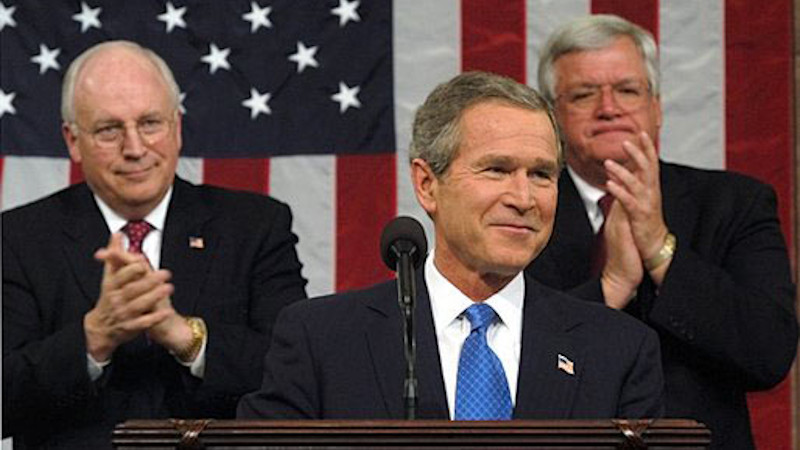
In 2001, after the horrific 9/11 attacks, an apoplectic George W. Bush administration ignored Congress’s narrow authorization to use military force against the perpetrators of the attacks and those who harbored them. Instead, it launched a grandiose global war on terror much broader than those wisely limited legislative instructions. Congress’s authorization attempted to restrict U.S. retaliation to the al Qaeda group sheltering in Afghanistan and their Taliban hosts then ruling that country. Instead, President Bush proclaimed a wider war on terrorist groups having “global reach.”
Bush took advantage of the American public’s blind outrage over the 9/11 attacks on U.S. soil and its ignorance that all Islamist groups, and even some rulers of Muslim countries, were not somehow implicated in the terror strikes on two American cities. Instead of using surgical raids and strikes to decapitate al Qaeda and Taliban leaders in Afghanistan, Bush ignored the failures of the British (in the late 1800s and early 1900s) and the Soviets (in the 1980s) in the “graveyard of empires” by ordering an invasion of that country to topple the Taliban and stand up a working democracy there. This two decades–long nation-building attempt to bring democracy to a country that wasn’t developmentally ready for it yet;cost 243,000 lives and $2.3 trillion and ended in failure—with a resurgent Taliban reinstituting its oppressive rule.
Osama bin Laden, al Qaeda’s main leader, was not killed until 2011 by Bush’s successor, Barack Obama, because, despite the U.S. counterinsurgency quagmire in Afghanistan, Bush soon transferred many key intelligence and military resources to his higher priority invasion of Iraq. Falsely linking Iraq’s ruler Saddam Hussein to the 9/11 attacks, he involved the U.S. military in a costly, long counterinsurgency against Sunni guerrillas, which arose to fight the foreign invaders after Saddam had been toppled. One of these Sunni groups, al Qaeda in Iraq, morphed into the terrorist group Islamic State, or ISIS, which eventually took over vast swaths of land in Syria and Iraq.
Bush also conducted indiscriminate brushfire wars on many other Islamist groups in countless other countries, without regard to whether the groups posed an actual threat to the United States or were motivated by local grievances. In so doing, Bush was merely doubling down on the reason bin Laden had attacked the United States in the first place—excessive U.S. meddling in Islamic countries. Finally, Bush’s over-the-top war on terror also involved illegal surveillance within the United States, jailing suspected terrorist detainees without charges and the legal means to challenge their detention, the use of illegal torture on them, and the use of questionable kangaroo military commissions to try them instead of constitutionally guaranteed civilian trials.
But the war on terror didn’t end when Bush left office. Obama continued all these wars and started his own; his successor, Donald Trump, amped them up further. After seeing and inheriting Bush’s foibles in Afghanistan and Iraq, in a move that proved as disastrous as Bush’s invasion of the latter country, Obama took advantage of the Arab Spring uprisings in 2011 to help eliminate the Libyan dictator Muammar Gaddafi, a previous thorn in America’s side who had been playing ball with the West for some years.
Predictably, when popping the top off an iron-fisted dictatorship that holds a fractious country together, civil war and chaos were likely to ensue—and they did so in Libya as it did in Iraq. In fact, the rise of Islamist groups in the African Sahel, a semi-arid region south of the Sahara Desert, began when Mali fighters, who had defended Gaddafi, returned home to begin a rebellion with the plethora of weapon stocks from the late Libyan leader. Taking advantage of the turmoil, Islamist groups began to take over cities. A foreign intervention by the French pulled in other Western countries, including the United States, and expanded to other nearby West African countries in search of Islamists. Learning nothing from Vietnam, Afghanistan, and Iraq,;France and the United States worked with governments perceived locally as corrupt.
This corruption was the kiss of death for the counterterrorism and counterinsurgency campaign that the French and Americans were prosecuting in the West African Sahel. Unlike conventional war between mass armies, as in Russia’s invasion of Ukraine, the success of such irregular wars, when it can be had, revolves around good governance rather than military suppression of the terrorists or guerrillas. In other words, these irregular forces usually have local grievances with particular governments. And in those brushfire wars, foreign intervention to help the corrupt governments further inflames the jihadists, as has happened as the Islamist rebellion spread against other American or French client states in West Africa. Despite the insertion of American and French troops and hundreds of millions of dollars in military aid, these foreign interventions have failed. Military coups in several Sahel countries (some perpetrated with the help of American-trained local forces) have expelled French and American forces, and al Qaeda and ISIS are resurgent against these new military juntas.
Governments, especially the U.S. superpower, never seem to learn. Instead of admitting that democracy cannot be exported using military force to countries not yet ready developmentally to generate the middle class and political norms for it to arise organically, the U.S. government is merely shifting its nation building projects to countries on the coast of West Africa. The Biden administration is naively offering these coastal nations a 10-year plan to build solar-powered security lighting and new police stations to help nix terrorism.
Of course, the larger issue is that U.S. officials admit that local grievances are fueling the insurgencies rather than Islamist ideology. Thus, even experts say that nation-building approaches, such as water or electrification projects, face daunting odds of succeeding. Moreover, identifying a threat to the United States by these local Islamist groups is difficult. The Chinese may be after minerals and the Russians may be trying to replace the U.S. and France to gain influence, but their efforts are likely to be as much a waste of time and money as that of the United States.
- This article was also published in The American Conservative
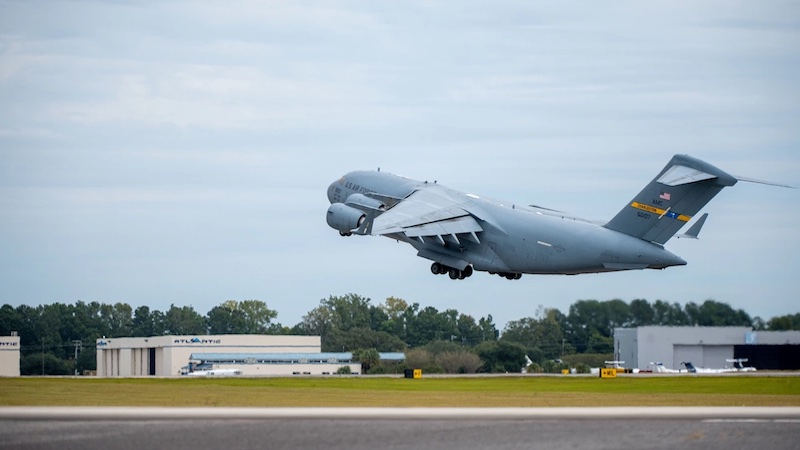
Boeing has introduced the new REVOLVER launcher system. This system is expected to significantly upgrade the C-17 Globemaster III, allowing it to carry powerful hypersonic missiles.
This state-of-the-art launcher features two drums that load one after the other and an electromagnetic catapult. This setup enables it to swiftly fire up to 12 Boeing X-51A Waverider hypersonic missiles. The drums hold the missiles and the catapult launches them rapidly, allowing the launcher to deploy all 12 missiles in a short period. Thanks to this design, each missile can be launched quickly and precisely, enhancing the USA’s air strike capabilities.
The C-17 Globemaster III is the US Air Force’s second-largest aircraft after the C-5M Super Galaxy. It is often called the ‘Buddha’ because of its strong and sturdy look. The C-17 Globemaster III can carry 102 paratroopers, 54 medical patients, or 85 tons of cargo, including tanks. It has a crew of three and can fly from the US to nearly any place in the world with mid-air refuelling.
This flexible military transport plane is great at moving troops, carrying out medical evacuations and transporting cargo. The C-17 can carry about 172,000 pounds (78,000 kg) of cargo and has a range of 2,765 miles (4,450 km), making it crucial for worldwide military missions. Advanced systems, such as the REVOLVER launcher, boost its effectiveness in modern military logistics.
Boeing has shared virtual images and videos of the REVOLVER launcher system to demonstrate its capabilities. Although it has not been installed in the C-17 Globemaster III yet, these visuals highlight its potential, according to a report by Interesting Engineering. The previews show how the system can quickly launch hypersonic missiles and hint at its possible impact on air combat.
Modern Warfare with X-51A
The system can launch the X-51A, a hypersonic cruise missile with a scramjet engine that travels faster than a speed of Mach 5 (over 6,400 km/h). This will allow for accurate long-distance strikes.
Over the coming years, test and integration; of the X-51A Waverider and the REVOLVER launcher on the C-17 aircraft will demonstrate advancements that have been made in military technology. This system aims to enhance military operations by quickly launching high-speed missiles and establishing new defence standards.
US Edge in Pacific Arms Race
The US Air Force, in March, for the first time, tested a hypersonic cruise missile in the Pacific. This move is viewed as a message to China, showing that the US is still competitive in an area where China is thought to have an edge.
On March 17, a B-52 bomber from Andersen Air Force Base in Guam launched “a fully operational hypersonic missile prototype”, an air force spokesperson told CNN. Hypersonic glide vehicles travel faster than Mach 5, at about 4,000 miles/hour (over 6,400 km/h), making them hard to detect and intercept. They can also change direction and altitude, which helps them avoid current missile defence systems.
US officials recognize that China and Russia are aggressively advancing in hypersonic technology. The non-partisan group—which is an organization that does not support, or align with, any political party or agenda and aims at providing unbiased and objective information, or advocacy, on specific issues—the Missile Defense Advocacy Alliance, reports that, since 2014, China has been testing hypersonic glide vehicles that can carry both nuclear and conventional warheads.