
Azerbaijan’s share in the natural gas market of the European Union has been reported, Azernews reports, citing the data reported by the European Commission regarding the previous year.
Day: June 18, 2024
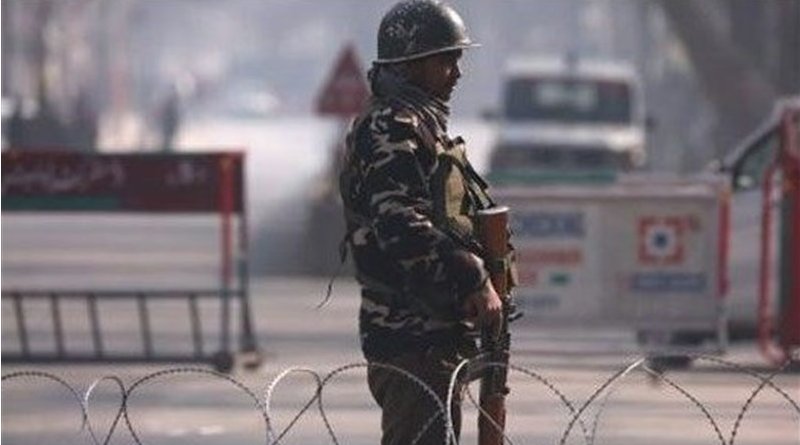
On June 9, Pakistan sponsored terrorists opened indiscriminate fire on a bus carrying pilgrims in the Reasi district of J&K killing nine and injuring 33 passengers. The date and timing of this dastardly attack as well as the target weren’t randomly selected -while the date and timing coincided with the oath taking ceremony of Indian Prime Minister Narendra Modi, the passengers travelling in the bus that was attacked were exclusively Hindu devotees who were on pilgrimage.
Needless to say, this cold blooded massacre that occurred as Modi took oath for his third consecutive term as Prime Minister followed by three other terror attacks within 72 hours was primarily meant to mock New Delhi’s claim of normalcy returning to J&K. Similarly, the obvious objective of targeting a bus exclusively carrying Hindu pilgrims was to incite communal violence as it would buttress Islamabad’s ludicrous narrative that Muslims in India are getting a raw deal.
However, the plan of Pakistan army’s spy agency Inter Services Intelligence [ISI] which is directing the ongoing proxy war in J&K to create mayhem through this extremely perverse act has failed. This incident has created such intense revulsion that even pro-Pakistan All Parties Hurriyat Conference [APHC] whose tallest leader SAS Geelani had proudly admitted that;“we never denied or ignored the role of [the gun] in our struggle,”;had to issue a statement condemning the Reasi bus terrorist strike!
Now that its brazen provocation has failed to create unrest, the Pakistan army is visibly rattled by the looming threat of retribution by India which is evident from the otherwise reticent Pakistan army chief Gen Syed Asif Munir suddenly turning offensively vocal after the Reasi bus terrorist attack. As per;The Express Tribune, he has noted;“that post-election, India has been attempting to mask its aggression with false propaganda and provocations against Pakistan,”;but he hasn’t been able to substantiate these allegations.
By talking about;“false flag operations”;and threatening;that;“any provocation or violation of Pakistan’s territorial sovereignty will be met with a swift and resolute response,”;Gen Munir may be trying to put up a brave face. However, the timing, tone and tenor of his rant leaves no room for any doubt that he’s definitely perturbed by the distinct possibility of New Delhi avenging the cold-blooded murder of innocent Indians, and since such retribution already has a precedent, Rawalpindi’s apprehensions are well founded. It’s also an admission of complicity and guilt!
While New Delhi is under public pressure to take punitive action as the majority feel that there is no other language which Pakistan understands, there are some who despite being aware of Pakistan’s brazen duplicity on the Kashmir issue still believe that talks can normalise the situation. National Conference [NC] president Farook Abdullah is one such person who feels that the present government in Pakistan wants “to have a peaceful atmosphere with us,”;and hence suggests “Let’s open the door to them.”
While the NC president’s optimism is praiseworthy, past experience has proven beyond any doubt that expecting any positive move from Islamabad’s side to amicably resolve the Kashmir issue is [to say the least], being acutely delusional. What needs to be clearly understood is that even if Islamabad is keen to normalise relations with India, Rawalpindi will definitely play spoiler and being the last word in Pakistan’s Kashmir policy, the army will never allow any rapprochement between New Delhi and Islamabad, simply because normalcy would demolish Rawalpindi’s contrived narrative of it being the nation’s ultimate bulwark that’s keeping Indian hegemonistic ambitions at bay!
Those who advocate peaceful resolution of the Kashmir issue through are perhaps not aware of the reality coming right from the proverbial horse’s mouth. In his book;‘The Other Side of The Mountain’,;Former Indian External Affairs Minister Salman Khurshid has mentioned the then Indian Prime Minister Manmohan Singh telling his Pakistani counterpart Nawaz Sharif on the sidelines of the UN General Assembly in September 2013 that;“Mian Saheb, no Indian Prime Minister can sign away Kashmir, and nor can I…”
Two years later, while addressing the inaugural session of Srinagar Media Summit organised by Lehar NGO, veteran journalist Kuldip Nayyar mentioned that;“My friendship with Nawaz Sharif goes back a long way,”;and revealed that;“I met him in Jeddah [Saudi Arabia] during his wilderness years… He told me ‘Neither we can take Kashmir from you, nor you can give Kashmir [to us]’.”;With Nawaz Sharif [who is president of PML-N party which is currently part of Pakistan’s coalition government] expressing helplessness on the issue of Kashmir, how can one expect it to be sorted out through talks?
Lastly, it would be worthwhile for those who still think that the Pakistan sponsored proxy war in J&K can be ended through dialogue to understand the near complete dependence of Islamabad’s feeble Kashmir narrative on terrorism. In an interview given to;Der Spiegel;in 2010, when asked;“Why did you form militant [terrorist] underground groups to fight India in Kashmir,”;former president of Pakistan and its ex army chief Gen Pervez Musharraf nonchalantly replied,;“They were indeed formed. The government turned a blind eye because they wanted India to discuss Kashmir.”
Eight years later, during an interview with a domestic news channel, Gen Musharraf not only disclosed that;“In 1990s the freedom struggle [terrorism] began in Kashmir…At that time Lashkar-e-Taiba [LeT] and 11 or 12 other organisations were formed,”;but also went as far as accepting that;“We supported them and trained them as they were fighting in Kashmir…”;[Emphasis added]. This admission of Rawalpindi using terrorists to wage proxy war in J&K is buttressed by none other than chief of the ISI created United Jihad Council and head of Hizbul Mujahideen Syed Salahuddin who has admitted that;“we are fighting Pakistan’s war in Kashmir.”;[Emphasis added].
Since it’s giving Rawalpindi the low cost option of bleeding India through a thousand cuts, how can anyone expect Pakistan to give up sponsoring terrorism in J&K?
While the NC president and others who opine that military action will not resolve the Kashmir imbroglio are spot-on, given Rawalpindi’s obdurate stance, parleys not be of any help either. This is exactly what Abdullah has implied by observing that “The terrorists are coming through borders, and they will continue coming. Whichever government will be there tomorrow, will have to face the same thing…”;So, while his genuine concern and anguish;“that innocent people are getting killed,”;is understandable, the NC president’s belief that this tragedy can be overcome through dialogue is unfortunately misplaced.
Accordingly, while military action may not end the incessant tribulations of the Kashmiris caused by terrorism, punitive action against perpetrators would certainly serve as a deterrent, and hence is the only practical option available to New Delhi for ensuring that terrorist violence levels do not spiral out of control!
Secretary General Jens Stoltenberg met with U.S. President Joe Biden at the White House in Washington D.C. on Monday (17 June 2024), announcing new defence spending figures and outlining priorities for the upcoming NATO Summit.;
Mr Stoltenberg announced that in 2024, defence spending across European Allies and Canada is up 18 percent, “the biggest increase in decades.” He further confirmed that 23 Allies will meet the target of spending at least two percent of GDP on defence. Over the past four years, the number of Allies hitting that target more than doubled.
Mr Stoltenberg thanked President Biden for his leadership and strong commitment to NATO. He highlighted that NATO is making America stronger by advancing US interests. In response to the changing security landscape, Allies have put forth the most comprehensive defence plans since the Cold War, featuring more forces, capabilities, and investment. On Ukraine, the Secretary General stressed the need to continue to provide long-term support, arguing that the stronger support is for Ukraine, the sooner Russia’s war will end. He welcomed the 10-year bilateral security agreement between the US and Ukraine and said that at the Washington Summit, leaders are expected to agree a greater NATO role in coordinating security assistance and training for Ukraine, as well as a long-term financial pledge.;
Earlier, Mr Stoltenberg delivered a speech at the Wilson Center. He emphasised that keeping Europe safe and NATO strong is in the vital national interest of the United States. “This was true 75 years ago. It is true today and will continue to be the case in the future,” he said. Talking about deterrence and defence, the Secretary General said that European Allies are “doing far more for their collective security.” They are investing a lot more in defence and spending a lot of this money in the US. He pointed out that since 2022, “over two-thirds of European defence acquisitions were made with US firms.” He added: “NATO is good for US security, good for the US industry, and good for US jobs.”
The Secretary General is on a week-long visit to North America. On Tuesday, he will meet with Secretary of State Antony Blinken and engage with Senators. On Wednesday, Mr Stoltenberg will travel to Ottawa to meet with Canadian Prime Minister Justin Trudeau. He will return to Washington D.C. on Thursday to meet with National Security Advisor Jake Sullivan and Members of the U.S. Congress.
India and the United States are in advanced talks to jointly produce the latest generation of Stryker armoured infantry combat vehicles. This effort is part of a larger plan for defence-industrial cooperation. Recently, the US offered to show the mobility and firepower of the Stryker in high-altitude areas of India. First Post quotes The Times of India as saying that the Indian defence ministry is looking into a three-phase plan for this project.
The project will, initially, purchase a limited, off-the-shelf consignment of Strykers through the US Foreign Military Sales (FMS) programme. After that, there will be joint production in India and, eventually, they will co-develop advanced versions of the vehicle, the First Post report adds.
The entire plan depends on the Stryker meeting the operational needs of the Indian Army’s mechanized infantry units and achieving a high level of local production. This includes transfering important technologies to the Indian co-production partner, which could be a defence public sector undertaking (PSU), or a private company.
The Indian Army needs a large number of advanced wheeled and tracked infantry combat vehicles (ICVs) to replace its current fleet of over 2,000 Russian-made BMP-II vehicles in the next few years. The Ministry of Defence (MoD) is also working on indigenous projects to meet this demand.
The US is actively promoting the Stryker vehicles. Before US National Security Adviser Jake Sullivan’s visit to India, US Secretary of Defense Lloyd J Austin highlighted the “co-production of armoured vehicles with India” as a sign of the growing defence partnership between the two countries during the Shangri-La Dialogue in Singapore two weeks ago. Since 2007, the US has secured Indian defence deals worth about $22 billion.
Features and Abilities of Stryker
- Stryker: A Versatile Armored Platform
The Stryker is an armoured infantry combat vehicle (ICV) based on the Canadian light armoured vehicle, LAV-III—a type of armoured vehicle used by the Canadian military—which, in turn, is derived from the Swiss Mowag Piranha. General Dynamics Land Systems-Canada (GDLS-C) manufactures these vehicles at a plant in London, Ontario, in Canada. Two US Servicemen—Pfc Stuart S Stryker and Spc4 Robert F Stryker, who posthumously received the Medal of Honor—were inspiration behind the ICV’s name.
- Durable, Flexible, All-Terrain Mobility
Strykers are robust vehicles that weigh 19 tons and have eight wheels. They have the flexibility to function in both 4-wheel and 8-wheel drive modes. One of their key features is their blast-resistant and fireproof armoured tyres, enhancing their durability and safety. This makes them highly versatile and reliable in various conditions.
A 4-wheel drive mode means that power is only sent to four of the vehicle’s eight wheels. This mode is typically used for regular driving on smoother surfaces, where full traction—the grip or friction between a vehicle’s tyres and the surface it is driving on—is not needed. Good traction means the tyres can effectively ‘stick’ to the road, which helps the vehicle move forward, stop and turn without slipping.
In the 8-wheel drive mode, power is sent to all eight wheels, providing maximum traction. It is used for rough or slippery terrain, helping the vehicle move more effectively in difficult conditions.
The vehicles can carry nine soldiers and a crew of two. It can reach a top speed of around 60 mph (97 km/h) and have a range of 330 miles (531 km) with just 53 gallons (200 litres) of fuel. They are manoeuvrable and can operate on various types of terrain.
- Firepower, Protection, Remote Capabilities
A quick refuel can extend their operation time, and speed is not the only advantage of a Stryker. While mainly used to transport soldiers safely, the Stryker is also armed. Each vehicle usually comes with an M2 .50 calibre machine gun or an MK19 40mm grenade launcher. Soldiers can operate both weapon systems remotely, so they do not need to be inside a turret to fire them.
The Stryker can also support an M240 7.62mm machine gun. Its armour protects the occupants from 14.5mm bullets and against 152mm artillery airbursts. Extra armour can enhance protection, allowing the Stryker to withstand rocket-propelled grenades (RPGs) and other high-explosive weapons.
- Diverse Variants on a Common Platform
The Stryker armoured vehicle (IAV) offers the army a range of 10 different vehicles built on a common chassis. There are two main types of Strykers
- The Infantry Carrier Vehicle (ICV) and
- The Mobile Gun System (MGS)
The ICV comes in eight additional configurations
- Mortar Carrier (MC)
- Reconnaissance Vehicle (RV)
- Commander’s Vehicle (CV)
- Fire Support Vehicle (FSV)
- Medical Evacuation Vehicle (MEV)
- Engineer Squad Vehicle (ESV)
- Anti-Tank Guided Missile Vehicle (ATGM) and
- Nuclear, Biological, and Chemical Reconnaissance Vehicle (NBCRV)
President Vladimir Putin’s visit to North Korea comes at a crucial time for global relations and signifies a significant shift in geopolitical dynamics. This visit not only highlights the strengthening of Russia-North Korea relations but also has profound implications for the Korean Peninsula and the international community as a whole. This essay explores the multifaceted consequences of this diplomatic engagement, examining its impact on regional stability, geopolitical alliances, and the global response to North Korea’s contentious activities.
Strengthening Russia-North Korea Relations
Putin’s visit to North Korea signifies the strengthening of diplomatic and economic ties between Moscow and Pyongyang. Throughout history, Russia has maintained a cautious yet supportive relationship with North Korea, driven mainly by strategic and economic interests. This visit reaffirms that relationship and has the potential to enhance bilateral cooperation in various sectors, such as trade, energy, and military technology. By forming such an alliance, North Korea would gain a crucial economic lifeline in the face of strict international sanctions, enabling them to alleviate some of the economic pressures imposed by the United Nations and Western powers.
Geopolitical Dynamics and Regional Reactions
The visit has implications beyond the bilateral relationship and has the potential to impact the broader geopolitical landscape of East Asia. For South Korea and Japan, who are traditional allies of the United States, the strengthening ties between Russia and North Korea raise significant security concerns. These nations may see the visit as a direct challenge to their security interests, leading them to reevaluate their defence strategies and diplomatic approaches. Additionally, the United States, which has long sought to isolate North Korea through sanctions and diplomatic pressure, sees this development as undermining its efforts. As a result, the U.S. could increase its military presence in the region or enhance diplomatic engagements with South Korea and Japan to counterbalance Russian influence
Impact on Sanctions and International Response
One of the immediate implications of Putin’s visit is the potential to weaken the international sanctions regime against North Korea. By establishing robust trade and financial channels with Russia, North Korea could alleviate some of the economic pressures that have crippled its economy. However, this would likely provoke a strong response from Western countries, potentially leading to new rounds of sanctions or diplomatic measures against both Russia and North Korea. The European Union and other global powers may also join these efforts, seeking to uphold the integrity of the international sanctions framework and prevent erosion of its effectiveness, particularly in influencing the North Korean nuclear program.
The visit could have significant implications for North Korea’s nuclear ambitions. If cooperation with Russia is enhanced, it may provide Pyongyang with critical resources, technology, and expertise to advance its nuclear and missile programs. This scenario would worsen security concerns not only for neighbouring countries but also for the international community as a whole. The possibility of North Korea accelerating weapons development could lead to a regional arms race, with South Korea and Japan potentially bolstering their military capabilities in response. Moreover, this could hinder denuclearization efforts and complicate negotiations, making it even more challenging to achieve a peaceful resolution to the North Korean nuclear issue.
Regional Stability and Military Tensions
Putin’s visit to North Korea may increase tensions on the Korean Peninsula, raising the risk of military conflicts. The fact that a major power like Russia supports North Korea might make Pyongyang more confident and inclined to adopt a more aggressive approach towards South Korea and other regional players. This enhanced assertiveness could result in more frequent missile tests, military drills, or even border skirmishes, further destabilizing the region. Furthermore, the visit could impact peace negotiations by potentially hardening North Korea’s negotiating stance, making it more challenging to achieve meaningful progress in diplomatic talks aimed at reducing tensions.
Broader International Implications
On a global scale, the visit reflects Russia’s broader strategic objective of asserting influence and challenging US dominance in international affairs. By aligning closely with North Korea, Russia aims to expand its geopolitical reach and create a counterbalance to Western hegemony. This strategy might inspire other countries under international sanctions, such as Iran or Venezuela, to seek similar alliances, thereby complicating global diplomatic and economic relations. Furthermore, the visit highlights the shifting dynamics of international alliances, where traditional power blocs are increasingly being questioned and redefined in response to evolving geopolitical realities.
Conclusion
The visit of Russian President Vladimir Putin to North Korea has important implications for the Korean Peninsula and the international community. The growing relationship between Russia and North Korea could potentially destabilize the security environment in the region, undermine international sanctions, and expedite North Korea’s nuclear program. Additionally, this visit reflects Russia’s larger strategy of challenging Western dominance and reshaping global alliances. Therefore, it is crucial for the international community to closely monitor these developments and responses to maintain stability and ensure the effectiveness of the global sanctions regime. This visit serves as a clear reminder of the complexities and interconnectedness of contemporary international relations and actions, where the actions of one state can have far-reaching consequences for global peace and security.
The opinions expressed in this article are the author’s own.
.References
- Chestnut Greitens, S. (2019). “North Korea’s Strategies to Adapt and Deter: Building a Domestic Knowledge Base for Counter-Sanctions.” Asia Policy, 14(2), 39-64.
- Haggard, S., & Noland, M. (2017). “Hard Target: Sanctions, Inducements, and the Case of North Korea.” Stanford University Press.
- Kim, D. (2020). “The Impact of U.S. Policy on the Security Environment of Northeast Asia.” Journal of East Asian Affairs, 34(1), 123-145.
- Revere, E. J. R. (2019). “The U.S. and North Korea: No “Art of the Deal”.” Brookings Institution Report.
- Rumer, E. (2019). “Russia in the Middle East: Jack of All Trades, Master of None.” Carnegie Endowment for International Peace.
As often reiterated, Russia and Zimbabwe have had an excellent bilateral relations, dating from the time of Zimbabwe’s struggle for political independence. Soviet Union supported with military equipment, training specialists and offered humanitarian supplies, and until today Zimbabwe is still looking for such bilateral relations. A comprehensive analysis indicates that not much is visible on the landscape of Zimbabwe, except frequent shuttling visits of government officials between Harare and Moscow.
The list of those official visits could be found on government websites. Of course, not all have been documented there such as those dealing with military-technical cooperation and intelligence services. But it can also be recalled here in 2022, Speaker of the National Assembly of the Republic of Zimbabwe Jacob Mudenda and his delegation paid a reciprocal working visit late September to Moscow, held separate meetings with Russian Upper House Speaker Valentina Matviyenko and Chairman of the State Duma Vyacheslav Volodin, and finally addressed the plenary session of the State Duma.
Upper Chamber Senator Matviyenko and Lower Chamber Legislator Volodin, both have similar unique declaratory statement emphasizing the fact that Russia considers cooperation with African countries to be a foreign policy priority. And that Zimbabwe is Russia’s priority in southern African region.
Upper House Speaker Valentina Matviyenko visited and donated, as Zimbabweans expected from Moscow, huge gifts in June 2022. During her conversation with the head of the charitable foundation and First Lady of the Republic of Zimbabwe Auxilia Mnangagwa with Matviyenko noted mutual understanding that has developed in Russian-Zimbabwean relations. She, in addition, drew attention to the fact that the Angels of Hope charity fund coordinates the selection of candidates from low-income families for higher education in Russia under the quota of the Government of the Russian Federation.
“We highly appreciate it that the Zimbabwean leadership remains committed to the development of bilateral relations and mutually beneficial cooperation with Russia. And that Zimbabwe is resolutely resisting the unprecedented pressure of the collective West led by the United States, their open attempts to dictate their will,” Matviyenko said.
Besides the above charity, Russia-Zimbabwe Intergovernmental Commission on Economic, Scientific and Technical Cooperation has held series of meetings in Harare and Moscow. Several agreements have been signed down the years to engage seriously in economic sectors, just mention them, infrastructure development, transport, agriculture, industry ;nuclear technology et cetera. An increasing interest points to the Russian business community in building a beneficial partnership with Zimbabwe. For these to materialize, frequent interactions have been made possible, based on decades of strong ties of friendship and cooperation since the days of Zimbabwean Robert Mugabe.
One major landmark was Zimbabwe and Ethiopia, among African countries, have signed agreements with Russia to cooperate on the peaceful use of nuclear technology on the sidelines of the Russia-Africa Economic and Humanitarian Forum in St Petersburg, in July 2023. Rosatom has offices in Cairo and Pretoria with the responsibility of managing the nuclear projects in Africa.
For decades, Rosatom has signed (and resigned) agreements with African countries for the construction of nuclear plants for civilian purposes. Today, African countries face major challenges in ensuring energy security. Experts believe that nuclear technologies can become a driver for socio-economic development and a comprehensive solution to the systemic continent-wide problems. In addition, nuclear, of course, offers long-term sustainability and diversity away from solar and hydro.
This unique steps seemingly suggests a pragmatic approach prioritizing Africa’s energy security, on one hand. It is interesting to note, on the other hand, that Russia’s nuclear agreements with 28 African countries, none has been fully undertaken and completed primarily due to lack of finance. The key hindrance is the cost of producing nuclear energy and how best to deal with nuclear waste so as to maintain safe environment, the risk that it poses from poor handling and management. After the first Russia-Africa summit held 2019, Russia has, as an exceptional case, granted $29 billion loan for the nuclear plants construction in Egypt based on its strategic bilateral relations. The nuclear agreement was signed as far back in 2015.
President of the Republic of Zimbabwe, Emmerson Dambudzo Mnangagwa, since the beginning of the Russia-Ukraine crisis and the ‘special military operation’ aims at denazifying and demilitarizing Ukraine, has utterly rejected the United States appeal to support sanctions against Russia. It has, therefore, won Russia’s sympathy as a ‘friendly’ African ally. In return, Zimbabwe was given in late 2023 what was termed ‘delivery at no-cost’ grains and fertilizers, these were in addition to supplies of military equipment and training of Zimbabwean citizens on state budget at educational institutions in the Russian Federation. According the official statistics, there are currently 400 Zimbabweans studying in the Russian Federation.
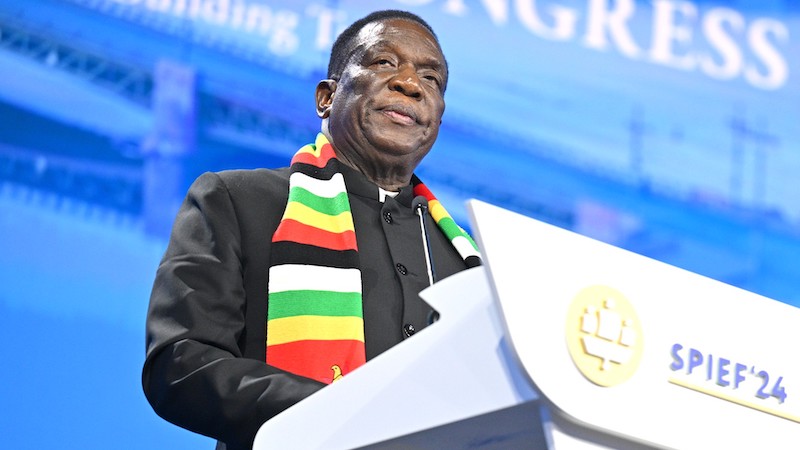
Mnangagwa, while visiting as a guest speaker at the 27th St. Petersburg International Economic Forum (SPIEF) and his special meeting with President Vladimir Putin in June 2024, was excited at winning favours by explaining, at length, how the United States has been supporting neighbouring southern African countries. Ultimately, Mnangagwa was to get better treatment for a broader supply of arms and weaponry, and food to feed the impoverished population. He did not negotiate for investment in agriculture, he did not suggest the construction of, at least, a kilometer road or a local school in any of the rural regions in Zimbabwe.
What was important for Zimbabwe, Mnangagwa asked for the chance to enhance bilateral cooperation, and that Zimbabwe is “one of the few countries in southern Africa that is regarded as anti-West” so there is the concrete basis for pursuing a more consolidated relations to escape being further isolated in southern Africa. “And there is a lot more that we can open for the Russian Federation to participate in our economy, especially in the mining sector and agriculture,” he stressed in his discussion.;
Russia’s perspectives on the struggle against growing neo-colonialism and Western-style tendencies, most probably, has to do with pushing for large-scale development programmes, supports for attaining economic sovereignty. If that is the case, then Russia needs to borrow a single page from China. Zimbabwe has the full-fledged confidence to opt for hosting the third Russia-Africa Summit in Harare simply because China has given that country a new parliamentary village with modern facilities for large conferences. That compared, Russia has not constructed a single one-kilometer road in the transport sector in Zimbabwe consistently claims having under its umbrella an excellent relations from the Soviet times.
The new parliament building is located in Mount Hampden, approximately 25 kilometres (16 mi) northwest of Harare. The parliamentary chambers can accommodate up to 650 legislators, their offices, conference rooms and meeting spaces. The engineering, procurement and construction (EPC) contract was awarded to Shanghai Construction Group, who erected the building between December 2018 and April 2022. The building complex was officially handed over by a Chinese government delegation to the government of Zimbabwe on 26 October 2023. The construction was fully funded at the cost of nearly $200 million by the Government of China, according to reports by Zimbabwean media.
Perhaps generally, Russia aspires positioning itself as a leader in Africa, it thus far remains with its aspirations in the media headlines. Uprooting neo-colonialism requires investment in building economic sectors designed to improve the living standards of the impoverished population, creating employment for the youth. Russia’s footprints, such as providing infrastructure in agriculture, industry, transport and other sectors, are really invisible in the continent. The fundamental conservative assessment indicates that Africa is largely at the bottom position in terms of overall development in the southern hemisphere, what is now called the Global South.
Russia is gathering the Global South as a force against the United States and western Europe. Africa has been ;give all kinds of descriptions, one being having “unparalleled natural wealth and boundless potentials,” and by this definition, Russia has to determine its proposed commitment for driving economic diversification, transformation and development across the African continent. That however, its rhetoric has reached the highest peak of the African mountains.
Zimbabwe has the world’s second-largest platinum reserves after South Africa. Russia declared interest in the development of a platinum deposit in Darwendale. Several reports later confirmed that Russians have abandoned their lucrative platinum project contract that was signed for $3 billion in September 2014, the platinum mine in the sun-scorched location about 50 km northwest of Harare, the Zimbabwean capital. With great pomp and pageantry, Foreign Minister Sergey Lavrov launched the $3 billion Russian project back in 2014, after years of negotiations, with the hope of raising its economic profile in Zimbabwe.
Reports also indicated that the project was expected to involve a consortium consisting of the Rostekhnologii State Corporation, Vneshekonombank and Vi Holding in a joint venture with some private Zimbabwe investors as well as the Zimbabwean government.
Mnangagwa has been committed to opening up Zimbabwe’s economy to the rest of the world in order to attract the much-needed foreign direct investment to revive the ailing economy and make maximum use of the opportunities for bolstering and implementing a number of large projects in the country. That Zimbabwe would undergo a “painful” reform process to achieve transformation and modernization of the economy.
Zimbabwe has various potential investment sectors besides mining. There is a possibility of greater participation of Russian economic operators in the development processes in Zimbabwe, and southern Africa. But Russians need to move away from too much rhetoric and to make concrete economic engagement over the forthcoming years.
Zimbabwe, a landlocked country in southern Africa, shares a 200-kilometre border on the south with South Africa, bounded on the southwest and west by Botswana, on the north by Zambia and on the northeast and east by Mozambique. Zimbabwe is a member of the Southern African Development Community (SADC).;