
Armenia to receive CAESAR howitzers from France defence-blog.com
Day: June 18, 2024
Pashinyan, Erdogan reiterate political will to fully normalize relations between Armenia and Turkey – Public Radio of … Public Radio of Armenia – Official Web site
LOS ANGELES—Armenia Fund celebrated the completion of the latest phase of the “Our Gyumri” Housing Project on June 13 at a grand opening ceremony held in Gyumri, Armenia. This important project was made possible by the generous donations from the Armenian-American community, with major funding from the Western Diocese of the Armenian Church of North America.
Armenia Fund Board Chair Maria Mehranian expressed her appreciation for the support stating, “In 2023, our efforts enabled 36 families in Gyumri to experience the security and comfort of contemporary homes, made possible by the generous support of our donors. Today, we are delighted to open our two new, larger apartment buildings offering homes to 50 additional families.”
 Armenia Fund Board Chair Maria Mehranian addressing attendees at the Grand Opening Ceremony
Located within the Mush 2 District, with the recently completed phase, the Gyumri Housing Project offers a total of 86 units. Engineered to withstand seismic activity, these apartments are equipped with solar heaters to minimize their environmental impact. Fully furnished with essential amenities, including appliances, these residences will provide a sustainable and comfortable living space for their occupants.
“This latest phase marks a significant milestone in Armenia Fund’s continued commitment to enhance the quality of life in Gyumri by providing new housing and infrastructure for local residents,” said Ms. Mehranian.
 Armenia Fund’s “Our Gyumri” Housing Project
Gyumri residents have faced numerous challenges, including natural disasters and wars, often finding themselves living in inadequate shelters such as makeshift huts. Following the Artsakh War of 2020, the demand for secure housing has increased, especially among families affected by the conflict. With the support of the Armenian American community, the lives of 50 families will be positively transformed, addressing the issue of homelessness in a significant way.
For more information, please visit the website.
The article “What is the endpoint? A call for pragmatism…” by Stepan Piligian addresses the challenges facing the Armenian diaspora in its advocacy efforts for Armenia. Piligian calls for pragmatism and unity, urging the diaspora to support Armenia constructively rather than engage in actions that could undermine the nation’s “sovereignty and stability,” two concepts that have been under assault over the past six years. He highlights the internal political tensions within Armenia, particularly the protests led by religious figures. He calls for a focus on practical solutions, prioritizing the country’s long-term stability and development.
A long-time contributor and columnist for the Armenian Weekly, Piligian has written extensively about the Armenian church and the elusive concept of unity that also reared its head in this piece. The unity trope is one of the more overplayed cliches in the Armenian world, along with that of the external boogeymen, as Armenians lament a long list of external players who do not rescue us from ourselves (depending on one’s vantage point), as well as the gospel of uncritical positivity in the face of impending doom. What does he mean by this unity? Has anyone attempted to define it? Does it mean that everyone must think the same way? Does it mean there must be certain red lines within which all Armenians must unite? The former has potential since regression to the mean is real when there is an illusion of choice, further assisted by the proclivity of human beings to social engineering. Unfortunately, the latter has proven to be weak. The rights of Artsakh Armenians to live freely on their lands under their own rule and the territorial integrity of Armenia were those red lines, and we all know how they’ve turned out in the past four years. So, let’s stop throwing this nonsensical concept around as if it is the panache for our collective ailment. What unity do we have in the United States, France, Belgium or other nations? Somehow, the Armenian nation must magically get behind this concept when it’s reeling from six years of death, destruction and humiliation and unite around an arbitrary, undefined and abstract concept with all our baggage and challenges.
This is not a matter of unity but rather a battle along ideological lines for Armeno-centric and non-Armeno-centric principles, with the latter being promoted within our communities by external forces, with the knowing and unknowing participation of our people. Do we want a strong Armenia that can defend itself as a viable nation and pursue its strategic interests in partnership with other forces with similar interests in different spaces? Is this a unifying factor we can all subscribe to and support? Or do we want a vilayet with an Armenian name only that fulfills the wishes and interests of regional and larger powers at the expense of our people? We had the concept of unity across the diaspora, Armenia and Artsakh. Yet that concept has been under assault by Turkey covertly and by the current Armenian regime overtly and blatantly.
While espousing the concept of unity, Piligian questions the coalition that has emerged across different political forces in Armenia against the destructive actions of the current regime. The “Tavush for the Homeland” movement comprises many organizations and entities that do not want to see Armenia subjugated to its enemies and have come together in response to the destructive and defeatist behavior of the current government. These Armenians are united with a goal: to save Armenia. Not all entities must agree on everything, but they all agree on the need to save Armenia and live with dignity in a country capable of securing its borders and offering an Armeno-centric vision, rather than what Azerbaijani President Ilham Aliyev dictates.
Piligian goes on to question the credentials of Archbishop Bagrat Galstanyan in leading the movement and the role of the Armenian church in the protests. However, let’s consider the credentials of the ruling regime, with a yellow journalist at the helm, a teacher turned Turkish agent as foreign minister, a teacher turned criminal (who stabbed his superior officer while serving in the military and served jail time) as defense minister, an English tutor as the ambassador to the United States, an NGO project manager straight out of college turned secretary of the Security Council of Armenia and a DJ/assistant tour guide as a journeyman culture minister turned high tech minister, to name a few.
Several members of the current government hold dual citizenships contrary to the Armenian Constitution, but that has hardly been an issue for these agents, who have unilaterally decided to give up Armenian lands to the enemy without a referendum that the Armenian Constitution requires. The same authorities are trying to convince the Armenian public that after the surrender of eight Armenian villages, we will have a “real” Armenia with “real” borders, as stated by Dr. Varuzhan Geghamyan: “Azerbaijan initially wanted all eight at once, but seeing the resistance in Armenia, they agreed to a 4+4 option. The delivery of the first four villages took place in May, and the next four villages should happen in mid-July. Baku’s primary target is Tigranashen, along another highway that connects Armenia to the outside world. For the first time, different parts of Armenia will face connectivity problems with each other. What is happening is not the unblocking of Armenia but a total blockade of Armenia. All these processes are to speed up the implementation of the so-called Zangezur corridor project.”
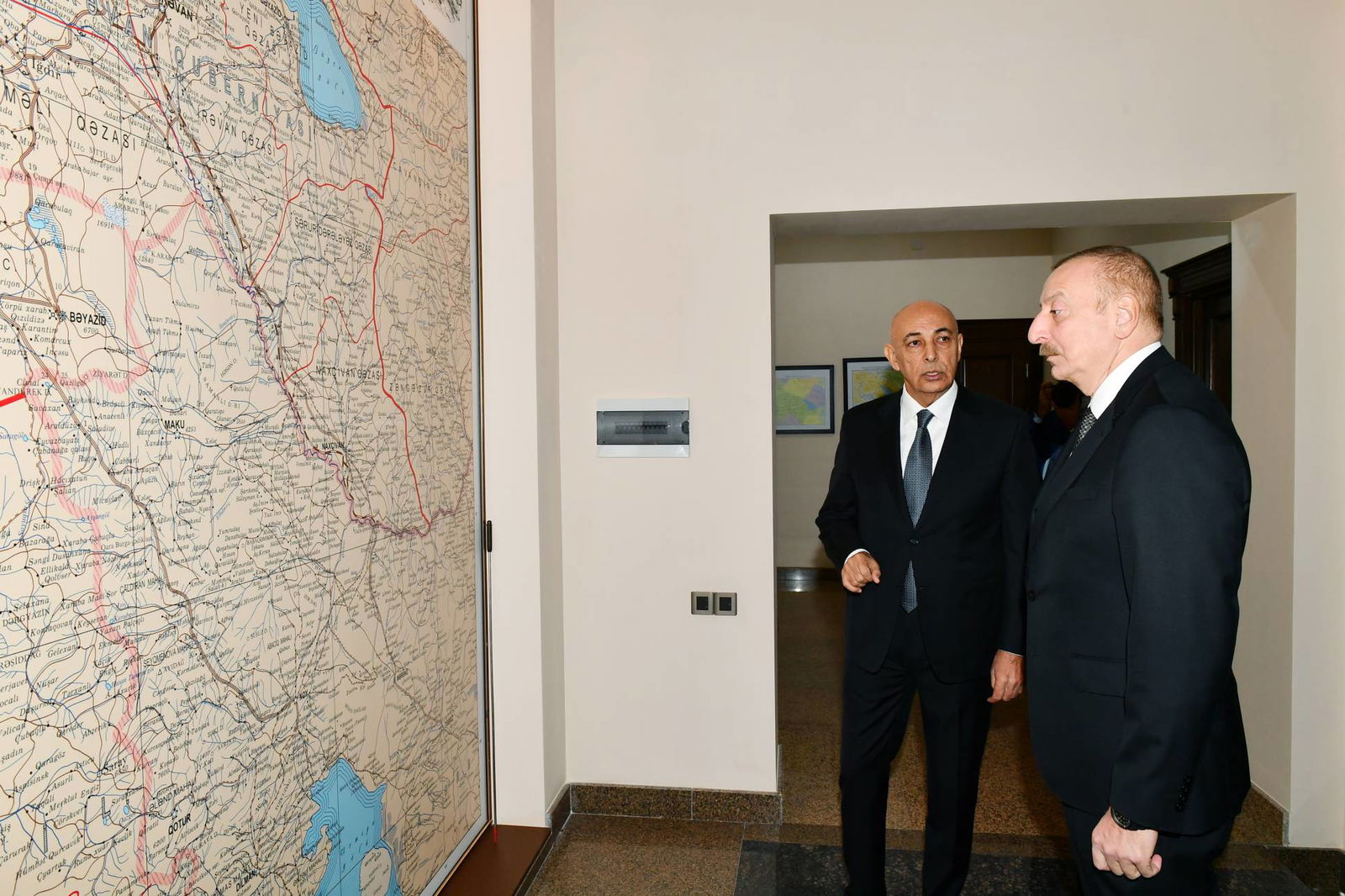 Azerbaijan’s Pres. Aliyev studies a map of “Western Azerbaijan” during a tour of the “Western Azerbaijan” community administrative building, Dec. 2022 (President of Azerbaijan)
On to our church, which has kept our nation together for centuries when we did not have a government. It is also the last institution that has not been destroyed by this regime, and the fact that a representative of our church is leading this effort is a cause for celebration, not scorn. Let us not forget that the Armenian nation IS the Armenian church. We, the people, are what makes our church.
Piligian argues that while the diaspora’s emotional attachment to Armenia is understandable, it is crucial to balance this with a realistic approach that considers the complexities of the political and social landscape. He criticizes advocacy actions that, although well-intentioned, may inadvertently weaken Armenia’s position on the global stage. He advocates instead for strategies that enhance Armenia’s resilience and self-sufficiency. At least a part of the Armenian lobby has historically taken significant, pragmatic steps in collaboration with the Armenian government to pass key issues in Congress that benefit Armenia and Armenians. This has required extensive effort and capital, only to be thwarted at the last minute (anyone remember Section 907?). So, pragmatism has been a key component of advocacy in Washington. That same lobby is taking a far more active role in outlining the shortcomings of the State Department concerning Artsakh and Armenia. How can one forget Undersecretary Yuri Kim’s assertion that the U.S. would “not countenance any attempt to ethnically cleanse the Armenian people of Nagorno-Karabakh” two days before the genocide of the Armenians of Artsakh? Was she not in on what was about to happen? Was she lying under oath? Was the State Department unable to exert pressure on a petty dictator despite its declarations of “non-countenance?” Was the State Department only giving lip service to the community, knowing what was about to happen? These are legitimate questions the community must ask the State Department, and a segment of our advocacy is doing just that. Are we not to ask our government uncomfortable questions? Are we all to be “good Armenians” and not rock the boat?
On why Washington seeks Armenia-Azerbaijan normalization, James O’Brien, a senior U.S. official, responded that it would “reduce Russian influence in the region and facilitate a new trade route from Central Asia to Turkey.” Asked whether Washington backs Baku’s demands, O’Brien said: “Well, we usually talk about it as a trade route.”
The United States just sanctioned the Republic of Georgia for passing a law similar to our Foreign Agent Registration Act (FARA). Georgia, a nation of 3.7 million, has around 35,000 to 45,000 non-governmental organizations (NGOs), roughly one NGO per 82 to 106 Georgian citizens. While a portion of these NGOs do good work, many are there to collect data and intelligence in service to other interests. Georgians must wise up to this matter, and it seems they have. The situation is not so different in Armenia with the NGOs, except Armenia does not have a FARA law in the books. To be clear, the United States has yet to sanction Azerbaijan for its “non-countenance” and genocide against the Armenians of Artsakh.
Also, let us not forget when the NATO Secretary General traveled to Turkey in October of 2020 for a photo-op with Turkish President Recep Tayyip Erdogan, thanking him for his essential work for the alliance, while Turkish NATO F-16s were raining fire on the Armenian population of Artsakh. Are we to ignore this as well? It is certainly true that all nations act in their own interests, be it the United States, Russia or anyone else. It is the Armenian government’s job to pursue the Armenian nation’s interests and leverage support from regional and larger players when interests are collinear. This has been absent from any aspect of the current government’s efforts. Russia is no different as well. It made moves based on its interests, which ceased to align with those of Armenia, given the Armenian government’s positions and steps concerning Russia, taken without securing other guarantees for its security dilemma. Seeing this, Russia sought short-term gains by working with our enemies, Turkey and Azerbaijan, at our expense, despite our “strategic” alliance. President Vladimir Putin saw value in Aliyev’s steady hand and predictable behavior and understood where interests aligned. The same could not be said for the current regime in Armenia, whose erratic and unpredictable behavior shunned all allies and emboldened enemies.
Diplomat Edward Djerejian recently warned of the diplomatization of national security needs and shared insights regarding Yerevan’s confusing and adventurous moves. He said, “I can’t see it’s in Armenia’s interest to pivot in any serious way to any one power…We’re going into a more multipolar, multilateral world…I can’t see Armenia pivoting into a pro-western, anti-Russian matrix; that would bring harm to Armenia…You cannot depend on one major external power to come to your aid, and that goes for all interests, all powers involved.” He continued, “Whatever strategic assessment or reassessment is being made in Yerevan, I think it would be a major, major mistake and miscalculation that Armenia be identified with either one pole or the other.”
In off-the-record discussions, even State Department officials have expressed bewilderment at the actions of the current regime in Armenia. They are bemused by the speed with which the current government has shrunk its list of potential allies and partners without securing alternative options, a grave mistake committed by Georgian President Mikheil Saakashvili and doubled down on by the Armenian ruling elite. Their answer to national security questions is reduced to promoting “democracy” in Armenia and increasing rankings on irrelevant democracy indices.
Oddly enough, this bastion of democracy needs 17,000 red and black beret internal security forces trained by the United States to let protesting citizens taste democracy from the bottoms of their boots. Imagine 17,000 internal security forces, in addition to the regular police, with better pay than the military, in a country of less than 3,000,000 with unprotected borders against an active aggressor. For those who were paying attention, one of Pashinyan’s stated goals early on was for Armenia not to have a military. We’re almost there. Among our brightest military leaders, one is under house arrest in Yerevan, and the other two are imprisoned in Baku, with the remaining seasoned mid-level officers having been driven out of the military. Now, our generals receive ribbons for giving up land to the enemy without a shot fired, and the Armenian military has been reduced to a propaganda tool that makes short videos of troops playing dress-up without actually defending the nation’s territorial integrity. This is akin to the paper tiger militaries of most European nations, who do not have existential threats at their borders. Then again, what do we expect from the cadre of draft dodgers who “lead” Armenia at the moment?
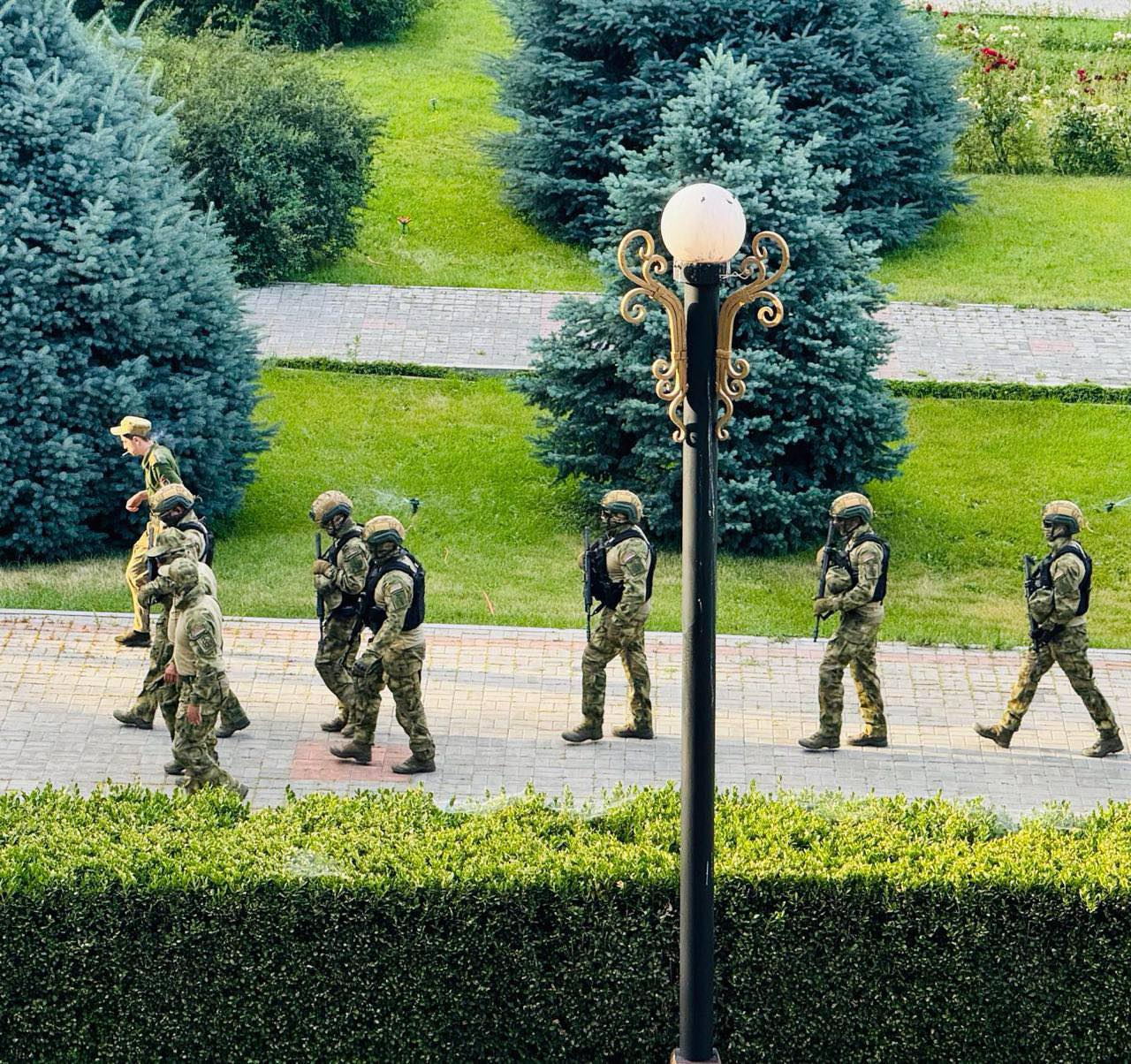 Special Forces in the courtyard of the Armenian National Assembly, June 17, 2024 (“Tavush for the Homeland” movement)
Piligian’s article also touches on the role of the Armenian government in addressing these challenges, stressing the need for leadership that can navigate both internal dissent and external pressures. Piligian points out that effective governance is key to ensuring that Armenia can stand firm in the face of adversity and continue its path toward growth and prosperity. However, the Armenian government is not interested in real Armeno-centric governance, but rather populist nonsense that satisfies the less critical components of our society, who are encouraged to remain indifferent and go about their tomorrow without thinking of the week after. Unfortunately, the Armenian government is the primary source of the misery and losses that have befallen the Armenian nation over the past six years. It is impossible to ask a regime whose actions are in lockstep with those of our enemies to address our challenges. At this point, there is overwhelming evidence pointing to the compromised actions of this government. Asking them to solve the problems they have willingly created is not a suggestion that merits any serious consideration.
Armenia is not an orphan for any passerby to throw a piece of bread or whatever spare change they carry her way. Armenia’s future deserves and requires thoughtful and in-depth planning with the active participation of the entire Armenian nation with vision, willingness, and ability to execute.
Furthermore, Piligian calls on the diaspora to dialogue and collaborate with the Armenian government and civil society. He believes a unified approach, grounded in mutual respect and understanding, can lead to more effective advocacy and support for Armenia’s interests. I would argue that cooperating with a compromised regime only makes one complicit in collaboration, pure and simple. This may offend some people, but that is fine. A lot of people need to be offended and awakened, and a lot of people must be held to account for their participation in the planned destruction of the Armenian nation. Piligian is right that the diaspora needs to be much more engaged. Successive Armenian governments have discouraged real ownership of Armenia’s future, with the current government actively working to drive a wedge between the country and the diaspora. This is in direct contrast to Piligian’s argument that the diaspora should play a “supportive” role and follow the lines of the current regime in Armenia, whose goals are to segregate the Armenian nation based on an arbitrary map dictated by our enemies, actively work towards losing Artsakh (not even able to bring themselves to use the word Artsakh) and divide the diaspora for their dastardly aims. Before the 100th anniversary of the Armenian Genocide, Turkey embarked on an extensive campaign to paint good and bad Armenians: those in Armenia, good, and those in the diaspora, bad. This served Turkish policies in the region while indoctrinating the likes of Ararat Mirzoyan and Ruben Rubinyan for eventual use from within Armenia. The same language continued when Pashinyan came to power, segregating the nation between black and white, Artsakhtsi and others. Armenia needs a much more active and engaged diaspora besides just writing checks here and there and visiting Armenia a couple of weeks per year. The diaspora must also hold the Armenian leadership accountable, regardless of who is in power. Harnessing this awesome power requires systemic and strategic thinking and planning on the part of the Armenian government, with the help of the diaspora and other expert entities, to engage diasporan resources as part of a synergistic and extensive program and cohesively address the many needs in Armenia, be they in primary and secondary education, healthcare, finance, economy, high tech or other domains. One-off diaspora-led efforts are not the answer to Armenia’s many needs. Well-meaning individuals who want to take a positive step based on their expertise and capabilities, and some looking for attention and accolades while generating more smoke than fire, do not constitute proper diasporan engagement.
Armenia is not an orphan for any passerby to throw a piece of bread or whatever spare change they carry her way. Armenia’s future deserves and requires thoughtful and in-depth planning with the active participation of the entire Armenian nation with vision, willingness, and ability to execute.
If Piligian’s extensive former writings are a clue, there is no doubt that his heart is in the right place. Unfortunately, the sheer number of assumptions and the use of non-existent concepts that circulate within the Armenian community and have shackled the Armenian nation as “cogent” arguments are surprising and alarming. As they say, everyone is entitled to their opinion, but Piligian’s piece is short on facts and meaningful solutions other than unity, pragmatism and cooperation with a compromised regime in the name of stability.
Author information
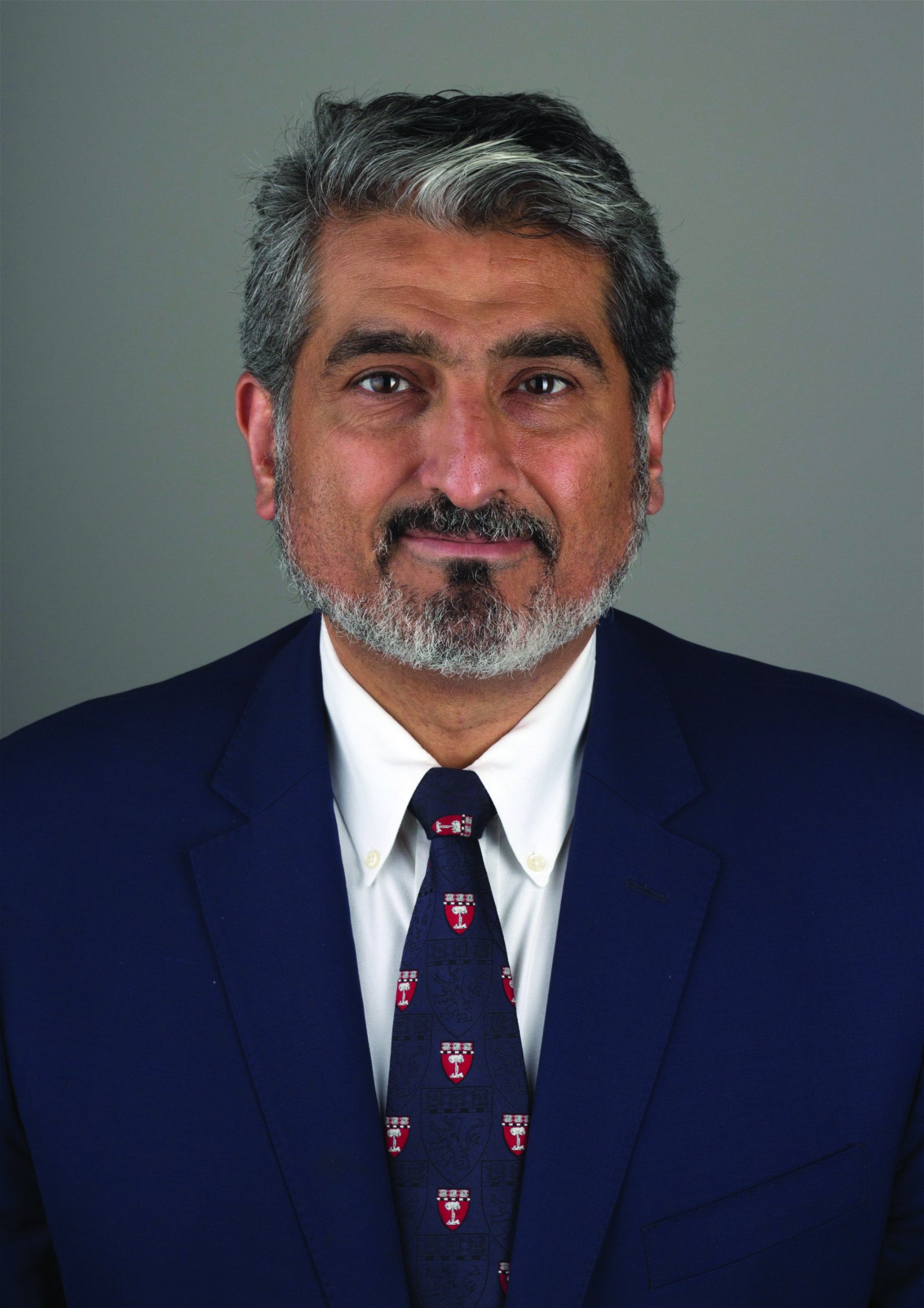
Ara Nazarian, PhD
Ara Nazarian is an associate professor of Orthopaedic Surgery at Harvard Medical School. He graduated from Tennessee Technological University with a degree in mechanical engineering, followed by graduate degrees from Boston University, Swiss Federal Institute of Technology and Harvard University. He has been involved in the Armenian community for over a decade, having served in a variety of capacities at the Hamazkayin Armenian Educational and Cultural Society, the Armenian Cultural and Educational Center, Armenian National Committee of America, St. Stephen’s Armenian Elementary School and the Armenian Revolutionary Federation.
|
The post Responding to “A call for pragmatism” with a compromised regime appeared first on The Armenian Weekly.
The Armenian Bar Association is overjoyed with the recent appointment of its long-time member, Justice Gabrielle Wolohojian, to the Supreme Judicial Court of the Commonwealth of Massachusetts. The Supreme Judicial Court is the Commonwealth’s highest appellate court and is comprised of a chief justice and six associate justices. In front of a capacity audience of friends, family and colleagues, Massachusetts Governor Maura Healey delivered a ceremonial administration of the oath of office in the Great Hall of the John Adams Courthouse in Boston.
Justice Wolohojian’s June 10, 2024 oath ceremony, which was attended by Armenian Bar leaders from around the country including members of the executive committee, marked a significant milestone as Wolohojian becomes the first Armenian-American woman to serve on the state’s, indeed on any state’s, highest court. This momentous occasion highlighted Justice Wolohojian’s exceptional legal career and underscored the significance of representation of Armenian-Americans in the judiciary. Wolohojian used her full name — Gabrielle Repsimé Wolohojian — as she swore the three requisite oaths.
 Massachusetts Governor Maura Healey (R) administers oath of office to Associate Justice Gabrielle R. Wolohojian (L) (Photo credit: Joshua Qualls from the Massachusetts Governor’s Office)
Justice Wolohojian brings a wealth of experience and a sustained commitment to justice to the Supreme Judicial Court. Her distinguished career, marked by her 16-year tenure on the Massachusetts Appeals Court and her extensive contributions to legal scholarship and public service, exemplifies the dedication and excellence in which the Armenian community takes pride. Her appointment is a testament to her unwavering commitment to the rule of law and her passion for upholding justice for all.
In her acceptance remarks, Justice Wolohojian offered the following glimpse into the roots of her inspiration and humility: “Like all Armenian-Americans, my deepest dept of gratitude is owed to my family, not only to those who are present, but to those who are not, and particularly to our grandparents and great-grandparents, whose journeys of survival and sacrifice after the Armenian Genocide laid the foundation for the generations who followed them. Although involuntarily scattered across the globe, that first generation managed to take root in new countries. And here we are as lawyers, 110 years later, with an obligation to pay that debt forward through public service and pro bono work.”
In celebrating this landmark achievement, the Armenian Bar Association also reflects on the enduring legacies of Justice Armand Arabian and Justice Marvin Baxter, who previously paved the way for Armenian-Americans in the judiciary with their historic appointments to the California Supreme Court. Justice Arabian, appointed in 1990, and Justice Baxter, appointed in 1991, both served with distinction and left an indelible mark on California’s legal landscape.
 Armenian Bar delegation: Board member Souren Israelyan, Massachusetts Bar Association former president Marsha Kazarosian, former United States Attorney for the Northern District of New York Richard S. Hartunian, Melanie Hagopian, Governor Maura Healey, Associate Justice Gabrielle R. Wolohojian, chairwoman Lucy Varpetian, immediate past chairwoman Taline Sahakian, past chairwoman Sonya Nersessian
“The appointment of Justice Gabrielle Wolohojian to the Supreme Judicial Court is a proud moment for the Armenian-American community and a testament to her exceptional legal acumen and dedication,” said Armenian Bar Association chairwoman Lucy Varpetian.
The Armenian Bar Association remains committed to supporting and promoting the advancement of Armenian-Americans in the legal profession. Justice Wolohojian’s appointment serves as a magnificent ideal for aspiring lawyers and a reminder of the importance of diversity and representation in the judiciary.
For more information about the Armenian Bar Association and its initiatives, please visit www.armenianbar.org.
Author information

Guest Contributor
Guest contributions to the Armenian Weekly are informative articles or press releases written and submitted by members of the community.
|
The post Armenian Bar Association celebrates historic appointment of Justice Gabrielle R. Wolohojian to Massachusetts’ Highest Court appeared first on The Armenian Weekly.
 Police clashing with protesters in Yerevan, June 12, 2024 (“Tavush for the Homeland” movement)
I am deeply disappointed and saddened by the events that took place in Armenia last week. There was so much violence and blood in the streets of Yerevan and so many insane statements made by Prime Minister Nikol Pashinyan.
It was so upsetting to see Pashinyan’s police throwing stun grenades and beating to a pulp peaceful men, women and children who were merely exercising their civil rights in a country falsely labeled as democratic. To hide the violence from the public, the police even assaulted a dozen members of the media and destroyed their equipment. The police used the same tactic inside the parliament, when pro-Pashinyan members physically assaulted the opposition. The police tried to force the journalists to stop broadcasting the parliament members’ violent behavior, but the courageous journalists, who were all female, continued to air the embarrassing brawl.
Over 100 civilians and a handful of policemen were hospitalized. One protester lost three fingers because of the stun grenades. In addition, Abraham Gasparyan Ph.D., a critic of Pashinyan, was specifically targeted by the police. After his arrest, a dozen policemen attacked him viciously, causing him to suffer a concussion, a deep gash in his head and several broken ribs. Gasparyan, an expat from Syria, is an associate professor, TV anchor and founding director of the Genesis Armenia think tank. These brutal actions were condemned by Amnesty International, the Lemkin Institute and the Armenian Bar Association of the U.S.
We now turn to Pashinyan’s absurd statements in parliament, lasting more than five hours over a two-day period. He started by announcing that Armenia will withdraw from the Collective Security Treaty Organization (CSTO), but he said he does not know when. It could be “in one month, one year or three years from now.” This is what I call “a decisive leader!”
Pashinyan then went on to denounce President Alexander Lukashenko of Belarus (a CSTO member) for backing Azerbaijan before and during the 2020 war. Pashinyan said that neither he nor any of his officials will visit Belarus. In line with his constantly contradictory statements, Pashinyan then turned around and said that he will reconsider his decision only after Belarus leaves the CSTO or if Lukashenko offers apologies and explanations that are understandable and acceptable to the Armenian people!
Even though Lukashenko is no angel and should be criticized for his support of Azerbaijan, Pashinyan once again proved his incompetence by making several errors:
1) Why did Pashinyan all of sudden in 2024 realize the fact that Belarus supported Azerbaijan, when this has been public knowledge since before 2020?
2) Russia, the leader of the CSTO, has supplied Azerbaijan with around $5 billion of military hardware for the 2020 war. Why is Pashinyan not announcing that he will never visit Russia as long as Putin is president?
3) Even though Israel is not a CSTO member, why is Pashinyan not criticizing that country and pledging not to have anything to do with it, since Israel has supplied Azerbaijan with billions of dollars of advanced drones and other sophisticated weapons with which thousands of Armenian soldiers were injured or killed?
4) While Pashinyan is refusing to go to Belarus, he gladly went to Ankara for the inauguration ceremony of Pres. Recep Tayyip Erdogan and shook his hand in congratulations! Turkey not only supplied deadly Bayraktar drones and transferred thousands of Jihadist terrorists to Azerbaijan to fight against Artsakh, but more significantly directed the 2020 war. Shouldn’t Pashinyan have refused to go to Turkey, instead of cozying up to Erdogan and normalizing relations with an unrepentant genocidal country that is still helping to kill Armenians?
5) Why didn’t Pashinyan announce that he will stop all trade with Belarus, Russia, Turkey and Israel because of their support for Azerbaijan? Why is it business as usual with countries that are arming your enemy to kill your citizens?
Pashinyan went on to say from the podium of the parliament the most insulting and vicious lies about the Catholicos, Archbishop Bagrat Galstanyan, Artsakh Armenians and the opposition. Such behavior is inappropriate for the prime minister of a country.
Pashinyan then confessed that it was his biggest failure that he had not given Artsakh to Azerbaijan when he first came to power: “And, yes, I admitted yesterday that it was my greatest mistake and my greatest failure that I did not do it in 2018.” This is the same man who proclaimed while visiting Artsakh in 2019: “Artsakh is Armenia. Period.” He then turned around in 2023 and said the exact opposite: “Artsakh is part of Azerbaijan.” No wonder Pashinyan’s critics think that something is wrong with him.
Pashinyan went on to say that Armenia should have “lowered the bar” of the Artsakh settlement in order to comply with international consensus on the issue. He forgot that his job was to defend Armenia’s interests, not to comply with other countries’ wishes. Illogically, he tried to explain why it was wrong to start bargaining from your highest demand. He then said that he had discovered a document from 1996, but claimed that hardly anyone knew about it since there was no internet back then. In reality, the internet was created in the 1970s. He read the Organization for Security and Cooperation in Europe chairman’s criticism of Armenia, but failed to read Armenia’s objections to it. He falsely claimed that “the clerical-feudal elite of Armenia” had fooled the people, even though he himself was trying to deceive the public.
Pashinyan and his supporters should know that sooner or later they will be prosecuted for their multiple violations of Armenian laws. He and his police should be tried by the European Court of Human Rights and International Criminal Court. All of the illegal agreements Pashinyan signed with Azerbaijan will be considered null and void and reversed by the next nationalistic government.
Author information

Harut Sassounian
California Courier Editor
Harut Sassounian is the publisher of The California Courier, a weekly newspaper based in Glendale, Calif. He is the president of the Armenia Artsakh Fund, a non-profit organization that has donated to Armenia and Artsakh one billion dollars of humanitarian aid, mostly medicines, since 1989 (including its predecessor, the United Armenian Fund). He has been decorated by the presidents of Armenia and Artsakh and the heads of the Armenian Apostolic and Catholic churches. He is also the recipient of the Ellis Island Medal of Honor.
|
The post The regime that rules Armenia has crossed all red lines appeared first on The Armenian Weekly.