
Day: June 18, 2024
YEREVAN (Azatutyun.am)—The Armenian Revolutionary Federation, a major opposition party involved in antigovernment protests in Yerevan, on Tuesday rejected as politically motivated criminal charges brought against nine of its activists.
Law-enforcement authorities on Friday raided ARF offices in the southeastern Vayots Dzor province and rounded up the party’s provincial leader and a dozen local members. They went on to also arrest Gerasim Vartanian, a Yerevan-based member of the party’s governing body in Armenia.
The vast majority of the activists were charged over the weekend with paying people to participate in the protests led by Archbishop Bagrat Galstanyan. According to Artsvik Minasyan, a ARF leader, Armenian courts remanded five of them, including Vartanian, in pre-trial custody and moved three others to house arrest.
The accusations brought by the Investigative Committee are based on an audio of three wiretapped phone conversations posted on the website of a media outlet controlled by Prime Minister Nikol Pashinyan’s Civil Contract party. The law-enforcement agency posted the audio on its website without clarifying who recorded it.
One of the recordings purportedly features Vartanian and a local ARF activist. Vartanian, who already spent seven months in jail in 2022, described the accusations as “lies” when he briefly spoke to RFE/RL’s Armenian Service while being arrested on Saturday.
Lawyers representing him and other suspects likewise insisted that the recordings do not corroborate the accusations. They said the party activists only discussed the purchase of fuel for cars and buses that transported opposition supporters from Vayots Dzor to Yerevan for free.
Minasyan charged, for his part, that the criminal proceedings are aimed at intimidating and discrediting ARF. The investigators, he said, are also trying to prove Pashinyan’s allegations made in the Armenian parliament a week ago. The prime minister accused protest leaders of paying refugees from Nagorno-Karabakh to attend the rallies aimed at toppling him.
A total of 59 supporters of Archbishop Galstanyan have been prosecuted since the start of the antigovernment protests in late April. Twenty-nine of them are currently held in detention on various charges denied by them.
A key member of the main opposition Hayastan alliance, ARF has been at the forefront of the demonstrations. Riot police allegedly tried to enter the party’s Yerevan headquarters during one of the protests staged on May 27.
Several policemen were caught on camera punching, kicking and swearing at a ARF lawmaker, Ashot Simonyan, outside the headquarters. None of them was prosecuted for the violent conduct.
A senior Russian official again warned Yerevan, saying its ongoing tilt toward the West will risk the loss of access to the Russian market, which he said is crucial to Armenia’s economic progress.
Russia’ Deputy Foreign Minister Mikhail Galuzin said in an interview with Komsomolskaya Pravda published late Monday that Western powers were using Armenia as a pawn in their ongoing conflict —war— with Russia, warning of “further erosion of Armenia’s sovereignty and security.”
The Russian official said that Yerevan was pressured by the West to distance itself from Moscow or the Collective Security Treaty Organization.
“Unfounded criticisms of Russia, the CSTO, and the existing security system are being heard more and more often from Yerevan. This is destructive and short-sighted, to put it mildly,” Galuzin said.
“Armenia’s full participation in the CSTO corresponds to the aspirations of the Armenian people and serves the cause of maintaining peace and stability in the South Caucasus,” added Galuzin.
“No matter the promises made by the West, which pushed the Armenian authorities to ‘freeze’ participation in the bloc, there are no effective alternatives to the CSTO as a mechanism for ensuring Armenia’s security today,” the Russian diplomat emphasized, adding that the security bloc is continuing to advance its mission, and “leaving Armenia behind.”
Galuzin also said that at this rate, Western powers will also pressure Yerevan to leave the Eurasian Economic Union, which this year is being chaired by Armenia.
“It’s not hard to guess that the country will be pressed to abandon the mechanisms that have ensured record growth of its [Armenia’s] economy in recent years,” Galuzin said. “Severing of economic ties with Russia will mean a loss of the main [export] market for Armenian business.”
Prime Minister Nikol Pashinyan last week announced that Armenia will leave the CSTO at a time that his government deems fit. Meanwhile, the United States signed a strategic agreement with Armenia last week, while Yerevan is also advancing its ties with the European Union, even discussing membership in the bloc. France, an EU member, is also providing military equipment and assistance to Armenia, announcing on Tuesday that Armenia will acquire Howitzer anti-missile systems from a French arms manufacturer.
Galuzin lamented that his government has not received a response from Yerevan on various initiatives it has proposed.
He said, Russia expects that “the leadership of Armenia will have enough political wisdom to understand the illusive nature of the West’s promises and the importance of relations with Russia from the point of view of the republic’s sovereignty, security, and economic development.”
I wish to thank my friend Stepan Piligian for his June 5, 2024 column, “What is the end point? A call for pragmatism…” By writing such a column, he has afforded me the opportunity to address a number of misconceptions prevalent in Armenian political discourse. These misconceptions sound reasonable superficially, which is why they are used by those supporting the current regime, led by PM Nikol Pashinyan, in attempts to blunt criticisms of his policies. But when one delves deeper, the problematic nature of these positions becomes evident.
To begin, there is the claim that the Diaspora (if we can even use such a term, implying homogeneity), is “duplicitous” in advocating for Armenia and at the same time being critical of the policies of its government. Is this behavior so extraordinary? In a democracy, everyone has the right to be critical; that criticism does not relinquish the right to advocate for the country. More to the point, those criticisms are part of advocating for what is thought to be in the best interests of the country. Claiming that this behavior is deceitful harkens back to the days of “America, love it or leave it.”
We are United States citizens of Armenian descent. We advocate for policies that are in the best interests of the United States and Armenia. We do not require anyone to “respect us.” Again, we are fulfilling a fundamental role in a democracy. The United States has blundered in its South Caucasus policy. While this blunder is a minor blemish for the U.S., tragically, it has led to Armenia being placed on life-support.
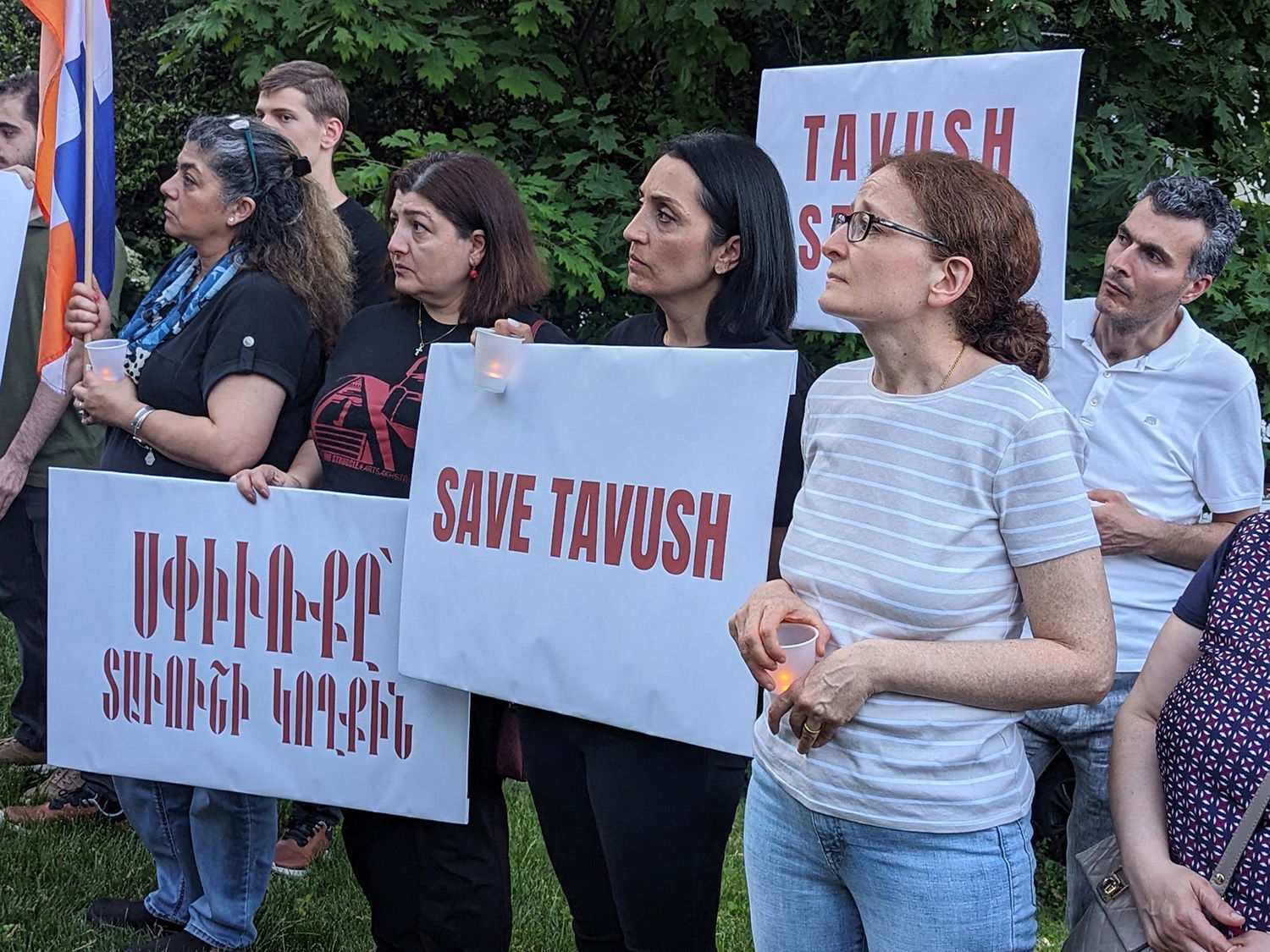 Greater Washington D.C. community members stand in solidarity with Tavush, May 8, 2024
While we each individually and organizationally have the ability to formulate the policies we believe to be most beneficial to both the U.S. and Armenia, critics also have the right to challenge those positions. However, it is unacceptable to dismiss criticisms of the policies of the government of Armenia simply based on where we live or the country of our citizenship. Attacking critics of the Pashinyan regime, not based on the merits or failings of their criticisms but rather the right of those people to criticize, is extremely problematic.
It is unacceptable to dismiss criticisms of the policies of the government of Armenia simply based on where we live or the country of our citizenship. Attacking critics of the Pashinyan regime, not based on the merits or failings of their criticisms but rather the right of those people to criticize, is extremely problematic.
First, it generally indicates to me that criticisms of Pashinyan’s policies must have merit, if the only argument against them is to claim that critics don’t have a right to evaluate his policies. Second, we regularly criticize the policies of many countries where we do not live or have citizenship (Russia, Turkey, Azerbaijan, etc.). So, then, why must we remain muted toward Armenia? Lastly, such argumentation implies that Diasporan Armenians are not impacted by the policies of Armenia. That may be the case with some policies, but when the policies of the Armenian government involve the Genocide with implications for descendants of that heinous crime, then those policies do impact us all, and we have a right to not only disagree but to actively implement policies in our interests, even if they counter the government’s.
In addition, an independent Armenia does have a direct impact on each of us, even in the Diaspora. Neither Armenia nor the Diaspora can survive without the other. But even if that were not the case, and somehow we were not impacted, that would neither inhibit our ability to openly evaluate the policies of the Armenian government nor diminish our criticisms.
This line of argumentation is extrapolated further to say, if you do not have children of military age in Armenia, then you cannot criticize. It continues until the only one “allowed” to have a position on the policies of Armenia is Pashinyan himself. It is odd to me, though the tactic is not surprising, as in the U.S. we do not relinquish our right to comment on the policies set by the president after an election just because they receive the majority of votes.
Another tactic deployed to disqualify critics is to claim that they are backed by some outside power. Those espousing such views never asked where Pashinyan’s funding came from in 2018 and the years prior to his rise to power. Neither do these supporters comment on Pashinyan’s protests against the elected government at that time. At least the former elected government had the honor to resign instead of responding with force as Pashinyan has done today.
But that really doesn’t matter, as we can never know people’s motivations. All we can do is evaluate their positions based on merit. The question today is whether Pashinyan’s current policies in regards to Azerbaijan, Turkey, Russia, the U.S., Iran, etc. are to the benefit of Armenia or not. There is a long discussion to be had on this topic, but it is clear from Pashinyan’s policies that it does indeed “take more than protests to govern,” if only his supporters would acknowledge that fact.
Author information

George Aghjayan
George Aghjayan is the Director of the ARF Archives and a member of the Armenian Revolutionary Federation (ARF) Central Committee of the Eastern United States. Aghjayan graduated with honors from Worcester Polytechnic Institute in 1988 with a Bachelor of Science degree in Actuarial Mathematics. He achieved Fellowship in the Society of Actuaries in 1996. After a career in both insurance and structured finance, Aghjayan retired in 2014 to concentrate on Armenian related research and projects. His primary area of focus is the demographics and geography of western Armenia as well as a keen interest in the hidden Armenians living there today. Other topics he has written and lectured on include Armenian genealogy and genocide denial. He is a frequent contributor to the Armenian Weekly and Houshamadyan.org, and the creator and curator westernarmenia.weebly.com, a website dedicated to the preservation of Armenian culture in Western Armenia.
|
The post Beyond “pragmatic,” the obligation to be critical appeared first on The Armenian Weekly.
Categories
NPR News: 06-18-2024 5PM EDT
On 18 June, Prime Minister Nikol Pashinyan had a telephone conversation with the President of Turkey, Recep Tayyip Erdogan.
The Prime Minister congratulated the President on Kurban Bayram, and the President congratulated the Prime Minister on the upcoming Vardavar – the Feast of the Transfiguration of Jesus Christ.
President Erdogan offered condolences to Prime Minister Pashinyan with regard to the recent floods in the northern regions of Armenia.
The leaders underlined their political will to fully normalize the relations between Armenia and Turkey without any preconditions.
In this regard the leaders noted the importance of the continuation of meetings between the Special representatives of both countries and reconfirmed the agreements reached so far.
The leaders also commended the ongoing dialogue between high level officials of Armenia and Turkey. They also discussed recent developments in the region and international agenda.