Categories
South Caucasus News

We Can And Must Adjust To Climate Change – And Not Kill Billions – OpEd


We Can And Must Adjust To Climate Change – And Not Kill Billions – OpEd

Oil Prices Oilfield Oil Petroleum Pumpjack

We’ve always done so and have no right to tell others they can’t have modern living standards

Earth’s climate has changed many times over four billion years, and 99.999% of those changes occurred before humans were on this planet. During that short time, humans adjusted their housing, clothing and agriculture in response to climate changes. Can we now;control;the climate?

Except for;decades-long droughts;or;massive volcanic explosions;that ended some civilizations, humanity generally adjusted successfully – through a Pleistocene Ice Age, a;Little Ice Age, a Dust Bowl and other natural crises. Numerous state high temperature records were set in Dust Bowl years.

After putting our current “microsecond” on Earth into its proper perspective, we might therefore ask:

* With today’s vastly superior technologies, why would humanity possibly be unable to adjust to even a few-degrees temperature increase, especially with more atmospheric carbon dioxide helping plants grow faster and better, providing more food for animals and people?

* How dare the political, bureaucratic, academic and media;ruling elites;– who propagate GIGO computer predictions, calculated myths and;outright disinformation;– tell us we must implement their “green” policies immediately and universally … or humanity won’t survive manmade climate influences that are minuscule compared to the planetary, solar and galactic forces that really control Earth’s climate?

* How dare those elites tell Earth’s poorest people and nations they have no right to seek energy, health and living standards akin to what developed countries already enjoy?

Scientists, geophysicists and engineers have yet to explain or prove what caused the slight change in global temperatures we are experiencing today – much less the huge fluctuations that brought five successive mile-high continental glaciers, and sea levels that plunged 400 feet each time (because seawater was turned to ice), interspersed with warm interglacial periods like the one we’re in now.

Moreover,;none;of the dire predictions of cataclysmic temperature increases, sea level rise, and more;frequent and intense storms;have actually occurred, despite decades of climate chaos fearmongering.

Earth continues to experience climate changes, from natural forces and/or human activity. However, adjusting to small temperature, sea level and precipitation changes would inflict far less harm on our planet’s eight billion people than would ridding the world of fossil fuels that provide 80% of our energy and myriad products that helped to nearly double human life expectancy over the past 200 years.

Today, with fuels, products, housing and infrastructures that didn’t even exist one or two centuries ago, we can adjust to almost anything.

When it’s cold, we heat insulated homes and wear appropriate winter clothing; when it’s hot, we use air conditioning and wear lighter clothing. When it rains, we remain dry inside or with umbrellas; when it snows, we stay warm indoors or ski, bobsled and build snowmen.

Climate changes may impact us in many ways. But eliminating coal, oil and natural gas – with no 24/7/365 substitutes to replace them – would be;immoral and evil. It would bring extreme shortages of reliable, affordable, essential energy, and of over;6,000 essential products;derived from fossil fuels.

It would inflict billions of needless deaths from diseases, malnutrition, extreme heat and cold, and wild weather – on a planet where the human population has grown from;1 billion to 8 billion;since Col. Edwin Drake drilled the first oilwell in 1859.

*;Weather-related fatalities;have virtually disappeared, thanks to accurate forecasting, storm warnings, modern buildings, and medicines and other petroleum-based products that weren’t available even 100 years ago.

* Fossil fuels for huge long-range jets and merchant ships move people, products, food and medications to support global trade, mobility, health and lifestyle choices. Indeed, more than;50,000 merchant ships,;20,000 commercial aircraft;and;50,000 military aircraft;use fuels manufactured from crude oil.;

* Food to feed Americans and humanity would be far less abundant and affordable without the fertilizers, insecticides, herbicides, and tractor and transportation fuels that;come from oil and natural gas.

* Everything powered by electricity utilizes petroleum-based derivatives: wind turbine blades and nacelle covers, wire insulation, iPhone and computer housings, defibrillators, myriad EV components and more.

Petroleum industry history;demonstrates that crude oil was virtually useless until it could be transformed in refineries and chemical plants into derivatives that are the foundation for plastics, solvents, medications and other products that support industries, health and living standards. The same is true for everything else that comes out of holes in the ground.

Plants and rocks, metals and minerals have no inherent value unless we learn how to cook them, extract metals from them, bend and shape them, or otherwise convert them into something we can use.

Similarly, the futures of poor developing countries hinge on their ability to harness foundational elements: fuels, electricity, , minerals and feed stocks made from fossil fuels and other materials that are the basis for all buildings, infrastructures and other technologies in industrialized countries.

For the;80% of humanity;in Africa, Asia and Latin America who still;live on less;than $10 a day;– and the billions who still have;little to no access to electricity;– life is severely complicated and compromised by the hypocritical “green” agendas of wealthy country elites who have benefited so tremendously from fossil fuels since the modern industrial era began around 1850. Before that:

* Life spans were around 40 years, and people seldom travelled more than 100 miles from their birthplaces.

* There was no electricity, since generating, transmitting and utilizing this amazing energy resource requires technologies made from oil and natural gas derivatives.

* That meant the world had no modern transportation, hospitals, medicines and medical equipment, kitchen and laundry appliances, radio and other electronics, cell phones and other telecommunications, air and space travel, central heating and air conditioning, or year-round shipping and preservation of meats, fruits and vegetables, to name just a few things most of us just take for granted.

There are no silver-bullet solutions to save people from natural or manmade climate changes. However, adjusting to those fluctuations is the only solution that minimizes fatalities which would be caused by the callous or unthinking elimination of the petroleum fuels and building blocks that truly make life possible and enjoyable, instead of nasty, brutish and short. The late;Steven Lyazi explained it;perfectly:

“Wind and solar are … short-term solutions …. to meet basic needs until [faraway Ugandan villages] can be connected to transmission lines and a grid. Only in that way can we have modern homes, heating, lighting, cooking, refrigeration, offices, factories, schools, shops and hospitals – so that we can enjoy the same living standards people in industrialized countries do (and think is their right). We deserve the same rights and lives.

“What is an extra degree, or even two degrees, of warming in places like Africa? It’s already incredibly hot here, and people are used to it. What we Africans worry about and need to fix are malnutrition and starvation, the absence of electricity, and killer diseases like malaria, tuberculosis, sleeping sickness and HIV/AIDS…. We just need to be set free to [get the job done].”

  • About the authors: Paul Driessen is senior policy analyst for the Committee For A Constructive Tomorrow (www.CFACT.org), and author of articles and books on environmental, climate and human rights issues. Ronald Stein is an engineer, senior policy advisor on energy literacy for the Heartland Institute and CFACT, and co-author of the Pulitzer Prize-nominated book “Clean Energy Exploitations.”


Categories
South Caucasus News

How Secret US Anti-Vax Operation Disrupted Chinese Sinovac From The Philippines To Central Asia And The Middle East – OpEd


How Secret US Anti-Vax Operation Disrupted Chinese Sinovac From The Philippines To Central Asia And The Middle East – OpEd

First image of the vaccine developed by UC and the Chinese laboratory Sinovac Biotech Ltd. Credit: Karina Fuenzalida. Photo Credit: Wikimedia Commons

At the height of the COVID-19 pandemic, the US military launched a secret campaign to discredit China’s Sinovac inoculation and to counter what it perceived as China’s growing influence in the Philippines, according to a new Reuters investigation. 

According to the Reuters investigation, the clandestine operation affected the Philippines which had been hit particularly hard by the virus. I should know. I was in Metro Manila at the time. 

In 2020, I released two reports on the pandemic and its international human and economic costs (here, here). The situation was particularly dire in the Philippines. I took the Sinovac shot twice and talked with some who were afraid to do so and chose to wait. Since then, I have wondered what happened to them.

US troll farms against Chinese Sinovac

The covert US military operation was particularly harmful because, as Reuters put it, “it aimed to sow doubt about the safety and efficacy of vaccines and other life-saving aid that was being supplied by China.”

How did it happen? Fake internet accounts impersonating Filipinos and used by US military’s propaganda were transformed into an anti-vax campaign. As Filipino public health officials struggled to contain the epidemic, the covert operation morphed social media posts into troll farms decrying the quality of face masks, test kits and especially the first vaccine that would become available in the Philippines – China’s Sinovac inoculation.

Reuters identified 300 accounts on X (Twitter) matching descriptions shared by former US military officials familiar with the Philippines operation. They urged Filipinos “not to trust the China vax, which was a “rat killer” and so on.;

The origins of the US operation went back to the pre-pandemic 2019, when Trump’s defense secretary Mark Esper signed a secret order paving the way to the launch of the campaign. As Pentagon’s “competition” with China was identified with “active combat,” it enabled the military to bypass the State Department in its psychological warfare (psyop) operations. Ironically, that year, Esper was shaking hands in the Philippines with his counterpart Delfin Lorenzana; a meeting that was later linked with pledges of quick vax delivery and military cooperation, as reflected by a Rappler report.

From PH and Southeast Asia to Central Asia and the Middle East

Pentagon’s active use of social media tools began around 2010, with the onset of the Obama pivot to Asia, “leveraging phony accounts to spread messages of sympathetic local voices – themselves often secretly paid by the United States government.” Today, the US military employs an extensive ecosystem of social media influencers, fronts and covertly-placed digital ads to influence overseas audiences. In the Philippines, these ops are fostering an atmosphere of fear and political paranoia.

Most social media accounts were created in the summer of 2020 and centered on the slogan #Chinaangvirus. The anti-vax effort started in spring of 2020 expanding beyond Southeast Asia before it was terminated in mid-2021. Some of the set of fake social media accounts used by the US military “were active for more than five years,” according to Reuters.

After the successful test-run in the Philippines and Southeast Asia, the clandestine propaganda campaign was tailored to and recycled among local audiences across Central Asia and the Middle East. It was designed to spread fear of China’s vaccines among Muslims when the virus was killing tens of thousands of people daily.;

But why was the timing so destructive in the Philippines? Two (linear-scale) charts tell the story. When the US military anti-vax operation kicked in, there were fewer than 20,000 detected cases in the country. In the next three months, that figure surged to 215,000 and by the end of the year it exceeded 460,000, soaring to 2.8 million by the year-end of 2021. In mid-2021, the Philippines still had one of the worst inoculation rates in Southeast Asia. The difficulty in vaccinating the population, thanks in part to the covert US military op, contributed to the worst death rate in the region.;

Attack from Florida, undermined global vax supply

The US campaign undermined the supply of life-saving vacs when they were needed the most. In May 2020, Chinese president Xi said the Chinese vaccine would be made available as a “global public good,” to ensure “vaccine accessibility and affordability in developing countries.” Sinovac was the primary vaccine available in the Philippines for a year until US-made and other vaccines became more available in early 2022.;

Running the program through the military’s psyop center in Tampa, Florida, US military disregarded the collateral devastation the propaganda was expected to have on Filipinos. “We weren’t looking at this from a public health perspective,” said a senior military officer to Reuters. “We were looking at how we could drag China through the mud.”

Worse, Washington’s own vax plan inoculated Americans first and placed no restrictions on what the Big Pharma could charge developing countries for the remaining vaccines. It let the US pharma giants “play hardball” with developing countries and suck the supply out of the global market. It set a terrible precedent for the West’s vaccine nationalism, at the expense of human lives in the Global South.

They knew…

Who was in charge? The campaign began under former President Trump and continued months into Joe Biden’s presidency. Worse, it prevailed “even after alarmed social media executives warned the Biden administration that the Pentagon had been trafficking in COVID misinformation,” as Reuters found.

Knowing the lethal implications of the campaign in several world regions, Facebook could have protested. It didn’t. There could have resignations. There weren’t. What about orchestrated leaks? None. In the past, opposition from the State Department might have penalized the program. Not so now.;

To implement its anti-vax campaign, the Pentagon overrode objections from top US diplomats in Southeast Asia. Yet, during the Gaza War, many patriotic Americans in the US military, intelligence and foreign service have protested the genocidal atrocities and some have resigned. Not so in the Philippines. There was no public protest by US ambassador Sung Y. Kim or his successors, John C. Law and Heather Variava, from early 2020 to mid-2022, not to mention resignations. And so, Jonathan Braga, senior US military commander responsible for Southeast Asia, could target Sinovac and the campaign was expanded to target Muslim-majority countries.;

Following its audit of its campaign, the Pentagon criticized its primary contractor General Dynamics IT for getting caught, due to its sloppy tradecraft, and inadequate steps to hide the origin of the fake accounts. But there is a silver lining. In February, GD won a $493 million contract, to continue providing clandestine influence services for the military. These are the kind of defense contractors that also play a role in Philippines weapons buys.;

Thanks to its weapons sales in Ukraine and Gaza, GD stock has almost rippled up to $300 since early 2020. But new conflicts will be needed in Asia to sustain the stock surge in the future. It’s just business.;

  • The original version was published by The Manila Times on June 17, 2024

Categories
South Caucasus News

Armenian FM Discusses Priorities of Partnership with EU Ambassadors – Armenian News by MassisPost


Armenian FM Discusses Priorities of Partnership with EU Ambassadors  Armenian News by MassisPost

Categories
South Caucasus News

Armenia News – Armenia News


Armenia News  Armenia News

Categories
South Caucasus News

Toomaj Sanctions Passes Unanimously in Canadian Parliament – ایران اینترنشنال


Toomaj Sanctions Passes Unanimously in Canadian Parliament  ایران اینترنشنال

Categories
South Caucasus News

NPR News: 06-17-2024 6PM EDT


NPR News: 06-17-2024 6PM EDT

Learn more about sponsor message choices: podcastchoices.com/adchoices

NPR Privacy Policy


Categories
South Caucasus News

Origins Of Cumulative Culture In Human Evolution


Origins Of Cumulative Culture In Human Evolution

Oldowan core, Koobi Fora, Kenya (First time period, below baselines). CREDIT Curry, Michael. 2020. Oldowan Core, Koobi Fora. Museum of Stone Tools. Retrieved June 10, 2024.

Each of us individually is the accumulated product of thousands of generations that have come before us in an unbroken line. Our culture and technology today are also the result of thousands of years of accumulated and remixed cultural knowledge.

But when did our earliest ancestors begin to make connections and start to build on the knowledge of others, setting us apart from other primates? Cumulative culture — the accumulation of technological modifications and improvements over generations — allowed humans to adapt to a diversity of environments and challenges. But, it is unclear when cumulative culture first developed during hominin evolution.

A study published this week in the Proceedings of the National Academy of Sciences by Arizona State University researcher Charles Perreault and doctoral graduate Jonathan Paige, concludes that humans began to rapidly accumulate technological knowledge through social learning around 600,000 years ago.

“Our species, Homo sapiens,” said Perreault, “has been successful at adapting to ecological conditions — from tropical forests to arctic tundra — that require different kinds of problems to be solved. Cumulative culture is key because it allows human populations to build on and recombine the solutions of prior generations and to develop new complex solutions to problems very quickly. The result is, our cultures, from technological problems and solutions to how we organize our institutions, are too complex for individuals to invent on their own.” Perreault is a research scientist with the Institute of Human Origins and associate professor with the School of Human Evolution and Social Change.

To investigate when this technological turn may have begun, Paige and Perreault;analyzed changes in the complexity of stone tool manufacturing techniques across the last 3.3 million years of the archaeological record to explore the origin of cumulative culture.

As a baseline for the complexity of stone tool technologies achievable without cumulative culture, the researchers analyzed technologies used by nonhuman primates — like chimpanzees — and stone tool manufacturing experiments involving inexperienced human flintknappers and randomized flaking.

The researchers broke down the complexity of the stone tool technologies by the number of steps (PUs or procedural units) that each tool-making sequence involved. The results suggested that from around 3.3 to 1.8 million years ago — when australopiths and earliest;Homo;species were around — stone tool manufacturing sequences remained within the range of the baselines (1 to 6 PUs). From around 1.8 million to 600,000 years ago, manufacturing sequences began to overlap with and slightly exceed the complexity baseline (4 to 7 PUs). But, after around 600,000 years ago, the complexity of manufacturing sequences rapidly increased (5 to 18 PUs).

“By 600,000 years ago or so, hominin populations started relying on unusually complex technologies, and we only see rapid increases in complexity after that time as well. Both of those findings match what we expect to see among hominins who rely on cumulative culture,” said Paige, a postdoctoral researcher at the University of Missouri and ASU PhD graduate.

Tool-assisted foraging may have been the impetus for the earliest beginning of the evolution of cumulative culture. Early hominins, 3.4 to 2 million years ago, likely relied on foraging strategies that require tools, like accessing meat, marrow and organs, leading to changes in brain size, life span and biology that set the stage for cumulative culture. While other forms of social learning may have influenced tool making, it is only in the Middle Pleistocene when there is evidence for rapid increases in technological complexity and the development of other kinds of new technologies.

The Middle Pleistocene also shows consistent evidence of controlled use of fire, hearths and domestic spaces, likely essential components of the development of cumulative culture. Other kinds of complex technologies also developed in the Middle Pleistocene, including wooden structures constructed with logs hewn using hafted tools, which are stone blades affixed to wooden or bone handles.

This all suggests that cumulative culture arose near the beginning of the Middle Pleistocene epoch, possibly predating the divergence of Neanderthals and modern humans.


Categories
South Caucasus News

Michigan Armenian Americans backing Biden-Harris ticket hits new low


Michigan’s Armenian voters speak out on their disappointment with President Biden’s aiding and abetting of Azerbaijan’s Artsakh genocide.

DEARBORN, Mich.—A new community canvass of Michigan residents of Armenian heritage reveals persistent anger and outrage over President Biden’s decision to arm and abet Azerbaijan’s genocide of indigenous Armenians in their Artsakh (Nagorno Karabakh) homeland — adding to serious concerns held by the Biden-Harris campaign about the president’s ability to carry this pivotal swing state in November, reported the Armenian National Committee of America (ANCA).

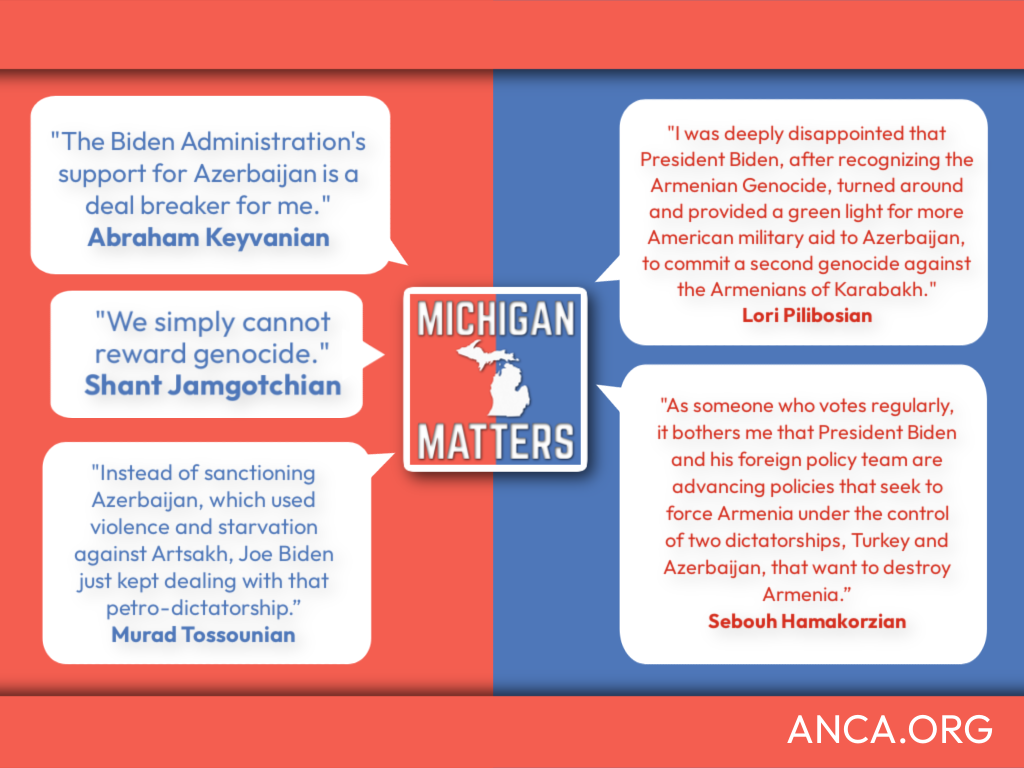
“I supported President Biden in 2020, but just cannot see myself doing that again in 2024,” stated Michigan voter Abraham Keyvanian.  “The Biden administration’s support for Azerbaijan is a deal breaker for me. Why the president maintained U.S. military aid to the dictatorship in Baku while they ethnically cleansed Armenians from Artsakh is hard — if not impossible — to understand. Speaking frankly, Biden has lost my support.”

Shant Jamgotchian concurred, noting, “Joe Biden has given me no reason to vote for him. I care deeply about Armenia, and the fact is the Biden administration has been a total disaster in supporting Armenia and the Christians of Nagorno-Karabakh. Joe Biden made his decision to keep funding military assistance for Azerbaijan. That is, I suppose, his prerogative as president. As an American, I will be exercising my prerogative and will not be voting to keep him in office. We simply cannot reward genocide.”

This past February, Armenian Americans were well represented among the more than 100,000 (13%) Michiganders who cast “uncommitted” votes in the Michigan Democratic presidential primary to protest President Biden’s complicity in Azerbaijan’s 2023 genocide of Artsakh’s indigenous Armenians. This ANC-Michigan driven electoral activism garnered international news coverage, including reports in POLITICO, The New York Times, The Washington Post, USA Today, BBC, and Reason Magazine. Links are available in this ANCA press release.

“Joe Biden has been AWOL on protecting Armenia from Turkey and Azerbaijan. Even worse, he’s armed Azerbaijan’s anti-Armenian aggression,” explained Sebouh Hamakorzian. “This is something that I do not respect. As someone who votes regularly, it bothers me that President Biden and his foreign policy team are advancing policies that seek to force Armenia under the control of two dictatorships — Turkey and Azerbaijan — that want to destroy Armenia.”

Lori Pilibosian concurred, noting, “The 2024 presidential race is, for many Americans, a big disappointment. I support the freedom and liberty of the Armenian people in their ancient homeland. I was deeply disappointed that President Biden, after recognizing the Armenian Genocide, turned around and provided a green light for more American military aid to Azerbaijan, to commit a second genocide against the Armenians of Karabakh. That is the type of hypocrisy that makes me question how I will vote this November.”

In the days leading up to the Michigan primary, the chair of the ANC-Michigan published an essay in The Armenian Weekly explaining that she was casting her “uncommitted” vote to “send a message that crimes come with costs, and enabling ethnic cleansing is not ‘business-as-usual.’ To cast a vote for Biden is to endorse his actions. To support him as the lesser of two evils is to accept evil. I will not do that.”

In the 2020 presidential election, the winning margin of victory in Michigan was approximately 150,000 votes, out of over 5.5 million votes cast in the state. In the 2016 presidential election, the winning margin of victory in Michigan was approximately 11,000 votes, of which over 4.7 million votes were cast in the state. Likewise, the 2024 presidential race in the state of Michigan is expected to be razor close — with both presidential campaigns spending large amounts of money in the state to sway voters.

“I know that the presidential race in my home state of Michigan will be close this year — just like it was in 2020 and in 2016,” stated Murad Tossounian. “I care a lot about policy issues — including matters related to Armenia. As an Armenian American and active member of the Armenian Youth Federation, my view of the presidential race this year is defined by Joe Biden’s callous disregard for human rights as it relates to my brothers and sisters in Artsakh. Instead of sanctioning Azerbaijan, which used violence and starvation against the people of Artsakh, Joe Biden just kept dealing with that petro-dictatorship with a business-as-usual approach. That type of foreign policy will not win my vote.”

Author information

ANCA

The Armenian National Committee of America (ANCA) is the largest and most influential Armenian-American grassroots organization. Working in coordination with a network of offices, chapters and supporters throughout the United States and affiliated organizations around the world, the ANCA actively advances the concerns of the Armenian American community on a broad range of issues.

| Twitter |

The post Michigan Armenian Americans backing Biden-Harris ticket hits new low appeared first on The Armenian Weekly.


Categories
South Caucasus News

Georgian Dream Considers a Confederation With Breakaway Territories – The Jamestown Foundation


Georgian Dream Considers a Confederation With Breakaway Territories  The Jamestown Foundation

Categories
South Caucasus News

US, Armenia Top Security Officials Discuss Bilateral Cooperation – Armenian News by MassisPost


US, Armenia Top Security Officials Discuss Bilateral Cooperation  Armenian News by MassisPost