Categories
South Caucasus News

Brazil’s Petrobras Says It Lost 10 Years By Not Exploring Equatorial Margin


Brazil’s Petrobras Says It Lost 10 Years By Not Exploring Equatorial Margin

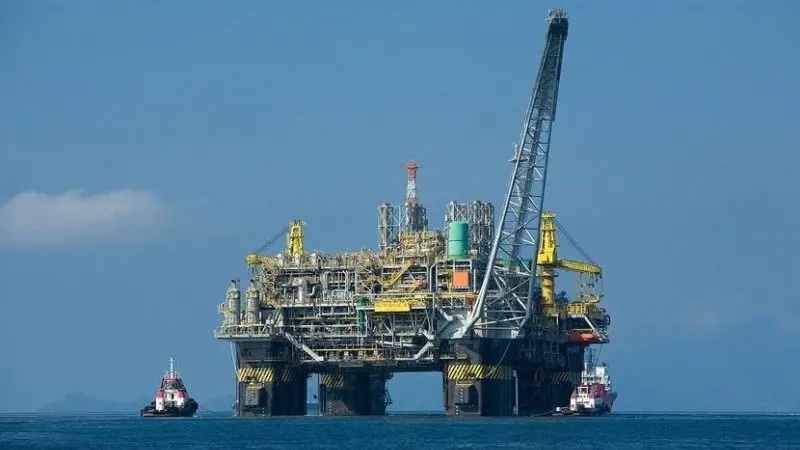
Oil platform P-51 offshore Brazil. Photo by Divulgação Petrobras / ABr, Wikipedia Commons.

By Bruno de Freitas Moura 

Petrobras’ CEO Magda Chambriard criticized the Brazilian Institute for the Environment and Renewable Natural Resources (IBAMA) for the delay in authorizing oil exploration in the Equatorial Margin, an area off the Brazilian coast identified as the new “pre-salt” due to its oil production potential.

“We’ve already lost ten years,” lamented Chambriard, referring to the bidding process for exploring the region that took place in 2013.

The Equatorial Margin extends from the coast of Rio Grande do Norte state to Amapá state. Potential oil exploration in this region, which includes the mouth of the Amazon River, has drawn criticism from environmentalists concerned about possible environmental damage.

Petrobras is authorized to drill off the coast of Rio Grande do Norte, but Ibama has rejected exploratory efforts in the northernmost part of the country.

Convincing

On Wednesday (Jun. 12), Chambriard announced that Petrobras intends to convene a meeting with the National Energy Policy Council (CNPE), an advisory body to the country’s president for formulating energy policies and guidelines, to deliver a presentation on the company’s commitment to safety and “excellence” in oil production. This presentation will highlight Petrobras’ efforts to ensure environmental preservation and support for affected communities.

“We explore in the pre-salt, off the coast of Ipanema, Búzios, and Angra dos Reis, and all stakeholders, including society, mayors, and state and federal representatives, are pleased with the results. The revenue and development stemming from this exploration and production benefit everyone,” she said, referring to tourist destinations along the coast of Rio de Janeiro.

Since the end of May, when she took over as Petrobras’ CEO, Magda Chambriard has defended oil exploration on the Equatorial Margin as an alternative to the future decline in oil production in pre-salt fields, a natural cycle in the oil industry. “It’s a question of national security,” she said.

The CEO of the state-owned company made these statements during the FII Priority Summit, an event sponsored by the government of Saudi Arabia. The summit brought together global personalities from the public and private sectors at the Copacabana Palace hotel in Rio de Janeiro.

During the meeting’s opening, President Luiz Inácio Lula da Silva also voiced his support for oil exploration in the Equatorial Margin.

“When we begin exploring the Equatorial Margin, I believe we will make an extraordinary leap in quality. We aim to do everything legally, respecting the environment and all regulations. However, we will not miss any opportunity to help this country grow,” noted the president.


Categories
South Caucasus News

Biden Can’t Fix Our Immigration System By Banning Asylum – OpEd


Biden Can’t Fix Our Immigration System By Banning Asylum – OpEd

united states mexico border migrant

President Biden once;pledged;to adopt more humane immigration policies than his predecessor.;

But in practice, as immigrant rights advocates have;documented, his administration has escalated the attack on the legal right of people facing life-threatening conditions to seek safety. Even though this right is guaranteed regardless of how asylum seekers enter the country, he has sought to;restrict;access to ports of entry.

Under both;U.S.;and;international law, anyone fleeing persecution in another country has a right to request asylum and have their claim assessed.;But both the Trump and Biden administrations have dramatically undermined these protections.

Most recently, Biden’s;executive order;and accompanying;federal rule;on “Securing the Border” —;which effectively closed the U.S.-Mexico border this June — all but suspended the right to asylum altogether.

The new rule;bars asylum access;for the vast majority of people once the daily average of border;crossings;reaches 2,500 between ports of entry for seven consecutive days — a completely arbitrary figure with no basis in law.

In addition, while the ban is in effect Customs and Border Protection (CBP) agents will no longer screen arriving asylum seekers at the border to see if they have a reasonable fear of returning to their home countries. Instead, the burden is on individuals and families to;“manifest”;their fear of persecution to CBP agents, who have a known record of;intimidating;asylum seekers. And the majority will have to do so without legal assistance.

The executive action relies on;a section of the Immigration and Nationality Act;that President Trump previously invoked and resembles his unlawful attempts to ban asylum seekers — which the courts repeatedly;struck down. The same statute makes it;crystal clear;that any person arriving on U.S. soil may request asylum;regardless of their manner of entry.;

Returning people back to countries where they could face persecution, torture, or other irreparable harm is not only illegal, but cruel and immoral.;Nor will it “restore order” at the border. If anything,;Biden’s crackdown on asylum will only create more panic and confusion.;

As political and economic conditions continue to deteriorate in Haiti, Venezuela, and throughout Central America, more and more people are being displaced. Biden’s order essentially forces asylum seekers to wait in Mexico, where they are;exploited;by cartels and other criminals, or else deports them back to places where they’ll face harm.

Like previous presidents, Biden has ignored the root causes of forced displacement.;

We must begin by re-examining U.S. policies toward our neighbors in Latin America and the Caribbean. Our trade policies and sanctions (like those against;Venezuela) have devastated local economies. And many have fled the violence and repression of U.S.-backed authoritarian governments across the region.

Fully “shutting down” the border would be physically impossible. Efforts to do so have merely produced a;costly, militarized border security and detention apparatus that;punishes;people for requesting asylum — and has a;vested;interest in never fixing our broken immigration system.

Instead, we need a just and humane approach grounded in law and the inherent dignity of all people.;

Common sense measures should include improving the arrival process at ports of entry, ensuring that asylum applications are reviewed promptly and fairly, hiring more asylum officers and properly staffing immigration courts to address;backlogs, providing access to legal counsel, and establishing more legal pathways to citizenship.

Seeking asylum from persecution is a fundamental human right that transcends borders and partisan politics. America has a long tradition of providing a safe haven for the persecuted. We must not lose sight of this value in our immigration policies. 

  • This article was published by Other Words

Categories
South Caucasus News

Biden, G7 Leaders Focus On Ukraine, Gaza, Global Infrastructure, Africa


Biden, G7 Leaders Focus On Ukraine, Gaza, Global Infrastructure, Africa

Summit host, Italian Prime Minister Georgia Meloni, top center, next to US President Joe Biden, with fellow G7 leaders during a roundtable session on the first day of their summit, at Borgo Egnazia, southern Italy, June 13, 2024. Photo Credit: G7 Italia

By Patsy Widakuswara

U.S. President Joe Biden is in Apuglia, Italy, meeting with leaders of the Group of Seven wealthy democracies Thursday, aiming to address global economic security amid wars in Europe and the Middle East and U.S. rivalry with China.

The G7 leaders arrived at the luxury resort of Borgo Egnazia, the summit venue, welcomed by Italian Prime Minister Giorgia Meloni. Meloni’s hard-right party took nearly 29% of the vote in last weekend’s European Parliament election, making her the only leader of a major Western European country to emerge from the ballots stronger.

Meanwhile Biden is dealing with a contentious reelection campaign against Republican presumptive nominee Donald Trump, and a personal ordeal. On Tuesday, a day before departing for the summit, his son, Hunter, was found guilty on federal charges for possessing a gun while being addicted to drugs.

Still, Biden came to the summit hoping to convince the group to provide a $50 billion loan to Ukraine using interest from Russian frozen assets, and deal with Chinese overcapacity in strategic green technologies, including electric vehicles.;

The European Union signaled their support by announcing duties on Chinese EVs a day ahead of the summit, a move that echoed the Biden administration’s steep tariff hike on Chinese EVs and other key sectors in May.

Biden is also lending his support to key themes in Meloni’s presidency – investing in Africa, international development, and climate change. Those topics were covered in the opening session of the G7 on Thursday, followed by discussions on the Gaza and Ukraine wars.;

Gaza cease-fire

With cease-fire negotiations at a critical juncture, Biden could face tough questions from leaders on whether he is doing enough to pressure Israel to pause its military campaign, reduce civilian casualties and provide more aid for Palestinians.

Leaders are “focused on one thing overall; getting a cease-fire in place and getting the hostages home as part of that,” White House national security adviser Jake Sullivan told VOA as he spoke to reporters on board Air Force One en route to Italy. Biden has “their full backing,” Sullivan added.

Leaders will also discuss increasing tension along the Israeli border with Lebanon, Sullivan told reporters Thursday morning.;

“They’ll compare notes on the continuing threat posed by Iran both with respect to its support for proxy forces and with respect to the Iranian nuclear program,” he added.

While the group has thrown its weight behind the cease-fire, G7 members are split on other Gaza-related issues, including the International Criminal Court’s decision last month to seek arrest warrants for the leaders of Hamas and Israeli Prime Minister Benjamin Netanyahu.

The United States denounced the court’s decision, and Britain called it “unhelpful.” France said it supports the court’s “fight against impunity,” while Berlin said it would arrest Netanyahu on German soil should a warrant is released.

Sullivan dismissed a United Nations inquiry result released Wednesday that alleges both Israel and Hamas committed war crimes and grave violations of international law.

“We’ve made our position clear,” he told VOA, referring to a review published in April by the State Department concluding that Israel’s campaign did not violate international humanitarian law.

Russian assets

Biden is pushing G7 leaders to provide Kyiv with a loan of up to $50 billion that will be paid back to Western allies using interest income from the $280 billion Russian assets frozen in Western financial institutions, estimated at $3 billion a year, for 10 years or more.

The goal is a leaders declaration at the end of the summit, a “framework that is not generic, that is quite specific in terms of what it would entail,” Sullivan told VOA Wednesday. Core operational details would still need to be worked out, he added.;

In April, Biden signed legislation to seize the roughly $5 billion in Russian assets that had been immobilized in U.S. financial institutions. The bulk of the money, though, $190 billion, is in Belgium, and much of the rest is in France and Germany.

“There’s a tension here between a Biden administration ambition on an issue in which they do not have the final say, hitting against very staunch European fiscal conservatism and simply the mechanics of, how do you get something done in Europe in the week of European [parliamentary] elections,” Kristine Berzina, managing director of Geostrategy North at the German Marshall Fund think tank, told VOA.

Attending the summit for the second consecutive year, Ukrainian President Volodymyr Zelenskyy is advocating for the deal to pass. He and Biden will sign a separate bilateral security agreement outlining U.S. support for Ukraine and speak in a joint press conference Thursday evening.

From Italy, Zelenskyy heads to Switzerland for a Ukraine peace conference over the weekend.

Africa, climate change and development

Meloni, a far-right politician who once called for a naval blockade to prevent African migrants from crossing the Mediterranean Sea to Europe, now wants to achieve the goal by bolstering international investments to the continent.

Most of the nearly 261,000 migrants who crossed the Mediterranean Sea from northern Africa in 2023 entered Europe through Italy, according to the United Nations.

She has aligned her G7 presidency with this agenda, and the group is set to release a statement on providing debt relief for low- and middle-income countries, dealing with irregular migration and calling for more investments in Africa.

The G7 statement will reflect the Nairobi/Washington vision that;Biden signed with Kenyan President William Ruto, Sullivan said.

Meloni invited several African leaders as observers to the G7 meeting, including Algerian President Abdelmadjid Tebboune, Tunisia’s Kais Saied, Kenyan President William Ruto and Mohamed Ould Ghazouani, the president of Mauritania. The invitation follows the first Italy-Africa summit in Rome in January, where Meloni launched her investment initiative called the Mattei Plan for Africa.

The Mattei Plan has been integrated into the G7’s Partnership for Global Infrastructure and Investment, which aims to mobilize $600 billion private infrastructure funding by 2027 as an alternative to Chin’s Belt and Road initiative.

On climate change, the G7 has an uphill climb. None of the group’s members are on track to meet their existing emission reduction targets for 2030 to align with the Paris Agreement goal, according to data compiled by Climate Analytics.


Categories
South Caucasus News

Nobel Peace Prize Winner Yunus Caged During Dhaka Court Hearing


Nobel Peace Prize Winner Yunus Caged During Dhaka Court Hearing

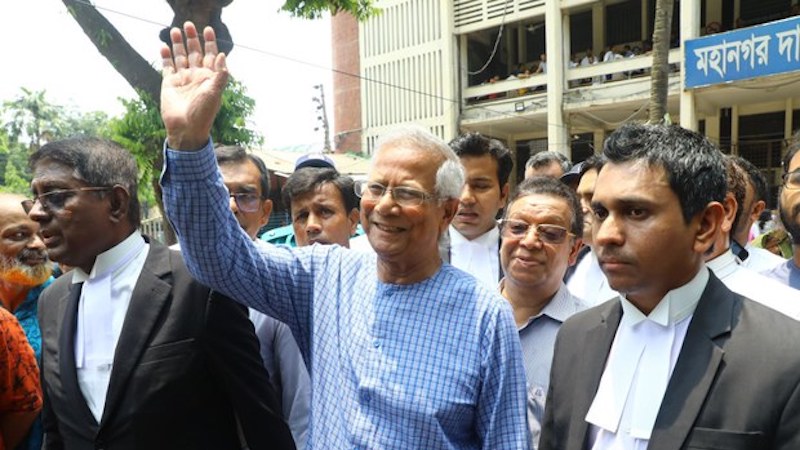
Nobel Laureate Muhammad Yunus waves to reporters as he leaves the Special Judge’s Court in Dhaka, June 12, 2024. Photo Credit: Mehedi Rana/BenarNews

By Kamran Reza Chowdhury

Nobel laureate Muhammad Yunus spoke out against making defendants stand in an iron cage in court, moments after his arraignment in Dhaka on Wednesday over charges linked to alleged money laundering.

Prosecutor Mosharraf Hossain Kajol said the Special Judge’s Court-4 had accepted the charge sheet submitted by the Anti-Corruption Commission and set July 15 to begin hearing testimony against Yunus and 13 co-defendants.;

Exiting the court on Wednesday, Yunus told reporters he was being harassed.

“Today, we had been inside an iron cage for long hours. We were told, ‘you stay here,’ but we passed the whole hearing period inside the iron cage,” he said.;

“Earlier, I raised similar questions, whether it was a fair practice – as far as I know, an accused person will be treated as innocent until they are convicted.”;

The 83-year-old compared himself and the others to animals.

“This is a humiliation for me – an innocent person must stand inside an iron cage during the whole hearing time! This is an abominable practice … this provision should be reviewed,” he said.;

The money laundering charges against Yunus mark the second criminal case against him that has gone to trial. He was awarded the Nobel Peace Prize in 2006 in recognition of his pioneering micro-credit loans that helped Bangladeshi people – women in particular – lift themselves out of poverty through the Grameen Bank, which he founded.;

Yunus is out on bail following his previous conviction over;labor law violations. On Jan. 1, a court in Dhaka sentenced him and three conspirators to six months.;

Law Minister Anisul Huq challenged Yunus’s complaint.

“Dr. Yunus was given a chair to sit, but he rejected the offer saying he could not sit as other co-accused persons did not get a chair,” Huq told BenarNews. “Dr. Yunus tried to create an issue in the trial.”;

While he is popular among Western leaders for his work in the field of poverty alleviation, Yunus was removed from Grameen’s board of directors in 2011, amid legal battles with the government of Prime Minister Sheikh Hasina, who remains in power.

Mizanur Rahman, a former chairman of National Human Rights Commission, supported Yunus.;

“Putting Muhammad Yunus inside an iron cage was not decent at all – he is not a serious, notorious criminal. This is ‘too much’ to put a man of his stature inside an iron cage,” Rahman told BenarNews.;

“[T]his sort of practice does not convey a good message about the country’s judicial system,” he said.;

Money transfer

Prosecutors allege that Yunus and the others illegally transferred;260 million taka (U.S. $2.2 million) from the Grameen Telecom workers’ compensation fund to the employees’ welfare union.;;

“Examining the documents and papers, the court has ruled that money laundering takes place in it. So, the money laundering charge has been framed against Yunus and others,” prosecutor Kajol said.;

“This is not the point to consider whether Yunus embezzled the money. The point is – the workers’ money had been transferred to the account of the employees’ union,” he said. “According to the Money Laundering Prevention Act and the Penal Code, this is money laundering.”;

If convicted, Yunus could face up to 12 years in prison, according to Kajol.

The prosecutor noted that Grameen Telecom had agreed to pay 4.3 billion taka ($37.2 million) as compensation.;

Defense attorney Abdullah Al Mamun said the charge against Yunus was “completely baseless” and aimed at “harassing” the Nobel laureate on political grounds.;

“Money laundering means embezzlement and personal gains. Has Dr. Yunus embezzled the money?” Mamun told BenarNews.;

“That 260 million taka was transferred from one account of the workers to another account. With their consent, the money was transferred to pay the fees of the lawyers of the workers – where is money laundering here?”


Categories
South Caucasus News

Lawyers educated in Germany undermine democracy in Georgia – German newspaper


Frankfurter Allgemeine Zeitung on Georgian PM

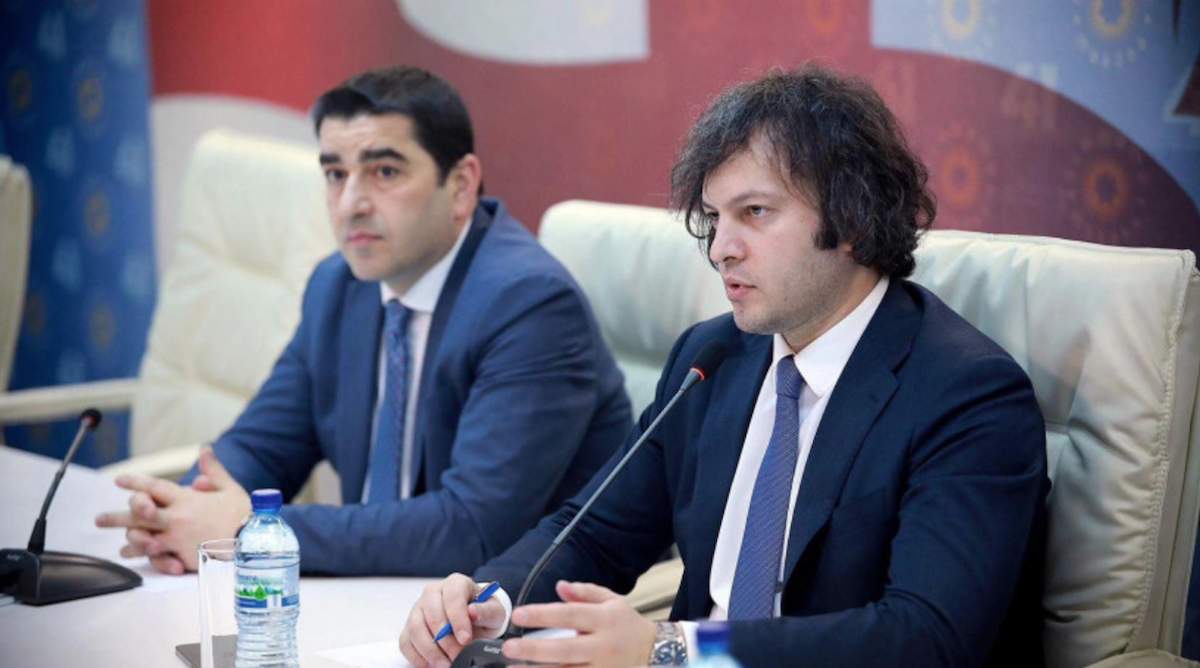
On June 13, one of Germany’s most popular newspapers, Frankfurter Allgemeine Zeitung, published an article titled “German Doctors from Tbilisi: How Lawyers Educated in Germany Are Undermining Democracy in Georgia.”

The article, written by journalist Reinhard Veser, discusses the prime minister and the speaker of the Georgian Parliament.

What is written in the article

“When prime minister Irakli Kobakhidze visited Berlin in April, he spoke fluently in German with Federal Chancellor Olaf Scholz at a joint press conference about an important aspect of the relationship between Georgia and Germany — the systematic training of Georgian lawyers in Germany since the 1990s.

I, the speaker of Parliament, the minister of Justice, the chairman of the Parliamentary Committee on Legal Affairs, and many other politicians from the Georgian government studied and graduated from universities in Germany,’ Kobakhidze said. ‘In Germany, we learned that democracy, the rule of law, fundamental rights, and state sovereignty are the highest basic principles and must be protected with particular attention.’

These words were not only a diplomatic gesture but also part of a confrontation between Kobakhidze and the German Chancellor, who had explicitly criticized the ‘Foreign Influence’ law presented by the ruling party ‘Georgian Dream’ in parliament a few months earlier.

Kobakhidze and the politicians with German doctoral degrees, whom he mentioned, played a crucial role in passing the law, which will come into force in August.

And they, like Kobakhidze in Berlin, have repeatedly mentioned their German education in various circumstances as an argument for the compliance of this law with European standards: the message being that it couldn’t be otherwise from those with such a background.

The doctoral supervisor of the minister of Justice of Georgia, Rati Bregadze, Hamburg expert on Eastern law Otto Luchterhandt, previously tried to organize a joint statement from professors but received only refusals.

In the end, he wrote an open letter to his former student. Düsseldorf constitutional law expert Martin Morlok, with whom prime minister Kobakhidze worked on a dissertation titled ‘The Functioning of Political Parties and Their Freedom,’ told FAZ that he does not feel responsible for his former students, as ‘that would be paternalism.’

One of the professors justified his refusal to Luchterhandt by saying that he lacked ‘scientific knowledge’ on this issue. However, it has never been impossible to obtain detailed information about the content of the Georgian law and its consequences.”


Categories
South Caucasus News

Azerbaijan awards medals to activists living in US (PHOTO) – Trend News Agency


Azerbaijan awards medals to activists living in US (PHOTO)  Trend News Agency

Categories
South Caucasus News

AP Headline News – Jun 13 2024 18:00 (EDT)


28013281


Categories
South Caucasus News

Armenia, Belarus Recall Respective Ambassadors as Yerevan’s Diplomatic Row with Minsk Escalates – Asbarez.com – Asbarez Armenian News


Armenia, Belarus Recall Respective Ambassadors as Yerevan’s Diplomatic Row with Minsk Escalates – Asbarez.com  Asbarez Armenian News

Categories
South Caucasus News

Afeyan Launches New Initiative: Armenian Spiritual Revival Foundation – The Armenian Mirror-Spectator


Afeyan Launches New Initiative: Armenian Spiritual Revival Foundation  The Armenian Mirror-Spectator

Categories
South Caucasus News

NATO Secretary General: ‘The Longer We Commit, The Sooner Ukraine Can Have Peace’


NATO Secretary General: ‘The Longer We Commit, The Sooner Ukraine Can Have Peace’

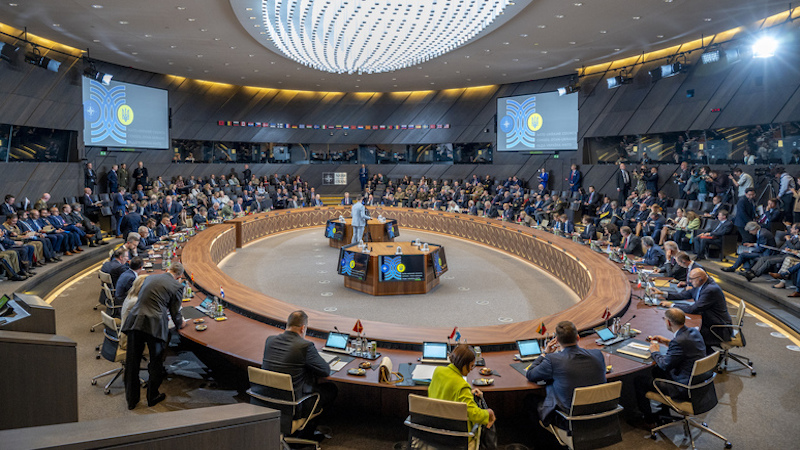
Meeting of the NATO-Ukraine Council - Meeting of NATO Ministers of Defence. Photo Credit: NATO

Defence Ministers met in Brussels on Thursday (13 June 2024) to finalise preparations for NATO’s Washington Summit and discuss support for Ukraine.;

In a meeting of the NATO-Ukraine Council, Ukrainian Defence Minister Rustem Umerov briefed Allies on the battlefield situation. Following the meeting, the Secretary General said he expects Allies to agree tomorrow on the plan for NATO security assistance and training to Ukraine. He added that he has also proposed that Allies provide Ukraine at least 40 billion euros in military support each year, for as long as necessary. “The paradox is that the longer we plan, and the longer we commit, the sooner Ukraine can have peace,” he said, underlining;that a credible, long-term commitment shows Moscow that they cannot wait out Allied support.;

Ukraine’s future in NATO was also discussed,;with Mr Stoltenberg pointing to Allies’ efforts to bring Ukraine “ever closer to NATO membership”. To that end, Allies discussed plans to align Ukraine’s defence and security sectors with NATO standards, and improve its defence procurement. They also endorsed the first-ever NATO-Ukraine Innovation Cooperation Roadmap and are preparing to endorse a NATO-Ukraine Joint Analysis, Training and Education Centre (JATEC) in Poland.

On Friday, Ministers will discuss strengthening NATO’s deterrence and defence, including a new defence industrial pledge to scale up military production. “This is our last Ministerial before the Washington Summit, so we have a lot to get done,” the Secretary General concluded.