
Day: June 11, 2024
By C. Todd Lopez
U.S. and South Korean officials Monday convened the third meeting of the Nuclear Consultative Group, where among other things, participants planned greater cooperation between the two nations and enhanced nuclear deterrence on the Korean Peninsula.
“Across the board, we’re making progress in the Nuclear Consultative Group,” said Richard C. Johnson, deputy assistant secretary of defense for nuclear and countering weapons of mass destruction policy. “Just the establishment of that group, I think, was very important to demonstrate how we are elevating the discussion that we’re having on nuclear deterrence issues, but the work that we’re doing is really key. Whether that’s from information sharing to joint planning and execution.”
Johnson spoke Monday at the Center for Strategic and International Studies in Washington.
At this meeting of the NCG, Johnson said, a “big outcome” was the signing out of a set of shared guidelines for the U.S. and South Korean alliance.;
“These guidelines really serve as kind of the principles and procedures upon which the alliance will serve to really look at nuclear deterrence issues in terms of policy and posture,” Johnson said. “This will really be the foundation upon which we move forward in the NCG on U.S./[South Korea] cooperation.”
According to a statement released Monday by the NCG, the guidelines provide principles and procedures for the U.S./South Korea alliance to maintain and strengthen a credible and effective nuclear deterrence policy and posture.
A key focus of this most recent meeting of the NCG, Johnson said, was planning and execution related to conventional nuclear integration, or CNI.;
The NCG is interested in ensuring that, in the event of a nuclear crisis on the Korean peninsula, U.S nuclear capabilities are effectively integrated with Korea’s own conventional capabilities. “[South Korea] … is really advancing its conventional capabilities,” he said. “And I think we’re making real progress there.”;
The NCG statement today said participants in the meeting discussed the planning and execution of U.S/South Korea CNI options on the Korean Peninsula. The group reaffirmed that integration of South Korea’s conventional capabilities with U.S. nuclear operations “substantively strengthens the allied deterrence and response capabilities against the [North Korea] nuclear and missile threat.”;
Also on the agenda, Johnson said, was a focus on increased tabletop exercises so that the U.S. and South Korea can practice the integration and deterrence the NCG seeks.;
“The best way to understand how to operate in this … world is to practice,” he said. “We are doing more and more of what we call tabletop exercises, or TTXs. And we have at least, I believe, three coming up over the course of the next year, including a military-to-military exercise.”;
During today’s meeting, NCG participants agreed to an interagency simulation, an NCG-led TTX and a military-to-military TTX.;
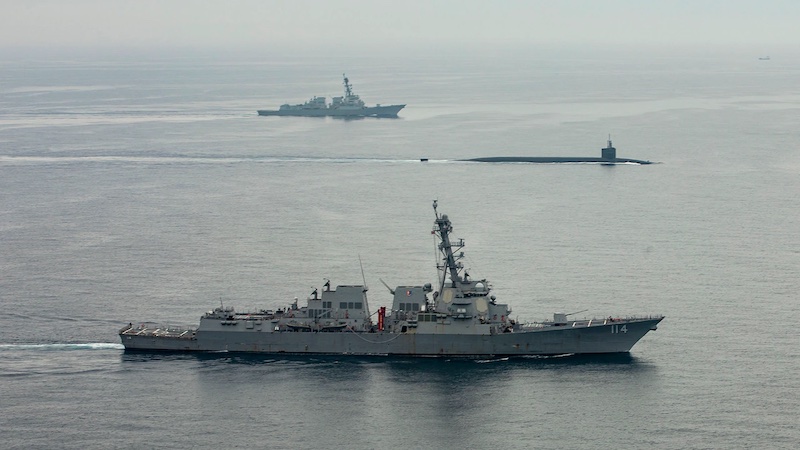
A big part of deterrence efforts, Johnson said, also includes enhanced visibility of U.S. commitment to the alliance through the visibility of American strategic deterrent assets. In July 2023, for instance, the USS Kentucky, a nuclear ballistic missile submarine, visited the South Korean port of Busan. It was the first time in over 40 years such a visit occurred.;
“I think we’re in a very good place,” Johnson said. “I don’t think we’ve ever had this high of a level of collaboration, commitment and trust on extended deterrence than we’ve ever had with the United States and the Republic of Korea.”;
The NCG was created to implement what was agreed to in the April 2023 Washington Agreement. In that agreement, the U.S. reaffirmed its commitment to South Korea and the Korean people and also agreed that any nuclear attack by North Korea against South Korea “will be met with a swift, overwhelming and decisive response.”

By Wanjiru Njoya
When socialist schemes fail, as they inevitably do, our attention is immediately drawn away from the destruction they cause to the “good intentions” behind the schemes. They meant well. Their good intentions override their disastrous results. One reason why good intentions are important to both sides of the political divide is that good intentions play well to voters. A good example of this is the national debt crisis in the United States. The economist Samuel Gregg;points out;that while both parties pledge to resolve the growing national debt, both parties regard the measures necessary to resolve the situation as electoral suicide: “America’s National Debt challenge constitutes a political iron cage for Democrat and Republican legislators alike. While they can talk a big game about courageously tackling the problem, the political consequences of actually doing so are deeply unattractive for both parties.” The politicians’ desire to present voters with some obviously well-intentioned schemes overrides their commitment to resolving the problem. They are well-aware that any subsequent failures will be overlooked or forgiven in light of their good intentions.
In his book;Socialism, Ludwig von Mises argues that socialist good intentions are “nothing but a grandiose rationalization of petty resentments.” They depict the politics of envy as a quest for justice, and they discount any cost as necessary for the pursuit of the higher goal of justice. However, as Mises points out, the assertion that socialism promotes justice is “merely an arbitrary assertion.” He explains:
“In fact Socialism is not in the least what it pretends to be. It is not the pioneer of a better and finer world, but the spoiler of what thousands of years of civilization have created. It does not build; it destroys. For destruction is the essence of it. . . . [It] raises the consumption of the masses at the cost of existing capital wealth, and thus sacrifices the future to the present. . . . The increasing difficulties of maintaining the higher standard of living are ascribed to various causes, but never to the fact that a policy of capital consumption is being followed.“
In highlighting the inherently destructive nature of socialism, Mises’s point is not that socialists necessarily set out to destroy society but that this is the inevitable result of their schemes: “Socialism has not consciously willed the destruction of society. It believed it was creating a higher form of society. But since a socialist society is not a possibility every step towards it must harm society.” Faced with the destruction of society, it is futile to divert our intention to the supposedly good intentions behind the destruction.
Mises’s concept of “destructionism” refers to “the consumption of capital” and ultimately the “destruction of what already exists.” He observes that “the policy of destructionism is the policy of the spendthrift who dissipates his inheritance regardless of the future.” The destructionism of socialism is pervasive: “Our whole life is so given over to destructionism that one can hardly name a field which it has not penetrated.” The contemporary significance of this concept is illustrated by;Tom DiLorenzo;in “Misesian Destructionism: Then and Now,” showing how destructionism takes effect through the “cultural Marxism” of the Frankfurt School. DiLorenzo observes:
One of my first observances of such idiocy was in the mid-1980s when that great intellectual giant Jesse Jackson led mob of Stanford University students chanting “Hey, Hey, Ho, Ho, Western Civ Has Got to Go.” They wanted the university to drop its courses on Western Civilization and replace them with courses on “race, class, and gender studies.” The Stanford administration dutifully complied.
The same destructionism can be seen in attempts to “decolonize” history, art, culture, and all fields of academic inquiry. That the “decolonize” movement is destructive is clear from the violent rhetoric that accompanies it. Yet this too is spun in the language of good intentions. As;explained;by Ross Douthat in the;New York Times:
A key project of the 21st-century left has been to revive and mainstream language associated with violent revolutionary struggle by turning it to mostly therapeutic uses. .;.;.
.;.;. insisting, as in the work of Frantz Fanon, that revolutionary violence itself was therapeutic, a means by which the colonized can achieve self-assertion, dignity and wholeness. .;.;.
.;.;. a promise that all the rhetoric is therapeutic and psychological, that when we talk about stolen land and ending “whiteness” and decolonizing everything, we are, of course, merely speaking culturally, symbolically, metaphorically.
The excesses of wokery are provocative, but wokery is by no means the only contemporary emanation of socialist destructionism. The same destructive effect is seen in welfare schemes such as labor legislation and social insurance that now threaten to bankrupt welfare states. Samuel Gregg observes that “spending on major entitlement programs like Social Security, Medicare, and what is called Income Security .;.;. constituted 68 percent of Federal Government spending in 2023.” These welfare schemes may seem relatively beneficial compared to other forms of government spending, but they too are “a means of destructionism” as they rely on the “consumption of capital” while creating more incentives to consume and destroying all incentives to produce. Mises explains that social welfare “produces nothing, it only consumes what the social order based on private ownership in the means of production has created.”
Socialist legislative schemes are often lauded not only for their worthy social ideals and goals, but also because of the widespread fear that such well-meaning legislation is all that stands between vulnerable people and disaster. Even if it does not work, so the reasoning goes, it will signal the right aspirations and show what society stands for. This is the rationale behind “hate speech” legislation that is intended to “root out hate.” Hate may or may not be rooted out of the hearts wherein it lurks, but at least we will have signaled that hate is “unacceptable.” Similarly, employment protection and antidiscrimination legislation are supported by both political sides. All parties are resistant to abolishing the special “protection” given to various identity groups by legislation intended to “protect” them. In the absence of market opportunities and in the absence of charity, both of which are derided by socialists, it seems that welfare legislation and virtue signaling assume great importance as the means by which human life will flourish. In this way, destructive legislation is attributed with a lifesaving and life-affirming function, and the prospect of abolishing it becomes unthinkable.
The destructive effects of these measures, which are touted for their beneficial qualities, go unacknowledged. The causes of economic and social problems are not self-evident, and many people do not link cause and effect. The same destructive policies are repeatedly introduced as they are not viewed as causally linked to the disasters that lie in their wake. No lessons are learned. Mises explains:
To see the weakness of a policy which raises the consumption of the masses at the cost of existing capital wealth, and thus sacrifices the future to the present, and to recognize the nature of this policy, requires deeper insight than that vouchsafed to statesmen and politicians or to the masses who have put them into power. As long as the walls of the factory buildings stand, and the trains continue to run, it is supposed that all is well with the world. The increasing difficulties of maintaining the higher standard of living are ascribed to various causes, but never to the fact that a policy of capital consumption is being followed.
Mises argues that the fight against this destructionism requires more than simply correcting socialists concerning the facts:
Facts;per se;can neither prove nor refute anything. .;.;. From the socialist point of view, Capitalism alone is responsible for all the misery the world has had to endure in recent years. Socialists see only what they want to see and are blind to anything that might contradict their theory.
Thus, the rising cost of living is ascribed to corporate greed and profiteering, with the left-leaning;Guardian;informing its readers that inflation is caused by “energy prices and corporate profits” and the 2020 global economic recession was caused by covid. Simple explanations for economic crises play well to the voters, who are in that way well-primed to accept that all measures taken by the government to tackle the crises are well-intentioned.
In response, it is necessary to persuade our compatriots of the true causes of the destructionism they see unfolding around them by joining what Mises calls “the battle of ideas,” a battle based not only on pointing out the correct facts, but more so on “the interpretation and explanation of the facts, by the ideas and the theories.”
- About the author: Dr. Wanjiru Njoya is a Scholar-in-Residence for the Mises Institute. She is the author of Economic Freedom and Social Justice (Palgrave Macmillan, 2021), Redressing Historical Injustice (Palgrave Macmillan, 2023, with David Gordon) and “A Critique of Equality Legislation in Liberal Market Economies” (Journal of Libertarian Studies, 2021).
- Source: This article was published by the Mises Institute

The US had said that normalizing relations between Saudi Arabia and Israel seemed possible. Since 2020, the US has been pushing Saudi Arabia to recognize Israel officially and establish formal ties. As part of this deal, the US has offered Saudi Arabia advanced military equipment and help with developing a civilian nuclear programme, reports Grey Dynamics, a UK-based investigative media outlet.
However, talks have stalled since the attack by Hamas on Israel on October 7, 2023. Since then, Saudi Arabia, a key leader in the Sunni Muslim world, has insisted that Israel must outline a clear plan for creating a Palestinian state before discussions can move forward. Israel, on the other hand, sees an independent Palestine as a security risk and has firmly rejected Saudi Arabia’s proposals.
Critical Assessment 1: Saudi Arabia’s stance on Palestinian statehood has impeded normalization with Israel.
- According to a BBC report in January 2024, Saudi Arabia’s de facto leader, Crown Prince Mohammed-bin-Salman, emphasised the significance of the Palestinian issue and the need for measures that would improve the lives of Palestinians. However, he did not explicitly state that these measures would rely on progress towards establishing an independent Palestinian state
- The Saudi Arabian ambassador to the UK has expressed a desire to improve relations with Israel following the war in Gaza. However, they have emphasised that any potential agreement should include the creation of a Palestinian state. This statement was made during an interview with the BBC on January 9
- Normalizing relations with Saudi Arabia, a key Sunni Muslim country and home to two of Islam’s holiest sites, could potentially lead to broader acceptance of Israel in the Muslim world and strengthen an emerging Arab-Israeli defence alliance against Iran. However, Prime Minister Netanyahu’s far-Right coalition partners strongly oppose any concessions to Palestinians and have threatened to dissolve the government if such steps are taken, according to a May 2024 report by The Guardian
Critical Assessment 2: Iran’s nuclear ambitions and its role in destabilizing the Middle East are, possibly, the main reasons behind the trilateral normalization talks.
- Since 2020, the US has aimed to form an Arab-Israeli defence alliance which includes Saudi Arabia. Achieving this coalition would be a significant policy success, especially during an election year, according to a report by Grey Dynamics citing information from The Guardian
- In an August 2023 report by The Washington Institute, it was stated that Crown Prince Muhammad-bin-Salman has three main demands for a potential normalization deal with Israel:
- US security guarantees
- Access to advanced American military equipment, and
- Technology and support for a domestic civilian nuclear programme
The last demand is particularly challenging for Washington because it involves access to uranium enrichment technology, which can be used to make nuclear weapons. The report also mentioned that, while Saudi Arabia does not seek to build a nuclear bomb, it would quickly pursue one if Iran developed one first
- Since 2023, Iran has attacked Israeli territory through various means, including proxy forces and missile strikes. Iran does not recognize Israel’s right to exist and aims for its destruction. The country’s supreme leader, Ayatollah Ali Khamenei, has called Israel a “cancerous tumour” that “will undoubtedly be uprooted and destroyed”, according to an April 2024 BBC report, which was further confirmed by Grey Dynamics
Critical Assessment 3: Israel and Saudi Arabia will, probably, wait until the war in Gaza ends to resume normalization talks. This way, both can use the outcome to influence their plans for Palestine’s future.
- In May 2024, US Secretary of State Antony Blinken told Al-Monitor he was unsure if Israel was willing to make the necessary compromises to normalize relations with Saudi Arabia, particularly regarding a path to a Palestinian state. He noted that this would require ending the Gaza war and establishing a credible path to a Palestinian state
- As of May 2024, Prime Minister Netanyahu did not commit to a plan for Palestine after the war in Gaza. On May 8, Benny Gantz, a member of Israel’s War Cabinet, suggested a six-point plan that included a joint administration by the US, Europe, Arab nations and Palestinians. However, Saudi Arabia has called for a more defined path to Palestinian statehood, according to a May 2024 report by Al-Jazeera
- Since October 2023, Netanyahu has been leading a war government and holding onto his political position through emergency powers. The Gaza war is expected to bring an end to Netanyahu’s government. The fall of his coalition could open the doors for potential compromises, according to a May 2024 report by Al-Jazeera
In Conclusion
Grey Dynamics concludes that Saudi-Israeli normalization talks are unlikely to resume until the war in Gaza ends. This assessment is based on information from government reports, think tanks and various media sources. More details on Israel’s post-war plans for Gaza would improve the accuracy of this judgment.
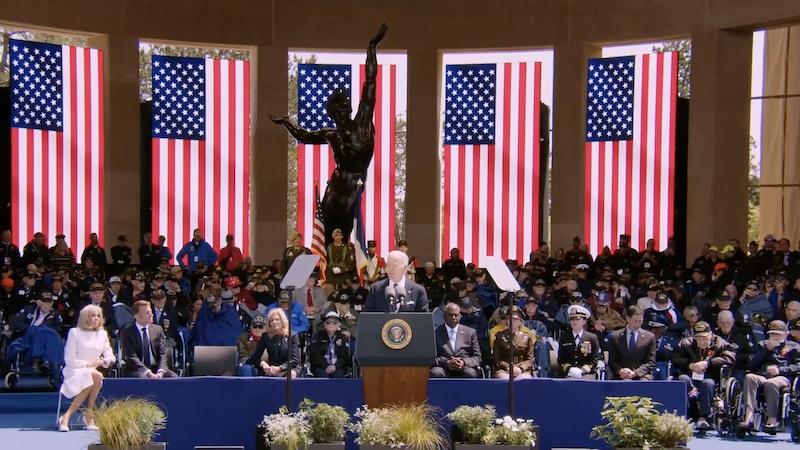
A charitable view would be U.S. President Joe Biden has no awareness and therefore no shame. But what he did during the 80th anniversary of D-Day landings last week was nonetheless repugnant. He exploited the historic event to cheaply justify NATO’s proxy war against Russia.
Biden delivered an open-air;speech;at Pointe du Pointe in Normandy. That is where some 225 U.S. Rangers stormed the beach during the D-Day landings in northwest France on June 6, 1944. The American troops scaled the cliffs under constant gunfire to capture German heavy artillery placements. The daring attack helped relieve the German firing on thousands of other Allied troops who were also storming the Normandy beaches nearby that day.
“My God, how did they do that?” asked Biden in awe.
There is no doubting the bravery of those American soldiers and their sacrifice that day. More than half of the spearhead Rangers were killed in action. The D-Day landings were one of the biggest military forces ever assembled. The second front it opened against Nazi Germany precipitated the eventual defeat in Berlin in May 1945, less than a year later.
Still, let’s not forget that the Soviet Union had been battling the Third Reich for three years before the British and American landings in Western Europe. Stalin had pleaded with Roosevelt and Churchill to open the Western front much sooner, to no avail.
It was the Soviet Red Army that inflicted the crucial blow to Hitler’s regime claiming 90 percent of Wehrmacht’s losses in countless heroic battles until the final conquest of Berlin. The iconic hoisting of the Red Flag over the Reichstag was a fitting symbol of who was the principal victor over Nazi Germany.
No disrespect to the sacrifices of the American, British and other Allied troops in Normandy, but their action was a sideshow to the main event of Soviet triumph and sacrifice – with more than 27 million Soviet citizens, some 10 million of them being soldiers,; having been killed in the war compared with less than one million U.S. and British troops.
American and British national narcissism of course likes to project an outsized role played by D-Day landings. Hollywood presentations like Steven Spielberg’s feature movie, Saving Private Ryan, are cringe-making in their vainglorious appropriation of historical valor. Laughably, actor Tom Hanks, who starred in Saving Private Ryan, was present at the 80th anniversary events in France, giving media interviews about the historical importance of the invasion. How embarrassing that Hollywood versions of history are taken as factual accounts and presented with gravitas to the public by “mainstream media news” outlets.
Anyway, the conceited notion peddled by American and British media is that it was the courage and efforts of their soldiers that won World War Two. This absurd bias has long been baked into Hollywood and mass media messaging. However, the distortion has reached the level of blatant falsification whereby Russian representation was not even permitted at the commemorative events. This is of course because of the war in Ukraine and the Western propaganda that vilifies Russia as the aggressor in Ukraine. The contradictions would be too much to bear.
Imagine that. A supposedly major event dedicated to the defeat of Nazi Germany has the brazen audacity to omit any official acknowledgment of the vital contribution made by the Soviet Union.
Not only that, but American President Joe Biden has the gall to use the D-Day landings to justify the expansion of the present U.S.-led NATO proxy war against Russia. Biden is using his falsification of World War Two as a propellant for starting World War Three. This is beyond malicious stupidity. It is criminal in the Nuremberg definition.
On the U.S. Rangers’ assault on Pointe du Hoc on June 6, 1944, Biden declared: “They breached Hitler’s Atlantic Wall.; And they turned, in that one effort, the tide of war that began to save the world.”
The incredible arrogance here by Biden is that the beach landing “turned the tide of war to save the world”.
Any honest historian, regardless of nationality, would contend the tide of war was turned during the Battle of Stalingrad in 1943 and numerous other battles on the Eastern Front which decimated the fearsome Nazi war machine.
Biden continued with his Hollywoodesque narration: “A feared dictator [who] had conquered a continent had finally met his match. Because of them, the war turned.”
Again, this is Biden making stuff up to plump up America’s myths about its presumed virtues and exceptional leadership of the “free world”.
He says of the U.S. soldiers in Normandy: “They stood against Hitler’s aggression.”
Let’s give those American and other Allied soldiers their just respect. Yes, they did stand up to Hitler and fascist aggression in Europe. As did the Soviet soldiers with whom the West was allied during WWII.
Then Biden twists the narrative with odious intent. He asks: “Does anyone doubt — does anyone doubt that they [the U.S. troops in the D-Day landings] would want America to stand up against Putin’s aggression here in Europe today?”
Biden goes on: “As we gather here today, it’s not just to honor those who showed such remarkable bravery on that day, June 6th, 1944.; It’s to listen to the echoes of their voices, to hear them, because they are summoning us, and they’re summoning us now.
“They’re ask[ing] us: What will we do?
“They’re not asking us to scale these cliffs, but they’re asking us to stay true to what America stands for.
“They’re not asking us to do their job.; They’re asking us to do our job: to protect freedom in our time, to defend democracy, to stand up to aggression abroad and at home, to be part of something bigger than ourselves.”
Biden’s distortion of history and the historic defeat of fascism is breathtaking. He is equating present-day Russia with Nazi Germany and Putin with Hitler. This is surely the pinnacle of Russophobia. And an incredibly dangerous climax to the assault that Washington has been leading in Ukraine since the CIA coup in 2014.
In truth, U.S. imperialism and its NATO war machine have resurrected the aggression of Nazi Germany against Russia. That aggression is recklessly, criminally risking inciting a nuclear conflagration. Biden and the Western ruling class have repudiated any diplomatic resolution to the worst conflict in Europe since the Second World War and are unilaterally escalating the provocations against Russia with no accountability to the Western public, all based on lies and distortions.
Biden and his Western ilk are the embodiment of fascist aggression today.
And sickening insult upon insult, Biden exploited the memory of soldiers who died fighting Nazi fascism 80 years ago to promote American fascism today.
- This article was published at Strategic Culture
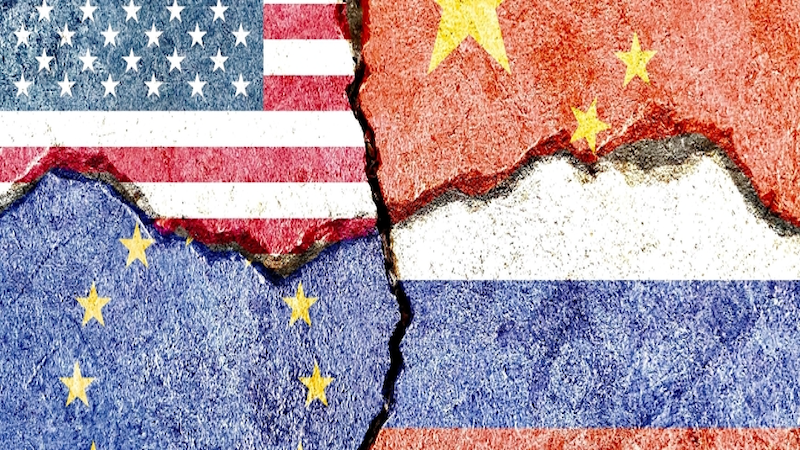
The United States (USA), China, Russia, France, the United Kingdom (UK), and The European Union (EU) are the main global actors that have significant influences over the international system. They have distinct responsibilities in securing global peace and stability. In this essay, I will analyze the roles and responsibilities of these major powers in maintaining global peace and stability.
The United States of America:
The United States occupies a unique position as a superpower, with global reach and ready influence in diplomacy, military alliances, and economic systems. As a founding member of NATO, the USA plays a decisive role in collective defense and security, countering aggression, and managing crises.
Moreover, the USA provides extensive foreign aid and humanitarian assistance, combating poverty and fostering democratic governance around the world. Its role extends to international organizations such as the United Nations (UN) and the World Bank, where it helps shape global policies affecting security and economic stability. The USA’s commitment to order and international law, using its diplomacy and military power, makes it crucial to preserving peace and preventing conflict.
Russia:
Russia possesses substantial sway on the world stage due both to its strategic position and its military capabilities. As one of the primary nuclear powers and as a permanent member of the United Nations Security Council, Russia is indispensable to international security. Its geographic reach extends throughout Eastern Europe, Central Asia, and the Middle East, giving Russia great influence in those arenas.
Consequently, Russia conducts peacekeeping and conflict resolution operations in these regions to shape the outcomes according to its national interests and the broader goal of regional and international stability. Literally and figuratively, Russian policy-makers meet the world where it is by leveraging its undertakings in multilateral forums and in bilateral relations to encourage dialogue and negotiation in the protection and resolution of disputes worldwide.
France:
France’s role as a global actor takes shape in its commitment to international peace and security, being a permanent member of the UN Security Council. It engages vigorously in peacekeeping missions worldwide, specializing in the African continent. This has been accentuated through historical links and a matter of international stability.
Within the EU, France is a key player in encouraging policies that promote collective security and economic stability. Its involvement and diplomatic relations with international organizations highlight France’s aspiration to attain peace globally.
China:
China has become a significant worldwide governance actor due to its swift economic growth and its expanding military capabilities. Its membership at the UN Security Council as one of the permanent members enables China to partake in international diplomacy and peacekeeping missions.
China’s Belt and Road Initiative, showcasing its focus on enhancing global economic stability, is designed to achieve global goals of interconnection, intercommunication, and interrelationship through investment and infrastructure in many countries in the world. China values no interference not only in its domestic issues but also in others. This is significant of China’s wide-ranging strategy to keep on having a steady international surrounding for continuous national growth. China’s engagement in multilateral institutions in conjunction with what China does in conflict resolutions mirrors China’s recognition of its part in international peace and stability.
United Kingdom:
The United Kingdom is an important peace and security actor since it is a permanent member of the UN Security Council, an active member of NATO, a key ally in regional and global peace operations, a provider of considerable levels of development aid, and an important diplomatic actor.
European Union:
The European Union (EU) is a unique supranational organization that seeks peace, economic partnership, and stability both across its member states and throughout the world at large. One of the largest providers of international development aid and humanitarian emergency response, the EU wields its economic power to further global stability.
The EU encourages dialogue and cooperation in unstable regions through its foreign policy, security architecture, and diplomacy. By privileging multilateralism and the rule of law, the EU encourages a sort of international interaction ordered by a set of common principles.
Conclusion:
In conclusion, maintaining global peace and stability is an integral and multifarious role for the USA, Russia, France, China, the UK, and the EU. Each of these countries/powers has unique attributes and skills to bring to the international system. Strengths may lie in their military capability, economic leverage, diplomatic connections, and contributions to global institutions. Their actions and policies together shape the world and set the tone for peace and stability across regions. As the world grapples with complex problems of regional conflict, terrorism, and economic instability, the cooperation and leadership of these major countries/powers are vital to establishing a stable and peaceful world order.
The opinions expressed in this article are the author’s own.
References
- Hanhimäki, J. M. (2008). The United Nations: A Very Short Introduction. Oxford University Press.
- Ikenberry, G. J. (2011). Liberal Leviathan: The Origins, Crisis, and Transformation of the American World Order. Princeton University Press.
- Nye, J. S. (2004). Soft Power: The Means to Success in World Politics. PublicAffairs.
- Smith, K. E. (2003). European Union Foreign Policy in a Changing World. Polity Press.
- Tsygankov, A. P. (2012). Russia and the West from Alexander to Putin: Honor in International Relations. Cambridge University Press.