
Categories
South Caucasus News

Better Policing In South Africa Is Well Within Reach – Analysis


Better Policing In South Africa Is Well Within Reach – Analysis

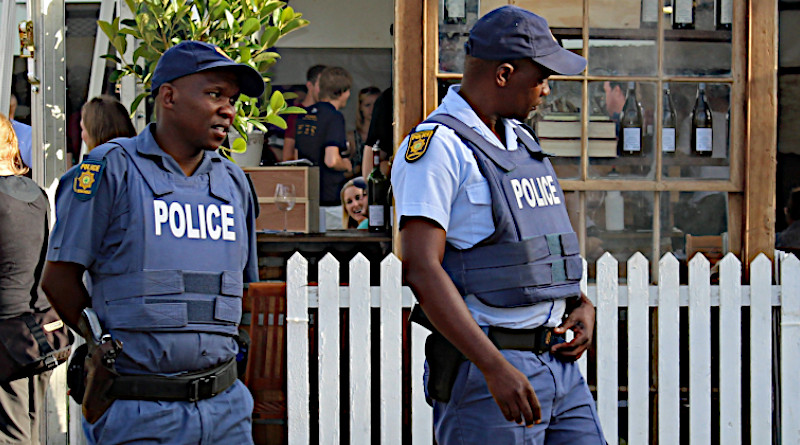
File photo of members of South Africa police. Photo Credit: HelenOnline, Wikipedia Commons

By Gareth Newham 

Imagine a South Africa where policing worked and people were safe. Imagine that by the country’s next national polls in 2029, voters knew that the 2024 election had delivered a president and police minister who took;reform;seriously.

‘Safety for all starts with a motivated police service trusted by the public and equipped to make sure violent criminals face trial,’ they would have said, as they took up their new posts.

For one, crime would be less of a campaign issue in 2029 than it was in 2024. The murder rate would have dropped. Organised crime was on the back foot, with more kingpins in the National Prosecuting Authority’s crosshairs.

Guns were starting to fall silent. There were fewer robberies and less taxi violence. People noticed less drug dealers and addicts on the streets. International investment in the country was rising as safety ratings improved. Shops stayed open longer, and less money was spent on extortion or private security. Young people felt hopeful.

Policing all 62 million people is impossible – SAPS should target the 30 000 offenders who make us feel least safe

A clear, practical programme to improve the South African Police Service’s (SAPS) professionalism, performance and integrity was bearing fruit. The new leaders revitalised police management systems so that only the best candidates were in positions of authority. There was a clear line of sight from head office to police stations nationwide. Local safety challenges were quickly recognised and resolved.

A rigorous independent assessment had pinpointed policing priorities. The intelligence and investigative units were properly resourced and worked together well. Repeat violent offenders and those leading criminal networks found themselves before the courts.

Visible policing and high-density operations were carefully planned to tackle specific crimes. An Evidence-Based Policing Centre was set up to document lessons and apply them countrywide, guide police leaders’ decisions and regularly update training and station-level instructions.

Recognising that it was impossible to police all of the country’s 62 million people, leaders decided to go after the 30 000 who made civilians the least safe. Working with a revamped intelligence division, each station commander identified the top 20 accused in their precincts who caused the most harm, and brought them to book.

Dedicated forensics and anti-firearm units could trace and remove guns and ammunition used in crime

As the SAPS started using resources better, they closed in on those responsible for most of the 27 494 murders recorded in 2024 and thereafter. These offenders also typically committed other crimes, so ending their impunity dramatically improved safety. Police stopped wasting resources on arresting tens of thousands of poor people in the streets for petty crimes.

The new police minister understood that the SAPS was too large and complex to change overnight. It needed a carefully considered approach developed by skilled police working with experienced outsiders. The minister stuck to her commitment that the SAPS would be assessed against the best police and crime prevention practices internationally.

Rigorous analysis of firearm crimes allowed the police to remove illegal guns from the streets. The Central Firearm Registry was fully digitised and capacitated, and;the loss of police firearms dropped from 740 in 2023 to under 20. Dedicated forensics capacity helped anti-firearm units trace and remove guns and ammunition used in crime. Those involved in dealing or possession of illegal firearms were jailed. Management of firearm stocks by private security companies and legal firearm owners improved.

The police minister saw that a few practical changes made a big difference in the SAPS’ ability to reduce murder, with the rate of solved murder dockets increasing dramatically from the paltry 12% in 2024.

Recruitment practices were overhauled so only the best were selected as SAPS trainees. Entry-level recruitment was fully digitised to prevent bribery and ensure applicants had a minimum level of skill. Those selected were good communicators, problem solvers and team players. They brought fresh thinking, skills and pride to their work. Joining the police was no longer a last-hope chance at a job.

Entry-level recruitment should be fully digitised to prevent bribery and ensure applicants have minimum skills 

The new administration realised that the high levels of police corruption and misconduct led to low levels of public trust in the police and government as a whole. These problems were also costly and wasteful – with hundreds of millions paid out in civil claims to victims of unlawful police behaviour.

The SAPS Integrity Management Component was given the resources and authority to undertake regular random tests on police officials suspected of wrongdoing. Those who did their jobs honestly and to standard were empowered and eligible for promotion. Those who brought the SAPS into disrepute were removed. Dedicated internal investigation units ensured that officers failing to meet the codes of conduct and ethics standards were dismissed.

The SAPS was on the road to becoming an organisation the public trusted. This was an improvement from 2021, when 73% of people surveyed by the Human Sciences Research Council said they had no or little trust in the police. Or the Transparency International survey finding that almost one in five people thought all police were corrupt, and 30% said they thought most police were corrupt.

Instead of fearing the police, communities appreciated them.;People reported crime and gave information to the police on those they knew were involved;in wrongdoing. Women no longer worried;as much;about being harassed by policemen, and more parents told their children to find the nearest officer for help if they were lost or in trouble.

All of this is possible – it need not be imaginary. South Africa has the skills, expertise and resources to make it happen. Will our new political leaders and government seize the opportunity?


Categories
South Caucasus News

When A 20th-Century US President Prosecuted His Political Opponent – OpEd


When A 20th-Century US President Prosecuted His Political Opponent – OpEd

Eugene V. Debs speaking in Canton, Ohio, in 1918, being arrested for sedition shortly thereafter. Photo Credit: Wikipedia Commons

By Jon Miltimore

In June 1918, near the end of;World War I,;the Socialist Party of America’s presidential candidate, Eugene Debs, delivered;a scathing antiwar speech;to a crowd in Canton,;Ohio.

Debs knew that he had to be careful in how he phrased his remarks, noting ironically that “it is extremely dangerous to exercise the constitutional right of;free speech;in a country fighting to make democracy safe in the world,” a reference to the;Espionage Act;that had been signed by President Woodrow Wilson the previous year, which made it a crime to criticize the draft.

Though Debs called the idea that America was fighting to make the world safe for democracy “rot” and “humbug,” the word;draft;appeared nowhere in the speech.

Nevertheless, Debs was arrested and charged with 10 counts of sedition. He was eventually found guilty of incitement and obstruction, and he was sentenced to 10 years in prison. (Wilson;had a knack;for imprisoning his political opponents.)

The conviction of Debs, whose sentence was later commuted by President Warren Harding, received attention in 2016 after then-presidential candidate Donald Trump threatened to put political opponent Hillary Clinton “in jail” if he was elected president, citing her use of an unauthorized personal email system while she was secretary of state.

“We don’t jail our political foes here like in tin-pot, third-world banana republics or dictatorships,”;Chicago Tribune;columnist Eric Zorn;said.

Though he went on to win the election, Trump’s threats to jail Clinton, fortunately, proved idle.

“I think it would be very, very divisive for the country,” Trump;told reporters;after securing victory.

Trump’s decision not to follow through on his threat was prudent, even though the FBI;had concluded in 2016;that Clinton had been “extremely reckless” in her handling of classified materials and didn’t rule out that laws “governing the handling of classified information” may have been broken.

One of the things that has made America unique is that those in power, since the Debs conviction, have largely refrained from using the immense power of the state to target political opponents and former presidents.

At least, they had.

Last week, Trump was convicted on 34 counts in a New York courtroom, making him the first former president to be tried and convicted of crimes.

The case stemmed from “misclassified” hush money that Trump’s lawyer sent to porn star Stormy Daniels in a move that the prosecution said was designed to boost his 2016 electoral prospects.

The verdict brought;an orgy of celebration;from those who despise Trump, who point out that “nobody is above the law.”

This axiom is of course true, but it neglects important context, including the fact that just two years ago, Hillary Clinton’s presidential campaign;agreed to pay;a $113,000 fine to the Federal Election Commission for “misreporting” spending on research supporting the;Steele dossier.

The dark truth is that Trump’s conviction is part of a larger campaign by his enemies to use the legal system to destroy him. As readers likely know, Trump is also facing federal charges in South Florida; Washington, D.C.; and Fulton County, Georgia.

Elie Honig, a former prosecutor and CNN legal commentator,;noted;in a;New York;magazine article the “legal contortions” District Attorney Alvin Bragg used to convict Trump:

“The charges against Trump are obscure, and nearly entirely unprecedented. In fact, no state prosecutor … has ever charged federal election laws as a direct or predicate state crime, against anyone, for anything. None. Ever.”

While it’s true that presidents should not be “above the law,” neither should they be targeted for political purposes.

Yet Bragg openly campaigned on his ability to take down Trump,;bragging;that he had “sued Trump over 100 times.” (So did;New York Attorney General Letitia James.);

This is not truth, justice, and the American way. It’s closer to the Bolshevik idea of “justice.”;

“Show me the man, and I’ll show you the crime,” Lavrentiy Beria, the minister of internal affairs of the Soviet Union, famously said.

Many argue that Trump’s conviction will almost certainly be overturned on appeal, and they might be right. But this should not overshadow the damage Trump’s political opponents are doing to the American system.

We’re witnessing in real time a perversion of the law that, instead of being used to protect life, liberty, and property, is being used to destroy a former president, and current front-runner, months before a presidential election.

Indeed, just days before the verdict was announced, President Joe Biden’s campaign visited the courthouse in the borough of Manhattan where Trump was being prosecuted;to hold an event.

While recent headlines were all about Trump, history is likely to remember it as the day the president of the United States oversaw, for the first time, the prosecution of a former president.

  • About the author: Jonathan Miltimore is the Senior Creative Strategist of FEE.org at the Foundation for Economic Education.
  • Source: This article was published by FEE and originally appeared in The Washington Examiner.

Categories
South Caucasus News

The dates of the V International Women’s Documentary Film Festival “Sevil”


have been announced. The long-awaited V International Women’s Documentary Film Festival “Sevil” will be held from July 5 to 12, 2024 in many cities of Azerbaijan, including Baku, Shaki, Lankaran and Shabran. For the fifth year now, the International Women’s Documentary Film Festival, commonly known as “Sevil”, continues to provide…


Categories
South Caucasus News

Russia puts former Ukrainian Prime Minister Yulia Tymoshenko on its wanted list


AP:  Russia has put former Ukrainian Prime Minister Yulia Tymoshenko on its wanted list, Russian state media reported, citing the Interior Ministry’s database.

Russian state news agency Tass said Tymoshenko was listed as wanted on unspecified criminal charges.

She reportedly joins Ukrainian President Volodymyr Zelenskyy and his predecessor, 


Categories
South Caucasus News

Several roads closed across Armenia – ARMENPRESS


Several roads closed across Armenia  ARMENPRESS

Categories
South Caucasus News

Azerbaijani minister: Decline in Caspian Sea level – clear reminder of global warming consequences


The decline in the level of the Caspian Sea observed in recent decades is a clear reminder of the consequences of global warming

Categories
South Caucasus News

Kazakhstan’s foreign minister to attend BRICS event


Deputy Prime Minister – Minister of Foreign Affairs of Kazakhstan Murat Nurtleu will take part in the ministerial session of the BRICS dialogue in Nizhny Novgorod on June 10-11, Kazakhstan Foreign Ministry’s spokesperson Aibek Smadiyarov said at a briefin

Categories
South Caucasus News

Far right show record result in Poland’s elections to EP


According to the results of the elections to the European Parliament in Poland, the party of the current Prime Minister Donald Tusk beat the previous party in power, Law and Justice, by a slight margin, and the far-right Confederation took third place

Categories
South Caucasus News

Arpadarai: Ecological balance of Caspian Sea very fragile


The ecological balance of the Caspian Sea is very fragile

Categories
Audio Review - South Caucasus News

North Korea warns of response against South Korean leaflets, loudspeakers


SEOUL, SOUTH KOREA — The influential sister of North Korean leader Kim Jong Un warned of a new response against South Korea if the South continued with loudspeaker broadcasts and scattering leaflets.

“If the ROK simultaneously carries out the leaflet scattering and loudspeaker broadcasting provocation over the border, it will undoubtedly witness the new counteraction of the DPRK,” Kim Yo Jong said in a statement late Sunday carried by state news agency KCNA, using the official names of South and North Korea.

South Korea resumed loudspeaker broadcasts directed at North Korea on Sunday, its military said, following through on a warning that it would do so if Pyongyang kept sending balloons carrying trash into the South.

North Korea on Saturday launched about 330 balloons with trash attached; about 80 of them landed over the border, South Korea’s military said. On Monday South Korea said a further 310 balloons had been launched, with about 50 landing in the South.

“This is a prelude to a very dangerous situation,” said Kim, a vice department director in the ruling Workers’ Party, referring to the South’s loudspeaker broadcasts.

Pyongyang started sending balloons carrying trash and fertilizer, including possible manure, across the border in May, calling it retaliation for anti-North leaflets flown by South Korean activists as part of a propaganda campaign.

“Seoul does not want military tension at the inter-Korean border, and Pyongyang does not want outside information threatening the legitimacy of the Kim regime,” said Leif-Eric Easley, a professor at Ewha University in Seoul. “For both sides, ‘escalating to deescalate’ is a risky proposition.”

The U.S.-led United Nations Command, which oversees the armistice that established the Demilitarized Zone between the two Koreas as fighting ended in the 1950-1953 Korean War, has said it is investigating the balloons, including the reports of possible fecal matter and other waste products.

“We’d hope that everyone would come to the table to resolve their issues,” said U.S. Army Colonel Isaac Taylor, a spokesman for United Nations Command.

North Korea has in some cases fired weapons at the balloons and speakers.

South Korea stopped the broadcasts under an agreement signed by the two Koreas’ leaders in 2018, but tensions have increased since then as Pyongyang pushed ahead with weapons development.

South Korea’s broadcasts include world news and information about democratic and capitalist society, with a mix of popular K-pop music. The sound is believed to travel more than 20 kilometers (12.4 miles) into North Korea.

North Korean troops have been seen clearing trees and building fences within the Demilitarized Zone in recent weeks.

Taylor said that United Nations Command does not assess that the intent of the work is to enable a “disparate” military buildup in the border zone, which would be a violation of the armistice.

He noted that since North Korea’s recent declaration that unification with the South is no longer a goal, it has pursued measures to “harden” its boundaries.