
Video shows helicopter rescue of Israeli hostages https://t.co/AnMEy4ErKY via @YouTube
— Michael Novakhov (@mikenov) June 8, 2024
Day: June 8, 2024

Israeli Prime Minister Benjamin Netanyahu said Israel will not give in to terror after Israeli troops rescued four hostages Saturday who had been held by Hamas militants in the Gaza Strip after they were abducted during the October 7 Hamas terror attack on southern Israel.
“Israel does not surrender to terrorism,” Netanyahu said. “We will not let go until we complete the mission and return all our hostages home — both the living and the dead,” he said while speaking after the rescue operation in the situation room.
Israeli Defense Minister Yoav Gallant said the rescue operation Saturday was challenging. “Our troops showed so much courage — operating under heavy fire in the most complex urban environment in Gaza,” he said in a statement.
Gallant called it “one of the most heroic and extraordinary operations” he has witnessed during his 47 years of service in Israel’s defense establishment.
At least 210 Palestinians were killed and 400 were wounded in airstrikes near where the rescue operation took place in central Gaza’s Nuseirat, a densely populated area. Local medical officials called the incident one of the bloodiest since the war began, Reuters reported.
Social media footage showed the carnage, although Reuters could not immediately verify it.
“It was like a horror movie, but this was a real massacre. Israeli drones and warplanes fired all night randomly at people’s houses and at people who tried to flee the area,” said Ziad, 45, a paramedic and resident of Nuseirat, who gave only his first name.
The bombardment targeted a local marketplace and the Al-Awda mosque, he told Reuters via a messaging app.;
“To free four people, Israel killed dozens of innocent civilians,” he said.;
Rear Admiral Daniel Hagari, an Israeli military spokesperson, said the hostage rescue operation took place under fire in the heart of a residential neighborhood, where he said Hamas had been hiding captives among Gaza civilians under guard by armed militants.;
Israeli forces returned fire, including with airstrikes, Hagari said. One Israeli special forces soldier was killed during the operation, a police statement said.;
Israel named the rescued hostages as Noa Argamani, 25, Almog Meir Jan, 21, Andrey Kozlov, 27, and Shlomi Ziv, 40. They were taken to a hospital for medical checks and were in good health, the military said.
Hamas leader Ismail Haniyeh said Saturday in a statement that “our people will not surrender, and the resistance will continue to defend our rights in the face of this criminal enemy,” while a Hamas official told Reuters that Israel’s rescue of just four hostages since the beginning of the war eight months ago is “a sign of failure, not an achievement.”
Hamas also said it still held the largest number of hostages and could still increase it.
The rescue comes amid international pressure on Israel to protect civilians in Gaza.
Cease-fire push
U.S. President Joe Biden hailed the return of the four Israeli hostages rescued alive in Gaza. Speaking at a news conference in Paris with French President Emmanuel Macron, Biden said he joined his host in welcoming the return of the hostages. “We won’t stop working until all the hostages come home and a cease-fire is reached.”
In a statement Saturday, the White House also expressed its support of all efforts ensuring the release of the remaining hostages, including American citizens. White House national security adviser Jake Sullivan emphasized the significance of ongoing cease-fire negotiations.
“The hostage release and cease-fire deal that is now on the table would secure the release of all the remaining hostages together with security assurances for Israel and relief for the innocent civilians in Gaza. This deal has the full backing of the United States and has been endorsed by countries from around the world, including the G7, Saudi Arabia, Jordan, Egypt, UAE and Qatar, as well as the sixteen countries with their citizens still being held by Hamas. They all must be released — now,” the statement reads.
U.S. Secretary of State Antony Blinken will return to the Middle East on Sunday to try to revive the stalled cease-fire negotiations between Israel and Hamas.
His three-day trip will include stops in Egypt, Israel, Jordan and Qatar, where he will emphasize the importance of Hamas accepting the cease-fire proposal on the table that is nearly identical to one Hamas endorsed last month.
Netanyahu also is facing growing demands to embrace the deal endorsed last month by Biden ending the fighting in Gaza, although Israel’s far right is threatening to collapse Netanyahu’s government if he does.
United Nations conflict
Tensions between the United Nations and Israel escalated further Friday when the U.N. added Israel’s military to a global list of offenders it says have committed violations against children. Hamas is also on the list.
Netanyahu, in a post on his X social media account, decried the action. “Today, the U.N. added itself to the blacklist of history when it joined those who support the Hamas murderers. The IDF is the most moral army in the world; no delusional U.N. decision will change that.”
A report by U.N. Secretary-General Antonio Guterres documents the killing, maiming, sexual abuse, abduction or recruitment of children, denial of aid access and targeting of schools and hospitals. The report is compiled annually and will formally be published and presented to the 15-member Security Council on June 18.
Israel blames Hamas for its strike on a U.N.-run school in northern Gaza where, Israel contends, Hamas militants were embedded.
Commissioner-General Philippe Lazzarini of the United Nations agency for Palestinian refugees said he found the claim that Hamas was operating out of the school shocking and said his agency was unable to verify it.
So far, Israel’s offensive has killed at least 36,801 Palestinians, according to Gaza’s Health Ministry, which does not distinguish between fighters and civilians in its figures.
The October 7 terror attack resulted in the deaths of 1,194 people in Israel, mostly civilians, according to an Agence France-Presse tally based on official Israeli figures. Hamas militants took 251 hostages, 116 of whom still remain in the Palestinian territory, including 41 the army says are dead.

By Hannah Brockhaus
Pope Francis on Friday evening recalled the “significant, historic gesture of dialogue and peace” made by the presidents of Israel and Palestine 10 years ago in the Vatican Gardens.
An interreligious prayer service was held in the Vatican Gardens June 7 to mark the 10th anniversary of the June 8, 2014,;“prayer for peace in the Holy Land,”;at which Israel’s then-President Shimon Peres and Palestine’s President Mahmoud Abbas;embraced.
“I carry in my heart much gratitude to the Lord for that day, while I cherish the memory of that emotional embrace that the two presidents exchanged,” Francis said June 7 in the presence of 23 cardinals, ambassadors accredited to the Holy See, and representatives of the Jewish and Islamic communities of Rome.
“Today, remembering that event is important, especially in light of what is unfortunately happening in Palestine and Israel,” he said. “Every day I pray that this war will finally come to an end.”
Pope Francis, who arrived at the prayer in a golf cart, remained for around 30 minutes. The ambassadors of Palestine, Israel, Ukraine, and Russia were among those present as well as Rabbi Alberto Funaro and Abdellah Redouane, secretary general of the Islamic Cultural Center of Italy-Grand Mosque of Rome.
In his remarks, the pontiff said he thinks “of all those who are suffering, in Israel and Palestine: the Christians, the Jews, the Muslims.”
“I think of how urgent it is that from the rubble of Gaza there is finally a decision to stop the weapons and, therefore, I ask that there be a cease-fire; I think of the Israeli family members and hostages and ask that they be freed as soon as possible; I think of the Palestinian population and ask that they be protected and receive all the humanitarian aid they need; I think of the many people displaced by the fighting, and I ask that soon their homes be rebuilt so that they can return to them in peace,” he said.
Francis said he is also thinking of all the Palestinians and Israelis of goodwill who, amid tears and suffering, are waiting in hope for peace.
“We must all work and strive so that a lasting peace is achieved, where the State of Palestine and the State of Israel can live side by side, breaking down the walls of enmity and hatred; and we must all cherish Jerusalem, so that it becomes the city of fraternal encounter between Christians, Jews, and Muslims, protected by a special internationally guaranteed status,” he urged.
The 2014 prayer for peace in the Vatican Gardens took place two weeks after Pope Francis’ pilgrimage to the Holy Land May 24–26. On that occasion, he had invited the Israeli and Palestinian leaders to come to the Vatican “to implore God for the gift of peace.” Ecumenical Patriarch Bartholomew I was also present at the 2014 prayer service, which included the symbolic gesture of the planting of an olive tree.
In his speech on Friday, Pope Francis warned against an ideology that says “war can solve problems and lead to peace.”
“At stake are always power struggles between different social groups, partisan economic interests, and international political balancing acts that aim for an apparent peace while running away from the real problems,” he underlined.
Francis also noted the “growing trail of hostility” between Israel and Palestine, which has made the world witnesses to the deaths of so many innocent people.
“All of this suffering, the brutality of war, the violence it unleashes, and the hatred it sows even in future generations should convince us that ‘every war leaves the world worse off than it found it. War is a failure of politics and humanity, a shameful surrender, a defeat in the face of the forces of evil,’” he said, quoting from his 2020 encyclical;Fratelli Tutti.
“We are here today to invoke peace. We ask God for it as a gift of his mercy. For peace is not made only on paper agreements or on the tables of human and political compromises. It comes from transformed hearts, it arises when each of us is reached and touched by God’s love,” he said.
“There can be no peace unless we first let God himself disarm our hearts, to make them hospitable, compassionate, and merciful.”
Pope Francis concluded his remarks with the same prayer for peace he invoked at the 2014 meeting.
“Now, Lord, come to our aid! Grant us peace, teach us peace; guide our steps in the way of peace. Open our eyes and our hearts, and give us the courage to say: ‘Never again war!’” he prayed.

“Approximately one in seventy working people in the United States are employed by either the police or departments of corrections.” In recent years, and in particular, in the aftermath of the Black Lives Matter protests of 2020, activists have focused renewed attention on the role of prisons in the United States.
Thinkers like Angela Davis have articulated the ways in which the prison-industrial complex serves the interest of an oppressive state by reinforcing race and class hierarchies and extracting value from its incarcerated population. But despite this surge of interest in its dissolution, the problems created by the prison system have not been resolved in any meaningful way.
A new paper in Ethics, reviewing the 2022 book The Idea of Prison Abolition by Tommie Shelby, identifies some generative criticisms Shelby makes of the work of Angela Davis and other prison abolitionists. Ultimately, however, “The Problem with Prisons” by Erin I. Kelly argues that Shelby misreads the intentions of the abolition movement, and that while the penal system still so widely permeates American society, causing real harm, quibbles with the efforts to overturn it are perhaps unproductive.
One of the more significant disagreements between Shelby and Davis, Kelly writes, is where they position the prison within a broader network of inequality. Where Shelby posits, according to Kelly, that the “injustice prisons represent largely occurs downstream, so to speak, from a wider set of social and political injustices,” Davis and other abolition advocates argue that the penal system itself enacts and reproduces these injustices. Shelby, furthermore, represents the abolitionist position as one that would not support incarceration under any circumstances. On the contrary, Kelly writes: abolitionists understand that “some criminal law enforcement is necessary and that incarceration may be warranted in serious cases,” but believe that this abstraction is marginal to the actual abuse being perpetrated by the prison system.
Kelly goes on to outline these actual abuses. The article examines the ways in which mass incarceration structures U.S. society through an exacerbated fear of crime, the vilification of an underclass composed predominantly of Black, poor men, the ironclad defense of the police force and criminal prosecutors against accountability for their transgressions, and the hypocrisy of an overly harsh, disenfranchising penal system in a nation founded on the “aspiration to democracy.” Through these strategies, Kelly writes, “the punishment system entrenches and reproduces white supremacy in the United States.”
Shelby’s book attempts to salvage incarceration as a tool of harm reduction and law enforcement, particularly when it may benefit poor urban neighborhoods affected by violent crime. Kelly understands this framing, but argues that the prison performs oppressive functions excessive of its protective role. In conclusion, Kelly suggests that prison reform, as opposed to abolition, is not enough to liberate society from punition. “Abolitionists,” Kelly writes, “target the contribution the punishment system makes to the American racial caste system in order to force a deeper reckoning with entrenched socioeconomic inequality–” and “nothing short of the power of collective outrage has a chance of unsettling the alliance of interests behind carceral business as usual.”
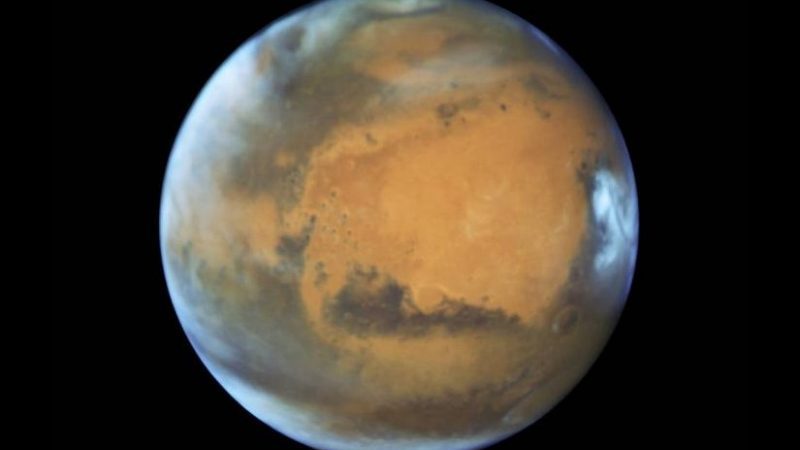
Cornell University researchers have provided a simple and comprehensive – if less dramatic – explanation for bright radar reflections initially interpreted as liquid water beneath the ice cap on Mars’ south pole.
Their simulations show that small variations in layers of water ice – too subtle for ground-penetrating radar instruments to resolve – can cause constructive interference between radar waves. Such interference can produce reflections whose intensity and variability match observations to date – not only in the area proposed to be liquid water, but across the so-called south polar layered deposits.
“I can’t say it’s impossible that there’s liquid water down there, but we’re showing that there are much simpler ways to get the same observation without having to stretch that far, using mechanisms and materials that we already know exist there,” said Daniel Lalich, research associate in the Cornell Center for Astrophysics and Planetary Science. “Just through random chance you can create the same observed signal in the radar.”
Lalich is the first author of “Small Variations in Ice Composition and Layer Thickness Explain Bright Reflections Below Martian Polar Cap Without Liquid Water,” publishe in Science Advances.
Robotic explorers have provided extensive evidence that water flowed on the surface of ancient Mars, including at a former river delta now under investigation by NASA’s Perseverance rover. Relying on a radar instrument that can probe below the surface to detect water ice and potentially hidden aquifers, members of the European Space Agency-led Mars Express orbiter’s science team in 2018 announced they’d discovered a lake buried below the south polar cap.
The implications were enormous: Where there is liquid water, there could be microbial life.
But while the same bright radar reflections would likely indicate a subglacial lake on Earth, Lalich said, the temperature and pressure conditions on Mars are very different.
Using simpler models, Lalich previously showed that the bright radar signals could be created in the absence of liquid water, but he said assumptions about layers of frozen carbon dioxide below the ice cap likely were incorrect.
The new research tells a more complete story, he said, closing gaps in the radar interference hypothesis with more realistic modeling. The thousands of randomly generated layering scenarios were based only on conditions known to exist at the Martian poles, and varied the ice layers’ composition and spacing in ways that would be expected over tens or hundreds of miles.
Those slight adjustments sometimes produced bright subsurface signals consistent with observations in each of the three frequencies used by the Mars Express orbiter’s MARSIS radar instrument, a partnership between NASA and the Italian Space Agency. Likely for a simple reason, Lalich argues: Radar waves bouncing off layers spaced too closely for the instrument to resolve may be combined, amplifying their peaks and troughs.
“This is the first time we have a hypothesis that explains the entire population of observations below the ice cap, without having to introduce anything unique or odd,” Lalich said. “This result where we get bright reflections scattered all over the place is exactly what you would expect from thin-layer interference in the radar.”
While not ruling out the potential for some future detection by more capable instruments, Lalich said he suspects the story of liquid water and potential life on the red planet ended long ago.
“The idea that there would be liquid water even somewhat near the surface would have been really exciting,” Lalich said. “I just don’t think it’s there.”
The research was supported by NASA.

Even widespread species could be genomically vulnerable to the climate crisis, scientists warn. By studying the DNA of puddle frogs living in central African rainforests, the scientists found that areas of high environmental variation foster high genetic variation. If these varied habitats and the frogs that live there are lost, genetic variants that could have allowed the species to evolve to survive the climate crisis could be lost too. Meanwhile, populations with low genetic variation could become extinct quickly, unable to adapt.
“Generally, the more genomic variation within a population, the more likely they will be able to respond to changes in their environment, such as future climate change,” said Dr Courtney Miller of the University of New Orleans, lead author of the study in Frontiers in Conservation Science.
“We wanted to identify drivers of genomic variation and how populations might respond to future climate change,” added Dr Geraud Tasse Taboue of the University of Buea, second author.
Survival of the fittest
The climate crisis is expected to change the face of the world very rapidly. If animals can’t find suitable habitats, they will need to adapt, either by evolving or by making behavioral changes. The more genetic diversity in a species, the more likely it can successfully evolve to survive.
The tropical forests of the Gulf of Guinea and the Congo Basin are predicted to be particularly seriously affected by the climate crisis. These forests are also biodiversity hotspots. Several factors could contribute to this, by separating populations of a species from each other so that they become more distinct over time: distance, physical barriers like large rivers, environmental variation, and fragmentation of the forest during the Pleistocene. A widespread species like puddle frogs makes an ideal model for unravelling the impact of these factors on genetic variation, which is critical to understanding species’ genomic vulnerability — how likely it is that they will be able to adapt evolutionarily to climate change.
The scientists sampled 191 frogs across a range of different locations and habitats, extracting DNA and mapping the occurrence of different variants. They then used environmental variables linked to the frogs’ biology and behavior to map differences between the frogs’ habitats: the annual temperature and rainfall and how much these varied across the year, and the amount of precipitation in the coldest quarter of the year. They used projections of how these variables will change with the climate crisis to model the frogs’ future habitat. They also used models of the past climate to understand how habitat availability in the Pleistocene could affect present-day variation.
Habitat hotspots
Combining this data and analyzing it with specialized statistical methods allowed the scientists to identify the most important forces in driving the puddle frogs’ genetic variation and to determine areas where the frogs would be more genomically vulnerable. ;The team found that for puddle frogs, genetic variation was influenced by the distance between sites but primarily predicted by their environment. Seasonal patterns of precipitation were particularly influential. Landscapes with multiple types of habitat in close proximity also overlapped with areas of high genetic variation.
“Variation in precipitation is the main factor in environmentally-associated genomic variation for this frog,” said Miller. “Frogs that occur within the Cameroonian highlands, the forest-savanna ecotone of south-central Cameroon, across the equator, and from the coast to the interior of Gabon may be more likely to keep pace with future climate change.”
The scientists also identified several areas where frog populations may not have enough genetic variation to be able to adapt to abrupt habitat changes — for example, in southwest Gabon.
The team suggests that these findings, and similar research on different species, could be useful for planning conservation interventions. However, the scientists caution that their analysis only partially captures the frogs’ genetic variation, and that to fully understand the impact of these variants on puddle frogs’ future survival we’ll need to link them to phenotypic traits.
“We weren’t able to identify variants under selection, which might have provided additional insight on adaptive potential,” said Tasse Taboue. “But conservation efforts could focus on preserving areas with high genomic variation, under the assumption that these areas harbor individuals that may be more likely to persist given environmental change.”
Categories
NPR News: 06-08-2024 6PM EDT
Video shows helicopter rescue of Israeli hostages https://t.co/AnMEy4ErKY via @YouTube
— Michael Novakhov (@mikenov) June 8, 2024
Categories