
“The statement by the Ministry of Foreign Affairs of Armenia of 7 June 2024 that contests the fact of territorial claims of this country towards its neighbors in fact is nothing than an intention to divert the attention of the international community from
Day: June 7, 2024
Washington has announced that it has sanctioned ‘dozens’ of Georgian citizens in relation to the foreign agent law, including politicians involved in its adoption, and their family members.
US State Department spokesperson Matthew Miller announced on Thursday that Washington was imposing individual visa bans on members of the ruling Georgian Dream party, MPs, law enforcement officials, private citizens, and their immediate family members.
‘The United States remains deeply concerned with the Georgian Dream party’s anti-democratic actions as well as its recent statements and rhetoric’, said Miller. ‘These actions risk derailing Georgia’s European future and run counter to the […] Georgian constitution and the wishes of its people’.
He said the sanctions would cover individuals ‘complicit’ in undermining democracy in Georgia by ‘undermining freedoms of peaceful assembly and association, violently attacking peaceful protesters, intimidating civil society representatives, and deliberately spreading disinformation at the direction of the Georgian Government’.
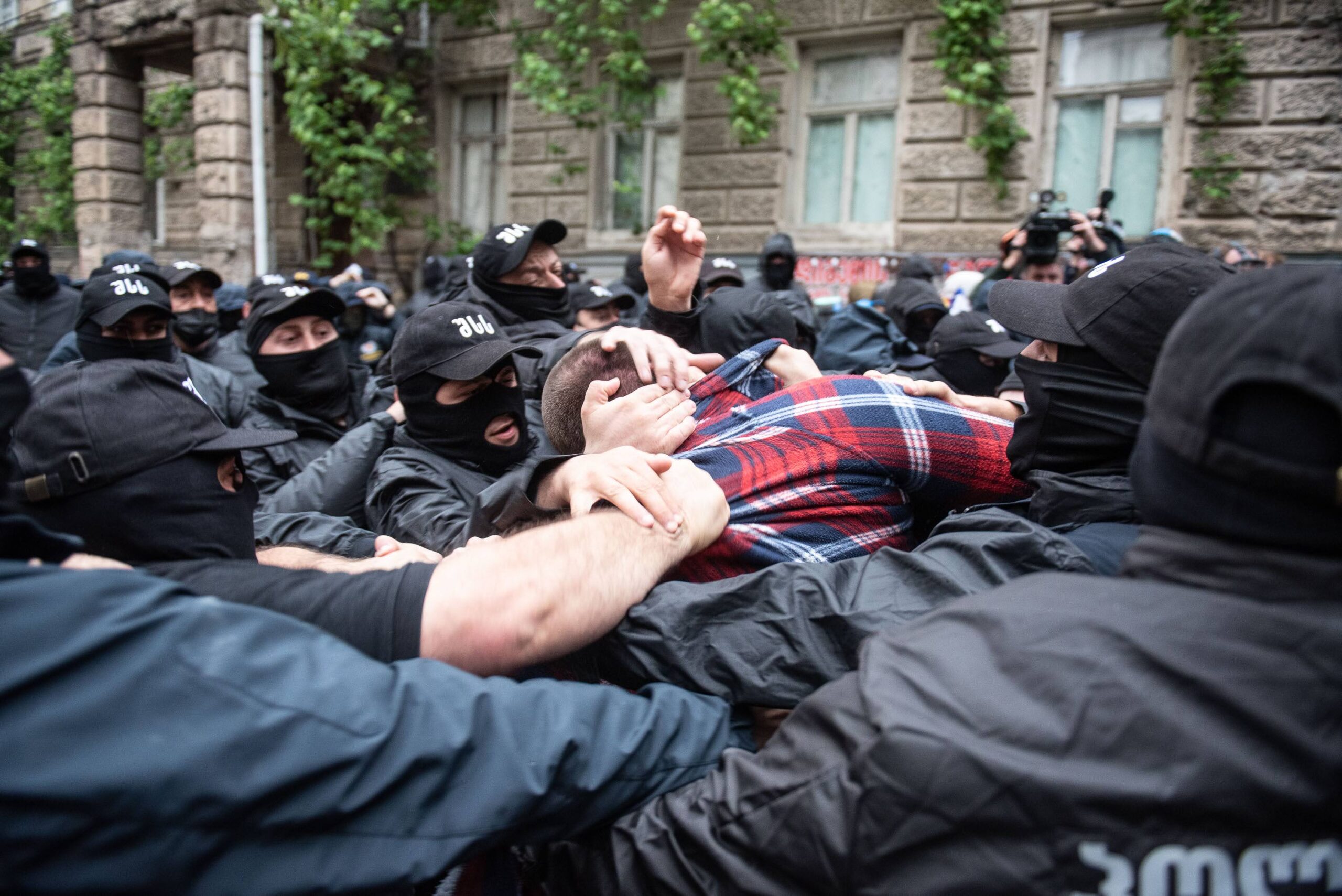 Law enforcement officers using violence against protesters against the foreign agent law. Photo: Mariam Nikuradze/OC Media.
Miller said the US maintained hope that Georgian Dream would ‘reconsider’ its actions, warning that the US was ‘prepared to take additional actions’.
Asked about who the bans would affect, Miller stated that he was unable to provide reporters with the names of those sanctioned. He noted that they also did not inform the individuals of the sanctions imposed on them, and that they would only learn of them once they tried to cross the US border. He added, however, that those who currently held a valid visa would be notified following his announcement.
Miller stated that the US was not ‘dictating in any way to the government of Georgia what laws it should pass’.
He suggested that the law had conversely been inspired by ‘another country that has passed its own version of the law’.
‘It’s Russia that passed this version of law […] and clearly was the model for the law that Georgia has passed’.
Miller also noted that the US would continue to review the financial assistance it provides to Georgia, saying that it was ‘potentially at jeopardy if Georgia is not pursuing policies that are in line with the interests and values we have seen it express here to date’.
Georgian Dream mocks US sanctions
The ruling party in Georgia derided Washington’s sanctions, with Tbilisi Mayor and Georgian Dream Secretary General Kakha Kaladze stating on Friday that ‘no one is afraid of these sanctions’.
‘Talking about sanctions just makes me smile’, he said, adding that he did not have a US visa and that he had not been notified of any sanctions being imposed against him.
Kaladze earlier this week stated that he was ‘certain there won’t be any sanctions’.
Georgia Dream’s parliamentary leader, Mamuka Mdinaradze, also appeared to mock the sanctions, stating that sanctioned individuals had a ‘right to know, at least, whether we are the first legislators in the world to be sanctioned for passing a law’.
‘Also, the Georgian opposition–[secret services] can rejoice in light of more specific news, and not with a tenth announcement of general hints’, he said.
Dimitri Khundadze, a member of the parliamentary majority, deemed the sanctions to be the exertion of pressure on Georgia’s democracy, and a ‘black day for Western democracy’.
‘This is gross interference in internal state affairs and pressure on state institutions […] This is a precondition for having Ukrainian Maidanisation in Tbilisi as well, which will lead to the development of war. Because the reality is, we would rather be sanctioned [ourselves], than for our citizens — especially the youth — to receive summons to war’, he said.
Georgia’s opposition warned that Georgian Dream’s actions could damage Georgia’s economy.
Levan Khabeishvili, the chair of the United National Movement, Georgia’s largest opposition party, stated on Thursday that the ‘maliciousness of [Georgian Dream founder Bidzina] Ivanishvili’s team affects the pockets of Georgian citizens’.
‘What investor would enter or stay in such a country? Under Ivanishvili, economic collapse is inevitable!’, said Khabeishvili.
Salome Samadashvili, a Lelo MP, stated that October’s upcoming parliamentary elections were a ‘referendum on Georgia’s sovereignty’, and ‘whether we want to maintain an independent state or not’.
‘Without the support of our main ally, the USA, Georgia simply cannot survive as an independent state’, she said.
The US announced its plans to impose travel and financial sanctions against individuals involved in the foreign agent law and their families earlier in May, with Assistant Secretary of State for European and Eurasian Affairs Jim O’Brien warning that further action could be taken if the law went forward in its then-current form.
Georgian Dream’s reintroduction of the foreign agent law was met with mass protests throughout May, with Georgia’s Western partners continuously stressing that the law was anti-European and anti-democratic, and that MPs who voted for the law could face sanctions.
The law labels any civil society or media organisation that receive at least 20% of their funding from outside Georgia ‘organisations carrying out the interests of a foreign power’. Such organisations are subject to ‘monitoring’ by the Ministry of Justice every six months, which could include forcing them to hand over internal communications and documents and confidential sources. Organisations and individuals who do not comply will be subject to large fines.
The post Washington sanctions ‘dozens’ over Georgia’s foreign agent law appeared first on OC Media.
By Can Kasapoğlu
Battlefield Assessment
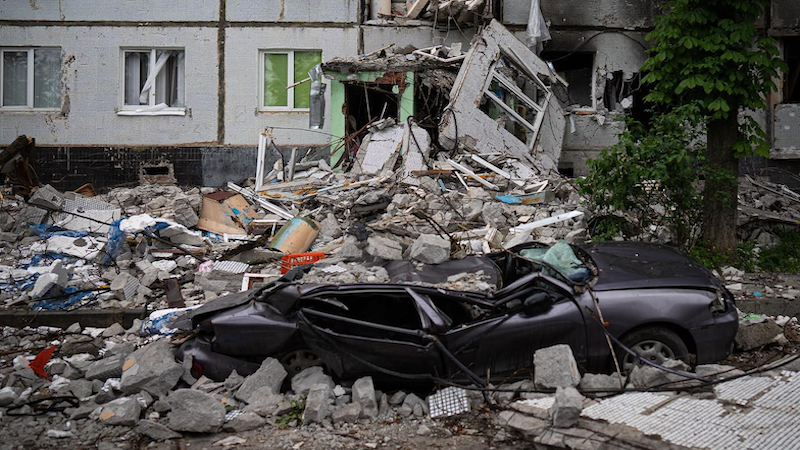
This week, Russia’s offensive continued to focus on eastern and northeastern Ukraine. Russian combat formations pummeled the Kharkiv front and the Donetsk and Luhansk regions and mounted a smaller attack in southern Ukraine. In Donetsk and Luhansk, positional fighting persisted. Moscow achieved;marginal territorial gains;around important contested towns such as Chasiv Yar and areas adjacent to Avdiivka, a city already occupied by Russian forces.
Open-source intelligence indicates that Russian and Ukrainian drones have;saturated the airspace;over Kharkiv, constantly tracking the city and its surrounding environs. Reports suggest that Ukraine’s drone presence is pushing Russian troops to adopt alternative concepts of operations (CONOPS) using smaller armored vehicles, motorcycles, and all-terrain vehicles rather than bulkier;main battle tanks;supporting large combat formations. This adjustment is slowing Russia’s offensive by dispersing its troop concentrations and reducing its effectiveness in mechanized warfare.
Yet Russia is sending waves of glide bombs and missiles to wreak destruction on Kharkiv. While Russia’s strikes have produced only incremental advances and minimal territorial changes,;these salvos often hit;the city’s civilian population, in an echo of the Kremlin’s massacres in the restive Chechnya during the 1990s.
Ukrainian officials suggest that Moscow is preparing;to deploy;additional regiments and brigades;around Kharkiv;to bolster its push in the region. With force-on-force and force-to-terrain ratios that already favor the Kremlin, this move would stress Ukraine’s defenses even further.
Battlefield developments this week served as a reminder that drone-on-drone warfare is now a permanent feature of this conflict. Both sides are using first-person-view (FPV) drones to hunt their opponent’s own unmanned systems. Ukraine preys on advanced Russian robotic systems like the;Lancetand;Orlan. This week, a Russian FPV drone destroyed a Ukrainian unmanned surface vehicle (USV), providing the world with perhaps the first documented instance of an;FPV drone destroying;a naval platform of this kind. It remains to be seen whether Ukraine will use its USVs, some of which possess;R-73 aerial missiles, to attack Russian aerial drones.
The Russia-Iran Drone Plant Uses Coercive Child Labor to Meet Its Production Goals
Russia is quickly—and bloodily—improving its arms production capabilities, likely by using abusive child labor. Western assessments suggest that;the joint Russian-Iranian drone factory;in Alabuga in the Russian Republic of Tatarstan can now produce up to 6,000 Shahed loitering munitions per year. The Kremlin has achieved this gruesome milestone by;forcing the local underaged Tatar population into;child labor.
Some of Russia’s victims are as young as;14 years old. Moscow is also;recruiting female students from;Africa for its war efforts. The Iranian Revolutionary Guards Corps is the critical enabler of the child abuse in Tatarstan, supporting drone production there in return for critical arms deals and the flow of $1.7 billion, some of it in;gold bars, from Russia. Following Russia’s mass abduction of Ukrainian children, a war crime it;perpetrated jointly;with Belarus, Moscow and Tehran are using child abuse to advance their growing partnership.
Ukraine’s Asymmetric Strikes Now Target Russia’s Most Critical Radar Assets
Ukraine has continued to asymmetrically target the Russian Black Sea Fleet with growing success. Kyiv’s indigenous, combat-proven Sea Baby unmanned surface vehicles have pioneered robotic naval warfare efforts. Recent visual imagery suggests that a Ukrainian;Sea Baby;attacked two Russian warships, reportedly KS-701 Tunets patrol boats, off the coast of;occupied Crimea.
Ukraine has used its naval and aerial unmanned vehicles to prey on Russia’s critical naval assets and strategic oil refineries, such as the;Port Kavkaz oil depot;next to the Kerch Bridge. Recently, Kyiv has added a new target to its hit list: Russia’s strategic radar architecture.
Last week, Ukrainian forces conducted a bold strike on the Voronezh-DM early warning radar deep inside Russia.;This sensor complex;was one of the main pillars of Russia’s nuclear deterrence infrastructure and a key component of Moscow’s nuclear alert warning system. In another incident near the Luhansk region, Ukrainian forces;targeted a site reportedly;hosting a Nebo-M high-band anti-stealth radar. Russia had used this system primarily to detect fifth-generation tactical military aviation assets.
Ukraine Attains Greater Freedom to Use Western-Supplied Weapons inside Russia
Responding to Ukraine’s pressing operational needs, a growing number of European nations have given Kyiv the go-ahead to use European-supplied weapons to strike critical assets inside Russia. This signals that several North Atlantic Treaty Organization members are changing their approach, which was clouded by wariness and skepticism in the early stages of the war. The;main factor driving;this new perspective is the NATO allies’ belated admission that international law allows Ukraine to attack military targets in Russian territory to defend its sovereignty.
Perhaps signaling this political change, Europe’s most recent military assistance packages for Ukraine have included high-value strategic assets. Sweden, for example, recently sent two ASC 890 airborne early warning and control (AEW&C);aircraft;to the Ukrainian Air Force. The ASC 890, the first long-range high-end intelligence aircraft Ukraine is set to receive, carries immense strategic value for Kyiv.
Sent as part of a $1.3 billion military aid package, the aircraft will be a;valuable force multiplier;for the F-16s Ukraine is set to receive. The ASC 890’s advanced sensor systems will allow Kyiv to detect enemy assets such as helicopters, fighter jets, cruise missiles, and naval targets from a significant distance. The generous Swedish assistance package also;includes other critical;supplies such as 155mm artillery shells and long-range aerial missiles. Copenhagen also announced;that it;will;allow Ukraine;to use soon-to-be-delivered Danish F-16s to strike military targets inside Russia.
The wind of change sweeping Europe is also affecting the United States. The Biden administration recently announced a;new policy;that allows Ukraine to use US-provided artillery and short-range rockets from High Mobility Artillery Rocket (HIMARS) launchers to strike command posts, arms depots, and other military targets Russia uses in its attacks on Kharkiv. Although Washington will continue to limit Kyiv’s use of long-range weapons, such as the Army Tactical Missile System (ATACMS), the Biden team’s recent adjustment is an important step in the right direction. Washington’s new policy also prevents Ukraine from using US-provided weapons to strike parked fighter aircraft and bomber jets inside Russia,;leaving room;for improvement in the push to fully enable Kyiv to defeat the Russian war machine.
- About the author: Can Kasapoğlu is a Senior Fellow at the Hudson Institute
- Source: This article was published at the Hudson Institute

By Rhys Davies
The New York Based;Human Rights Foundation;(HRF) recently published a bombshell new report describing one of the greatest infiltrations of America’s political system ever conducted by a foreign power. For years, the autocratic United Arab Emirates has waged an aggressive, multi-pronged campaign of interference – deploying covert lobbying, illicit funding, and exploitation of legal loopholes to an unprecedented degree. The issue of challenging the UAE’s influence within US institutions now demands serious action, including the potential imposition of sanctions.
While Russia, China and other conventional adversaries tend to garner focus, the UAE has been quietly but importantly building its influence in the U.S. As laid bare in the HRF report;Infiltrating America: How the United Arab Emirates Launched an Unprecedented Political Interference Campaign in the United States, the UAE has orchestrated an audacious infiltration campaign targeting the highest levels of the US government, think tanks, academic institutions, and lobbying firms.
From funnelling tens of millions in illicit funding to American policy influencers, to covertly;recruiting former US military and intelligence officials;into its service, the UAE’s pattern of behaviour is deeply alarming. Furthermore, the UAE has deployed an array of cyber-surveillance tools, including the notorious Pegasus malware created by the Israeli firm;NSO Group, against a wide range of targets across national borders, including;American journalists, the British;House of Lords, the editor of the;Financial Times, as well as myriad domestic and regional opponents. This transnational repression represents a flagrant violation of the sovereignty of democratic nations.
This disturbing reality can no longer be politely ignored in service of preserving a convenient geopolitical partnership. The UAE’s unparalleled interference poses an existential test of America’s ability to protect its institutions from being compromised by an emboldened autocratic state actor.
Moreover, the UAE’s transgressions as an offender against the democratic world order extend far beyond spying. Following the Russian invasion of Ukraine, the Emirati regime tacitly sided with the Kremlin as it rolled out the;red carpet for Vladimir Putin 2023. The embrace represents an endorsement of Moscow’s foreign policy.
The UAE has since emerged as one of the largest trans-shipment hubs for Russian oil exports, effectively facilitating the;evasion of Western sanctions. This undermining of much of the international stance against Moscow’s aggression indicates the UAE believes it can act with impunity, without fearing serious repercussions that might impact its reputation or relations with the West. This should put to bed any illusion that the UAE can be treated as a reliable American partner aboard and demands a clear change in policy by the U.S. and its democratic partners.
Yet, the United Arab Emirates portrays itself as a modern, reform-minded ally of the West and has worked aggressively to whitewash its own dismal human rights record and domestic totalitarian reality. It has poured billions into a global influence campaign of “reputation laundering” to remake its public image. According to analysis of foreign influence tracker data, the UAE has spent over;$154 million on lobbyists since 2016.
Any positive PR garnered abroad is solely for international consumption, starkly contrasting with the repression the regime routinely inflicts upon its own population. The UAE has continued its;unrelenting criminalization of dissent, with the recent prosecution of dozens of activists and human rights defenders in mass injustice legal proceedings known as the UAE94 and UAE84 trials.
I have directly witnessed the UAE’s repressive overreach as an international human rights barrister. I represent Western nationals like US citizen Zack Shahin and Briton Ryan Cornelius who have been arbitrarily detained for years in the UAE, with the United Nations affirming their imprisonment violates international law.
There must be tangible consequences for the UAE’s interference in domestic affairs, human rights abuses, and active subversion of the rule-based international order. Democratic nations can no longer indulge the facade of the UAE as a reform-minded ally while turning a blind eye to its assault on human rights, sovereignty, and rules-based norms. Western institutions and governments must wake up to the reality of the UAE’s intent and infiltration. A firm line should be drawn, with the potential imposition of sanctions and curtailing of economic ties if the UAE’s;attempts to play both sides;continue unabated. Likewise, with the UAE’s well-documented appetite for lobbying, there are genuine risks of the UAE attempting to manipulate upcoming US and European Union elections. Proactive measures, such as stringent monitoring of UAE-linked entities, finance flows, and influence operations, are crucial to protect the integrity of the electoral process.
The UAE’s lobbying efforts in the U.S., coupled with its use of transnational repression, highlight a disturbing trend. While portraying itself as a democratic ally, the UAE is actively undermining democratic institutions abroad while cracking down on dissent at home. This necessitates a strong international response to hold the UAE accountable for its actions. For too long, the international community has indulged the UAE’s blatant misconduct as a way to preserve a pragmatic yet thoroughly unpalatable status quo. But the regime has demonstrated it is not a status quo actor, but one actively seeking to subvert democracy, sovereignty and human rights norms from within and without. Accountability is long overdue.
- About the author: Rhys Davies is an international human rights barrister based in London, United Kingdom, and will be speaking at the “Hostile Intent: UAE Subversion & Transnational Repression” seminar on June 11th at the National Press Club in Washington D.C.
- Source: The views expressed in this article belong to the author(s) alone and do not necessarily reflect those of Geopoliticalmonitor.com.

Remember Deborah Birx, the “scarf lady” United States bureaucrat who joined President Donald Trump and chief coronavirus fearmonger Anthony Fauci for regular televised briefings to whip up fear of coronavirus and support for crackdowns and new health practices supposedly required by “the science”?
She was there day after day pushing mask wearing and social distancing that had not been shown to produce any net reduction in disease spread, mass PCR testing that proved unreliable, elimination of early treatment efforts, implementation of conveyor belt to death ventilators and remdesivir hospital protocols, production and distribution of Operation Warp Speed “vaccines” that proved to be both ineffective and dangerous, closure of businesses, prohibition of gatherings, and other tyrannical quackery. Birx also was;conniving behind the scenes to strengthen national crackdown-related measures;and;traveling around the country promoting coronavirus fear and encouraging state governments to implement, maintain, and expand their crackdown measures.
In other words, Birx was a primary villain behind the coronavirus crackdowns in America.
Well, Birx is back. And she is pursuing a similar mission again. She is stirring up fear of a new disease;du jour;— bird flu — and calling for new crackdowns in response. In an;interview;this week at CNN, Birx declared, “we should be testing every cow weekly” with PCR tests for bird flu. She also wants to test every “dairy worker” as well as test “to really see how many people have been exposed and got asymptomatically infected.”
Birx seems to be jonesing for a replay of the coronavirus crackdown approach, this time in the name of countering bird flu. Indeed, she may want to take the crackdown bigger this time. In the interview, she suggests that the failure to already be doing the extensive testing she supports for bird flu means “we’re making the same mistakes today that we made with covid.” Got that? For Birx, a big mistake with the government response to coronavirus was that it didn’t do enough soon enough. With time, however, Americans have increasingly come to realize that government actions taken in the name of countering coronavirus created much more suffering than did coronavirus.
Don’t let Birx and other authoritarians succeed in using bird flu as an excuse to roll out a new crackdown dangerous to both health and liberty. Let’s end this tyrannical push now. Just say no to Birx and her new scheme.
- This article was published at RonPaul Institute
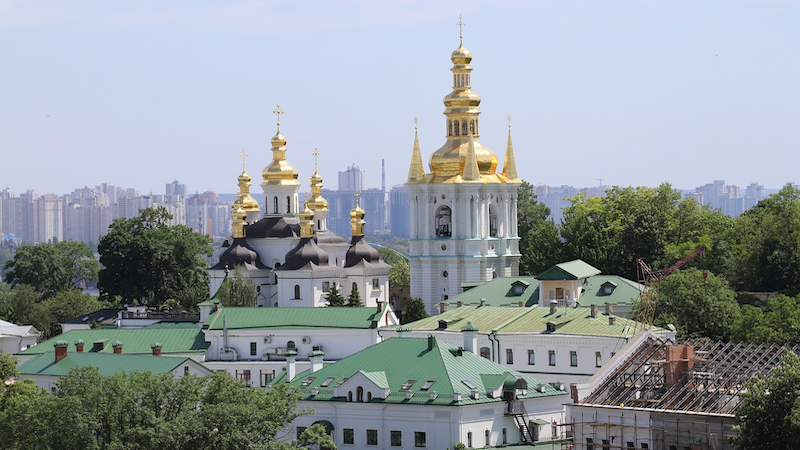
Few atheists can be found in foxholes, and the populations of countries at war typically become more interested in religion. Ukraine today is a classic example. Since February 2022, the number of religious organizations in Ukraine has jumped by more than 3,000 to 36,195. This is according to data released at the end of May by Kyiv’s State Service on Ethnopolitics and Freedom of Conscience (Data.gov.ua, accessed June 6).
Over the same period, the Ukrainian agency’s figures indicate that approximately 1,000 of the parishes that had belonged to the Ukrainian Orthodox Church of the Moscow Patriarchate have shifted their allegiance to the autocephalous Orthodox Church of Ukraine (OCU) [1]. Despite that trend, however, the Moscow church still has more religious organizations than the Kyiv church—29 percent compared to 22 percent.
These statistics, however, focus on structures rather than identification and church attendance and, therefore, are misleading. They overstate the size of the Russian church while minimizing that of its Ukrainian Orthodox competitor. These figures also understate the rise of other non-Orthodox Christian denominations in Ukraine. A survey taken at the end of 2023 found that only 5.6 percent of Ukrainians identify with the Moscow Patriarchate, while 42.2 percent said they are part of the OCU. Another 11 percent said they were followers of the Ukrainian Greek Catholic Church, and nearly 40 percent identified with other Christian denominations or none at all (Razumkov Center, December 26, 2023).
On the one hand, these figures mean the Moscow church is increasingly becoming a shell of its former self, with the hierarchy keeping open and counting parishes few Ukrainians attend. On the other hand, they suggest that the real rise in religious life in Ukraine since Moscow’s war began has not been so much in the autocephalous church, though attendance has risen. Nor has it been the case among the Uniates, who are Christian Orthodox in practice but are subordinate to the pope in Rome. Their share of the Ukrainian population has remained largely unchanged. Instead, more Ukrainians are now orienting themselves toward or even becoming members of Roman Catholic and Protestant denominations.
Many observers have failed to take note of this change and have focused instead on the contest of the two Orthodox churches both within Ukraine and between Ukraine and Russia in the Orthodox world as a whole. This has been the case ever since the Ukrainian church gained autocephaly and thus independence from the Moscow church in 2018—at the time, an important indicator of Kyiv’s shift away from Moscow (see EDM,;September 23, 2018,;April 10). That approach has unfortunately become more widespread as the Moscow Patriarchate has grown more bellicose in its support for President Vladimir Putin’s war against Ukraine.
The Ukrainian government, in response, has put the power of the state behind the Ukrainian church while actively attacking the Moscow church (Dess.gov.ua, January 27, 2023; see EDM,;March 7, 2023,;February 13;;Novaya Gazeta, May 29). The Kremlin has good reason for that. Measured by the number of parishes and other religious institutions that have chosen to subordinate themselves to Kyiv rather than Moscow, the Russian campaign has only partially succeeded.; Measured by the number of Ukrainians who identify with one side rather than the other, however, it has been remarkably successful and has impacted Orthodox believers throughout the post-Soviet space (see;EDM, December 8, 2022).
Moscow continues to be alarmed by and regularly attacks the autocephalous Kyiv church, seeing the independence of Orthodoxy in Ukraine as a direct threat to Putin’s aspirations. The Kremlin, if anything, is perhaps even more alarmed by the spread of Roman Catholicism and Protestantism among Ukrainian believers, which is concentrated in Ukraine’s western regions but not restricted to those areas. The Kremlin has long viewed these denominations as even more hostile to its interests than even autocephalous Orthodox churches in the post-Soviet space.
Such fears lie behind Moscow’s continuing celebration of Prince Alexander Nevsky’s alliance with the Mongol Horde in the 13th century against the Roman Catholic crusade in the Baltic region and its continuing attacks on Roman Catholicism in Poland, Lithuania, and Belarus. The Kremlin regularly expresses fear about the spread of Roman Catholicism across the post-Soviet space and in Russia itself. These attacks are understandable, given the opposition of such groups to Putin’s authoritarianism (Window on Eurasia, November 29, 2019, April 9, May 27, 2023).
Lying behind those growing fears is an even greater one for Moscow—a fear discussed most usefully by Russian commentator Vladislav Inozemtsev in an important but largely neglected article last year. Writing in;Neprikosnovenny zapas, Inozemtsev argued that Putin’s efforts to correct what the Kremlin leader views as “the greatest geopolitical catastrophe of the 20th century” (i.e., the disintegration of the Soviet Union) are unintentionally triggering something that may be even more profound—namely, “the greatest ethno-social crisis of the 21st century.” Specifically, this refers to the collapse of the model of relations between state and religion that has dominated Russia for centuries. As part of that model, religion subordinates itself to state power and simultaneously transforms identification with and loyalty to the state into a religious principle (Magazines.gorky.media, February 2023)
Inozemtsev suggests that in the Christian West, over the past 500 years, “wars between individual Catholic countries were conducted dozens of times without destroying church unity.” In Eastern Christendom, however, “Orthodoxy always split into parts as soon as attempts were made to establish an empire out of relatively separate peoples or those attempting to form independent states.” Sometimes, such efforts have driven whole nations to shift from Orthodoxy to Roman Catholicism and Protestantism, ultimately undermining the countries that have engaged in such imperial projects. Unfortunately, he continues, “the Kremlin and the Russian Orthodox Church have not learned from such earlier cases and are now engaged in actions that will lead not only to the demise of a Russian church extending beyond the borders of a Russian state but likely to something even more profound—the undermining or even destruction of the basis of state loyalty within Russia.”
Should that be the case, the latest data from Ukraine on changing religious identities points to an even more fundamental shift in Kyiv’s orientation than many now think. That trend may lend itself to the transformation of Russia itself—something that helps explain why Putin views what he is doing as existential for Russia and why what he is doing makes that even more likely.
[1] An Autocephalous church is a hierarchical Christian church whose head bishop does not report to any higher-ranking bishop. The autocephalous Ukrainian Orthodox Church, which was officially recognized by the Ecumenical Patriarchate of Constantinople in 2018, is headed by Metropolitan Epiphanius of Kyiv and All Ukraine.
- This article was published at The Jamestown Foundation

It has been popular for people commenting on the state of the economy to say that consumers have to pull back on consumption because they have exhausted their savings. A big part of this story is that the saving rate is supposedly near a record low.
The reported saving rate, at;3.8 percent;in the first quarter, is in fact very low, But treating this as a good measure of savings misunderstands the National Income and Product Accounts.
The first point to understand is how saving is measured. The saving rate does not measure money put into a savings account; it is simply a residual. The Commerce Department estimates disposable income, and then subtracts consumption. What is left is “savings.”
This definition is important to keep in mind if we are trying to get the story right. In recent quarters, we have had an unusually large and positive “statistical discrepancy” in the GDP accounts. The statistical discrepancy is the gap between GDP measured on the output side and the income side.
In principle, we can measure GDP by adding up the value of everything sold, whether as consumption items, investment, government purchases, or net exports. We can also measure GDP by adding up the income generated in the production process, wages, profits, interest, and rent.
We should get the same number either way, but in a $28 trillion economy the sums never come out exactly equal. In recent quarters the output side has been considerably larger than the income side. In the first quarter, the output side measure was;2.2 percent;higher than the income side measure.
At this point, we don’t know which measure is closer to the true number, but for calculating the saving rate, it doesn’t matter. Either way, the saving rate has been substantially understated.
Suppose that the income side is correct, and output has been overstated by 2.2 percentage points. This means that the output components of GDP have been overstated, which means that consumption, which is more than 70 percent of GDP, has been overstated. If consumption has been overstated by 2.2 percent, then saving has been understated by roughly 2.2 percentage points. That would mean the true saving rate would be close to 6.0 percent.
Let’s assume the opposite; that the output side number is closer to the true number. In that case income is roughly 2.2 percent higher than currently reported. In that case, since consumption is unchanged, but disposable income is 2.2 percent higher, then the saving rate would again be roughly 2.2 percentage points higher, again putting it close to 6.0 percent.
The true number for GDP is likely somewhere in the middle, but the exact point doesn’t matter. The true saving rate is roughly 2.2 percentage points higher than the reported saving rate. That puts it equal to the 5.9 percent saving rate in the three years before the pandemic.
In short, when someone tells you that the saving rate is near a record low, they are telling you that they don’t understand the national accounts. They are not actually telling you about the saving rate.
- This article first appeared on Dean Baker’s Beat the Press blog.