Categories
South Caucasus News

Supreme Court Calls Foul On Government Efforts To Blacklist And Informally Censor Disfavored Political Groups Such As The NRA


Supreme Court Calls Foul On Government Efforts To Blacklist And Informally Censor Disfavored Political Groups Such As The NRA

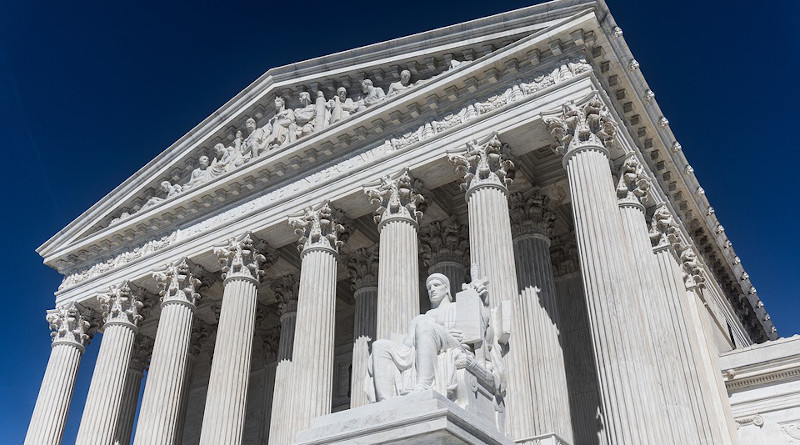
United States Us Supreme Court Building Washington Dc Gov

In a unanimous ruling, the;U.S. Supreme Court issued a warning to government officials;that the First Amendment prohibits them from “wielding their power selectively to punish or suppress speech,” whether directly or indirectly by “coerc[ing] a private party to punish or suppress disfavored speech on [the government’s] behalf.”

Warning against;a growing cancel culture mindset within government agencies across the political spectrum which seeks to censor, ostracize, and shun those with opposing, disfavored, or politically unpopular viewpoints, a legal coalition made up of The Rutherford Institute, FIRE, the National Coalition Against Censorship, and the First Amendment Lawyers Association had filed an;amicus brief;with the Supreme Court in;NRA v. Vullo;challenging government efforts to indirectly censor the National Rifle Association by pressuring regulated insurance companies to disassociate from and stop offering certain services to the pro-gun advocacy group.

“Whatever government-driven censorship we tolerate now is destined to serve as a building block for greater acts of tyranny,” said constitutional attorney John W. Whitehead, president of The Rutherford Institute and author of Battlefield America: The War on the American People. “Given the government’s tendency to attach its own labels to behavior and speech that challenges its authority, these efforts to ostracize those with politically unpopular viewpoints should be cause for alarm across the entire political spectrum.”

In October 2017, the New York State Department of Financial Services (DFS) opened an investigation into an NRA-endorsed insurance program called “Carry Guard,” which provided coverage for losses caused by licensed firearm use, including criminal defense costs resulting from the intentional use of a firearm in wrongdoing, which was a violation of New York law. DFS Superintendent Maria Vullo met with one of the insurance companies under investigation, which was facing millions in fines, and explained how the company could come into compliance, including by no longer providing insurance to gun groups like the NRA. Vullo also sought the company’s aid in DFS’s campaign against gun groups following the February 2018 school shooting in Parkland, Florida. Later, Vullo called upon banks and insurance companies doing business in New York to consider the risks, including reputational risks, which might arise from doing business with the NRA, urging them to join others that had discontinued their associations with the NRA. Multiple entities publicly severed their ties or determined not to do business with the NRA.

In response, the NRA filed a First Amendment lawsuit against Vullo. The Second Circuit Court of Appeals ordered the case to be dismissed, concluding that Vullo engaged in permissible government speech. But The Rutherford Institute and other amici on the brief pointed to Vullo’s words, the perception of a threat for companies continuing to do business with the NRA, and the power of DFS’ regulatory authority as factors showing improper coercion to indirectly censor the NRA, and;urged the Supreme Court to make clear that government officials cannot sidestep the First Amendment. The Supreme Court’s;opinion;did that, and the NRA’s lawsuit against Vullo can now proceed.

The Supreme Court;opinion;and the coalition’s;amicus brief;in;NRA v. Vullo;are available at;www.rutherford.org. Robert Corn-Revere, Ronald G. London, Will Creeley, and Joshua A. House with FIRE advanced the arguments in the;brief.


Categories
South Caucasus News

Myanmar’s Civil War: A Golden Opportunity Tor US Sabotage Of China’s Interests – OpEd


Myanmar’s Civil War: A Golden Opportunity Tor US Sabotage Of China’s Interests – OpEd

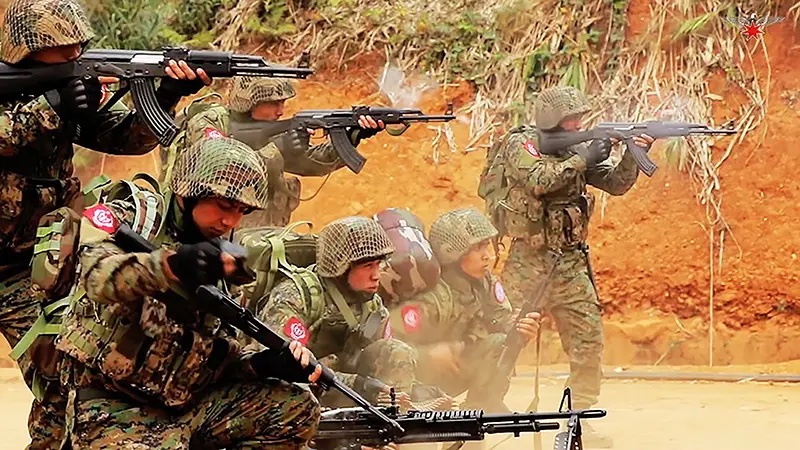
File photo of Arakan Army soldiers in Myanmar. Photo Credit: Arakan Army

Myanmar’s civil war is in a critical phase where the ruling military government is losing significant territory to a broad coalition of insurgent armies. It is;estimated;that insurgents now control over half the area in the Southeast Asian country after nearly three years of conflict.

Washington;views;the conflict as an “unmissable opportunity” to topple the military rulers and restore an elected government. The real objective of the United States is not to support democratic politics in Myanmar or peace and stability, but rather to exploit the turmoil in the country as a way to contain China and undermine Beijing’s strategic interests.

In a set-piece;interview;with Time magazine published this week, President Joe Biden reiterated that Washington is pursuing a Cold War-style containment strategy against Russia and China. As the U.S.-led proxy war in Ukraine against Russia looks increasingly like a dead-end from the West’s perspective, one can expect Washington to up the ante by turning its focus more on hampering China as a geopolitical rival. In his Time interview, Biden provocatively talks about “defending Taiwan against a Chinese invasion”, and mobilization of other Asia-Pacific nations in a U.S.-led alliance to curb Beijing’s influence.

Myanmar is one such locus for the U.S. to exercise involvement and policies to foment problems for China which shares a southern border with this strategically important nation of 57 million people.

In a recent planning;document, The Wilson Center, a U.S. government-owned think tank, urged a massive scaling up of Washington’s support for Myanmar’s insurgent paramilitaries under the remit of the newly enacted BURMA Act. The Wilson Center, whose most prominent public member is Secretary of State Antony Blinken, candidly endorses “increased support from the United States and like-minded allies and partners [that] could prove crucial in defeating the junta on a shorter timeline.”

Defeating the military government, according to Washington planners, is essential to “counter undue Chinese influence in Myanmar”. Referring to the regional Association of South East Asian Nations, the U.S. also aims to “ensure a more stable ASEAN and Southeast Asia” and “assist in the establishment of a democratic government in a region facing rising authoritarianism.”

In other words, Washington wants to contain China’s influence in Myanmar and forge the region for its geopolitical interests – albeit using virtue-signaling rhetoric about promoting “stability” and “democracy” over “authoritarianism”.

Myanmar is a linchpin nation in China’s ambitious Belt and Road Initiative for transcontinental trade and development. Beijing has invested heavily in its southern neighbor to build energy and transport infrastructure linking China with the Indian Ocean and to create an alternative commercial shipping route to the Malacca Strait. Dependence on the Malacca sea route can be seen as a huge risk for China because it is a chokepoint for international trade.

China has centuries of close cultural ties with Myanmar. In more recent times, Beijing was an important supporter of political independence from Britain in 1948 when the country was known as “British Burma”. It seems significant that the American positioning of itself as an ally is belied by invoking an antiquated colonial term for the Southeast Asian nation. The White House and Congress insist on;referring;to the colonial-era term “Burma” when the country;officially changed;its name to Myanmar in 1989, which the United Nations and most of the world recognize.

Since independence, Myanmar has seen decades of unrest between myriad ethnic groups and a checkered history of alternating between military and civilian rule. A military coup in 2021 ousted an elected civilian government led by Nobel laureate Aung San Suu Kyi. That crisis in turn escalated into a civil war between the military junta, the Tatmadaw, headed by General Min Aung Hlaing, and several insurgent armies.

A determined offensive last October by the three main opposition groups – the Three Brotherhood Alliance (3BA) – has put the military rulers on the back foot from the loss of large swathes of territory beyond the capital, Naypyidaw.

China has striven to maintain balanced links with all ethnic and civilian political parties as well as traditional ties with the country’s military. When Aung San Suu Kyi was in power in 2020 before the coup, China’s President Xi Jinping made a historic;state visitduring which the two leaders agreed on major trade partnerships.

It is not in Beijing’s strategic interest to take a partisan approach to the conflict in Myanmar. Above all, China’s priority is to see political stability prevailing in its neighbor. That is not just about protecting mega investment and trade projects. Border insecurity has spawned a lot of trouble for China from crime and illegal trafficking. To that end, at the start of the year, Beijing;organized;peace talks aimed at bringing the various antagonists to a consensus for governance.

However, the ceasefire deal brokered by China does not appear to be holding and there is ongoing violence in several regions.

As the Wilson Center planning document makes clear, it is in the U.S. interest to increase military and political interference in Myanmar to “ensure victory” for the insurgents over the junta. With a budget of several hundred million dollars under the BURMA Act, the Washington planners are;aiming;to boost military support for the various insurgent groups. At this stage, the equipment is cautiously described as “non-lethal aid”. But as other foreign interventions by the United States demonstrate, such aid is more often merely a wedge opening for eventual lethal supplies.

American covert involvement in Myanmar has a long history going back to the 1950s when the CIA;exploited;the country as a base for paramilitaries recruited from the Kuomintang, the nationalist faction defeated by the communists in China’s civil war in 1949. In 2007, during a previous episode of civil conflict in Myanmar, the CIA was;accused;of assassinating an ethnic Karen rebel leader who was negotiating a peace deal with the military government.

In another recent planning;study;by the more hawkish Jamestown Foundation, which is believed to have close links with the CIA, it was stated: “The struggle to end authoritarian rule in Myanmar is far from resolved and remains rife with challenges, including the risk of escalating regional and international tensions. A sudden breakthrough toward the overthrow of Myanmar’s junta seems exceedingly improbable. The only possibility for this would be a massive and intricate offensive by a larger alliance of militias… in such a way as to directly disrupt Myanmar’s capital, severely destabilizing the governing junta.”

This is a strident call for covert military intervention to escalate Myanmar’s civil war.

Another aspect of U.S. policy is to polarize the conflict in Myanmar and to portray China as being the sponsor of the military rulers in violent opposition to “pro-democracy groups” that the United States is supporting. This is a tried and trusted ploy straight from the U.S. playbook for regime change as seen elsewhere such as in Syria’s civil war or Ukraine leading up to the CIA-backed coup in 2014.

To that end, Western media aligned with Washington’s geopolitical agenda such as Radio Free Asia and the Murdoch-owned newspaper The Australian, are promoting the narrative that China is on the side of Myanmar’s dictators. Other Western media;outletsdisparage China as cynically “playing both sides”.

The reality is that China is trying to broker a peaceful settlement in a country that has long been beset with internal political problems. Many of those problems stem from the British colonialist legacy of sectarian divisions in Myanmar.

Ominously, the United States is threatening to crudely intervene in Myanmar’s civil war which could make the conflict more bloody and protracted. Because doing so is an “unmissable opportunity” for Washington to sabotage China’s policy of promoting good neighborliness and regional development.


Categories
South Caucasus News

What India’s New Government Means For Surrounding Nations – OpEd


What India’s New Government Means For Surrounding Nations – OpEd

India Pakistan Map South Asia Bangladesh

In a surprising turn of events, India’s General Elections 2024 did not go as expected for Prime Minister Narendra Modi’s Bharatiya Janata Party (BJP). The party did not secure enough seats to govern on its own and now needs support from its coalition partners to stay in power.

For the past 10 years, Modi and the BJP have been very powerful in Indian politics. However, Modi’s third term as prime minister may not be as easy. This time, he will face the difficulties that come with coalition politics.

Experts say the election results will not significantly change India’s foreign policy. Since Modi took office in 2014, India has focused on its ‘Neighborhood First’ policy, aiming to strengthen relationships with neighbouring countries.

Ongoing Tensions with Pakistan

India’s most strained relationship is with its western neighbour and rival, Pakistan. Many people in Pakistan closely watched the Indian elections. The BJP’s campaign promised a tough stance on terrorism, mentioning the 2016 surgical strike and the 2019 airstrikes to show its strong position on Pakistan.

Rezaul H Laskar, foreign affairs editor at;Hindustan Times, has stated that India’s foreign policy, especially its stance towards Pakistan, is expected to remain consistent without any major changes in the near future, according to;The Dawn. Leading a potentially unstable coalition government, the BJP may find it challenging to keep its tough stance on Pakistan because it will have to consider the various opinions of its allies.

This could limit Modi’s ability to take bold actions, especially in being aggressive towards the neighbouring rival. Consequently, the political situation may lead to a more moderate foreign policy, potentially easing the tough stance that has been characteristic of a strong BJP government.

Abdul Basit, a former high commissioner to India, told;The Dawn;he believes that Modi will, probably, respond positively to Pakistan’s repeated calls to restore full diplomatic relations. He also thinks Modi may visit Pakistan for the long-delayed 19th;SAARC Summit later this year, or early next year. Additionally, the prime ministers of both countries may meet during the SCO Summit in Russia in October. Basit has suggested that reconnecting with Pakistan without giving an inch on Kashmir will be seen as a victory for Modi.

According to Maleeha Lodhi, Pakistan’s former representative to the United Nations, the current situation is not conducive for India and Pakistan to improve relations. She believes Modi’s third term in power is unlikely to bring about significant changes. The prospects of normalizing ties between the two countries are uncertain at best. Pakistan will adopt a cautious approach and wait to see how things unfold in future.

China’s presence still a factor

As Islamabad strengthens its relationship with Beijing, China is investing significant amounts of money in Pakistan to develop crucial infrastructure projects, including roads and ports. However, India is cautious of China’s increasing presence and influence in Pakistan. Following the election results, China extended congratulations to Modi and emphasized the importance of maintaining “healthy and stable” relations between the two countries. However, longstanding issues and unresolved border disputes have led to deep-rooted mutual distrust in Sino-Indian relations. Since a violent clash in 2020 that resulted in the death of 20 Indian soldiers and four Chinese soldiers, tensions have remained high. Both sides have stationed tens of thousands of troops along the disputed border.

Sana Hashmi, former consultant in India’s Foreign Ministry and an expert on China, expressed her opinion to;Deutsche Welle;(DW), stating that there would be no significant improvement in India-China relations in the coming years. According to her, unless China makes concessions on the border issue, New Delhi is unlikely to change its tough stance on China.

According to Rezaul H Laskar, cited in;The Dawn, China will remain a central focus of India’s foreign policy regardless of the ruling party. India perceives China as its biggest foreign policy challenge and aims to forge partnerships focusing on the Indo-Pacific region.

China’s growing clout among India’s neighbouring countries is creating pressure points, potentially incentivizing India to pursue a more stable relationship with Pakistan. This strategic shift would allow India to prioritize pressing concerns, including the simmering tensions along its northern border with China.

Lanka invited to Modi’s swearing-in: Modi’s swearing-in ceremony for his third term is scheduled to happen on Sunday (June 9). Reports from the local media suggest that New Delhi has extended invitations to neighbouring leaders, such as Bangladeshi Prime Minister Sheikh Hasina and Sri Lankan President Ranil Wickremesinghe, to attend the ceremony. Both Prime Minister Sheikh Hasina of Bangladesh and President Ranil Wickremesinghe of Sri Lanka have confirmed that they will attend.

India has consistently made efforts to strengthen its ties with neighbouring Sri Lanka. An illustrative example of this is India’s timely response and assistance during Sri Lanka’s economic crisis. Recognizing the importance of supporting its southern neighbour, India extended aid amounting to nearly $4 billion, which played a crucial role in helping Sri Lanka during challenging times.

India’s support to Sri Lanka during its economic crisis went beyond just financial assistance. India provided lines of credit for essential commodities and currency support and aided in accessing loans from the International Monetary Fund. In contrast, China’s response appeared relatively inactive. India’s timely intervention emerged as a saving grace for Colombo, establishing India as a saviour for Sri Lanka during its critical time.

India and Sri Lanka not only have strong trade connections, but also share ethnic and religious ties.

However, China’s endeavours to increase its influence in Colombo have raised concerns in New Delhi. Sri Lanka has become a battleground for geopolitical rivalry and maritime competition between India and China. Due to its strategic location at the intersection of busy shipping routes, Sri Lanka holds significant importance in the region.

During Wickremesinghe’s term, the relationship between Sri Lanka and India has seemingly improved in recent years. Experts believe the outcome of the Indian elections will not significantly impact ties between the two countries.

;Shihar Aneez, a journalist based in Colombo, noted that, although Modi’s party might face limitations in implementing policies due to the lack of a clear majority, India’s long-standing support to Sri Lanka remains unwavering.

Restoring faith in neighbour Nepal

India has recently been committed to providing development aid to Nepal, particularly after the devastating earthquake in 2015. However, their genuine efforts to encourage Nepal to make its constitution more inclusive of various minority groups faced opposition from the Nepalese. This led to a negative perception of India, as they were accused of obstructing vital supplies during Nepal’s post-earthquake recovery.

In an attempt to mend relations, India is now focused on rebuilding trust by implementing aid projects and adopting a more passive role, avoiding involvement in Nepal’s internal political conflicts.

Strengthening ties with Bangladesh

According to Bangladeshi officials and observers, the strong relationship between India and Bangladesh is expected to remain unchanged after the recent election results. They emphasized the continuity of deep, friendly ties between the two countries, noting that the bond had significantly strengthened in recent years under the leadership of Prime Minister Modi and his Bangladeshi counterpart, Hasina. The connection between New Delhi and Dhaka runs deep, with both countries having mutual security and economic interests.

According to Touhid Hossain, a former Bangladeshi foreign secretary interviewed by;DW, there are no anticipated significant policy changes between New Delhi and Dhaka regarding Bangladesh.

Ali Riaz, a Bangladesh expert and professor at Illinois State University, expressed a similar opinion to;DW. He stated that Prime Minister Modi would persist with his foreign policy goals, as the Indian government is united in supporting him. Riaz also highlighted the consensus among the BJP and Opposition parties on projecting India as a growing global force.

Categories
South Caucasus News

Should Low-Brain-Cell Sociopaths Play With Bioweapons? – OpEd


Should Low-Brain-Cell Sociopaths Play With Bioweapons? – OpEd

Pandemic Conspiracy Coronavirus Fear Corona Virus Infection Quarantine

That is the question, and it’s not very different from Hamlet’s: Should we exist or not?

When you watch Congressional hearings on COVID, please ignore every other question.

The question is not whether Marjorie Taylor Green could find her ass with a map and two hands, or why it’s left to her to oppose torturing dogs, or whether you like or dislike Fauci. The question is whether these nitwits — or any other human beings whatsoever — should keep monkeying around with bioweapons.

The;New York Times;this week;published;something called “Why the Pandemic Probably Started in a Lab, in 5 Key Points,” each of which points many of us have been making since Day 1. The point regarding the lack of evidence for an alternative origin for COVID is perhaps stronger now, with the passage of time, but otherwise it seems to be purely the passage of time that has caused these five obvious observations to find their way into the;New York Times.

Then, also this week, Congress held hearings on who approves or disapproves of Anthony Fauci and who can be the biggest clown about it — after which the media went into nonsense mode. Here’s;a link to Sam Husseini;getting appropriately frustrated with these media distractions.

It seems that either you’re a good Democrat who likes Fauci or a bad Republican who doesn’t. That dichotomy seems to have replaced the one in which either you are a Sinophobic bigot because you think a U.S.-backed bioweapons lab might be where a bioweapon came from or you are a good multicultural liberal who simply knows COVID could not possibly have come from a lab that was working on COVID.

Even the tiny window left for vaguely serious media coverage now has Fauci singing a heavily modified tune. He no longer says that COVID didn’t come from a lab,;but that if it came;from a lab that was partially funded by the U.S. government, everything bad done at that lab;should be thought of;as having been funded with non-U.S.-government dollars. But the notion that he once sang from a different hymnal is, of course, “preposterous.”

What is preposterous is the absence of any serious push to end the practice of tinkering around with bioweapons. These things serve no useful purpose and may get us all killed. Perhaps the same can be said for Congressional committees, but one step at a time.


Categories
South Caucasus News

Biden: Flim-Flam Man – OpEd


Biden: Flim-Flam Man – OpEd

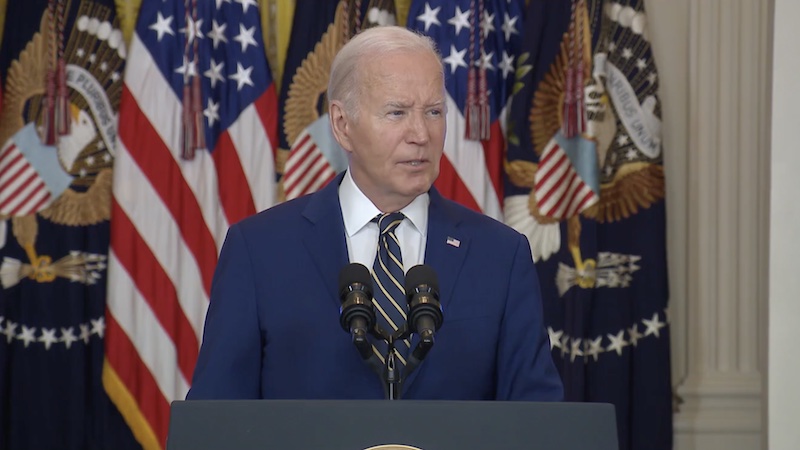
US President Joe Biden. Photo Credit: White House video screenshot

Last week, Pres. Biden announced an “Israeli peace plan” for Gaza, which Israel’s prime Minister all but disavowed within 24 hours of its debut. He reiterated his intent to battle to the last Hamas fighter, though it appears unlikely the IDF can accomplish this objective. Netanyahu’s maximalist position appears to remain unchanged.

The Opposition notified him that it would support a ceasefire plan in the Knesset, giving the PM political cover if he chose to accept it.  But it would mean the dissolution of his government and lead to new elections. Polls show that he would lose the election, following which the corruption trials against him would move into a new phase. A conviction could lead to prison time.  The war is Bibi’s stay-out-of-jail card.  As long as there is war the nation will support him. Though even that is changing with a burgeoning anti-war movement led by families of hostages held in Gaza.

Biden’s plan calls for release of all Israeli hostages, followed by the release of Palestinian hostages (detainees arrested by Israel) and withdrawal of Israeli troops from “populated areas” in Gaza. It would be accompanied by a 45-day ceasefire at the end of which hostilities would conclude and the IDF would completely withdraw from the enclave.  Afterward, the US, European and Arab states would launch a massive reconstruction effort in Gaza.

It’s unclear who or what would govern Gaza after the war.; Israel refuses to permit Hamas to return, and for the Palestinian Authority to take control. If it did, this would strengthen the case for a Palestinian state, which Israel vehemently opposes.

Israel identified a powerful clan in Gaza as an alternative force capable to governing, but Hamas;assassinated;the its leader for negotiating with the Israelis.; It will not permit a rival to rule.

The US wants the PA to take over, but Israel’s refusal has torpedoed that option.; The US also wants the war to lead to creation of a Palestinian state. This plan too is dead in the water due to Israeli opposition.; Though it’s important to note that European nations have newly recognized such a state; as a consequence of Israeli genocide. As have well over 100 UN member states have done so as well.

Biden’s plan is close to Hamas’s proposals, but far from Israeli demands. It’s not clear how or why this is an Israeli proposal. Netanyahu said as much, claiming that Israeli goals remain the same: eradication of Hamas and Israeli security control of the enclave.

There are several scenarios that may be at play here. Biden may hope that Netanyahu actually;wants;such an agreement, but needs to cover his right flank; since Bezalel Smotrich and Itamar Ben Gvir could topple his government. That would explain Bibi’s reaffirmation of his maximalist goals to assuage their own expectations.

Biden would clearly prefer a government consisting of Likud and the current center- right Opposition. The US wants the current far-right government to fall, as it would never accept any agreement with Hamas.; Benny Gantz and Yair Lapid, leaders of the Opposition, have already signaled their support for the US-Israeli plan.

However, Netanyahu could have cobbled together such a unity government after winning the last election. Instead he chose the Judeo- fascist parties as his bedfellows.; It seems dubious he would choose a path he’d once rejected.

Curiously, Netanyahu did not explicitly renounce the US Proposal. He could have rejected it out of hand and denied it was an Israeli plan at all. Since that didn’t happen, there had to have been some coordination with the US.

Hamas, for the first time since 10/7, reacted favorably to a ceasefire proposal. But that’s not surprising, since this plan is close to its past ones, which Israel rejected.

For Biden, this is a must-win situation. He’s being pummeled in the polls, on campuses, and in the media for his refusal to take concrete action to bring the war to a close. Despite Trump’s guilty verdict in his hush money case, he still leads Biden by 2% in the latest polls. A successful agreement would, so the president hopes, wipe away this stain on his campaign.; Even if the gambit fails, he can go to the electorate and say that he put forward a peace plan which the parties rejected.

Further, Biden’s entire approach to the war, including his assumptions about both the Israelis and Palestinians, has been so far off the mark, that any betting person would give his plan very long odds.; If there is to be any long-term resolution to the conflict it must be imposed on Israel by a global movement of international bodies like the UN and the European Union. And by a grassroots movement for a Palestinian state.

A conviction of Netanyahu by the International Criminal Court would play a major role in weakening Israeli opposition. As long as the world gives cover to genocide, there will be no accountability and Israelis will continue their policies of Occupation, land theft, ethnic cleansing, and genocide.

I would not break out the champagne just yet. In fact, this proposal sits on a rickety platform. There are so many moving parts and so many ways in which the wheels can fall off, that success, in fact, seems a long way off. In fact, I believe it will meet the same fate as scores of such agreements announced with great fanfare in the past.


Categories
South Caucasus News

Armenian Parliament Speaker deems information regarding Pashinyan’s visit to Azerbaijan absurd


Categories
South Caucasus News

Bonn hosts presentation on COP29 preparations – AZERTAC – AZERTAC News


Bonn hosts presentation on COP29 preparations – AZERTAC  AZERTAC News

Categories
South Caucasus News

President of Montenegro congratulates President Ilham Aliyev – Trend News Agency


President of Montenegro congratulates President Ilham Aliyev  Trend News Agency

Categories
South Caucasus News

President Ilham Aliyev embarks on official visit to Egypt [PHOTOS] – AzerNews.Az


President Ilham Aliyev embarks on official visit to Egypt [PHOTOS]  AzerNews.Az

Categories
Audio Review - South Caucasus News

@mikenov: Fact Check: FBI did not ‘get bullied’ into deleting its Pride post on X reuters.com/fact-check/fbi…


Fact Check: FBI did not ‘get bullied’ into deleting its Pride post on X https://t.co/x18zSGV4mF

— Michael Novakhov (@mikenov) June 7, 2024