

Day: June 5, 2024
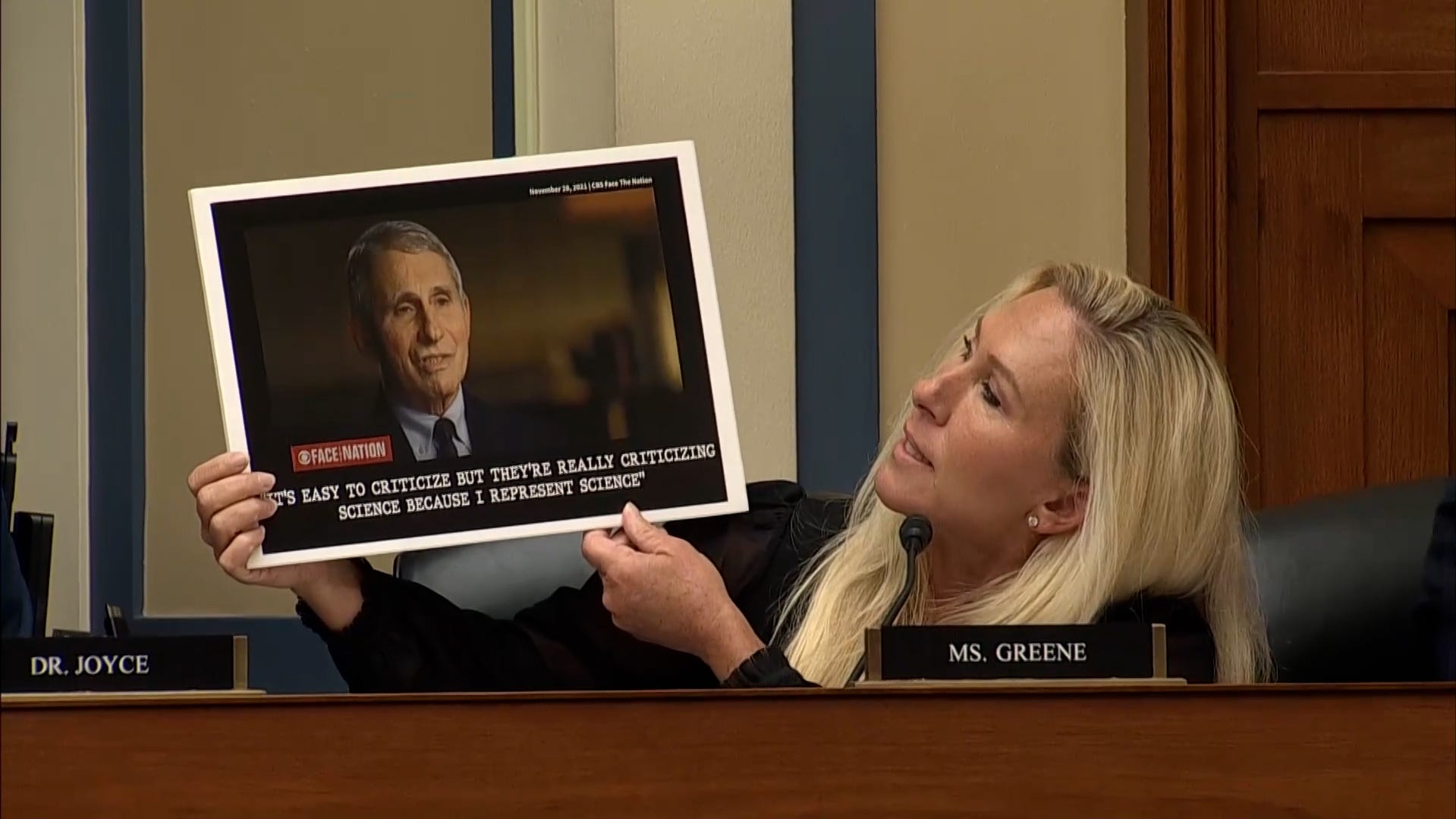

Dr. Anthony Fauci disparaged by Marjorie Taylor Greene during House hearing
Rep. Marjorie Taylor Greene refused to refer to Anthony Fauci as “doctor” during a congressional hearing focused on the COVID-19 pandemic response and the virus’s origins.
When COVID-19 hit in 2020, I jotted down a makeshift “will” for my four kids under 12. It wasn’t official, just a set of instructions for my children and other immediate family members in case anything happened to me. Bank accounts, passwords, and access to other valuable information the family might need were included.
It was the beginning of the pandemic and we had no idea just how serious things would get.
As a single parent, I worried that if I suddenly caught it and died, my children would languish. The virus was rampant, and the risk of dying seemed high and very real. Fear and anxiety took hold.
COVID-19 deaths weren’t exactly uncommon. The pandemic killed more than a million Americans, and there have been about 104 million confirmed cases in the United States alone. A lot of decisions were rooted in fear and brought with them life-changing consequences. Statewide lockdowns, shuttered businesses, school closings: All were based initially on the social distancing rule of the Centers for Disease Control and Prevention.
We’re now getting answers to questions those decisions raised.
In his testimony to the House Oversight and Accountability Committee on Monday, Dr. Anthony Fauci, former director of the National Institute of Allergy and Infectious Diseases and former chief medical adviser to President Donald Trump, said the 6-foot social distancing rule, which the CDC originally recommended, had not been backed by a clinical trial. This is despite constant claims that COVID-19 protocols were based on science.
These disclosures are damning and maddening for all of us who had structured our lives around these rules for years. As a result, millions of people suffered needlessly.
On Monday, Fauci was also asked to clarify his comments during the two-day congressional testimony he gave in January. The transcript of that testimony was recently released.
He specifically responded on Monday to questions about the 6-foot rule: “It had little to do with me since I didn’t make the recommendation and my saying ‘there was no science behind it’ meant there was no clinical trial behind that.”
In January, Fauci told staff and members of the Select Subcommittee on the Coronavirus Pandemic that “there was no science behind” the 6-foot social distancing rule that state and local governments repeated for months if not years.
What about the next pandemic: The world desperately needs a pandemic agreement. Will we come together to save lives?
“You know, I don’t recall. It sort of just appeared. I don’t recall, like, a discussion of whether it should be 5 or 6 or whatever,” Fauci said in January’s testimony.
He also admitted in the January interview that there was little science that backed requiring children to wear masks in public and at schools for almost two years.
“Do you recall reviewing any studies or data supporting masking for children?” a staffer asked Fauci.
“You know, I might have,” he answered, “but I don’t recall specifically that I did. I might have.”
These revelations are infuriating. Fauci repeated CDC-based COVID-19 protocols as the mouthpiece of President Trump’s administration. Desperate for guidance, states, local governments, businesses, churches and schools instituted them.
The real effect of social distancing − which Fauci basically admitted Monday and in January’s testimony was just an educated guess on how to deter COVID-19 − devastated America’s economy, small businesses and families. It interrupted the fabric of American life. For what?
The CDC’s now-infamous three weeks to “flatten the curve” turned into months for students and families living with the consequences. Here are some.
Closing schools was devastating to kids, especially poor or otherwise disadvantaged children. Remote learning wasn’t as effective as in-person learning, especially in the first year, as teachers had no time to prepare. Kids fell behind their grade levels. Pandemic closings resulted in two decades of learning loss.
Operation Warp Speed: Trump has to disavow his COVID vaccine to keep voters from RFK Jr. and his anti-vax clout
Anxiety and depression skyrocketed, especially among adolescents and teens. Kids with learning disabilities were completely left behind.
Non-urgent but still important medical diagnoses and exams were halted altogether. (This went for adults, too.) When schools did reconvene, masks were treated as sacrosanct, and kids were forced to eat lunch several feet apart.
Children learning to read and write at the beginning of the pandemic are still behind even now. Never mind that kids rarely showed any adverse effects of COVID-19, let alone died from it.
This is not a matter of hindsight being 20/20, either. People, including myself, were calling for schools to open in the fall months after the pandemic began, predicting it would continue to be harmful.
The entire medical profession, well beyond Fauci’s purview, seemed to struggle to understand how to mitigate the virus while continuing to provide medical care to those in need. While most providers pushed everyone to get vaccinated, screenings and routine care were pushed off for fear of COVID-19, even though they themselves were vaccinated.
At one point during the first year of COVID-19, one of my daughters became extremely ill. I phoned our pediatrician. Even though the staff was vaccinated, they would only see newborns. Her pediatrician refused to examine my daughter in person, and we tested negative for COVID-19 three times. She lost weight and refused to eat, sleeping all day.
After about 10 days, she eventually recovered. We still have no idea what illness she had, but her pediatrician’s treatment, based on COVID-19 guidelines, made no sense.
Hundreds of providers endangered patients based on ideas that had no basis in research. We’re only now learning just how much delaying cancer treatments out of the fear of spreading COVID-19 will cost people.
Schools were just one example. The economic data, representing millions of families, is no more comforting.
In the second quarter of 2020, 1.2 million jobs were destroyed. In June 2021, 6.2 million people did not work at all or worked fewer hours because their employers closed or lost business. Family-owned businesses were lost, savings wiped, all for rules that had no real scientific basis.
Elderly loved ones, the most susceptible to COVID-19, died alone in hospital beds, with no one holding their hands and whispering last prayers. If funerals were held at all, expressions of affection was banned.
On Monday, Fauci did concede that some COVID-19 preventative measures may have gone too far and led to harmful outcomes. He said it is “very, very clear” that public health officials in the future should consider “the potential collateral negative effects” of controversial ideas like requiring masks and ask “how we can do better next time.”
Still, even this seems too little too late.
While COVID-19 measures were set in place immediately, as hundreds, if not thousands, were at risk of dying from the disease, it became clear within months that the disease disproportionately targeted elderly people and hardly affected kids at all.
An adaptable administration led by Fauci, the CDC and the National Institutes of Health would have observed such shifts and lifted strict lockdowns of schools and businesses. A healthy society quarantines the sick, not the young. A robust economy never shuts down its economy and hopes it will thrive.
Because we live in Texas, which remained largely open save for a couple of months, my kids and I watched as friends and family struggled through the pandemic with shuttered businesses and schools. The contrast between living in a state where responsible freedom was encouraged compared with places where local governments kept businesses and schools closed was obvious and remains cemented in my mind.
COVID-19 was four years ago now, but as time marches on, we must never forget its valuable lessons so we don’t repeat those mistakes again.
Nicole Russell is an opinion columnist with USA TODAY. She lives in Texas with her four kids.
Dr. Anthony Fauci disparaged by Marjorie Taylor Greene during House hearing
Rep. Marjorie Taylor Greene refused to refer to Anthony Fauci as “doctor” during a congressional hearing focused on the COVID-19 pandemic response and the virus’s origins.
When COVID-19 hit in 2020, I jotted down a makeshift “will” for my four kids under 12. It wasn’t official, just a set of instructions for my children and other immediate family members in case anything happened to me. Bank accounts, passwords, and access to other valuable information the family might need were included.
It was the beginning of the pandemic and we had no idea just how serious things would get.
As a single parent, I worried that if I suddenly caught it and died, my children would languish. The virus was rampant, and the risk of dying seemed high and very real. Fear and anxiety took hold.
COVID-19 deaths weren’t exactly uncommon. The pandemic killed more than a million Americans, and there have been about 104 million confirmed cases in the United States alone. A lot of decisions were rooted in fear and brought with them life-changing consequences. Statewide lockdowns, shuttered businesses, school closings: All were based initially on the social distancing rule of the Centers for Disease Control and Prevention.
We’re now getting answers to questions those decisions raised.
In his testimony to the House Oversight and Accountability Committee on Monday, Dr. Anthony Fauci, former director of the National Institute of Allergy and Infectious Diseases and former chief medical adviser to President Donald Trump, said the 6-foot social distancing rule, which the CDC originally recommended, had not been backed by a clinical trial. This is despite constant claims that COVID-19 protocols were based on science.
These disclosures are damning and maddening for all of us who had structured our lives around these rules for years. As a result, millions of people suffered needlessly.
On Monday, Fauci was also asked to clarify his comments during the two-day congressional testimony he gave in January. The transcript of that testimony was recently released.
He specifically responded on Monday to questions about the 6-foot rule: “It had little to do with me since I didn’t make the recommendation and my saying ‘there was no science behind it’ meant there was no clinical trial behind that.”
In January, Fauci told staff and members of the Select Subcommittee on the Coronavirus Pandemic that “there was no science behind” the 6-foot social distancing rule that state and local governments repeated for months if not years.
What about the next pandemic: The world desperately needs a pandemic agreement. Will we come together to save lives?
“You know, I don’t recall. It sort of just appeared. I don’t recall, like, a discussion of whether it should be 5 or 6 or whatever,” Fauci said in January’s testimony.
He also admitted in the January interview that there was little science that backed requiring children to wear masks in public and at schools for almost two years.
“Do you recall reviewing any studies or data supporting masking for children?” a staffer asked Fauci.
“You know, I might have,” he answered, “but I don’t recall specifically that I did. I might have.”
These revelations are infuriating. Fauci repeated CDC-based COVID-19 protocols as the mouthpiece of President Trump’s administration. Desperate for guidance, states, local governments, businesses, churches and schools instituted them.
The real effect of social distancing − which Fauci basically admitted Monday and in January’s testimony was just an educated guess on how to deter COVID-19 − devastated America’s economy, small businesses and families. It interrupted the fabric of American life. For what?
The CDC’s now-infamous three weeks to “flatten the curve” turned into months for students and families living with the consequences. Here are some.
Closing schools was devastating to kids, especially poor or otherwise disadvantaged children. Remote learning wasn’t as effective as in-person learning, especially in the first year, as teachers had no time to prepare. Kids fell behind their grade levels. Pandemic closings resulted in two decades of learning loss.
Operation Warp Speed: Trump has to disavow his COVID vaccine to keep voters from RFK Jr. and his anti-vax clout
Anxiety and depression skyrocketed, especially among adolescents and teens. Kids with learning disabilities were completely left behind.
Non-urgent but still important medical diagnoses and exams were halted altogether. (This went for adults, too.) When schools did reconvene, masks were treated as sacrosanct, and kids were forced to eat lunch several feet apart.
Children learning to read and write at the beginning of the pandemic are still behind even now. Never mind that kids rarely showed any adverse effects of COVID-19, let alone died from it.
This is not a matter of hindsight being 20/20, either. People, including myself, were calling for schools to open in the fall months after the pandemic began, predicting it would continue to be harmful.
The entire medical profession, well beyond Fauci’s purview, seemed to struggle to understand how to mitigate the virus while continuing to provide medical care to those in need. While most providers pushed everyone to get vaccinated, screenings and routine care were pushed off for fear of COVID-19, even though they themselves were vaccinated.
At one point during the first year of COVID-19, one of my daughters became extremely ill. I phoned our pediatrician. Even though the staff was vaccinated, they would only see newborns. Her pediatrician refused to examine my daughter in person, and we tested negative for COVID-19 three times. She lost weight and refused to eat, sleeping all day.
After about 10 days, she eventually recovered. We still have no idea what illness she had, but her pediatrician’s treatment, based on COVID-19 guidelines, made no sense.
Hundreds of providers endangered patients based on ideas that had no basis in research. We’re only now learning just how much delaying cancer treatments out of the fear of spreading COVID-19 will cost people.
Schools were just one example. The economic data, representing millions of families, is no more comforting.
In the second quarter of 2020, 1.2 million jobs were destroyed. In June 2021, 6.2 million people did not work at all or worked fewer hours because their employers closed or lost business. Family-owned businesses were lost, savings wiped, all for rules that had no real scientific basis.
Elderly loved ones, the most susceptible to COVID-19, died alone in hospital beds, with no one holding their hands and whispering last prayers. If funerals were held at all, expressions of affection was banned.
On Monday, Fauci did concede that some COVID-19 preventative measures may have gone too far and led to harmful outcomes. He said it is “very, very clear” that public health officials in the future should consider “the potential collateral negative effects” of controversial ideas like requiring masks and ask “how we can do better next time.”
Still, even this seems too little too late.
While COVID-19 measures were set in place immediately, as hundreds, if not thousands, were at risk of dying from the disease, it became clear within months that the disease disproportionately targeted elderly people and hardly affected kids at all.
An adaptable administration led by Fauci, the CDC and the National Institutes of Health would have observed such shifts and lifted strict lockdowns of schools and businesses. A healthy society quarantines the sick, not the young. A robust economy never shuts down its economy and hopes it will thrive.
Because we live in Texas, which remained largely open save for a couple of months, my kids and I watched as friends and family struggled through the pandemic with shuttered businesses and schools. The contrast between living in a state where responsible freedom was encouraged compared with places where local governments kept businesses and schools closed was obvious and remains cemented in my mind.
COVID-19 was four years ago now, but as time marches on, we must never forget its valuable lessons so we don’t repeat those mistakes again.
Nicole Russell is an opinion columnist with USA TODAY. She lives in Texas with her four kids.
Azerbaijani economist Farid Mehralizade was detained as part of the government’s crackdown on AbzasMedia, despite not having any ties to the independent news outlet.
Mehralizade was expected to testify in the AbzasMedia case on Saturday, but was reportedly abducted and detained two days earlier, on 30 May.
His wife, Nargiz Mukhtarova, said that her husband disappeared in the early morning of 30 May, and was escorted to their home by the police around noon that day.
‘The police brought him home at noon. They raided our house and took only our mobile phones, even the old ones that were unusable. When the police arrested him they put a bag over his head’, she told OC Media.
During the raid, Mehralizade told his wife that he was abducted from the 28 May Metro Station in Baku.
OC Media has reached out to the Interior Ministry for comment on Mehralizade’s detention.
Mehralizade is an economic analyst often contacted by pro-government media outlets for comments. He also runs Çəpəki, a Telegram channel covering Azerbaijan’s economic policies and statistics.
An unexpected arrest
Mukhtarova told OC Media that they did not foresee Mehralizade’s arrest, as he was never asked to testify against AbzasMedia by the police.
‘I tried to find the logic behind it, but I couldn’t find it. Everything is so unclear to me’, she said.
Following his arrest, AbzasMedia, which now operates out of exile, issued a statement stressing that they had never worked with Mehralizade. They said that he had given comment to the independent media outlet as ‘one of hundreds of experts’ they have contacted.
They stated that ‘dozens of people who have no cooperation or connection with Abzas Media have been brought in for questioning as witnesses in this case.’
Azerbaijan began its crackdown on media in November, targeting independent journalists and their organisations and political activists.
[Read more: ‘My son is not a smuggler’: how Azerbaijan detains critics]
Journalists and activists in Azerbaijan have since decided to largely operate underground in fear of government persecution.
The Baku Community Space, a platform for youth activism, was one of the latest organisations to shut down in light of the ongoing crackdown.
‘We couldn’t work in such a tough situation, and to save our members we decided to close the platform’, a member of the organisation told OC Media.
The post Azerbaijani economist ‘kidnapped’ and detained in AbzasMedia case appeared first on OC Media.
This year’s Independence Day celebrations came at the height of political turmoil. Opponents of the foreign agents’ law marked the day by retracing the path of the first-ever Independence Day celebrations in 1919, a year after the country officially split from the Russian Empire. The march began near the Tbilisi Concert Hall and ended in Vake Park. As the old national anthem was played and the flags of the First Republic were waved, the mystery remained. In 1918-1921, Georgia was able to create an exemplary (social-) democratic experiment in just three years, and it took a Soviet invasion to end it. And now, in a second attempt, we have had 33 years and are about to lose everything to the whims of a billionaire simply because he failed to withdraw money from a troubled Swiss bank and panicked. How could things go THIS wrong?
Here is Nini and the Dispatch newsletter, on our way to take a walk on the grass and try to reconnect with what was lost.
 Independence Day celebration on May 26, 1919. Photo shared on social media by historian Dimitri Silakadze
 Independence Day celebration on May 26, 1919. Photo shared on social media by historian Dimitri Silakadze
We can leave it to historians and academics to draw detailed conclusions and simply look at the pictures above. Rare photos from that 1919 celebration show a large festive gathering where today’s Vake Park is in Tbilisi. The images couldn’t feel more different from today. What makes that key difference is the vast space of naked slopes and wide fields. Somehow, these black-and-white photos look greener than any color pictures of the same area now: you don’t find such open landscapes in Tbilisi anymore.
Over the past century, Georgia appears to have developed a strange phobia of open and free spaces and a peculiar fear of wild green grass. Such places have been disappearing in the cities one by one, and unsurprisingly so: with every field comes a businessman, or a government official, or (most often) both incarnated in the same person, who feels an irresistible urge “to do something with it” – which, in most cases involves turning the place into a concrete jungle. Where the communities were quick and strong enough, the best they could do was to compromise with the authorities, who agreed to build a park there – the only way to save it from another claustrophobic project. Often, it’s the locals themselves who propose the idea of a park, knowing full well that the place won’t survive the greed of the mighty for too long.
These parks then come with fountains, exercise equipment, chairs, playgrounds, lights, bike lanes, stadiums, cafes, decorations, this, that, and – as a tribute to good old free times – a few small patches of grass, where it is strictly forbidden to walk. Work is underway to do the same for the largest such grassy place – the former hippodrome grounds in Tbilisi’s Saburtalo district. The areas around Tbilisi’s lakes were either gentrified or, if it’s not central enough for the government or property developers to care, turned into abandoned, dangerous places. The only time the government cares about creating more green spaces is when it wants to make it harder for crowds to gather at traditional political rallying points.
Walking Barefoot
“If, barefoot, I can’t walk on the grassy knoll… what is motherland?” reads a famous, melancholic line by the revered Georgian poet Galaktion Tabidze. This was a forlorn cry for the forsaken freedom then, and it remains so now. Walking on the grass – with or without shoes – has long felt as illegal as simply walking freely increasingly does. The fields have been transformed and shaped in such a way as to turn the grass into mere decorations at the expense of that intimate connection the poet was writing about. And it’s not just the businessmen and officials who are to blame – over the past decades, society as a whole has done its best to shrink public spaces and mark territories – in all possible senses.
If the First Republic was born out of decades of vibrant and spacious intellectual life – even under the Tsarist rule – this did not seem to be the case in its successor. In the current republic, we’ve looked at free intellectual spaces as we’ve looked at untouched fields: it could ideally mean beauty and freedom, but more tangibly, it meant uncertainty and imminent fear of someone stealing and exploiting it. So before someone else comes in with a novel idea, why not fence ourselves in and lay down some ideologically armored concrete? Or if we are forced to give it away, let’s do it on our own terms to satisfy that tiny illusion of agency!
This “someone” was mostly Russia: faced with a constant existential threat from the North, political and intellectual elites felt the urge to shut down discussion in case anyone fell prey to “Russian narratives.” Georgians became overprotective and patronizing of each other, clear lines were drawn, and everyone was forced to choose their echo chambers. No wonder we ran away too easily with the concept of “disinformation,” passionately embarked on a great mission of “myth-busting,” and thought we’d figured it all out.
Overprotected Kid Syndrome
But perhaps, sometimes, the fear of propaganda can be as harmful as propaganda itself. Facts only matter if there is a space to communicate them, a space that includes everyone and exposes them to a larger diversity of sensitive and possibly even dangerous ideas. But at least a space that makes room for discussion and makes society more resilient, more comfortable with, and more discerning about ambiguities. Yet few of such spaces faded without even properly emerging. And since the Georgians keep waking up in barely parallel ideological and political realities that are narrowly defined, bad barely overlapping.
After Russia invaded Ukraine in 2022, things got worse as both uncertainty and fear grew. Instead of acknowledging each other’s fears and finding ways to confront them, many Georgians chose outright denial. Hostage to self-imposed limitations, Georgian opposition elites failed to develop a discourse to talk to citizens and address their fears, ending up effectively alienating them and leaving them in a state of anxiety and distress. This left room for the ruling party a free hand to manipulate and then completely subvert the truth, feeding Georgians conspiracies that violate every law of logic, gaslighting anyone with common sense.
The government knows how much it benefited from the lack of such open spaces for argumentation. Now, with the foreign agents’ law targeting independent media and watchdogs, the ruling party is seeking to eliminate the last sources of trust and truth in Georgia. Is there a way out?
Reclaiming Wet Grass
Will the emerging, more decentralized Georgian civil society reclaim these lost spaces? Or tear down the concrete and (re)create them?
It remains to be seen, but at least they are reclaiming and redefining some physical spaces. Through their spontaneous rallies and marches in recent weeks, Georgian protesters have occupied places from which citizens have long been exiled. The most obvious example is Heroes’ Square: a dizzying concrete intersection and traffic artery dedicated to vehicles. Seeing a pedestrian there, let alone someone sitting on the grass, was hardly imaginable just months ago. But large crowds have marched through that uncharted pedestrian jungle, filled spaces carved out for cars, and distended them back for human use – an occurrence so unnatural that ruling party officials responded with desperate attempts to downplay the numbers and even questioned the authenticity of photos taken there.
Business, power politics, restrictive past, and collective traumas have all teamed up to limit the spaces where Georgians can connect and face the uncertainties of this world together. But now that more young people are breaking those boundaries and walking on the grass without asking anyone’s permission, will they rekindle that physical bond with their homeland and find the space to reconnect with each other? Time will tell. But time is running out.
 Protesters sitting on a grass previously uninhabited by a human race, Heroes Square, Tbilisi, May 15, 2024. Photo: Nini Gabritchidze/Civil.ge
The Georgian Parliament has banned another journalist, Natalia Kajaia of the opposition-leaning TV Pirveli, from working in the legislative building for one month, until July 3, at the request of the leader of the GD’s spinoff People’s Power party, MP Sozar Subari. Her accreditation was suspended because she continued to record the interview despite the MP’s refusal.
A few days ago, two other journalists from another opposition-leaning media outlet, Mtavari TV and Formula TV, were also temporarily banned from working in Parliament at the request of the Deputy Speaker, GD MP Nino Tsilosani. In these cases, too, the journalists continued to ask Tsilosani questions, although she refused to give an interview.
The bans come as a result of implementing a controversial February 2023 Order issued by Speaker Shalva Papuashvili, which restricted the framework of accreditation and conduct of the media in the legislative building. The rules oblige the journalists to terminate an interview if an MP, staff member, or guest objects.
Also Read: