Categories
South Caucasus News

“EU won’t fuel Yerevan’s false hopes”. Opinion


Armenia and EU

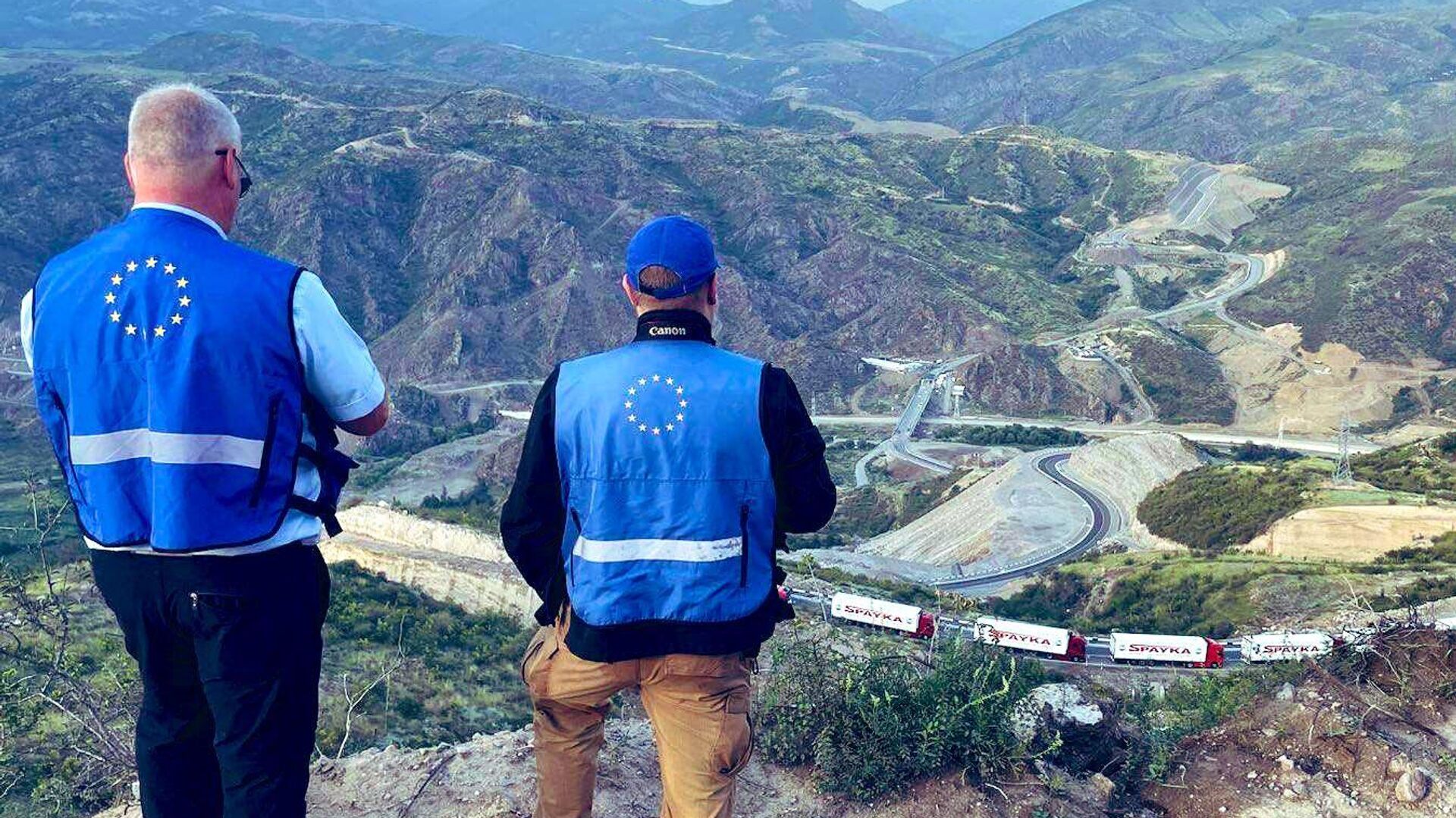
The EU‘s civilian observer mission, patrolling the Armenia border, has opened an office in Yerevan. The “liaison and support office will enhance the mission’s mandate by strengthening cooperation with local and international partners in the capital.”

This observer mission is the primary security achievement in Armenia-EU relations, according to international relations and security expert Sossi Tatikyan.

“It’s a soft deterrent against Azerbaijan‘s creeping annexation and potential military aggression. Without this mission, Armenia would have lost more territory by now,” she said.


EU observer mission opens an office in Yerevan

The EU observer mission has opened another office, this time in Yerevan, located in the Armenia Marriott Hotel. Previously, six offices were established in the regions, in the cities of Yeghegnadzor, Jermuk, Martuni, Ijevan, Goris, and Kapan.

Markus Ritter, head of the EU mission in Armenia, emphasized that the new office will not only serve as a workplace for staff but also “facilitate information exchange and coordination with stakeholders in Yerevan for the successful implementation of the mission’s mandate.”

The observer mission began its operations on the Armenia-Azerbaijan border on February 20, 2023. It includes 132 representatives from 23 EU member states. Since then, the observers have conducted over 2,300 patrols. The mandate of the civilian mission is set for two years, until February 2025, with the possibility of extension before its expiration.

Commentary

The European Union does not want to instill false illusions that “it will come to save Armenians in the event of an attack by Azerbaijan,” says Sossi Tatikyan, an expert on international relations and security issues. She emphasizes that the deployment of the EU observer mission was the most that European partners “could do for us” to prevent a new war:

Another important step would be to provide peace support tools and appropriate [security] funding. Although Hungary creates problems in this regard.”

EU High Representative for Foreign Affairs Josep Borrell spoke back in 2023 about “possible support for Armenia within the framework of the European Peace Facility.” It is an instrument through which Brussels provides funds to non-EU countries to improve their defense capabilities, prevent conflicts and promote peace. Through this mechanism, the EU supported Ukraine, Georgia and Moldova. Armenian experts often say that it is Hungary that opposes the provision of this instrument to Armenia.

Tatikyan emphasized that there are other EU members who are “supporters of Baku, as they receive gas from Azerbaijan.” However, she hopes that consensus on this issue will still be reached, and this will allow Armenia to receive EU assistance.

She also said that the European Union does not want a new war in the South Caucasus, it is already “burdened” with military actions in Ukraine and is trying to manage the situation created as a result of the Russian-Ukrainian war.

In her opinion, the EU is trying to balance between its commitment to democracy and human rights, on the one hand, and geopolitical interests, on the other. An important argument in this chain, according to the expert, is the energy security of the union member countries:

To ensure their energy security and reduce dependence on Russia, the European Union has concluded energy agreements with Azerbaijan and the authoritarian Gulf countries.”
According to the expert, Armenia’s desire to join the European Union is more than obvious:

The EU is negotiating with our government regarding Armenia’s membership so that our population does not develop false expectations and the opinion that a year after submitting an application for membership, Armenia will easily become a full member of the organization.”

She warns that this is a long and difficult process. And Armenia needs to make efforts to meet the requirements regarding democracy, human rights and other important standards. In addition, a prerequisite for a country applying for membership is the requirement “not to have a conflict with its neighbors.”

The expert also recalled another factor, the country’s economy, which is currently closely connected with Russia and the Eurasian Economic Union operating under its auspices:

If Armenia leaves the EAEU right now, the Armenian economy will instantly collapse. The transition should be gradual. On this path, the European Union must help us by providing certain quotas and advantages in order to direct our market step by step from the EAEU to the EU.”

Categories
South Caucasus News

Opposition MP decries ‘climate of impunity’ in Armenia


Categories
South Caucasus News

NPR News: 06-04-2024 6AM EDT


NPR News: 06-04-2024 6AM EDT

Learn more about sponsor message choices: podcastchoices.com/adchoices

NPR Privacy Policy


Categories
South Caucasus News

Georgia introduces Russian-style crackdown on LGBTQ+ rights – POLITICO Europe


Georgia introduces Russian-style crackdown on LGBTQ+ rights  POLITICO Europe

Categories
South Caucasus News

EU Visa Restrictions On Ethiopians Reflect Strained Migration Relations – Analysis


EU Visa Restrictions On Ethiopians Reflect Strained Migration Relations – Analysis

ethiopia eritrea somalia Horn of Africa map

By Margaret Monyani 

Since 29 April, the European Union (EU) has imposed temporary restrictions on Schengen short-term visas for Ethiopians. These include prohibiting multiple entry visas, longer processing times, and eliminating waivers for certain documentary requirements and visa fees.

The European Commission said the action was due to a ‘lack of response from the Ethiopian authorities regarding readmission requests,’ and shortcomings in organising ‘voluntary and non-voluntary return operations,’ (the latter is how the EU describes deportation).

The restrictions raise concerns about the efficiency and fairness of the EU’s migration policies. Ethiopia’s Foreign Ministry Spokesperson Nebiyu Tedla said the developments were ‘incompatible with acceptable diplomatic practices’ and asked the EU Council to reconsider the ‘unfair’ restrictions.

In 2017, the EU and Ethiopia agreed on admission procedures for the return of Ethiopians from EU countries. Although this agreement was never made public, a leaked statement revealed that similar arrangements were later made between Ethiopia and Norway and Switzerland.

Only about one in three people ordered to leave European Union countries do so

Since then, two EU-Ethiopia working group meetings and two technical meetings organised by the EU Commission have taken place to facilitate implementation of the 2017 procedures. In 2018, the EU and Ethiopia reached a non-binding agreement on the readmission of Ethiopians without visas or the legal right to remain in the EU.

In 2019, 1 395 Ethiopians staying illegally in EU member states were issued return decisions, but only 215 travelled home – an average return rate of 15%. Member states submitted 985 readmission requests to Ethiopian authorities, who issued 41 travel documents – an issuance rate of just 4%.

The overall return rates from the EU are low. Last year, over 83 000 people were returned to countries outside the EU, which the European Commission says is a return rate of 19% – not much higher than Ethiopia’s return rate of 15% in 2019.

Most people residing unlawfully in the EU initially enter through legal means via airports, but overstay their visas. These numbers far exceed those who arrive by sea or land seeking asylum or other opportunities. Only about one in three people ordered to leave the EU do.

If the problem is overstaying, efforts should focus on finding solutions to this legitimate concern. Instead, the EU’s new measures unfairly target Ethiopians travelling for legitimate reasons, such as education, family reunification, medical treatment or business. Individuals shouldn’t be held accountable for their government’s actions. Imposing additional hurdles on those who enter the EU legally doesn’t address the root causes of irregular migration, but punishes those following the law.

Despite substantial EU financial support, the Migration Partnership Framework failed to meet its goals

This punitive approach contradicts the principles of good migration governance and contrasts with the EU’s New Pact on Migration and Asylum, which advocates for accessible and efficient legal migration channels. Experts say for the New Pact to be effective, the EU must critically re-evaluate readmission agreements to return rejected asylum seekers to their home countries or safe third countries.

These agreements must respect international law, particularly the non-refoulement principle, which prohibits returning individuals to a country where they may face persecution, torture or serious harm.

The Ethiopian government needs to address the socio-economic costs of reintegration and protect its emigrants. The country’s growing engagement with its diaspora for economic and political reasons has influenced its stance on admitting returnees from the EU. Ethiopia is willing to repatriate its citizens detained in countries like Saudi Arabia, Yemen or Libya, viewing their return from inhumane detention conditions as a humanitarian protection measure.

However, Ethiopian officials don’t see rejected asylum seekers in the EU who are awaiting deportation as being in similarly dire conditions, so don’t prioritise their return on humanitarian grounds. Ethiopian officials also feel the EU hasn’t offered significant incentives, such as development funding, as part of its return agenda, so they are less inclined to help with the return of rejected asylum seekers or irregular migrants.

Even so, why is the EU targeting Ethiopia with these latest restrictions? Past Institute for Security Studies analysis has suggested that the stance of the African Union and most African countries is not to accept forced returns. While the EU’s restrictions could be a tactic to pressure Ethiopia into compliance, it also reflects a history of significant EU investment in Ethiopia on migration governance – with minimal results.

The restrictions could be applied to other African nations, leading to a more fragmented migration landscape

The longstanding EU–Ethiopia partnership, including the 2016 Migration Partnership Framework, raised expectations. However, the framework failed to meet its goals despite substantial EU financial support. The EU criticised Ethiopia for inadequate returns, while Ethiopian officials felt the focus on migrant returns overshadowed broader cooperation.

The new restrictions could indicate a worrying future trend. The EU’s move is symbolic, demonstrating its resolve in handling non-compliant countries and setting a precedent. If successful, it could be applied to other African nations, increasing disparity and leading to a more fragmented migration landscape.

The European Commission is apparently using visa rules to pressure countries to cooperate with deportation procedures. This isn’t new – agreements with Sahelian countries such as Libya and Tunisia show that the EU rewards countries that cooperate on migration governance, and penalises those that are reluctant to comply.

Last July, a European delegation signed a memorandum of understanding with Tunisia that included measures to combat irregular immigration in exchange for increased immigration controls and facilitation of voluntary returns. Between 2014 and 2020, the EU allocated over €700 million to Libya for the same reasons.

The EU’s migration policies must be consistent, fair and effective. Rather than resorting to punitive measures, it should engage in constructive dialogue with Ethiopia to address concerns about irregular migration and foster cooperation. By aligning its actions with its stated goals, the EU can promote a balanced, humane migration system that respects individuals’ rights and supports legal migration pathways.


Categories
South Caucasus News

Moscow’s First Move Against NATO Could Take Place In Norway’s Svalbard Archipelago – Analysis


Moscow’s First Move Against NATO Could Take Place In Norway’s Svalbard Archipelago – Analysis

A road sign indicating the chance of polar bear appearance in Svalbard, Norway. Photo Credit: Sprok, Wikipedia Commons

Given Moscow’s bellicose rhetoric about the North Atlantic Treaty Organization (NATO) and threats to attack one or more of its members if the West continues to support Ukraine, many in Russia and the West have been speculating about where such a Russian move might occur.

Most have focused on Poland, the Baltic countries, and Finland as possible targets, but perhaps the most likely one is elsewhere: the Svalbard archipelago. Svalbard is part of Norway, a NATO member, but is demilitarized by the provisions of the 1920 Svalbard Treaty, which has currently been signed by 46 countries, including the United States, Norway, and France. Because of that agreement, NATO remains deeply divided as to whether, in the case of a Russian move, all the members of the alliance would want to invoke the provisions of Article 5 of the NATO charter, which requires alliance members to view an attack on one as an attack on all. That division, of which Moscow is well aware, may lead the Kremlin to decide that an attack on Svalbard is less risky than an attack on any other NATO country.

The Svalbard archipelago, often referred to as Spitsbergen, the largest and only populated island in this group, lies approximately 1,000 kilometers (about 620 miles) northwest of Norway and covers 22,000 square kilometers (about 8,500 square miles) of territory. The island has fewer than 3,500 residents, of whom approximately a fifth are Russians and a handful are Chinese.

Because of its isolation, Svalbard was one of the last European territories whose status remained undefined into the 20th century, with various countries, including Norway, Sweden, and Russia, using it as a base for shipping and mining and even claiming it as their own. In 1920, however, the Western powers, without Russia’s participation, signed a treaty that declared that Norway had sovereignty over the islands but required that Oslo kept the archipelago demilitarized and permitted the development of other national communities, including, most prominently, the Russians. (On these unusual arrangements and their consequences, see Christopher R. Rossi, “’A Unique International Problem’: The Svalbard Treaty,” Washington University Global Studies Law Review 15-1 (2015).)

After the demise of the Soviet Union, Moscow continued to expand its presence on the archipelago. By the early years of the 21st century, there were nearly 4,000 Russians there, most of whom were engaged in coal mining. The closure of these mines due to others elsewhere being more cost-effective and the fall of the demand for coal, however, led to a rapid decline in the number of Russians in Svalbard over the last 15 years. There are now fewer than 700. In the summer of 2022, they became the center of a controversy when Norway imposed sanctions on Russia because of Russian President Vladimir Putin’s war in Ukraine. Oslo said it would restrict Moscow’s ability to supply the Russian community in Svalbard. That sparked outrage in Moscow and even suggestions by Russian parliamentarians that their country should use military means to defend its rights under the 1920 treaty. Fortunately, this conflict was resolved without any direct use of force (see EDM, July 7, 2022).

That clash also highlighted divisions in Europe that may now be more critical. NATO Secretary General Jens Stoltenberg said then and has repeated that any attack on Svalbard would be treated as an attack on the Alliance as a whole and thus trigger an Article 5 response. However, he is Norwegian, and his words appear to reflect Oslo’s hopes more than the position of all NATO countries.

Many in the alliance, including the United States, have not adopted an unequivocal position. Thus, in a crisis, Putin might be tempted to test the West in a place few have thought about. (On these divisions and especially on the ambivalent US position, see National Defense University Press, November 8, 2018.) 

Such a crisis now appears to be brewing, the result of an extraordinary mix of developments coming together:

  • First, Moscow is increasingly angry about the West’s growing projection of power in the Arctic, one the Kremlin believes Russia has no choice but to oppose to defend the entrance to the Northern Sea Route and support its expansive claims to the Arctic seabed (see EDM, June 7, 2022; Korabel.ru, May 20; Fond Strategicheskoi Kul’tury, May 24; Live24.ruSegodnia.ru, May 27).
  • Second, ever more Russian officials, in comparison to two years ago, are suggesting that Norway has allowed the West to militarize Svalbard and thus has lost the right to claim sovereignty over the archipelago (Svobodnaya Pressa, May 11; Segodnia.ru, May 27). 
  • Third, the Russian Federation, for the first time, enjoys the support of China on this issue. Beijing has now called for the development of a seed vault in Russia to replace the one in Svalbard and has simultaneously dispatched a new research expedition to the Norwegian archipelago to show the flag (T.me/first_arctic, May 5; TASS, May 7; Yakutiya24, May 8; NewsX, May 18;  Vybor Naroda, May 28). 
  • Fourth, international demand for coal has been rising, and the rapid warming of Svalbard, currently running at twice the rate of the Arctic in general, is making mining there an increasingly attractive option for Moscow, which sees such sales as helping to maintain its economy and project power (RG.ru, May 7). 
  • Fifth, in what may prove the black swan of this trend, a parcel of private land in Svalbard larger than Manhattan has been put up for sale, sparking fears that whoever purchases it will use it against the interests of one side or the other (Bloomberg, May 10; Svobodnaya PressaFontanka.ru, May 11).  

So far, Russia has largely limited its response to patriotic actions among Russians in Svalbard beyond propaganda campaigns in Russia about the Svalbard situation. However, it has increased its military actions in the area around the archipelago (Izvestiya, May 10; Smotrim.ru, May 21; The Barents Observer, May 2629Info24.ru, May 29). Some may assume that the current upsurge in tensions will ease and be resolved in much the same way the crisis was two years ago, especially as some Russian businesses are very publicly talking about organizing Russian tourism to Svalbard, visits that, because of the 1920 treaty, would not require visas but could be used to test Norway’s position (Epigraph, April 5). Such an outcome is certainly to be desired, but it is far from certain, especially given the overheated atmosphere in the Kremlin and Putin’s search for new targets to threaten and undermine the West and its support for Ukraine.

To ensure that Svalbard, a place mostly known, if at all, in the past for having more polar bears than people, does not become a casus belli, NATO needs to adopt a common position regarding the defense of Svalbard against any Russian attack. A failure to do that will only increase the likelihood that Putin will target this isolated archipelago as the next step in his campaign to weaken the West.  


Categories
South Caucasus News

Acting Iranian FM holds talks with Hamas and Islamic Jihad leaders in Damascus – I24NEWS – i24NEWS


Acting Iranian FM holds talks with Hamas and Islamic Jihad leaders in Damascus – I24NEWS  i24NEWS

Categories
South Caucasus News

The IAEA is readying to censure Iran. It shouldn’t. – Responsible Statecraft


The IAEA is readying to censure Iran. It shouldn’t.  Responsible Statecraft

Categories
South Caucasus News

Georgian PM claims “protection of rights” in comments on bill on “family values”, “protection of minors”


Categories
South Caucasus News

Azerbaijan to increase gas exports to 24 billion cubic meters and help small countries


Implementation of the Shah Deniz project enabled Azerbaijan to eliminate the gas shortage inside the country and began exporting it to neighboring countries and Europe, Ilham Aliyev said.

“This year our gas exports will exceed 24 billion cubic meters. Today, eight countries import Azerbaijani gas,” the head of state said,…