Categories
South Caucasus News

Bibi’s Problem Is Now Biden’s Problem – OpEd


Bibi’s Problem Is Now Biden’s Problem – OpEd

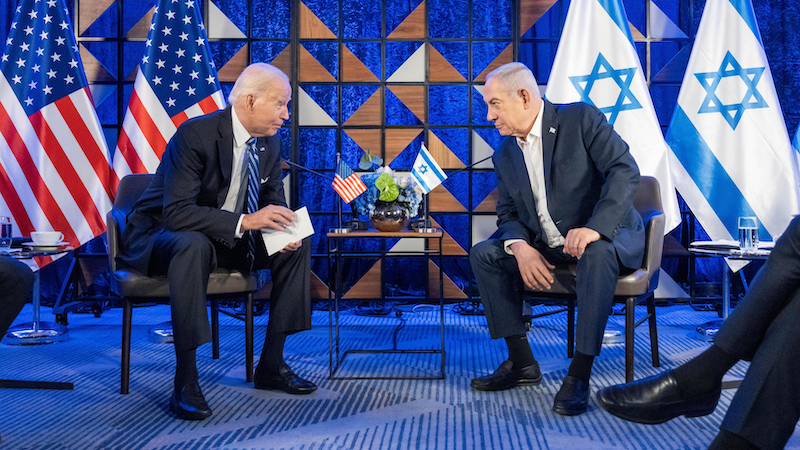
US President Joe Biden with Israel's Prime Minister Benjamin Netanyahu. Photo Credit: The White House, X

By Peter Isackson

In a highly instructive article teasing out the multiple threads of Prime Minister Benjamin Netanyahu’s current political quandary, former diplomat and Fair Observer board member Gary Grappo describes the growing pressure that directly threatens Bibi’s hold on power. Not only are members of his own team on the cusp of revolt, but even the faltering senior citizen now occupying the White House, known for his patient indulgence in the face of Israel’s most egregious excesses, now appears to be chafing at the bit over Bibi’s failure to reign in his ministers’ enthusiasm for genocidal acts carried out in the name of self-defense.

US President Joe Biden has never ceased aligning the adjectives that proclaim his nation’s unwavering, unbreakable, unreserved, iron-clad support for Israel. Earlier this month, however, he wavered ever so slightly — and only briefly —  when he chose to interrupt his regular delivery of the 2,000-pound bombs Israel needs in its quest to establish Greater Israel as a unified ethno-supremacist Jewish state.

In the meantime, the International Criminal Court prosecutor has requested an arrest warrant for Netanyahu as a war criminal. The International Court of Justice followed suit days later when it ordered Israel to halt its military operations on the town of Rafah which the IDF had previously designated as the last safe zone from Israeli bombing.

Grappo reveals the prevailing change of tone in Washington today. “Biden is fed up with Bibi’s resistance to addressing the Gaza humanitarian crisis satisfactorily (though matters have improved since early April), with his insistence on an all-out assault on Rafah, where refugees are still holed up, and with his refusal to articulate an effective plan for governance and security in Gaza after the war.”

Today’s Weekly Devil’s Dictionary definition:

Satisfactorily:

To an extent that pleases someone in a position in power, who imposes standards of levels of acceptability even on concepts such as genocide.

Contextual note

The parenthetical remark “though matters have improved since early April” helps us to understand what the adverb “satisfactorily” means in this context. The usual version of political ethics in Washington appeals to a binary distinction between what is lawful or unlawful, good or evil. The qualifier “satisfactory” suggest the possibility of a gradation of nuance added to the usual Manichean moral framework. There may be a “more satisfactory” way of committing genocide.

This method of introducing a third term to soften the sharp edge of binary logic is not new. When I was in school in California in the 1960s, our teachers applied a ternary system to assess our behavior and work habits. The three terms were: E (Excellent), S (Satisfactory) and U (Unsatisfactory). Students capable of a minimum of self-control, some luck in having a captivating teacher worth listening to and a modicum of carefully managed flattery could earn an “E.” It wasn’t essential to strive for it, but it felt good when you got it. Most of us were reasonably happy with an S since either an E or an S put you on the right side of the law, shielding you from opprobrium. U alone branded you as a misfit.

Israel’s behavior before April was so bad that most reasonable people other than fanatical Zionists would have given it a U. As a nation, it had clearly become a misfit. The world’s international courts, NGOs specialized in human rights and quite a lot of neutral observers concurred. The UN’s International Court of Justice solemnly declared genocide a “plausible” description of Israel’s conduct of the war, another way of saying it was “unsatisfactory.”

Grappo’s term “satisfactorily” correctly helps us to understand the moral system shared by a tiny group of people in an enclave called “the Beltway,” known for its flexible ethics The starting point for Beltway reasoning is, of course, the distinction between good and evil. Things that favor peace, stability and US economic interests are good. Things that tend towards conflict, instability or that challenge the US idea of “freedom” are evil. When Russia unlawfully invaded Ukraine it immediately proved itself guilty of irrevocably unsatisfactory behavior. No need to explore why Putin may have had such an outlandish idea.

Manichean systems make life and moral judgment easy. Especially if you tend to think of everyone as a potential enemy. France, for example, earned a U in 2003 when it refused to join the Bush administration’s ethically motivated invasion of Iraq. A traditional, nearly “iron-clad” ally instantly became an adversary through its display of “unsatisfactory” behavior. That’s when French fries, in the White House cantine, were canceled and rebranded “freedom fries.”

For some reason, Washington’s relationship with Israel belongs to another ethical dimension. If friends like France can instantly become adversaries, there is also at least one friend that can never become an adversary, however outrageous its behavior. “Outrageous,” by the way, is the adjective Joe Biden chose to qualify the International Criminal Court’s decision to call Bibi’s behavior unsatisfactory!

Historical note

The current conflicts that dominate the headlines, despite the horrors they have produced, have the merit of raising the public’s awareness of an interesting historical trend. In our current conception of democracy, we have traditionally assumed that, because elected officials are deemed to be “representative,” the policies enacted by our governments correlate with the popular will. Most people aligned with the idea that the government was doing its best to respond to the wants and needs of its people. That belief has radically eroded in recent years.

Today’s pro-Palestinian protest movements on college campuses in the US are one obvious indication of that disconnect. But that is an isolated issue that reveals a lot but remains exceptional. At a deeper level, thanks to a 2014 Princeton study of how democratic politics works in the US, we can understand that US democracy has, in its depth, become a de facto oligarchy. The study demonstrated that the policies legislated, enacted and enforced by elected officials in their grand majority reflect the wishes of a wealthy, corporate elite, often in direct opposition to what used to be called “the will of the people.”

Back in 2014, the publication of the study had little impact. Mainstream media paid no attention to it. In times of peace, people tend to prefer to ignore the kind of bad news that requires reflection and the effort of remedying “unsatisfactory” behavior. In times of conflict, however, especially when serious moral questions are raised, the public’s awareness of what’s going on in the depths grows and can even become acute.

Everything that is happening in the world points in the direction of rethinking old relationships. It also implies calling into question the supposed majoritarian orientation of democratic societies. Fragmentation has become the new norm. This year’s presidential election in the US may end up electing Biden the Democrat or Trump the Republican, but the presence and attraction of third parties will have a major effect on the result. And neither Biden nor Trump truly represents a unified party that can pretend to represent a majority of the American people. Both major parties are irrevocably fractured. Traditionally, either a strong leader or a strong ideology — and ideally both — could unify a party. Nothing and no one appears to be capable of taking on that task.

Grappo tells us that “the majority of Israelis … want to see their leadership work more cooperatively with Washington and Israel’s moderate neighbors to confront the true existential threat to the Jewish state, Iran.” This vague formulation may contain some truth, but, even in this traumatized nation that wants in its vast majority to achieve security by eliminating Hamas, this is a particularly difficult time to get any clear idea of what an identifiable majority of Israelis want. Yes, security is the absolute priority. But I doubt that any pollster could find a consensus on the practical means of achieving that.

The EU parliamentary elections, only days away, are likely to demonstrate a similar trend in Europe’s democracies. While governments struggle to find satisfactory responses to questions of war and failing economies, their electors increasingly judge their governments’ conduct unsatisfactory.

The views expressed in this article are the author’s own and do not necessarily reflect Fair Observer’s editorial policy. *[In the age of Oscar Wilde and Mark Twain, another American wit, the journalist Ambrose Bierce produced a series of satirical definitions of commonly used terms, throwing light on their hidden meanings in real discourse. Bierce eventually collected and published them as a book, The Devil’s Dictionary, in 1911. We have shamelessly appropriated his title in the interest of continuing his wholesome pedagogical effort to enlighten generations of readers of the news. Read more of Fair Observer Devil’s Dictionary.]

  • About the author: Peter Isackson is Fair Observer’s chief strategy officer . He is an author and media producer who has worked on ground-breaking projects focused on innovative learning technology. For more than 30 years, Peter has dedicated himself to innovative publishing, coaching, consulting and learning management. As a publisher, he has developed collaborative methods and revolutionary software tools based on non-linear logic for soft skills training. He has authored, produced and published numerous multimedia and e-learning products and partnered with major organizations such as the BBC, Heinemann and Macmillan. 
  • Source: This article was published by Fair Observer
Categories
South Caucasus News

Multilateral Peace Operations In 2023: Developments And Trends – Analysis


Multilateral Peace Operations In 2023: Developments And Trends – Analysis

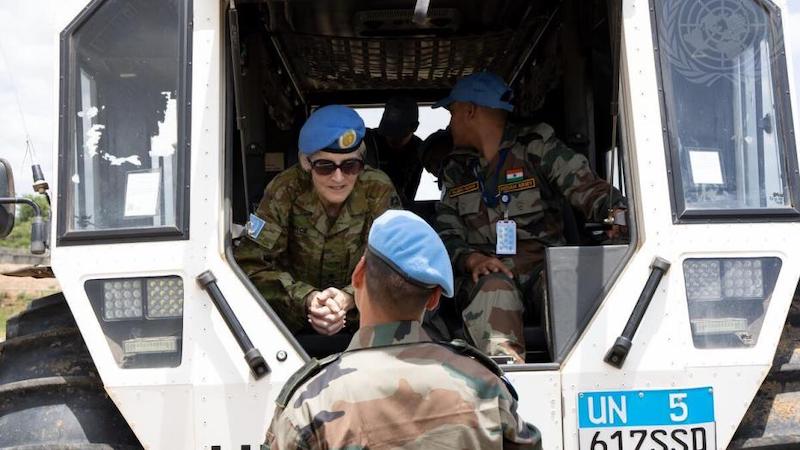
Acting military advisers visits UNMISS. Photo credit: UN Photo/Nektarios Markogiannis

By Dr Claudia Pfeifer Cruz and Dr Jaïr van der Lijn

Ahead of the International Day of United Nations Peacekeepers, SIPRI presents its latest data on multilateral peace operations in 2023. SIPRI has published this topical backgrounder that summarizes the key findings of the new data along with important developments related to multilateral peace operations during the year. In addition, SIPRI has issued a map that covers all multilateral peace operations that were active as of May 2023. Click here to access the map.

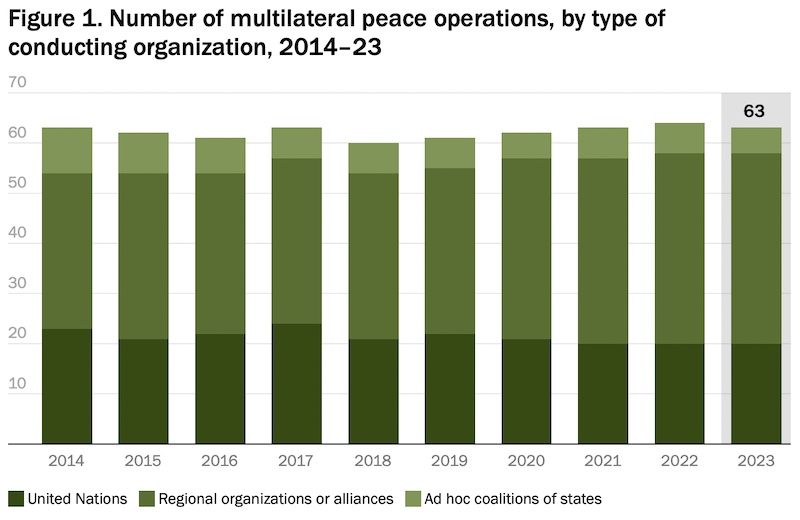
In 2023, 63 multilateral peace operations were active in 37 countries or territories around the world. This was one operation less than in 2022 (see figure 1). The largest number of multilateral peace operations, 20, were conducted by the United Nations. Another 38 operations were conducted by different regional organizations and alliances. The other 5 were conducted by ad hoc coalitions of states. Of the 63 operations, 24 were in sub-Saharan Africa, 19 in Europe, 14 in the Middle East and North Africa, 3 in Asia and 3 in the Americas.

SourceSIPRI Multilateral Peace Operations Database, May 2024

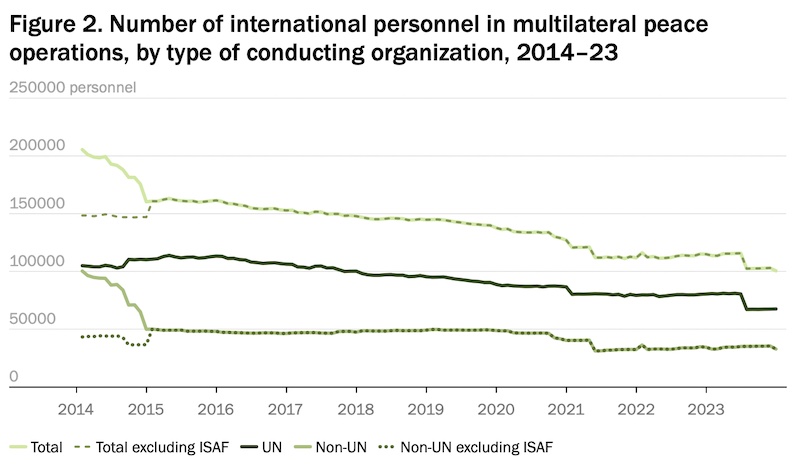
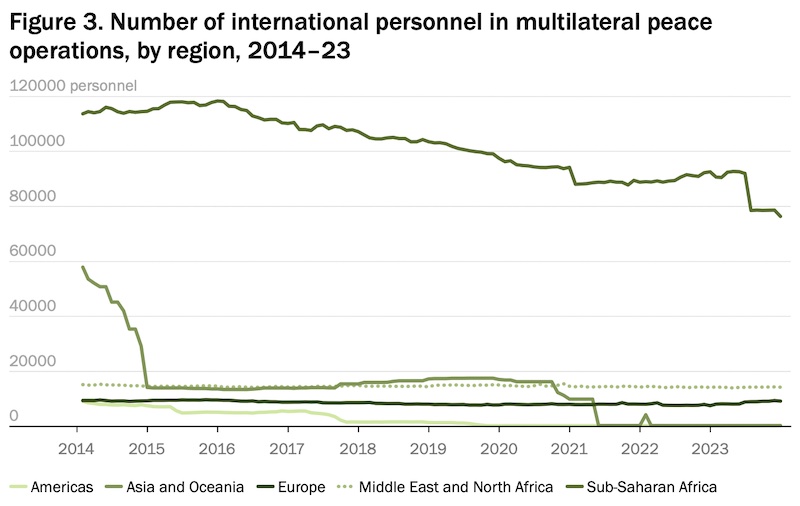
A total of 100 568 international personnel were deployed to multilateral peace operations as of 31 December, 13 per cent fewer than at the end of 2022 (see figure 2). This marked both the largest decrease and the lowest total seen in the past decade. The overall decrease in personnel numbers was primarily due to an 18-per cent drop in sub-Saharan Africa. Nevertheless, sub-Saharan Africa still accounted for the vast majority, with 76 372 international personnel deployed (see figure 3). 

The year saw new operations opening in Armenia, Moldova and the Democratic Republic of the Congo (DRC), while operations closed in Mali, Sudan, the DRC and the Central African Republic (CAR).

Three overall trends identified in 2022 continued and intensified in multilateral peace operations in 2023: the increasing effects of geopolitical rivalries; the growing tensions in relations between peace operations and their host countries; and the increasing regionalization of peace operations.

New operations in Armenia, Moldova and the Democratic Republic of the Congo

Three new multilateral peace operations started in 2023, deploying approximately 800 personnel.

The European Union Mission in Armenia (EUMA) was established on 23 January 2023. It succeeded the temporary EU Monitoring Capacity to Armenia (EUMCAP), which was deployed between October and December 2022 following renewed hostilities between Armenia and Azerbaijan. EUMA’s mandate is to observe and report on the security situation along the Armenian side of the international border with Azerbaijan. The objective of the mission is to decrease risks for people in conflict-affected areas and support confidence building between Armenia and Azerbaijan.

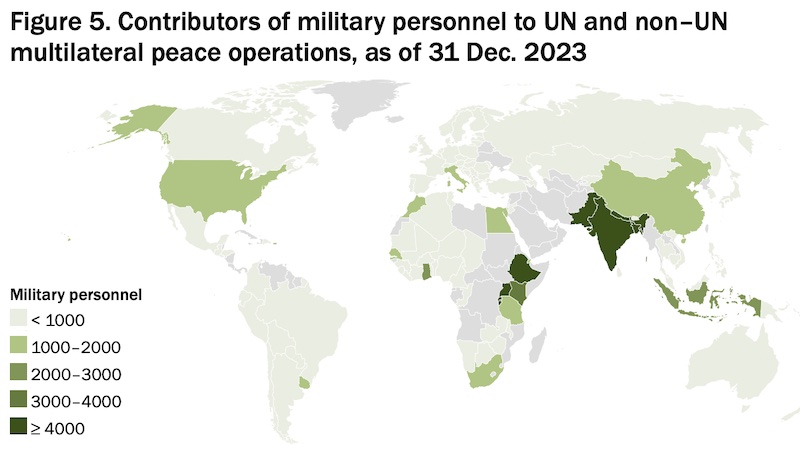
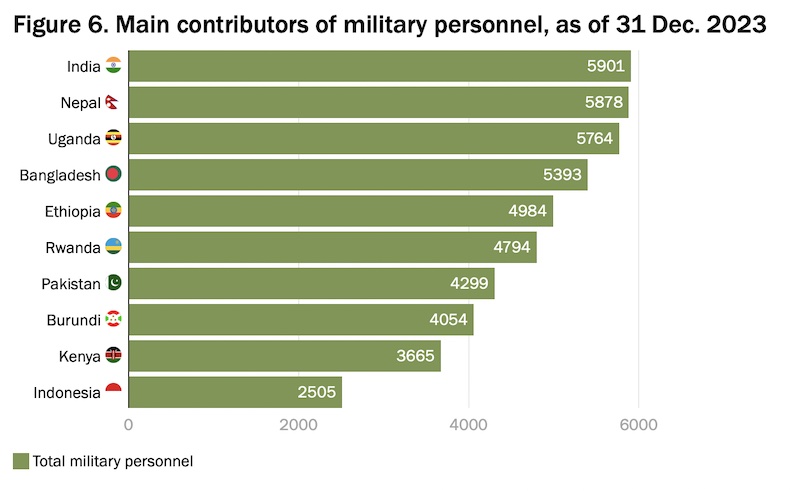
ISAF = International Security Assistance Force; UN = United Nations. Note: Personnel numbers are based on monthly data, with the last observation from Dec. 2023.  SourceSIPRI Multilateral Peace Operations Database, May 2024.

The EU Partnership Mission in the Republic of Moldova (EUPM Moldova) was established on 24 April 2023 at the request of the Moldovan government, as the country had been severely affected by Russia’s full-scale invasion of Ukraine in 2022. Among other things, Moldova had experienced security challenges such as an influx of refugees, an energy crisis and violations of its airspace by Russian missiles. EUPM Moldova aims to contribute to strengthening the country’s crisis management structures and to support enhancing the resilience of the country to hybrid threats.

The Southern African Development Community (SADC) Mission in the Democratic Republic of Congo (SAMIDRC) was established on 8 May 2023, and was officially deployed on 15 December 2023. The main task of the mission is to support the Congolese army in fighting armed groups in eastern DRC. The mission is expected to take over tasks previously handled by the East African Community (EAC) Regional Force in the DRC (EACRF-DRC).

The security situation and violence in eastern DRC have worsened since the resurgence of the March 23 Movement (Mouvement du 23 mars, M23) armed group in late 2021. Despite the deployment of SAMIDRC, M23 made advances in North Kivu province in late 2023, taking several villages in the surroundings of the provincial capital, Goma, in early 2024. The toll on civilians has been high, with areas surrounding Goma facing massive waves of displacement. Moreover, the killing of SAMIDRC troops has engendered concerns about the mission’s capacity to defeat M23, which increasingly uses military-grade weaponry. On 4 March 2024, SAMIDRC’s mandate was endorsed by the African Union Peace and Security Council.

In October 2023, the UN Security Council authorized the establishment of the Multinational Security Support (MSS) Mission in Haiti by an ad hoc coalition of states. The mission’s task is to is to support the Haitian National Police in addressing the security crisis in the country, but it has not yet been deployed.

Operations terminated in Mali, Sudan, the Central African Republic and the Democratic Republic of the Congo

Four multilateral peace operations terminated in 2023. On 30 June 2023, after a decade of operations in Mali, the UN Security Council terminated the mandate of the UN Multidimensional Integrated Stabilization Mission in Mali (MINUSMA) and ordered its full withdrawal, at the request of Mali’s transitional government. This request reportedly caught UN Security Council members by surprise, although relations between the host government and MINUSMA had been deteriorating, marked by incidents such as the expulsion of UN personnel and the temporary arrest of newly arrived peacekeepers. Tensions were further exacerbated in Mali by the activities of the Wagner Group, a Russian private military company (PMC), after December 2021, leading several troop-contributing countries to announce their withdrawal from MINUSMA. The mission’s high casualty rate also made contributors increasingly hesitant to deploy troops.

MINUSMA was established in 2013, following a French intervention that reversed the advance of armed groups towards the south of Mali. It had a mandate to support political processes in the country and carry out a number of security-related tasks.

Note: Personnel numbers are based on monthly data, with the last observation from Dec. 2023. SourceSIPRI Multilateral Peace Operations Database, May 2024.

UN Security Council members expressed concern that MINUSMA’s termination might lead to intensified conflict between armed groups and Malian forces, potentially jeopardizing the 2015 Algiers peace agreement. Indeed, after an eight-year ceasefire, hostilities resumed in northern Mali between some signatories of the peace agreement and government forces in August 2023. In January 2024, shortly after MINUSMA’s departure, the Malian junta ended the Algiers peace agreement.

In November 2023 the Sudanese government demanded the termination of the UN Integrated Transition Assistance Mission in Sudan (UNITAMS) with immediate effect, claiming the mission’s performance in implementing its objectives had been disappointing. The Security Council complied with this request, and UNITAMS ceased its mandate delivery on 4 December 2023.

The mission was established in 2020, with a mandate to support Sudan’s transition to democracy—a mandate that was called into question following the 2021 coup d’état in the country. With the deterioration of the security situation that took place when fighting erupted between the Sudanese Armed Forces (SAF) and the Rapid Support Forces (RSF) in April 2023, communication disruptions and security risks hampered the activities of UNITAMS. Additionally, in June 2023 the Sudanese Ministry of Foreign Affairs said in a statement that the head of UNITAMS, Volker Perthes, was considered persona non grata in the country. In September 2023 Perthes resigned and warned of the risk of a full-scale civil war in Sudan.

The EAC Regional Force in the DRC (EACRF-DRC) was terminated on 8 December 2023. In October 2023 the Congolese government announced that it would not seek the operation’s renewal, having criticized its effectiveness, particularly in combating the armed group M23 in eastern DRC. Local civil society organizations also perceived the operation as ineffective and several public demonstrations against the operation took place in Goma, similar to those held against the UN Organization Stabilization Mission in the DRC (MONUSCO).

Even though the EACRF-DRC’s leadership expected the termination to coincide with the deployment and handover of the mandate to SAMIDRC, when the latter started to deploy on 15 December the EACRF-DRC had already withdrawn from some areas. In the meeting where the operation’s exit plan was agreed by chiefs of EAC defence forces and staff, concerns were raised about ongoing fighting in areas where the EACRF-DRC was deployed. Following the termination of the operation, its leadership expressed regretthat armed groups had reoccupied areas that it had vacated.

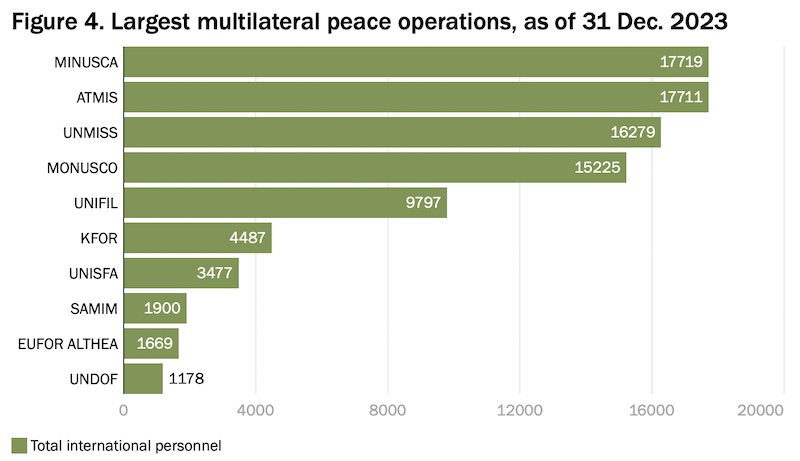
SourceSIPRI Multilateral Peace Operations Database, May 2024.

There has been little information regarding the closure of the AU Military Observer Mission to the CAR (MOUACA), but the mission appears to have ceased operating by 2023. The mission was established in July 2020 to support the monitoring of the implementation of the 2019 Political Agreement for Peace and Reconciliation in the CAR. In October 2022 the AU Peace and Security Council directed the AU Commission to initiate the gradual withdrawal and eventual closure of MOUACA, transferring its mandate responsibilities to the AU Mission for the CAR and Central Africa (MISAC). This decision was influenced by the precarious security conditions in CAR and the uncertain financial support for MOUACA. 

In addition to the closure of the missions above, two peace operations faced significant constraints on their operations in 2023 and were eventually terminated in early 2024. The Russian–Turkish Joint Monitoring Centre (RTJMC) in Azerbaijan was established in 2021 to monitor a ceasefire agreement between Armenian and Azerbaijani forces signed in the aftermath of the second Nagorno-Karabakh war (2020). The RTJMC closed on 26 April 2024. After a months-long blockade of the ethnic Armenian enclave of Nagorno-Karabakh, an Azerbaijani military offensive in September 2023 quickly overwhelmed local defences and forced the de facto authorities of the enclave to accept a ceasefire. Shortly afterwards, over 100 000 residents fled the region for Armenia and the de facto government signed a decree to dissolve all state institutions by 1 January 2024.

The EU Capacity Building Mission in Niger (EUCAP Sahel Niger) also faced difficulties following the coup d’état in Niger in July 2023 and the subsequent suspension of the EU’s development and military cooperation with the country. The mission was established in 2012 with a mandate to assist in the implementation of Niger’s security strategy, strengthen the rule of law and support the sustainability of the Nigerien security forces. On 4 December, the new junta formally withdrew its consent for EUCAP Sahel Niger by revoking its status-of-mission agreement, giving it six months’ notice to withdraw. By May 2024, the mission had withdrawn all international personnel from Niger and ceased its activities.

SourceSIPRI Multilateral Peace Operations Database, May 2024.

Geopolitical rivalries affect peace operations 

Political agreement on how to manage armed conflicts became increasingly difficult in 2023, due to escalating geopolitical tensions. While many multilateral peace operations were apparently able to continue business as usual, there was frequent disagreement in the UN Security Council and in the AU Peace and Security Council on the establishment of new operations and changes to existing mandates. At the same time, the attention of most Western governments was on supporting Ukraine against Russia and strengthening their own capacities for collective defence and deterrence. In particular, these governments made less military capacity and funding available for multilateral peace operations in Africa, as illustrated by the focus of the European Peace Facility on Ukraine. Simultaneously, Russia increased its engagement in parts of sub-Saharan Africa, offering governments the use of PMCs to combat armed groups.

Relations with host countries

Among donor countries and financial contributors to UN peacekeeping operations, discussions about value for money and effectiveness are nothing new. However, in 2023 the governments of countries such as the DRC, Mali, Niger and Sudan increasingly questioned whether the peace operations they hosted were fit for purpose, considering these governments’ expectations that the operations would directly combat terrorist and armed groups. Indeed, several peace and other multilateral operations such as the EACRF-DRC, the Joint Force of the Group of Five for the Sahel (JF-G5S), SAMIDRC and the SADC Mission in Mozambique (SAMIM) were deployed to fulfil those expectations.

In a geopolitical environment in which host governments have more conflict management options outside of the framework of peace operations to respond to their security concerns, they feel more confident to withdraw their consent for peace operations when they no longer serve their purpose. This was the case for the EACRF-DRC, MINUSMA and UNITAMS.

SourceSIPRI Multilateral Peace Operations Database, May 2024.

The regionalization of peace operations

A move away from the UN had already started before 2023, as there has been no new UN peacekeeping operation since the establishment of MINUSCA in 2014. Furthermore, over the past decade the number of multilateral peace operations deployed by regional organizations has increased while the number of active UN peace operations has decreased. 

In 2023, two policy developments clearly supported this trend towards the regionalization of peace operations. In ‘A New Agenda for Peace’, UN Secretary-General António Guterres describes his vision for the future for multilateral peace and security architecture. This entails a form of ‘networked, inclusive and effective multilateralism’ in which the UN has strong peace operation partnerships with regional organizations. Strengthening the role of regional organizations was also the purpose of UN Security Council Resolution 2719 on the financing of AU peace support operations authorized by the UN Security Council. Moreover, in the lead-up to the Summit of the Future and the annual UN Peacekeeping Ministerial, both taking place in September 2024, further discussions will be held in which such a partnerships approach is likely to be at the top of the agenda.

Prospects for peace operations

The implications of the trends outlined above for future peace operations and conflict management are uncertain. However, extrapolating from these trends suggests four potential ways they could play out in future peace operations and broader conflict management.

1. Inaction. The continued regionalization of peace operations, based on a partnership between the UN and regional organizations, assumes that there are at least two functioning partners. Despite the renewal of all UN and AU peace operation mandates so far, growing polarization may continue to challenge consensus and decision-making within both the UN Security Council and the AU Peace and Security Council. This ongoing discord could lead to increased inaction in peace operations and conflict management, and negatively impact the functionality of the partnership between the UN Security Council and regional bodies like the AU Peace and Security Council.

2. Fragmentation. Such inaction may result in increasingly fragmented approaches to peace operations. CAR, Kosovo and Mali have hosted complex constellations of multilateral peace operations within the same mission areas; and in Libya and Syria, different international coalitions have supported opposing sides through distinct conflict management approaches. If international polarization worsens, such fragmentation could raise the cost and compromise the effectiveness of operations and, in extreme cases, lead to confrontations between competing conflict-management interventions within the same territory.

3. Deinstitutionalization. If international and regional organizations become deadlocked and fail to agree on future mission mandates, we may see an increase in conflict management outside established institutional frameworks. Governments may turn to creative solutions, potentially fostering the growth of ad hoc coalitions or multilateral operations other than peace operations, such as the JF-G5S. These ‘creative solutions’ have already included the use of PMCs in countries like CAR, the DRC, Mali and Mozambique. Additionally, Bilateral operations like the Rwanda Defence Force and National Police joint effort in Mozambique might also become more common.

4. Militarization and securitization. As multilateral peace operations face increasing demands from host governments, conflict management is likely to become more militarized and securitized. This is evident from the closure of MINUSMA and the pressures on MONUSCO to either fight armed groups or close. Similarly, the establishment of forces such as the EACRF-DRC, SAMIDRC and SAMIM, along with the expanded use of PMCs to counter terrorist or rebel activities, highlights this shift. As a result, multilateral peace operations may be slowly pulled towards more militarized approaches and away from multidimensional peacekeeping. 

About the authors:

  • Dr Claudia Pfeifer Cruz is a Researcher in the SIPRI Peace Operations and Conflict Management Programme.
  • Dr Jaïr van der Lijn is a Senior Researcher and Director of the SIPRI Peace Operations and Conflict Management Programme.

Source: This article was published by SIPRI


Categories
South Caucasus News

Modern (Mis)interpretations Of Clean Slates – Analysis


Modern (Mis)interpretations Of Clean Slates – Analysis

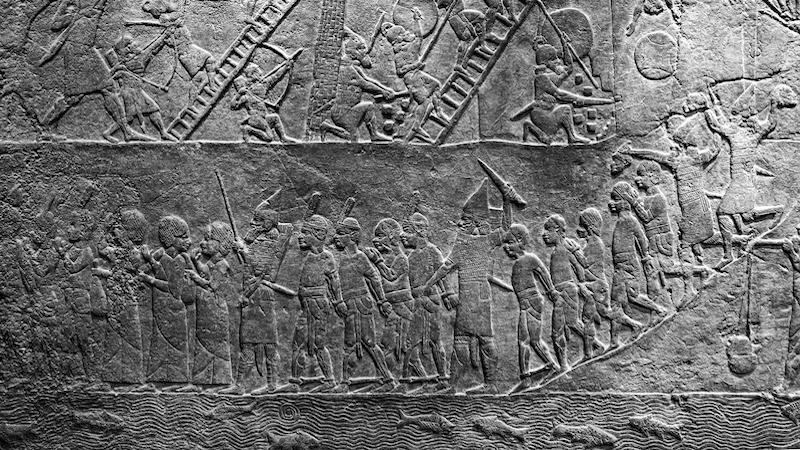
Mesopotamia sculpture

Today’s creditor-oriented ideology depicts the archaic past as much like our own world, as if civilization was developed by individuals thinking in terms of modern orthodoxy.

Why were Clean Slates so important to Bronze Age societies? From the third millennium in Mesopotamia, people were aware that debt pressures, if left to accumulate unchecked, would distort normal fiscal and landholding patterns to the detriment of the community. They perceived that debts grow autonomously under their own dynamic by the exponential curves of compound interest rather than adjusting themselves to reflect the ability of debtors to pay. This idea never has been accepted by modern economic doctrine, which assumes that disturbances are cured by automatically self-correcting market mechanisms. That assumption blocks discussion of what governments can do to prevent the debt overhead from destabilizing economies.

The Cosmological Dimension of Clean Slates

Mesopotamia’s concept of divine kingship was key to the practice of declaring Clean Slates. The prefatory passages of Babylonian edicts cited the ruler’s commitment to serve his city-god by promoting equity in the land. Myth and ritual were integrated with economic relations and were viewed as forming the natural order that rulers were charged with overseeing; in this context, canceling debts helped fulfill their sacred obligation to their city-gods.

Commemorated by their year-names and often by foundation deposits in temples, these amnesties appear to have been proclaimed at a major festival, replete with rituals such as Babylon’s ruler raising a sacred torch to signal the renewal of the social cosmos in good order—what the Romanian historian Mircea Eliade called “the eternal return,” the idea of circular time that formed the context in which rulers restored an idealized status quo ante. By integrating debt annulments with social cosmology, the image of rulers restoring economic order was central to the archaic idea of justice and equity.

(Mis)Interpreting the Meaning of ‘Freedom’

The Hebrew word used for the Jubilee Year in Leviticus 25 is dêror, but not until cuneiform texts could be read was it recognized as cognate to Akkadian andurarum. Before the early meaning was clarified, the King James Version translated the relevant phrase as: “Proclaim liberty throughout all the land, and to all the inhabitants thereof.” But the root meaning of andurarum is to move freely, as running water—or (for humans) as bondservants liberated to rejoin their families of origin.

The wide variety of modern interpretations of such key terms as Sumerianamargi, Akkadian andurarum and misharum, and Hurrian shudutu serve as an ideological Rorschach test reflecting the translator’s own beliefs. The earliest reading was by Francois Thureau-Dangin1, who related the Sumerian term amargi to Akkadian andurarum and saw it as a debt cancellation. Ten years later Schorr (1915) related these acts to Solon’s seisachtheia, the “shedding of burdens” that annulled the debts of rural Athens in 594 BC. The Canadian scholar George Barton2 translated Urukagina’s and Gudea’s use of the term amargi as “release,” although the Jesuit Anton Deimel3 rendered it rather obscurely as “security.”

Maurice Lambert4 initially interpreted Urukagina’s amargi act as an exemption from taxes, on the ground that most of the debts being annulled were owed to the palace. His subsequent 1972 discovery of Enmetena’s kindred proclamation dating some fifty years earlier led him to see amargi as signifying a debt cancellation. F. R. Kraus5 had followed this view in 1954, and greatly elaborated his survey of Babylonian proclamations in his 1984 survey of rulers “raising the torch” to signal debt cancelations.6

In America, Samuel Kramer (History Begins at Sumer [New York, 1959]) interpreted these acts as tax reductions. In a letter to The New York Timesthe day President Reagan took office in 1981, he even urged the president-elect to emulate Urukagina and cut taxes! The term amargi became popular with U.S. libertarians seeking an archaic precedent for their tax protests.

Kramer7 further belittled Urukagina’s reforms as soon “gone with the wind,” being “too little, too late,” as if they were failures for not solving the debt problem permanently. In a similar vein Stephen Lieberman8, deemed Babylonian debt cancelations ineffective on the ground that they kept having to be repeated: “The need to repeat the enactment of identical provisions shows that the misharum provided relief, but did not eliminate the difficulties which made it necessary….What seems to have been needed was reform which would have eliminated all need for such adjustments.” He did not suggest just what could have created an economy free of credit cycles.

A Practical Solution

Mesopotamian rulers were not seeking a debt-free utopia but coped pragmatically with the most adverse consequences of rural debt when it became top-heavy. Usury was not banned, as it would be in Judaism’s Exodus Code, but its effects were reversed when the debt overhead exceeded the ability to pay on a widespread basis. These royal edicts retained the economy’s underlying structure The palace did not deter new debts from being run up, and kept leasing out land to sharecroppers, who owed the usual proportion of crops and were obliged to pay the usual interest penalties for non-delivery.

Igor Diakonoff9 emphasized that “the word andurarum does not mean ‘political liberation.’ It is a translation of Sumerian amargi ‘returning to mother,’ that is, ‘to the original situation.’ It does not mean liberation from some supreme authority but the canceling of debts, duties, and the like.

The Assyrian term “washing the tablets” (hubullam masa’um10; may refer to dissolving them in water, akin to breaking or pulverizing them. Likening it to the Babylonian term meaning “to kill the tablet,” Kemal Balkan11 explained that the idea was to cancel grain debts by physically destroying their records. Along more abstract lines, Raymond Westbrook12 likens the idea of “washing” to a ritual cleansing of the population from inequities that would displease Sumerian and Babylonian patron deities. Urukagina’s edict thus was held to have cleansed Lagash from the moral blemish of inequity.

Some Anachronistic Creditor-Oriented Views of Clean Slates

Instead of enforcing debt contracts at the cost of social and military instability, Sumer and Babylonia preserved economic viability via Clean Slates. Today’s creditor-oriented ideology denies the success of Clean Slates overriding free-market relations. It depicts the archaic past as much like our own world, as if civilization was developed by individuals thinking in terms of modern orthodoxy, letting interest rates be determined simply by market supply and demand, duly adjusted for risk of non-payment.

Modern economic theory assumes that debts normally can be paid, with the interest rate reflecting the borrower’s profit. The implication is that the fall in interest rates from Mesopotamia to Greece and Rome resulted from falling profit rates and/or the greater security of investment. In this view, debt cancellations would only have aggravated debt problems, by increasing the creditor’s risk and hence the interest rate.

Modernist assumptions distract attention from what actually happened. No writer in antiquity is known to have related interest rates to profit rates or risk, or to the use of seeds or breeding cattle to produce offspring. We may well ask whether it was fortunate for the survival of Babylonian society that its rulers were not “advanced economic theoreticians” of the modern sort. If they had not proclaimed Clean Slates, creditors would have reduced debtors to bondage and taken their lands irreversibly. But in canceling crop debts, rulers acknowledged that the palace had taken all that it could without destroying the economy’s foundations. If they had demanded that debt arrears be made up by cultivators forfeiting their family members and land rights to royal collectors (who sought to keep debt charges on the crop yield for themselves), the palace would have lost the services of these debtors for corvée labor and in the armed forces to resist foreign attack.

Markets indeed became less stable as economies polarized in classical antiquity. Yet it was only at the end of antiquity that Diodorus of Sicily (I.79) explained the most practical rationale for Clean Slates. Describing how Egypt’s pharaoh Bakenranef (720-715) abolished debt bondage and canceled undocumented debts, Diodorus wrote that the pharaoh’s guiding logic was that:

“the bodies of citizens should belong to the state, to the end that it might avail itself of the services which its citizens owed it, in times of both war and peace. For he felt that it would be absurd for a soldier, perhaps at the moment when he was setting forth to fight for his fatherland, to be haled to prison by his creditor for an unpaid loan, and that the greed of private citizens should in this way endanger the safety of all.”

That would seem to be how early Mesopotamian rulers must have reasoned. Letting soldiers pledge their land to creditors and then lose this basic means of self-support through foreclosure would have expropriated the community’s fighting force—or led to their flight or defection. By the 4th century BC, the Greek military writer known as Tacticus recommended that a general attacking a town might promise to cancel the debts owed by its inhabitants if they defected to his side. Likewise, defenders of towns could strengthen the resistance of their citizens by agreeing to annul their debts.

This emergency military tactic no longer reflected a royal duty to restore economic self-reliance as a guiding principle of overall order. What disappeared was the relief of debtors from their obligations and reversal of their land sales or forfeitures when natural disasters blocked their ability to pay or after a new ruler took the throne. The oligarchic epoch had arrived, abolishing any public power able to cancel the society-wide debt overgrowth.

1. Les inscriptions de Sumer et d’Akkad, 1905, pp. 86-87
2. The Royal Inscriptions of Sumer and Akkad, 1929.
3. Sumerische Tempelwirtschaft der Zeit Urukaginas und seiner Vorgänger, 1930, p. 9.
4. “Les ‘Reformes’ d’Urukagina,” La Revue Archéologique 60, 1956, pp. 169-184..
5. Ein Edikt des Königs Ammisaduqa von Babylon (SD 5, [Leiden]).
6. Fritz Rudolph Kraus, Königliche Verfügungen in altbabylonischer Zeit, 1984.
7. Samuel Noah Kramer History Begins at Sumer 1959, p. 49.
8. Stephen J. Lieberman “Royal ‘Reforms’ of the Amurrite Dynasty,” Bibliotecha Orientalis 46, 1989, pp. 241-259.
9. “The City-States of Sumer” and “Early Despotisms in Mesopotamia,” in Early Antiquity 1991, pp. 67-97, p. 234. 
10. A. Kirk Grayson Assyrian Royal Inscriptions: From the beginning to Ashur-resha-ishi I, Volume 1 of the Records of the Near East  Harrassowitz, 1972, p. 7.
11. “Cancellation of Debts in Cappadocian Tablets from Kultepe,” Anatolian Studies Presented to Hans C. Guterbock, 1974, pp. 29-36, p. 33.
12. Raymond Westbrook, “Social Justice in the Ancient Near East,” in Morris Silver and K. D. Irani, eds., Social Justice in the Ancient World, 1995, pp. 149-163.

  • About the author: Michael Hudson is an American economist, a professor of economics at the University of Missouri–Kansas City, and a researcher at the Levy Economics Institute at Bard College. He is a former Wall Street analyst, political consultant, commentator, and journalist. You can read more of Hudson’s economic history on the Observatory.
  • Source: This article was produced by Human Bridges.

Categories
South Caucasus News

Georgian Dream Party Has Blown Up Tbilisi’s Track To Europe – Analysis


Georgian Dream Party Has Blown Up Tbilisi’s Track To Europe – Analysis

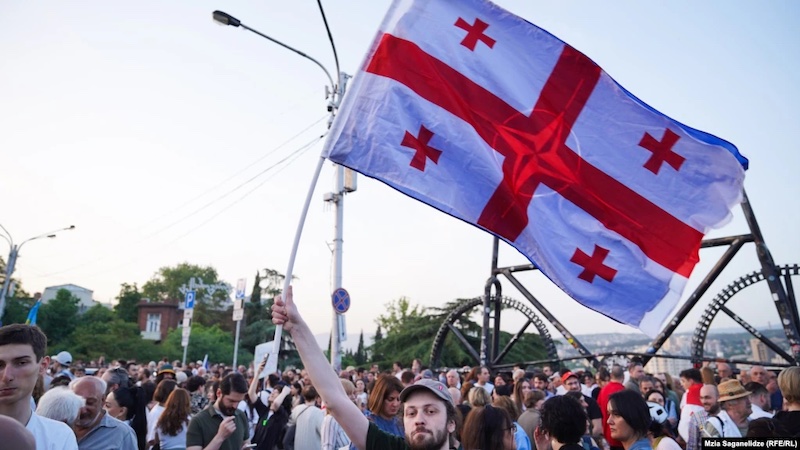
Protest in Georgia. Photo Credit: RFE/RL

By Rajoli Siddharth Jayaprakash

On 15 May, the members of the Georgian Parliament passed the draft law on transparency of foreign influence or the Foreign Agents Law, intensifying the protests underway since mid-April when the draft was first introduced. This law makes it mandatory for NGOs and media organisations receiving more than 20 percent foreign funding to register as foreign agents.

This bill was re-introduced in the Parliament after it was quashed post extensive protests last year. The Opposition believe that the law and its motives are akin to the Russian “Foreign Agents Law’’ passed in 2012. In 2023, Georgia’s bid to join the European Union (EU) was conditionally accepted. The passing of the legislation may complicate matters for the South Caucasian Republic.

What is the Foreign Agents Law?

Apart from registering as an entity receiving foreign funds, the law states that if NGOs and media organisations fail to register as foreign agents, fines will be imposed on them. Further, the legislation also clarifies that it does not limit the activities of the subject registered as an organisation carrying out the interests of a foreign power. The Georgian Dream Party, the ruling party in Georgia, believes the legislation will promote transparency and national sovereignty. The politicians voted 84 to 30, with the President of Georgia, Salome Zourabichvili, vetoing the bill, but the veto could be overridden by another vote.

Georgia is not the first country to introduce such legislation. The first Foreign Agents Law was passed in the United States (US) in 1938. Countries such as Australia, France, Hungary and several other countries have laws regulating NGO funding. According to Archil Sikharulidze, the founder of the Sikha Foundation in Georgia, the Foreign Agents Law should not be misperceived as only curbing the influence of the West, as there is an increasing influence of NGOs funded by Türkiye, China, Iran, and the Arab states in Georgia with agendas beyond the cultural realm.

Understanding the role of the NGOs in Georgia

NGOs have had a place in Georgian politics since the 1990s. The late President Edvard Shevardnadze allowed for the presence of NGOs, which played a prominent role in Georgia’s political economy. Influencing policy and maintaining a vocal presence in the country with the support of international donors . After the Rose Revolution in 2003, when the liberal leader Mikhail Saakashvili overthrew President Shevardnadze, the influence of NGOs in Georgia began to increase as the period was characterised by the appointment of pro-Western professionals from NGOs in the bureaucracy. The country was now open to foreign aid and foreign reform experiments, which resulted in the decline of the influence of Georgian people in policymaking.

Over the years, employment in the NGO sector has been lucrative in Georgian society. There are over 25,000NGOs in Georgia, with 90 percent of those having funding from foreign sources. The Georgian financial contributions to these NGOs are minimal. Thus, we can observe the agendas of foreign nations or international organisations reflected in public policy.

For the Georgian Dream Party, however, this was not the primary reason why the legislation was brought. Some of these NGOs are hyper-partisan groups which back the United Movement party and do not recognise the legitimacy of the Dream party. Before introducing the legislation, the government informed the foreign embassies to cease funding hyper-partisan groups. However, no action was taken.

The fragmented political landscape of Georgia

President Zourabichvili, who gave up her French citizenship in 2018, was initially supported by the Georgian Dream Party. However, her pro-Western stance and her increasingly vocal accusations of pro-Russian influence within the Georgian Dream Party have led to impeachment proceedings in 2022. These were triggered by her unauthorised official visits to Brussels and Paris, which violated the Constitution as she did not seek the Georgian government’s consent for them. Zourabichvili advocates for a European path for Georgia, distancing from Russia, in contrast to the Georgian Dream Party’s stance.

Among the most prominent Dream Party members are Bidzina Ivanishvili, the founder of the Georgian Dream, a former billionaire and oligarch who amassed considerable wealth under Russian President Boris Yeltsin. He is known to have pro-Russian views, wields considerable influence in the Georgian political system, and is the honorary chairman of the Georgian Dream Party. Recently, Ivanishvili denounced the West by calling it a global party of war, trying to drag Georgia into conflict with Russia; according to him, foreign influence in the country has to be checked to avoid colour revolutions sponsored by foreign nations. However, according to Tina Khidasheli, the former defence minister, Ivanishvili is introducing this law to strengthen his grip on power before parliamentary elections this October.

There is no strong political opposition against the Dream Party. The political elite in Georgia is concerned about antagonising Russia. In 2008, Russian-backed separatists took control of South Ossetia and Abkhazia, and political relations with Russia were strained and  improved only with the arrival of Ivanishvili as Prime Minister in 2012, where trade relations were restored, the visa-free regime was established for Russians, and flights resumed between Moscow and Tbilisi.

After normalising ties with Russia, the Dream Party followed a more Western-oriented foreign policy while maintaining relations with Russia. However, over the last few years, it has deepened its relations with Russia by partaking in the parallel import of sanctioned goods through Georgia. Furthermore, since the invasion of Ukraine, Georgia has emerged as a major destination for Russians. Russia has some influence in Georgia, but it would be too far to state that the Georgian Dream Party or Ivanishvili is a Kremlin affiliate. More than 89 percent of the Georgians want to join the EU. Georgia is among the poorest countries in Europe and lacks connectivity with the EU. However, angering Russia by increasing its interaction with the West can have negative consequences, and thus, it is counter-productive for Georgia to pick a side.

International response to the bill

The US Assistant Secretary of State criticised the bill and threatened the parliamentarians with financial sanctions if the law was not in compliance with Western standards or if violence was used on protesters The US State Department issued visa restrictions on individuals responsible for suppressing civil society and freedom of peaceful assembly in Georgia through a campaign of violence or intimidation. The US Assistant Secretary of State further added that the US$ 390 million which was allocated by the US to Georgia would come under review.

EU’s top aide Joseph Borell stated that “adoption of this law negatively impacts Georgia’s progress on the EU path” and urged the Georgian authorities to withdraw the law. The Kremlin stated that the law is being misused by the West to stoke anti-Russia sentiments and should not be called a “Russian” law. Furthermore, the contexts under which the Foreign Agents Law emerged in Georgia differs from the Russian Foreign Agents Law. The NGOs in Georgia have considerable influence in the public policy realm. However, the same cannot be said about Russia, as the Russian Foreign Agents Law of 2012 not only keeps a check but also bans media and civil society organisations on non-compliance with the law.

Conclusion

There is some similarity between Georgia adopting the perceived pro-Russian legislation and the then-President of Ukraine, Victor Yanukovich, refusing to sign the EU accession agreement and instead signing economic agreements with Russia in 2013, thereby preventing a move towards EU membership and triggering an intense wave of protests (leading to the ouster of Yanukovich and the installation of a pro-Western government, culminating in the beginning of Russia’s aggression in Ukraine). That said, one must avoid equating the two. The Foreign Agents Law will be used to curb the influence of foreign NGOs, which can influence foreign and domestic policy. Unlike Ukraine circa 2013-14, the Dream Party wants to balance its foreign policy options and avoid being seen as a state aligning with either the West or Russia. This legislation can give more agency to the aspirations of local civil society activists, but considering Georgia’s democratic backslide over the years, the scope of misuse, which includes branding any opposition to the Georgian Dream Party as a foreign agent, is high. What is clear is that Georgia’s accession to the EU will not be easy.


  • About the author: Rajoli Siddharth Jayaprakash is a Research Assistant with the Strategic Studies Programme at the Observer Research Foundation.
  • Source: This article was published by Observer Research Foundation

Categories
South Caucasus News

Georgian Election Commission Chair, IRI representatives discuss October elections


Categories
Audio Review - South Caucasus News

Parliament Adopts Amendments to Election Code


On May 30, the Parliament of Georgia adopted amendments to the Election code with 80 votes in favor, which among other issues, change the Central Election Commission rules of operation and abolish the CEC advisory group, which consists of a representative of the Public Defender as well as the national and international experts selected by observer organizations.

Prior to the amendments, the Central Election Commission of Georgia was required to approve the composition of the CEC Advisory Group, which was tasked with making recommendations to the CEC regarding the dispute review process, within 10 days of the call for elections.

The CEC advisory group would be set up for the electoral period, with not less that 9 and not more than 15 members. In the explanatory note to the amendments, the ruling Georgian Dream party said that the group wasn’t in fact functional, which “was mainly caused by the unwillingness of the monitoring organizations to participate in the activities of this group.”

As for the amendments to the Election Commission’s rules of procedure, the amendments provide that if a decision of the Central Election Commission (CEC) requiring the support of at least two-thirds of its full membership cannot be passed during a CEC meeting, it will be subject to a revote at the same meeting and will be considered passed if it receives a majority of the CEC’s full membership. The ruling party justifies the change as a necessary anti-deadlock mechanism.

Also Read:


Categories
South Caucasus News

Parliament Adopts Amendments to Election Code


On May 30, the Parliament of Georgia adopted amendments to the Election code with 80 votes in favor, which among other issues, change the Central Election Commission rules of operation and abolish the CEC advisory group, which consists of a representative of the Public Defender as well as the national and international experts selected by observer organizations.

Prior to the amendments, the Central Election Commission of Georgia was required to approve the composition of the CEC Advisory Group, which was tasked with making recommendations to the CEC regarding the dispute review process, within 10 days of the call for elections.

The CEC advisory group would be set up for the electoral period, with not less that 9 and not more than 15 members. In the explanatory note to the amendments, the ruling Georgian Dream party said that the group wasn’t in fact functional, which “was mainly caused by the unwillingness of the monitoring organizations to participate in the activities of this group.”

As for the amendments to the Election Commission’s rules of procedure, the amendments provide that if a decision of the Central Election Commission (CEC) requiring the support of at least two-thirds of its full membership cannot be passed during a CEC meeting, it will be subject to a revote at the same meeting and will be considered passed if it receives a majority of the CEC’s full membership. The ruling party justifies the change as a necessary anti-deadlock mechanism.

Also Read:


Categories
South Caucasus News

Stockholm accuses Iran of using criminals in Sweden to target Israel or Jewish interests – The Associated Press


Stockholm accuses Iran of using criminals in Sweden to target Israel or Jewish interests  The Associated Press

Categories
South Caucasus News

US boycotts UN tribute to late Iran President – Middle East Monitor


US boycotts UN tribute to late Iran President  Middle East Monitor

Categories
South Caucasus News

Iran-Backed Gangs Blamed for Israeli Embassy Attacks in Sweden – Bloomberg


Iran-Backed Gangs Blamed for Israeli Embassy Attacks in Sweden  Bloomberg