
Menendez bribery trial: Jurors see texts sent between senator and wife regarding Egyptian military aid thepress.net
Day: May 29, 2024
Menendez bribery trial: Jurors see texts sent between senator and wife regarding Egyptian military aid Northeast Mississippi Daily Journal
Menendez bribery trial: Jurors see texts sent between senator and wife regarding Egyptian military aid Vermont Community Newspaper Group
Armenia’s Foreign Intelligence Service head, Kristinne Grigoryan, told reporters on Wednesday that there were threats to Armenia’s sovereignty and independence from various countries, but did not specify which external forces posed those threats.
Speaking to reporters outside of parliament, Grigoryan also did not comment on accusations made by Prime Minister Nikol Pashinyan, who last week claimed that two members states of the Collective Security Treaty Organizations were actively supporting Azerbaijan during the 2020 War.
Pashinyan made the claim in parliament last week, without naming the countries. However, through his statements, it could be surmised that he was referring to Belarus and Russia.
The Russian Foreign Ministry called on Pashinyan to name the two countries, and amid escalating tensions between Yerevan and Moscow, it recalled its ambassador from Armenia “for consultations.”
“Reforms are being carried out in the security sector of Armenia to neutralize those threats,” Grigoryan, the national security chief, said on Wednesday.
“Our prioritized efforts have determined where the external threats emanate and the type of intelligence needed for the development of the state. These efforts are mainly aimed at neutralizing the external threats to Armenia, which come from various countries and angles. Our intelligence is aimed at ensuring that policy and political decisions are made on solid information,” Grigoryan explained.
“In all modern countries, external security challenges have both internal players and external players, and the Republic of Armenia is no exception,” the intelligence chief said when asked whether there are groups within Armenia that are aiding these threats.
Grigoryan was vague in most of her responses to questions from reporters, who, point blank, asked her whether her department saw direct threats from Russia.
“Threats to the independence, sovereignty, territorial integrity of the Republic of Armenia come from various countries,” she said in response to that question, adding that her agency is “doing everything we can, and sometimes we are trying to do impossible things.”
After warning that these threats were, in fact, existential to Armenia’s sovereignty and independence, she touched on the possibility of military attacks against Armenia.
“There are always threats of a military attack. As long as relations with Azerbaijan are not normalized as they should be, these threats should be taken seriously. But, also, they should not be overestimated and certain conclusions should not be drawn,” said Grigoryan.
Categories
NPR News: 05-29-2024 6PM EDT
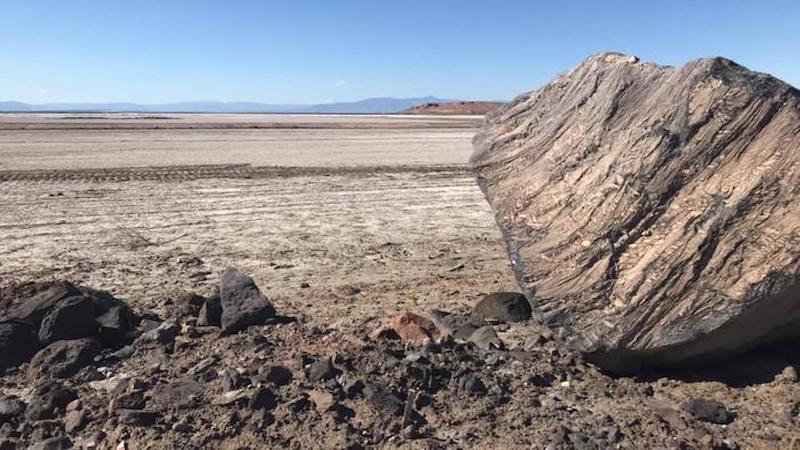
When desert winds stir up dust from the Salton Sea’s exposed lakebed, nearby communities suffer from increased air pollution. The deterioration coincides with reduced flows into California’s largest lake, a new research paper in the American Journal of Agricultural Economics finds.
Disadvantaged communities have been affected more than others in the areas near the Salton Sea, which has been shrinking for years, said the paper’s co-leading author Eric Edwards. He is an assistant professor of agricultural economics at University of California, Davis, who did the research while at North Carolina State University.
“We have a dusty area, and any time there is wind, it’s going to pick up dust and move it around,” Edwards said. “We think this new dust is increasing the amount of pollution faced by disadvantaged communities in the region surrounding the lake.”
An overflowing river
The Salton Sea formed in 1905 after the Colorado River overflowed its banks and the floodwaters settled into what was known as the Salton Sink. It was primarily fed by water runoff from agricultural operations for almost a century. As the southern part of California struggled to meet growing water demand, the Imperial Irrigation District agreed to send water to San Diego for urban use.
Imperial, which supplies water to vast desert farms as well as seven towns and two special districts, is the largest user of Colorado River water. The agreement with San Diego required agricultural water users to increase efficiency and reduce their water consumption, which reduced water running into the Salton Sea, Edwards said.
The reductions increased the lake’s salt content, which is higher than in the Pacific Ocean. This also harmed wildlife habitats and created localized air pollution. The area is the subject of many environmental restoration projects.
Studying implications
Edwards and others used a particle transport model to study the effects of changing water diversions on particulate pollution.
They found that the paths of fine particulate matter — which can cause asthma, heart and respiratory issues when inhaled — were associated with higher air pollution readings after Imperial began reducing runoff water to the Salton Sea around 2011 in order to transfer it to San Diego, a practice that continues today.
Researchers modeled lakebed exposure by dividing the lake’s shoreline into 1-square-kilometer grids and collected air pollution data daily for over 20 years, from 1998 to 2018. They added data about the exposed lakebed, or playa, and used a sophisticated physics model called HYSPLIT to factor in wind levels and particle size to track the movement of dust over time. State health screening information available by ZIP code added more to the story by pinpointing disadvantaged areas, asthma rates and other vulnerabilities.
Lake levels were higher in 1998 before the transfers, so the change was not evident until later years, when the lakebed became more exposed.
“We show that during that post-2011, there is an increase in particles going through disadvantaged communities relative to non-disadvantaged communities, which are farther away from the sea,” Edwards said.
In the paper, the pollution paths are depicted on a map of the state. The Salton Sea is marked with a black dot, and red lines radiate from there to distances of 100 miles or more.
“From every exposed grid cell you have these paths predicting where the particles are going based on physics,” Edwards said. “That’s the path of emissions.”
Prior research suggests that dust particles from newly exposed playa are more susceptible to wind erosion.
“There’s lots of evidence that playa is particularly emissive in terms of dust,” Edwards said. “If it’s dry, those particles get picked up readily by the wind and create dust — and at rates higher than areas that have been exposed to the wind over long periods of time.”
Informing decision makers
Edwards said policymakers and regulators should consider the health and environmental impacts of water diversions in their decision making.
“The drying up of the Salton Sea has serious health consequences that have generally fallen on more disadvantaged populations, who may not be well equipped to advocate for policies that improve their health,” he said. “Policymakers need to think about how to facilitate the movement of water via market transactions, which are essential, while also accounting for potential negative effects on the environment.”
The number of refugees has sharply increased in recent decades, reaching 37.8 million in 2022. Amidst this surge, host communities—locals residing in areas where refugee camps are situated—are also positively and negatively impacted by the refugee influxes. The negative impacts include competition over scarce resources and in the unskilled labor market. While the international media and aid organizations put the spotlight on assisting refugees, the challenges faced by host communities are frequently sidelined.
In 2017, over 700,000 Rohingyas—a Muslim minority group from Rakhine State in Myanmar—fled to their neighboring country, Bangladesh, amidst a large-scale Rohingya clearance operation by the Burmese government. The hosts—the Bangladeshi Muslim population—were initially sympathetic toward the refugees because of their shared religion and language. Yet, their sympathy faded over time due to the extended stay of refugees and other negative consequences, including high fertility rates. Overlooking such adverse impacts on host communities can stir social unrest among them.
Against this backdrop, a research team led by Associate Professor Yuki Higuchi from the Faculty of Economics at Sophia University, Japan, examined how the 2017 Rohingya refugee influx impacted the public sentiments of host communities in Bangladesh. Their paper, published in Economic Development and Cultural Change on March 16, 2024, was co-authored by Mohammad Mosharraf Hossain from the Institute of Forestry and Environmental Sciences at the University of Chittagong and Mohammad Sujauddin from the Department of Environmental Science and Management at North South University.
Dr. Higuchi asserts, “The 2017 Rohingya refugee crisis persists even after five years. International attention and support are fading, worsening the situation. We emphasize that this crisis is still ongoing, and Rohingya refugees, along with the host communities who are also poor, are in a difficult situation. The world must act now.”
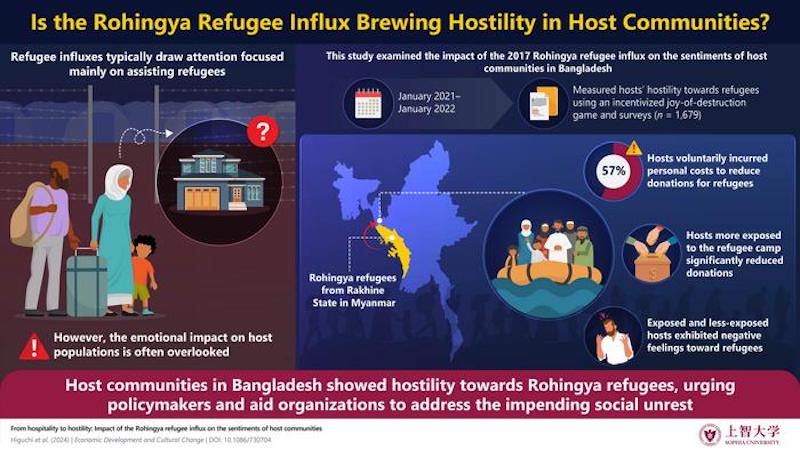
To this end, researchers surveyed 1,679 households in refugee-hosting districts of Bangladesh from January 2021 to January 2022. Respondents received 400 Bangladeshi Taka, or BDT (equivalent to 4.7 US Dollars or USD), as an honorarium for their participation in the survey. They were also informed that researchers pledged to donate 400 BDT per respondent to a non-governmental organization (NGO) supporting the refugees. Respondents then played a joy-of-destruction (JOD) game where they were given a choice to contribute part of their honorarium to reduce the pledged donation. Each BDT paid led to a fivefold deduction from the donation. The amount paid was then used to measure hostility towards the refugees. Additionally, researchers used satellite imagery to assess environmental changes.
“Surprisingly, 57% of the hosts paid a non-zero amount to reduce donations for refugees, indicating their intention of harming the refugees even at a personal cost. Here, 15% of the hosts even paid 80 BDT (0.9 USD), which is closer to their average daily per capita income, to nullify the donation entirely,” says Dr. Higuchi.
Specifically, hosts closer to the camp—exposed hosts—paid significantly more to reduce donations than those far away from the camp—less exposed hosts. The amount paid increased by 1.4% for every kilometer closer to the camp. This is likely because exposed hosts face more hardships due to lower incomes, higher prices of commodities, forest degradation, and perceived higher crime rates.
Both exposed and less exposed hosts expressed negative feelings toward Rohingya refugees. Though exposed hosts did not express more negative feelings than less exposed hosts, their deep-seated hostility towards refugees was evident in the JOD game. This contrast between what the hosts expressed during the surveys and what they did during the JOD game suggests that the incentivized game elicited genuine hostility toward refugees.
Overall, the refugee influx has dramatically impacted both the host communities and the environment in Bangladesh. Dr. Higuchi further elaborates, “Host communities in a developing country are also as poor as the refugees. So, even though the hosts receive some support from aid agencies, they still show an alarming level of hostility toward the refugees. Policymakers and aid organizations must address the current situation and prevent impending tensions. Sufficient compensation for hosts and initiatives to reconcile with refugees are necessary to foster social cohesion.”
In conclusion, as the number of refugees increases, so does the strain on host communities and the risk of social unrest, necessitating urgent international support.