Categories
South Caucasus News

Get Up, Stand Up, Don’t Give Up The Fight: Know Your Rights Or You Will Lose Them – OpEd


Get Up, Stand Up, Don’t Give Up The Fight: Know Your Rights Or You Will Lose Them – OpEd

patriot flag United States use

If America’s schools are to impart principles of freedom and democracy to future generations, they must start by respecting the constitutional rights of their students

Take the case of Lucas Hudson.

With all the negative press being written about today’s young people, it’s refreshing to meet a young person who not only knows his rights but is prepared to stand up for them. 

Lucas is a smart kid, a valedictorian of his graduating class at the Collegiate Academy at Armwood High School in Hillsborough County, Fla.

So, when school officials gave Lucas an ultimatum: either remove most of his speech’s religious references from his graduation speech—in which he thanked the people who helped shape his character, reflected on how quickly time goes by, and urged people to use whatever time they have to love others and serve the God who loves us—or he would not be speaking at all, Lucas refused to forfeit his rights.

That’s when Lucas’s father turned to The Rutherford Institute for help.

In coming to Lucas’ defense, attorneys for The Rutherford Institute warned school officials that their attempts to browbeat Lucas into watering down his graduation speech could expose the school to a First Amendment lawsuit.

Thankfully for Lucas, the school backed down, and he was able to deliver his speech as written.

It doesn’t always work out so well, unfortunately.

Over the course of The Rutherford Institute’s 42-year history, we have defended countless young people who found themselves censored, silenced and denied their basic First Amendment rights, especially when they chose to exercise their rights to free speech and religious freedom.

In case after case, we encounter an appalling level of ignorance on the part of public school officials who mistakenly believe that the law requires anything religious be banned from public schools.

Here’s where government officials get it wrong: while the government may not establish or compel a particular religion, it also may not silence and suppress religious speech merely because others might take offense.

People are free to ignore, disagree with, or counter the religious speech of others, but the government cannot censor private religious speech.

Unfortunately, you can only defend your rights when you know them, and the American people—and those who represent them—are utterly ignorant about their freedoms, history, and how the government is supposed to operate.

As Morris Berman points out in his book Dark Ages America, “70 percent of American adults cannot name their senators or congressmen; more than half don’t know the actual number of senators, and nearly a quarter cannot name a single right guaranteed by the First Amendment. Sixty-three percent cannot name the three branches of government. Other studies reveal that uninformed or undecided voters often vote for the candidate whose name and packaging (e.g., logo) are the most powerful; color is apparently a major factor in their decision.”

More than government corruption and ineptitude, police brutality, terrorism, gun violence, drugs, illegal immigration or any other so-called “danger” that threatens our nation, civic illiteracy may be what finally pushes us over the edge.

As Thomas Jefferson warned, no nation can be both ignorant and free.

Unfortunately, the American people have existed in a technology-laden, entertainment-fueled, perpetual state of cluelessness for so long that civic illiteracy has become the new normal for the citizenry.

In fact, most immigrants who aspire to become citizens know more about national civics than native-born Americans. Surveys indicate that half of native-born Americans couldn’t correctly answer 70% of the civics questions on the U.S. Citizenship test.

Not even the government bureaucrats who are supposed to represent us know much about civics, American history and geography, or the Constitution although they take an oath to uphold, support and defend the Constitution against “enemies foreign and domestic.”

For instance, a couple attempting to get a marriage license was recently forced to prove to a government official that New Mexico is, in fact, one of the 50 states and not a foreign country.

You can’t make this stuff up.

Those who gave us the Constitution and the Bill of Rights believed that the government exists at the behest of its citizens. The government’s purpose is to protect, defend and even enhance our freedoms, not violate them.

It was no idle happenstance that the Constitution opens with these three powerful words: “We the people.”

Those who founded this country knew quite well that every citizen must remain vigilant or freedom would be lost. As Thomas Paine recognized, “It is the responsibility of the patriot to protect his country from its government.”

You have no rights unless you exercise them.

Still, you can’t exercise your rights unless you know what those rights are.

“If Americans do not understand the Constitution and the institutions and processes through which we are governed, we cannot rationally evaluate important legislation and the efforts of our elected officials, nor can we preserve the national unity necessary to meaningfully confront the multiple problems we face today,” warns the Brennan Center in its Civic Literacy Report Card. “Rather, every act of government will be measured only by its individual value or cost, without concern for its larger impact. More and more we will ‘want what we want, and [will be] convinced that the system that is stopping us is wrong, flawed, broken or outmoded.’”

Education precedes action.

As the Brennan Center concludes “America, unlike most of the world’s nations, is not a country defined by blood or belief. America is an idea, or a set of ideas, about freedom and opportunity. It is these ideas that bind us together as Americans and have kept us free, strong, and prosperous. But these ideas do not perpetuate themselves. They must be taught and learned anew with each generation.”

There is a movement underway to require that all public-school students pass the civics portion of the U.S. naturalization test100 basic facts about U.S. history and civics—before receiving their high-school diploma, and that’s a start.

Lucas Hudson would have passed such a test with flying colors.

On graduation day, Lucas stepped up to the podium and delivered his uncensored valedictorian speech as written, without any interference by school censors.

As Lucas’s father relayed to The Rutherford Institute:

“In the end, Lucas got to give his entire speech the way he wanted to give it, and everybody was paying attention.  Nobody got hurt.  Nothing bad happened.  It was just a young man using the First Amendment rights to speak his mind regarding his personal beliefs. [Lucas] never thought a few sentences in a speech would create such a controversy in his world, but this speech turned into a defining moment for him.  He will never be the same after this experience, but this permanent change is a good thing.  When it mattered, Lucas stood up for himself, and when those he stood up against tried to push him down, [The Rutherford Institute] came to his aide and backed him up to make it a fair fight. I am comforted to know you are defending the rights of the people.  These fights matter.  Every time you defend the rights of one person, you defend the rights of every person.  You helped my son fight for his rights against the school, and, in doing so, Hillsborough County Public Schools will think twice before infringing on the rights of future students. Your defense of Lucas became an inspiration for the students in his school and sparked a healthy and meaningful debate among the teachers, students, and parents about the value of the First Amendment and the need for limits on government control over our personal beliefs.  You are fighting for good and doing important work.  Don’t ever stop. Thank you, Rutherford Institute, for being there for my son when he needed you most.”

America needs more freedom fighters like Lucas Hudson and The Rutherford Institute.

It’s up to us.

We have the power to make and break the government.

We the American people—the citizenry—are the arbiters and ultimate guardians of America’s welfare, defense, liberty, laws and prosperity.

We must act—and act responsibly.

A healthy, representative government is hard work. It takes a citizenry that is informed about the issues, educated about how the government operates, and willing to make the sacrifices necessary to stay involved.

As I make clear in my book Battlefield America: The War on the American People and in its fictional counterpart The Erik Blair Diaries, it’s our job to keep freedom alive using every nonviolent means available to us.

As Martin Luther King Jr. recognized in a speech delivered on December 5, 1955, just four days after Rosa Parks was arrested for refusing to relinquish her seat on a Montgomery city bus: “Democracy transformed from thin paper to thick action is the greatest form of government on earth.”

Know your rights. Exercise your rights. Defend your rights. If not, you will lose them.


Categories
South Caucasus News

Ukraine: Russia’s Odesa Cluster Munition Attack Harms Civilians, Says HRW


Ukraine: Russia’s Odesa Cluster Munition Attack Harms Civilians, Says HRW

Odesa Legal Academy in flames after a Russian cluster munition attack, April 29, 2024. Photo Credit: 2024 Ukraine’s Southern Defense Forces

A recent Russian cluster munition strike on Odesa, Ukraine, that killed seven civilians and injured dozens more highlights the urgent need for all countries to join the international treaty banning these weapons, Human Rights Watch said today. 

“Russia’s cluster munition strikes on Ukraine are a case study of the grave harm posed to civilians,” said Belkis Wille, associate crisis, conflict, and arms director at Human Rights Watch. “The many countries that have banned cluster munitions under the treaty have made great strides destroying stockpiles and clearing explosive remnants, but the continued use of these weapons increases the risk to civilians everywhere.”

Sixteen years on, 124 countries have ratified the May 30, 2008 Convention on Cluster Munitions but not Russia and Ukraine. 

On April 29, 2024, a ballistic missile equipped with a cluster munition warhead scattered its payload of submunitions in and around one of the Odesa Legal Academy’s compounds on Odesa’s waterfront. Ukrainian authorities reported that among the civilians killed was a 4-year-old girl, who died of her injuries three weeks after the attack. The detonations started a fire that destroyed the roof of the residence of the Legal Academy’s president, who was injured in the attack.

Another 28 civilians were wounded, including a pregnant woman and a child. Most victims were in a popular park outside one of the academy’s buildings, which feature a seafront promenade used by joggers, dog walkers, and other civilians.

Cluster munitions are inherently indiscriminate weapons that pose a foreseeable and long-lasting danger to civilians. Delivered by artillery, rockets, missiles, and aircraft, cluster munitions open in mid-air to disperse multiple submunitions over an area the size of several city blocks. Many submunitions fail to explode on impact, leaving duds that can wound and kill like landmines for years, until they are located and destroyed.

The Ukrainian prosecutor general, Andriy Kostin, said that Russian forces carried out the attack using an Iskandar ballistic missile equipped with a cluster munition warhead. Dmytro Pletenchyk, a Ukrainian military spokesperson, said he immediately visited the site of the attack and observed remnants of the missile and the explosive submunitions it carried. Each Iskander-M 9M723-series ballistic missile contains 54 9N730 dual-purpose submunitions.

A security camera video of the attack posted to Facebook by Kostin on April 30 and verified by Human Rights Watch as taken on the Odesa waterfront near the academy shows at least 25 small explosions in under six seconds, indicative of the detonation of multiple submunitions from a cluster munition attack. 

Human Rights Watch verified six videos and photographs from the attack and its aftermath posted on social media, including blood splatter and fragmentation damage caused by a detonation on the pavement, the fire at the legal academy, and remnants of the munition from the attack. One photograph shows production markings on a remnant of the missile’s engine section, identifying the weapon used as a 9M723 ballistic missile. Only Russia produces and stockpiles Iskander ballistic missiles equipped with cluster munition warheads.

Denys Sebov, the director of City Clinical Hospital No. 10 in Odesa, told Human Rights Watch that 15 injured people were transported there after the attack, all with injuries caused by metal fragments. He said that of those brought to the hospital, one 40-year-old woman died on arrival from fragmentation injuries to her neck, lungs, and heart; a 30-year-old man died of head trauma; and another man died after surgeons removed two fragments from his head. Some survivors were transferred to other medical institutions for further surgery. 

Russian missiles and drones have regularly targeted Odesa’s port infrastructure. However, the April 29 strike site is eight kilometers from the port and not known to be close to any military objective, such as military buildings or supply storehouses. 

Human Rights Watch has documented many Russian cluster munition attacks that have caused civilian casualties since the first day of the full-scale Russian invasion in February 2022. The cluster munition attacks began in Vuhledar, followed by subsequent attacksin KharkivMykolaivChernihivKherson, and other cities. The Russian cluster munition attack on the crowded Kramatorsk train station on April 8, 2022, remains one of the single deadliest incidents for civilians during the war.

The Ukrainian military has also used cluster munitions, including in the Izium area during 2022 that resulted in numerous deaths and serious injuries to civilians, Human Rights Watch said.

Four rounds of US transfers of cluster munitions to Ukraine since 2023 prompted the convention’s member countries, US lawmakers, and civil societygroups to criticize the US actions. The US announced a fifth round on April 24. The US is also not a party to the cluster munitions convention. 

In September 2023, the convention’s member countries condemned “any use of cluster munitions by any actor” and expressed “grave concern at the significant increase in civilian casualties and the humanitarian impact resulting from the repeated and well documented use of cluster munitions since 2021,” particularly in Ukraine.

Russia, Ukraine, and the US should each make a commitment that they will not further endanger civilian lives in indiscriminate attacks by joining the Convention on Cluster Munitions and destroying their stockpiles, clearing areas contaminated by cluster munition remnants, and assisting victims of the weapons. No country should transfer cluster munitions given the international norm prohibiting any transfer of these weapons.

Russia and Ukraine should promptly compensate victims and their families for loss of life and limb, or access to use of land.

“The deaths and injuries to civilians in Odesa from cluster munitions sadly won’t be the last time civilians are harmed by these weapons,” Wille said. “Concerted international pressure is needed not only to end cluster munition use in Ukraine but throughout the world.” 


Categories
South Caucasus News

Menendez bribery trial: Jurors see texts sent between senator and wife regarding Egyptian military aid – Ottumwacourier


Menendez bribery trial: Jurors see texts sent between senator and wife regarding Egyptian military aid  Ottumwacourier

Categories
South Caucasus News

Eyes On Georgia’s President After Lawmakers Nix Her Veto Of ‘Foreign Agent’ Law – Radio Free Europe / Radio Liberty


Eyes On Georgia’s President After Lawmakers Nix Her Veto Of ‘Foreign Agent’ Law  Radio Free Europe / Radio Liberty

Categories
South Caucasus News

Advisor to the US Secretary of State Louis Bono is in Azerbaijan – radar.am


Advisor to the US Secretary of State Louis Bono is in Azerbaijan  radar.am

Categories
South Caucasus News

Meditation And Capitalism – OpEd


Meditation And Capitalism – OpEd

dollar handshake

The working masses have been practicing meditation for centuries to survive the ever-alienating ordeals of various forms of patriarchy, feudalism, and capitalism. Meditation has become a coping mechanism to confront the challenges of capitalism, which breeds various forms of alienation, inequalities, and exploitation on a daily basis. However, meditation has been co-opted by the consumeristic and therapeutic cultures of capitalism, where the disciplining of body and mind is central to domesticating and controlling the working masses.

The meditation centers, which have been commercialised and medicalised, serve as instruments of a social system where individuals self-discipline in the name of self-help under the guidance of experts (gurus) to ensure a social, spiritual, and cultural order that aligns with the requirements of capitalism. Such monetised processes of homogeneous institutionalisation, standardisation of practice and marketisation have destroyed the collective foundations of meditation as a social and spiritual practice. Despite this, many European scholars still promote meditation as unabashedly anti-capitalist. Such an uncritical justification promotes neo-traditionalist values in the name of meditation.

Meditation serves capitalism in different ways. Firstly, the atomization of the individual self and consciousness is crucial for capitalism to expand by dismantling the shared foundations of individual lives and collective consciousness, promoting a profit-seeking commodity market. Meditation, as a tool of atomisation of the ‘individual self,’ aids in the processes of deconditioning individual experiences and consciousness from their social and shared experiences of collective consciousness. It helps in the normalisation of capitalist alienation. Meditation supports the conditions that reconcile people with the unnatural, abnormal, and exploitative capitalist system. The meditation training for mindfulness is a tool of governance in the name of self-optimisation in the service of capitalism.

Meditation, in the name of building resilience, individualises sufferings and silences the conditions of collective and radical consciousness by domesticating individuals to face their challenges alone. Meditation under capitalism functions as a mode of self-governance, empowering individuals to attribute their own miseries to themselves and to independently overcome them with their meditative power alone. This conditioning grants carte blanche to capitalist institutions, structures, and processes, allowing them to persist in their unchecked exploitation of both human beings and nature. Capitalism produces loneliness, mental health issues, and various other forms of vulnerabilities. In response, it promotes meditation as a means for individuals to address and reconcile these issues on a personal level. 

Global, regional, national, and local celebrities promote meditation as a mindful revolution, suggesting as if it can spark a universal renaissance and serve as a panacea for all contemporary societal ailments. However, this culture of naive ethos merely promotes capitalism by individualising alternatives and eroding the radical consciousness people derive from their own labour and working conditions. Individual alienation is not solely a result of individual actions; rather, it is an inherent outcome and integral aspect of capitalism as a system. No amount of meditation can resolve the issues of alienation within capitalism. Therefore, promoting meditation as an alternative is merely a naive diversionary strategy.

The commodification and standardisation of meditation practices have led to the exponential growth of the mindfulness market. This industry is rapidly expanding as a low-investment, high-return service sector where profit is based on individual alienation. In this way, capitalism and the meditation industry complement each other: one produces alienation, and the other offers temporary relief from it. Meditation has become a lucrative and burgeoning business.  In this cycle of profit driven therapeutic religiosity between capitalism and meditation, alienated individuals endure false hopes in life. Neither capitalism nor meditation provides any permanent solutions to the issues of alienation and other forms of vulnerabilities within capitalist societies.

The missionaries of meditation and the messiahs of capitalism work together to normalise and naturalise the ravages of capitalism, while working people search for elusive happiness within. It is like seeking salvation only after death. Therefore, it is time for working people to reclaim their collective practice of meditation beyond the market-driven logic of therapeutic culture within capitalism.


Categories
South Caucasus News

Spain’s PM Meets Joint Arab-Islamic Ministerial Committee On Gaza In Madrid


Spain’s PM Meets Joint Arab-Islamic Ministerial Committee On Gaza In Madrid

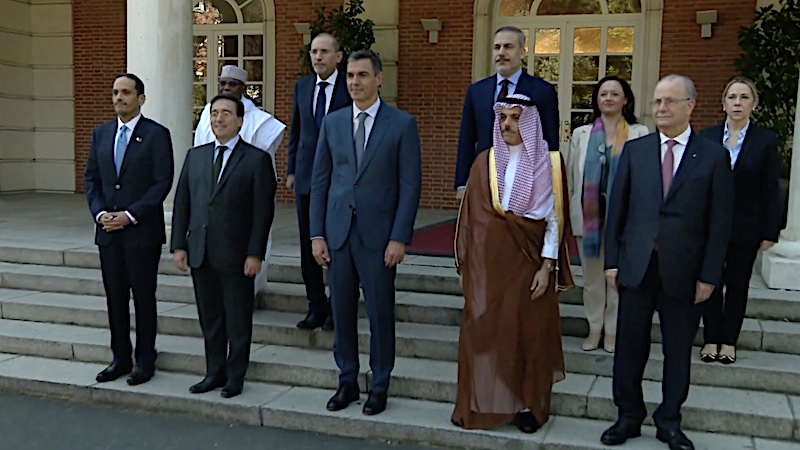
Spain’s Prime Minister Pedro Sanchez with the members of the Joint Arab-Islamic Ministerial Committee on Gaza in Madrid. Photo Credit: La Moncloa video screenshot

Spain’s Prime Minister Pedro Sanchez on Wednesday held talks in Madrid with the members of the Joint Arab-Islamic Ministerial Committee on Gaza, headed by Saudi Foreign Minister Prince Faisal bin Farhan, the Saudi Press Agency reported.

The meeting, to discuss developments in the besieged Gaza Strip, was attended by the foreign ministers of Qatar, Palestine, Jordan and Turkiye and the secretary-general of the Organization of Islamic Cooperation.

The committee members hailed Spain’s move to recognize the State of Palestine and vowed to keep pushing to secure Palestinians’ rights and promote peace in the region and the world at a time of extremism, violence and violations of international law, the report said.

More than 140 countries now recognize a Palestinian state, after Spain, Norway and Ireland made the diplomatic move on Tuesday.

The meeting discussed efforts to stop Israeli aggression in the Gaza Strip and the city of Rafah, the importance of an immediate ceasefire and the introduction of sustainable humanitarian aid.

It also called for an end to illegitimate Israeli actions in the West Bank, including East Jerusalem, in order to achieve a comprehensive peace, protect Palestinian rights and ensure regional security.

The meeting reviewed the committee’s efforts to support Palestinian statehood and take the necessary steps to implement the two-state solution in line with the Arab Peace Initiative and other international proposals.

The committee stressed the importance of the international community taking urgent steps to recognize Palestine to preserve the rights of its people and achieve security in the region.

Prince Faisal thanked Spain and said its move gave “hope in a very dark time.”

“We are here to say thank you to Spain, Norway, Ireland and Slovenia for taking the right decision at the right time, for being on the right side of history, for being on the right side of justice with all the dark we are seeing as a result of the continuing human catastrophe in Gaza,” he said.

“This is the right moment to give a beacon of hope to the two-state solution, to peace, to coexistence and for that we thank you and we hope that others will follow suit because the only way forward is the path to peace and the path to peace goes through a two-state solution, through a state of Palestine that lives in peace and harmony with all its neighbors including Israel.”


Categories
South Caucasus News

Iran Says Its Naval Ballistic Missile’s Technology At Disposal Of Houthis


Iran Says Its Naval Ballistic Missile’s Technology At Disposal Of Houthis

Yemeni domestically-built Borkan (Volcano) long-range missiles. Photo Credit: Tasnim News Agency

Inspired by Iran, the Houthi military forces have obtained the technology to manufacture anti-ship ballistic missiles. 

Iran’s first homegrown naval ballistic missile, called ‘Qadr’, was developed by late Iranian commander Brigadier General Hassan Tehrani-Moqaddam more than a decade ago.

Iran’s technical know-how to produce such anti-ship missiles is now at the disposal of the Houthi military forces.

Patterned after the Iranian missile, the Houthis ‘Muhit’ (Ocean) missile is capable of detonating naval targets.

The Houthi Army has been in possession of surface-to-air missiles for many years. After the invasion of Yemen by a Saudi-led coalition in March 2015, the Yemeni forces converted the SAMs into surface-to-surface missiles, known as Qaher-2 and Qaher-2M, which carried out many successful operations against hostile targets.

The Ansarullah (Houthi) forces have also unveiled an anti-ship version of the Qaher missile in military parades. Like the Iranian Qadr, Yemen’s Muhit missile is equipped with an optical seeker that can home in on hostile warships.

It indicates that Iran has acted successfully in supporting the resistance front across the region. Iran has empowered the resistance groups by providing them with modern technologies. Such policy has led to the formation of an integrated command and control center in the region, specifically in the drone and missile sectors.


Categories
South Caucasus News

Russia: Church To Be Demolished As Place Where Crime ‘Repeatedly Committed’?


Russia: Church To Be Demolished As Place Where Crime ‘Repeatedly Committed’?

Holy Intercession Tikhonite Church. Photo Credit: Private, Forum 18

By Victoria Arnold

An independent Orthodox parish in the southern Krasnodar Region may be forced to demolish its own church, apparently as a direct result of its Archbishop’s prosecution for opposing Russia’s invasion of Ukraine. The city administration in Slavyansk-na-Kubani has lodged a civil lawsuit against Archbishop Viktor Pivovarov, claiming that the Holy Intercession Tikhonite Church – which has stood for nearly 25 years – is an “unauthorised structure” and must be demolished at his own expense.

Slavyansk City Court began hearing the suit on 23 May, and is due to resume consideration on 18 June (see below).

If the court upholds the Administration’s request, Archbishop Viktor would be obliged to have the church demolished within 30 days of the written decision entering legal force. The decision comes into force either one month after the judge issues it in its final form, or upon an unsuccessful appeal. Archbishop Viktor would have one month to lodge an appeal, should he choose to do so.

The Administration argues that holding worship services in the building constitutes misuse of a land plot designated as being for “individual residential construction” only. It appears, however, that the underlying reason is the parish clergy’s stance against Russia’s war in Ukraine and its leader’s criminal prosecution for repeatedly “discrediting” the Russian Armed Forces (see below).

Archbishop Viktor, who has consistently and repeatedly publicly criticised from a religious perspective both the invasion of Ukraine and Russia’s conduct in the war, was convicted and fined under Criminal Code Article 280.3, Part 1 (repeat “discreditation” of the Russian Armed Forces) on 8 April (see below).

There have been multiple prosecutions of clergy from the Holy Intercession Tikhonite Church, as well as an armed raid in October 2023, during which Fr Iona Sigida was tortured. He was later prosecuted for writing an anti-war article. There has been no answer to Forum 18’s questions about the raid, including why Fr Iona’s torturers are not facing criminal prosecution for torture, in line with Russia’s obligations under the United Nations (UN) Convention against Torture and Other Cruel, Inhuman or Degrading Treatment or Punishment (see below).

In December 2023, during the investigation of the criminal case against Archbishop Viktor, Slavyansk Inter-District Investigative Department informed the city administration that the Church was “a public place where a crime has been repeatedly committed against the basis of the constitutional order and security of the Russian Federation”, suggested that it had not been built in accordance with planning regulations, and demanded that the administration “take measures to eliminate violations” (see below).

Forum 18 wrote to the Administration of Slavyansk Urban Settlement (which brought the suit) and Slavyansk District Municipality (a party to the suit) asking:

– why the city administration wants to demolish the Church when it has existed without causing problems for the administration or local residents for 25 years;
– why the criminal case against Archbishop Viktor, initiated because of his expression of religious views on war in general and the war in Ukraine, should be considered grounds for demolishing a building used by an entire religious community;
– whether the community might be given the opportunity to legalise the Church building retrospectively, if it is found to have been built in violation of planning regulations.
Neither body has answered these questions (see below).

In a statement on its website on 27 May, the parish called the authorities’ accusations “ridiculous and godless”, and noted that it had undergone many inspections over the thirty years of its existence, “with no claims made against us”. 

“It is clear that the reason for the decision to demolish our church is not formal violations, but only anger and revenge for the sermons and articles of Archbishop Viktor, for his confession of the Truth of Christ, which they hate so much”, the statement concluded.

Church has stood for 25 years

Viktor Pivovarov, who is now 87, was ordained a priest in the Russian Orthodox Church Outside Russia (ROCOR), which opened parishes inside Russia in the early 1990s. In 2006 he became an Archbishop in the Russian [Rossiyskaya] Orthodox Church (RosPTs), which was founded after a series of splits within ROCOR. He now leads a rival branch of RosPTs which he established in 2009 after a further split. It is not in communion with either other parts of ROCOR or the Moscow Patriarchate.

The Holy Intercession Tikhonite Church was built in the late 1990s and funded by donations from parishioners, a church member now living outside Russia explained to Forum 18. The first service in the building took place in January 2000. The community was registered as a local religious organisation between 2000 and 2018, and has since existed as an unregistered religious group.

(According to tax records, the local religious organisation took the decision to liquidate itself in June 2017 and ceased its existence in July 2018. In its statement of 27 May, the parish claims that its registration was “forcibly taken away” in 2018 after amendments to the Religion Law, and that it was subsequently unable to re-register.)

“A place where a crime has been repeatedly committed”

In January 2024, shortly after investigators initiated the criminal case against Archbishop Viktor, the parish became concerned that there could also be a threat to the Church itself.

“For now, everything is uncertain, because as you understand, this does not depend on us”, a church member outside Russia explained to Forum 18 on 8 April.

While investigating the criminal case against Archbishop Viktor, Slavyansk Inter-District Investigative Department (a subdivision of the Krasnodar Region branch of the Investigative Committee) wrote to the Administration of Slavyansk Urban Settlement on 20 December 2023 about “elimination of causes and conditions conducive to the commission of crimes”. The Administration appears to have received this in January 2024.

In the letter, seen by Forum 18, the Investigative Department informs administration head Aleksandr Bersenev that Archbishop Viktor has been charged under Criminal Code Article 280.3, Part 1 (“Public actions aimed at discrediting the use of the Armed Forces of the Russian Federation”)

The letter stated that Archbishop Viktor had committed his alleged offences “in a public place, namely, in the building of the Holy Intercession Tikhonite Church .. foreseeing the inevitability of socially dangerous consequences in the form of destabilisation of the socio-political situation, the exertion of influence on public opinion, the formation in society of a negative mood and disruption of trust in decisions taken by the Supreme Commander in Chief [and] state bodies of the Russian Federation”.

The Investigative Department particularly noted Archbishop Viktor’s May 2023 video interview with Novaya Gazeta Europe.

After the October 2023 raid on the Church and “further inspection”, the Investigative Committee decided that, despite the land’s designated purpose as “individual residential construction”, “in actuality there is a church located on this land plot – the building of the Holy Intercession Tikhonite Church, converted from a private house”, in which “church services take place, attended by residents of Slavyansk-na-Kubani and other population centres”.

Rather than “individual residential construction”, the Church is “actually a public place, with a large number of visitors, where a crime has been repeatedly committed against the basis of the constitutional order and security of the Russian Federation”.

“This speaks of the improper execution of their professional obligations by employees of the department for municipal land control of the administration of Slavyansk-na-Kubani”, the Investigative Department concluded. It added that the land plot and buildings should be inspected for compliance with their designated use and demanded that the city administration “take immediate measures to eliminate violations and take disciplinary action against the perpetrators”.

Administration fulfils Investigative Committee’s demand

The Slavyansk Urban Settlement Administration appears to have fulfilled the Investigative Committee’s demands. According to an Act of Inspection, also seen by Forum 18, two members of the Settlement Administration’s staff visited the Church on 29 March 2024 and noted that its door was open, there was no service in progress, and “Inside the premises were religious objects (icons, an altar, candles)”.

The parish claimed in its statement of 27 May that “the inspections carried out took place in secret from us, and no one informed us of this or issued any warnings about violations or asked any questions”.

On 10 April 2024, Aleksandr Gopak, head of the Department for Architecture and Town Planning for Slavyansk District Municipality, responded to a request from the Administration, stating that there was no permission for construction of the Church, or for bringing it into commission (vvod v ekspluatatiyu), in the archive of his department.

It is unclear whether officials conducted any search for a permit granted for the construction of a private house, which Archbishop Viktor obtained in 1996, according to the parish statement of 27 May.

In the lawsuit seeking to have the Church demolished, seen by Forum 18, the Administration notes that Archbishop Viktor owns the land plot at 130 Yunykh Kommunarov Street, as well as the red-brick, two-storey house which stands on it, as shown in the cadastral register. The second building on the plot – built of white brick and with an Orthodox cross on the roof – is not entered in the cadastral register.

This second building is “used for carrying out the activities of religious organisations [sic]. There are religious objects installed in the premises, [and] icons hanging up. The premises are accessible to an unlimited circle of persons”. The land plot’s designated purpose is “individual residential construction”.

The Administration then cites Slavyansk Inter-District Investigative Department’s communication “On the elimination of the reasons and conditions enabling the commission of a crime”, outlining its criminal prosecution of Archbishop Viktor, the Archbishop’s “negative attitude to the activities of the state organs of the Russian Federation [and] the use of the Armed Forces of the Russian Federation in the conduct of the special military operation on the territory of the Republic of Ukraine”, and the fact that his alleged offences occurred “in a public place – namely in the building of the Holy Intercession Tikhonite Church”.

The lawsuit notes that an “unauthorised structure” [samovolnaya postroyka] is one built on a land plot “not designated for these purposes in the manner established by law, or without receiving the necessary permissions, or with significant violations of town-planning and building norms and rules”. A person who builds or allows the building of an unauthorised structure does not have right of ownership, and such a structure is subject to demolition at this person’s expense.

The Administration therefore asks the court to recognise the Holy Intercession Tikhonite Church as an “unauthorised structure” and to order Archbishop Viktor to demolish the building at his own expense within thirty days of the ruling coming into legal force.

On 18 April 2024, the Administration lodged its civil lawsuit against Archbishop Viktor at Slavyansk City Court. Judge Natalya Kovalchuk accepted the case for consideration on 22 April.

“It is clear that the reason for the decision to demolish our church is not formal violations, but only anger and revenge for the sermons and articles of Archbishop Viktor, for his confession of the Truth of Christ, which they hate so much”, the parish wrote on its website on 27 May.

The parish compares the threat of demolition with the destruction of religious buildings in the Soviet era: “Just read the [court] sentences of the New Martyrs or the decrees on the demolition of churches by the communists – how do they differ from [the Administration’s lawsuit]? Both of them hide behind a formal law, which they themselves have written and interpreted, and refer to the hostile attitude [of the Churches] towards them.”

Administration does not respond as to why it wants to demolish church

The plaintiff in the case to have the Holy Intercession Tikhonite Church demolished is the Administration of Slavyansk Urban Settlement. This is the local government body which runs the town of Slavyansk-na-Kubani.

The Architecture and Town Planning Department of Slavyansk District Municipality is named as a third party; the Municipality administers Slavyansk District, one of the territorial subdivisions of Krasnodar Region. The region lies across the Sea of Azov from Russian-occupied southern Ukraine.

Forum 18 wrote to both local government bodies on 22 May to ask for the reasons behind the lawsuit, and again on 27 May with the following questions:

– why the city administration wants to demolish the Church when it has existed without causing problems for the administration or local residents for 25 years;
– why the criminal case against Archbishop Viktor, initiated because of his expression of religious views on war in general and the war in Ukraine, should be considered grounds for demolishing a building used by an entire religious community;
– whether the community might be given the opportunity to legalise the Church building retrospectively, if it is found to have been built in violation of planning regulations.

The city administration replied on 27 May, directing Forum 18 to contact the Slavyansk District Municipality as there is no department for architecture and town-planning at the city level.

When Forum 18 pointed out that it is the city administration which is the plaintiff in the case (as a third party, the Municipality’s town planning department is making no explicit claim of its own), it responded further on 28 May: “We will register your request today and it will go to the head [of the Administration] for consideration. The legal department will provide you with an answer within the period established by law” (this should be no more than 15 days).

What is an “unauthorised structure”?

According to Article 222 of the Civil Code, an “unauthorised structure” is one which has been erected on a land plot whose designated use does not allow for this type of building, or which has been built without the necessary permits or in violation of town-planning and construction regulations, if these regulations and requirements were in force when construction began and when authorities found out about the unauthorised structure.

The person who built an unauthorised structure has no right of ownership to it, and therefore cannot legally sell it, rent it out, or transfer it to another party for their use. If local authorities believe a building is an unauthorised structure, they can apply for a court order to have it demolished at the landowner’s expense.

Many religious communities across Russia have faced the loss of their places of worship because of alleged violations of planning regulations.

Since municipal authorities are usually unwilling to permit the construction of purpose-built churches and mosques, congregations can be obliged to meet in residential, agricultural, or commercial buildings. This leaves them vulnerable to the complexities and contradictions of the legislation which regulates the use of land.

Individuals and religious communities also risk punishment if they exercise their right to freedom of religion or belief by meeting for worship on land not designated for the purpose, such as in homes.

Civil Code amendments of 30 March 2016 and 4 August 2018, which give religious organisations the right to use “unauthorised structures” indefinitely if they conform to legal requirements, and up to 2030 if they do not, resulted in the halting on 5 December 2019 of a threat to demolish the Good News Pentecostal Church in Samara. The Holy Intercession Tikhonite Church is not, however, a registered religious organisation.

The Administration “wanted to demolish the Church on the quiet”

Judge Natalya Kovalchuk held the first hearing of the civil lawsuit brought by the Administration of Slavyansk Urban Settlement against Archbishop Viktor Pivovarov at Slavyansk City Court on 23 May. Parish representatives attended the first hearing, only shortly after learning of its existence. Judge Kovalchuk adjourned the case with a request for more evidence to be provided. She set the date of the next hearing as 18 June 2024.

“[The Administration] wanted to demolish the church on the quiet, but haven’t managed it”, a church member told Forum 18 from outside Russia the same day.

The Church member explained to Forum 18 on 22 May that the Church had been built over several years in the late 1990s, paid for by parishioners’ donations. The first service had taken place at Old New Year (14 January) 2000. Before this, the community had worshipped at a house church on Pobeda Street in Slavyansk.

Before the current lawsuit, there had “of course” been no problems with the city administration, the Church member told Forum 18. “[Archbishop Viktor] has always been well known in the town. The gate is always open.”

Multiple prosecutions, armed raid on church

In March 2023, Slavyansk City Court fined Archbishop Viktor Pivovarov 40,000 Roubles – one month’s average local wage or more than two months’ average local pension – under Administrative Code Article 20.3.3, Part 1 (“Public actions aimed at discrediting the use of the Armed Forces of the Russian Federation”) for an anti-war sermon he had given in church.

Subsequently, the Archbishop continued openly to oppose Russia’s war in Ukraine in his articles, his sermons (many of which are available on his YouTube channel), and in a video made by independent Russian media outlet Novaya Gazeta Europe and published on 5 May 2023.

On 3 October 2023, Slavyansk Inter-District Investigative Department of the Investigative Committee led a raid on the Holy Intercession Tikhonite Church and at least four other places, during which unidentified armed men physically assaulted, tortured, and detained 32-year-old Hieromonk Iona Sigida, the Archbishop’s assistant. Officers also searched the premises and seized electronic devices, documents, and money.

“I was amazed by this level of aggression and anger”, Fr Iona told Novaya Gazeta Europe. “And the most important thing is that they entered the Church with machine guns. They completely turned everything over .. They scattered everything as if on purpose.”

There has been no answer to Forum 18’s questions about the raid, including why Fr Iona’s torturers are not facing criminal prosecution for torture, in line with Russia’s obligations under the United Nations (UN) Convention against Torture and Other Cruel, Inhuman or Degrading Treatment or Punishment.

In Fr Iona’s and Archbishop Viktor’s account of the raid on the Church website, they describe the armed men as belonging to “SOBR” (Spetsialny Otryad Bystrogo Reagirovaniya), the Special Rapid Response Unit which has been part of the National Guard (Rosgvardiya) since 2016 and which frequently provides armed support for Investigative Committee operations.

Fr Iona was later charged with “disobeying a police officer” (Administrative Code Article 19.3, Part 1), for which a court gave him two days’ short-term imprisonment (administrativny arest). On 20 November 2023, Slavyansk City Court also fined Fr Iona 30,000 Roubles (about three weeks’ average local wage) under Administrative Code Article 20.3.3, Part 1 (“Public actions aimed at discrediting the use of the Armed Forces of the Russian Federation”) for his article “The cult of war”, which he had published on the Church’s website on 28 September 2023.

During the October 2023 raid Fr Iona’s torturers directly referred to this article, in which he discusses how “the cult of war is an integral part of all totalitarian anti-human regimes”. He refers to prophecies in the Book of Daniel and the Book of Revelation, and criticises the “militarisation” of the Moscow Patriarchate.

Criminal prosecution

December 2023, investigators summoned Archbishop Viktor for questioningand informed him that they had opened a case against him under Criminal Code Article 280.3, Part 1 (“Public actions aimed at discrediting the use of the Armed Forces of the Russian Federation”).

The basis for the criminal prosecution appears to be an October 2023 post on Archbishop Viktor’s blog, entitled “An answer to the question which concerns everyone today: what is this war?”, the May 2023 Novaya Gazeta Europe video interview, and other articles and sermons.

The investigators did not say for which agency they worked, but it now appears from the court verdict that it was the Slavyansk department of the Investigative Committee which both handled the criminal case and led the October 2023 raid.

Slavyansk City Court registered the case on 22 January 2024, and three hearings took place on 27 February, 11 March, and 8 April. In court, Archbishop Viktor pleaded not guilty and refused to testify.

The written verdict summarises statements he gave during questioning in December 2023, noting that he thinks that the Russian government has “no right” to declare Ukrainians to be enemies or to have invaded Ukraine, and does not recognise the annexation of the Donetsk, Luhansk, Kherson, and Zaporizhzhia Regions, saying that “this decision was imposed and these territories were taken by force by the Russian Federation from the state of Ukraine”. The “special military operation” is, for Archbishop Viktor, “lawless and aggressive” and a violation of Ukrainian sovereignty.

On 8 April, the court fined Archbishop Viktor 150,000 Roubles – nearly eight times the local average monthly pension – under Criminal Code Article 280.3, Part 1 (“Public actions aimed at discrediting the use of the Armed Forces of the Russian Federation”, committed more than once in one year). Archbishop Viktor will have a criminal record (sudimost – the state of being a convicted person) for one year after he pays the fine.

Parishioners “scared away by recent events”

After the October 2023 raid on their Church, the parish community became concerned that investigative agencies were monitoring its activities.

“Officers come to every service, openly film everything and all the parishioners; others, under the guise of random people or parishioners, also holding their phones, ask intrusive questions”, the Church member outside Russia told Forum 18 in January. “This is probably a method of intimidation.” Sunday services are continuing to take place, but “of course not as normal”, the Church member told Forum 18 on 12 April. “Many people have been scared away by recent events.”

Forum 18 has repeatedly asked the Federal Investigative Committee and the Krasnodar Region branches of the FSB security service and Interior Ministry why investigators had placed the Church under surveillance, why they were threatening members of the community with prosecution, and whether any further administrative or criminal cases had been opened against anybody other than Archbishop Viktor. Forum 18 has received no replies.

“Numerous inspections by the Justice Ministry, as well as by local authorities”

“Regarding the ridiculous and godless accusations brought against us in the spirit of Bolshevik materialism and Satanism, we want to respond”, the parish wrote in a statement on its website on 27 May. It noted that, since its founding in 1993 under the auspices of the Russian Orthodox Church Outside Russia, the parish has undergone “numerous inspections by the Justice Ministry, as well as by local authorities, [during which] no claims were made against us”.

The parish claimed that it had found it impossible in the 1990s to gain permission to construct a church which was actually registered as a religious building, on land explicitly designated for this purpose: “Construction by the book [po dokumentam] of a church not belonging to the Soviet Moscow Patriarchate was blocked by local atheist communists – those in the authorities and the [Russian Orthodox-Moscow Patriarchate] Church – and then [we] decided to build the same as at 61 Pobeda Street, a private house, which would be transferred to the use of the Church community for worship.”

The parish understood – both at the time and since – that it could hold services in a private house. Technically, this has continued to be permitted under the 1997 Religion Law, but religious communities have frequently encountered problems in doing so, including fines under Administrative Code Article 8.8, Part 1 (“The use of a land plot not for its intended purpose”).

“In 1996, the project was approved and a building permit was obtained”, the parish stated on 27 May. The two buildings on the plot – the Church and the house in which Archbishop Viktor lives – were built at the same time, a church member explained to Forum 18. All property rights were always held by the Archbishop, and “he wrote an agreement which transferred [the Church] to the use of the local religious organisation”.

After construction was completed, the parish transferred its registered address to the new location, at 130 Yunykh Kommunarov Street: “Here, too, the Justice Ministry did not have any complaints against us”, the parish said in its statement. “And as far as we know, other religious communities of other religious movements and faiths in the town were also forced to operate without officially registering the land for religious use, and registered [it] however they could [kak pridetsya]”.

According to the state cadastral register, the land plot on which the Church stands belongs to Archbishop Viktor, as does the house behind the Church in which the Archbishop lives. The church building itself does not appear in the cadastral register – it is unclear why this is the case. The land plot is designated as being for “individual residential construction”.


Categories
South Caucasus News

AI Browser Plug-Ins To Help Consumers Improve Digital Privacy Literacy, Combat Manipulative Design


AI Browser Plug-Ins To Help Consumers Improve Digital Privacy Literacy, Combat Manipulative Design

The Dark Pita browser plug-in detects dark pattern designs, notifies the user and allows the user to customize their online experience. CREDIT: Toby Li/University of Notre Dame

Researchers at the University of Notre Dame are developing artificial intelligence tools that help consumers understand how they are being exploited as they navigate online platforms. The goal is to boost the digital literacy of end users so they can better control how they interact with these websites.

In a recent study, participants were invited to experiment with online privacy settings without consequence. To test how different data privacy settings work, the researchers created a Chrome browser plug-in called Privacy Sandbox that replaced participant data with personas generated by GPT-4, a large language model from OpenAI.

With Privacy Sandbox, participants could interact with different websites, such as social media platforms or news outlets. As they navigated to various sites, the browser plug-in applied AI-generated data, making it more obvious for participants to see how they were targeted based on their supposed age, race, location, income, household size and more.

“From a user perspective, allowing the platform’s access to private data may be appealing because you could get better content out of it, but once you turn it on, you cannot get that data back. Once you do, the site already knows where you live,” said Toby Li, assistant professor of computer science and engineering and a faculty affiliate at the Lucy Family Institute for Data & Society at Notre Dame, who led the research. “This is something that we wanted participants to understand, figure out whether the setting is worth it in a risk-free environment, and allow them to make informed decisions.”

Another study looked at dark patterns — or the design features on digital platforms that subtly nudge users to perform specific actions — and how they are used on websites to manipulate customers. For the study, Li and his team looked at how dark patterns are applied by interface designers to encourage people to consume more content or make impulsive purchasing decisions. 

The researchers developed a Chrome browser plug-in dubbed Dark Pita to identify dark patterns on five popular online platforms: Amazon, YouTube, Netflix, Facebook and X. 

Using machine learning, the plug-in would first notify study participants that a dark pattern was detected. It would then identify the threat susceptibility of the dark pattern and explain the impact of the dark pattern — financial loss, invasion of privacy or cognitive burden. Dark Pita would then give participants the option to “take action” by modifying the website code through an easy-to-use interface to change the deceptive design features of the site and explain the effect of the modification.

The researchers plan to eventually make both browser plug-ins, Privacy Sandbox and Dark Pita, available to the public. Li believes these tools are great examples of how the use of AI can be democratized for regular users to benefit society.

“Companies will increasingly use AI to their advantage, which will continue to widen the power gap between them and users. So with our research, we are exploring how we can give back power to the public by allowing them to use AI tools in their best interest against the existing oppressive algorithms. This ‘fight fire with fire’ approach should level the playing field a little bit,” Li said.

“An empathy-based sandbox approach to bridge the privacy gap among attitudes, goals, knowledge, and behaviors” was presented this month at the 2024 Association of Computing Machinery CHI Conference. Led by Li, fellow study co-authors include Chaoran Chen and Yanfang (Fanny) Ye from Notre Dame, Weijun Li from Zhejiang University, Wenxin Song at the Chinese University of Hong Kong and Yaxing Yao at Virginia Tech.