
“Они нас бьют со своей стороны, а мы должны стоять и молчать? Так не бывает. Они пошли на нас войной, не мы”, – говорит о войсках РФ солдат ВСУ, который воюет на Харьковском направлении. Он не понимает, почему Украине нельзя бить западным оружием по территории агрессора – России pic.twitter.com/7WAsMdrpVA
— DW на русском (@dw_russian) May 28, 2024
Day: May 28, 2024
IDF says hidden store of terror munitions may have caused deadly Rafah blaze https://t.co/9OQxhIGND0
— The Times of Israel (@TimesofIsrael) May 28, 2024
Ukraine should be allowed to “neutralize” Russian military bases from where Moscow is firing missiles, says France’s President Emmanuel Macron. pic.twitter.com/jZ8RMJ6BT7
— DW Politics (@dw_politics) May 28, 2024
Prime Minister Benjamin Netanyahu visited the IDF Northern District Intelligence Branch base today, together with Intelligence Branch Commander Maj.-Gen. Aharon Haliva and Unit 8200 Commander Brig.-Gen. Y.https://t.co/1gnnSkNTCk pic.twitter.com/cdSbgeikx4
— Prime Minister of Israel (@IsraeliPM) May 28, 2024
Categories
NPR News: 05-28-2024 7PM EDT

Harnessing the power of the sun to convert carbon dioxide into useful chemicals is the goal of a new junior research group at the University of Oldenburg. The international team led by chemist Dr Lars Mohrhusen will adopt a double-sustainable approach: it aims to develop precious-metal-free catalysts that use sunlight to chemically activate this relatively inert greenhouse gas. The Federal Ministry of Education and Research (BMBF) has approved 2.6 million euros in funding for the project Su2nCat-CO2 over the next six years as part of its funding programme SINATRA (for junior research groups focused on “Artificial Photosynthesis” and the “Use of Alternative Raw Materials for Hydrogen Production”).
Commenting on the project, Prof. Dr Ralph Bruder, President of the University of Oldenburg, said: “The new junior research group’s work is aimed at finding inexpensive and durable materials to replace the precious metal catalysts currently in use. The BMBF’s funding commitment acknowledges the University of Oldenburg’s extensive interdisciplinary expertise in the fields of catalysis and nanomaterials and underlines the great importance of this research for society.”
Catalysts without precious metals
Mohrhusen and his team will focus on developing catalyst materials based on readily available and inexpensive components such as titanium dioxide. The aim is to find highly energy-efficient ways to convert the greenhouse gas carbon dioxide into compounds such as methanol, formaldehyde or ethylene which can be used by the chemical industry in the manufacture of plastics or synthetic fuels, for example. “The conversion of substances like carbon dioxide generally involves precious-metal-containing catalysts, which often require high pressure and high temperatures during operation,” Mohrhusen explains. In addition to the large amounts of energy required to create the right conditions to trigger a reaction, these materials often have the disadvantage of being expensive and not particularly durable. Impurities in the gas feed, for example, can easily “poison” the catalyst material so that it becomes less active over time, the chemist points out.
Mohrhusen’s team plans to investigate two different types of hybrid catalyst materials in model systems. For this they will create combinations of titanium dioxide and semi-metal nanoparticles as the first class of materials, and organic structures on oxide surfaces as the second. In the next step, the researchers will use various techniques to characterise the systems at the atomic level– a process which typically requires ultra-high vacuum conditions. Both material classes will be photocatalysts, meaning that they become catalytically active when exposed to light. Their exposure to sunlight generates charge carriers – negatively charged electrons and positively charged “vacancies”, so called “holes” – which can then react chemically with carbon dioxide.
“On the basis of these model catalysts we aim to gain a detailed, atomic-level understanding of which material properties enhance the reactivity as well as the stability of these systems,” says Mohrhusen. This can be very difficult under the technical conditions that prevail in large reactors, he explains.
In a third sub-project the team plans to design micro reactors to test the model catalysts under more realistic conditions. This will involve bringing the catalyst materials into a gas atmosphere – a combination of carbon dioxide, hydrogen and water, for example – in a special chamber and simultaneously irradiating them with light. The researchers will analyse the formation of reaction products during the process and can also examine the catalyst materials for structural changes caused by the reaction once the tests have been completed.
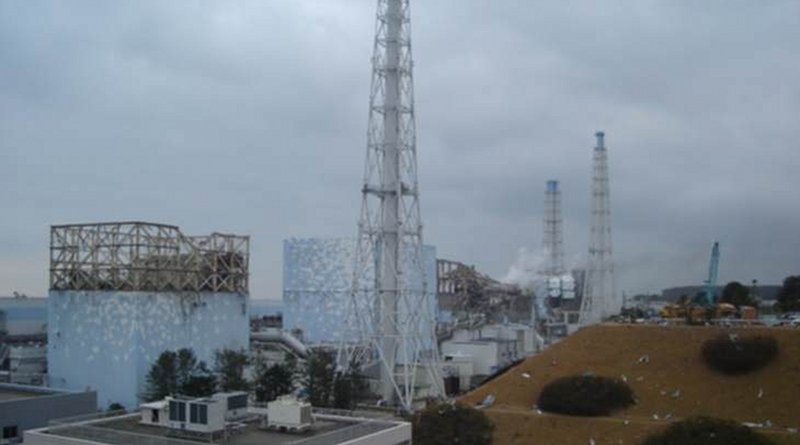
Offshore wind could have prevented the Fukushima disaster, according to a review of wind energy led by the University of Surrey.
The researchers found that offshore turbines could have averted the 2011 nuclear disaster in Japan by keeping the cooling systems running and avoiding meltdown. The team also found that wind farms are not as vulnerable to earthquakes.
Suby Bhattacharya, Professor of Geomechanics at the University of Surrey’s Department of Civil and Environmental Engineering, said:
“Wind power gives us plentiful clean energy – now we know that it could also make other facilities safer and more reliable. The global review finds that greener really is cheaper – thanks to falling construction costs and new ways to reduce wind turbines’ ecological impact.”
One of the report’s starkest findings was that new wind farms can produce energy over twice as cheaply as new nuclear power stations.
The lifetime cost of generating wind power in the UK has fallen dramatically, from £160/MWh to £44/MWh. This includes all the costs of planning, building, operating and decommissioning the wind farm over its entire life.
By comparison, the UK Government agreed to pay £92.50/MWh for energy produced at Hinkley Point C nuclear power station.
Professor Bhattacharya said:
“What makes wind so attractive is that the fuel is free – and the cost of building turbines is falling. There is enough of it blowing around the world to power the planet 18 times over. Our report shows the industry is ironing out practical challenges and making this green power sustainable, too.”
Although less power is generated in calmer conditions, the electricity generated could be stored in batteries – as planned for the Ishikari project off the coast of Hokkaido, Japan. Or it could be used to produce hydrogen from seawater – giving us the fuel of the future.

Researchers at the University of California, Davis, have updated their guidelines on when to neuter 40 popular dog varieties by breed and sex. Their recent paper in Frontiers in Veterinary Science adds five breeds to a line of research that began in 2013 with a study that suggested that early neutering of golden retrievers puts them at increased risk of joint diseases and certain cancers.
That initial study set off a flurry of debate about the best age to neuter other popular breeds. Professors Lynette and Benjamin Hart of the School of Veterinary Medicine, the study’s lead authors, set out to add more breed studies by examining more than a decade of data from thousands of dogs treated at the UC Davis veterinary hospital. Their goal was to provide owners with more information to make the best decision for their animals.
They specifically looked at the correlation between neutering or spaying a dog before 1 year of age and a dog’s risk of developing certain cancers. These include cancers of the lymph nodes, bones, blood vessels or mast cell tumors for some breeds; and joint disorders such as hip or elbow dysplasia, or cranial cruciate ligament tears. Joint disorders and cancers are of particular interest because neutering removes male and female sex hormones that play key roles in important body processes such as closure of bone growth plates.
For the most recent study, they focused on German short/wirehaired pointer, mastiff, Newfoundland, Rhodesian ridgeback and Siberian husky. Data was collected from the UC Davis veterinary hospital’s records that included more than 200 cases for each of these five breeds weighing more than 20 kg (or 44 pounds), spanning January 2000 through December 2020.
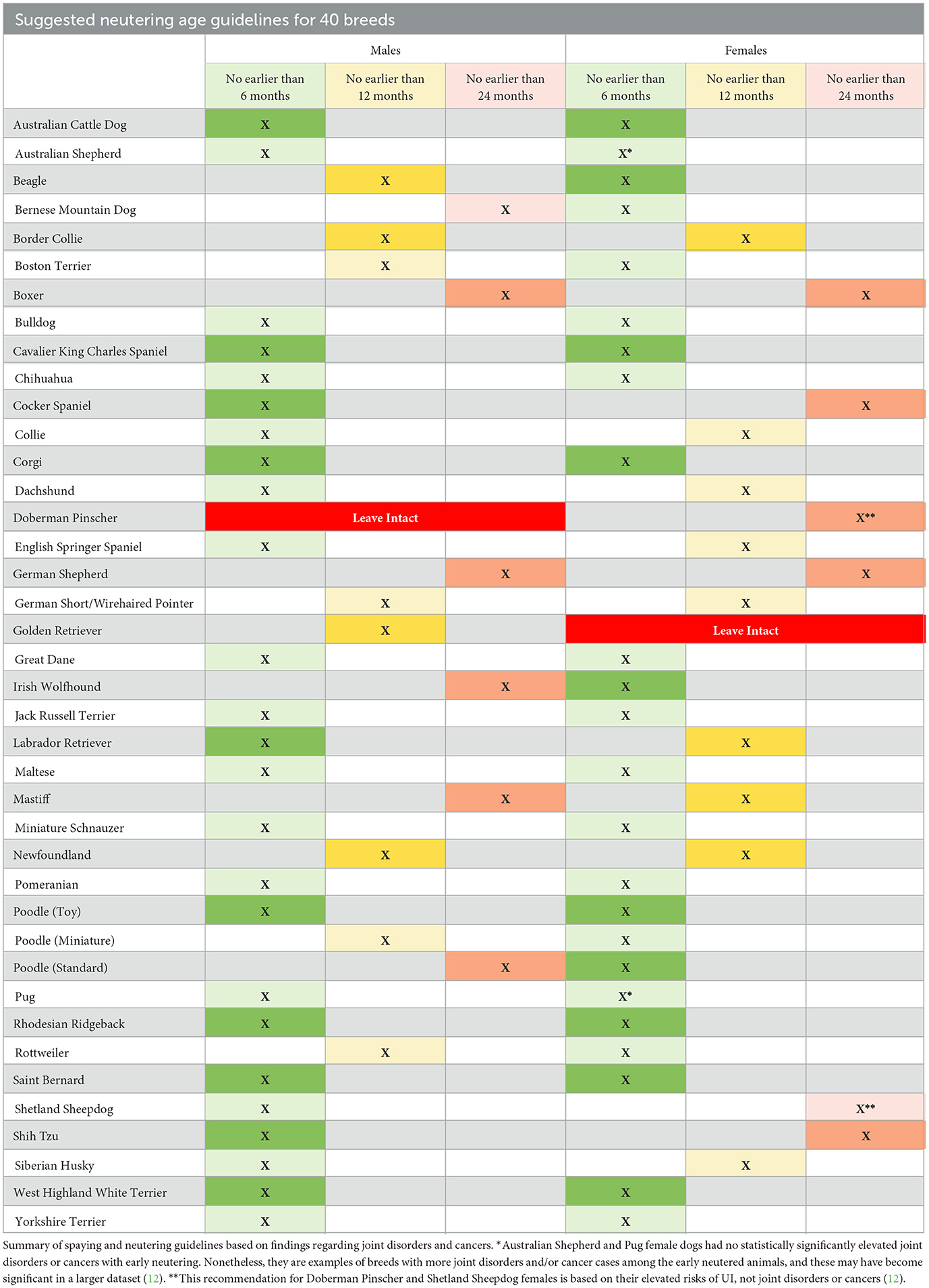
The Harts said their updated guidelines emphasize the importance of personalized decisions regarding the neutering of dogs, considering the dog’s breed, sex and context. A table representing guidelines reflecting the research findings for all 40 breeds that have been studied, including the five new breeds, can be found here.
Health risks different among breeds
“It’s always complicated to consider an alternate paradigm,” said Professor Lynette Hart. “This is a shift from a long-standing model of early spay/neuter practices in the U.S. and much of Europe to neuter by 6 months of age, but important to consider as we see the connections between gonadal hormone withdrawal from early spay/neuter and potential health concerns.”
The study found major differences among these breeds for developing joint disorders and cancers when neutered early. Male and female pointer breeds had elevated joint disorders and increased cancers; male mastiff breeds had increased cranial cruciate ligament tears and lymphoma; female Newfoundland breeds had heightened risks for joint disorders; female Ridgeback breeds had heightened risks for mast cell tumors with very early neutering; and Siberian huskies showed no significant effects on joint disorders or cancers.
“We’re invested in making contributions to people’s relationship with their animals,” said Benjamin Hart, distinguished professor emeritus. “This guidance provides information and options for veterinarians to give pet owners, who should have the final decision-making role for the health and well-being of their animal.”
Their combined research studies will soon be available with others in the open access journal, Frontiers of Veterinary Science, as a free e-book, Effective Options Regarding Spay or Neuter of Dogs.