Categories
South Caucasus News

Belgium Pledges $1 Billion In Military Aid, 30 F-16s For Ukraine


Belgium Pledges $1 Billion In Military Aid, 30 F-16s For Ukraine

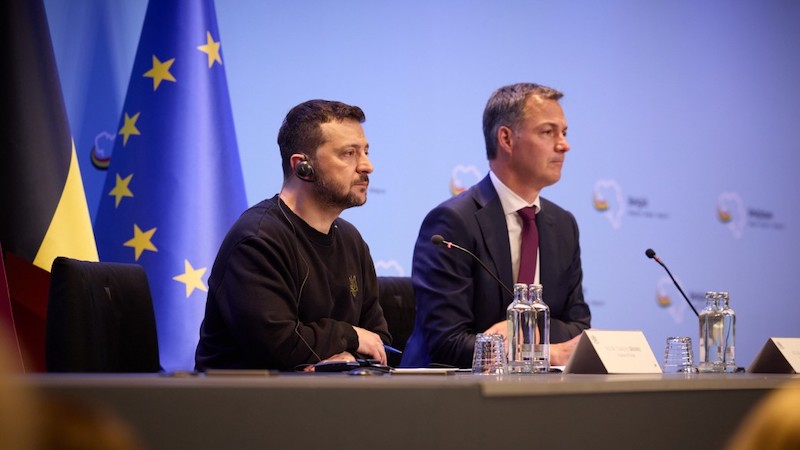
Ukrainian President Volodymyr Zelenskiy (left) and Belgian Prime Minister Alexander De Croo. Photo Credit: Ukraine Presidential Press Service

(RFE/RL) — Belgium will deliver 977 million euros ($1 billion) in military aid and 30 F-16 fighter jets for Ukraine under a 10-year bilateral security agreement signed by President Volodymyr Zelenskiy and Belgian Prime Minister Alexander De Croo on May 28 in Brussels.

The agreement is the second of its kind signed by Zelenskiy in as many days as he continues a whirlwind tour to secure more military aid for Ukraine’s outgunned and outmanned troops as they struggle to fend off a Russian offensive and relentless strikes on civilian targets in the northeastern region of Kharkiv.

“For the first time, such an agreement specifies the exact number of F-16 fighter jets — 30 — that will be delivered to Ukraine until 2028, with the first arriving already this year,” Zelenskiy wrote on X, formerly Twitter.

De Croo said at a joint news conference that Brussels will do “everything possible” to deliver the first fighter jets by the end of the year.

Asked by RFE/RL to specify how many warplanes will be delivered this year, De Croo did not answer, saying just that efforts of the aircraft coalition for Ukraine were ongoing.

De Croo stressed that the planes are to be used only above the territory of Ukraine. “The security agreement stipulates that military equipment will be used by the armed forces of Ukraine and on the territory of Ukraine,” he said.

The Belgian prime minister added that training was already under way for Ukrainian pilots on Belgian F-16s.

“Today, our planes are used to train new Ukrainian pilots. Our technical teams are used to provide technical support to keep aircraft in the air. Our teams are training Ukrainian technicians how to perform [technical support],” he said.

Zelenskiy, asked by RFE/RL about the progress of negotiations with partners on obtaining permission to strike targets on the territory of Russia, replied that he was “confident of a positive result both from some partners and from our production.”

Ukraine has been frustrated by the lack of permission from some of its allies, mainly the United States and Germany, to hit military targets inside Russia with Western weapons systems.

The European Union’s top diplomat, Josep Borrell, has backed Kyiv’s request.

“According with the law of war, it is perfectly possible and there is no contradiction. I could retaliate or I could fight against the one who fights against me from his territory,” Borrell told journalists ahead of a meeting with EU defense ministers.

“You have to balance the risk of escalation and the need for Ukrainians to defend,” he said.

NATO Secretary-General Jens Stoltenberg has also thrown his weight behind Ukraine’s plea, saying concerns that the use of Western weapons inside Russia would implicate the alliance in the war are unfounded.

“Ukraine’s use of weapons supplied by its Western allies against targets inside Russia would not make NATO and its members part of the conflict,” Stoltenberg said in Brussels on May 28.

French President Emmanuel Macron added his voice, saying on May 28 that Kyiv should be allowed to “neutralize” Russian military bases from which Moscow troops have fired missiles into Ukraine.

“We think that we should allow them to neutralize military sites where missiles are fired,” Macron said on a state visit to Germany.

He stressed, however, that Ukraine should not be allowed to hit other targets in Russia or civilian facilities.

But the White House on May 28 again rejected ending restrictions on Kyiv using U.S.-supplied arms to strike Russian territory.

“There’s no change to our policy at this point. We don’t encourage or enable the use of U.S.-supplied weapons to strike inside Russia,” White House National Security Council spokesman John Kirby told a briefing.

Russian President Vladimir Putin warned earlier on May 28 that hitting Russian soil with Western-supplied long-range weapons could set the war on a dangerous new path.

Speaking to reporters while on a trip to Uzbekistan, Putin said the use of such weapons would rely on Western intelligence data and imply the involvement of NATO military personnel.

“Representatives of countries that are NATO members, particularly in Europe, should be aware of what they are playing with,” Putin said, adding that “countries with small territory and dense populations” should be particularly careful.


Categories
South Caucasus News

Thousands rally in Georgia to protest adoption of ‘foreign influence’ law – The Paintsville Herald


Thousands rally in Georgia to protest adoption of ‘foreign influence’ law  The Paintsville Herald

Categories
South Caucasus News

Michael Roth to Georgian MPs: Get your glorious country back on track! – Georgia Today


Michael Roth to Georgian MPs: Get your glorious country back on track!  Georgia Today

Categories
South Caucasus News

Margus Tsahkna congratulated the Armenian people on the occasion of the Republic Day – ARMENPRESS


Margus Tsahkna congratulated the Armenian people on the occasion of the Republic Day  ARMENPRESS

Categories
South Caucasus News

Sen. Bob Menendez’s federal corruption trial enters 3rd week – CBS News


Sen. Bob Menendez’s federal corruption trial enters 3rd week  CBS News

Categories
South Caucasus News

Prosecutors build their case at bribery trial of Sen. Bob Menendez with emails and texts – ABC 6 News KAAL TV


Prosecutors build their case at bribery trial of Sen. Bob Menendez with emails and texts  ABC 6 News KAAL TV

Categories
South Caucasus News

How Prehistoric Humans Discovered Fire Making – Analysis


How Prehistoric Humans Discovered Fire Making – Analysis

Of all the pivotal technologies discovered by humans, fire making was the one that gifted our species with power beyond all others.

An ancient Greek myth tells the story of Prometheus, who, after molding humans out of clay and teaching them the fine arts of civilization, defied the Olympian Gods by stealing the secret of fire and offering it to humans. Prometheus paid dearly for this act of transgression that doted humankind with unprecedented technological know-how ultimately transforming their condition into one of great power.

The moral behind the Promethean archetype is a cautionary one, intended to warn us about the risks attached to the unbridled pursuit of technology that can inadvertently result in catastrophic scenarios. The Prometheus myth underscores not only the formidable power that individuals may come to possess by defying authority in the quest to develop science and technology but also suggests that anyone who does so will suffer the consequences.

It is significant that the Greeks chose fire as the subject to deliver this warning. Without a doubt, the capacity to produce and control fire stands out among the most transformative technological feats achieved by our prehistoric ancestors; one that ultimately consolidated human planetary domination. But how, when, and where did early humans harness the technologies necessary to master fire making? What does the archeological record tell us about how they finally obtained the Promethean secret of fire making?

Like other milestones marking the human evolutionary pathway (like perfecting stone axes or mastering advanced hunting practices), the know-how required to make, use, and control fire evolved progressively, encouraged by human ingenuity and, probably also, by trial and error. Fire making techniques were perfected over time and transmitted socially, while different human groups explored the multifaceted revolutionary potential offered by controlling it. Before truly mastering fire making, early humans may have experienced a precedent phase during which they used fire passively, gathering, preserving and even transporting brazes ignited by natural causes (lightning, spontaneous combustion, etc.), prior to learning how to actively generate and control it. In the meantime, curiosity led them to explore the mysterious properties of fire, while also inspiring them to seek ways to master its secrets.

While looking back in time, it is difficult to pinpoint exactly when our ancestors began to control fire-making technologies. Recognizing intentionally ignited and sustained fires in archeological contexts poses challenges since the simple presence of burned bones and stones or localized areas of charred soils are not sufficient to prove that hominins were actively producing fire. Before 1 million years ago, sparse evidence from some African sites could suggest that hominins were opportunistically harvesting fire from naturally kindled blazes; rather than practicing truly operative fire making. However, a multidisciplinary study from the Wonderwerk Cave in South Africa reports convincing evidence for intentional burning in a controlled archeological context dated to 1 million years old.

While such early signals of fire making are rare and difficult to recognize and interpret, globally, the ability to set fire at will is heralded as a major groundbreaking accomplishment attributed to the Homo erectus lineage who lived during the Lower Paleolithic period. This group of hominins is known to have produced an impressive array of tools belonging to the so-called Acheulian industrial complex that emerged in Africa 1.75 million years ago. Fire making is not the only groundbreaking achievement marking the 1.4 million-year-long reign of the Acheulian peoples. Throughout this time, hominins invented and came to master highly complex technological achievements, documented archeologically in the form of stone and (sometimes) bone tools. These technologies facilitated the expansion of H. erectus populations into Eurasia, where they continued to perfect and diversify the toolkits that afforded them adaptive advantages; improving their ability to multiply and flourish.

Aside from their broadening cultural repertoire, parallel processes of social development (more difficult to recognize in the archeological record) were also taking place. Rising demography is manifest in both Africa and Eurasia from the exponential increases in the number, density, and variety of archeological sites: a phenomenon that must in turn have generated more frequent interpopulational encounters, assuring reproductive viability and offering opportunities for cultural transmission at various levels. Acheulian hominins began to organize themselves into functional collective units that allowed them to more effectively share and exchange their newfound skills: a strategy that would ultimately favor their survival.

It is only after the 1-million-year mark that the global repercussions of the consolidation of fire-making technologies become more clearly visible in some archeological contexts outside of Africa. At the Acheulian site of Gesher Benot Ya’aqov, in the Jordan Valley, for example, compelling evidence some 780,000 years old confirms that hominins were not only making fire at willbut were also deliberately cooking fish. Meanwhile, as far away as China, but in a similar timeframe (800,000 to 600,000 years ago), there is proof in the famous multi-leveled Acheulian cave site of Zhoukoudian that individuals belonging to an Asian strain of H. erectus were also successfully experimenting with controlled burning in occupational settings.

Despite these rare and ancient occurrences, indications that hominins were actively generating and controlling fire became more ubiquitous only thousands of years later, toward the end of the Acheulian phase (after around 400,000 years ago), and then even more frequent as we move into the Eurasian Middle Paleolithic and African Middle Stone Age. Technological and behavioral diversity multiplies exponentially from this time forward, as toolkits differentiate to form complex formal manifestations of culture. Importantly, dwellings (often in caves) become recognizable provisioned home bases, where hominins returned regularly (or seasonally) over many generations. For the first time, organized living spaces can be identified within base camp settings that were structured around easily recognizable combustion structures, or hearths.

So, while H. erectus is credited with initiating the fire-making revolution sometime during the early phases of the Acheulian, it is only much later that the Pre-Neandertals and other forms of pre-modern and modern Homothriving in Eurasia at the end of this period began to more intensively experiment with the enormous potential offered by the Promethean gift of fire. Around 350,000 years ago, on the eve of the shift from the Lower to the Middle Paleolithic, the prevalence of hearths within prehistoric living spaces signals important changes taking place in hominin lifestyles.

Making fire was interwoven with many social, technological, and behavioral developments that triggered major changes that would shape humanity from that point onward. While (rather surprisingly) fire does not seem to have been a requirement for hominins expanding to territories situated in higher latitudes, it would have helped facilitate their capacity to take root in areas dominated by harsh or unstable climatic conditions. In terms of hunting, fire-wielding hominins would have had huge advantages over other kinds of carnivores with whom they competed for resources; fire also guaranteed the safety and protection of their own communities.

Besides taking advantage of these benefits, our ancestors experimented extensively with fire over thousands of years and grasped the significance of its power to transform the properties of other materials available in the landscape. They eventually learned to use fire to improve their weaponry (like heating flint to improve its knapping quality) and to assemble composite implements by hafting pointed stone tools onto branches using adhesives prepared with heat—such as tar and ocher. In addition, cooking food must radically have transformed the hominin diet, reducing the likelihood of contracting bacterial diseases and parasites from meat and other foodstuffs, while opening up innovative pathways toward enlarging the paleo diet (boiling, smoking, drying, etc.).

But among all of the spectacular changes afforded to prehistoric humans by the mastery of fire perhaps the most important and most difficult to assess archeologically is the social impact it must have had. With fire, humans were finally able to dompt the darkness and linger with confidence into the night, gathered together in proximity to hearths that afforded them warmth, light, and comfort. This leads us to postulate a variety of socially related activities, like storytelling or other communal rituals. While it is impossible to measure the impact of this complex series of events that so indelibly affected human evolution, we can still discern how technology and culture were interwoven to catalyze the advancement of symbolic communication within the developing brains of our ancestors, finally grouped into distinct territorial social units.

Later still, during the Middle and Upper Paleolithic periods, our human predecessors used firelight to venture into deep cave systems to perform ritual activities and create art on the cave walls, bringing it to life with the play of torchlight. Toward the end of the Paleolithic, humans continued to explore the powerful transformative qualities of fire, eventually learning to obtain and maintain the high temperatures necessary to transform clay into pottery and, later, to melt metal ores into usable items that would, once again, revolutionize the human story.

Even today, fire remains a powerful force whose symbolic meaning is deeply rooted within our collective unconsciousness. Though Prometheus was eventually delivered from his torment, his transgression still resonates as a lesson to humankind’s defiant striving to master transformative technologies without heeding the looming dangers posed by the unforeseen consequences of such actions.


Categories
South Caucasus News

On Climate Change, Centrism Means A Slow Death – OpEd


On Climate Change, Centrism Means A Slow Death – OpEd

climate change extreme weather tornado

The GOP wants to accelerate climate change, while Democratic centrists are content with slowly embracing it. As hurricane season approaches, shouldn’t we be choosing life?

The Miami Herald recently reported on the National Oceanic and Atmospheric Administration’s (NOAA) latest forecast predicting a record-breaking hurricane season for the Atlantic Ocean. “Brace Yourself, Florida,” warned the paper, explaining that the “NOAA is predicting that 17 to 25 named storms could form this year,” which is “the highest ever forecast by the federal agency.”

The paper, to its credit, made clear links between such dire predictions and global warming, saying, “Climate change is making more powerful storms more likely, cranking up the dial on extreme rainfall and strong surge and making it more common that storms rapidly strengthen as they approach land.” Insurance companies are likely taking heed, and have rightly pointed out that it’s “no surprise that Florida has been hit by more hurricanes than any other state since… 1851.”

But there was no mention in the Herald story about Florida Gov. Ron DeSantis signing a series of bills aimed at limiting solutions to global warming and even removing mentions of the phrase “climate change” from state laws. DeSantis proudly proclaimed that his intention was to, “keep windmills off our beaches, gas in our tanks, and China out of our state.”

The Florida Republican seems unconcerned about NOAA’s prediction nor of the record high temperatures impacting his state, such as Key West’s heat index of 115 degrees Fahrenheit. He did not acknowledge that Florida, given its peninsula coastline and location in the Atlantic, remains one of the most vulnerable states to climate change in the nation.

Florida-based meteorologist and climate change reporter Steve MacLaughlin made all the links between the coming storms, climate change, and the governor’s policy. He cited the NOAA report and warned NBC 6 News audiences that the “entire world is looking to Florida to lead in climate change, and our government is saying that climate change is no longer the priority it once was.”

There was a time, not too long ago when journalists and media outlets avoided any mention of climate change, even as scientists and climate activists urged them to say the words. Today, although media outlets have significantly improved coverage of the science, they tend not to explicitly draw a line between climate disasters and policy failures on the part of elected officials like DeSantis.

The Florida governor, who is waging a battle against climate justice as part of his culture wars, isn’t even the biggest threat to curbing climate change. He controls legislation in only one state. If Donald Trump captures the White House, the entire nation will fall even further behind in tackling the climate. Far-right shills for oil and gas companies have an ambitious battle plan in place to begin undoing the modest climate progress that the federal government has made. It’s called Project 2025 and is a brazen call “to deconstruct the Administrative State” on Day 1 of a Republican—read Trump—Presidency.

Like the hardliners who are openly articulating their doomsday plan, Trump has made no secret of where his allegiances lie, unabashedly demanding a billion dollars in campaign funding from oil and gas companies. At a now-infamous April 2024 Mar-a-Lago dinner, Trump directly solicited financial help from fossil fuel executives in exchange for more than $100 billion worth of tax breaks that President Joe Biden has proposed repealing.

The grift was so clearly a quid pro quo, so openly veering on extortion, that some Senators have now launched an inquiry into Trump’s statements. But they can’t keep up. A day before the Senate action, Trump made more such offers, saying to oil company executives at a fundraiser in Houston, Texas, that he would issue “immediate approvals for energy infrastructure” such as “pipelines, power plants” if he returned to the White House. Trump raised an easy $25 million at that event. If he regains power, he will engage in a new ethical infraction every other day, as he did the first time around.

To listen to Republicans, one might imagine that Democrats are Big Oil’s worst enemy, fighting to curb climate change on behalf of the good people of Florida and the rest of the nation. But much Democratic opposition exists in the form of incentives for green energy industries, for example, those built into the Inflation Reduction Act.

In terms of actually holding climate polluters accountable, other than Biden’s budgetary proposal to end tax breaks (which is, after all, only a proposal), and a pause on natural gas permits, Democratic challenges have come in the form of “homework assignments for companies, and requests for Justice Department investigations,” wrote Axios reporter Ben German.

Such tepid actions are not good enough, especially in the face of the overt Republican war on our climate, and by extension, our lives. The GOP may claim it wants to ban windmills on beaches, but its real agenda is handing our future over to oil and gas companies.

If the climate is to be a battleground for the GOP’s culture wars, and if Democrats are going to face the wrath of oil and gas companies for the most modest of limits on greenhouse gas emissions, why not go all in, and actually wage their own culture and policy war to save the climate?

Trying to capture voters who are at the center of the political spectrum has been a go-to Democratic strategy that has often ended in loss. Already centrist commentators are warning Biden to stop appealing to the left edge of his party ahead of November’s election.

But, growing numbers of Americans—and a majority of Democratic voters—are seeing past the media’s limited coverage and politicians’ doublespeak on the climate. They are deeply worried about climate change and are critical of Biden’s milquetoast approach to curbing it.

Labeling parts of the political spectrum is a helpful exercise. The left edge wants to move us forward, to progress, hence the adoption of the term “progressive.” The right flank wants to move society backward, and really ought to be dubbed “regressive.” Meanwhile, the center is happy with the current status quo and is best defined by the term “conservative.” Centrists want to conserve things just as they are.

On the issue of climate change, progressive policies mean a future for our children, stability for our homes and communities, and the preservation of human and other species. It literally means we have a good chance at life as a whole.

Regressive policies will lead to certain, accelerated death, broadly speaking, while conservative centrists appear to endorse a slow death. In other words, DeSantis, Trump, and their party are leading a death cult, while Biden and his party seem torn over the choice between life and death. To the rest of us, decisively choosing life is the only option.


Categories
South Caucasus News

Social Media, Democracy And National Security – OpEd


Social Media, Democracy And National Security – OpEd

Social media and democracy are interlinked matters of grave importance. Democracy according to (the Parliamentary Education Office) is, “rule by the people. The word comes from the ancient Greek words ‘demos’ (the people) and ‘kratos’ (to rule). A democratic country has a system of government where people have the power to participate in decision-making.” Accordingly, through democracy, there are ways to resolve disputes amicably, respect human dignity, and exercise rights of expression. In addition, democracy allows people to demand accountability and transparency from people in power who are elected by them.

However, with the advent and expansion of access and usage of social media, democracy is a word often discussed and debated. Further, social media in a democratic society has a direct bearing on national security, since the content and consequences of social media can exert both positive and negative matters towards national security. Therefore, this article attempts to look briefly into types of democracies and showcase the relationship between social media and democracy, the advantages reaped by social media in an age of democracy, threats to democracy, the impact on national security and a way forward in balancing the contradictions arising when using social media in a country of democracy.

There are multiple types of democracy including direct, representative, constitutional, parliamentary and presidential. Explaining, that in direct democracy, there are three distinct types of votes, such as referendums, citizen initiatives and recall which bestow powers on the voters. On the other hand, representative democracy is people electing representatives to make decisions on their behalf rather than getting involved as direct democracy. As cited by, (Anyanwu,2020) from Karvonen, “The concept of constitutional democracy has been defined as a system of government based on popular sovereignty in which a constitution determines the structures, powers and limits of government.” However, it is imperative to mention the fact that not all countries have a written Constitution such an example is Great Britain. In Parliamentary democracy, people elect Members of Parliament who will be the government and will make laws. In presidential democracy, the president is the head of state and government, elected separately from the legislature providing a system of checks and balances.

Needless to say, social media is because we all live in a digitalized world where we can reach many miles with our fingertips. Social media applications such as Facebook, Twitter, Instagram and LinkedIn have been platforms for information creation, dissemination and modification. Since social media is widely accessible, people utilize it for entertainment and many other actions such as empowerment and advocacy. In light of this, democracy becomes a crucial matter of discussion. Further, social media is utilized both for positives and negatives in a democracy.

The advantages of social media in a democracy are varied. As mentioned, (Sunstein, 2017), social media “gives more voice to independent journalism and underrepresented and non-mainstream groups”. Social media becomes a platform of discussion, analysis and debate where constructive criticisms will take place. Social media has become a platform that encourages the political involvement and engagement of individuals who would have been apathetic if it were exclusively in print or catering to a particular social class. By such involvement, people will be kept informed as well. In addition, social media acts as a platform where people can raise awareness, demand accountability and act as a whistleblower against corruption and bribery. 

As much as social media is used to promote democracy by demanding rights and advocating for them, on the other hand, social media can also be utilized detrimentally. One such example is the impact of algorithms on decision-making. According to (Demo Finland, 2019), “In particular, discussions often focus on the impact of algorithm decision-making systems in amplifying the scope of human action as well as their threats in conjunction with democracy, broadly understood in its deliberative form but also affecting individual and group rights such as privacy, expression, and association.” Such other adverse effects are in the name of democracy, people may engage in false news, disinformation, misinformation and hate speech. The false narratives, manipulations and deviations will become a threat to national security which includes political, economic and physical dimensions. In addition, emerging and novel technologies with the use of deep fakes give rise to the erosion of trust and amplify biases as well. In addition, social media usage can cause ethical concerns if used detrimentally as it jeopardizes privacy and other human security facets. 

Due to the mixed consequences and effects of social media countries have opted for various mechanisms to fight the threats posed by social media in a democratic society. For example, some countries utilize different social media applications to prevent data breaches and privacy violations. Governments also utilize laws and regulations to curb social media falsehoods and hate speech content. In addition, tech companies use strategies and good practices to prevent fictitious narratives in social media as well. Furthermore, tech companies use content moderation and human moderators to ensure community guidelines and the accuracy of the content.

However, it is vital to mention the fact that information literacy as well as media literacy is often not given the prominence it deserves. People do not tend to effectively verify sources, facts and news rather they merely believe the news when it is caught in a fad. In addition, certain social media posts use eye-catching phrases to attract attention without giving adequate attention to the reality of the content. This showcases the grim reality behind generating false and exaggerated news and narratives respectively. Therefore, it is crucial to have a strong relationship with the public, tech companies, media as well as government to ensure accurate information over false and exaggerated content. In addition, false content in social media is transnational and without any said limit. Therefore, not only countries in an individual capacity but also collectively should engage in best practices and share lessons learned.


Categories
South Caucasus News

Prophet Jesus, A Mahdi And Many Messiahs Will Come If … OpEd


Prophet Jesus, A Mahdi And Many Messiahs Will Come If … OpEd

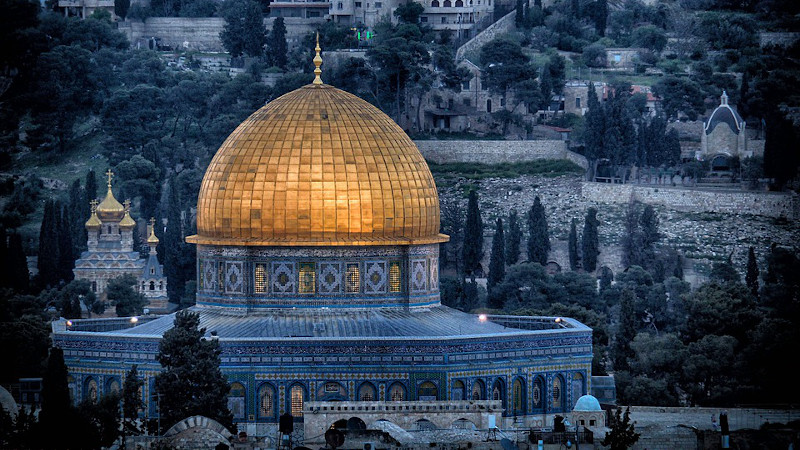
Jerusalem Dome Palestine Israel Architecture Islam

If the Palestine leadership in the 1920’s had welcomed the early Zionists as cousins returning home after a very long absence, there would have been no need for Britain’s “Peel Commission” to propose partitioning the mandate into a Jewish and an Arab state. If the Palestine leadership in the 1930’s had been willing to share the land there would have been a Palestine state and no war in 1948. 

The Zionist leadership, led by David Ben-Gurion and Chaim Weizmann, accepted the proposal. Mohammed Amin al-Husseini, grand mufti of Jerusalem and de facto leader of the Palestinian Arab community, rejected the idea and called for jihad. Al-Husseini later went to Nazi Germany.

Now political scientist Menahem Klein has charted the post Yom Kippur war emergence of contemporary expressions of Israeli, Orthodox, Judaism and sees it as “a new Judaism.” This new Judaism was not shaped in the academic study halls of the Torah as classical Judaism was, but within the framework of an Israeli political regime ruling over west bank hostile Palestinians. Klein suggested that Israeli Orthodox Jewish messianism has undergone a transformation. 

First, are the Palestinian Arabs victims of a “settler colonial project,” or their own failed leadership? Can two people at odds share the land, either by dividing it or creating some sort of confederation? Might knowing this history bring both sides closer to a resolution?

The idea that things could have indeed gone differently and that we weren’t fated for endless conflict suggests maybe they still can go differently in the present and the future. What if Herbert Samuel, the British high commissioner for Palestine, had appointed a moderate instead of al-Husseini as grand mufti? What if the two-state solution offered by the Peel Commission report in 1937 had been accepted by both sides? 

Jews would have gotten less than 20% of the country but hundreds of thousands of Jews would have escaped from death in  Europe. And there would have been no Palestinian refugee crisis. There would have been no Nakhba in 1948. The Gaza Strip would not be filled with refugees.

Classic Jewish literature depicted the advent of a messianic age following a catastrophe, or a great crisis called the birth pangs of the Messiah, and the war of Gog and Magog (which the Qur’an also mentions). These elements are part of the messianic transition from the realm of violent history into a worldwide peace where even animals will live in harmony and peace: 

“The wolf will live with the lamb, the leopard will lie down with the goat, the calf, the lion and the yearling together; and a little child will lead them…They will neither harm nor destroy on all my holy mountain (Zion), for the earth will be filled with the knowledge of the Lord as the waters cover the sea… There will be a highway for the remnant of his people that is left from Assyria, as there was for Israel when they came up from Egypt.” (Isaiah 11) 

Klein says that in contrast, the new Israeli Orthodox Jewish messianism is a product of historical success, the ingathering of exiled and persecuted Jewish communities, the achievement of Jewish sovereignty, and the wielding of political power over non-Jewish hostile surroundings.” 

The belief that there would be two different messiahs, one a moral political leader from the house of David (Davidson) and the other, a religious reformer from the house of Aaron (Aronson), as well as a special “end of days” prophet such as Elijah or Jeremiah (Matthew 16:14) is found in inter- testament literature. A Dead Sea scroll states that the Qumran community must continue to live according to the original discipline “until there shall come a prophet (Elijah) and the Messiahs of Aaron and Israel.” (Manual of Discipline 9:11). 

There is also a rabbinic belief in a messianic figure from the northern tribes called a Josephson messiah who is killed by Israel’s enemies. This idea may be modeled on the example of Saul who reigned before David and was killed in battle by the enemies of Israel. Thus there could be as many as four individual messianic figures as well as the people of Israel who act as God’s agents in bringing about the Messianic Age. 

Gentile rulers also play a role, first as destructive oppressors of the Jewish people, and second when their successors later acknowledge their error and are ultimately included in helping bring about the Messianic Age’s worldwide blessings. The Persian King Cyrus was such a messiah (Isaiah 45:1)

All of this makes for a complicated future scenario that might take generations, or even centuries to develop. When people are persecuted, afflicted and oppressed as a community, and despised and rejected as individuals, they need hope for a much quicker and simpler process of redemption. This is why there is an overwhelming focus on the final stage Davidson messiah by most teachers, preachers, commentators and expositors. This is also the reason that those who believe in the imminent coming of the Davidson messiah always think it will occur soon within their lifetime (John 14:19, 21:22). 

Islam adds to all these Messiahs the figure of a Mahdi (Arabic: ٱلْمَهْدِيّ al-Mahdī). A messianic figure in Islamic eschatology who will appear at the end of times to rid the world of evil and injustice. Said to be a descendant of Muhammad, and thus a descendant of Prophet Abraham, he will appear shortly before Prophet ʿĪsā (Jesus) and defeat the evil forces of Gog and Magog (Ya’juj and Ma’juj or Ajuj and Majuj). Gog and Magog appear metaphorically in the Hebrew Bible, the Christian Bible, and the Islamic Quran as individuals, tribes, nations, catastrophes of nature; and in our own days as racist nationalist states and political movements. 

The Quran mentions Gog and Magog twice: “He said: “This (barrier) is a mercy from my Lord: but when the warning of my Lord comes to pass, He will reduce it to dust (and Gog and Magog—the Colonialist Empires, the Nazi racists, and the Communists would be released into the world); and the promise of my Lord is true.” (Qur’an 18:98)  

So Gog and Magog are destructive groups like the Colonialist Empires, Nazi racists, and the Communists, as well as widespread human pollution of Mother Earth, that near the time of the end of days will penetrate every part of the world like the persistently high levels of ozone pollution in Asia that are costing China, Japan and South Korea an estimated $63 billion annually in lost rice, wheat and maize crops.

The other mention of Gog and Magog in the Quran is: “But there is a ban on a town which We have destroyed: that they (the people of the town) shall not return (to reclaim that town as their own); until Gog and Magog are let through (the barrier), and swiftly spread out in every direction.” (Qur’an 21:95-96) 

This verse refers to Jerusalem, destroyed by the Romans in 70 CE, and only reclaimed 18 1/2 centuries later as the State of Israel’s capital, following the era of the defeat of the Nazis, the Communists, and the Colonialist Empires, who had been Gog and Magog for many generations. 

Though the Mahdi is not mentioned in the Quran, and is absent from the two most-revered Sunni hadith collections: Sahih al-Bukhari and Sahih Muslim – he is mentioned in other Hadith literature; and Islamic end-time images of pre Judgement Days natural catastrophes are similar to Christian and Jewish imagery of nature’s potential disruptiveness (plagues, famine, draught, earthquakes etc.). 

Also, since humans have free will, the exact time and manner of redemption cannot be determined in advance. Much depends on what we do. Repentance produces changes in the future of both individuals and nations. Repentance enables some individuals and communities to escape the consequences of prior evil. On the other hand, God’s promise is that evil powers will never succeed in destroying Israel or in overcoming worldwide justice in the long run. Thus even without full repentance, God will act if the Divine promise of a Messianic Age is threatened. 

As Isaiah states a few verses prior to the suffering servant passage, “The Lord says: you were sold but no price was paid, and without payment you shall be redeemed.” (52:3) i.e. all your suffering in exile was not merited and your redemption from exile will not be fully earned. Both are part of God’s outline for human destiny and will occur sooner (through repentance) or later (in God’s own time). 

Finally, if one believes that God inspired prophets are able to describe scenarios of various developments in the distant future then one has to accept that the understanding of these passages should change and improve as we come closer and closer to the times they describe. As an example, Jeremiah describes a radical future in which women surround men, “The Lord will create a new thing on earth-a woman will surround a man” (31:22). 

The great commentator Rashi understands ‘surround’ to mean encircle. The most radical thing Rashi can think of (and in 11th century France it was radical) is that women will propose marriage (a wedding ring, or encircling the groom at the wedding ceremony) to men. In today’s feminist generation we can see women surrounding men in fields once almost exclusively male such as law, medical and theological schools. 

Of course, this means that a few generations from now we might have even better understandings of some predictive passages in the prophets, so humility should always be with us.

Now let us try to understand the suffering servant passage in light of 20th century Jewish history. Isaiah proclaims the good news of peace and salvation (52:7) when God returns to Zion (8) and comforts his people (9) so all the Gentiles see his salvation (10). The Jewish people will depart the exile not in flight but under God’s protection (11&12). Israel/Jacob, God’s servant, whose appearance (14) was disfigured, marred and appalling (during the holocaust) will prosper (13) and be lifted up (in subsequent generations). 

A marvel for many nations, whose rulers will shut their (anti-Semitic) mouths because of this, since they will see what they had not been taught and will understand what they never heard of (15). For centuries the Church taught that the Jews were being punished for rejecting Christ and couldn’t be redeemed without believing Jesus was the Son of God. 

Now some Gentile rulers see that this teaching is not really correct doctrine. The biblical message of God’s commitment to redeem Israel without explicitly believing in Jesus wasn’t believed (53:1) but now there is a growing minority who affirm a two covenant theology. 

Many Gentile rulers (kings, governments, business and religious leaders) now admit what their anti-Semitism did to the people of Israel. The Jews were like a tender shoot in dry ground, unattractive and undesirable, despised and rejected, sorrowful and familiar (intimate) with suffering (52:2&3). We (the Gentile rulers) scapegoated them and they carried our projected infirmities, but we rationalized that the Jews were stricken and afflicted by God, not by us. Israel was pierced and crushed due to our transgressions (anti-Semitism) for we sought our peace by blaming Jews for all kinds of evils (54:4&5). 

This anti-Semitism led to: Crusaders slaughtering Jews in France and Germany, blaming Jews for the Bubonic Plague in central Europe, torture by the Spanish and Portuguese Inquisition, many expulsions and pogroms at various times throughout Europe, and the deaths of tens of thousands of Jewish civilians massacred during wars in Poland (1648-9) and the Ukraine (1919-21). All this set the stage for the worst martyrdom of all, the six million Jewish victims of the Holocaust (plus five million non-Jews). Each evil regime turned its own kind of iniquity (religious, political, economic and social) on its Jews (54:6). 

Again and again Jews were passively taken away to exile, or like sheep to the slaughter cut off from the land of the living, though they had done no violence (54:7-9). Yet faithful Jews accepted all this as God’s will and refused to abandon their religion or their people. Survivors of the concentration camps, who had lost their entire family, had the courage and faith to marry, and lived to see their offspring (Jewish children and grandchildren) grow up (54:10). Many, whose days were prolonged (54:10) and are now in their 70’s and 80’s, have lived long enough to see the most amazing outcomes of the Holocaust. 

The return of the Jewish people to the land of Israel and the rebuilding of its cities and countryside are the subject of many passages in Isaiah both preceding chapter 53 and following it. The realization of these prophecies did not require a Holocaust. The collapse of the Soviet Union and the mass departure of more than one million Soviet Jews to the land of Israel also are not directly linked to the Holocaust.But the redemptive aspect of Jewish suffering during the Holocaust for Gentile rulers and nations is emphasized in this suffering servant passage. 

Of course, the Turkish government still denies responsibility for the death of over one million Armenians; the Japanese deny slaughtering 300,000 residents of Nanking during WW2, and only a few French leaders admit to the complicity of the Vichy government in rounding up Jews for the Nazi death camps. Even the UN has not officially admitted its dereliction of duty in the genocide of 800,000 Tutsis and moderate Hutus in Rwanda. Yet the few steps of public confession and atonement that have been taken by some political and religious leaders are truly remarkable when you consider that nothing like this has ever happened in previous human history. 

If the Holocaust stimulated a willingness of religious and political leaders to accept responsibility for past examples of persecution and iniquity done by their institutions and governments continues to expand, society will improve greatly. If other governments and institutions admit responsibility for the sins of their predecessors it reduces the likelihood of repetition. Then the numbering of God’s innocent servant- Israel/Jacob with transgressors will, when the lessons are finally learned, justify not just those directly involved in the atonement process but also many others. Israel’s pouring out of life (six million deaths) will not have been in vain, and the revivified Jewish people will see the light of life and be satisfied (Isaiah 54:11-12).

The ability of Christians and Jews to understand that both religions’ interpretation of Isaiah’s Suffering Servant has helped bring us closer to an age of increased human rights will lead to a greater demand for universal peace and security. (Isaiah 2:1-4 and Micah 4:1-8) Christians have always stressed the individual aspects of personal self sacrifice for salvation. By adding national and organizational aspects, Christians can help elevate the moral level of political and organizational behavior. 

When current political and religious leaders feel the need to publicly acknowledge the sins of their predecessors, itt helps to reduce the level of self righteousness that usually accompanies the corruption of political and religious power. It also warns religious people and their leaders that in the words of Pascal, “Men never do evil so completely and cheerfully as when they do it from religious conviction.” 

Jews can now begin to understand how the role of Jesus as the Josephson Messiah, and the example of the passion of Jesus, has motivated many political and religious leaders in our generation to apologize for evils they personally did not do, in order to set the record right. 

The Davidson messiah will come after all nations, religions and political parties learn to respect and value as a gift from God, each other’s right to differ in large as well as small issues. (Micah 4:5) Since this religious reform requires great leadership from all the major religions, each religion will have to produce its own Aronson religious reformer Messianic Mahdi figure. 

These many messianic mahdi religious reformers are referred to by Prophet Jeremiah positively as ‘shepherds’ (3:14-18) and their teachings will provide each religion with a reformed and renewed covenant (31:31-34). 

The advocacy of  religious pluralism by the major religious communities will then produce the bases for the ultimate messianic predictions of worldwide peace, justice, prosperity, and salvation that the prophets proclaimed so often. The Davidson Messiah will come last to crown our faith in God’s inspiration and deliverance.

Until then let us remember that the Qur’an refers to Prophet Abraham as a community or a nation: “Abraham was a nation/community [Ummah]; dutiful to God, a monotheist [hanif], not one of the polytheists.” (16:120) If Prophet Abraham is an Ummah then fighting between the descendants of Prophets Ishmael and Isaac is a civil war and should always be avoided.

If all Arabs and Jews can live up to the ideal that ‘the descendants of Abraham’s sons should never make war against each other’ is the will of God; we will help fulfill the 2700 year old vision of Prophet Isaiah: “In that day there will be a highway from Egypt to Assyria. The Assyrians will go to Egypt, and the Egyptians to Assyria. The Egyptians and Assyrians will worship together. In that day Israel  will join a three-party alliance with Egypt and Assyria, a blessing upon the heart. The LORD of Hosts will bless them saying, “Blessed be Egypt My people, Assyria My handiwork, and Israel My inheritance.”…(Isaiah 19:23-5)