
Day: May 28, 2024
Categories
NPR News: 05-28-2024 9PM EDT
By Anant Mishra and Prof. Dr. Christian Kaunert
In August 2021, after US forces withdrew from Afghanistan, the Taliban took over Kabul with little to no resistance (besides serious firefight in Panjshir between Talibs & members of the National Resistance Front), forming an interim government and completing two years of governance in 2023. As the world transits to 2024, the Taliban proved numerous predictions untrue, gripping hold to power in the region and slowly transiting from an Islamist insurgent group to a net-security provider of the local Afghans. Since taking over Kabul, one would argue, insurgent driven violence has largely decreased, but the state continues to experience one of the worst economic and humanitarian crises, with an upward trajectory of violence induced by different sects, against each other.[2]
As the Taliban continues to strengthen its position, it’s relationship with other Islamist factions (which may have once supported the group during insurgency) deteriorates, as reflected from the surge of attacks (against key Taliban leaders) carried by Islamic State-Khorasan Province (ISKP) since August 2021. To the context of the Taliban’s working relationship with al-Qaeda (exercised primarily through Sirajuddin Haqqani, the Taliban Minister of Interior), experts remain skeptical on the Taliban granting some leverage to Al Qaeda-linked networks to flourish or even recruit fighters within Afghanistan. Some experts believe Al Qaeda is taking a meagre supervisory role, focusing on Islamist propaganda at the behest of Siraj Haqqani.[3] Whereas some find this point contradictory, arguing Al Qaeda being focused on recruitment from Central Asian nations, filling the Taliban ranks.
That said, if the aforementioned argument holds true for the global community (particularly for South Asian economies), is Afghanistan heading to, or, has already become a hub for foreign terrorist fighters under the Taliban regime? If not, is there an influx of foreign fighters entering Afghanistan and will it increase in 2024?[4]
Taking the aforementioned questions into account, the authors have based this analysis on two key questions: did the Taliban, after coming to power, impact recruitment of foreign terrorist fighters entering in the region? And what does this mean for South Asian/East Asian economies to the context of threat posed by these fighters, if they decide to return to their homeland?
Tracing foreign fighters post-Taliban takeover of Kabul
With the Taliban completing two years in power, the presence of foreign terror fighters in the region does not surprise the authors. Even before the Taliban formally took over Kabul, A UN Security Council report published in June 2021, estimated foreign terrorist fighters between 8,000 and 10,000 in the country then, with nationalities from Central Asian economies, the Caucasian region of the Russian Federation, northern provinces of Pakistan and some from Xinjiang, Uighur Autonomous Region of China.[5] By one estimate, June 2022, witnessed a dip in the presence of foreign terrorist fighters in the region, between 3,000 and 4,000 – primarily affiliated to the Taliban, deputed to fill the ranks of Tehrik-e-the Taliban Pakistan (TTP), a the Taliban affiliate group.[6] By another estimate, June 2023 witnessed a tide of recruits volunteering from terror factions in Central Asian economies to join the Taliban ranks. More than 7000 fighters may have joined the Taliban ranks alone between June and August 2023, presenting itself as a model entity ‘more structured, hierarchical and truly Islamist’, than others South/Central Asia.[7]
That said, foreign terrorist fighters have also joined the ranks of Islamic State (Daesh) in Afghanistan, in significant numbers. According to the UN Secretary General, in June 2022, he had reported ISKP ranks to have been doubled than their initial estimated size from 2020-21, growing from an estimate of 2,500 fighters to almost 4,000 fighters with half recruits volunteering from regional terror factions.[8] ISKP membership have garnered greater recruitment because of internal tussle within the Taliban factions – Akhundzada’s preferential treatment in appointments at Rahbari Shura or provincial commanders, religious clerics, governors and special emphasis to sect based propagandists, alienating ambitious foreign fighters, certain ethnicities even loyalist Talibs (hoping for recognition and key appointments) – unifying their hatred under one flag.[9] Since July 2022, ISKP has been focusing on recruiting foreign terror factions, picking up certain ethnicities that are at swords against the Taliban. This has resulted in increased recruitment of Tajik fighters, taking the benefit of their grievances against the larger Pashtuns, channeling it against the Taliban leadership and hailing Tajik led attacks against them.[10] ISKP can also be perceived as more lucrative due to its ability to pay higher monthly wages than the Taliban. According to one estimate, a Taliban fighter makes 75$ to 100$ a day, whereas an ISKP fighter makes anywhere between 200$ to 250$ a day. That said, ISKP’s ability to pay has resulted in severe desertion in regional Islamist factions, including 50 Uighurs and almost 75 to 90 Tajiks from the Eastern Turkistan Islamic Movement (ETIM), 65 Uzbeks from the Islamic Movement of Uzbekistan (IMU) to ISKP, according to one expert.[11]
In the context of fighters within the Al Qaeda in the Indian Subcontinent (AQIS) – officially reported in May 2022, stood anywhere between 200 to 400 then, according to one estimate, stands anywhere between 800 to 1200 in August 2023 – mostly originating from Pakistan & Afghanistan with some nationalities from Bangladesh and Myanmar.[12] Other Islamist groups such as the ETIM, IMU including Pakistan sponsored Jaish-e-Mohammed (JeM) and Lashkar-e-Tayyiba (LeT), comprise a total of 2000 to 4000 fighters.[13]According to one scholar, even after completion two years of reign, in August 2023, there were no visible actions undertaken by the Rahbari Shura or any decree issued by the Emir to provincial leaders in the context of foreign fighters within their ranks. To that, one may conclude, terror factions (Islamist groups) enjoy greater freedom of movement under the IEA than, in the erstwhile republic.[14]
Islamic Emirate of Afghanistan (IEA): A new safe haven?
How can one travel to Afghanistan? Taking that question to a senior counter terrorism expert based in London, he cited numerous conversations intercepted from individuals looking to travel from South East Asian economies to join the new IEA, mainly enquiring on existing Islamist networks for potential allegiance or for assistance in prospective travel.[15] That said, security agencies and independent experts alike argue on Afghanistan transitioning from a perspective safe haven to a potential safe ground for foreign terrorist fighters, opening recruitment opportunities to regional Islamist groups such as IMU or ETIM to ISKP and reinforce ranks, raise finances even execute operations (in case of ISKP against the Taliban).[16] Months before the Taliban’s takeover of Kabul, experts argued on a potential increase in travel patterns (altering course from Middle East to Afghanistan) regional Islamist factions from South East Asia entering into Afghanistan through illegal routes from Pakistan, with Central Asian and South East Asian based groups entering Badakhshan via Tajikistan.[17]
With 2024 in hindsight, the authors identify numerous factors that could result in a potential increase in foreign fighters entering into Afghanistan:
- The Taliban’s constant grip on power (uncontested and stable) continues to inspire Islamist factions, potentially validating Jihadi doctrine (more than a religious decree) as a rule book of governance.[18]
- It not only boosted the moral of Islamic jihad organizations in Syria, Iraq, Libya or Egypt, but also motivated Palestinian Islamic Jihad and Hamas (in particular), renewing their purpose, perhaps motivating to undertake a Taliban styled victory.[19]
- According to one scholar, groups such as Al Qaeda in the Islamic Maghreb (AQIM) and Syrian based Hay’at Tahrir al Sham (HTS) have altered instruction manuals (for new recruits) based on the Taliban’s recruiting propaganda, with potential fighters embedding within the Taliban ranks to gain experience.[20]
- Under Haqqani’s influence, Al Qaida too has remodeled its recruitment propaganda to attract recruits, in an effort to support its affiliates globally.”[21] It aims to enlist young fighters within the Taliban ranks for greater combat experience, with intent to support their factions in the Middle East.[22]
- Post Islamic State’s military defeat plunged motivations of prospective Islamist factions in the region, which was revived by the Taliban’s takeover of Kabul and strengthened after Hamas attack on Israel. The on-going battle in Gaza has elevated motivations of numerous Islamist factions significantly, with militant groups looking to send recruits Afghanistan for greater combat experience.[23]
That may be true, geographically, Afghanistan shares more than boundaries but greater cultural and ethnic ties with Central Asia rather than Syria, Iraq or Yemen. It shares linguistic and social fabric across the borders with Uzbeks, Tajiks and Turkmen sharing not just familial ties but international borders. An influx of ethnic based foreign terrorists within Afghanistan will have ripple effect in Central Asian economies.”[24] This is all the more true for Islamic State in Khorasan Province (ISKP), which continues to expand recruiting drives in Kazakhstan, Kyrgyzstan, Uzbekistan, and Tajikistan, using its media wing Al Azaim, to public propaganda materials in Tajik, Uzbek, and other regional languages with an intent to exploit vulnerable masses to join their ranks.[25] That said, according to one security expert, fighters with nationalities from Uzbekistan and Tajikistan currently fighting in Syria, Yemen and Iraq are making a move to return to their homeland via Afghanistan without worrying for an arrest warrant or prosecution.”[26]
Despite taking the aforementioned factors into account, the authors did not find sizeable movements of foreign terrorists (between 2021, 2022 & November 2023) but predicts a change in this trend for 2024.[27]According to one expert, central Asian states witnessed fewer numbers in transition, with Tajikistan and Uzbekistan witnessing more of its citizens making a move across Amu Dariya.”[28] That said, with Gaza still under siege, Afghanistan may witness a thrust in foreign fighters, making it a transit hub for a perspective jihadin the Middle East.
Prospects for a greater foreign terrorists’ mobilization in 2024?
Even with two years in power, mass mobilization of foreign terrorists in Afghanistan have not fructified as expected by many scholars. That said, the on-going war in Gaza and the Taliban’s stability in the region may alter the outcome for 2024. While identifying reasons of less mobilization in the last two years, the authors highlight two (potential) factors that could alter the outcome for 2024.
- The Taliban’s takeover of Kabul and subsequent governance has altered perspectives of many Islamists militant factions including the Al Qaeda.[29] During the insurgency, Afghanistan was one of the few destinations (hot bed) for radical factions/individuals conduct jihad under an Islamist flag, but after the Taliban’s takeover and Hamas’ war against Israel, Afghanistan has become a door way to existing conflict in the Middle East, with south Asian/central Asian jihadists willing to join The Taliban ranks (albeit momentarily) for greater experience before making a move into the Middle East.”[30]
- It will not be incorrect to stat that, Hamas’ war against Israel has altered traditional Islamists approach. The Taliban sent a message of realization for such factions to emphasize jihad locally/regionally without making a transition, sending a message of unification under one flag with a renewed focus on coordinating small scale attacks with greater intensity. This perspective altered after Hamas’ attack on Israel on October 7, with Islamists factions abandoning modus operandi involving small scale IEDs or ramming through vehicles (in public spaces), with renew in demand for greater professionally trained fighters capable to withstand well-equipped forces.
To that end, if the aforementioned arguments hold true, foreign terrorist/Islamists factions in South & Central Asia, are likely to move to Afghanistan with intent to expand their professional experience/battle training before making a move elsewhere.
This further means that, for certain Islamist factions (anti-Taliban) there could be a significant increase in recruitment within the ISKP ranks, moving from relatively less violent regions to Afghanistan, marking a trajectory for sympathetic groups/individuals to follow the trail.”[31] As assessed by one counter-terrorism expert in Lebanon, potential travellers may now leave comfortable lives behind (for a cause) and travel to Afghanistan in an intend to gather significant experience, enough to withstand combat in Syria before relocating to Turkey for possible recuperation.[32]
Logistically, such foreign fighters may enter Afghanistan through facilitation from sympathetic Wahhabi non-government organizations and humanitarian centers well networked through madrassas, at the behest of Saudi Arabia, Qatar, UAE and Pakistan.[33] Travelling to Syria may be facilitated by Haqqani’s or partnered factions supported by Saudi or Qataris, transiting from Iran. This could force Ankara to propose greater relaxations on entry of such fighters in the region, perhaps even proposing to facilitate entry into Europe (highly likely) elevating Turkey at the high table in the Middle East, with a possible ear to EU. An entry into turkey would relieve stress on such clandestine travellers since:
- Turkey’s relationship with EU grants access to border patrol policies
- Current arrangement on intelligence sharing and coordination with NATO grants Ankara to what to share (what not to)
- Identify flaws in enhanced EU immigration policies.[34]
That said, it is highly likely for foreign fighters entering into Afghanistan to increase in 2024. To that end, the authors have classified them on the basis of their willingness to travel to (and from) Afghanistan:
- Motivated individuals
- Experienced fighters
- The Freelancers
The Motivated
Security establishments hoping to monitor/track foreign terrorist fighters travelling to Afghanistan must identify certain (potential) individuals, who are highly motivated to take this journey. To that end, by 2024, the authors predict a trend of foreign fighters entering into Afghanistan:
- Foreign Islamist fighters residing in South East/South Asia looking to relocate
- Foreign Islamist fighters from Central Asian economies
- Foreign Islamist fighters currently in Syria/Iraq looking to return
In the light of on-going Israel-Hamas war, Islamist fighters from South East/South Asia may actively look for battlefield for quick experience before making a move into Egypt, Syria, Yemen, via Afghanistan.[35] Those fighters willing to return to their homeland in South East Asia/South Asia, could potentially use Turkey, as a transit hub using Islamist humanitarian networks to access the land routes via Iran entering Afghanistan with the assistance from the Taliban’s border police. In 2023, travel routes altered frequently due to the Russia-Ukraine war, but according to one scholar, Islamist fighters made numerous crossings via Waziristan with support from Pakistani intelligence, possibly recruited to reinforce ISI sponsored Islamist terror groups. That said, the land route in particular, is of several thousand kilometers, which can take months if not weeks of travel. Reaching Afghanistan from Central Asian economies may not attract significant support, but a transit from Syria/Iraq to Afghanistan relies principally on motivated recruitment networks with similar ideology and objectives. Potential motivated individuals from central Asian economies (also applicable for South East/Asian nations) could use potentially small-scale smuggling networks, entering Afghanistan via ethnic based warlords/militia-controlled territories sympathetic to their cause.
The Experienced
Security establishments must retain their focus on active recruitment and potential travel of motivated individuals/fighters, those already battle-hardened pose a greater risk for Central and South Asian economies, particularly due to its proximity in the neighborhood. In the light of fewer data available on active foreign terrorist fighters currently within the Taliban or other Islamist ranks, the authors argue of a possibility for such battle-hardened militants to make frequent visits to their homeland.[36] This is possible from the Taliban issuing national identification cards and erstwhile republic passports identifying them as Afghan nationals.[37]
The Freelancers
Before the Israel-Hamas war, Islamist factions and militant groups were developing more lethal and cost-effective attack modules devoid of specialized training or relevant tools to carry out attacks. After October 7, the authors witnessed a sudden surge in Islamist factions/motivated lone wolves seeking quicker ways to enter conflict zones, some potentials reaching out to active terrorist sympathizers directly for transit, either alone or in groups seeking an affiliation. This resulted in a surge within AQ factions to restart training modules, partnering with organized networks for greater access to smuggling routes, with intent to train even the most amateur fighters, forfeiting the term freelancers.[38]
Drawing lessons
It will not be incorrect to state that, the Taliban’s takeover of Kabul in 2021 and subsequent stability in power (in 2023) has motivated Islamists factions (Hamas to name a few) all across the world, remerging Afghanistan as the most attractive destination for potential fighters, young recruits, motivated individuals, and Islamist factions alike. Potential recruits are already being identified/approached by ISKP recruitment cells, exploiting their grievances against their homeland, motivating them to join the fight in eastern Afghanistan, with intent to expand influence in their homeland, in the years to come.
That said, with non-governmental organizations and certain government watch dogs still active in Afghanistan, the term safe-haven may become interchangeable in 2024 and beyond, if the situation continues to persist. The Israel-Hamas war has potentially impacted leadership and modus operandi of many Islamists factions, forfeiting small scall attacks, reorienting tactical skills by thriving to participate/engage in conflict zones for greater experiences.
As discussed above, the authors have designated three key groups for security establishments to track movements to (and from) Afghanistan:
- Motivated individuals willing to travel for their jihad,
- Battle hardened fighters willing to return to conflict zones near their homeland,
- Lone actors willing to join any Islamist faction in return for potential training
It is without a doubt impossible for the authors to simply state/brand Afghanistan as a hub of terrorism (in the light of limited available data), but in 2024 the trends do point towards an increased transit to (and from) Afghanistan pointing towards its possibility. With limited information available on open source, devoid of active intelligence institutions focused on the reason, the authors argue on the need for greater/detailed assessment to acknowledge this possibility.
That said, terror threats emanating from Afghanistan may potentially increase in 2024 as foreign terrorists’ transit into Afghanistan after being inspired not just by the Taliban’s takeover of Kabul but the on-going Israel-Hamas war, instilling refueling their objectives, which were largely forgotten after Islamic State demise in Syria & Iraq. For 2024, Afghanistan may certainly become a theatre delivering much surprise.
About the authors:
- Anant Mishra is a visiting fellow at the International Centre for Policing and Security, University of South Wales.
- Dr. Christian Kaunert is Professor of International Security at Dublin City University, Ireland. He is also Professor of Policing and Security, as well as Director of the International Centre for Policing and Security at the University of South Wales. In addition, he is Jean Monnet Chair, Director of the Jean Monnet Centre of Excellence and Director of the Jean Monnet Network on EU Counter-Terrorism (www.eucter.net).
The views expressed in this article are the author’s own and do not necessarily reflect IFIMES official position.
[1] IFIMES – International Institute for Middle East and Balkan Studies, based in Ljubljana, Slovenia, has Special Consultative status at ECOSOC/UN, New York, since 2018 and it is publisher of the international scientific journal “European Perspectives”.
[2] Bizhan, Nematullah. 2022. “State Fragility.” State Fragility.
https://doi.org/10.4324/9781003297697.
[3] Hassan, Yaqoob-Ul-. 2022. “Taliban and Al-Qaeda: The Unbreakable Relationship.” Strategic Analysis 46 (2): 211–19. https://doi.org/10.1080/09700161.2022.2076305.
[4] Farhadi, Adib. 2023. “Lessons Learned from Afghanistan: The Heavy Price of Treating Long-Term Strategic Issues with Short-Term Tactical Approaches BT – The Great Power Competition Volume 4: Lessons Learned in Afghanistan: America’s Longest War.” In , edited by Adib Farhadi and Anthony Masys, 1–13. Cham: Springer International Publishing. https://doi.org/10.1007/978-3-031-22934-3_1.
[5] United Nations Security Council. 2021. “Twenty-Eighth Report of the Analytical Support and Sanctions Monitoring Team Submitted Pursuant to Resolution 2368 (2017) Concerning ISIL (Da’esh), Al-Qaida and Associated Individuals and Entities.”https://www.securitycouncilreport.org/atf/cf/%7B65BFCF9B-6D27-4E9C-8CD3-CF6E4FF96FF9%7D/S_2021_655_E.pdf.
[6] Akhtar, Shahzad, and Zahid Shahab Ahmed. n.d. “Understanding the Resurgence of the Tehrik-e-The Taliban Pakistan.” Dynamics of Asymmetric Conflict, 1–22. https://doi.org/10.1080/17467586.2023.2280924.
[7] In discussion with a State Department official on the promise of anonymity
[8] Rehman, Zia ur. 2022. “How ISKP Has Affected Afghanistan, Regional Security in The Taliban-Ruled Country.” Voice of America, August 14, 2022. https://www.voanews.com/a/how-iskp-has-affected-afghanistan-regional-security-in-the Taliban-ruled-country/6701180.html.
[9] In discussion with a former Afghan NDS official on the promise of anonymity
[10] Webber, Lucas. 2022. “The Taliban Target Tajik Islamic State Fighters.” Eurasia Net, July 29, 2022. https://eurasianet.org/the Taliban-target-tajik-islamic-state-fighters.
[11] In discussion with a State Department official on the promise of anonymity
[12] Sayed, Abdul, and Tore Refslund Hamming. 2023. “The Growing Threat of the Islamic State in Afghanistan and South Asia.”
[13] In discussion with a former Afghan Ministry of Interior (MoI) official on the promise of anonymity
[14] Mehran, Weeda, Dominika Imiolek, Lucy Smeddle, and Jack Springett-Gilling. 2022. “The Depiction of Women in Jihadi Magazines: A Comparative Analysis of Islamic State, Al Qaeda, and Tahrik-e Taliban Pakistan.” Small Wars & Insurgencies 33 (3): 382–408.
[15] In conversation with a senior counterterrorism official with State Department.
[16] Blair, Christopher W, and Philip B K Potter. 2023. “The Strategic Logic of Large Militant Alliance Networks.” Journal of Global Security Studies 8 (1): ogac035.
[17] Parveen, Tahira, Zainab Siddiqui, Nazir Hussain Shah, and Muhammad Akram Soomro. 2023. “Security and Economic Prospects of Fencing Along Pak-Afghan Border.” Journal of Politics and International Studies 6 (2).
[18] Cook, Joana, and Shiraz Maher. 2023. The Rule Is for None But Allah: Islamist Approaches to Governance. Oxford University Press.
[19] Ibrahimi, Salem, and Sam Vincent. n.d. “The Evolving Information Environment in Afghanistan.”
[20] Basit, Abdul. 2023. “Afghanistan-Pakistan’s Radical Social Media Ecosystem: Actors, Propaganda Comparison and Implications.” Counter Terrorist Trends & Analysis 15 (4).
[21] Hadzhiev, Boyan. n.d. “Adaptation of Propaganda and Communication: The Online Magazines of Al-Qaeda and the Islamic State Compared.” In How Terrorists Learn, 103–22. Routledge.
[22] Fisher, Ali, and Nico Prucha. 2023. “The Taliban-Al-Qaeda Nexus: Brothers in Arms.” In Routledge Handbook of Transnational Terrorism, 528–44. Routledge.
[23] Prezelj, Iztok, and Luka Zalokar. 2024. “Recruitment Models and Approaches of Islamist Terrorist Groups: The Cases of Al Qaeda and ISIS.” Cogent Social Sciences 10 (1): 2289873.
[24] Jeganaathan, J. 2023. “Dealing with the New Taliban Regime in Afghanistan.” National Security 6 (1): 46–68.
[25] Verma, Raj, and Shahid Ali. 2023. “How the Islamic State Rivalry Pushes the Taliban to Extremes.” Middle East Policy.
[26] The authors used predictive analytical method, collating data points since Taliban rule in August 2021 till November 2023. The data sets were put in Time Series model with recruitment parameters to predict trends for 2024
[27] In conversation with a State Department official
[28] Collins, Kathleen. 2023. Politicizing Islam in Central Asia: From the Russian Revolution to the Afghan and Syrian Jihads. Oxford University Press.
[29] Prezelj, Iztok, and Luka Zalokar. 2024. “Recruitment Models and Approaches of Islamist Terrorist Groups: The Cases of Al Qaeda and ISIS.” Cogent Social Sciences 10 (1): 2289873.
[30] Jules, Tavis D. 2023. “Al Qaeda in the Islamic Maghreb (AQIM).” The Handbook of Homeland Security, 317–24.
[31] Verma, Raj, and Shahid Ali. 2023. “How the Islamic State Rivalry Pushes the Taliban to Extremes.” Middle East Policy.
[32] Szekely, Ora. 2023. Syria Divided: Patterns of Violence in a Complex Civil War. Columbia University Press.
[33] Morisco, Vito. 2023. “From Rebel Governance to Institutionalization? Prospects for the Taliban and Afghanistan.”
[34] Vrânceanu, Alina, Elias Dinas, Tobias Heidland, and Martin Ruhs. 2023. “The European Refugee Crisis and Public Support for the Externalisation of Migration Management.” European Journal of Political Research 62 (4): 1146–67.
[35] Vincent, Elemanya A. 2023. “Terrorism and Global Security: A Comparative Analysis of Al-Qaeda and the Islamic State (IS).” Saudi J. Humanities Soc Sci 8 (10): 318–28.
[36] Olsson, Peter A. 2023. “Zawahiri and Bin Laden’s Evangelistic Legacy: ISIS and Al Qaeda’s Magnetism for Arab and Muslim Youths.” The Journal of Psychohistory 50 (4): 261–73.
[37] In conversation with a former Afghan NDS official
[38] Habeeb, Angham Adil, and Ali Hussien Hamad. 2023. “The Manifestations of The Contemporary Combat Tactics of Terrorism (Lone Wolves as A Model).” Resmilitaris 13 (2): 2699–2710.
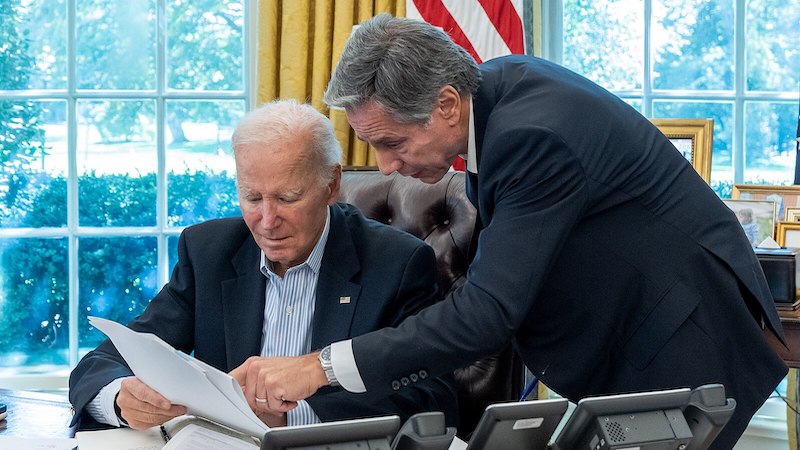
Eavesdropping on the threesome’s most recent chat
Biden: Damnit Bibi! I warned you – don’t drop our American bombs in Rafah. Why man? On tents with kids and women….
No response.
Blinken: Hello Bibi. Hello. Blinken here with Joe. Can you hear us? Bibi! Netan?… Man, the latest bombing is making us look really bad. My boys say that even our media cannot avoid running the story.
Netanyahu: Yes, yes, I’m here. Look. All is fine. Don’t panic. We have always used your bombs. Everybody knows that.
I’ve said that it was a mistake and that we will do a full investigation. Blinky, tell your media that we killed several militants hiding in the tents. We have every right to defend ourselves when Hamas uses women and children to fight.
Biden: Damnit. For now until later, please, Stop using our bombs in Rafah, please. I’m right in the middle of my campaign and I can’t afford to lose any more votes over Gaza.
Blinken: I told Gallant earlier. You can use the heavy stuff given by the Brits, French or Germans. Or any other. But don’t use our stuff indiscriminately.
The Brits and others want to look good standing with you against Hamas and the Muslims. They are shit-scared of the Islamics. It’s perfectly okay to use their bombs, rockets and other stuff on Hamas or whoever. Nobody in Europe really bothers. In fact, most will support. They are all focused on Putin.
Biden: Listen, we have the college kids giving us a hard time and we also need to look better with the Saudis, Egypt and others. This kind of mistake is playing into Iran’s hand. So go easy and tell your IDF and air force not to be so trigger-happy and to avoid any more mistakes.
Netanyahu: Come on, surely you can deal with college kids. Just kick them where it hurts. They will run back to their mummies.
Look. I have bigger issues to deal with. The campaign against me by the hostage trouble making families and pro Hamas peace shitheads has gone on too long. I need to show Lapid and Benny that there’s no way they can bring me down. I, and only I, can lead Israel to victory.
Biden: We’re standing by you Net. All the way.
Biden: Yes. Boss just recently told the ICC off for the arrest warrant on you. If you do a Google search, you will find that all the world media carried Joe’s statement that what’s happened in Gaza is not genocide. Every media, everyone headlined the Boss’s defence of you. CNN, BBC, NYT, Washington Post, Reuters, Fox, Al Jazeera, ABC, Politico….
You name it. All of them share our view that there’s no genocide taking place in Gaza or Rafah.
There’s no way the ICC can touch you. We guarantee you that and we’ll also take care of Karim and Bensouda. Make sure they regret their action against you.
Netanyahu: Yes, okay. I know Joe. You are my good friend. You pull the strings on your side and we’ll make sure ours will help you in November. In fact, our people are already working hard to make sure you win.
Don’t forget I was the first person to congratulate you when you won. That pissed Trump. The schmuck cannot be trusted. Can you imagine! He used the F… word on me. I will never forget it.
Biden: Thanks again Bibi. Yeah, He’s a really bad guy. I will cut him down to size. But you have to help a lot more this time. We need plenty of moolah for the campaign. If I lose, you will have to deal with him.
Blinken: I’ll make sure the money is properly handled, Bibi.
It’s touch and go but the money can make the difference. Americans will vote for Biden if we can get more negative news out on Trump. And let me remind you that everyone knows that Trump wants to cut a deal on Palestine if he wins.
This means that you have to keep the war against Hamas going until election day at the least.
Netanyahu: No problem on the money, my friend. And I promise you I will keep the battle against Hamas and in Gaza going for much longer than anyone expects. You just have to keep sending us the war stuff.
For now though you need to help me first in dealing with the Euros.
Bloody Norwegians, Spanish, and Irish cannot be trusted. How dare they recognise Palestine. I thought you would keep them on our side.
I’ve told Kantz to screw Sanchez on this. Unbelievable that Spain is encouraging the genocide against us. Ireland and Norway, I can understand. Their public has always been anti Jew.
But the Spanish. I know that they have always been against us throughout history. But we never expected them to stoop so low to bring the other two against us. I am giving a warning to Sanchez and the other two. We will fight to the end and finish off Hamas. However long it takes and whatever is needed. Total victory is my promise to my people.
Blinken: Just received this message that Katz has been on X to say that Sánchez’s government is “being complicit in inciting genocide against Jews and war crimes.” We will play this up, Bibi. We will make the world realise the G word is one that we have full control over – not the ICC, not the UN, not the rest of the world.
Biden: I have to go now to prep for my debate against Trump. Don’t forget to get the moolah to us quick, Bibi.
Blinken: Good to chat again, Bibi. We will make sure Biden has nice things to say about you and Israel on the 27th.
Netanyahu: Okay. My boys will tune in to give full support to you.
From Google Search
By Olivia Enos
Since 2017, the Chinese Communist Party (CCP) has carried out a comprehensive campaign against the Uyghurs, a Muslim minority group predominately based in Xinjiang, China. Beijing is holding an estimated 1.8 million Uyghurs in political reeducation camps, subjecting more than 3 million to some form of forced labor, and seeking to reduce the Uyghur population through forced abortions and sterilizations. Because of this and other evidence, the United States issued an atrocity determination declaring that Uyghurs face ongoing genocide and crimes against humanity.
The atrocity determination was incredibly important as it spurred follow-on action from the US and other governments. The passage of the Uyghur Forced Labor Prevention Act (UFLPA) was one of the more powerful actions following the US determination. The UFLPA created a “rebuttable presumption” stating that the government would bar all goods produced “wholly or in part” with Uyghur forced labor from entering US markets.
The UFLPA was signed into law in December 2021 and enforcement provisions went into effect in June 2022. Now, more than two years after its passage, trendlines are emerging, and policymakers can now evaluate the law’s effectiveness and ascertain new means for mitigating Uyghur forced labor.
The CCP has not stopped targeting Uyghurs, and in fact has subjected even more of them to forced labor. Today, the CCP operates what some analysts believe is the largest state-sponsored forced labor program in the world. Given the CCP’s ongoing exploitation, the onus is on the US and the international community to curtail this egregious practice. At a minimum, democratic leaders need to ensure that citizens of the free world are not inadvertently supporting the continuation of these abuses.
For the UFLPA to be maximally effective, Washington should complement it with comprehensive sanctions implementation and a secondary sanctions regime that targets entities aiding and abetting in the CCP’s enslavement of Uyghurs. Moreover, other countries need to close their markets to goods produced with Uyghur forced labor. To that end, the US and other countries can coordinate better to implement strong measures similar to the UFLPA. Perpetrators of Uyghur forced labor need to pay financially for their crimes through fines and forfeiture. Finally, the US should offer financial remedies to help survivors of the CCP’s ongoing genocide and crimes against humanity.
While the UFLPA was a notable development in the fight against Uyghur forced labor, more has to be done to ensure the end of Uyghur forced labor. The international community needs to join together to hold the CCP accountable and protect Uyghur rights.
Understanding the UFLPA Toolbox
The Goals
The UFLPA’s goals are multifaceted, so analysts should evaluate its implementation in a multifaceted manner. The law has two aims. First, it seeks to ensure that goods produced with Uyghur forced labor do not enter US markets, where Americans would inadvertently support the Uyghur’s continued enslavement. Second, the law seeks to end Uyghur enslavement.
Implementation and effective enforcement of the UFLPA more readily accomplishes the first goal. But implementation alone cannot accomplish the second goal. After all, if Customs and Border Protection (CBP) discovers goods produced with Uyghur forced labor at the border, then the Uyghur forced labor has already occurred.
The Tools
The UFLPA has four discrete areas of policy action: (1) the rebuttable presumption, (2) the UFLPA Entity List, (3) the strategies, and (4) amended sanctions authorities.
1. The rebuttable presumption. The rebuttable presumption is the most noteworthy element of the UFLPA. This tool requires CBP to presume that “all goods, wares, articles, and merchandise mined, produced, or manufactured wholly or in part in the Xinjiang Uyghur Autonomous Region of China, or by persons working with the Xinjiang Uyghur Autonomous Region government for purposes of the ‘poverty alleviation’ program or the ‘pairing-assistance’ program which subsidizes the establishment of manufacturing facilities in the Xinjiang Uyghur Autonomous Region,” are produced with Uyghur forced labor.
The rebuttable presumption amplifies Section 307 of the Tariff Act of 1930. The policy puts the onus on businesses to prove that they did not import goods produced with Uyghur forced labor, requiring a “clear and convincing” evidentiary standard to rebut the presumption. The rebuttable presumption applies not only to Xinjiang but also to other places in China where the CCP coerces Uyghurs to work through various forced labor transfer programs. It also applies to other persecuted groups, including Kyrgyz, Kazakhs, and Tibetans, and members of other groups persecuted by the CCP. The UFLPA’s broader nature is critical since substantial evidence shows that the CCP is targeting members of these other groups.
This act is not the first time that the US has used a rebuttable presumption to combat forced labor. The Countering America’s Adversaries Through Sanctions Act (CAATSA) also applied a rebuttable presumption to North Korea, stating that any goods produced “wholly or in part” with North Korean forced labor are banned from entering the US. Both acts assert that if Uyghur or North Korean labor produced a good, that labor is presumed to be forced, so it cannot enter the US.
2. The UFLPA Entity List. The UFLPA Entity List prohibits the importation of goods from certain entities using authorities derived from 19 U.S.C. § 1307. Congress created the UFLPA Entity List to identify “entities working with the government of the Xinjiang Uyghur Autonomous Region to recruit, transport, transfer, harbor or receive forced labor or Uyghurs, Kazakhs, Kyrgyz, or members of other persecuted groups out of the Xinjiang Uyghur Autonomous Region.” In the original statute, there were four separate lists, but those lists have been consolidated into one. The list has a few discernible purposes, such as making the US business community aware of actors known to employ Uyghur forced labor, as well as naming and shaming entities responsible for Uyghur enslavement.
The UFLPA Entity List was modeled after the US Department of Commerce’s Bureau of Industry and Science (BIS) Entity List, which specifically bans Americans from investing in companies on the list; although, this was not how it was originally crafted in the statute. Entities can be added to the list by either Congress (see the text of UFLPA legislationthat specifically added the Xinjiang Production and Construction Corps, or XPCC, to the list) or the Forced Labor Enforcement Task Force (FLETF). This organization is an executive branch task force chaired by the Department of Homeland Security (DHS) and composed of seven UFLPA implementing agencies—including the US Trade Representative, Department of Labor, Department of Justice, Department of State (DoS), Department of Treasury, and the Department of Commerce. Entities can request to be removed from the UFLPA Entity List if they can prove that they no longer meet the statutory criteria.
3. The strategies. The UFLPA required the secretary of state to produce a report to Congress within 90 days of the law’s passage detailing the DoS’s diplomatic strategy for advancing certain UFLPA priorities. The law specified that the report must include a strategy for bilateral and multilateral engagement to end Uyghur and other forms of forced labor in China; a detailed plan for public diplomacy and counter-messaging to raise awareness about the Uyghur cause; and finally, a two-pronged plan outlining DoS’s coordination with civil society, as well as plans of action to secure political prisoner releases and resettle Uyghur and other refugees.
While DoS produced the strategies, they were never shared publicly; they were merely transmitted to Congress. In a private conversation with one State Department employee, it was suggested that there was no plan to make them public out of a desire to not hand the game plan to the CCP.1 Other strategies published by DHS, however, have been made public; the department released its first one in June 2022 and updated it in July 2023.
4. Sanctions authorities. In addition to the aforementioned tools, the UFLPA also amended and expanded sanctions authorities under the Uyghur Human Rights Policy Act (UHRPA) of 2020 to include individuals involved in “serious human rights abuses in connection with forced labor.”
Since UHRPA’s passage, Treasury only designated two individuals under its sanction’s authorities, neither for their involvement in forced labor. In short, no individuals have faced financial sanctions under UFLPA or UHRPA authorities specifically for their involvement in perpetuating Uyghur forced labor since the UFLPA went into effect.
Prior to the UFLPA’s passage, the US government sanctioned key entities and individuals in China, including XPCC, for their facilitation of forced labor in China. These sanctions were issued under Global Magnitsky sanctions authorities.
The Outcomes
CBP created a statistics dashboard to track the dollar value of goods detained at ports under UFLPA. As of May 2024, the agency had investigated over $3 billion in goods; of that number, approximately $680 million in goods were found to be subject to the rebuttable presumption and denied entry into the US. To put this in perspective, less than one-third of the dollar value of goods reviewed by CBP were denied entry to the US under UFLPA. On a pure shipment-by-shipment basis, of the 7,000 shipments investigated, less than half were denied entry to the US.
Not only is the total value of goods investigated relatively low, but the percentage of goods suspected of being tainted by Uyghur forced labor also seems low relative to the scale of the Uyghur forced labor challenge. A 2024 report from Adrian Zenz found evidence from CCP documents that over 3 million Uyghurs continue to labor through the party’s so-called Poverty Alleviation Through Forced Labor Program. While other forms of forced labor, like camp-adjacent forced labor, are believed to have ended in 2020, forced labor transfers continue to expand. To make matters worse, if Uyghurs refuse to participate in forced labor transfer programs, new evidencesuggests the CCP sends them to political reeducation camps.
Furthermore, a team of researchers at Sheffield Hallam University identified 55,000 companies of varying sizes operating in the Uyghur region. Of that number, the report found at least 150 companies actively hiring Uyghurs through state-sponsored forced labor transfer programs. While more research needs to be done to connect these companies exporting products made with Uyghur forced labor to US markets, the Sheffield Hallam reports raised awareness about global supply chains’ vast vulnerabilities to Uyghur forced labor, even after the UFLPA went into effect.
While not all goods produced with Uyghur forced labor will enter US markets (for example, businesses may send the goods to other markets or divert them due to the UFLPA), the CBP’s documented rate of apprehension seems low compared to the number of companies (including US companies) doing business in Xinjiang and the sheer volume of Uyghur forced labor.
Challenges and Opportunities for Future Implementation
To strengthen the UFLPA, the US government needs to adequately enforce the law, hold bad actors accountable for perpetrating Uyghur enslavement, and offer relief to Uyghur survivors of the CCP’s genocidal practices. Doing so requires an assessment of how the tools are working so far. Although UFLPA is landmark legislation, enforcement issues pose by far the greatest challenge to its effective implementation. Accountability measures—like sanctions and fines—are also needed to complement preexisting UFLPA structures. And finally, the US government should coordinate better with allies to provide more comprehensive relief and assistance to Uyghur survivors of the CCP’s ongoing genocide and crimes against humanity.
Enforcement
Several gaps in enforcement remain, and closing them would substantially improve the law’s outcomes.
Reexport. If CBP suspects that a good was produced with Uyghur forced labor and detains it under UFLPA, businesses can still reexport it to another country. In general, importers have the option to reexport a product even before CBP makes a final determination on whether it was produced with forced labor. While an importer should have the ability to reexport a good if it is not suspected of being produced with forced labor, the importer should arguably not be able to evade accountability if it violated the UFLPA. The ability to reexport substantially diminishes the financial consequences an importer would face for using Uyghur forced labor and means that the goods prohibited entry in the US may simply find a home in another market. While the reexport policy does achieve one goal—ensuring that US consumers are not inadvertently complicit in supporting Uyghur enslavement—it does not prevent importers from benefiting financially from Uyghur exploitation.
Ineffective use of the UFLPA Entity List. The UFLPA Entity List is one of the most essential elements of the UFLPA. Since the bill’s passage, the government has updated the list five times, and now it includes 56 entities. Thirty-six additions have been made since the list’s creation in 2022; the latest addition of 26 entities to the list occurred on May 16, 2024. After being placed on the list, that entity is among the highest priorities for CBP enforcement. The slow pace at which additions have been made and the relatively low number of additions is concerning, even after the most recent, albeit notable, additions. Many, including the US House Select Committee on Strategic Competition between the United States and the Chinese Communist Party (Select Committee on the CCP), have raised concerns about the limited use of the UFLPA Entity List and asked the Biden administration to increase enforcement.
Adding an entity to the UFLPA Entity List is a relatively onerous process. The seven agencies on the FLETF—some of which are less engaged in enforcing UFLPA than others—need to approve the addition. To be more precise, any members of the FLETF can propose additions of an entity to the list, and in the final analysis, it requires a majority vote to approve the additions. Some analysts have suggested that the government revise the process to make it faster, especially in light of the fact that some of the agencies, like Treasury, have not put forth a single recommendation for entities to be added to the list.
If the inter-agency process proves too cumbersome, the government can add entities to the list in other ways. In both the initial draft legislation and final version of the statute, Congress named the XPCC to the UFLPA Entity List, so Congress should have the authority to make further additions. If the White House fails to make additions to the list, then Congress could put forward a list of entities they suspect are complicit in Uyghur forced labor and require the administration to say whether these entities have imported goods to the US and therefore should be added to the UFLPA Entity List. Congress would ostensibly be exercising its legitimate oversight responsibility in ensuring the implementation of UFLPA.
Inadequate use of the UFLPA Entity List has several consequences. First, placement on the list is an important punitive measure, allowing the FLETF and Congress to name and shame offending corporations. Second, the list helps importers avoid doing business with the worst abusers of Uyghur forced labor. Finally, this awareness helps businesses better ensure that the goods they import are not tainted by Uyghur forced labor.
The scope of products targeted. The UFLPA gives CBP the ability to target not only Uyghur forced labor but also forced labor of Kyrgyz, Kazakhs, Tibetans, and other groups persecuted by the CCP. Goods produced through such labor should be denied entry to US markets.
The case for Tibetans, in particular, is strong. One 2020 report documented the mobilization of over half a million rural laborers in Tibet through vocationalized military training programs, which were similar to those for Uyghurs. Given the scope of forced labor programs in Tibet, denying entry to goods produced by Tibetan forced laborers should be a CBP priority. But so far there is no public evidence that the CBP has stopped goods that were believed to be produced with Tibetan forced labor.
CBP has taken steps to target third countries responsible for facilitating Uyghur forced labor. According to the CBP dashboard, the agency has denied entry to more goods produced with Uyghur forced labor imported from Malaysia, Vietnam, and Thailand than from China. It is not clear whether or to what extent CBP has stopped goods produced with forced labor from other groups persecuted by the CCP.
De minimis. Under US law—Section 321, or 19 U.S.C. § 1321—de minimis allows daily low-dollar shipments to enter the US market free of tariffs and duties. More specifically, CBP says “de minimis provides admission of articles free of duty and of any tax imposed on or by reason of importation, but the aggregate fair retail value in the country of shipment of articles imported by one person on one day and exempted from the payment of duty shall not exceed $800.”The government originally set de minimis at $5 per day and later adjusted it to $200 per day in 1994. The Trade Facilitation and Trade Enforcement Act of 2015, which became law in February 2016, increased the threshold to $800. Congress designed de minimis to reduce the government’s overhead costs for customs processing and ultimately reduce the cost of imported goods to US consumers.
The alternative to de minimis entry to the US is formal entry. CBP receives nominally more information about the goods entering through formal entry processes than through de minimis, because the agency does not give goods entering under de minimis a Harmonized Tariff Schedule (HTS) code. An HTS code assigns the relevant tariff rate for the good in question. Goods entering the US under de minimis are still required to provide manifest data. CBP still reviews goods entering the US under de minimis before permitting entry, and nearly 90 percent of counterfeit goods are seized in the de minimis context. In fact, CBP has the same authority to investigate and seize goods entering under de minimis as it does for goods entering through formal entry.
The human rights and business communities have debated whether de minimis is a loophole that allows goods produced with forced labor to avoid scrutiny and pass through US borders. The Select Committee on the CCP released an interim report in June 2023 detailing preliminary evidence that Shein and Temu may abuse de minimis provisions to skirt CBP enforcement of its ban on products produced with Uyghur forced labor.
Since then, Congress has taken several actions and held notable hearings on the topic, including one before the US House of Representatives’ Committee on Homeland Security. Testimony from Kimberly Glas, president and chief executive officer of the National Council of Textile Organizations, noted that 90 percent of China’s cotton crop comes from Xinjiang and China supplies 20 percent of the world’s cotton production. Given the scope of China’s cotton production, Glas expressed concern about the limited scrutiny textiles produced in China receive under de minimis provisions.
Allowing the importation of goods below a certain dollar amount without tariffs or duties is not, in and of itself, a bad thing. The ill is not from tariff-free treatment; it is from companies abusing the privilege by importing goods produced with forced labor. As such, the way to strengthen enforcement across all entry types is likely not to throw out de minimis or return the threshold to $200 per shipment per day. Instead, the government should punish offending companies. The US should deny companies (or even countries) access to de minimis privileges when they repeatedly violate the UFLPA through de minimis. Then all future shipments imported by the offending company or country should enter the US under the formal entry process and face tariffs and duties.
Accountability
There is a need for greater accountability for perpetrators of Uyghur forced labor. This can come in many forms, but making better use of CBP’s preexisting authorities and expanding other sanctions authorities should be a top priority.
Fines and forfeiture. While CBP possesses the authority to fine importers or seize or forfeit goods made in whole or in part with forced labor, it rarely does so. If the agency finds goods produced with forced labor, it could, for example, issue fines under U.S.C. 1592 or issue “penalties for fraud, gross negligence, and negligence.” While first-time violators of UFLPA should likely not be subject to fines, repeat offenders should face higher consequences than merely having their goods denied entry to the US because they failed to keep their supply chains free of Uyghur forced labor. Fines and even forfeiture have the potential to do just that.
There is precedent for fines in US law regarding forced labor. One report from the Congressional Research Service noted:
The importer of record may face liability for noncompliance with Section 307. For example, in its first civil enforcement action since the passage of TFTEA, in August 2020, CBP fined Pure Circle U.S.A. Inc. $575,000 after an investigation found evidence of past imports of stevia made with prison labor in China. Additionally, the Tariff Act of 1930 permits CBP to impose civil penalties for any person who “by fraud, gross negligence, or negligence” introduces or attempts to introduce any merchandise into the United States by means of false information or material omissions. Such penalties can extend to persons beyond the importer of record. A person or corporation that “benefits, financially or by receiving anything of value, from participation in a venture which has engaged in the providing or obtaining of [forced labor],” when that person or corporation knew, or recklessly disregarded, how the labor was obtained may face further criminal and civil penalties under anti-trafficking laws.
Therefore, CBP can levy civil penalties under the Tariff Act for failure to keep supply chains clear of forced labor. This precedent should embolden CBP to undertake more civil actions as an additional mechanism for both accountability and enforcement of UFLPA.
Fines from companies could go into a dedicated fund administered by Treasury or State, where they could be payable to Uyghur survivors of ongoing genocide and crimes against humanity, including forced labor, or for organizations fighting for justice for Uyghurs. The fund would ensure that the US government was not profiting from enforcement of UFLPA but instead was using the fines to help survivors of the CCP’s atrocities.
Sanctions and secondary sanctions. Sanctions are an important tool for holding perpetrators accountable. In the one other context where Washington implemented a rebuttable presumption—North Korea—the US complemented these policies with a robust sanctions regime.
Due to congressional action, Treasury already has substantial authorities to sanction actors who use forced labor. However, the department has not effectively or proactively used preexisting sanctions tools under UHRPA and Global Magnitsky. Under the Biden administration, for example, Treasury has sanctioned only four individuals and one entity from China for human rights violations under UHRPA and Global Magnitsky authorities. None of these sanctions were issued on forced labor grounds.
During the Trump administration, the US issued sanctions against XPCC, the entity most responsible for the enslavement of Uyghurs, as mentioned earlier. But Treasury has not sanctioned additional subsidiaries of XPCC since the initial designations in 2020, and some experts question how much the US has enforced existing XPCC sanctions.
While Treasury has many primary sanctions authorities to target human rights violations, it does not yet have the authority to issue secondary sanctions to target violators of forced labor. Last year, Congress introduced legislation that would expand secondary sanctions authorities as a complement to its passage of UFLPA. But that legislation has not passed. Secondary sanctions would enable Treasury to target those aiding and abetting Uyghur forced labor. Such tools would strengthen the US government’s ability to more thoroughly tackle the forced labor challenge.
Partnerships and International Cooperation
Effectively ending Uyghur forced labor requires partnership and collaboration with countries around the globe.
The need for UFLPA-like laws in other countries. Although the UFLPA sparked interest among other countries to implement similar laws to ban Uyghur forced labor and combat forced labor generally, foreign governments have been slow to act.
A new Canadian law, the Fighting Against Forced Labor and Child Labor in Supply Chains Act in 2023, went into effect in January 2024. The new law implements reporting requirements on Canadian businesses (and others) to outline their efforts to prevent forced labor in their supply chains. It also includes punitive components for failure to comply with the law’s regulations. Likewise, the European Union reached a provisional agreement on banning goods produced with forced labor in March 2024. But the law is awaiting official approval, after which EU countries will have three years to comply with the law. The law is aimed at China, but it targets forced labor broadly and stops short of a rebuttable presumption. The United Kingdom has similarly introduced legislation that complements the Anti-Slavery Actpassed in 2015, which specifically targets Uyghur forced labor. But the new law has been slow-moving, and there is little political will to pass it. The US and Japan also launched a task force to combat forced labor, with an eye toward tackling Uyghur forced labor challenges; their first meeting was in February 2024.
While these actions are commendable, more is necessary to ensure that goods produced with Uyghur forced labor do not find homes in other markets. In particular, most of these efforts so far have not included a rebuttable presumption provision to tackle Uyghur forced labor. Now that the UFLPA has been in effect for nearly two years, countries around the globe can glean lessons learned from the UFLPA’s successes and failures to create and pass similar and stronger legislation to curtail the CCP’s continued exploitation of Uyghurs.
The need for coordinated action and response. Beyond crafting their own laws to target Uyghur forced labor, the US and the international community should strengthen efforts to support the Uyghur people.
Multilateral sanctions issued by the US, EU, UK, and Canada in response to the determination that Uyghurs face ongoing genocide and crimes against humanity sent a powerful signal that the world was united in its condemnation of CCP atrocities. Additional multilateral sanctions should be issued by the US and allies; a tranche specifically responding to forced labor could be particularly powerful.
Furthermore, Uyghur survivors of the atrocities, including those who spent time in the camps or were subject to forced labor, may eventually seek safe haven in the US or elsewhere. One 2023 report from the Uyghur Human Rights Project noted that the US has between 500 and 1,000 Uyghur asylum cases sitting in backlog—and some have waited eight years or more for their claim to be resolved. Another report from Time noted that in 2021 the US did not admit a single Uyghur refugee. The US and the world can do better. Both should adopt more welcoming policies with expedited means of resettling Uyghurs within their borders.
Policy Recommendations
The scope and scale of the Uyghur forced labor problem merits a strong response. The UFLPA marked a strong start—and a commitment to strengthening its effectiveness and enforcement is critical to ensuring UFLPA’s long-term success.
The UFLPA alone cannot end Uyghur forced labor. The US and the international community need to implement complementary policies that punish perpetrators of forced labor and ensure that goods produced with forced labor do not make their way to their markets. The US Congress and executive branch should implement the following 13 measures.
1. Fine repeat offenders of UFLPA for importing goods produced with Uyghur forced labor. Under U.S.C. 1592, CBP has the authority to fine importers for fraud, gross negligence, and negligence. There is also precedent for issuing civil penalties to companies that use forced labor. Repeat offenders of UFLPA are particularly ripe for facing penalties. In fact, issuing fines adds an additional layer of accountability to especially gross violators of the UFLPA, and will increase the risk to businesses of having Uyghur forced labor in their supply chains. CBP should make better use of these preexisting legal authorities and issue fines against repeat violators of the UFLPA.
2. Create a fund for Uyghur survivors of the CCP’s ongoing genocide and crimes against humanity. The government should place fines collected from repeat violators of the UFLPA into a fund administered by Treasury or State payable to Uyghur survivors of ongoing genocide and crimes against humanity. These funds could also support the important work of organizations providing direct support to Uyghur survivors of forced labor and other injustices, including various forms of technical assistance, counseling and rehabilitation services, advocacy funding and support, among other potential worthy causes.
3. Prohibit imports produced with Uyghur forced labor from being reexported. When CBP detains a good, it uses authorities under 19 U.S.C. 1499. Once a shipment is detained, importers have a range of options for what they can do with it, including reexportation, even if CBP believes the good was produced with forced labor. Those importers should not have the option to reexport such a shipment until it is established through a clear and convincing evidentiary standard that it was not produced with forced labor. Importers should not be permitted to profit from goods potentially produced with forced labor in the US or other markets, and this restriction on reexportation would more effectively ensure that does not happen. If CBP investigates a good and deems that it was not produced with forced labor, it should then be released, and reexport would then be an option for importers.
4. Congress and the executive branch should more expeditiously add entities responsible for enslaving Uyghurs to the UFLPA Entity List. UFLPA technically gives both Congress and the administration the ability to add entities to the UFLPA Entity List. This design is evident by the construction of the law, which automatically added XPCC to the UFLPA Entity List when the act passed.
Congress may choose to exercise its oversight authority by putting the administration on notice. For example, Congress could put forward a list of entities for consideration to be added to the UFLPA Entity List and give the FLETF 90 to 180 days to either place the entities on the list or justify to Congress why they have not been added. Congress exercises these authorities when it comes to sanctions and could undertake similar oversight measures as it relates to additions to the UFLPA Entity List.
FLETF also has full statutory authority to add entities to the list. Given that FLETF comprises seven implementing agencies with varying levels of commitment to countering Uyghur forced labor, the process of adding entities has proved cumbersome. Although recent additions add some hope that the UFLPA Entity List will be more robustly used, only time will tell how effectively and expeditiously additions will be made. If it continues to prove a slow and cumbersome process, revising the process may be worth considering for the sake of efficiency and expediency. Such a move would likely require an amendment to the UFLPA.
5. CBP should use existing authorities to ban violators of Section 307 of the Tariff Act of 1930 and UFLPA from using de minimis entry. Companies found to repeatedly import goods produced with Uyghur forced labor through de minimis should be denied the ability to use this form of entry.To that end, Congress should create a list that CBP has the authority to add companies to who are violating UFLPA while importing through de minimis. Such a list sufficiently punishes perpetrators of Uyghur forced labor while allowing compliant companies to continue to use tariff-free forms of importing to the US. Doing this would target CBP’s limited resources toward addressing and punishing the conduct of the worst actors.
6. Ramp up efforts to ensure that goods produced with forced labor from other groups—including Tibetans, Kyrgyz, Kazakhs, and other groups persecuted by the CCP are not entering US markets. CBP can include a section in the UFLPA dashboard that outlines the agency’s efforts to stop goods produced with forced labor from these other groups from entering the US. In lieu of their permanent inclusion in CBP’s dashboard, the agency can send Congress an update outlining its efforts to stop the importation of such goods.
7. Extend permanent refugee pathways, like Priority-2 refugee status, to Uyghurs. The UFLPA mandated that the US Department of State include in its strategy their plans “to provide humanitarian assistance, including with respect to resettlement and advocacy for imprisoned family members, to Uyghurs, Kazakhs, Kyrgyz, Tibetans, and members of other persecuted groups, including members of such groups formerly detained in mass internment camps in the Xinjiang Uyghur Autonomous Region.” Yet the administration has done little to ensure the swift resettlement of Uyghurs.
To accomplish this goal, Congress or the administration should extend expedited and permanent means of resettlement by designating Uyghurs a group of special humanitarian concern under the Priority-2 (P-2) refugee program. As such, they can bypass UN High Commissioner for Refugees (UNHCR), non-governmental organization, and embassy referral and enter straight into the US refugee system. P-2 refugees are vetted by the US government as stringently as every other refugee entering the US. Extending this form of protection would adequately reflect the unique persecution Uyghurs face.
8. Strengthen sanctions with a robust regime to increase the enforcement and effectiveness of the UFLPA. To be effective, the US should complement the rebuttable presumption with a robust sanctions regime. Washington implemented previous rebuttable presumptions, like the one CAATSA created for North Korea, alongside a strong set of sanctions responsible for ensuring compliance with the rebuttable presumption. Failure to comply with the rebuttable presumption should have implications for those perpetrating Uyghur forced labor and those aiding and abetting in its continuation.
9. Make full use of preexisting sanctions authorities under the UHRPA as amended by the UFLPA. The UFLPA amended the UHRPA to include the ability to target foreign individuals responsible for serious human rights abuses related to forced labor in China. Even though almost two years have passed since the law’s modification, the US has sanctioned only two individuals under the UHRPA, and did not do so for their involvement in carrying out forced labor in China. Meanwhile, UHRPA is slated to sunset in June 2025, so Congress should codify those authorities to ensure that they continue and Treasury can possess the authorities it needs to target CCP human rights violations against the Uyghurs. Washington should use the additional sanctions authorities under Global Magnitsky executive order authorities to target individuals and entities responsible for carrying out Uyghur forced labor. And Treasury should implement sanctions currently on the books, especially those against XPCC, to the fullest extent of the department’s authorities.
10. Create and enforce secondary sanctions against individuals and entities complicit in Uyghur forced labor. Most goods imported to the US that are found to be tainted by Uyghur forced labor come from Vietnam, Malaysia, or Thailand. So subsidiaries of Chinese companies in both countries are actively aiding and abetting the continuation of Uyghur forced labor. The US should target those entities with robust secondary sanctions designed to improve the enforcement of preexisting sanctions against entities like XPCC and others responsible for the perpetuation of Uyghur forced labor. Legislation in both the House and the Senate currently proposes the use of secondary sanctions to counter China’s use of Uyghur forced labor. Congress should consider such legislation that would strengthen primary sanctions and build out a thorough secondary sanctions regime.
11. Issue a DHS FAQ on importer evidentiary standards for rebutting the presumption and criteria for being added to the UFLPA Entity List. A rebuttable presumption is maximally effective when evidence shows that the presumption is accurate. In order to have a strong rebuttable presumption, importers should have access to clear guidance on what evidence they can present to meet the clear and convincing evidentiary standard required to rebut the presumption. While these guidelines should be flexible, they should be sufficiently stringent so as to not present potential loopholes for importers to falsely rebut the presumption.
12. Work with partner nations—especially allies, including the United Kingdom, the European Union, Japan, Korea, Australia, and others—to institute legislation similar to the UFLPA. Without similar legislation implemented and enforced around the world, Uyghur forced labor will not stop. Instead, businesses will reexport goods to other markets after the US rejects them, or purposefully divert goods produced with Uyghur forced labor away from US markets since the UFLPA went into effect. While steps taken so far by other capitals are welcome, actual bans on products produced with Uyghur forced labor are necessary to have the full deterrent effect. Countries should observe the lessons learned in the US context to put forward legislation that effectively counters Uyghur exploitation.
13. Allocate additional funding for forced labor divisions in US government agencies. Divisions specifically focused on UFLPA enforcement are in need of additional funding to more effectively enforce UFLPA. Funding could go toward staffing up, especially staff with much-needed Chinese language skills, and dedicated roles of identifying policy responses to improve the UFLPA. There is a need for staff dedicated to researching entities to be added to the UFLPA Entity List in many of the agencies that are members of the FLETF, for example. Previous increases in funding principally went to improving CBP’s enforcement of the UFLPA. Future funding should certainly support that goal while also ensuring adequate funding for other agency’s priorities that complement CBP’s important work.
This report was made possible through the generous support of The Public Interest Fellowship.
- About the author: Olivia Enos is a Senior Fellow at the Hudson Institute
- Source: This article was published by the Hudson Institute

By Iman Muttaqin Yusof
Malaysia will allocate 25 billion ringgit (U.S. $5.3 billion) to train 60,000 local engineers and expand the domestic semiconductor industry, Prime Minister Anwar Ibrahim said Tuesday, as the country seeks to become a neutral, global chip-making hub amid U.S.-China tensions.
The Southeast Asian nation is also looking to capitalize on chip companies diversifying their supply chains with a “China Plus One” strategy, where companies complement production in China with investment in other countries, to avoid a repeat of the demand shock caused during the COVID-19 pandemic.
During a speech at the Semicon Southeast Asia 2024 trade show in Kuala Lumpur, Anwar lobbied for Malaysia as a non-partisan hub for top chipmakers amid rising concerns that U.S.-China tech battles would disrupt supply chains for a range of products, from smartphones to electric vehicles.
“I offer our nation as the most neutral and non-aligned location for semiconductor production, to help build a more secure and resilient global semiconductor supply chain,” Anwar said during the Semicon Southeast Asia 2024 trade show in Kuala Lumpur.
“Geopolitical dynamics aside, a robust multinational semiconductor production remains vital for humankind’s survival, particularly as we are running out of time in our climate action and risk mitigation.”
Anwar said his administration planned to create 10 local companies for semiconductor design and packaging, with projected revenues of $210 million to $1 billion (1 billion to 4.7 billion ringgit). Nurturing an additional 100 semiconductor-related companies with revenue close to 1 billion ringgit ($210 million) would also create higher wages for Malaysian workers, he said.
“We have a strong capacity to diversify and move higher in the value chain towards even more high-end manufacturing, semiconductor design and advanced packaging,” he said.
“We will court at least 500 billion ringgit [$106.5 billion] of investments with domestic direct investment focusing on integrated circuit design, advanced packaging and foreign direct investment focusing on wafer fabs and manufacturing equipment,” he said referring to the production of semiconductor fabrication.
Anwar did not provide a timeline for these targets, but Tengku Zafrul Aziz, minister of Investment, Trade and Industry Malaysia has set targets to achieve its semiconductor ambitions over the next five to 10 years.
In April, Anwar announced a plan to build Southeast Asia’s largest integrated circuit design park to shift focus from chip assembly to high-value work and attract global tech companies and investors.
Malaysia controls about 13% of global chip packaging, assembly and testing services, according to the Malaysian Investment Development Authority, making it the world’s sixth-largest exporter of semiconductors.
Major investments in Malaysia’s semiconductor sector recently include expansions by the U.S.-based Intel and Germany’s Infineon, and AI infrastructure development by Nvidia and Microsoft, according to the authority.
In August 2023, Infineon Technologies announced an investment of up to 5 billion euros ($5.4 billion) over the next five years to build the world’s largest 200-mm silicon carbide power fabrication facility in Malaysia.
Zafrul, the investment minister, said Malaysia’s stance on “geopolitical neutrality, coupled with its adept investment diplomacy” strengthened its global position.
In August 2022, U.S. lawmakers passed the CHIPS and Science Act, authorizing incentives such as subsidies and tax breaks to boost advanced semiconductor production.
Two months later, Washington imposed broad export restrictions on chips and chip-making technology to limit China’s “ability to both purchase and manufacture certain high-end chips used in military applications and build on prior policies, company-specific actions, and less public regulatory, legal, and enforcement actions …”
The U.S.-China tech war and the China Plus One strategy has presented a golden opportunity for Malaysia’s economy, said Wong Siew Hai, president of Malaysia Semiconductor Industry Association.
“In 2021, Malaysia grew 18% in semiconductor export value and in 2022 we grew 30%. The export value was 595 billion ringgit ($126.8 billion) in 2022,” he told BenarNews.
“In 2022, the global semiconductor market grew 3.3% but Malaysia grew 30%, so what that means is that the China Plus One strategy is actually working. … Malaysia is one of the biggest beneficiaries of that shift,” he told BenarNews.
Additionally, said Samuel Tan, a property consultant, Malaysia’s friendly relations with China and the West were key factors in making it an attractive investment hub for companies relocating their manufacturing facilities.
“Malaysia offers a conducive environment for companies due to factors such as a skilled talent pool, robust legal frameworks, political stability, investment-friendly policies, and a supportive ecosystem of small and midsize enterprises,” the executive director of KGV International Property Consultants told BenarNews.
“The country’s multilingual capabilities, low currency rate for competitive exports, and ability to diversify risks further enhance its attractiveness for establishing production hubs.”
China’s approach
Meanwhile, even Chinese firms are applying the China Plus One strategy, according to analyst Collins Chong Yew Keat of the University of Malaya.
“While U.S. and European firms are keen to diversify out of China, Chinese firms are doing the same – to avoid the aftermath of U.S. sanctions – and locating facilities outside of the mainland as part of the China Plus One,” he told BenarNews.
“Concerns on the long-term durability of Taiwan’s prowess in the semiconductor sector with increasing geopolitical and security volatilities have also fueled further focus on Malaysia.”
Collins said Malaysia, Indonesia, Thailand, Vietnam and India stand to be the potential front-runners or popular destinations for companies implementing the plus-one strategy.
Still, Malaysia has the “right ingredients and advantages” to be the top pick of these countries for chipmakers firms, he said.