
Day: May 26, 2024
Today, the Russian “First Channel” published false information about the rally of the “Tavush for the Motherland” movement held in #Yerevan‘s Republic Square. The Russian “First Channel,” directly managed by the #Kremlin, claimed that more than 100,000 people participated in the… pic.twitter.com/zniPldfSub
— Robert Ananyan (@robananyan) May 26, 2024
Current situation | Locust Watch in Caucasus and Central Asia | 联合国粮食及 农业组织 Food and Agriculture Organization of the United Nations
Categories
NPR News: 05-26-2024 5PM EDT
An IDF aircraft struck a Hamas compound in Rafah, targeting senior members of the terrorist organization, an IDF spokesperson said in a statement on Sunday.https://t.co/9gEyKRtd1h
— The Jerusalem Post (@Jerusalem_Post) May 26, 2024
Georgian President Salome Zourabichvili has invited opposition parties to sign a ‘Georgian Charter’ pledging to support the President’s nominations for a new, temporary government after the elections with the stated aim of carrying out pro-European reforms.
At an announcement at the Orbeliani Palace marking Independence Day on Sunday, Zourabichvili said she would choose a government of ‘distinguished, selected, and professional members of society’, rather than politicians.
The president said the new government, to be formed after upcoming elections, would be ‘tasked with implementing a specific European plan’, after which new elections would be held in a ‘new, free environment’ in late 2025.
She said the charter did not entail a joint opposition electoral list. ‘Political parties should determine their own election tactics and strategies once they have signed the Charter — that matter is not mine’, she said.
Georgians are set to go to the polls on 26 October amidst rising anger at the ruling party’s authoritarian and anti-Western turn, including their passage of the controversial foreign agent law.
The move comes just days before Georgian Dream are expected to overcome the president’s veto of the law, despite mass protests and widespread Western condemnation, including the imposition of US sanctions on Georgian officials.
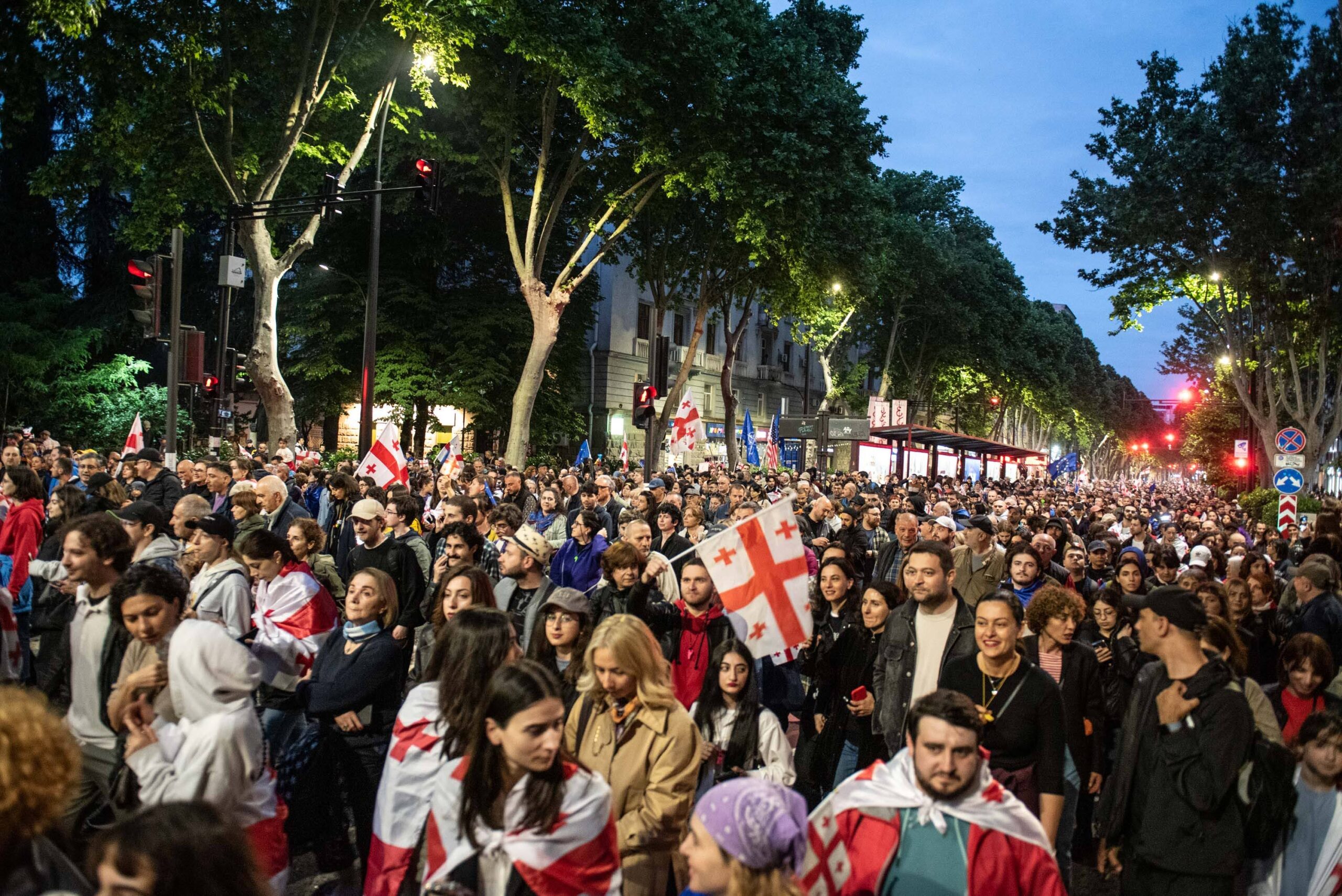 Tens of thousands of protesters came out to the street once again on 26 May. Photo: Mariam Nikuradze/OC Media
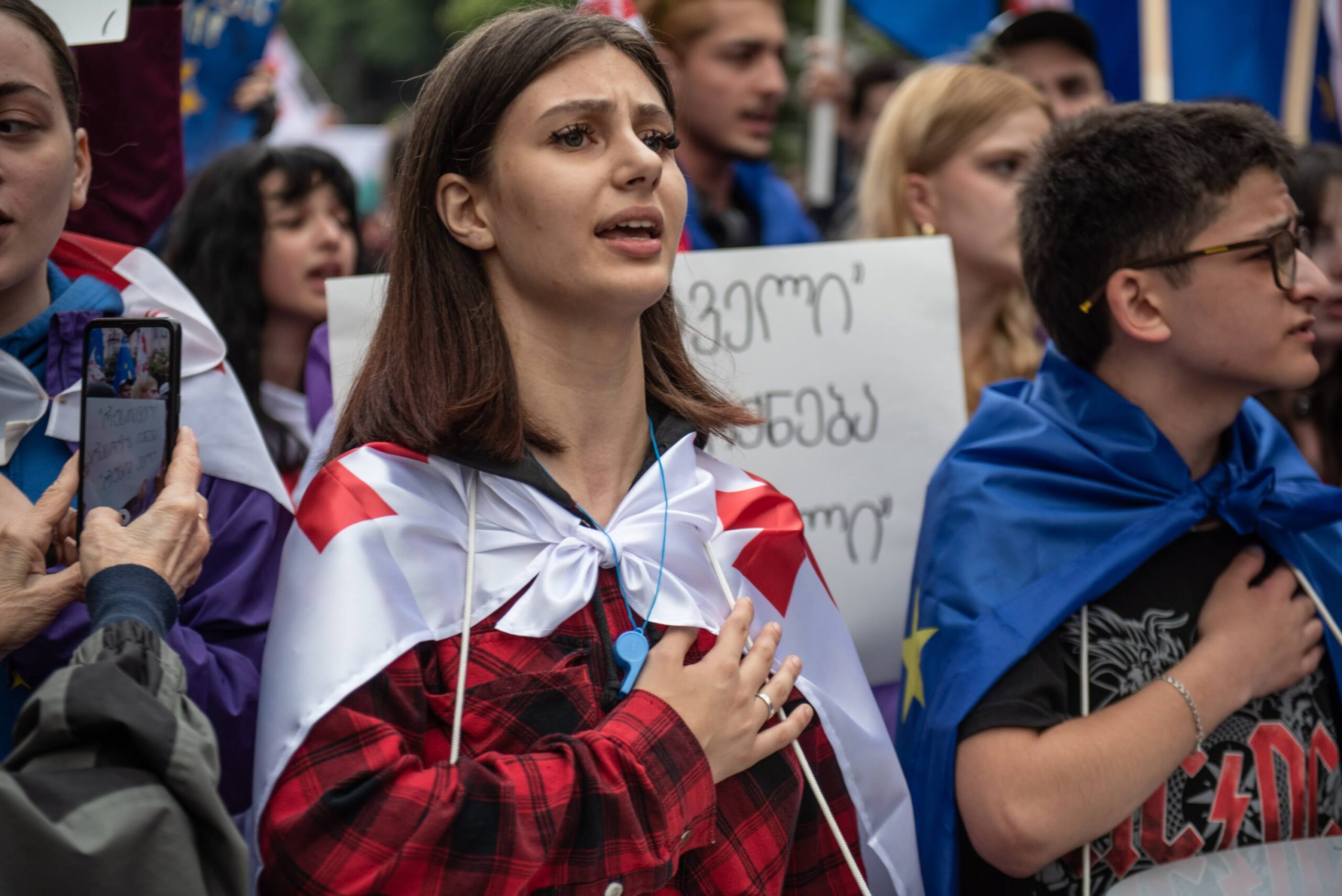 A protester sings the national anthem during 26 May’s protest march. Photo: Mariam Nikuradze/OC Media
On Sunday evening, IPN reported that a number of opposition parties and figures vowed to sign the charter. These included the United National Movement, Lelo, Ahali, Girchi — More Freedom, Droa, European Georgia, as well as independent MP Khatia Dekanoidze from the parliamentary Europtimists group.
Georgian Dream’s parliamentary leader, Mamuka Mdinaradze, attacked the initiative on Sunday night. IPN cited him as saying it was not a ‘Georgian Charter’ but a ‘charter of local war’.
The ‘Georgian Charter’
Since Georgian Dreamreintroduced the foreign agent law in April, a number of European officials have made clear that the law would preclude Georgia from joining the EU. The law threatens to stifle Georgia’s civil society and media.
The President said that autumn’s election would be a referendum on the country’s EU membership.
‘In these elections, we have to decide not who we vote for, but what we vote for! That is why these elections will, in reality, be a referendum — a referendum where we have to answer the following question: do we want Europe or not? And when we vote for any under-signatory party of this Charter, we are, in fact, voting for the “Georgian Charter” and, therefore, for a European future’, she said.
In addition to a promise to support the president’s choice of temporary government, the charter included a number of pledged reforms to be carried out before new elections would be held.
Signatories would promise to immediately repeal legislation passed by the ruling party that ‘contradict [Georgia’s] European path and European recommendations’. These included the foreign agent law, the offshore law, and more.
The charter also promised an amnesty for protesters against the foreign agent law.
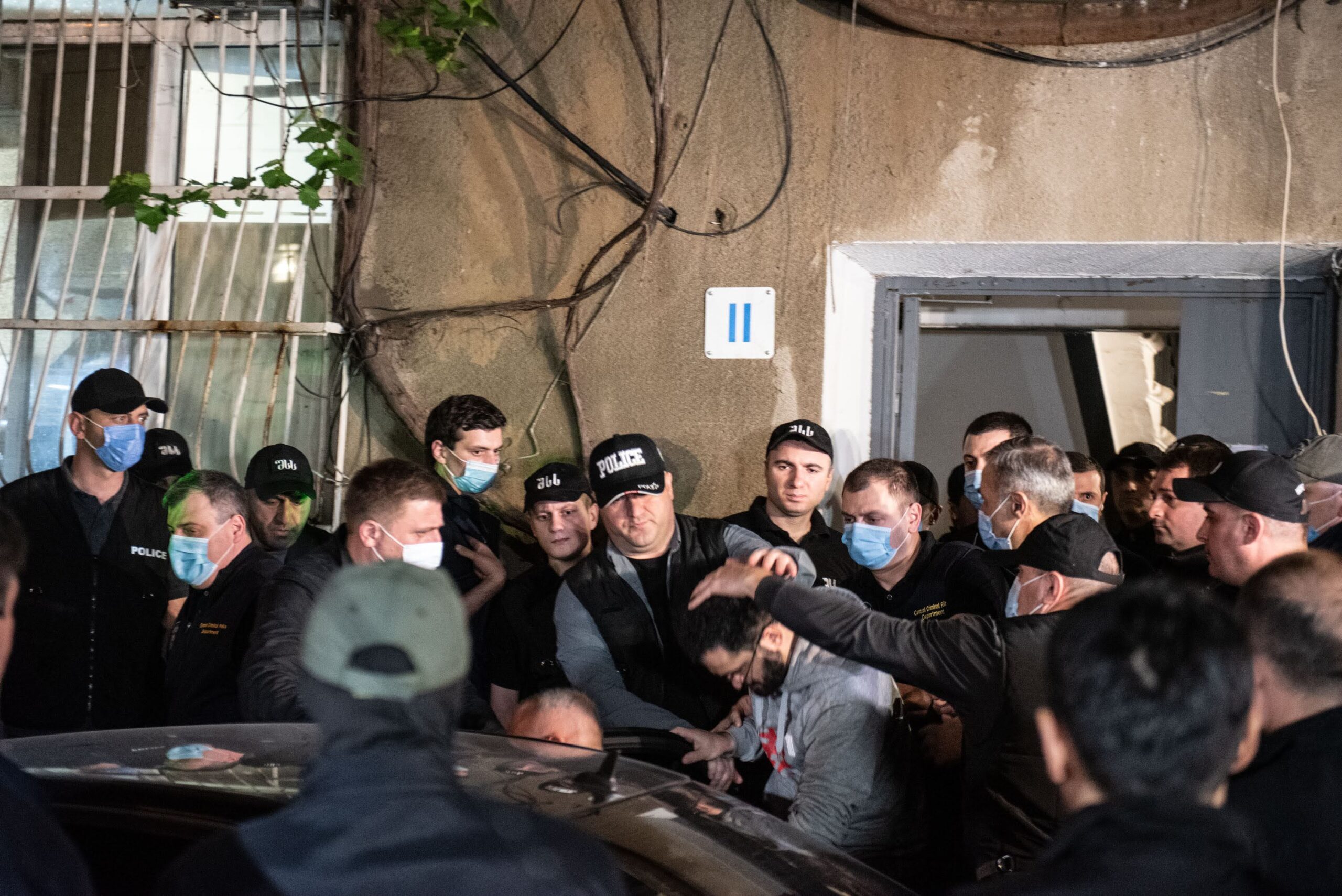 Police arrest Ucha Abashidze, a vlogger critical of foreign agent bill, in Tbilisi on 9 May. Hacking and illegal arms possession charges levied against him are widely believed by critics to be politically motivated. Photo: Mariam Nikuradze/OC Media.
It laid out a series of sweeping judicial reforms. Both local and international critics of the government have accused the ruling party of capturing the judiciary, supporting an influential ‘clan’ of judges who rule on politically sensitive cases.
It promises a ‘fundamental reform’ of the State Security Service and Ministry of Internal Affairs ‘in order to deconcentrate the power’.
‘Effective parliamentary control will be established over the activities of each institution, which will protect them from political influence’, the charter reads.
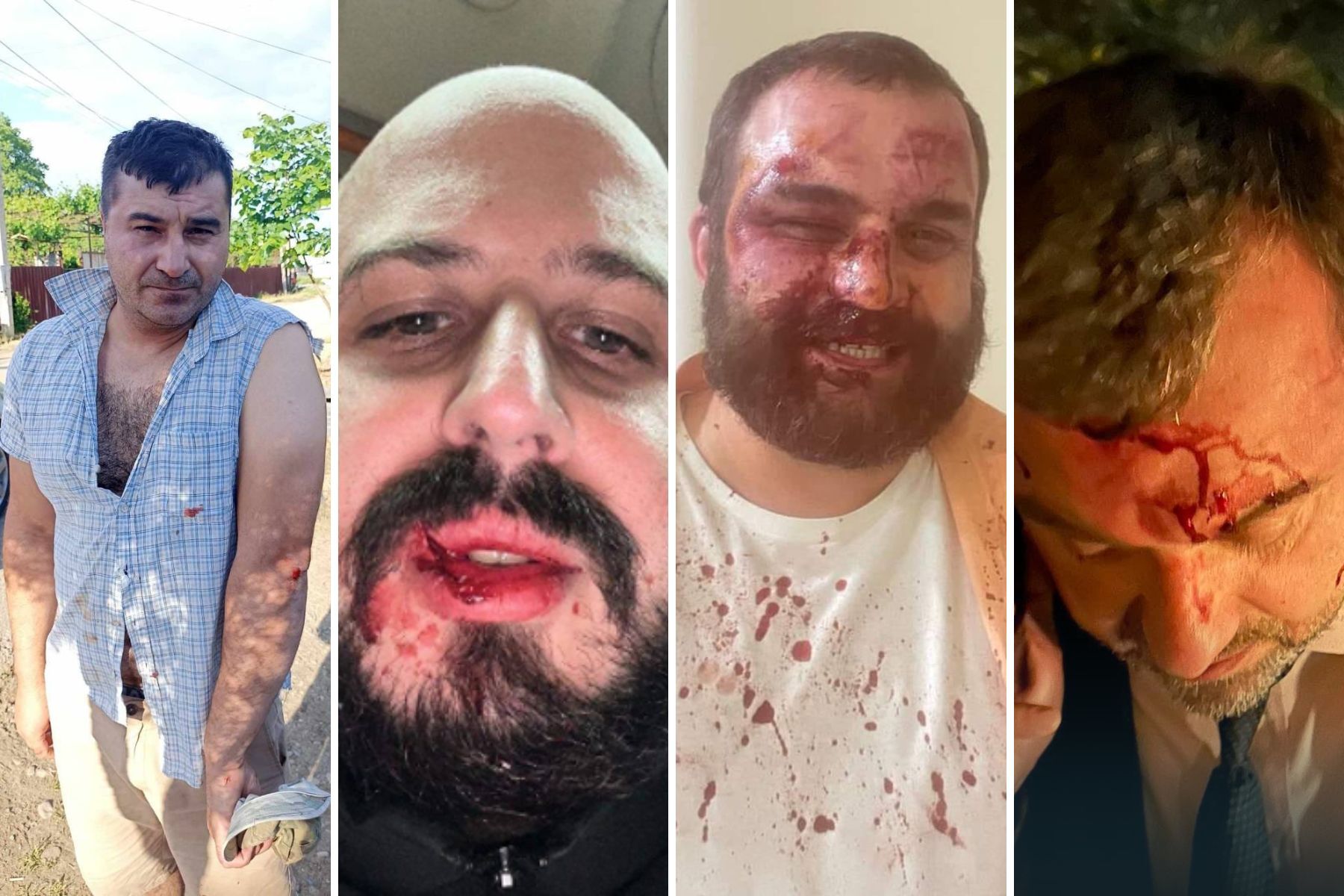 A number of government critics have been injured by both police, as well as unidentified masked men waiting for them outside their homes in recent weeks. Left to right: Giorgi Mumladze, Lasha Ghvinianidze, Dimitri Chikovani, and Gia Japaridze. Images via social media.
The charter also vows to strengthen the Special Investigation Service, which investigates police abuses, and the Anti-corruption Bureau, and make them more independent.
The charter vows to restore independence to the National Bank. Georgia’s central bank saw practically its entire upper management quit last year after new regulations were introduced to shield Georgian citizens from international sanctions.
The new government would also be tasked with creating ‘appropriate conditions [to] hold free and fair elections’.
‘We, the signatories of this charter, who will receive a mandate from the Georgian people in the 26 October 2024 elections, make a commitment and promise. That we meet the conditions set out in this Charter before the end of the very first spring session [of parliament] and that early parliamentary elections will be held in a free and fair manner upon execution’, it concludes.
The post President Zourabichvili announces plan for temporary government following elections appeared first on OC Media.
Vilnius, Lithuania — Lithuania’s Gitanas Nauseda announced his reelection in a presidential ballot on Sunday, following a campaign dominated by security concerns in the European Union and NATO member next door to Russia.
The Baltic nation of 2.8 million people has been a staunch ally of Ukraine since Russia’s 2022 invasion. Like other countries in the region, it worries it could be Moscow’s next target.
Ballots from nearly 90% of polling stations showed Nauseda, 60, winning roughly three quarters of the vote, followed by Prime Minister Ingrida Simonyte, 49, from the ruling center-right Homeland Union party.
If confirmed by final results, Nauseda’s backing in his bid for a second term will be highest in the country since it split from the Soviet Union in 1991.
A former senior economist with Swedish banking group SEB who is not affiliated with any party, Nauseda won the first round of the election on May 12 with 44% of the votes, short of the 50% he needed for an outright victory.
Just over half of Lithuanians believe a Russian attack is possible or even very likely, according to a ELTA/Baltijos Tyrimai poll conducted between February and March. Russia has regularly dismissed concerns that it might attack a NATO member.
Nauseda told jubilant supporters in the capital Vilnius that he will continue working on the country’s defense capabilities.
“Lithuanian independence and freedom is like a fragile vessel which we need to cherish and keep from cracking,” he said.
Both Nauseda and Simonyte support increasing defense spending to at least 3% of Lithuania’s gross domestic product, from the 2.75% planned for this year.
But Nauseda, who is a social conservative, has clashed with Simonyte on other issues, including whether to give a legal recognition to same-sex civil partnerships, which Nauseda opposes.
He has said it would make such unions too similar to marriage, which Lithuania’s constitution only allows between a man and a woman.
Simonyte, a former finance minister and a fiscal hawk, said on Thursday that if she won, “the direction for the country – pro-European, pro-Western – would not change.”
“But I would like quicker progress, more openness and understanding, larger tolerance to people who are different from us,” she said.
Lithuania’s president has a semi-executive role, which includes heading the armed forces, chairing the supreme defense and national security policy body and representing the country at EU and NATO summits.
The president sets foreign and security policy in tandem with the government, can veto laws and has a say in the appointment of key officials such as judges, the chief prosecutor, the chief of defense and the head of the central bank.