NPR News: 05-26-2024 9PM EDT
Learn more about sponsor message choices: podcastchoices.com/adchoices
 The South Caucasus News - SouthCaucasusNews.com
As fighting rages in Rafah and Jabaliya, IDF announces deaths of 2 soldiers https://t.co/qJitOFRhyL
— The Times of Israel (@TimesofIsrael) May 26, 2024
Протестующие в Ереване потребовали отставки Пашиняна. Несколько тысяч человек, также выступили против проведенной недавно делимитации и демаркации границы между Арменией и Азербайджаном, в результате чего четыре села оказались под контролем Баку.
Акцию возглавил глава Тавушской… pic.twitter.com/9zjuHtNXYE
— DW на русском (@dw_russian) May 26, 2024
As fighting rages in Rafah and Jabaliya, IDF announces deaths of 2 soldiers https://t.co/qJitOFRhyL
— The Times of Israel (@TimesofIsrael) May 26, 2024
Протестующие в Ереване потребовали отставки Пашиняна. Несколько тысяч человек, также выступили против проведенной недавно делимитации и демаркации границы между Арменией и Азербайджаном, в результате чего четыре села оказались под контролем Баку.
Акцию возглавил глава Тавушской… pic.twitter.com/9zjuHtNXYE
— DW на русском (@dw_russian) May 26, 2024
By Wanjiru Njoya
Some philosophers, drawing upon Immanuel Kant’s Critique of Pure Reason, have questioned the nature and limits of reason. By contrast, human reason plays a central role in libertarian thought. In the ordinary dictionary sense, human reason means simply “the ability of a healthy mind to think and make judgments, especially based on practical facts.”
In Human Action, Ludwig von Mises depicts reason as a universal quality common to all human beings, emphasizing that reason is “the mark that distinguishes man from animals and has brought about everything that is specifically human.” As all humans have the ability to reason, human logic can only proceed by reference to reason. Reason is the only basis on which we can conduct inquiry and endeavor to expand the frontiers of knowledge. As Mises explains: “Scientists are bound to deal with every doctrine as if its supporters were inspired by nothing else than the thirst for knowledge.”
Those who reject the universality of human reason attempt thereby to avoid grappling with its dictates. They reject conclusions that follow from “an irrefutable chain of reason” and brazenly promote their own unreasonable theories if they regard such theories as politically expedient. For example, critical race theorists argue that objective truth, reason, and rationality are simply cover for the imposition of European values on nonwhite people and should therefore be rejected by those who favor multiculturalism. Their answer to the accusation that critical race theories are unreasonable is that the very concepts of reason and rationality are Eurocentric, and they are therefore justified in rejecting them:
Because critical theory rejects reason, it cannot be questioned. Under this rubric, [Allen C.] Guelzo says, the only purpose of questions is to serve the interests of the oppressive class, and “any answer you come up with, which doesn’t speak in terms of some hidden structure of oppression, can simply be dismissed as part of the structure of oppression.”
Critical race theorists argue that rather than being universal, logic is determined by personal characteristics such as one’s race or sex. Therefore, they embrace polylogism, which Pierre Perrin defines as “an epistemological view based on the proposition that the logical structure of the mind is substantially different between different groups.”
Mises explains that “the main motive for the development of the doctrines of polylogism, historicism, and irrationalism was to provide a justification for disregarding the teachings of economics in the determination of economic policies.” Mises’s response to that is that
it is a poor makeshift to dispose of a theory by referring to its historical background, to the “spirit” of its time, to the material conditions of the country of its origin, and to any personal qualities of its authors. A theory is subject to the tribunal of reason only. The yardstick to be applied is always the yardstick of reason.
Mises shows that rejecting human reason is incompatible with human flourishing, economic progress, and civilization itself.
Murray Rothbard also argues that human reason “dictates to man his proper ends as well as the means for their attainment.” He emphasizes the distinctive quality of reason in understanding human nature: “And here we come to a vital difference between inanimate or even non-human living creatures, and man himself . . . man, ‘the rational animal,’ possesses reason to discover such ends and the free will to choose.” Rothbard grounds the natural law principles that underpin his theory of ethics in “reason and rational inquiry.”
Mises does not link reason in that way to natural law principles, arguing instead that “the teachings of utilitarian philosophy and classical economics have nothing at all to do with the doctrine of natural right. With them the only point that matters is social utility.” From a utilitarian perspective, the reason why people should not choose to go on a murderous rampage is not because it violates an alleged natural right to life but rather because such conduct is inimical to man’s ultimate desires: “If you satisfy your thirst for blood, you must forego many other desires. You want to eat, to drink, to live in fine homes, to clothe yourselves, and a thousand other things which only society can provide.” Nobody will achieve their life goals if everybody attacks each other with impunity.
Other libertarians who do not accept the natural rights philosophy, relying instead on these types of consequentialist or contractual explanations for human action, have questioned the link drawn by Rothbard between human reason and natural law principles. For example, Butler Shaffer asks:
How does one discover the content of these principles? How do we distinguish one person’s identification of a transcendent “moral principle” from another person’s expression of a private prejudice? Are the natural rights theorists doing anything more than projecting their subjective preferences onto the universe and then characterizing them as “eternal principles”?
Rothbard’s answer to that is that the content of natural rights is derived through reason. In The Ethics of Liberty, he argues:
One common, flip criticism by opponents of natural law is: who is to establish the alleged truths about man? The answer is not who but what: man’s reason. Man’s reason is objective, i.e., it can be employed by all men to yield truths about the world. To ask what is man’s nature is to invite the answer. Go thou and study and find out!
In this way, albeit from different philosophical foundations, both natural rights and utilitarian philosophers uphold the importance and indispensability of human reason. Human reason is universal, but its universal quality does not mean that all people have equal reasoning ability—it means that all people can reason. Nor does this mean that people are always reasonable or that they are never influenced by their emotions or irrational feelings, or that all reasonable opinions should be treated as objective and universal. Further, the claim is not that the process of reasoning will lead to perfection or omniscience or that people will never fall into error. To err is human. However, as Mises asserts: “Man has only one tool to fight error: reason.”
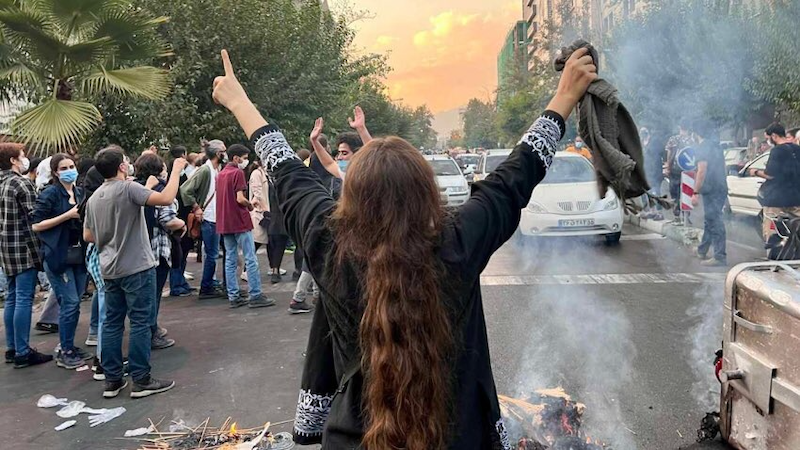
On the internet, we witness a lively and dynamic scene of political, social, professional, and cultural activities by Iranians. A considerable portion of these diverse activities is devoted to the struggle against the mullahs’ dictatorship and sheds light on the regime’s crimes and corruption.
When we consider many of these valuable activities together, we arrive at a collection that is happening in parallel but lacks the characteristics of an alternative. For example, many articles, speeches, interviews, and podcasts are published with the theme of exposing and shedding light on the crimes, but their totality does not possess the character and features of an alternative that would pose a real challenge to the regime.
History of uprisings and revolutions has shown that an alternative carries clear signs and concerns from the dominant dictator.
An alternative is always at the center of the issue, the nightmare, and its activities pose challenges to the dictator at home and across the globe.
An alternative always prioritizes its activities in service of the struggle to overthrow the dictator.
An alternative never engages itself in fueling the contradictions within the opposition front.
An alternative always considers organizing the front seeking the overthrow as a necessary condition to negate the ruling dictator and commits to it.
These characteristics, in political and diplomatic activities and in setting the relationship with the opposition front, both highlight the sign of the alternative in the eyes of the regime and attract internal and international credibility towards the seriousness of their struggle for major transformation.
For years, the protests of social groups such as retirees, workers, and wage-earners have been ongoing and are increasing. These are ongoing movements to achieve their legitimate labor rights that the regime has plundered and looted. Although these protests are pursuing economic demands, their essence and core are political and against the incumbent management and authority.
Despite these persistent labor protests with political undertones, and despite the various political, social, and cultural activities of Iranians inside and outside the country, we must look to the main battle against the dictator, with the criteria and standards for recognizing the alternative; a battle at the center of the political arena in Iran; a battle that determines the fate of the two fronts.
Based on the characteristics being outlined alluding to the current political landscape of Iran from both domestic and international perspectives, we can see that the persistent battle at the core and center of the Iranian political arena, with the determining balance of political forces, is the comprehensive struggle between the People’s Organization of Iran (PMOI/MEK) and the ruling clerical regime.
Based on the developments over the past one-and-half years following the 2022 uprising, a few key realities have become clear:
The above three pillars are the defining characteristics of the alternative to the clerical system. The reality is that currently, in the political arena of Iran, the National Council of Resistance of Iran (NCRI), with the PMOI at its core, is the concrete and tangible embodiment and bearer of these three principles.
It was the realization of these three principles in the outcome of the 2022 uprising that caused the regime to focus all of its political, propaganda, and judicial power against PMOI, both inside and outside of Iran. This is because the PMOI is currently the enduring, organized, and capable force that can serve as the center of the ongoing struggle for the overthrow of the regime, given its internal and international credibility as an alternative.
This is a factual, critical, and transparent political assessment, free from any form of propaganda or specific ideological leaning. Any serious observer of the Iranian political landscape, even if they are opposed to the PMOI, can see the reality that Iran’s regime fears no opposition other than the PMOI, and considers them the only threat to its very existence.
The months-long mobilization of the entire political, judicial, and propaganda apparatus of the mullahs’ regime against the PMOI is indicative of a fateful struggle at the center of Iran’s political arena between the mullahs’ dictatorship on one side and NCRI and the PMOI on the other.
For nearly 30 years, the propaganda apparatus of the clerical regime has been engaged in a media blackout of the PMOI and, at the same time, has been perpetrating astonishing demonization and slander campaigns against them. Several Persian-language media outlets outside of Iran have also been carrying out this boycott and defamation in parallel with the regime’s efforts against the PMOI, and they continue to do so even now.
Now, what has happened that neither the 30-year media blackout nor the astounding volume of slanders against the PMOI have borne fruit? The spokesman of the regime’s Judiciary was recently forced to admit that the youth of Iran should “not be deceived by the PMOI.” Undoubtedly, the regime and its domestic and foreign allies have realized that the solution proposed by the PMOI for rescuing Iran from hereditary dictatorships, as well as the penetration of this solution among the youth and those seeking the overthrow of the regime, has become the central issue in Iran’s political arena. An issue that the regime is pointing to more than ever.
Every Iranian who cares about the fate of their country should always, free from any bias, prejudice or inclination, study and recognize the characteristics of the forces present on the Iranian political scene. For now, the characteristics of the center of the Iranian political arena indicate a fateful struggle between the PMOI and the totality of the ruling regime. Future developments, measured by the existence and recognition of an alternative, will further elucidate this reality.