
Daily News Egypt
 The South Caucasus News - SouthCaucasusNews.com
By Kollen Post
(RFE/RL) — A three-kilometer shell shot from the Russian border, the boom of artillery fire rumbled over the village of Kozacha Lopan from both north and south every 10 minutes or less on a day in mid-May.
The central buildings were crumbling, many of them razed to the ground. Most of the homes bore obvious scars from shelling, and almost all had been abandoned in the face of an impending Russian advance across the northern edge of the Kharkiv region.
One of them, still occupied, was surrounded by two gardens of almost surreal loveliness against the backdrop of war and destruction. Sprigs of lavender and the broad leaves of hostas cropped up amid neat little hedges and statuettes.
But the flowers are in a bad way, said Tetyana, who lives there with her husband and adult daughter.
“All the rockets, they’ve thrown the atmosphere out of balance,” she said: A late frost took the cherry buds and the grape vines. And despite a continuous overcast sky, there hasn’t been a real rain.
Tetyana, who turns 87 in June, remembers the land suffering similarly under Nazi occupation in World War II, when she was a child.
“The same thing happened in that war,” she said. “I lived through that war. There wasn’t a drop of rain, it was a drought, and there were the same cracks in the earth, just like those.”
Two weeks ago, Russia opened up a new front in its war against Ukraine, sending troops across the northern border of the Kharkiv region and attacking cities and towns near the frontier from the ground and from the air.
Tetyana has lived in Kozacha Lopan her whole life. Now, signs all over town offer evacuation at no cost — but she, her 93-year-old husband, and their daughter, Natasha, don’t want to leave.
On the morning of May 17, they woke and left the damp cellar in which they sleep, detached from the main house and relatively safe underground, to find themselves surrounded by smoke.
“The fields in back had caught fire. We thought our house had finally burned down too. Thank God [the fire] burned itself out,” Tetyana said.
“[Russia’s] trying to make this a gray zone so that everyone goes to Kharkiv,” said Natasha, referring to the regional capital a few dozen kilometers to the south, which itself has been pounded by Russian missile and drone attacks. She has counted up to 60 hits on the village in a single day, she said.
The back vegetable garden was strewn with shrapnel from a large pole barn that was hit by a glide bomb in February. The mangled remains of three trucks that were inside the structure are exposed to the elements, and Natasha pointed out “iron leaves” – pieces of the destroyed building and garden walls — hanging from the trees. Meanwhile, the strawberries were ripening.
“And these are the potatoes. Still here, as long as the Colorado beetle doesn’t gobble them up,” Natasha said. It’s a play on words: The black-and-orange stripes on the beetle’s shell resembles the St. George Ribbon, a bellicose Russian symbol, which has turned the insect’s name into a go-to pejorative for pro-Russian separatists and suspected collaborators.
After waking up amid the smoke last week, the family found someone to take many of their possessions to an apartment in Kharkiv. But they don’t want to move there: It’s on the eighth floor of a building with little protection from drones, glide bombs, or – if Russian forces advance further — artillery that could come within striking range of the city.
“Because of that, we’re at a crossroads,” Tetyana said. “We don’t know what to do.”
They sent their possessions in case of a mandatory evacuation – in many cases, people ordered to evacuate are told to take only their official documents and leave everything else behind.
For now, the family is living in the dark and getting by with their own produce as well as boxes of canned food from the World Food Program. They do not venture outside the walls that wrap around their home, gardens, and a jumble of sheds, outhouses, and wash basins, as well as a water tank that was punctured in a blast.
Down the street, Mykola pointed to fresh craters from shells that struck his backyard a few days earlier. “They hit down in broad daylight,” he said.
A double amputee, Mykola has planted nothing in his garden this year. His wheelchair shielded a yellow-eyed kitten named Timukha, who flinched as explosions rung out in the distance.
“When they’re shooting from somewhere, he doesn’t even know where to hide anymore,” Mykola said.
Many of their neighbors, as well as people from other villages in the Kharkiv region, have been squeezed out by the Russian advance. Since they launched the cross-border offensive on May 10, Russian forces have taken two chunks of territory on the Ukrainian side of the border to the east of Kozacha Lopan. They are attempting to seize Vovchansk, a town with a pre-invasion population of 17,000, and have destroyed much of it with intense bombardments.
Russian progress in the area has slowed after an initial push forward. On May 24, the Ukrainian military claimed its forces “have stopped Russian troops in the Kharkiv sector and are conducting counteroffensive actions.”
Oleh Synyehubov, the governor of Kharkiv Oblast, said on Facebook that more than 11,000 people had been evacuated across the region as of May 24.
The newly displaced go mainly to Kharkiv — despite the danger in the city 30 kilometers from the Russian border — and weigh their options for getting further away from the front. Most of those who remain are elderly, with limited prospects for starting over in a new city.
Nina, a pensioner, was evacuated from Vilcha, outside of Vovchansk. For now, at least, she and her deaf mother live in the yellow dormitory of a former secondary school that has been converted into a hub for displaced people in Kharkiv, operated by the International Rescue Committee and the UN.
They provide everything she and her mother need, Nina said, but the pair remain in limbo. After about a week in the dorm, she found an apartment in the city.
“But I don’t know how I’m going to live there,” she said. “I’m not used to that life. I need to be in my crop rows, digging up grass, with flowers around.”
It was not the first time Nina has been uprooted by disaster: Many residents of Vilcha were moved there from their homes near the Chernobyl nuclear power plant in 1986.
Back in Kozacha Lopan, there’s something else that makes Natasha reluctant to leave: her own pets and the strays she takes care of.
When a particularly loud explosion sounds out, her dogs take cover in small cement cylinders that serve as their homes in the backyard.
And she takes it on herself to feed the dogs whose owners have been evacuated when they show up at her front gate – including a puppy with chocolate-colored fur that is, she says, afraid of strangers.
“They’re my darlings,” Natasha said. “How can I go and leave them behind?”
By Pimuk Rakkanam
Dozens of Myanmar soldiers fled into Thailand following a clash with ethnic minority insurgents, a Thai commander told Radio Free Asia Friday, the latest spillover from increasingly bitter fighting in Myanmar.
The junta troops fled a base in Kayin State’s southern Myawaddy district following attacks from the anti-junta Karen National Liberation Army, or KNLA, and allied groups, the Thai officer said.
“There were 31 Myanmar soldiers surrendering,” said Ratchamanu Task Force Commander Col. Nattakorn Reuntib, who is based in western Thailand’s Tak province, on the Myanmar border. “They were disarmed, identified, treated and are awaiting repatriation through the Thai-Myanmar border coordination center.”
Some troops were injured, he added. RFA could not confirm where they were being treated.
A KNLA soldier said about 20 junta soldiers were killed when Karen fighters captured their Po Chi Mu camp.
”The camp has been captured. Forty-eight junta troops, including officers, surrendered and about 20 were found dead,” he said, declining to be identified for security reasons.
An official from the Karen rebel force, which has been battling for self-determination for decades, told RFA that the junta troops escaping into Thailand had killed four civilians.
“The Thai army found the fleeing junta soldiers near Ohm Phyan village and arrested them,” he said, also requesting anonymity for safety reasons.
“They killed three villagers and another, a pregnant woman on her way to hospital, when they fled. They are now being questioned by the Thai army … but we don’t know what they’ll do with them,” said the official, who declined to be identified for security reasons.
Karen forces have been attacking the Po Chi Mu camp, opposite Thailand’s Umphang district, since Sunday and junta airstrikes in the area have forced hundreds to flee into Thailand, media reported.
Myanmar’s junta has been coming under pressure in different parts of the country since anti-junta forces went on offensive late last year.
Pro-democracy activists took up arms after the generals overthrew an elected government in early 2021, joining with ethnic minority insurgents to pose the most significant challenge to the military since shortly after the country’s independence from Britain.
Junta forces fled into Thailand during fighting in April with Karen forces over control of the main border town of Myawaddy. The Thai government warned both sides not to use Thai territory for any military advantage.
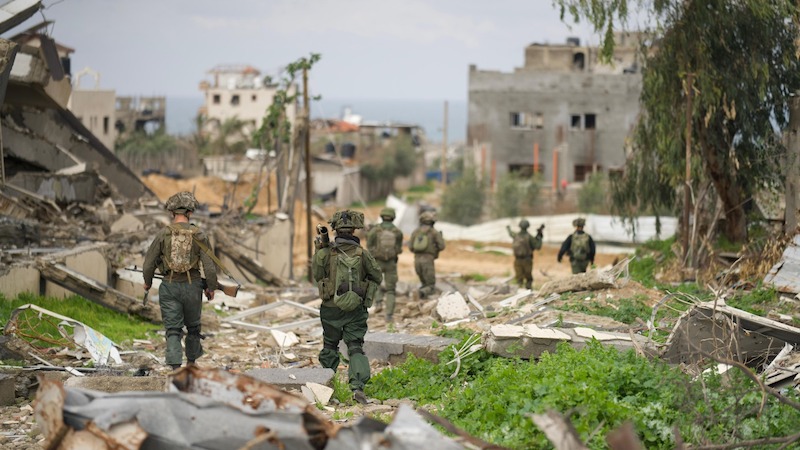
Israeli forces pressed on with their military operation against Hamas throughout the Gaza Strip but left the door open for a new round of mediated negotiations next week, an official said Saturday.
The decision for a new round of negotiations was made after the head of Israel’s Mossad intelligence agency met with CIA chief William Burns and Qatari Prime Minister Mohammed bin Abdulrahman bin Jassim Al Thani, said the source, who spoke to Reuters and declined to be identified because of the sensitivity of the situation.
“At the end of the meeting, it was decided that in the coming week, negotiations will open based on new proposals led by the mediators, Egypt and Qatar and with active U.S. involvement,” the source said.
There has been a stalemate in peace talks, with Israel demanding the release of the hostages held by Hamas and Hamas calling for the release of Palestinian prisoners and an end to the war in Gaza.
Thirty-one people were killed in the enclave Saturday, according to Palestinian medical officials, who do not distinguish between civilian and combatant casualties.
Israeli forces pushed deep into Jabalia, north of Gaza City, and said they “eliminated dozens of terrorists in close-quarter combat and aerial strikes.” Residents and civil emergency services in the area said Israeli tanks rolled in, destroying dozens of houses, shops and roads.
Hamas, which governs Gaza, and the smaller armed group Islamic Jihad said their fighters had fired anti-tank rockets and mortar bombs at Israeli troops in the north of the enclave.
In the southern city of Rafah, Israel’s military operations continued, despite the ruling by the U.N. International Court of Justice that Israel should “immediately halt its military offensive” in Rafah. Israel says its goal in Rafah is to eliminate Hamas cells embedded there. It also said that some of its hostages are being held there.
One Rafah resident who asked not to be named said the Israeli military is assaulting the city indiscriminately.
“The occupation forces keep the city under bombing, not only east where they invaded but at the center and the western sides. They want to scare people to leave the whole city,” the resident said.
The city has become a refuge for hundreds of thousands of Gazans fleeing fighting elsewhere in the enclave. After Rafah became a target as well, hundreds of thousands of Palestinians fled the city.
World leaders reacted to the ruling Friday by the U.N. International Court of Justice that Israel should “immediately halt its military offensive” in the southern Gaza city of Rafah. The decision intensifies international pressure on Israel regarding its assault on Gaza, but Israel has said it will not comply.
Reading the ruling, ICJ President Nawaf Salam cited “exceptionally grave” conditions for the “extremely vulnerable” population in Rafah.
In a TV interview, the Spanish defense minister, Margarita Robles, called the conflict in Gaza a “real genocide,” as relations between Israel and Spain worsen following Madrid’s decision to recognize a Palestinian state.
Her comments echoed similar remarks by Spanish Deputy Prime Minister Yolanda Diaz, who earlier this week described the Gaza conflict as a genocide.
The British government on Saturday criticized the International Court of Justice, saying the ruling would strengthen Hamas.
Israel has strongly rejected accusations that it is committing a genocide against Palestinians, saying it is waging war on the Hamas militant group that attacked Israel on October 7, triggering Israel’s offensive in Gaza.
In a joint statement, the offices of Israel’s prime minister and foreign ministry slammed the court’s decision, calling the accusations against it “false, outrageous and disgusting.”
Minister Benny Gantz, a member of Israel’s war Cabinet, responded to the ICJ decision by telling Israeli media that the military would keep fighting to return the nation’s abductees and ensure the safety of its citizens.
The ICJ is the highest U.N. body for hearing disputes between states. Its rulings are final and binding, but they have been ignored in the past because the court has no enforcement powers.
Its decision does add more diplomatic pressure on the Israeli government.
Richard Gowan of the International Crisis Group told VOA that the ICJ ruling may allow the U.S. to put more pressure on Israel and that Israel “may try and win back a little goodwill by allowing some more aid into Gaza.”
“I think that the Israelis have made it very clear all through the year that they will ignore any calls for restraint from the International Court of Justice,” he said.
South Africa’s international relations department hailed the ruling.
“South Africa welcomes the ruling made by the court today,” said Zane Dangor, director-general of the country’s Department of International Relations and Cooperation. “This is de facto calling for a cease-fire. It is ordering the major party in this conflict to end its belligerent action against the people of Palestine.”
Jordan’s Foreign Minister Ayman Safadi also applauded the ICJ’s decision.
“Once again, the ICJ exposes Israel’s war crimes in Gaza. And once again, the Israeli government reacts with disdain to international law, refusing to heed the court’s orders,” he said.
The European Union foreign policy chief, Josep Borrell, also reacted to the ruling. “What is going to be the [EU’s] answer to the ruling of the International Court of Justice that has been issued today? What is going to be our position? We will have to choose between our support to international institutions of the rule of law or our support to Israel.”
This week alone, three European countries announced they would recognize a Palestinian state — Ireland, Spain and Norway.
Hamas issued a statement welcoming the court’s decision but told Reuters the ruling fell short of recognizing that other parts of the enclave are under attack.
“We believe it is not enough since the occupation’s aggression across the Gaza Strip, especially in northern Gaza, is just as brutal and dangerous,” senior Hamas official Basem Naim said.
Israel has previously described the ICJ’s case against its assault on Gaza as “divorced from the facts.” It has repeatedly dismissed the accusations of genocide as baseless, stating that its offensive in Gaza is self-defense and targets Hamas militants.
Since Hamas launched a terror attack October 7 on Israel, killing about 1,200 people and taking roughly 250 hostages, Israel has embarked on an offensive to eliminate Hamas from Gaza. In recent weeks, Israel says, its forces have killed 30,000 people, the majority of them combatants. The Hamas-run Health Ministry in Gaza says 35,000 people have died, most of them women and children, but does not estimate how many of the dead were combatants.
The United States, Israel’s main ally, has opposed Israel’s invasion of Rafah, where more than a million refugees were sheltering from clashes elsewhere. Some 900,000 have since fled Rafah, according to the Israel military.