
Day: May 24, 2024
Canada extended its financial support for the AU-Canada development partnership. It has doubled its grants, and provided an additional $20 million to empower the African Union to pursue its goals and drive progress across the continent. It will, in addition, strengthen the existing partnership between Canada and the AU in paving the way for a more prosperous and secure future for Africa.
During the High-level Development Policy Dialogue between Canada and the African Union, H.E. Monique Nsanzabaganwa, AUC Deputy Chairperson, said, “The partnership between the African Union and Canada signifies a remarkable step forward in the collective efforts to achieve Agenda 2063, and the additional support from Canada will undoubtedly accelerate progress towards realizing this dream.”
The Deputy Chairperson was accompanied by the AU Commissioners who shared briefings on their respective departments, highlighting areas of collaboration. The delegation included Josefa Sacko, Commissioner for Agriculture, Rural Development, Blue Economy, and Sustainable Environment (ARBE); Albert Muchanga, Commissioner for Economic Development, Tourism, Trade, Industry, and Mining (ETTIM); Professor Mohammed Belhocine, Commissioner for Education, Science, Technology, and Innovation; and Amb. Minata Samate Cessouma, Commissioner for Health, Humanitarian Affairs, and Social Development.
“Canada is deeply committed to supporting Africa’s development journey. By doubling our grant to the African Union, we are not only reinforcing our partnership but also investing in the future of the continent,” said Hon. Ahmed Hussen, Canada’s Minister of International Development. “The additional $20 million, allocated over five years, empowers the African Union to pursue its goals and drive progress across the continent.”
This increase includes $7.5 million unearmarked through the Joint Financing Arrangement (JFA), $2.5 million for Peace and Security Programs (PAPs) also through the JFA, and $10 million dedicated to Education and Technical and Vocational Education and Training (TVET) delivered through AUC’s Education, Science, and Technology Department (ESTI), Together, we will work towards a more equitable, prosperous, and sustainable future for all Africans,” announced the Canadian Minister.
This policy dialogue followed the state visit of AUC Chairperson Moussa Faki Mahamat to Ottawa, where he held discussions with Prime Minister Trudeau on October 26, 2022. During their meeting, the two leaders discussed building on the collaborative partnership between Canada and the African Union, and advancing shared priorities, which include protecting democracy, advancing gender equality and women’s empowerment, and addressing challenges of shared concern such as food security and climate change.
“For over five decades, Canada has been committed to working with African countries on shared priorities. The Canada-African Union Commission High-Level Dialogue comes at a critical time, as democracies and peace processes are challenged. It has been an honour to host Chairperson Faki and his delegation in Ottawa for this historic event, the first of its kind for Canada, and we look forward to a new era of cooperation between Canada and the African Union Commission,” underscored Mélanie Joly, Minister of Foreign Affairs.
“Canada has long enjoyed a positive and mutually beneficial economic relationship with Africa. The Canada-African Union Commission High-Level Dialogue has been an opportunity to discuss ways to strengthen our economic resilience by deepening these ties. We are committed not only to supporting a number of projects across Africa, but to continue doing so sustainably and responsibly while ensuring our people continue to benefit from stable jobs and economic growth,” underlined Mary Ng, Minister of International Trade, Export Promotion, Small Business and Economic Development.
Harjit S. Sajjan, Minister of International Development and Minister responsible for the Pacific Economic Development Agency of Canada added that “The Canada-African Union Commission High-Level Dialogue was an unprecedented opportunity to see how we can strengthen our partnership and work toward a more prosperous and inclusive Africa that has greater food-system resilience and can better withstand climate change, conflict and other shocks.”
During the previous meeting, and throughout the sessions, the ministers reaffirmed Canada’s commitment to a strengthened Canada-African Union Commission partnership based on common priorities, recognizing the strategic vision provided by the African Union’s Agenda 2063. They announced their intention to hold regular high-level dialogues, as well as sectoral dialogues on trade and development, and welcomed the according of privileges and immunities to African Union Commission officials.
The ministers also announced over $223 million in project funding to support various priorities shared with African countries:
– over $37 million allocated for peace and security initiatives, including to respond to conflict-related sexual violence, for counter terrorism initiatives and to strengthen stabilization efforts;
– over $18 million to bolster economic development and to support small and medium-sized businesses;
– over $168 million earmarked for sustainable development initiatives with a focus on ensuring all interventions work towards gender equality, including to support climate-change adaptation, access to education and jobs, and COVID-19 vaccine delivery.
The last Canada hosted the first Canada-African Union Commission High-Level Dialogue was held on October 27, 2022. The dialogue gave Canadian and African Union representatives the opportunity to discuss efforts in the areas of peace and democracy, sustainable development and economic cooperation. It was in fulfillment of an agreement between Prime Minister Justin Trudeau and AUC Chairperson Moussa Faki Mahamat when they met on the margins of the 33rd African Union Summit in Ethiopia in February 2020.
As a socially oriented non-financial development institution, broadening mutual cooperation has been its main task since its creation. African Union is the continental organization whic is tackling Africa’s development and global challenges in the framework of its Agenda 2063 and the United Nations’ 2030 Agenda for Sustainable Development.
By Peter Fabricius
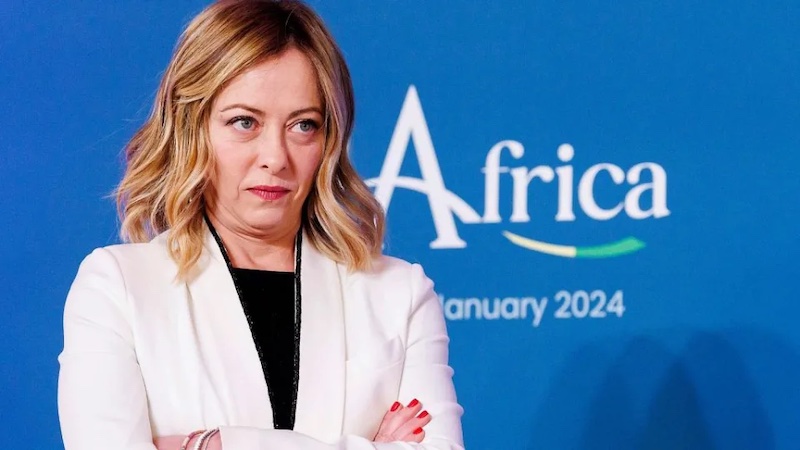
Italy’s Prime Minister Giorgia Meloni has proven more palatable than many Western leaders feared when this right-wing politician – some even called her a neo-fascist – became Italy’s prime minister in 2022. After all, she and her hard-right Fratelli d’Italia (Brothers of Italy) party belong in the same political stable as the likes of France’s Marine le Pen and the National Rally.
On the campaign trail, Meloni breathed fire against many of the European Union’s (EU) cherished values, including LGBTQIA rights and the ‘Brussels bureaucrats’ themselves. She also expressed sympathy, like other right-wingers, with Russian President Vladimir Putin.
But in office she has proved to be a model citizen of the European, G7 and North Atlantic Treaty Organization (NATO). Meloni hasn’t emulated the EU delinquent Viktor Orbán, Hungary’s prime minister, as many expected. She has fully supported Brussels and NATO in backing Ukraine against Russia and has bolstered Italy’s alliance with the United States.
She also seems to share some of the EU’s views on immigration – though her critics would probably say that’s more because she has brought Brussels into her orbit than vice versa.
Controlling migration is probably one of the main drivers of Meloni’s Africa policy
Last July, Meloni, EU Commission President Ursula von der Leyen, and Dutch Prime Minister Mark Rutte signed a memorandum of understanding with Tunisian President Kais Saied. The EU agreed to direct budgetary support and accelerated EU funding related to macroeconomic stability, economy and trade, renewable energies, and people-to-people contacts.
In exchange, Tunisia agreed to cooperate with the EU on migration control. In particular, it would prevent migrant departures by sea, address migrant smuggling and trafficking, and assist in returning foreigners seeking to reach Europe from Tunisia, to their home countries. In turn, the EU promised to enhance Tunisian citizens’ mobility to its member states.
The agreement was controversial in the EU, with some member states saying they weren’t properly consulted before it was reached. Their concern included Von der Leyen doing a deal with Saied, who has been dragging Tunisia down the slippery slope of autocracy.
Meloni has focused much attention on Tunisia – visiting it for the fourth time last month – apparently for two main reasons.
One is to establish Italy as a hub of African energy. The other is that Tunisia is a major launchpad to Europe for irregular migrants, and Italy is a leading destination. Although in 2024, Libya has been the main departure point and Spain the main point of arrival, many irregular immigrants make landfall in Italy. Lucio Malan, the Italian Senate’s chief whip, recently said, ‘Sicily is closer to Tunisia than Sicily is to Rome.’
Controlling migration is probably one of the main drivers of Meloni’s Africa policy. Among her other surprises was the first Italy-Africa summit in Rome in January, under the theme ‘A Bridge for Common Growth’. It attracted 20 African government leaders and representatives from 46 countries – including Saied. Also in attendance were leaders of the African Union (AU), African Development Bank, EU and International Monetary Fund.
The €5.5 billion announced for the Mattei Plan clearly isn’t enough to develop an Africa-wide strategy
The summit inaugurated the year of Italy’s G7 presidency and allowed Meloni to punt her so-called Mattei Plan for Africa, ostensibly based on the ‘cooperation as equals’ principle. It has six pillars – education, health, energy, water, agriculture and infrastructure.
In her speech to the summit, Meloni underscored energy, saying Italy’s goal was ‘to help African nations that are interested in producing enough energy to meet their own needs and then exporting the excess to Europe, combining two needs: Africa’s need to develop this production and generate wealth, and Europe’s need to ensure new energy supply routes.’
She said Italy had been working for some time with the EU on building the connection infrastructure for this energy bridge, citing for example the ELMED electricity interconnection between Italy and Tunisia, and the new SoutH2 Corridor to transport hydrogen from North Africa to central Europe, passing through Italy.
Meloni said Mattei Plan aimed to unleash Africa’s potential and guarantee Africa’s youth ‘the right not to be forced to emigrate, and not to have to cut your roots in search of a better life, which is increasingly difficult to achieve in Europe.’
The EU representatives generally welcomed Italy’s plan. Von der Leyen praised it as consistent with the European Global Gateway initiative, which includes a Europe-Africa investment package of €150 billion. As has been observed, it will be essential to integrate the Mattei Plan into an EU frame, as the €5.5 billion announced by Meloni isn’t enough to develop a continent-wide strategy.
Meloni won a rather unexpected endorsement from the president of the African Development Bank
In his response, AU Commission Chairperson Moussa Faki Mahamat lamented Italy’s lack of consultation with Africa before announcing the Mattei Plan. Yet he apparently agreed with her in principle that the only effective strategy for managing migratory flows was ‘transforming the vast regions of poverty, exclusion and human suffering into a space of prosperity and development.’
There have been other criticisms. A group of mainly environmental African non-governmental organisations rebuked Italy for not consulting civil society and for focusing the plan on fossil fuels. Other critics expressed concern about the EU jeopardising its values by collaborating with the likes of Saied, and for essentially buying the support of African countries to keep migrants at bay.
Some are suspicious of Von der Leyen’s support for the Mattei Plan, noting she faces a difficult re-election next month, against growing support for EU anti-immigrant right-wing parties.
Meloni did win a rather unexpected endorsement from African Development Bank President Akinwumi Adesina, who met her the day after the summit. He declared that the African Development Bank was ready to work with the Italian government because ‘the Mattei Plan fits into the priorities of the Bank … You can count on the African Development Bank as your partner of choice.’
Adesina’s approval suggested to Italy’s Istituto Affari Internazionali that despite its many faults, Meloni’s plan could be salvaged by wider consultation within Africa, not just with elites, and integrating it into a broader European framework.
- About the author: Peter Fabricius, Consultant, ISS Pretoria
- Source: This article was published by ISS Today
![Secretary of State Antony J. Blinken meets with Ukrainian President Volodymyr Zelenskyy in Kyiv, Ukraine, on September 8, 2022. [State Department photo]](https://www.eurasiareview.com/wp-content/uploads/2022/09/a-107.png)
By Andrew Byers
On April 4, speaking at a NATO Summit, US Secretary of State Antony Blinken stated that “Ukraine will become a member of NATO. Our purpose at the summit is to help build a bridge to that membership.” This is an exceedingly dangerous statement.This latest statement continues the trend of making promises to Ukraine that it may one day become a member of NATO without offering a concrete timeline. This is the worst of all possible worlds: such implicit promises provoke Russia, which has stated on multiple occasions that the prospect of NATO membership for Ukraine is a red line, while doing nothing to enhance Ukraine’s security.
At a NATO conference in Bucharest in 2008, President George W. Bush made the mistake of arguing for Georgia and Ukraine to be allowed to join NATO. France, Germany, and other NATO allies balked, and the conference ended by stating that Ukraine and Georgia would one day become NATO members but provided no clear pathway. Russia restated its opposition to NATO memberships for its immediate neighbors, and four months later, it invaded Georgia (Russian troops still occupy Abkhazia and South Ossetia). Six years later, Russia seized the Crimea from Ukraine, and then invaded Ukraine again in 2022. That war continues today in a bloody stalemate, though Russia has regained the momentum. This year, there is no more talk of a Ukrainian spring or summer offensive after last year’s disastrous showing. Prospects for Ukrainian success have vanished.
In July 2023, White House national security spokesman John Kirby said, “Of course, they [Ukraine] are at war right now. So, NATO membership in the immediate future isn’t likely because that would put NATO at war with Russia.” Kirby’s statement suggests that if Ukraine weren’t at war with Russia, it could become a member of NATO. This too is an exceedingly dangerous idea. If Russia believes that as soon as the current conflict is over, Ukraine will be granted NATO membership, it will be highly disincentivized to seek peace, the exact opposite of what the United States wants. We want Russia (and Ukraine) to find a peaceful means of resolving their conflict.
Even though most in the West are dismissive, Russia has security concerns about Ukraine, and NATO membership for Ukraine will only exacerbate those concerns. The United States would not have tolerated Canada or Mexico becoming a member of the Warsaw Pact during the Cold War, which would have meant the stationing of Soviet soldiers and military equipment just across the border. The United States has invaded both of its immediate neighbors on multiple occasions: in the case of Canada because of its status as a colony and client-state of Britain. Recall also that the Reagan administration invaded Grenada because of the pro-communist coup in 1983 and pursued covert action in El Salvador and Nicaragua for similar reasons. The Kennedy administration almost went to war over the Cuban Missile Crisis because the Soviet emplacement of nuclear weapons there shifted the strategic balance. Great powers do not like their neighbors joining military alliances with their rivals.
A Ukraine that is a member of NATO is likelier to behave in ways that would provoke Russia. The appropriate analogy here is that a little boy taunting a bigger bully while hiding behind his older brother. Eventually, the older brother is likely to get dragged into a fight he does not want.
We should fear Russia not because it is strong, but because it is weak. A strong great power would not have many security concerns. It could weather provocations like this one. It would be secure in the knowledge that it has the power to deter its enemies from attacking it or acting against its core interests, and the current regime would have strong domestic support. But Russia is not a strong great power, it is a weak one, and that is precisely why it is dangerous.
While many are concerned with China’s rise, militarily and economically, in relation to the United States, the trends for Russia are all heading in the opposite direction. As the recent 2024 annual threat assessment from the Office of the Director of National Intelligence stated, “Russia’s GDP is on a trajectory for modest growth in 2024 but its longer-term competitiveness has diminished in comparison to its pre-war outlook.” Even that is damning Russia with faint praise. Russia has vast fossil fuel reserves and has found many partners willing to buy energy from it, Russia has little else going for it. Demographically, Russia is a catastrophe, with declining health and population. It is expending its military resources in Ukraine as fast as new munitions and weapons systems can be built. It is sacrificing a generation of its (diminishing) young men in a grinding war of attrition that has produced more than 300,000 Russian casualties. The once-vaunted Russian military has been shown as a paper tiger, a force that cannot even seize significant territory from a much smaller, weaker neighbor. The Russian military will take a generation to reconstitute itself after the Ukraine debacle. Russia is certainly no threat to NATO.
But Russia has significantly increased its production of munitions, and has been willing to continue to expend as many Russian lives as necessary to eventually triumph in Ukraine. Russia is not strong enough to threaten NATO, but it is strong enough to eventually defeat Ukraine.
It is entirely rational for Ukraine to want NATO membership — why would it not seek Article 5 protection and a nuclear umbrella? — but it is unclear why NATO would want to extend membership to Ukraine. If Ukraine were a member of NATO, NATO would be at war with Russia. It is bad enough that NATO support of Ukraine means that the war between Ukraine and Russia is a de facto proxy war between Russia and NATO, with Ukraine supplying the warm bodies and NATO — mostly the United States — providing the weapons. Ukraine should not be welcomed into NATO because it brings nothing with it but security liabilities. Ukrainian membership in NATO would not enhance the security of the United States or any other current member of NATO, it would merely exacerbate Russian security concerns and increase the likelihood of a future war between NATO and Russia. In fact, the United States should announce that Ukraine will explicitly not be granted NATO membership. Alliances are about self-interest, not feelgood measures, or even rewarding heroic resistance to aggression.
Instead, the United States should encourage, explicitly, if behind closed doors, Ukraine to find a path to a ceasefire with Russia. A peace settlement will likely have to end with some territorial concessions by Ukraine, and a likely pledge that it will not join NATO for the foreseeable future. This outcome would be less than ideal from the Ukrainian perspective, but despite Ukraine’s resistance and the West’s aid, Ukraine has been unable to secure a victory on the battlefield. Its long-term prospects are grim. The Ukrainian economy is in shambles (GDP in 2024 is about 25 percent lower than prior to the invasion, with massive new trade deficits), as is its crumbling infrastructure, with at least a half trillion dollars in reconstruction needed. Casualties continue to mount and Ukraine has just been forced to lower its draft age. The status quo cannot persist indefinitely. Eventually, Russia’s superior numbers and military industrial production will prevail. There is no plausible scenario in which Ukraine can push all Russian forces out of the country. Better that Ukraine negotiate an end to the conflict now, while it still controls the bulk of its pre-war territory, than in another year or two, when it will control even less of its territory and when it will be in an even more precarious economic position. All wars eventually end, and it would be best for Ukraine if it can secure the best possible terms that it can.
- About the author: Andrew Byers is currently a non-resident fellow at the Texas A&M University’s Albritton Center for Grand Strategy. He is a former professor in the history department at Duke University and former director of foreign policy at the Charles Koch Foundation.
- Source: This article was published by AIER
Last week, I explained why the Federal Reserve (Fed) is unlikely to meet its 2% inflation target in 2024, and I haven’t changed my mind. I referred to an article that said, “Fed Chair Jerome Powell made it clear Tuesday he thinks the Fed will need more than a quarter’s worth of data to really make a judgment on whether inflation is steadily falling towards 2%.”
Based on that, I concluded, “If that is the case, and taking Powell’s statement at face value, interest rate cuts seem unlikely in 2024.”
Should we take Powell’s statement at face value?
I am more confident predicting the inflation rate through the end of the year than I am predicting interest rates. Inflation is the result of millions of people deciding what they want to charge for what they sell and what they are willing to pay for what they buy. Monetary policy is the primary determinant of inflation, but today’s inflation results from past monetary policy. Interest rates are heavily influenced by the decisions of a few people at the Fed.
Economics offers much insight into how people will respond to monetary policy in the recent past. However, it offers only a little insight into Powell and his colleagues at the Fed’s decisions.
If inflation does not meaningfully decline, then, taking Powell’s statement at face value, there will be no interest rate cuts in 2024. However, Fed decisions may have political motivations behind them. If so, in an election year, interest rate cuts could be coming even if inflation remains at (or above) its present level.
Economics does lend some insight into this, noting the possibility of political business cycles. The theory, in brief, is that incumbents are more likely to be reelected when the economy is in an upswing, so they have an incentive to stimulate the economy leading up to an election, even if negative consequences of that stimulus will occur after the election.
That stimulus might occur through fiscal policy. For example, an incumbent might introduce a policy to forgive the debts of a group of debtors, which would have the dual effects of injecting additional spending into the economy and buying the gratitude of those whose debts are forgiven. Related to today’s topic, the stimulus also might occur through monetary policy. The Fed can lower interest rates to provide stimulus, even though that would be counterproductive to its declared goal of lowering inflation.
If I am right that the inflation rate will show no meaningful decrease in 2024, and the Fed does not cut interest rates, then Powell’s statement means what it says. If inflation does not fall and the Fed cuts interest rates, that would be a sign that it is bowing to political pressure from incumbents to provide monetary stimulus to the economy prior to the election.
We can see what the Fed is doing. Intuiting its motives is conjecture. I have previously suggested that Powell’s Fed has been politically astute in its anti-inflation policies. In 2022, Powell and others at the Fed echoed the Biden administration’s line on inflation even though there was good reason to question it.
If my conjecture two years ago was correct, we might expect interest rate cuts leading up to the election, regardless of the inflation numbers.
Last week, I gave an inflation forecast. This week, I am telling you that I cannot forecast short-term interest rates because that is up to the Fed’s discretion, and I can’t read their minds. What I will say is that if my inflation forecast proves accurate and the Fed lowers interest rates prior to the election, there is good reason to think that the Fed’s “get tough on inflation” policy was put on hold for political reasons.
- This article was published by The Beacon

Four years later, many people are investigating how our lives were completely upended by a pandemic response. Over my time on the case, I’ve heard countless theories. It was Big Tech, Big Pharma, Big Finance, the Green New Deal, the CCP, Depopulation, Get Trump, Mail-In Ballots, and so on.
There is evidence to back them all.
The problem with having so many pieces of evidence and so many theories is that people can too easily get thrown off track, going on wild goose chases. It’s too much to follow through consistently, and this allows the perpetrators to hide their deeds.
For such situations, we can take recourse to Occam’s razor: the best explanation is the simplest one that explains the maximum number of facts. This is what I offer here.
Those in the know will be shocked by nothing herein. Those not in the know will be amazed at the audaciousness of the entire scheme. If it is true, there are surely documents and people who can confirm this. At least this model of thinking will assist in guiding thinking and research.
There are three parts to understanding what took place.
First, in late 2019 and perhaps as early as October, higher-ups in the biodefense industry and perhaps people like Anthony Fauci and Jeremy Farrar of the UK became aware of a lab leak at a US-funded bioweapons lab in Wuhan. This is a place that does gain-of-function research to produce both the pathogen and the antidote, just like in the movies. It’s gone on for decades in possibly hundreds of labs but this leak looked pretty bad, one with a fast-transmitting virus believed to be of high lethality.
The civilians were not likely the first to know. Military and security higher-ups, the people actually working with clearances in the bioweapons industry, were the first to get the word. They gradually leaked it out to civilian sources.
By January 2020, the situation had become dire within the bureaucracies. If the background of the lab leak got out, and millions died and the blame fell on the US and its labs around the world, there could be massive repercussions on politics and so much more. This is why, as Farrar admits, they went to burner phones and secure video hangouts, while experiencing weeks of sleepless nights. There was fear in the air among those who knew what had happened.
That’s when the effort began to shift blame over to the wet markets in Wuhan and scientifically back the idea of natural origins. They had to work very fast, but the result was the famed “proximal origins” article, published in early February, which was backed up by a stream of NIH-funded scientists labeling the claim of lab origin as conspiracy theory. The media backed the claim with censorship of anyone saying otherwise.
So far so good, but there was still the problem of the virus itself. That’s where the antidote labeled a vaccine came into play. This effort began in January too: the opportunity to deploy mRNA technology. It had been stuck in research for some 20 years but had never gained regulatory approval through conventional means. But with a pandemic declared, and the fix relabelled as a military countermeasure, the entire regulatory apparatus could be bypassed, along with all indemnifications pushed through and even taxpayer funding.
The people behind the lab disaster would become heroes instead of villains.
Speed was always an issue. How can a vaccine be produced, distributed, and injected into the world’s population before the pandemic has already passed through the population, ending the same way as every other such episode in history, namely through exposure and resulting immunological upgrades?
If that happened, the vaccine would be superfluous and the pharma would miss their chance to demonstrate the wonders of a technological promise that had consumed them for twenty-plus years.
That’s where the lockdowns come in. Here is where the plan gets truly insidious. The idea was to come up with some way in which the antidote would gain the credit for having solved the pandemic that supposedly emerged from a wet market. The new technology would get the credit and then obtain generalized approval for a new form of health care that could be applied to myriad maladies in the future. Everyone would get rich. And Big Pharma and Fauci would be the heroes.
Apart from convincing Donald Trump to authorize the wrecking of his prized economy (which is a story unto itself), the vexing problem with the plan was timing. There was likely no way to get this released to the population for at least 9 months or perhaps more. It could be sooner in the future, perhaps 100 days, but the first time out would require more time.
It’s not that the planners were in denial of natural immunity. They were simply against depending on it or even tolerating it when they could test out a new product on the population.
The objective in this little game must be to preserve population-wide immunological naivete for the entire period. Exposure needed to be minimized to keep seroprevalence levels at their lowest possible point, perhaps no more than 10 or 20 percent and certainly below 50 percent. The only possible path here was to insist on as little human-to-human contact as possible.
Hence: lockdown. Forced human separation. Not just for two weeks. The protocol needed to be maintained for 9-11 months. Nothing like this had ever been attempted in human history, especially not on a global level. But maybe it would work, thanks to online commerce, work-from-home tools, and a properly panicked population that had not been through anything like this in many generations.
Thus did the plan commence. There were slogans: “flatten the curve,” “slow the spread,” and so on. They all amounted to the same thing: prolong the pain as long as possible to get ready for mass injections.
This is why people were told to stay inside. AA meetings had to be canceled. The gyms were closed. There could be no church services, concerts, weddings, or funerals. There had to be Plexiglas at all merchant locations. Restaurants had to close or be only at half capacity. This was the reason for the masking, a lame ritual but a good symbol of disease avoidance. The travel restrictions were the same. Media messaging would be to demonize all infections and raise constant panic about any exposure.
It is rather obvious, even to the obtuse fools running the pandemic response, that all of this was bad for public health. You cannot make the population less sick by driving everyone into depression, unemployment, and substance abuse. That is so apparent that we are wasting breath even pointing that out.
But improving health was not the point.
The goal of all of it was to keep natural immunity from ruining the chance for the mRNA shots to save the day. That is also why we could not have off-the-shelf therapeutics. There could be no Ivermectin or Hydroxychloroquine, not because they didn’t work but precisely because they did. The last thing the pandemic planners wanted was a cure that was not mRNA.
This is also why the J&J shot was taken off the market very quickly on the grounds that it was generating blood clots. It was not a mRNA shot. And it was in competition with the preferred technology so it had to be knocked out. So too with AstraZeneca, which was also not part of the mRNA platform.
Keep in mind the perversity here: the goal was not health but sickness as long as possible, to be cured by a new technology. That was always the game plan.
Once you realize this, everything else falls into place. This is why officials early on stopped talking about the huge risk gradient between young and old. There was a 1,000-fold difference. Young students were at near-zero risk. Why did they have their schools canceled as if getting Covid would be the worst possible disaster? The reason was to keep to the bare minimum all population immunity to prepare the ground for the shots.
This theory explains the absolute hysterical reaction to Jay Bhattacharya’s seroprevalence study from May 2020 showing that 4 percent of the population already had some immunity. That was very early on. Fauci and the biodefense industry could not stand the idea that the population would already be exposed and recovered by the time the shots arrived.
It’s also why there was such a hysterical reaction to the Great Barrington Declaration. The problem was not its opposition to lockdowns as such. The problem was this sentence: “all populations will eventually reach herd immunity – i.e. the point at which the rate of new infections is stable – and that this can be assisted by (but is not dependent upon) a vaccine.” Further, with full and immediate opening, “society as a whole enjoys the protection conferred upon the vulnerable by those who have built up herd immunity.”
It was not obvious at the time but this plan directly contradicted the scheme hatched from the top to delay herd immunity until the vaccine could be developed. In fact, the World Health Organization was so furious at this claim that it changed its own definition from that which is conferred by exposure to that which is imposed upon the body by a shot.
Looking back at early statements from the likes of Deborah Birx, the scenario takes on great clarity. It makes sense of her war on cases, as if every verified exposure represented a policy failure. At the time, hardly anyone asked why this should be. After all, exposure represents rising immunity in the population, correct? Isn’t this a good thing and not a bad thing? Well, not if your ambition is to keep seroprevalence levels as low as possible in anticipation of the great inoculation.
Recall too that every digital platform changed even the definition of what it means to be a “case.” In traditional parlance, a case is meant to be actually sick, needing a doctor or bed rest or going to the hospital. It did not mean merely exposed or merely infected. But suddenly all that was gone and the difference between being exposed and being a case vanished. The FTX-funded outfit OurWorldinData branded every positive PCR test as a case. No one really complained.
It also explains the wild and essentially futile attempts at tracking and tracing every infection. It got so crazy that the iPhone even released an app that would warn you if you were near someone who at some point tested positive for Covid. Even now, the airlines want to know your every stop when flying in or out of the country in the name of tracking and tracing Covid infections. This whole enterprise was crazy from the get-go: there is simply no way to do this for a fast-moving and fast-mutating respiratory infection. They did it anyway in a futile effort to preserve immunological naivete as long as possible.
Let’s say you are convinced that I’m correct here, that the whole purpose of lockdowns was to prepare the population for an effective vaccine. There are a few remaining problems with the plan from the point of view of the plotters.
One is that it was already well-established in the scientific literature that physical interventions to stop such viruses are completely ineffective. That is true. Why would they do them anyway? Maybe they were the best hope they had. Also, maybe they served the purpose of keeping the population panicked enough to create a pent-up demand for the shots. That seemed to work more or less.
A second problem is that the infection fatality rate (and case fatality rate) was a tiny fraction of what it had been advertised to be at the outset. Plainly put, most everyone got and shook off Covid. As Trump said when he left the hospital, Covid is not to be feared. Such messaging was a disaster from the point of view of those who had embarked on the lockdowns for purpose of forcing the inoculation to be seen as the magic bullet. It goes without saying that this explains the shot mandates: so much had been sacrificed to prepare people for the inoculation that they could not give up until everyone got it.
A third problem for the plotters is one likely not fully anticipated. The shot did not in fact confer durable immunity and did not stop the spread of the virus. In other words, it failed spectacularly. These days, you hear top industry apologists claim that “millions” of lives were saved but the studies showing that all fall apart on close examination. They are built by models with assumptions baked in to give the right answer or use data that is itself compromised (for example, by tagging people as unvaccinated weeks after getting the shot).
In summary, if this theory is correct, what you have unfolding here is the biggest and most destructive flop in the history of public health. The entire scheme of lockdown-until-vaccination depended fundamentally on a shot that actually achieved its aim and certainly did not impose more harm than good. The trouble is that most everyone now knows what the pandemic masters tried to keep quiet for a very long time: natural immunity is real, the virus was mainly dangerous for the elderly and infirm, and the experimental shots were not worth the risk.
Today the pandemic planners find themselves in an awkward spot. Their scheme failed. The truth about the lab leak has been revealed anyway. And now they face a population worldwide that has lost trust in all authority, from government to industry to technology. That’s a serious problem.
None of this is to say that there weren’t other actors involved who benefitted. Big Tech and Big Media loved having people home to stream movies. Online commerce enjoyed the big bump. The censorship industry enjoyed having a new class of topics to ban. Government always loves power. And the Green New Dealers seized the moment to embark on their Great Reset. The CCP bragged about having shown the world how to lock down.
All that is true: the entire episode became history’s biggest grift.
Still, none of that should distract from the core plot: lock down until vaccination. It’s a model they hope to replay again and again in the future.
It’s customary in academic literature to admit problems with a hypothesis. Here are some.
First, the lockdowns were nearly universal at the same time, not just in the US and UK. How would the motivations described above apply to nearly every country in the world?
Second, it was known very early in the vaccine trials that the shots did not confer immunity or stop the spread, so why would authorities depend on them to upgrade immune systems if they knew they could and would not?
Third, if keeping seroprevalence levels as low as possible was really the goal, why did the same authorities who demanded lockdowns celebrate protests and mass gatherings in the summer of 2020 in the name of stopping racially motivated police brutality?
These are serious problems with the hypothesis, to be sure, but perhaps each has a believable answer.
I’ll end on a personal note, in April of 2020, I got a call from Rajeev Venkayya. He credits himself with coming up with the whole idea of lockdowns back in 2006 while working for the biodefense desk as part of the George W. Bush administration. He then moved on to the Gates Foundation, then started a vaccine company.
He told me on the phone to stop writing about lockdowns, which I found to be a ridiculous request. I asked him what the end game of these lockdowns was. He said plainly to me: there will be a vaccine. I was astounded that anyone could believe such a thing. No vaccine could be safely distributed to the population in time to keep society from falling apart. Moreover, there had never been an effective vaccine for a fast-mutating coronavirus.
I assumed that he had no idea what he was talking about. I figured that this guy was long out of the game and was just engaged in some kind of fantasy talk.
Looking back, I now see that he was telling me the actual gameplan. Which is to say, in the recesses of my mind, I’ve known this all along but it’s only now emerging as a clear picture in the midst of the massive fog of war.
- This article was published at Brownstone Institute
Categories