
Day: May 24, 2024
- U.S.
- World
- Business
- Arts
- Lifestyle
- Opinion
- Audio
- Games
- Cooking
- Wirecutter
- The Athletic

Credit…AFP/Getty Images
By John Ghazvinian
The uncertainty ushered in by the death of Iran’s president, Ebrahim Raisi, in a helicopter crash, just weeks after an unprecedented exchange of military attacks with Israel, has brought a chilling question to mind: Is 2024 the year that Iran finally decides it can no longer take chances with its security and races to build a nuclear bomb?
Up to now, for reasons experts often debate, Iran has never made the decision to build a nuclear weapon, despite having at least most of the resources and capabilities it needs to do so, as far as we know. But Mr. Raisi’s death has created an opportunity for the hard-liners in the country who are far less allergic to the idea of going nuclear than the regime has been for decades.
Even before Mr. Raisi’s death, there were indications that Iran’s position might be starting to shift. The recent exchange of hostilities with Israel, a country with an undeclared but widely acknowledged nuclear arsenal, has provoked a change of tone in Tehran. “We have no decision to build a nuclear bomb but should Iran’s existence be threatened, there will be no choice but to change our military doctrine,” Kamal Kharrazi, a leading adviser to Iran’s supreme leader, said on May 9.
In April, a senior Iranian lawmaker and former military commander had warned that Iran could enrich uranium to the 90 percent purity threshold required for a bomb in “half a day, or let’s say, one week.” He quoted the supreme leader, Ayatollah Ali Khamenei, saying that the regime will “respond to threats at the same level,” implying that Israeli attacks on Iran’s nuclear facilities would cause a rethinking of Iran’s nuclear posture.
Iran’s relationship with nuclear technology has always been ambiguous, even ambivalent. Both during the regime of the pro-western Shah Mohammed Reza Pahlavi in the 1960s and 1970s and the anti-American Islamic Republic that has held power since 1979, Iran has kept outside powers guessing and worrying about its nuclear intentions. But it has never made the decision to fully cross the threshold of weaponization. There are several important reasons for this, ranging from religious reservations about the morality of nuclear weapons to Iran’s membership in the global Treaty on the Non-Proliferation of Nuclear Weapons (NPT). But the biggest reason has been strategic.
Historically, Iran’s leaders have repeatedly concluded that they have more to gain from “playing by the rules” of the international nonproliferation order than they do from racing for the bomb. To do so, they would have to first withdraw from the nonproliferation treaty, which would immediately signal their intentions to the world and could invite American military intervention. At the same time, the revolutionary government has been reluctant to cave into Western demands and dismantle their program altogether, as that would demonstrate a different kind of weakness. Iran’s leaders are no doubt keenly aware of the example of Libya’s Muammar el-Qaddafi, who agreed in 2003 to abandon his country’s nuclear program, only to find himself overthrown eight years later following military intervention by a NATO-led coalition.
That strategic happy medium has worked well for the Islamic Republic — until now. Two decades of dysfunctional U.S. nuclear policy toward Iran have created a dangerous dynamic, in which Iran enriches more uranium than it otherwise might, either as a defensive posture or a negotiating tactic, and gradually inches its way toward being able to make a weapon that it might not even really want.
When the U.S.-Iran nuclear dispute first emerged in the early 2000s, Iran had only 164 antiquated centrifuges and little real appetite for a weapons program. But the Bush administration’s unrealistic insistence that Iran agree to “zero enrichment” turned it into a matter of national pride. During the years that the Obama administration spent negotiating with Iran, the regime kept enriching uranium and adding to its stockpile, in part as a hedge against future concessions. And of course, President Donald Trump’s withdrawal from the nuclear deal in 2018 and subsequent campaign of maximum pressure only added to Iran’s defiance.
Today, Iran has thousands of advanced centrifuges and a large stockpile of enriched uranium. This, in turn, has provoked some camps inside Iran to adopt a “might as well” argument for nuclear weaponization. If we’ve already come this far, the argument goes, then why not just go for a bomb?
Under Ayatollah Khamenei, Iran has remained adamant that it is better off demonstrating to the world its willingness to stay within the nonproliferation treaty. But in recent years, as Western sanctions have piled up and Iran’s economy has been strangled, hard-liners have occasionally suggested that the country has gained nothing from this posture and might be better off following the “North Korea model”— that is, pulling out of the nonproliferation treaty and racing for a bomb as North Korea did in 2003. Until now, these voices have been quickly marginalized, as it’s clear the supreme leader does not share the sentiment. An early 2000s fatwa, or religious ruling, by Ayatollah Khamenei declared nuclear weapons to be “forbidden under Islam” and decreed that “the Islamic Republic of Iran shall never acquire these weapons.”
Mr. Raisi’s death has quickly and dramatically shifted the landscape. A regime that had already begun to drift into militarism and domination by the Islamic Revolutionary Guards Corps (I.R.G.C.) now risks moving more firmly into this camp. Some in the I.R.G.C. see the fatwa as outdated: One senior former regime official recently told me that the top brass of the corps is “itching” to engineer the fatwa’s reversal — and will most likely do so at the first opportunity.
Regardless of who wins the snap presidential election that now must be held by early July, the ultimate succession battle will be for the role of supreme leader, and the I.R.G.C. is likely to play a decisive role in the transition. The late president was seen as a front-runner to succeed the 85-year-old ayatollah. Now, other than Ayatollah Khamenei’s son, there are few strong contenders. Whoever prevails is likely to rely heavily on the I.R.G.C. for his legitimacy.
Historically, Iran has felt a nuclear hedging strategy is its best defense against external aggression and invasion. And Tehran may continue to calculate that racing for a bomb would only invite more hostility, including from the United States. Then again, an increasingly distracted and unpredictable Washington might not be in a position to react forcefully against a sudden and rapid Iranian rush for a bomb, especially if Iran chooses its moment wisely.
Between the war in Gaza, a possible change in American leadership, and a domestic power vacuum that the I.R.G.C. could step into, it is not difficult to imagine a brief window in which Iran could pull out the stops and surprise the world by testing a nuclear device.
Would I bet the house on this scenario? Perhaps not. But from the perspective of a historian, the possibility of an Iranian rush for a bomb has never felt more real than it does today.
John Ghazvinian is executive director of the Middle East Center at the University of Pennsylvania and author of “America and Iran: A History, 1720 to the Present.” He is working on a book on the history of Iran’s nuclear program.
The Times is committed to publishing a diversity of letters to the editor. We’d like to hear what you think about this or any of our articles. Here are some tips. And here’s our email: letters@nytimes.com.
Follow the New York Times Opinion section on Facebook, Instagram, TikTok, WhatsApp, X and Threads.
 Photos and biographical information on fallen Armenian-American Veterans of World War II
BY ANI BOYADJIAN
One of the reasons I truly love my job is that after 25 years of working in this labyrinth called Central Library in Downtown Los Angeles, the rules of serendipity still apply when navigating over 2.2 million items. No matter how well we get to know our collections, we still find items of interest and intrigue almost every day.
While discussing an archival collection with a colleague, I glanced at some shelves in our closed stacks area (an area not accessible to the public), which hold some of our History Department folios—books that are older, large or hefty enough to warrant “Reference” or non-circulating status. Imagine my surprise when a book called “Armenian-American Veterans of World War II” caught my eye. I immediately took the volume down from the shelf, where it had been resting untouched, no doubt, for quite some time, and brought it to my office to have a look.
I searched the item in Worldcat, a national database, to see how many copies are in libraries—42 holdings, including ours. Most in California, but a good representation across the board. Our copy is water damaged, most likely from the fires of 1986. I wonder who was the good samaritan that dried up the book and didn’t throw it into the trash bin. Thank you, unknown good samaritan.
Published in 1951 by the “Our Boys” Committee of the Armenian General Benevolent Union, “Armenian-American Veterans of World War II” lists a near-exhaustive compendium of Armenian-American servicemen and women who served during the Second World War. The editor’s note states that this volume “concludes eight years of voluntary work, which was labor born of love for the boys and girls in service.” A preface by A. Karoghanlian, then President of the AGBU Board of Directors, mentions that “nearly 15,000 answered the call to the colors.” He also notes that “World War II, like all other wars, will in time become history instead of sharply-felt personal experience,” eerily cognizant of the effects of the inevitable march of the clock.
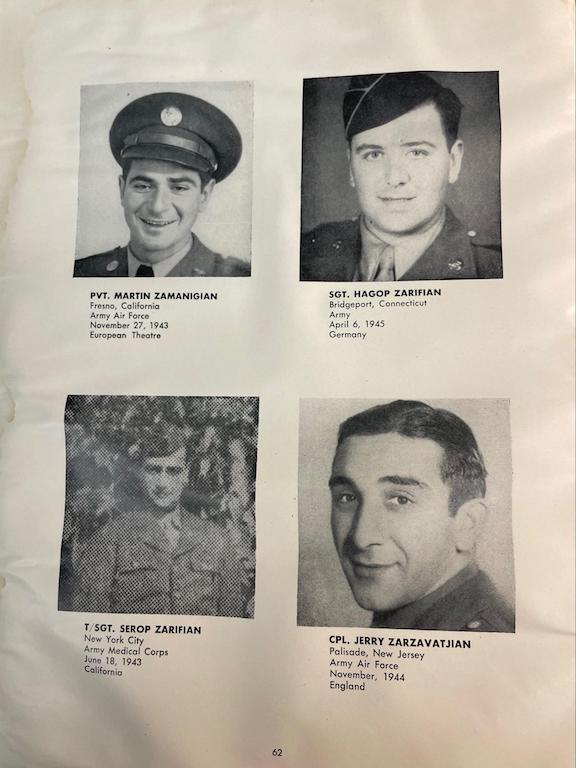 Photos and biographical information about fallen Armenian-American Veterans of World War II
He knew why this painstaking work, and efforts like it, are so important. Included in the volume are a list of those who made the ultimate sacrifice, often with brief biographies, and an alphabetical list, with photographs, of the thousands of servicemen and women. The book also provides information on city of origins, service dates, service areas, as well as any medals or awards received by those who had fought. From Fresno and Los Angeles, to Milwaukee, Worcester, Detroit, New York City and Providence, the list is long, and the faces full of hope with the exuberance that only comes with youth.
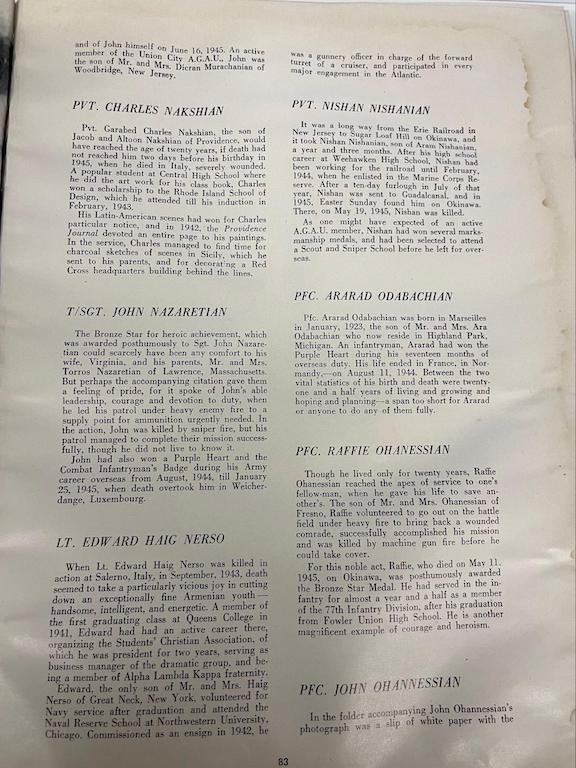
Particularly touching and fascinating are the compiled stories of the dead, in the “They Live Forever in Our Hearts” section. The first entry lists a Corporal Louis Abajian, from my hometown of Montebello.
“The Montebello News of Montebello, California carried a feature story in its March 22, 1945 issue on the three Abajian brothers, Louis, Art and Albert, sons of Mr and Mrs George Abajian who were serving in the United States Army. At that time, Corporal Louis Abajian had been overseas with the infantry for twenty-nine months. Participating in the triumphal entry of the 40th Division into Manila, he had seen action in Hawaii, Guadalcanal, New Britain, Luzon and the Panay islands. On April 1, 1945, ten days after the newspaper story, Louis was killed while attacking an enemy group on the Negros islands. For gallantry in action….he was awarded the Silver Star on what would have been his twenty-fourth birthday.”
Story after personal story unfolded the lives of only sons, of artists, farmers, engineers, students, all cut down in the prime of their lives.
 Short biographical sketches on fallen Armenian-American Veterans of World War II
“In the folder accompanying John Ohanessian’s photograph was a slip of white paper with the words ‘only son’—a stark reminder of the doubly tragic loss of his parents, Mr and Mrs Avades Ohannessian of Milford, Massachusetts. John was called to the colors in November of 1942 and in the course of events, became first trombonist with the Army Band Century Division. After a brief career overseas in which he received the Purple Heart, John sacrificed his life on March 16, 1945 to save twelve of his buddies in the Battle of the Bulge. To comment appropriately on a deed of such tremendous heroism is beyond the realm of rhetoric.”
Beyond these incredibly moving stories is the herculean effort of the all-volunteer committee of 48 of what I’ll call community archivists–45 of them women–who not only sent birthday cards, Easter cards, and Christmas packages during the war, but spent nearly a decade gathering photographs, stories and biographical information to ensure the participation of these Armenian men would not be relegated to the dustbin of history. They are the unsung heroes behind this project.
I wonder, have any similar efforts been made to collect images, stories and biographical information of heroes—fallen or living—of the first and second Artsakh wars? There has been a push to collect oral histories, but surely more can be done to preserve their stories, their memory; to ensure, as the “Our Boys” committee so painstakingly has done, that their existence is honored, archived and made accessible—for their friends and families, for historians and scholars, and for whomever is a student of this time in history. Because we know full well it just isn’t enough to collect and archive. If it isn’t accessible to anyone, for all intents and purposes, it does not exist.
Titan of all things Armenian genealogy Mark Arslan, with his incredible Armenian Immigration Project, has done so much in the realm of collection of primary source material. Made available online to anyone with any internet connection, his lists include, but are not limited to, birth records, ship manifests, census data, newspaper ads (Armenians searching for long lost family members, which deserves its own article). This mammoth database also includes the names of servicemen by birth place.
 The unsung heroes of this massive project
There is so much work to do to chronicle our enduring presence in this country and in Armenia, and this involves collection, metadata work, archival work, preservation work, digital preservation and sustainability, and addressing issues of access and discoverability. The unsexy jobs of librarians and archivists, where little money flows and whose very work will undermine and destroy all attempts to erase or deny these histories, needs to be generously funded and supported.
We have seen how our presence is being erased in real time in Artsakh. Attempts to document those places and histories are now lost to us, regardless of what has been done. And if what has been done is not shared and preserved, it too will be meaningless.
There are countless projects waiting to be started, archives to be surfaced, collections to be digitized and made widely accessible—in short, stories and histories to be told. It requires a selfless vision and dedicated effort.
Thanks to the Our Boys committee of amateur archivists, the images and stories of Armenian-American veterans of World War II will not be forgotten. Who will collect and write the stories of all of our diasporan communities, yet to be told?
Ani Boyadjian is Research & Special Collections Manager at the Los Angeles Public Library. She is also a founding member of the International Association of Armenian Librarian and Archivists (iaala.org) which seeks to uncover, map and surface Armenian collections and archives worldwide. She encourages anyone interested to join. She can be reached at aboyadjian@lapl.org.
In a nationally televised address, Prime Minister Nikol Pashinyan on Friday sought to justify his government’s recent decision to start the border demarcation process with Azerbaijan by ceding four villages in the Tavush Province without Baku’s guarantees to withdraw from territories it is currently occupying in Armenia.
He began his remarks by announcing that, beginning Friday, Armenia’s National Security Service has assumed the guarding of the newly demarcated border in Tavush.
“The key factor from which the current processes derive is the strategy that the government of the Republic of Armenia has put on its table. That is the strategy of Real Armenia, the strategy of Armenia, the gilded map-image of which I show you at every opportunity. That’s the Armenia I am talking about,” Pashinyan went on to say.
“And why should this map cause debates and inflame passions?” Pashinyan added, brandishing a cut out map of Armenia, which he has used as a prop to drive his point. “For a simple reason. not only in the previous 33 years, but also before that, the subject, goal and destination of our social psychology was not this Armenia.”
By recounting history — in broad strokes — Pashinyan attempted to justify the unilateral land transfer to Azerbaijan, by saying that he and his government want to create a “Real Armenia” based on what he called “realistic” approaches, rather than historic precedence.
This logic has seen Pashinyan and his allies continuously question Armenia’s historic turning points, including the victory that liberated Artsakh and the just struggle for the recognition of the Armenian Genocide.
“Together we must cross this path, which yes, is not covered with a red carpet, but passes through thorns and pitfalls, hard and difficult decisions, disappointments and misunderstandings, but it is the only one that has a horizon ahead of it and leads to the real Promised Land, Real Armenia: the Republic of Armenia,” Pashinyan said, adding that he and his government have been on a mission to formulate what is best for the people of Armenia.
“Our political team and I live with that mission and we see that we have put a formula on the table that will guarantee the 29,743 square kilometers of the internationally recognized legitimate territory of the Republic of Armenia and the borders that surround that territory, and our task is not only to lead, but also to to inspire the people, the citizens of the Republic of Armenia with that vision and formula, because this is a formula, a movement that leads us to real independence and sovereignty, territorial integrity and inviolability of borders,” Pashinyan said.
“This is a formula that will give our talented people, each and every one of you, the opportunity to concretize and enjoy the results of their work in the person of a free, fair, safe, prosperous and happy Armenia,” he added.
Below is the English translation of Pashinyan’s address to nation as provided by his press office.
Dear compatriots and citizens of the Republic of Armenia,
Starting from today, May 24, 2024, the border guard troops of the National Security Service of the Republic of Armenia took over the protection of the 1.9 km section of Berkaber settlement, 4.9 km section of Voskepar and Baghanis settlements of the state border of the Republic of Armenia.
Protection of the 5.8 km demarcated section of the Kirants settlement of the state border will be carried out by a transitional scheme until July 24, 2024.
This border demarcation process is understandably the most discussed topic of recent months, and I consider it important that each of us, each citizen, has a clear answer to the following questions: what is happening in our country, what is happening with our country, why is it all happening, what are the possible scenarios and alternatives after this point?
The key factor from which the current processes derive is the strategy that the government of the Republic of Armenia has put on its table. That is the strategy of Real Armenia, the strategy of Armenia, the gilded map-image of which I show you at every opportunity. That’s the Armenia I am talking about.
And why should this map cause debates and inflame passions? For a simple reason. not only in the previous 33 years, but also before that, the subject, goal and destination of our social psychology was not this Armenia.
And there were objective reasons for this. The most important of those reasons is our national misfortune of not having a state for centuries, which in itself should keep the dream of restoring statehood alive in our consciousness and subconsciousness, which has been the most important component of our national identity.
But while dreaming of a state, we relied on the memories that came from the state tradition we had in the past. Armenia of Yervanduni dynasty, Armenia of Artashesian dynasty, Armenia of Arshakuni dynasty, Armenia of Bagratuni dynasty, Cilician Armenia. Those Armenias were not identical and comparable with each other in terms of their territory and sometimes geographical location, which became an objective obstacle for the concretization and objectification of our ideas about Armenia.
This may seem not essential, but imagine you want to build a house, but you are not sure in which area, in what location, what size house you want to build. Until your understanding of these matters becomes concrete, you cannot build that house and your efforts to build it will never come to fruition. The most you will have is chaotic actions, because you do not decide in which area you want to build a house, in what position, in what size.
During the short period of existence of the First Republic, we did not manage to become concrete in our ideas about the Republic of Armenia.
The Second Republic was the Soviet Republic, which was not a sovereign state, but a country within the USSR, and due to this fact, it was a hostile environment for thinking about independence and an independent Armenia. Those with such thoughts and ideas were subject to criminal prosecution and were a threat to the integrity of the Soviet Union.
One of the methods of the Soviet Union’s struggle against the strong national self-awareness of the Armenians was to direct the independence dreams of the Armenian SSR outside the territory of Soviet Armenia and the Soviet Union, sometimes geopolitically, and sometimes in order to weaken and eradicate the perception of the Armenian SSR as a potential area for the re-creation of Armenian statehood. The Soviet Union promoted the formula of seeking a homeland outside the Armenian SSR among Armenians.
Due to this and a number of other factors, the search for the homeland became one of the pillars of our Armenians’ subconscious. This formula of searching a homeland from inside the homeland was harmless for the Soviet Union, because it directed the dreams of re-establishing statehood from the Armenian SSR, sometimes even outside the territory of the USSR, which also became a geopolitical factor that the Soviet Union could use in its international relations.
And those who still tried to connect the feelings of Armenian statehood with Soviet Armenia, ended up in prisons and on the political margins as carriers of anti-Soviet activities, that is, their supporters did not multiply. Here, it is in the conditions of the mentality of searching a homeland, a state outside the homeland, that the Third Republic of Armenia was formed, which positioned itself not as a means of ensuring the freedom, security and well-being of its own citizens, but adopted a vision that fully and completely fit into the Soviet-Armenian formula of the search for a homeland.
This is where we found ourselves in the situation described above, when we are not sure on what territory we want to build a state, in what position we want to build it and in what size.
And the search for homeland was reaffirmed as the key socio-psychology of the Third Republic.
A huge part of the deep problems of the Third Republic is related to this.
I cannot boast that I had this understanding and realized these conceptual nuances all the time or throughout my prime ministership. I have dealt with this agenda in a systematic way after assuming the position of the Prime Minister of the Republic of Armenia, seeing in depth and practically the threats that hang not only on the security of the Republic of Armenia, but also on the existence of our state in general.
And therefore, the conceptual question, the solution of which I have considered vital as the prime minister, is as follows: how are we going to ensure the lasting and prosperous future of the Republic of Armenia?
Strategic thinking on these issues led me to the Peace Agenda and the vision of Real Armenia, which are deeply interconnected.
If our strategic vision is not the Real Armenia, the already difficult peace will not be possible at all, because our environment will consider us a strategic threat and therefore will do everything to either physically destroy our statehood or prevent its development.
And secondly, when we do not spend our limited resources and energy on the strategic needs of Real Armenia, we do not have the results we could have and the development of Armenia, the future of our children is hindered doubly. And the peace that the Republic of Armenia needs so much is becoming more and more unattainable.
Under these conditions, the sovereignty of our country is significantly damaged, because when your ideas about the motherland do not exactly match with the internationally recognized legitimate borders of your country, you are forced to open the door for the disproportionate influence of others, because it seems to you that in this way you get strength and support to advance your agendas that do not coincide with legitimate borders.
So here we are again in the Soviet-Armenian model of patriotism. It is this model that separated the concept of homeland from the concept of state, solving the practical problem that the Armenian people should not consider the state of the Armenian SSR, even if incomplete, as a homeland, because the next step after considering the state as a homeland would be deepening the consciousness of independence.
Contrary to various assessments, our government is not separating, but trying to re-unite, to equate the concepts of homeland and state, because this is the only way to accomplish and strengthen the Republic of Armenia, otherwise we will spend our already limited resources on the search for a homeland, jeopardizing the future of the motherland-state.
As one of you who received a mandate from you to work on the formulas to ensure the future of Armenia, I spent years thinking about this epoch-making agenda, this tangle, before and after the 44-day war. And my thoughts have brought me to the unequivocal conviction that our duty to the future and future generations, as well as to the real people living in the Republic of Armenia today, requires us to do everything to make sovereign and democratic Armenia with demarcated borders a national and state ideology and concept.
And the discussions that are taking place in our country are not a surprise to me, because I have personally gone through that painful path, from the psychology of Historical Armenia to the psychology of Real Armenia, and we are going through that same path together now.
We are going through that path and at the end of that path is our Promised Land, the Republic of Armenia, with the difference that we are already here, but very often we do not notice our Promised Land, and because of not noticing it, we continue our search for the Promised Land. Today, our country is not perfect, also because of our endless search for the Promised Land inside the Promised Land does not allow us to make concrete and formulate the answer to the question of which area, in what position, of what size we want to build a home-state, and the demarcation process formulates the answer to this question column by column.
And together we must cross this path, which yes, is not covered with a red carpet, but passes through thorns and pitfalls, hard and difficult decisions, disappointments and misunderstandings, but it is the only one that has a horizon ahead of it and leads to the real Promised Land, Real Armenia: the Republic of Armenia. This is a crucial road. One philosopher says that the best path is the one that gets you where you are. This path brings us to where we are, the Republic of Armenia, and gives us the opportunity to look at our reality from a completely different perspective. And it is only from that point of view that the future and the route to that future can be seen. There is only one guarantee to realize that route: public knowledge and conviction in the mission of the political leadership.
Our political team and I live with that mission and we see that we have put a formula on the table that will guarantee the 29,743 square kilometers of the internationally recognized legitimate territory of the Republic of Armenia and the borders that surround that territory, and our task is not only to lead, but also to to inspire the people, the citizens of the Republic of Armenia with that vision and formula, because this is a formula, a movement that leads us to real independence and sovereignty, territorial integrity and inviolability of borders. This is a formula that will give our talented people, each and every one of you, the opportunity to concretize and enjoy the results of their work in the person of a free, fair, safe, prosperous and happy Armenia.
I presented in detail at the May 7 press conference how, in what sequence of steps we will achieve this goal, and I don’t see the need to repeat the same in other speeches and in this format.
The main purpose of this message is to clarify, comment on what is happening in our country, with our country, and why it is happening.
The establishment of the real Armenia is taking place in our lives and in our consciousness. It is a difficult, painful process that we go through and must go through together. It is a movement for independence and sovereignty that we must bring to its final destination, and my political team and I consider this our mission. Our mission is to make the state, independence and sovereignty a means that serves the citizen and not vice the versa.
Both in 2018 and 2021, the proud citizens of the Republic of Armenia have given us a mandate to ensure the future of the Republic of Armenia, and this mandate must be fully and completely implemented.
Glory to the martyrs and long live the Republic of Armenia.
And long live our children who will live in Free and Happy Armenia.