
Categories
South Caucasus News

Potentially Habitable ‘Exo-Venus’ With Earth-Like Temperature Discovered


Potentially Habitable ‘Exo-Venus’ With Earth-Like Temperature Discovered

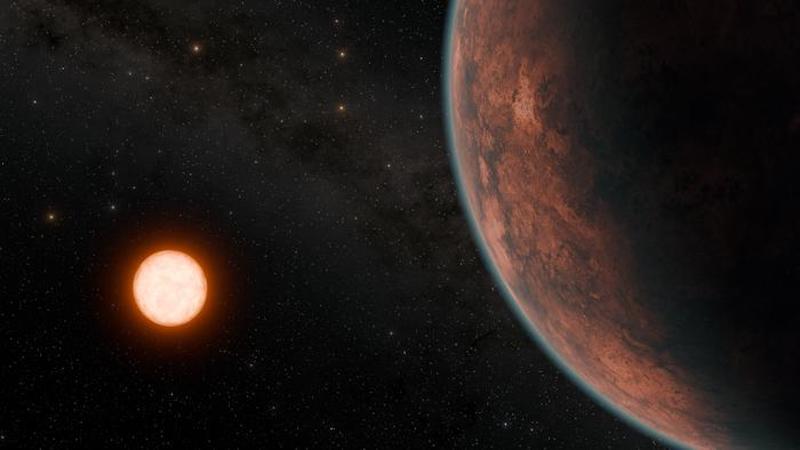
Gliese 12 b, which orbits a cool, red dwarf star located just 40 light-years away, promises to tell astronomers more about how planets close to their stars retain or lose their atmospheres. In this artist’s concept, Gliese 12 b is shown retaining a thin atmosphere. CREDIT: NASA/JPL-Caltech/R. Hurt (Caltech-IPAC)

Astronomers have made the rare and tantalising discovery of an Earth-like exoplanet 40 light-years away that may be just a little warmer than our own world.

The potentially-habitable planet, named Gliese 12 b, orbits its host star every 12.8 days, is comparable in size to Venus – so slightly smaller than Earth – and has an estimated surface temperature of 42°C (107°F), which is lower than most of the 5,000-odd exoplanets confirmed so far.

That is assuming it has no atmosphere, however, which is the crucial next step to establishing if it is habitable.

It may have an Earth-like atmosphere, one more akin to Venus – which experienced a runaway greenhouse effect that made it a 400°C (752°F) hellhole – no atmosphere, or perhaps a different kind of atmosphere not found in our solar system.

Getting an answer is vital because it would reveal if Gliese 12 b can maintain temperatures suitable for liquid water – and possibly life – to exist on its surface, while also unlocking answers about how and why Earth and Venus evolved so differently.

Gliese 12 b is by no means the first Earth-like exoplanet to have been discovered, but as NASA has said, there are only a handful of worlds like it that warrant a closer look.

It has been billed as “the nearest, transiting, temperate, Earth-size world located to date” and a potential target for further investigation by the US space agency’s £7.5billion James Webb Space Telescope.

The closest Earth-like exoplanet to us – and possibly the most famous – is Proxima Centauri b, which is only 4 light-years away. However, because it is not a transiting world we still have a lot to learn about it, including whether it has an atmosphere and the potential to harbour life.

Most exoplanets are discovered using the transit method, where a planet passes in front of its star from our point of view, causing a dip in the host star’s brightness.

During a transit, the star’s light also passes through an exoplanet’s atmosphere and some wavelengths get absorbed. Different gas molecules absorb different colours, so the transit provides a set of chemical fingerprints that can be detected by telescopes like Webb.

Gliese 12 b could also be significant because it may help reveal whether the majority of stars in our Milky Way galaxy – i.e. cool stars – are capable of hosting temperate planets that have atmospheres and are therefore habitable.

The discovery of the ‘exo-Venus’, by two international teams of astronomers, has been published in the Monthly Notices of the Royal Astronomical Society.

It orbits a cool red dwarf star called Gliese 12, which is almost 40 light-years away from Earth in the constellation Pisces.

“Gliese 12 b represents one of the best targets to study whether Earth-size planets orbiting cool stars can retain their atmospheres, a crucial step to advance our understanding of habitability on planets across our galaxy,” said Shishir Dholakia, a doctoral student at the Centre for Astrophysics at the University of Southern Queensland in Australia.

He co-led a research team with Larissa Palethorpe, a doctoral student at the University of Edinburgh and University College London.

The exoplanet’s host star is about 27 per cent of the size of our Sun and has a surface temperature that is around 60 per cent of our own star.

However, the distance separating Gliese 12 and the new planet is just 7 per cent of the distance between Earth and the Sun. Gliese 12 b therefore receives 1.6 times more energy from its star as Earth does from the Sun and about 85 per cent of what Venus experiences.

This difference in solar radiation is important because it means the planet’s surface temperature is highly dependent on its atmospheric conditions. As a comparison to Gliese 12 b’s estimated surface temperature of 42°C (107°F), Earth has an average surface temperature of 15°C (59°F).

“Atmospheres trap heat and – depending on the type – can change the actual surface temperature substantially,” Dholakia explained. “We are quoting the planet’s ‘equilibrium temperature’, which is the temperature the planet would be if it had no atmosphere.

“Much of the scientific value of this planet is to understand what kind of atmosphere it could have. Since Gliese 12 b gets in between the amount of light as Earth and Venus get from the Sun, it will be valuable for bridging the gap between these two planets in our solar system.”

Palethorpe added: “It is thought that Earth’s and Venus’s first atmospheres were stripped away and then replenished by volcanic outgassing and bombardments from residual material in the solar system.

“The Earth is habitable, but Venus is not due to its complete loss of water. Because Gliese 12 b is between Earth and Venus in temperature, its atmosphere could teach us a lot about the habitability pathways planets take as they develop.”

The researchers, along with another team in Tokyo, used observations by NASA’s TESS (Transiting Exoplanet Survey Satellite) to help make their discovery.

“We’ve found the nearest, transiting, temperate, Earth-size world located to date,” said Masayuki Kuzuhara, a project assistant professor at the Astrobiology Center in Tokyo, who co-led a research team with Akihiko Fukui, a project assistant professor at the University of Tokyo.

“Although we don’t yet know whether it possesses an atmosphere, we’ve been thinking of it as an exo-Venus, with similar size and energy received from its star as our planetary neighbour in the solar system.”

An important factor in retaining an atmosphere is the storminess of its star. Red dwarfs tend to be magnetically active, resulting in frequent, powerful X-ray flares.

However, analyses by both teams conclude that Gliese 12 shows no signs of such extreme behaviour, raising hopes that Gliese 12 b’s atmosphere may still be intact.

“We know of only a handful of temperate planets similar to Earth that are both close enough to us and meet other criteria needed for this kind of study, called transmission spectroscopy, using current facilities,” said Michael McElwain, a research astrophysicist at NASA’s Goddard Space Flight Center in Greenbelt, Maryland, and a co-author of the Kuzuhara and Fukui paper.

“To better understand the diversity of atmospheres and evolutionary outcomes for these planets, we need more examples like Gliese 12 b.”

At 40 light-years from Earth, Gliese 12 b is about the same distance as the TRAPPIST-1 system.

This is made up of seven planets, all roughly in Earth’s size range and likely rocky, orbiting a red dwarf star.

Three of these are in the habitable zone but at least two – and probably all of them – have no atmosphere and are likely barren, dismissing hopes when they were first discovered eight years ago that they could be water worlds hosting life.


Categories
South Caucasus News

AP Headline News – May 23 2024 18:00 (EDT)


28013281


Categories
South Caucasus News

Moscow Wants Pashinyan to Name CSTO Members He Claims Aided Baku – Asbarez.com – Asbarez Armenian News


Moscow Wants Pashinyan to Name CSTO Members He Claims Aided Baku – Asbarez.com  Asbarez Armenian News

Categories
South Caucasus News

U.S. Caucasus Envoy Meets with Armenia Officials – Asbarez.com – Asbarez Armenian News


U.S. Caucasus Envoy Meets with Armenia Officials – Asbarez.com  Asbarez Armenian News

Categories
South Caucasus News

Armenian Defense Minister receives Ambassador of the Kingdom of Belgium – ARMENPRESS


Armenian Defense Minister receives Ambassador of the Kingdom of Belgium  ARMENPRESS

Categories
South Caucasus News

President of Tajikistan Emomali Rahmon concludes his state visit to Azerbaijan [PHOTOS] – AzerNews.Az


President of Tajikistan Emomali Rahmon concludes his state visit to Azerbaijan [PHOTOS]  AzerNews.Az

Categories
South Caucasus News

A Familiar Scene: Kirants Resident Tries to Burn His Land Before Handover to Azerbaijan


YEREVAN (Azatutyun.am)—A resident of Kirants on Thursday tried to set fire to part of his agricultural land which Armenia’s government has decided to cede to Azerbaijan along with other areas in and outside the Armenian border village cordoned by off police.

A scuffle broke out moments later when police officers and firefighters intervened to extinguish the fire and prevent further damage to the plot of bushy land.

Kirants is one of four villages in the Tavush province adjacent to the border areas that are due to be transferred to Azerbaijan. It will be affected hardest by the planned handover.

Kirants residents say that their community will lose 54 agricultural plots owned by three dozen villagers in addition to two private houses, a cabin used as a shop and another structure. The shop owner began emptying it on Thursday morning, saying that authorities gave him 24 hours to leave the property. Officials clarified later in the day, however, that the affected villagers have one month to do so.

The authorities also distributed application forms that have to be filled out by villagers agreeing to give up their property rights in exchange for government compensation. The amount of that compensation is not yet known.

These and other villagers remain seriously concerned about their security. They say that the land transfer, touted by Prime Minister Nikol Pashinyan as a major achievement for Armenia, will leave their homes dangerously close to Azerbaijani troops. Also, the local school will move to within a few dozen meters away from the new border. Similar concerns have been voiced by many residents of the other affected Tavush communities.

Meanwhile, security forces continued to block all roads leading to Kirants for the fifth consecutive day. Only local residents were allowed to leave or enter the village 160 kilometers north of Yerevan.

Kirants was the epicenter of protests that broke out in Tavush following the announcement of the Armenian territorial concessions on April 19. The protest leader, Archbishop Bagrat Galstanyan, and his supporters took their campaign to Yerevan on May 9 to demand Pashinyan’s resignation. Their next major rally is scheduled for Sunday.


Categories
South Caucasus News

Moscow Wants Pashinyan to Name CSTO Members He Claims Aided Baku


Moscow called on Prime Minister Nikol Pashinyan to name the two CSTO member countries he accused of helping Azerbaijan during the 2020 war.

“I know that at least two CSTO member countries participated in preparing for the war against us. These countries may have created an illusion that they wanted to help us or that they allegedly helped us,” Pashinyan told lawmakers on Wednesday.

He also claimed that the issue of Karabakh had been “closed” for these countries and their ultimate goals was to “eradicate the independent Republic of Armenia.”

Pashinyan then referenced remarks made by Belarus President Alexander Lukashenko, who during a visit last week to occupied Shushi in Artsakh, boasted of his country’s support in remarks addressed to his Azerbaijani counterpart Ilham Aliyev.

He added that Azerbaijan’s 2021 and 2022 incursions into Armenia’s sovereign territory, as well as the September 2023 military offensive in Artsakh pursued the same goals.

Russia’s foreign ministry spokesperson Maria Zakharova on Thursday challenges Pashinyan to name the two countries he claimed had helped Baku.

I am interested to know which countries the prime minister of Armenia was talking about. Do we all have to figure it out for ourselves? Or will they tell us later?” Zakharova said at a press briefing.

“I think it would be quite logical to name them if such serious statements are made. But let’s leave that to official Yerevan,” she added.

Zakharova then went on to elaborate that President Vladimir Putin of Russia personally had done everything “so that Armenia does not feel abandoned and forgotten.”

The foreign ministry spokesperson said that Putin spared no effort to stop the war and curb the losses. However, she said, it was Pashinyan who rejected a cease fire proposal that would have ended the war in October 2020.

On numerous occasions Putin has claimed that the cease fire proposal in October, 2020 would have ensured that Shushi would remain a part of Artsakh and has insisted that Pashinyan’s so-called rejection led to the escalation of military hostilities and the loss of Shushi and other territories.


Categories
South Caucasus News

U.S. Caucasus Envoy Meets with Armenia Officials


The United States senior advisor for the Caucasus Louis Bono visited Yerevan on Thursday and met with various government officials, among them Foreign Minister Ararat Mirzoyan.

The two reportedly discussed the latest developments in the process to normalize relations between Armenia and Azerbaijan, as well as approached to key issues of the draft peace treaty, around which negotiations were held as recently as this month when Mirzoyan and his Azerbaijani counterpart, Jeyhun Bayramov, met in Astana, Kazakhstan.

According to a press statement, Mirzoyan emphasized the importance of adhering to the commitments expressed by the top leaders of both countries regarding the mutual recognition of each other’s territorial integrity based on the 1991 Alma-Ata Declaration.

Bono was also briefed about the agreements reached during the recent meetings of the border delimitation commissions between Armenia and Azerbaijan. That agreement, initiated on April 19 and essentially codified last week, resulted in Yerevan ceding four villages in the Tavush Province to Azerbaijan, without a reciprocal mandate on Baku.

This decision by the Armenian government has sparked the “Tavush for the Homeland” movement, led by Archbishop Bagrat Galstanyan, who has called for Pashinyan’s resignation and is planning a rally on Sunday.

According to the statement, Mirzoyan and Bono exchanged ideas on the issues of unblocking regional transit connections..

“Minister Mirzoyan reaffirmed Armenia’s consistent approach to implementing the process based on well-known principles: sovereignty, jurisdiction, reciprocity and equality,” the statement said.

Bono also met with Armenia’s Deputy Prime Minister Mher Grigoryan and National Security Chief Armen Grigoryan (no relation), with whom he discussed similar topics.

This was second visit by a high-level U.S. official to Armenia.

Deputy Director of the Central Intelligence Agency David Cohen visited Yerevan on Tuesday and held meetings with government officials, among them Prime Minister Nikol Pashinyan.

In a short press statement following the meeting, Pashinyan’s office said “Armenia-US bilateral, as well as international agenda matters were discussed,” without elaborating.

Meanwhile, Secretary of State Antony Blinken on Wednesday told the U.S. House Foreign Affairs Committee that the U.S. is considering providing more assistance to Armenia.

“We are looking at a series of requests from Armenia to see what we can do to strengthen even more our support and cooperation with Armenia,” Blinken said, in response to an question by Rep. Jim Costa, a Democrat representing California’s San Joaquin Valley.

Blinken added that Washington already promised last month $65 million in additional “development assistance” to Armenia.

“We’ll be moving forward, I think, in a number of different areas. Prime Minister Pashinian has done an extraordinary job leading his country in very, very difficult times,” Blinken said.


Categories
South Caucasus News

NPR News: 05-23-2024 6PM EDT


NPR News: 05-23-2024 6PM EDT

Learn more about sponsor message choices: podcastchoices.com/adchoices

NPR Privacy Policy