
Day: May 22, 2024
Executive Summary:
-
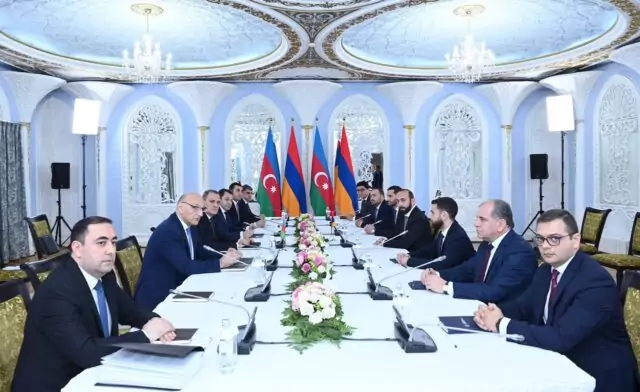
The foreign ministers of Armenia and Azerbaijan met for bilateral negotiations in Almaty, Kazakhstan, in April, following the start of the delimitation of the two countries’ shared interstate border.
-
Both sides emphasized that though they still have their differences, some progress has been made, including agreeing on which maps to reference for the talks.
-
Azerbaijani President Ilham Aliyev believes that an initial agreement on “basic principles” could be reached by the end of the year, but a comprehensive peace treaty will likely take longer.
On May 10 and 11, the foreign ministers of Armenia and Azerbaijan, Ararat Mirzoyan and Jeyhun Bayramov, respectively, met for another round of bilateral peace negotiations in Almaty, Kazakhstan. It was the second meeting this year between the two sides after meeting in Berlin on February 28 and 29. The Almaty talks came after the initiation of the delimitation process on the Armenian-Azerbaijani interstate border, with the return of four non-enclave villages to Azerbaijan in April (see EDM, April 17, 23, May 14). The act was celebrated by some as the first instance in the post-Soviet era of a peaceful resolution in the long-standing territorial disputes between the two countries (Azertag.az, April 19; State.gov, April 28). The two parties hopes to build on this progress and foster a constructive atmosphere during the talks in Almaty. These developments point to progress in the peace process between Armenia and Azerbaijan, demonstrating both sides’ willingness to pursue improved relations.
After the meeting, the two foreign ministries put out identical press releases highlighting this momentum (Mfa.gov.az; Mfa.am, May 11). One significant agreement came in choosing which maps to use for the delimitation process. Previously, the two countries were on opposite sides of the issue. Armenia proposed using a Soviet map drawn in 1975, while Azerbaijan insisted that the new boundaries not be based solely on one map (1lurer.am, May 22, 2023; Turan.az, October 11, 2023; President.az, January 10). On May 7, Armenian Prime Minister Nikol Pashinyan stated that the delimitation process would be “carried out on the basis of the latest Soviet maps with legal force,” not on the basis of a single map (News.am, May 7). On April 19, the delimitation commissions of the two countries, in the press release about the transfer of the four non-enclave villages, stated, “The Parties agreed that within the delimitation process, they will be guided by the Alma-Ata Declaration of 1991” (Azertag.az, April 19).
The location of Almaty for the talks was symbolic in this context as the Alma-Ata Declaration was signed in 1991. (Following the fall of the Soviet Union in 1991, Almaty was changed to its Kazakh name from the Russian version, Alma-Ata.) Unlike most earlier negotiations between the two countries, the Armenian-Azerbaijani talks are now being held in a bilateral format, with the host country providing only a platform to facilitate the meeting (Armenpress.am, April 29).
Despite the progress, the press release claimed that the two sides still differ on some key issues, though it did not specify which matters. The delegations agreed to continue discussing possible resolutions in future meetings. Based on the earlier statements, at least some of these issues concern the existence of territorial claims against Azerbaijan in Armenia’s constitution and the proposals to reopen regional transit routes. The former issue has become more complicated. Pashinyan acknowledged the problem and proposed constitutional reforms in January (see EDM, January 24).
The prospects for a referendum on constitutional changes are slim against the backdrop of ongoing anti-government protests in Armenia, which started following the handover of the four non-enclave villages to Azerbaijan (see EDM, April 23). Protestors that oppose the delimitation process have been led by representatives of the Armenian Apostolic Church and supported by various parties including some former Armenian diplomats, pro-Russian opposition parties, diasporan groups, and the nationalist Dashnaktsutyun Party (Azatutyun.am, May 1; Civilnet.am, May 8; EDM, May 14). The protests threaten to destabilize Armenia and thereby derail the peace talks.
Logistically, the main obstacle to reopening transit links between the two countries concerns the security and customs regulations along the Zangezur Corridor (see EDM, April 15). Some analysts believe that the deployment of Russian border guards to the corridor would no longer be a precondition for opening the passage. Instead, another international security mechanism could be agreed upon (Novosti Kavkaza, May 10). In 2021, Russian troops were deployed at the request of the Armenian government on the border between Armenia and Azerbaijan as a security measure against Azerbaijan. These troops were withdrawn on May 8 from the Gegharkunik, Syunik, Tavush, Ararat, and Vayots Dzor regions in accordance with an agreement between Pashinyan and Russian President Vladimir Putin (see EDM, May 2, 16). Some outlets have interpreted this move as a sign that Russian troops will not be deployed to the Zangezur Corridor (Report.az, May 12). Others believe that Russia may support the use of another international security mechanism to hasten the opening of regional transit channels (Novosti Kavkaza, May 10).
Azerbaijani President Ilham Aliyev also hinted at this possibility in an international conference on April 23. He stated, “Land access from mainland Azerbaijan to the Nakhchivan Autonomous Republic through Armenia must be provided with international control and a security mechanism.” Aliyev said that if Armenia does not want that mechanism to be Russian border security, “they should say it. But again, it is something they signed themselves, and they must respect their signature” (President. az, April 23). This statement, however, may not suffice to conclude a shift in Baku’s position. Earlier this year, Aliyev presented the deployment of the Russian border guards as a “must” for the opening of the Zangezur Corridor. “The statement of November 10 indicated that Russian border guards would provide security and control in the 42–43 kilometer stretch, and this obligation must be fulfilled,” he said on January 10 (President.az, January 10).
The two countries are unlikely to sign a comprehensive peace treaty in the coming months, because of these challenges, particularly the call for constitutional changes in Armenia. However, Baku and Yerevan may be able to agree to some fundamental principles by the end of the year. On April 23, Aliyev outlined this possibility: “I think it is absolutely realistic to reach an agreement between Azerbaijan and Armenia before COP29 [the United Nations Climate Change Conference to be held in November in Baku], at least an agreement on our basic principles” (President.az, April 23). He said the two countries may first sign such an agreement and then work on the details and wording for a more comprehensive peace treaty. The Almaty meeting of the Armenian and Azerbaijani foreign ministers on May 10 seems to have been a constructive step in this direction.
https://jamestown.org/program/armenia-and-azerbaijan-step-up-work-on-peace-deal/
YEREVAN—The American University of Armenia announced the appointment of new Provost Dr. Alina Gharabegian. Occupying various teaching roles since the age of 19, Dr. Gharabegian taught in California and New York — at California State University in Los Angeles and throughout four of the City University of New York’s campuses, teaching both literature and composition/rhetoric — before she was hired into a tenure track position at New Jersey City University in 2009. She served as chair of the English department at NJCU from 2014 to 2017, vice president of NJCU’s Union for a term, and interim dean of AUA’s College of Humanities and Social Sciences during her Fulbright stint in the 2018 to 2019 academic year.
“We are delighted to welcome Dr. Gharabegian to the role of provost of the American University of Armenia,” said AUA President Dr. Bruce Boghosian. “She brings a wealth of experience in academic administration, combined with familiarity with the AUA community from her time as acting dean here. As our chief academic officer, she is well equipped to raise the level of teaching and research at this institution to the next level. All of us on the AUA executive team are very much looking forward to working with her.”
Dr. Gharabegian holds B.A., M.A., and M.Phil. degrees in the field of English literature, as well as a Ph.D. in English, with an emphasis in Victorian poetry and poetics, from the Graduate Center of the City University of New York, the largest urban university system in the United States. There, she also underwent extensive training and developed expertise in composition/rhetoric theory and pedagogy, in addition to her primary training in 19th-century British literature. The AUA asked Dr. Gharabegian about her vision for the role of provost, her motivation to return to the institution, and more.
AUA: What is your vision for your role of provost?
Dr. Alina Gharabegian: AUA has articulated for itself a sacred mission, in my opinion. Guarding the integrity of this mission is, in part, the provost’s responsibility. As chief academic officer, the provost is charged with maintaining the academic standards and facilitating the academic growth of the institution, so I see my role primarily as serving those twin purposes. I hope to foster a greater sense of community and collaboration among the academic units, and one way to achieve a sense of community is by unifying people, which I take to be part of my charge, as well. I’m a humanist, first and foremost, so I intend to model humanistic conduct — to privilege ethics and rationality, honor and inspire individuals, and expect social responsibility from all. It’s also part of my role, I think, to learn from others and to teach. The provost’s position, if I may be allowed to use an analogy, is that of a conductor who relies on every single individual in the orchestra to make the magic happen — together!
AUA: What motivated you to join AUA?
A.G.: As I mentioned, I hold AUA’s mission sacred and near to my heart. The University’s formation — its very existence — is like a miracle. It has overcome some quite significant odds and obstacles in its history. And so, of course, this makes AUA a particularly special place. It’s an honor, I think, to be part of an institution that has met and conquered challenges and continues to grow. The year I spent at AUA as interim dean of CHSS was, despite its attendant difficulties, the most spiritually rewarding year of my academic career, so a potential return to AUA was an easy decision to make. And of course, as a Diasporan, I want very much to contribute in my own small way to nation-building; given the synergies between AUA’s current needs and my training and experience, I think this is an ideal role for me. I feel that work at AUA is meaningful work.
AUA: What are some challenges you foresee in this new role?
A.G.: Generally speaking, as in any undertaking in life, I think the greatest challenge is reconciling the gap between the ideal and the real. What do we hope for, desire, or aspire to, and what do we achieve in the world, by contrast? It’s challenging to negotiate the psychological space in which you have to accept that what you want and what you can have are often different things. So I imagine there will be things I will hope for, work toward, and then have to relinquish. The second challenge — a related challenge — concerns what is arguably our greatest commodity: time. I believe I will not have nearly enough time to do all I would want to do for the institution.
More specifically, AUA is on a huge growth trajectory, and where there is growth, growing pains are inevitable. I think that in the years ahead, there will be many challenges associated with that growth, which the provost’s office will have to face.
AUA: What do you enjoy most about working in education?
A.G.: An educational institution is a place that brings together people who are constantly involved in the multifaceted enterprise of learning-teaching-investigating-discovering-sharing. It’s a fascinating place, in a sense. And for those of us who remain with it past the mandated 12-year period, this enterprise involves love, to some degree. I’m a curious person, so I think the academy is the best place for me. However, I think my greatest curiosity (even my curiosity about history and literature) concerns people. (Etymologically, “curious” comes from “care.”) I’m curious about what makes people tick, what their interests and desires and hidden capabilities are, what inspires them, what and how they think, and so forth. So, discovering what motivates individuals and then helping them find their way to achieving what they want is a rewarding pursuit for me. As educators, we have the privilege of facilitating this discovery process for and with our students. My experience is that this paradigm holds true for people with whom one works in a leadership capacity, as well.
Founded in 1991, the American University of Armenia is a private, independent university located in Yerevan, Armenia, affiliated with the University of California, and accredited by the WASC Senior College and University Commission in the United States. AUA provides local and international students with Western-style education through top-quality undergraduate and graduate degree and certificate programs, promotes research and innovation, encourages civic engagement and community service, and fosters democratic values.
 Vartivar Mazmanian
VARTIVAR MAZMANIAN
Born on May 15, 1935
Vartivar Mazmanian, beloved husband, father, grandfather, brother-in-law, uncle, and relative passed away on Friday, May 17, 2024.
Funeral services followed by interment will be held on Wednesday, May 29 at 9 a.m. at the Old North Church in Hollywood Hills Forest Lawn Memorial Park.
He is survived by his:
Wife, Vanda Mazmanian
Son, Hratch Mazmanian
Son, Meher and Hourig Mazmanian
Grandchildren, Shant and Anais Mazmanian
Sister, Heghine Krjelian and family (Beirut, Lebanon)
Sister-in-law, Hayatt Najjarian
Sister-in-law, Hermine Janoyan
Sister-in-law, Ani Ajemian
Brother-in-law, Dr. Tavit and Sossie Najarian
In-laws, Ossanna Dakessian
Ara and Maral Dakessian and family
Archpriest Arshag Khatchadourian and yeretsgin Marcie and family
Nephews and Nieces,
Raffi Najjarian and family
Armen and Liz Najjarian and family
Maral and Michael Cohen
Nora and Dr. Philip Balikian and family
Aram and Lusine Janoyan and family
Sevag and Jacklin Ajemian and family
Shoghag and Houri Ajemian
Ohan and Erin Najarian and family
Talene and Eric Baroyan and family
And all relatives and friends.
Categories
NPR News: 05-22-2024 4AM EDT
Categories