Categories
South Caucasus News

Researchers Discover Hidden Step In Dinosaur Feather Evolution


Researchers Discover Hidden Step In Dinosaur Feather Evolution

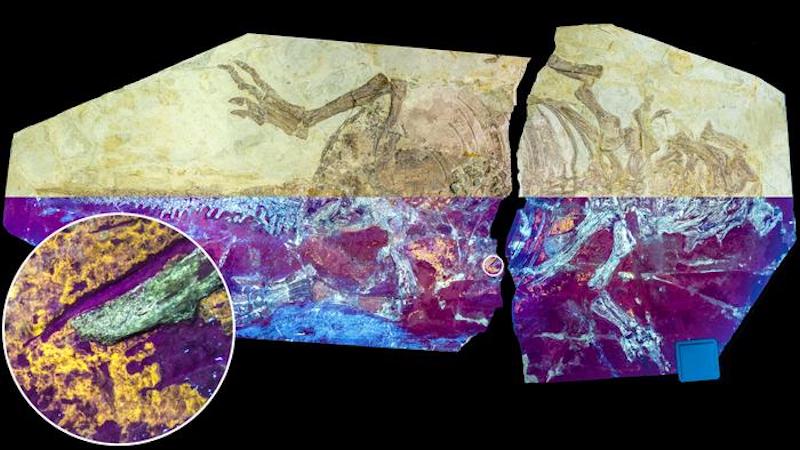
Studied dinosaur specimen NJUES-10 under natural (upper half) and UV light (lower half) showing the orange-yellow fluorescence of the fossil skin. CREDIT: Dr Zixiao Yang

Palaeontologists at University College Cork (UCC) in Ireland have discovered that some feathered dinosaurs had scaly skin like reptiles today, thus shedding new light on the evolutionary transition from scales to feathers.

The researchers studied a new specimen of the feathered dinosaur Psittacosaurus from the early Cretaceous (135–120 million years ago), a time when dinosaurs were evolving into birds. The study shows, for the first time, that Psittacosaurus had reptile-like skin in areas where it didn’t have feathers.

The study, published in Nature Communications, was led by UCC palaeontologists Dr Zixiao Yang and Prof. Maria McNamara of UCC’s School of Biological, Earth and Environmental Sciences, who teamed with scientists based in Nanjing University (China).

The team used ultraviolet (UV) light to identify patches of preserved skin, which are invisible in natural light. Further investigation of the fossil skin using X-rays and infrared light revealed spectacular details of preserved cellular structure.

Dr Yang says:

“The fossil truly is a hidden gem. The fossil skin is not visible to the naked eye, and it remained hidden when the specimen was donated to Nanjing University in 2021. Only under UV light is the skin visible, in a striking orange-yellow glow.

“What is really surprising is the chemistry of the fossil skin. It is composed of silica – the same as glass. This type of preservation has never been found in vertebrate fossils. There are potentially many more fossils with hidden soft tissues awaiting discovery.”

The most exciting aspect of the discovery, however, is what it tells us about the evolution of feathers in dinosaurs. Prof. McNamara, senior author on the study, says:

“The evolution of feathers from reptilian scales is one of the most profound yet poorly understood events in vertebrate evolution. While numerous fossils of feathers have been studied, fossil skin is much more rare.

“Our discovery suggests that soft, bird-like skin initially developed only in feathered regions of the body, while the rest of the skin was still scaly, like in modern reptiles. This zoned development would have maintained essential skin functions, such as protection against abrasion, dehydration and parasites. The first dinosaur to experiment with feathers could therefore survive and pass down the genes for feathers to their offspring.”

The Psittacosaurus specimen NJUES-10 is currently housed in Nanjing University.


Categories
South Caucasus News

Rise In Sea Urchins And Related Damage To Kelp Forests Impacts Oregon’s Gray Whales And Their Food


Rise In Sea Urchins And Related Damage To Kelp Forests Impacts Oregon’s Gray Whales And Their Food

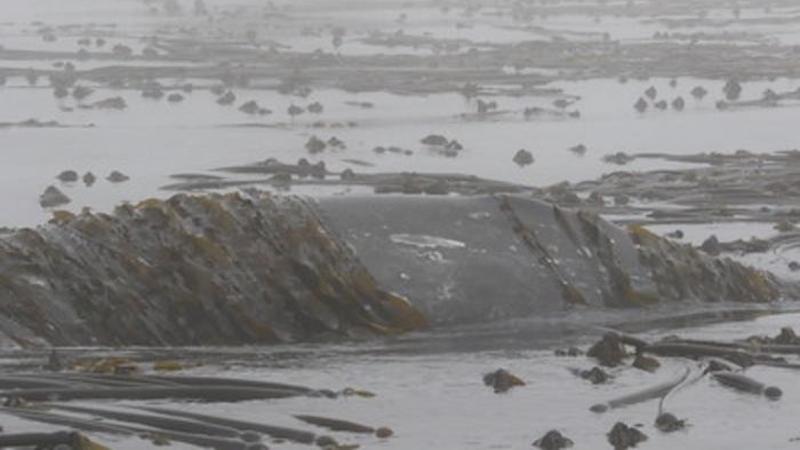
A gray whale swimming in healthy kelp. Photo collected under NOAA/NMFS research permit #16111. CREDIT: GEMM Lab, Marine Mammal Institute, Oregon State University.

A recent boom in the purple sea urchin population off the southern Oregon Coast appears to have had an indirect and negative impact on the gray whales that usually forage in the region, a new study shows.

When urchin numbers rise, the spiky marine invertebrates can devour kelp forests that are a critical habitat for zooplankton, the tiny aquatic organisms that are the primary prey of many marine animals. Damaged kelp forests lead to reductions in zooplankton, and with fewer zooplankton to feed on, gray whales spend less time foraging there, researchers with Oregon State University’s Marine Mammal Institute found.

“This study shows the cascading impacts of a change in the coastal ocean ecosystem in a way that has not been documented before,” said the study’s lead author, Lisa Hildebrand, a doctoral candidate in the Marine Mammal Institute’s Geospatial Ecology of Marine Megafauna Laboratory. “These impacts extend indirectly to a top predator, the gray whale, and it affects them in a negative way.”

The study was recently published in Nature Scientific Reports. Co-authors are Associate Professor Leigh Torres, who leads the GEMM Lab at Hatfield Marine Science Center in Newport, and researchers Solène Derville and Ines Hildebrand of Torres’ lab.

Sea urchin populations began to explode off the coast of Oregon following the Sea Star Wasting Syndrome pandemic that began in 2013. The pandemic led to an estimated 90% decline in sunflower sea stars, which are now listed as critically endangered.

Historically off the coast of Oregon, sunflower sea stars have been one of two natural predators of sea urchin. The other is the sea otter, which was wiped out of Oregon waters by fur trappers more than 100 years ago.

“In ecology, we think about the important role of redundancy in an ecosystem,” Torres said. “This is a good example of an ecosystem that lacks redundancy due to the loss of sea otters. The system could not sustain itself without both the otters and the sea stars.”

Sea urchins are naturally occurring in kelp forests, but the decline in sunflower sea stars meant there was no predator to keep the population in check. The researchers began to see the effects of that change in the ecosystem during their annual gray whale monitoring research in Port Orford.

Torres and her team have been monitoring gray whales and their environment in that region since 2015 as part of a 10-year study of the foraging ecology of gray whales in the Pacific Coast Feeding Group. This small subset of whales frequents near-shore waters along the Oregon and Pacific Northwest coast rather than traveling to the Arctic to forage each summer.

The research team, which includes local high school students and college undergraduates, spends six weeks each summer at OSU’s Port Orford Field Station. The location is ideal because there’s a large, protected cove that allows researchers to monitor whales easily from shore and also gives them access to the water, where they can collect zooplankton samples by kayak and use GoPro cameras to monitor underwater conditions.

“The overall goal of the research is to better understand what gray whales are feeding on near shore,” Lisa Hildebrand said. “We first started to see these dramatic images of sea urchins feeding on the kelp in 2018 and even more in 2019.”

The sea urchin-kelp dynamic has been well-studied, but this is the first study that looks beyond that relationship to the impacts on zooplankton that inhabit the kelp forest and their predators – the gray whales.

The researchers found that as the kelp was damaged or destroyed, fewer zooplankton, and in particular the tiny mysid shrimp that make up a big portion of the gray whale’s diet, remained in the near-shore waters. With fewer zooplankton in the area, the gray whales spent less time foraging there.

“In 2020 and 2021, we saw fewer whales and the whales we saw spent less time in that area,” Torres noted. “We also noted declines in gray whales’ body condition during these years while conducting other field studies off the coast of Newport.”

The researchers can’t say how exactly the decline in kelp leads to a decline in zooplankton, but they suspect the zooplankton may be using the kelp as a type of shelter, and it may be that zooplankton are retained within kelp beds because tides and currents are weaker inside these areas than outside, Hildebrand said.

The study highlights the ripple effects of ocean warming due to climate change, the researchers noted.

“Marine heatwaves and warmer ocean waters likely worsened the Sea Star Wasting Syndrome pandemic and young kelp tends to grow better in colder water. As a result, there was less drift kelp available for urchins to feed on in the nearshore system,” Lisa Hildebrand said.

In 2023, the researchers noted that the region showed signs of recovery, with fewer urchins and more kelp, zooplankton and whales. These recent observations may be signs of the ecosystem returning to conditions favorable for kelp growth.

“We think and we hope this system is recovering and we’ll continue to monitor it through our research,” Torres said. “Oregonians love having gray whales feeding along our coast and they need a healthy habitat to ensure that continues.”

The Marine Mammal Institute is part of Oregon State’s College of Agricultural Sciences and is based at Hatfield Marine Science Center. The study was funded in part by Oregon Sea Grant.

Categories
South Caucasus News

Cosmic Rays Illuminate The Past


Cosmic Rays Illuminate The Past

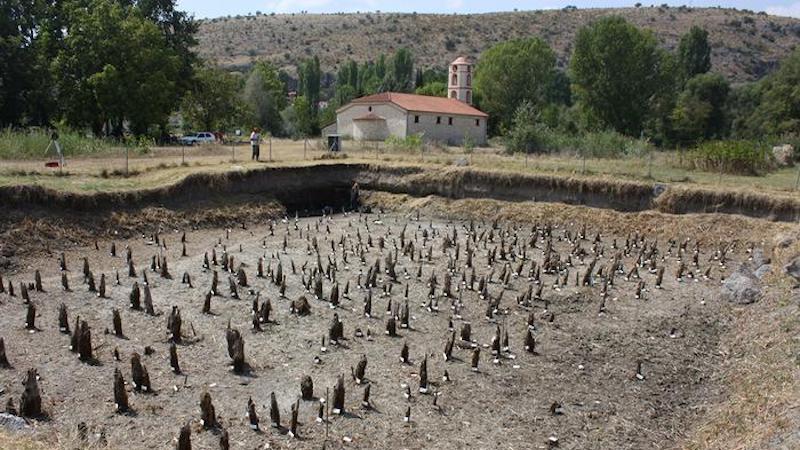
The pile field at the site of Dispilio. Almost 800 piles, mostly made of juniper and oak wood, were sampled and dendrochronologically measured. This data forms the basis for the high-precision dating of this site. Dispilio is the first archaeological site to be dated to a precise year using the Miyake event of 5259 BC. CREDIT: © Dispilio Excavation Archive

Researchers at the University of Bern have for the first time been able to pin down a prehistoric settlement of early farmers in northern Greece dating back more than 7,000 years to the year. For this they combined annual growth ring measurements on wooden building elements with the sudden spike of cosmogenic radiocarbon in 5259 BC. This provides a reliable chronological reference point for many other archaeological sites in Southeast Europe. 

Dating finds plays a key role in archaeology. It is always essential to find out how old a tomb, settlement or single object is. Determining the age of finds from prehistoric times has only been possible for a few decades. Two methods are used for this: dendrochronology, which enables dating on the basis of sequences of annual rings in trees, and radiocarbon dating, which can calculate the approximate age of the finds by the decay rate of the radioactive carbon isotope 14C contained in the tree rings.

A team led by the Institute of Archaeological Sciences at the University of Bern has now succeeded in precisely dating timber from the archaeological site of Dispilio in northern Greece, where dating to the year had previously not been possible, to different building activities between 5328 and 5140 BC. The researchers made use of high-energy particles from space, which can be reliably dated to 5259 BC. Their research has been published in the journal Nature Communications.

Tree-ring chronologies and the 14C method have their limits

Dendrochronology uses characteristic patterns of broad and narrow annual growth rings in wood, which are influenced by climatic conditions. As a result, a wooden object can be dated by comparing the annual growth ring widths with already existing standard or regional chronologies. “In Central Europe there is a tree-ring chronology that goes back almost 12,500 years into the past – to the year 10,375 BC. However, this chronology only applies to certain regions. There is no consistent chronology for the Mediterranean region,” says the lead author of the study, Andrej Maczkowski from the Institute of Archaeological Sciences at the University of Bern.

Therefore, dendrochronological dating from this region must be classified as ‘floating’ using radiocarbon dating. As long as a tree is alive, it absorbs the radioactive isotope 14C (radiocarbon) contained in the Earth’s atmosphere through photosynthesis. When it dies, it no longer absorbs 14C; the isotope decays with a half-life of 5730 years. A laboratory measurement method can then be used to determine how much 14C is still contained in a particular tree ring and thus calculate the tree’s approximate time of death over the known half-life. “However, the accuracy of such classifications is in the best case within the range of decades,” says Maczkowski. “Until recently, it was therefore believed that dendrochronological dating to the year was only possible if a continuous regional tree-ring chronology was available, which is the case for prehistoric periods in just three regions worldwide: this is the southwestern United States, the northern Alpine foothills and England/Ireland,” explains Albert Hafner, Professor of Prehistoric Archaeology at the University of Bern and senior author of the study.

Paradigm shift thanks to Japanese physicist

In 2012, a solution to the problem emerged: Japanese physicist Fusa Miyake discovered that a massive influx of cosmic rays, presumably due to solar flares, can cause an uptick in the atmosphere’s 14C content, which is deposited in the respective years’ tree rings. These spikes can be accurately dated on the basis of long tree-ring chronologies, and because they are global events, they are important anchor points, especially in regions without consistent annual growth ring chronologies.

“Miyake recognized the first anchor points of this kind and thus brought about a paradigm shift in prehistoric archaeology,” says Albert Hafner. Today, a dozen of these Miyake events are known up until 12,350 BC, and the two important events in 5259 and 7176 BC were only discovered in 2022 by researchers at ETH Zurich. No such events of similar magnitude have been recorded in the past few centuries. If an event of this magnitude, as in 5259 BC, happens today it will likely have a disastrous effect on telecommunications and electronics.

Miyake event enables dating in Dispilio

The research team from the EXPLO project led by the University of Bern (see box) has succeeded in establishing an annual growth ring chronology spanning 303 years, which ends in 5140 BC, by analyzing 787 pieces of timber from the archaeological site of Dispilio on Lake Orestida in northern Greece. The identified settlement phases show various house building activities over 188 years between 5328 and 5140 BC. This precise dating is possible because there was a known Miyake event during this period in 5259 BC.

Researchers at ETH Zurich were able to detect a spike in radiocarbon content during this time by radiocarbon dating several individually defined annual growth rings. It was therefore a question of reproducing this peak, which is reflected globally in the annual growth ring chronologies of Siberian larch, American pine, and European oak, on the annual growth ring chronology from Dispilio in Greece and connecting it to the anchor point 5259 BC. “The Balkans is therefore the first region in the world to benefit from this paradigm shift and to be able to successfully determine absolute dating independently of a consistent calendar,” says Albert Hafner.

Andrej Maczkowski adds: “We expect that other chronologies for the region from this period can now be linked to the ‘Dispilio Chronology’ in rapid succession. This paves the way to developing a regional dendrochronology for the southern Balkans. “The Balkans have the oldest lakeside settlements in Europe, whose sites are dated to just after 6000 BC. The region played a key role in the expansion of agriculture in Europe.


Categories
South Caucasus News

Arch. Bagrat Galstanyan Meets Artsakh Armenians


YEREVAN (Azatutyun.am)—Archbishop Bagrat Galstanyan met with exiled leaders and ordinary refugees from Nagorno-Karabakh on Tuesday as part of ongoing consultations aimed at ramping up momentum for his opposition-backed bid to oust Prime Minister Nikol Pashinyan.

“I want to make it very clear that the main goal of our movement is to have real peace,” Galstanyan said in his opening remarks at the meeting mostly held behind the closed doors.
He voiced support for the Karabakh Armenians’ right to return to their depopulated homeland recaptured by Azerbaijan last September. Armenia must assert that right in the international arena, he said.

Pashinyan publicly recognized Azerbaijani sovereignty over Karabakh several months before Azerbaijan’s September 2023 military offensive. He has since repeatedly indicated that the Karabakh issue is closed for his administration.

Pashinyan threatened to crack down on Samvel Shahramanyan, the Karabakh president now based in Yerevan, after the latter declared in March that the self-proclaimed Nagorno-Karabakh Republic continues to exist despite the Azerbaijani control over the region. Armenian opposition leaders condemned Pashinyan’s threats.

Shahramanyan did not take part in the meeting with Galstanyan. But some members of his team and exiled mayors of Karabakh towns and villages were in attendance.

“We don’t aim to strip anyone of power or fight against concrete people,” Gagik Baghunts, the acting Karabakh parliament speaker, said after the meeting. “Our goal is to fight for something that is dear to us.”

Baghunts referred to the eventual repatriation of Karabakh’s ethnic Armenian population that fled to Armenia during the Azerbaijani takeover. Other, more outspoken Karabakh lawmakers feel that regime change in Yerevan is a necessary condition for that.

“I don’t think that changes in the lives of Artsakh Armenians would be very fast,” cautioned Baghunts. “I don’t see decisive changes at this stage.”

Pashinyan’s political team seems concerned about Karabakh refugees’ participation in antigovernment rallies held by Archbishop Galstanyan. Some of its surrogates have openly warned them to stay away from the protests.


Categories
South Caucasus News

Ilham Aliyev visits Iranian Embassy – Turan.az


Ilham Aliyev visits Iranian Embassy  Turan.az

Categories
South Caucasus News

Presidents of Azerbaijan and Iran met in the presence of delegations VIDEO – AZERTAC News


Presidents of Azerbaijan and Iran met in the presence of delegations VIDEO  AZERTAC News

Categories
South Caucasus News

Azerbaijan Feels the Heat as U.S. House Considers Sanctions – OilPrice.com


Azerbaijan Feels the Heat as U.S. House Considers Sanctions  OilPrice.com

Categories
South Caucasus News

AGBU Distributes High-Capacity Generators Donated by France to Strategic Locations in Armenia


Categories
South Caucasus News

Bob Menendez: Trump circus overshadows senator’s corruption trial – CNN


Bob Menendez: Trump circus overshadows senator’s corruption trial  CNN

Categories
South Caucasus News

Trial of Sen. Bob Menendez takes a weeklong break after jurors get stuck in elevator – WOKV


Trial of Sen. Bob Menendez takes a weeklong break after jurors get stuck in elevator  WOKV