
Day: May 21, 2024
Menendez co-defendant instructed lawyer to pay off senator’s wife’s mortgage, witness says Courthouse News Service
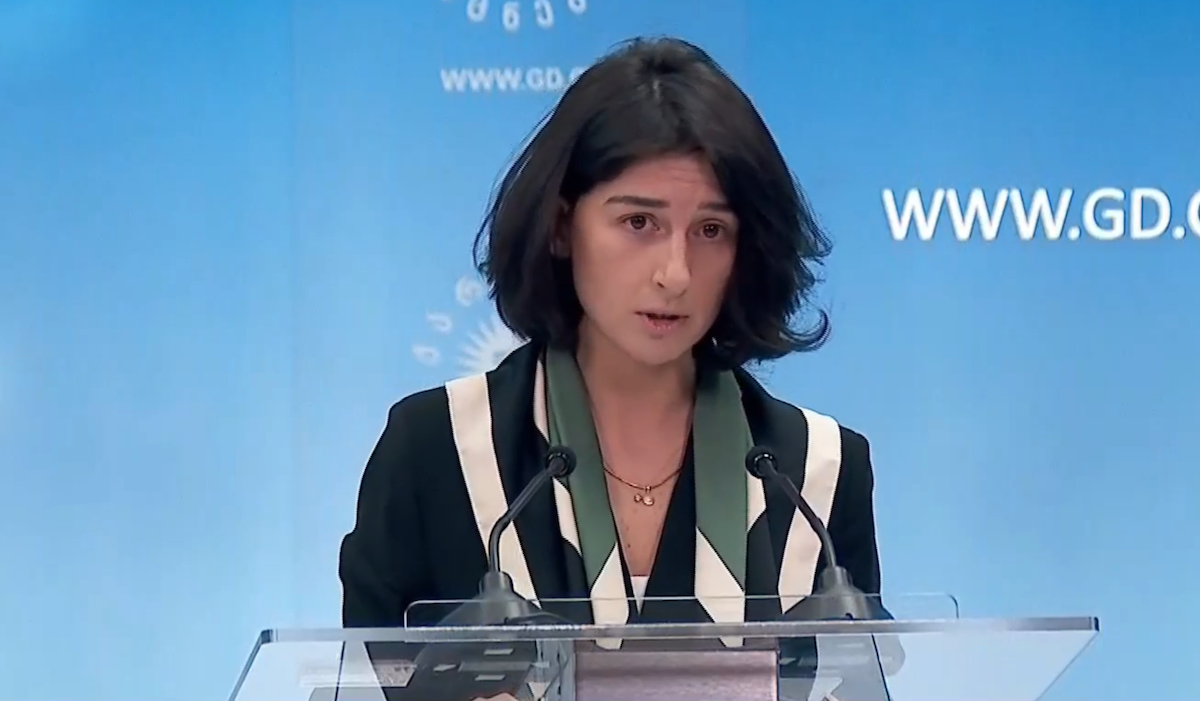
Georgian Dream response to the Venice Commission
In response to the Venice Commission’s opinion on the “foreign agents bill” in Georgia published today, the ruling party “Georgian Dream” accuses the commission of distorting facts and encouraging radicals.
Salome Kurasbediani, a member of the parliamentary majority, articulated the ruling party’s position during a special briefing.
“The Venice Commission’s opinion has once again confirmed that there are no legal or other arguments against the Georgian law on transparency of foreign influence.
The Venice Commission’s opinion contains numerous unsubstantiated and contradictory legal arguments, as well as several gross distortions of facts, which further encourage the radicalization of certain groups.
It is very unfortunate that the platform of the Venice Commission has been used to deliver biased political evaluations instead of professional judgments, which repeatedly damages the reputation of the Venice Commission.
Ultimately, the Venice Commission was even compelled to state that the transparency of NGOs and the media is bad and undemocratic. Naturally, this undermines trust in this organization and the values it is supposed to uphold,” stated Salome Kurasbediani.

In its opinion, the Venice Commission strongly recommends that the Georgian authorities “repeal the law in its current form.”
The Commission emphasizes that the current form of the law contains fundamental flaws that will have significant negative consequences for freedom of association and expression, privacy, and participation in public affairs, and will also create conditions for discrimination.
The Commission’s opinion also states that the law, allegedly aimed at ensuring transparency, objectively leads to the risk of stigmatization, silencing, and ultimately, the elimination of organizations and media that receive even a small portion of their funding from abroad.
Categories
Armenia News – NEWS.am
Bishkek, the capital city of Kyrgyzstan, has recently been the center of attention due to a troubling incident involving attacks on foreign students, including Pakistanis, in their hostels. This violent episode, which took place on May 18, has sparked widespread concern and misinformation across social media platforms. In response, key Pakistani officials have stepped forward to clarify the situation and provide reassurance to the affected communities.
In a press conference held by Federal Minister for Information and Broadcasting Attaullah Tarar, Deputy Prime Minister and Foreign Minister Ishaq Dar, and Federal Minister Engineer Amir Muqam addressed the media to shed light on the real facts surrounding the incident. They emphasized that the situation in Bishkek has now returned to normalcy, and importantly, no Pakistani student was killed in the attack. The officials highlighted the continuous communication between Prime Minister Shehbaz Sharif, his colleagues, Kyrgyz authorities, and the Pakistani embassy to ensure the safety and well-being of Pakistani students in Kyrgyzstan.
The violent attack on foreign students, primarily targeting Pakistani, Bangladeshi, and Indian nationals, was a culmination of rising tensions between local Kyrgyz and Egyptian students over the issue of Gaza. For the past two weeks, heated debates and an atmosphere of tension had been brewing among the student communities, eventually leading to the unfortunate incident on May 18. While the local miscreants were responsible for the direct attacks, the underlying causes point to a complex interplay of international political sentiments and local frustrations.
According to official statistics, Kyrgyzstan hosts around 10,000 to 12,000 Pakistani students and a total of approximately 125,000 international students, most of whom are enrolled in medical colleges. This large number of foreign students underscores the significance of Kyrgyzstan as a hub for medical education. However, it also highlights the vulnerability of these students in the face of local unrest and international political tensions. Foreign students in Kyrgyzstan, particularly those from South Asia, form a significant part of the academic community, contributing not only to the educational ecosystem but also to the local economy. The financial and emotional investments made by these students and their families back home are substantial. Therefore, any disruption to their studies or safety is a matter of serious concern that necessitates immediate and effective response.
The Pakistani government, acknowledging the gravity of the situation, has been proactive in addressing the concerns of students and their families. The Prime Minister’s office and the Pakistani embassy in Kyrgyzstan are in continuous dialogue with Kyrgyz authorities to ensure the safety of all Pakistani nationals. The diplomatic channels are being utilized effectively to not only address the immediate concerns but also to work towards preventing such incidents in the future.
Federal Minister Attaullah Tarar, during the press conference, reiterated the commitment of the Pakistani government to safeguard its citizens abroad. He stressed that the hard work, time, and significant financial investments made by Pakistani students should not be jeopardized by such incidents. Ensuring a conducive environment for education is a mutual responsibility, and the Pakistani government is taking all necessary steps to uphold this. The response from the Pakistani government also included directives to the embassy in Bishkek to increase vigilance and support for the students. This includes providing additional consular services, establishing emergency contact lines, and ensuring that students feel secure and supported during this challenging time.
Pakistan and Kyrgyzstan share a history of strong religious, trade, and cultural ties. These bilateral relations have been instrumental in fostering mutual respect and cooperation between the two nations. In light of the recent incident, it is expected that Kyrgyzstan will take comprehensive measures to address the situation and ensure that such events do not recur. The long-standing relationship between the two countries provides a robust framework for dialogue and resolution. Both nations have a vested interest in maintaining the safety and well-being of their citizens and fostering an environment of mutual respect and cooperation. Given the deep-rooted connections, it is anticipated that Kyrgyz authorities will take all necessary steps to ensure the safety and security of foreign students. This includes not only immediate measures to address the recent violence but also long-term strategies to foster a peaceful and inclusive environment for all students.
In the wake of the Bishkek incident, social media has been rife with misinformation and distorted facts. The Pakistani officials emphasized the importance of relying on verified information and official statements to understand the situation accurately. They warned against the spread of rumors and false narratives that could further escalate tensions and cause unnecessary panic. The role of social media in shaping public perception cannot be underestimated. While it serves as a powerful tool for information dissemination, it also has the potential to spread misinformation rapidly. The officials’ call for responsible use of social media is crucial in ensuring that the real facts are communicated effectively and that the affected communities are not misled by false information. Efforts are being made to counteract misinformation through official channels. The Pakistani embassy in Bishkek has been actively using its social media platforms to provide timely updates and factual information about the situation. This proactive approach aims to mitigate the spread of rumors and ensure that students and their families are well-informed.
The recent events in Bishkek serve as a stark reminder of the challenges faced by international students in foreign countries. Ensuring their safety and well-being requires a concerted effort from both the host country and the home country. The Pakistani government’s proactive approach, in collaboration with Kyrgyz authorities, is a step in the right direction. Moving forward, it is essential to focus on creating a safe and conducive environment for education. This involves not only addressing immediate safety concerns but also fostering a culture of mutual respect and understanding among the diverse student communities. The role of educational institutions in promoting dialogue and resolving conflicts cannot be overstated.
Furthermore, there is a need for enhanced communication channels between the students, educational institutions, and local authorities. Establishing clear protocols for reporting and addressing grievances can help in preventing such incidents in the future. Educational institutions should also consider implementing cultural sensitivity programs to promote understanding and harmony among the diverse student body.
Ultimately, while the incident in Bishkek has raised significant concerns, the prompt response from the Pakistani government and the collaborative efforts with Kyrgyz authorities offer hope for a safer and more secure environment for international students. The long-standing bilateral relations between Pakistan and Kyrgyzstan provide a solid foundation for addressing these challenges and ensuring that the educational aspirations of students are not compromised.
By fostering a collaborative approach and promoting mutual respect, both nations can work towards creating a safer and more inclusive environment for all students. The recent incident, though unfortunate, can serve as a catalyst for positive change and strengthened cooperation between Pakistan and Kyrgyzstan, ensuring that such events do not mar the educational journeys of future generations.

Prophet Muhammad was a messenger for all nations and not just for Arabs or Muslims. I think of myself as a Reform Rabbi who is an Islamic Jew. Actually I am an Islamic Jew i.e. a faithful Jew submitting to the will of God, because I am a Reform Rabbi.
As a Rabbi I am faithful to the covenant that God made with Prophet Abraham the Hebrew, the first Islamic Hebrew (Genesis 14:13), and I submit to the covenant and its commandments that God made at Mount Sinai with Banu Israel, the people of Israel.
As a Reform Rabbi I believe that Jewish spiritual leaders should modify Jewish tradition as social and historical circumstances change and develop. I also believe we should not make religion difficult for people to practice by adding an increasing number of restrictions to the commandments we Jews received at Mount Sinai.
These are lessons that prophet Muhammad taught 12 centuries before the rise of Reform Judaism in the early 19th century Germany. Although most Jews today are no longer Orthodox, if the Jews of Muhammad’s time had followed these teachings of prophet Muhammad, Reform Judaism would have started 1,400 years ago.
I believe that Muhammad was a prophet of Reform Judaism to the Orthodox Jews of his day; although he was 1,200 years ahead of his time. During the six centuries between the birth of Jesus and the arrival of Muhammad in Yathrib, the city of Jews (Medina), almost all Jews had become Orthodox Jews.
After the destruction of Jerusalem in the year 70 CE, the percentage of Jews living as minorities throughout the middle east, and in countries around the Mediterranean Sea, steadily rose higher and higher. In reaction to the danger of assimilation into the polytheistic majority, Orthodox Rabbis added many extra prohibitions to Jewish law and most Jews became increasingly strict in the observance of the laws of Shabbat and Kashrut (dietary restrictions).
Orthodox Rabbis did not follow the example of Muhammad as narrated by his wife ‘Aisha: Whenever Allah’s Apostle was given the choice of one of two matters, he would choose the easier of the two, as long as it was not sinful to do so, but if it was sinful to do so, he would not approach it. ‘Aisha also said: Whenever Allah’s Apostle ordered the Muslims to do something, he used to order them to do deeds which were easy for them to do.
Although the Torah of Moses prohibits adding to the commandments (Deuteronomy 4:2 and 13:1) over the centuries Orthodox Rabbis added many restrictions to the laws of prohibited activities under the theory of building a protective fence around the Torah’s laws. Also, whenever Orthodox Rabbis were in doubt if an animal had been slaughtered correctly according to Jewish law, or if one could eat a newly discovered species of bird, it was ruled prohibited.
They were not guided by Muhammad’s principle as narrated by Sa’d bin Abi Waqqas: The Prophet said, “The most sinful person among the Muslims is the one who asked about something which had not been prohibited, but was prohibited because of his asking.”
The Torah also teaches:”When a woman has a discharge, her discharge being blood from her body, do not come near her for seven days; she is taboo for her menstrual period. ” (Leviticus 15:19)
Orthodox Rabbis extended the period from seven to about twelve days and demanded no physical contact at all during that period. Muhammad supported the Torah’s ban on sex during a woman’s period, but opposed the additional restrictions enacted by Orthodox Rabbi.
As Thabit narrated it from Anas: “Among the Jews, when a woman menstruated, they did not dine with her, nor did they live with them in their houses (they slept in separate beds). The Companions asked The Apostle, and Allah, the Exalted revealed: ‘They ask you about menstruation; say it is a pollution, so keep away from women during menstruation and do not approach until they are clean again.’ (Qur’an 2: 222). The Messenger of Allah said: ‘Do everything except intercourse’. (Orthodox) Jews heard that and said: This man does not want to leave anything we do without opposing us in it.”
Reform Rabbis today would advocate that a Jewish couple behave in a way much closer to that of Muhammad than to that of Orthodox Rabbis then or now.
Unlike Orthodox Rabbis, Reform Rabbis accept the doctrine of nullification, which teaches that one verse in scripture can nullify another, and that rulings can be changed due to changed circumstances. Prophet Muhammad provides an excellent example of this principle in the following account.
Prophet Muhammad originally told women not to visit graveyards, but toward the end of his life, he said to them: “I had told you not to visit graves; now I am telling you to visit them.” The reason was that Arabian women used to wail at graves. The Prophet wanted this practice to be stopped. Therefore, he banned women from visiting graves to start with. After sometime, when Muslim women were better aware of how Islam wants them to behave in different situations, he allowed them such visits.
In fact, Prophet Muhammad encouraged visiting graveyards because such a visit reminds the visitor of his or her own death and the fact that they would have to stand in front of God when their actions are reckoned to determine their reward or punishment. Scholars like Ibn Qudamah, of the Hanbali school of law, make it clear that since this is the purpose of visiting graveyards, both men and women need such visits.
Another important teaching of the Qur’an for people all over the world today, is that God chose not to create human beings as one nation and bestowed upon them free will to believe or not to believe. As it is written in the Qur’an [5.48] “For every one of you did We appoint a law and a way. If God had pleased He would have made you one people, but (He didn’t) that He might test you in what He gave you. Therefore compete with one another to hasten to virtuous deeds; for all return to God, so He will let you know (after Judgment Day) that in which you differed.”
This is a wonderful further development of the teaching of the Biblical prophet Micah (4:5) that in the end of days—the Messianic Age—”All people will walk, each in the name of their own God, and we (Jews) shall walk in the name of the Lord our God forever.”
A Muslim is one who submits to the will of God and believes that God has sent thousands of different prophets to the many different peoples and languages of this world. As a Reform Rabbi I think that Muhammad was such a Prophet because I believe the Qur’an is as true for Muslims as the Torah is true for Jews.
If we all can live up to this ideal, that religious pluralism and mutual respect is the will of God, we will help fulfill the 2700 year old vision of Prophet Isaiah: “In that day there will be a highway from Egypt to Assyria. The Assyrians will go to Egypt, and the Egyptians to Assyria. The Egyptians and Assyrians will worship together. On that day Israel will join a three-party alliance with Egypt and Assyria, a blessing upon the heart. The LORD of Hosts will bless them saying, “Blessed be Egypt My people, Assyria My handiwork, and Israel My inheritance.”…(Isaiah 19:23-5)
The scramble for entrepreneurial influence in Africa by global players is a geopolitical reality. In order to be part of this geopolitical arena, foreign corporate business players have been devising different approaches and pathways for revitalizing investment partnership and strengthening cooperation with potential African partners, says Louis Gouend, founder of Hello Africa and founding Executive Director of the African Business Club.
In this interview, Louis Gouend further gives useful insights into the dynamics why Russia and Africa ultimately have to engage in business and economic sectors, to expand cooperation in both regions, and seriously address the existing challenges facing entrepreneurs in Russia and Africa. Here are the interview excerpts.
How would you characterize the level of business cooperation between Russia and Africa?
Louis Gouend: In recent years, business relations between Russia and Africa have acquired new dynamics. Russia is actively seeking opportunities to strengthen economic ties outside traditional Western markets, and Africa is attractive as a region experiencing rapid economic growth and rich natural resources. In this case, special attention is paid to sectors such as energy, mining, agriculture and educational projects. Russian companies are actively investing in mineral resource development projects, and are also entering the agricultural sector of some African countries.
ln your expert point of view, what are the basic challenges that currently confronting businesses on both sides?
LG: There are several key difficulties that complicate business interaction between Russia and Africa. These are, first of all, differences in business culture and legal regulation, which complicate the process of doing business. Logistics challenges, including the difficulty of transporting goods over long distances and across multiple borders, also pose additional obstacles. The bureaucracy can be sluggish, and corruption in some African countries makes the situation worse.
Another barrier is lack of knowledge. On one hand, Russian companies lack knowledge of the environment and available high-quality analytical materials about the African market, its specifics and risks. On the other hand, African entrepreneurs and consumers have virtually no knowledge about Russian products and coroprate business services. The main problem now is not funding, but the lack of sufficient knowledge and contacts. One of the options for resolving this issue is to increase Russian business missions to Africa, which will help promote Russian goods and technologies on the African market. And vice versa, in terms of bilateral cooperation.
Another factor limiting exports to Africa is the lack of special investment agreements and lack of regulation in this direction. When we talk about investment activity, the question arises about the lack of investment protection agreements. Their absence prevents Russian companies from insuring investments, which obviously prevents them from exporting to Africa.
Our club members are mainly representatives of various African diaspora who live or studied in Russia and have been operating businesses in Russia or Africa. They know the mentality and culture of both sides, and they have strong ties with both sides, allowing them to be reliable bridges between Africa and Russia.
We work with African chambers of commerce, embassies, diaspora representatives, as well as other regional associations and export companies. Stakeholders include large and small businesses from Russia and Africa, various industry associations, government agencies and diplomatic missions. To improve business cooperation, the club plans to develop knowledge exchange programs, conduct business forums and master classes, and create special working groups to discuss specific issues and problems.
Why the creation of an African Business Club (ABC) becomes necessary only now and what are its main goals?
LG: The growth of economic activity and the increase in the number of bilateral projects between Russia and Africa required the creation of a platform to facilitate these interactions. The African Business Club aims to be a platform where entrepreneurs can share knowledge, network, explore new opportunities and solve emerging problems together. The club’s main goals include strengthening trade relations, stimulating investment and technological exchange.
Our clients value us because, first of all, we help adapt the work of a foreign company to Russian realities, organize and debug many business processes within various aspects and support the foreign company as a reliable partner. Companies planning to invest in African economies will need strong ties to the African government and partnerships with local businesses. How to contact the right people? We are ready to help with this issue.
We offer advisory services to small, medium and global companies that want to invest in the African continent. Thus, we promote entrepreneurship and help create new trade ties between Russia and Africa. We attract potential investors interested in financing projects in the African private sector. We create online access to market research resources and relevant business contacts in Africa. We publish position papers covering issues related to trade with Africa, investment, regulation, policy and industry content.
The number of Russian companies wishing to enter the African market is growing regularly, and this confirms our intentions to promote the development of bilateral economic relations. On the other hand, we can note an increase in the number of African companies wishing to develop close cooperation with their Russian partners.
We offer a wide range of services for Russian companies entering the African market. This includes market research, selection of partner companies, assistance in organizing a business, personnel search, including offers for Russian citizens to work in African companies.
Who are your current stakeholders and members? And how do you plan to develop a common approach to increasing the level of business cooperation between the two regions?
LG: Our club members are mainly representatives of various African diaspora who live or studied in Russia and have operating businesses in Russia or Africa. They know the mentality and culture of both sides, and they have strong ties with both sides, allowing them to be a reliable bridge between Africa and Russia.
We work with African chambers of commerce, embassies, diaspora representatives, as well as other regional associations and export companies.
Stakeholders include large and small businesses from Russia and Africa, various industry associations, government agencies and diplomatic missions. To improve business cooperation, the club plans to develop knowledge exchange programs, conduct business forums and master classes, and create special working groups to discuss specific issues and problems.
Why is the presence of African business in the Russian Federation extremely low?
LG: A combination of bureaucratic barriers, lack of awareness of the economic environment and opportunities, complex legal and regulatory frameworks, and relatively high market entry costs deter African companies from actively doing business in Russia.
What complimentary roles can African diplomatic missions and business associations play here?
LG: The club has already been negotiating to simplify procedures for African investors and exporters, and assisting in the creation of reliable and effective communication channels between African companies and Russian regulators. As a two-way street, African diplomatic missions can also act as a bridge, helping to overcome cultural and administrative barriers, and actively participate in the activities of the club, supporting its multifaceted initiatives at various levels.