
National Churches On Both Sides Of The Political Divides In Armenia And Georgia – OpEd Eurasia Review
Day: May 17, 2024
Categories
Armenia News – NEWS.am
Categories
NPR News: 05-17-2024 6PM EDT
By Jim Garamone
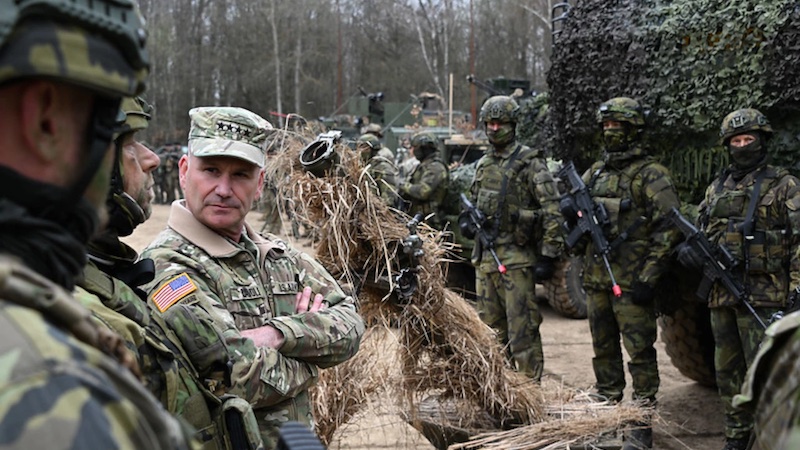
The Russian invasion of Ukraine is the largest war on the European continent since World War II, but NATO is still the answer, said Army Gen. Christopher Cavoli, commander of U.S. European Command and Supreme Allied Commander Europe.
Cavoli spoke to the Atlantic Council in Washington today and said the alliance is united and reacting quickly to Russian President Vladimir Putin’s war of choice in Ukraine, and the steps NATO leaders are taking today will, indeed, defend every last inch of NATO territory.
Russia continues to undermine freedom and democracy throughout Europe and beyond, the general said. Even after the Ukraine war is over, Russia will remain a threat, he said.
Russia’s “illegal, unprovoked and brutal invasion of Ukraine fundamentally altered our strategic landscape,” Cavoli said. “The war in Ukraine has compelled us to reevaluate our long-standing goals, our ideas regarding global security and international relations, and it has consequently forced us to re-examine how the NATO alliance is structured to deter and defend against our adversaries.”
Following the dissolution of the Soviet Union, the alliance switched from massive, collective defense operations to crisis management operations, he said. These were characterized by operations in the Balkans, Afghanistan and the Mediterranean.
The general said the NATO nations built small, highly expert militaries that didn’t expect to face near-peer foes and had little force in reserve.
“All that has changed,” he said. “The war we see in Ukraine could not be more different. This war is about hard power. And it is about scale. It is huge. Dozens of thousands dead. Hundreds of thousands wounded. Thousands of tanks lost.”
Where NATO forces operated as brigades in the past, the combat in Ukraine was all about big units — divisions, corps, air armies, fleets, he said.
The alliance had to revitalize the ability to conduct collective defense, and at the Madrid Summit in 2022, the heads of state directed NATO military leaders to do just that. This basically changes the way NATO forces are postured to “operate functionally and geographically to deny our adversaries any advantage they might seek in geography, readiness or domain,” Cavoli said. “This, of course, has required a wholesale modernization of our collective defense system because we had previously been optimized for very different tasks.”
This was the first large change in alliance strategy since 1986. The NATO military leaders rewrote the war plans quickly. “The development and approval of these plans — which involves multiple NATO headquarters, 30 and then 32 nations and their militaries and their national defense plans and their sovereignty with all of these political and military complexities — has been the single most impressive, collective military feat I have seen to get these things done.”
The plans are in place now. These are classic defense plans with geographically specific descriptions of how, where and with what NATO militaries will defend every inch of the alliance, he said.
First and foremost, the plans give military leaders force structure requirements. “For the first time in almost four decades, the alliance has objective, militarily sound plans based on the description of the forces that we require,” he said.
These plans will subsequently guide the NATO nations as they make spending decisions.
Second, the new plans give a blueprint for different delegations of authority for operational decision making. “Such things as movement of troops from staging area to operational areas, that sort of thing, that no longer works,” Cavoli said. “In order to be able to act and react at the speed of relevance, [the Supreme Allied Command, Europe] requires basic military authorities. These are working their way through the new modernized alert system.”
These permissions are on the verge of being approved at NATO headquarters in Brussels.
Third, the alliance systems of command and control needed to change. These systems were fine for crisis management, but not for large-scale conflict. “We needed headquarters to intimately understand the terrain, know the populations and appreciate the particular adversary across the border,” he said. “We’re in the process now of designing specific geographic areas and have [been] assigning specific geographic areas to each corps headquarters and to maritime headquarters, and we’re matching divisions and brigades to corps, which allows them to exercise and rehearse together.”
Cavoli said NATO is now also rigorously testing the plans through a revamped exercise program. One example of this is Exercise Steadfast Defender 2024. This is the largest NATO exercise since 1989, with more than 90,000 troops participating. “We will continue to train like this,” he said. “We’re taking every opportunity to rehearse and refine our plans and to deliver the right amount of deterrence required at any given time in any given place.”
These changes will take time, concentration and focus across NATO. They will also require nonmilitary adjustment, such as in the defense industrial base, he said.
“It will be difficult, but we are well on our way,” the general said. “The adaptation and transformation of the alliance in the past few years has been remarkable. I’m confident that we are ready to confront any challenge. Our nations remain committed, and they are united like never before [in] the world. The world may be turning out to be a different place than [we] would hope, but NATO is turning out to be exactly what we need.”
By Matthew Olay
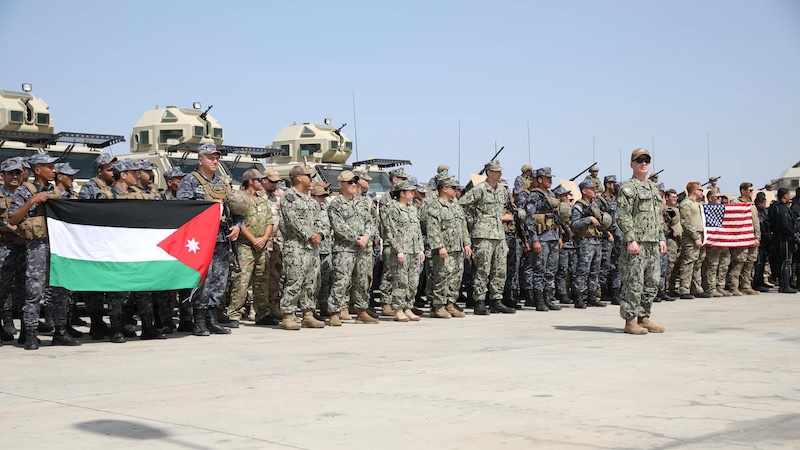
Forces from U.S. Central Command joined with host country Jordan and more than 30 additional partner nations Sunday to kick off Exercise Eager Lion 2024, the Pentagon announced.
This 11th iteration of Eager Lion serves to underscore the United States’ “commitment to interoperability with our partners in the region, while refining our ability to defend against … threats by state and non-state actors,” Deputy Pentagon Press Secretary Sabrina Singh told reporters.
Considered the most important exercise between the U.S. military and the Jordanian Armed Forces, Eager Lion 24 will focus on training the participating partner nations to develop cooperation and interoperability between military and interagency organizations, according to a Centcom press release on the exercise.
In addition to addressing challenges from across the region’s air, land, sea and cyber domains, the exercise will also support humanitarian aid assistance and multinational disaster response operations, the release states.
“Eager Lion demonstrates the value of working together to maintain a ready and responsive force that truly demonstrates we are prepared to respond together in times of crisis,” exercise director U.S. Army Brig. Gen. Jason Benson said.
Benson added that Eager Lion does more than merely demonstrate the commitment to interoperability between multiple partner nations.
“It also demonstrates that our coalition force can maintain a sufficient and sustainable presence in the region. It delivers a clear message that relationships matter,” he said.
“As we work to deter and address aggressive actions by maligned actors around the world, these kinds of exercises and partnerships enable us to meet new and continuing threats together,” Singh said.
She added that the U.S. military participates in more than 80 exercises with partner nations throughout Centcom’s area of responsibility each year to bolster military-to-military relationships that promote regional security.
Eager Lion 24 is scheduled to run until May 23.