
Witness at Sen. Bob Menendez’s bribery trial says meat-export monopoly made costs soar Yahoo! Voices
Day: May 17, 2024
“Sometimes empty is more full,” Giorgi Maisuradze, a leftist intellectual and professor at Ilia State University, wrote on Facebook as he posted a selfie from an empty lecture hall on May 15.
The post was part of a recent viral selfie trend in Georgian academia. Many professors have stood by thousands of their students across Georgia who have walked off campus in opposition to the ruling party’s fixation on passing and enforcing the law that would label their friends, civic activists, and journalists as “agents of influence.” The protest wave grew into anger after the government’s heavy-handed crackdown on the protesters, delivered both by the police and yet-unidentified thugs.
On May 14, the ruling Georgian Dream majority passed the Rubicon and adopted the law. Only an ephemeral presidential veto now stands in the way of enacting it formally.
This final pretense of parliamentary democracy followed more than a month when thousands protested. As protests have grown in size and passion, they engaged more Georgian cities and expanded to more social groups. Authorities have attempted to suppress the protests through police brutality, massive intimidation campaigns, and thuggish violence, including against political leaders. Police continued to arrest those accused of violence against law enforcement; they threatened harsh punishment.
So far, the threats and officially condoned violence have only brought more people into the streets. Even after the law was passed, student-led, spontaneous, simultaneous, and creative rallies continued shaking Georgian cities and paralyzing traffic. They capture the attention – and often the sympathy – of those otherwise indifferent to the political situation.
President Salome Zurabishvili, a fierce opponent of the controversial law, promised to use her veto power, which will at least prolong the process. However, the ruling majority can easily overcome that veto. The day passes, and hope flickers as people stand up in thousands to defend their liberty, but despair gains as repression gains momentum. Georgia is now stuck in sort of a vibrant limbo between newfound optimism created by the glimpse of citizenry committed to a democratic future and the shadow of violence that breeds the hard-to-ignore uncertainty.
Vague Future of Big Awakening
“Long live the united national front that brought Zura [Girchi] Japaridze and Giorgi Maisuradze together,” Beka Kobakhidze, a prominent historian, jokingly wrote on Facebook. The historian was expressing amazement at how the ongoing protests have attracted everyone across the ideological spectrum – from right-wing libertarian politicians to left-wing academics.
The current situation and the scale of what many call “decentralized” resistance is something most Georgians never expected to see. Government attempts to dismiss this movement as “LGBT-led protests” or to blame it on their arch-rivals, UNM, seem to have hit their limits.
The protesters have grabbed back the flag of patriotism from the populist ruling party, and their genuine faith and reverence for “ancestors” who fought for freedom have enmeshed into inspiring images of their own heroic and peaceful dedication. Playful youth in colorful raincoats flooding Tbilisi, their references to Harry Potter and LOTR universes, and braving the police in bad weather keep inspiring “light versus darkness” narratives.
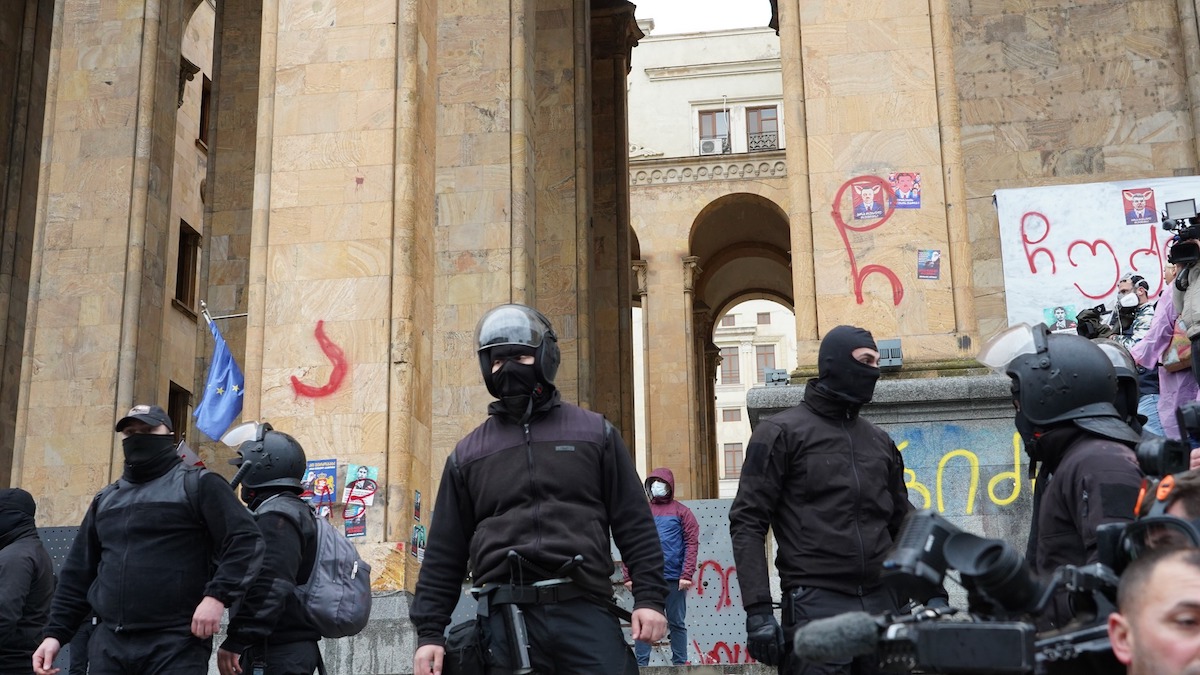
 Protesters facing riot police on the day of the final adoption of foreign agents law, May 14, 2024. Photo: Guram Muradov/Civil.ge
The rallies are organized by various youth activist groups. That includes groups like Daphioni, Talgha, GEUT, and Martianelebi, as well as students from various universities. So far, their diversity has made it difficult for the ruling party’s propaganda to pin down their identity and target and neutralize the resistance.
Yet, while the absence of one clear leader is a strength of the ongoing resistance, some fear that a lack of coherence and a clear political direction would ultimately doom the protests.
Fearful of extinguishing the embers of resistance in the highly polarized society, opposition politicians have struggled to find their voice and place in the ongoing protests. Some prominent opposition leaders were booed as they took the stage at a May 15 rally. While there are early signs of an emerging “European Platform” of pro-Western opposition (someone even suggesting such a possibility would have been laughed out of the room just two months ago), it has yet to take shape. The oft-repeated calls for a national workers’ strike have fallen flat.
What are the options?
One political figure whose leadership is more welcomed by the streets is the 72-year-old figurehead president, Salome Zurabishvili. This, too, is an unexpected development. She rode into the presidential palace on the coattails of Bidzina Ivanishvili and was considered a mere factotum by most Georgians just a few months ago. But her growing irritation at the Georgian Dream’s drift away from the European commitments expressed itself in an animus that bought her the admirative Gen-Z title of “Slay Queen.”
Zurabishvili recently told CNN’s Christiane Amanpour that she would be “leading the pro-European front” of the opposition parties and civil society towards the looming October elections. There are fears that the government might use the new law to hijack elections, for instance, by hobbling the election observation groups.
But before Georgia gets to elections, the President must decide how to wield her veto power, or, as it is called in the Constitution, her right to submit “motivated objections” to a law. Once the parliament passes a law, the president has up to two weeks to either sign the bill into law or send it back with her “motivated objections” – amendments or changes. The time for Parliament to consider the proposals is not strictly defined, but the ruling party can override the veto with a simple majority, as it has done many times already.
Yet, the Georgian Dream leaders are now making much of that veto, telling the Western partners and the hesitant Georgians that they would amend the law if they received “constructive criticism” from Western partners through the presidential objections.
The president called the offer “manipulation” and vowed “not to play these games.” Civil society actors also say the law must be withdrawn unconditionally.
According to the Constitution and the rules of procedure, there are two ways. If the Parliament decides to schedule the hearing of the president’s motivated arguments against the law, it can either accept them entirely or reject them (also entirely, no modifications are allowed) and re-vote the original text of the law. If the motion passes, the vote is overridden.
However, there is another way: the Parliament may decide not to debate the presidential suggestions and thus shelve the veto. Since new elections are scheduled in October, once the parliament goes into recess, the new composition of MPs would have to vote on the President’s veto (or not). This would effectively transform the October elections into a referendum on the ruling party’s policies.
Condurum for the West
How is the West to respond? In the most immediate sense, the ball is in the court of the Council of Europe’s Venice Commission – a body of experts that issues competent opinions about the pending legislation of the member states and their compatibility with the European Convention on Human Rights. The Venice Commission has been asked to provide an urgent opinion on the law, and their report was expected – in vain – before the adoption of the law in its third reading. This delay came as a surprise since the European Court of Human Rights has already ruled on a similar Russian law, while the Venice Commission itself has lambasted an attempt from Budapest to enact a similar law back in 2017.
Then, there is a political element. Georgia became an EU candidate country in December, and Brussels has to decide whether it is ready to begin accession negotiations. The Commission has issued a clear warning that adopting the law “negatively impacts Georgia’s progress on the EU path.” In layman’s terms, this would probably mean that Georgia’s candidacy would be suspended in limbo, too.
President of the Council of the European Union, Charles Michel spoke by phone with President Zurabishvili and Prime Minister Kobakhidze, and posted he would continue “to help Georgians to work towards a European future, including by helping to find the best way to address legitimate concerns of all sides.” The mention of “legitimate concerns of all sides” has angered the law’s opponents.
As Western attention intensifies and a steady stream of Western officials and politicians arrive in Tbilisi, some think that sanctioning the Georgian Dream MPs, officials, or Ivanishvili himself may help nudge them away from the abyss. In his May 14 briefing during his visit to Georgia, U.S. Assistant Secretary of State James O’Brien duly warned of the “consequences” if the law is enacted in its current form.
While Georgian Dream politicians try to look unconcerned about the prospect, and Ivanishvili seems to have made provisions to shield himself from the impact of such sanctions, not everyone in GD can afford such luxury.
Some Fallout Already
The final adoption of the law was followed by a small financial shock, as the Georgian currency rapidly depreciated and the shares of Georgian companies fell. Even usually cautious businessmen could not hide their concern about the prospects of a “collapsing” economy.
The individuals targeted by repression and organizations that expect to be targeted by the law are also making their plans. There are yet unconfirmed reports of an activist leader leaving the country, fearing prosecution. Many Georgian CSOs and media consult lawyers to help them register abroad and ponder contingencies for closing operations altogether.
In the coming days and weeks, we will still see many of them on the streets, but in the back of their minds, their lives, work, and the future of themselves and their families are suspended in limbo, between hope and despair.
Also Read:
Categories
Georgia’s Vibrant Limbo
“Sometimes empty is more full,” Giorgi Maisuradze, a leftist intellectual and professor at Ilia State University, wrote on Facebook as he posted a selfie from an empty lecture hall on May 15.
The post was part of a recent viral selfie trend in Georgian academia. Many professors have stood by thousands of their students across Georgia who have walked off campus in opposition to the ruling party’s fixation on passing and enforcing the law that would label their friends, civic activists, and journalists as “agents of influence.” The protest wave grew into anger after the government’s heavy-handed crackdown on the protesters, delivered both by the police and yet-unidentified thugs.
On May 14, the ruling Georgian Dream majority passed the Rubicon and adopted the law. Only an ephemeral presidential veto now stands in the way of enacting it formally.
This final pretense of parliamentary democracy followed more than a month when thousands protested. As protests have grown in size and passion, they engaged more Georgian cities and expanded to more social groups. Authorities have attempted to suppress the protests through police brutality, massive intimidation campaigns, and thuggish violence, including against political leaders. Police continued to arrest those accused of violence against law enforcement; they threatened harsh punishment.
So far, the threats and officially condoned violence have only brought more people into the streets. Even after the law was passed, student-led, spontaneous, simultaneous, and creative rallies continued shaking Georgian cities and paralyzing traffic. They capture the attention – and often the sympathy – of those otherwise indifferent to the political situation.
President Salome Zurabishvili, a fierce opponent of the controversial law, promised to use her veto power, which will at least prolong the process. However, the ruling majority can easily overcome that veto. The day passes, and hope flickers as people stand up in thousands to defend their liberty, but despair gains as repression gains momentum. Georgia is now stuck in sort of a vibrant limbo between newfound optimism created by the glimpse of citizenry committed to a democratic future and the shadow of violence that breeds the hard-to-ignore uncertainty.
Vague Future of Big Awakening
“Long live the united national front that brought Zura [Girchi] Japaridze and Giorgi Maisuradze together,” Beka Kobakhidze, a prominent historian, jokingly wrote on Facebook. The historian was expressing amazement at how the ongoing protests have attracted everyone across the ideological spectrum – from right-wing libertarian politicians to left-wing academics.
The current situation and the scale of what many call “decentralized” resistance is something most Georgians never expected to see. Government attempts to dismiss this movement as “LGBT-led protests” or to blame it on their arch-rivals, UNM, seem to have hit their limits.
The protesters have grabbed back the flag of patriotism from the populist ruling party, and their genuine faith and reverence for “ancestors” who fought for freedom have enmeshed into inspiring images of their own heroic and peaceful dedication. Playful youth in colorful raincoats flooding Tbilisi, their references to Harry Potter and LOTR universes, and braving the police in bad weather keep inspiring “light versus darkness” narratives.
Protesters facing riot police on the day of the final adoption of foreign agents law, May 14, 2024. Photo: Guram Muradov/Civil.ge
The rallies are organized by various youth activist groups. That includes groups like Daphioni, Talgha, GEUT, and Martianelebi, as well as students from various universities. So far, their diversity has made it difficult for the ruling party’s propaganda to pin down their identity and target and neutralize the resistance.
Yet, while the absence of one clear leader is a strength of the ongoing resistance, some fear that a lack of coherence and a clear political direction would ultimately doom the protests.
Fearful of extinguishing the embers of resistance in the highly polarized society, opposition politicians have struggled to find their voice and place in the ongoing protests. Some prominent opposition leaders were booed as they took the stage at a May 15 rally. While there are early signs of an emerging “European Platform” of pro-Western opposition (someone even suggesting such a possibility would have been laughed out of the room just two months ago), it has yet to take shape. The oft-repeated calls for a national workers’ strike have fallen flat.
What are the options?
One political figure whose leadership is more welcomed by the streets is the 72-year-old figurehead president, Salome Zurabishvili. This, too, is an unexpected development. She rode into the presidential palace on the coattails of Bidzina Ivanishvili and was considered a mere factotum by most Georgians just a few months ago. But her growing irritation at the Georgian Dream’s drift away from the European commitments expressed itself in an animus that bought her the admirative Gen-Z title of “Slay Queen.”
Zurabishvili recently told CNN’s Christiane Amanpour that she would be “leading the pro-European front” of the opposition parties and civil society towards the looming October elections. There are fears that the government might use the new law to hijack elections, for instance, by hobbling the election observation groups.
But before Georgia gets to elections, the President must decide how to wield her veto power, or, as it is called in the Constitution, her right to submit “motivated objections” to a law. Once the parliament passes a law, the president has up to two weeks to either sign the bill into law or send it back with her “motivated objections” – amendments or changes. The time for Parliament to consider the proposals is not strictly defined, but the ruling party can override the veto with a simple majority, as it has done many times already.
Yet, the Georgian Dream leaders are now making much of that veto, telling the Western partners and the hesitant Georgians that they would amend the law if they received “constructive criticism” from Western partners through the presidential objections.
The president called the offer “manipulation” and vowed “not to play these games.” Civil society actors also say the law must be withdrawn unconditionally.
According to the Constitution and the rules of procedure, there are two ways. If the Parliament decides to schedule the hearing of the president’s motivated arguments against the law, it can either accept them entirely or reject them (also entirely, no modifications are allowed) and re-vote the original text of the law. If the motion passes, the vote is overridden.
However, there is another way: the Parliament may decide not to debate the presidential suggestions and thus shelve the veto. Since new elections are scheduled in October, once the parliament goes into recess, the new composition of MPs would have to vote on the President’s veto (or not). This would effectively transform the October elections into a referendum on the ruling party’s policies.
Condurum for the West
How is the West to respond? In the most immediate sense, the ball is in the court of the Council of Europe’s Venice Commission – a body of experts that issues competent opinions about the pending legislation of the member states and their compatibility with the European Convention on Human Rights. The Venice Commission has been asked to provide an urgent opinion on the law, and their report was expected – in vain – before the adoption of the law in its third reading. This delay came as a surprise since the European Court of Human Rights has already ruled on a similar Russian law, while the Venice Commission itself has lambasted an attempt from Budapest to enact a similar law back in 2017.
Then, there is a political element. Georgia became an EU candidate country in December, and Brussels has to decide whether it is ready to begin accession negotiations. The Commission has issued a clear warning that adopting the law “negatively impacts Georgia’s progress on the EU path.” In layman’s terms, this would probably mean that Georgia’s candidacy would be suspended in limbo, too.
President of the Council of the European Union, Charles Michel spoke by phone with President Zurabishvili and Prime Minister Kobakhidze, and posted he would continue “to help Georgians to work towards a European future, including by helping to find the best way to address legitimate concerns of all sides.” The mention of “legitimate concerns of all sides” has angered the law’s opponents.
As Western attention intensifies and a steady stream of Western officials and politicians arrive in Tbilisi, some think that sanctioning the Georgian Dream MPs, officials, or Ivanishvili himself may help nudge them away from the abyss. In his May 14 briefing during his visit to Georgia, U.S. Assistant Secretary of State James O’Brien duly warned of the “consequences” if the law is enacted in its current form.
While Georgian Dream politicians try to look unconcerned about the prospect, and Ivanishvili seems to have made provisions to shield himself from the impact of such sanctions, not everyone in GD can afford such luxury.
Some Fallout Already
The final adoption of the law was followed by a small financial shock, as the Georgian currency rapidly depreciated and the shares of Georgian companies fell. Even usually cautious businessmen could not hide their concern about the prospects of a “collapsing” economy.
The individuals targeted by repression and organizations that expect to be targeted by the law are also making their plans. There are yet unconfirmed reports of an activist leader leaving the country, fearing prosecution. Many Georgian CSOs and media consult lawyers to help them register abroad and ponder contingencies for closing operations altogether.
In the coming days and weeks, we will still see many of them on the streets, but in the back of their minds, their lives, work, and the future of themselves and their families are suspended in limbo, between hope and despair.
Also Read:
Categories
Armenia News – NEWS.am
Georgia’s prime minister joins tens of thousands in a march to promote ‘family purity’ Bowling Green Daily News
Georgia’s prime minister joins tens of thousands in a march to promote ‘family purity’ The Caledonian-Record
Protesters complain to Georgian Ombudsman
According to information from the Georgian Ombudsman’s office, its representatives visited 180 individuals arrested from April 15 to May 17 during protest actions against the “foreign agents” bill in Tbilisi. Ninety-three of the arrested individuals complained about police misconduct, while 71 requested intervention, prompting the Ombudsman to refer the matter to the special investigative service. Additionally, during this period, the office’s hotline received 382 calls.
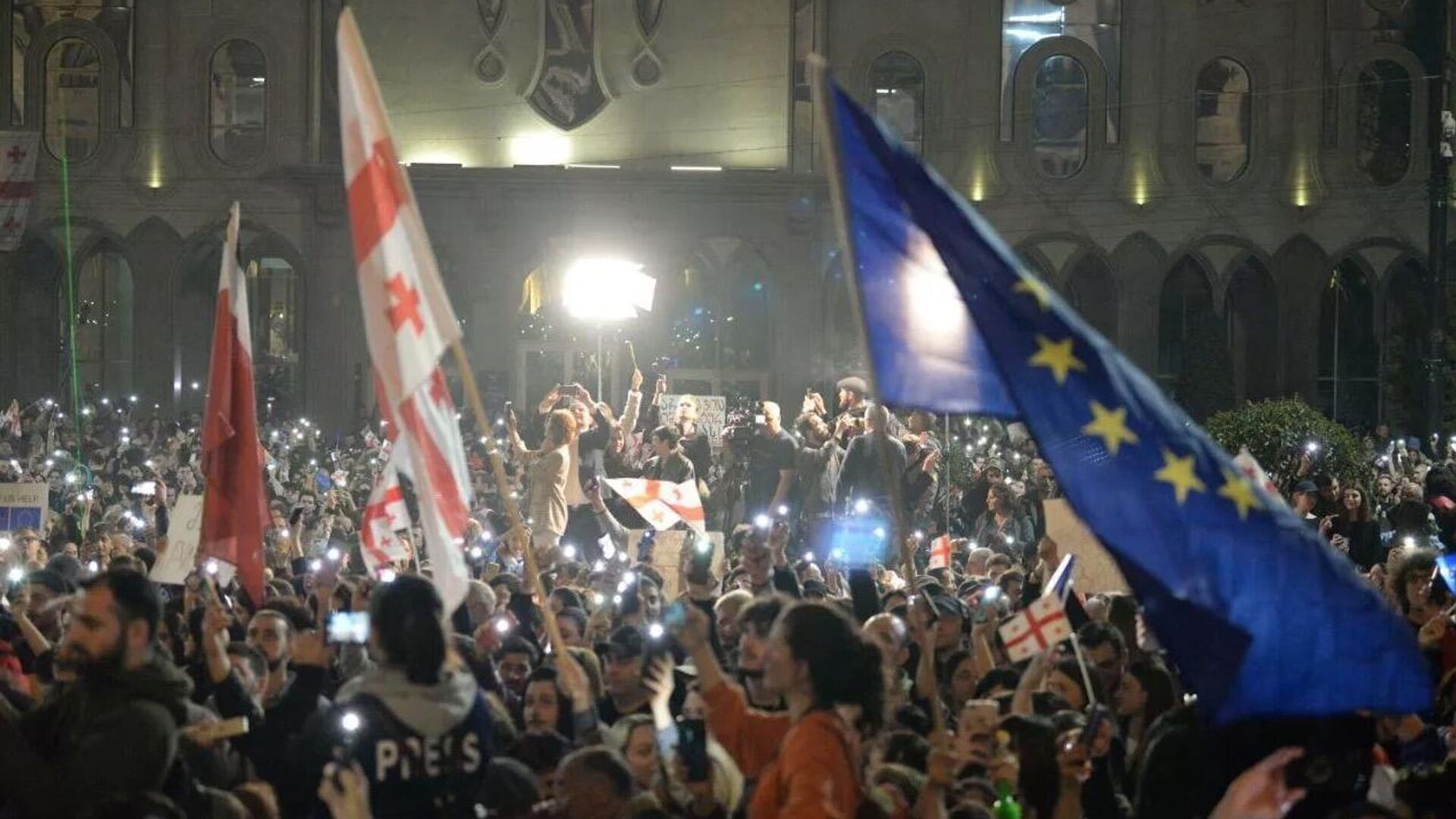
The adoption by the Georgian parliament of the “foreign agents” law (“On Transparency of Foreign Influence,” or the “Russian law”) and the arrest of activists coincided with a visit to Georgia by a European Union delegation. Senior officials from EU member states strongly condemned these events.
Describing the situation as a “Georgian nightmare,” Chairman of the Foreign Affairs Committee of the Lithuanian parliament, Žygimantas Pavilionis, expressed his assessment.
“I am disappointed,” stated Michael Roth, Chairman of the International Relations Committee of the German parliament. According to Roth, he is aware that civil society activists and parliamentarians are demanding sanctions from the European Union, but the most severe sanction would be the devaluation of candidate status for EU membership.
Protesters complain to Georgian Ombudsman