
Italian firms interested in participating in projects to be implemented in Karabakh
Day: May 14, 2024
Pashinyan, Rasmussen discuss Armenia’s “Crossroads of Peace” project – Public Radio of Armenia Public Radio of Armenia – Official Web site
Georgia and Armenia are again at odds. Mass protests have erupted in Georgia against the parliament’s “Foreign Influence Transparency Act.” This proposed law demands NGOs and media outlets register if more than 20 percent of their annual budget comes from foreign donors. While the government frames it as “safeguarding democracy from foreign interference,” the opposition argues, “Georgia doesn’t need a Russian-style law; the Georgian people choose Europe.”
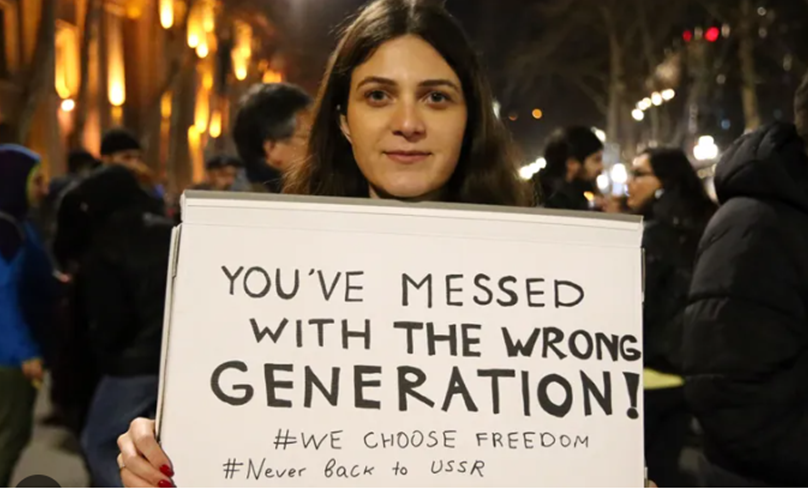
Among the slogans brandished by Georgian protesters: “You’ve messed with the wrong generation,” “We choose freedom,” “Never back to USSR.”
On the other hand, the Western backers of the protests, including the US, UK, and EU, are framing this law as a tool for Russia to extend its sway over Georgia. Take the EU’s statement, for instance: “This is deeply worrying, and if this law goes through, it’ll set Georgia back in its EU integration efforts. It simply goes against our fundamental values.” What’s ironic is that the US enacted a similar law way back in 1938, known as the “Foreign Agents Registration Act” (FARA), which is still in effect.
What’s interesting is how, despite Russia adopting a similar law in 2011, a good 73 years later, Western media brands it as a “Russian law,” a notion seemingly fueling the protesters. Also, it’s worth noting that Georgia hosts a plethora of NGOs, many funded from abroad. To give you an idea, there are about 25,000 NGOs operating in Georgia, with a good chunk of them receiving Western funding.
In Armenia, the protests against the return of four villages to Azerbaijan, which is an essential part of the border demarcation process, spilled into Yerevan on May 9. Archbishop Bagrat Galstanyan, spearheading the protests, is calling for Armenian Prime Minister Nikol Pashinyan’s resignation.
It’d be simplistic to view the current developments in Georgia and Armenia as mere happenstance. Georgia holds a pivotal role as a transit hub in the South Caucasus. Remember the “Rose Revolution” in 2003? It happened with foreign support. Similarly, various political factions are vying for influence in Armenia. For over three decades, the country has occupied a neighboring state’s territory, keeping its border with Turkey closed and missing out on key regional projects. Foreign actors orchestrate the ongoing protests in Armenia, employing tactics reminiscent of those in Georgia.
To grasp the social dynamics behind the ongoing protests, we need to delve into the demographic landscape of both nations. Youth undoubtedly lead the forefront of protests in countries undergoing significant turmoil, such as Georgia and Armenia. However, it’s worth noting that both countries are seeing a trend towards an older population. According to 2023 statistics, in Georgia, only 17.4 percent of the population fell within the 15–29 age group, while in Armenia, it was 17.9 percent. Therefore, it’s inaccurate to assert that the younger generation seeking change is the sole driving force behind these protests.
The current protests in Georgia and Armenia draw parallels to the upheavals in former Yugoslavia. Take Serbia in 2000, for instance, where the “Bulldozer Revolution” led to the downfall of Slobodan Milosevic. Behind those protests stood the student movement “Otpor,” fueled by foreign funding. However, analysts contend that foreign interests with stakes in the former Yugoslavian territories backed this revolution, not just a grassroots movement.

The Bulldozer Revolution in Serbia.
The international news agency “Associated Press” reported in the fall of 2000, just before the revolution began, that overseas sources had pumped $34 million into Yugoslavia. It’s also worth noting that even the symbols of organizations such as “Kmara” and “Pora,” which pull the strings in Georgia and Ukraine just like “Otpor” did in Serbia, have striking similarities. That alone is proof that foreign powers are employing the same tactics and methods across different nations, following the same playbook.

Symbols of major organizations – the driving force behind protests in Serbia, Georgia, and Ukraine.
All of this brings us to the conclusion that the current events in Georgia and Armenia are not unfolding by chance or naturally, but are being directed from multiple places using pre-existing scripts. Such events have occurred frequently throughout modern history. Yet, it’s worth noting that the current political forces and elites in these countries possess sufficient experience and knowledge to steer clear of potential upheaval scenarios.
This article originally appeared in Trend News on May 14, 2024.
The post Who is provoking tensions in South Caucasus? appeared first on Azerbaijan In Focus.
President of the Republic of Azerbaijan Ilham Aliyev proposed the dissolution of the OSCE Minsk Group and all associated institutions, as he received OSCE Chair-in-Office, Minister for Foreign and European Affairs and Trade of Malta Ian Borg and his accompanying delegation, according to Azerbaijan in Focus, reporting Trend.
The head of state noted that although the consequences of Armenia’s military aggression against Azerbaijan and the occupation of its lands has been on the agenda of the OSCE since its inception, neither this organization nor the OSCE Minsk-Group co-chairmanship mechanism had done anything to eliminate the consequences of the conflict, liberate Azerbaijani territories from occupation, and ensure the return of internally displaced persons. During these years, the negotiation process conducted by the co-chairs of the OSCE Minsk Group contributed to perpetuating the occupation of Azerbaijani territories.
President Ilham Aliyev emphasized that Azerbaijan, through its own determination and strength, has brought an end to the occupation, ensuring territorial integrity and sovereignty in accordance with international law and the UN Charter. Noting that the Armenia-Azerbaijan conflict is now a thing of the past, the head of state proposed the dissolution of the OSCE Minsk Group and all associated institutions. The Azerbaijani leader pointed out that Azerbaijan had raised this issue, and there appears to be no reason for Armenia to oppose it.
The post President Ilham Aliyev proposed dissolution of OSCE Minsk Group and all associated institutions appeared first on Azerbaijan In Focus.
“When it comes to the Karabakh region we continue to believe that peace is possible,” Principal Deputy Spokesperson for the U.S. Department of State Vedant Patel said at a regular press briefing responding to a question on the Azerbaijani and Armenian Foreign Minister’s meeting in Kazakhstan, according to Azerbaijan in Focus, reporting AzerTac.
“We think it is something that the secretary and others continue to remain deeply engaged on. I don’t have any updates on the negotiations between the parties. But we will continue to support this process,” he added.
The post U.S. Department of State: When it comes to the Karabakh region we continue to believe that peace is possible appeared first on Azerbaijan In Focus.

Danish Prime Minister accepts invitation to visit Armenia – Public Radio of Armenia Public Radio of Armenia – Official Web site