
Biden says ‘I’m not supplying the weapons’ for Israel to attack Rafah South China Morning Post
Day: May 8, 2024
UK expels Russian military officer and shuts diplomatic properties; Ukraine says its drone output matches Russia. What we know on day 806
The EU has reached a deal to arm Ukraine using seized profits from Russia’s frozen assets. EU senior diplomats meeting on Wednesday agreed on using the €4.4bn windfall profits, smoothing over a dispute about taxation and management costs in Belgium where most of the frozen assets are held.
Rajeev Syal writes that an “undeclared” Russian military intelligence officer, named as Col Maxim Elovik, will be expelled from the UK. James Cleverly, the British home secretary, also announced the closure of several Russian diplomatic premises in retaliation for “malign activity” across Britain and Europe. The Russian properties that have had diplomatic status removed include Seacox Heath in Ticehurst, East Sussex, and the Russian embassy’s trade and defence section in Highgate, north London.
The measures come after a suspected arson attack on a Ukrainian-linked business in east London which authorities suspect was organised by the Kremlin, and over which charges have been laid. Russia has denied involvement. In a separate case, six Bulgarian nationals have been charged with conspiring to commit espionage on behalf of Russia in the UK.
Russian missiles and drones struck nearly a dozen Ukrainian energy infrastructure facilities on Wednesday, causing serious damage at three thermal power plants and blackouts in multiple regions, officials said. Ukraine’s air force said it shot down 39 of 55 missiles and 20 of 21 drones. Two people were injured in the Kyiv region and one was hurt in the Kirovohrad region, said the interior minister, Ihor Klymenko. National power grid operator Ukrenergo said it was forced to introduce electricity cuts in nine regions and expanded them nationwide for businesses during the peak evening hours of Wednesday.
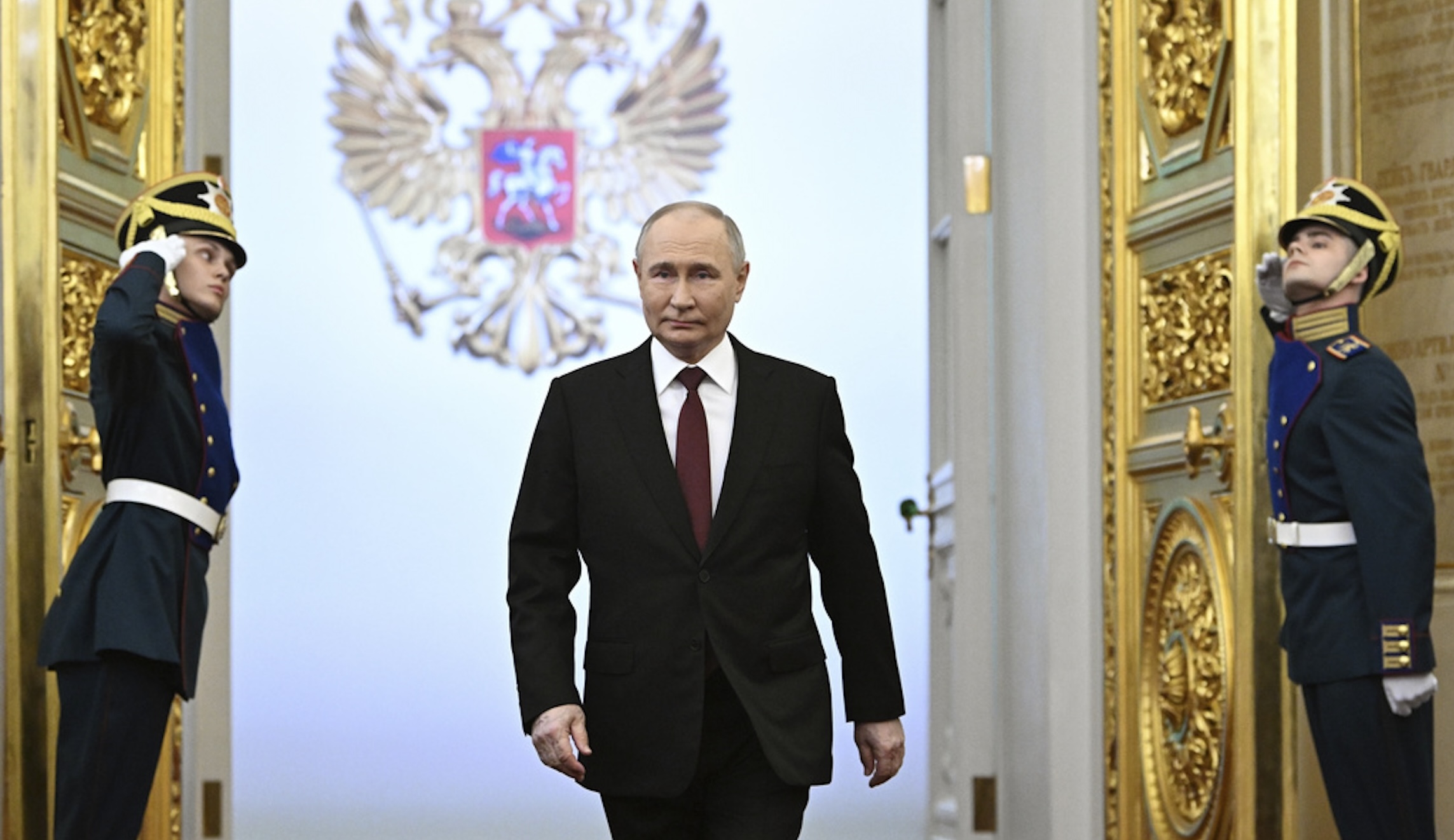
Volodymyr Zelenskiy noted the attacks were launched on the day Ukraine marks the end of the second world war. Ukraine’s president singled out what he said was the west’s limited progress in curbing energy revenue to Vladimir Putin’s regime. Fighting Nazism back then, he said, was “when humanity unites, opposes Hitler, instead of buying his oil and coming to his inauguration”.
Ukraine’s prime minister, Denys Shmyhal, estimated that more than 800 heating facilities had been damaged and up to 8GW of power generation lost so far, adding the government needed $1bn to fund repair work.
Ukraine said it was producing the same number of deep strike drones as Russia, claiming to have reached parity on a key type of weapon.
Russian forces have taken over the village of Kyslivka in Ukraine’s Kharkiv region and the village of Novokalynove in the Donetsk region, Russia’s defence ministry said.
Ukraine’s parliament has passed a bill allowing mobilisation of some categories of convicts but not those convicted of premeditated murder, rape, sexual violence, and crimes against national security.
Germany’s chancellor, Olaf Scholz, stressed Berlin’s support for a Ukraine peace summit to be held in Switzerland in mid-June during a phone call with Volodymyr Zelenskiy, the Ukrainian president, a government spokesperson in Berlin said. “They agreed to work towards the broadest possible global participation,” Reuters reported from a statement.
Categories
NPR News: 05-08-2024 8PM EDT
Russia is losing the South Caucasus – Washington Examiner https://t.co/znCzRjwECn
— Michael Novakhov (@mikenov) May 9, 2024
Russia is withdrawing its “peacekeeping forces” from Azerbaijan’s Karabakh region and from the Armenian border. They are no longer needed because the advantages that Moscow gained from a frozen conflict in the South Caucasus could only be maintained for as long as the conflict continued. With Armenia and Azerbaijan moving toward a peace agreement and looking westward to help develop their economies, Russia is losing its most important leverage in this strategic region linking Central Asia with Europe.
The Armenian-Azerbaijani conflict remained frozen from 1994 to 2020, and during this time it was Moscow’s greatest tool of influence in the South Caucasus. It enabled Russia to engage in a divide and rule strategy and minimize Western engagement. Russian peacekeepers also patrolled Armenia’s external borders, in effect ensuring that it remained a captive state inside the Collective Security Treaty Organization, the equivalent of the communist, anti-NATO Warsaw Pact.
When Azerbaijan recaptured Karabakh and other occupied districts from Armenian forces between September and November 2020, Russia did not defend its CSTO ally, and its influence in the region atrophied. Once Baku and Yerevan began the process of forging a peace deal, it made the Russian presence redundant. For Moscow, this was unacceptable, especially as Armenia’s Prime Minister Nikol Pashinyan, who won election in 2018, has been intent on steering Armenia out of the Moscow orbit and toward the West.
In retaliation, Moscow has supported domestic opposition to Pashinyan and has already attempted to overthrow him. Aware of the ever-present Russian threat, Yerevan is now proposing a full withdrawal of all 3,000 Russian troops from their remaining military base in Gyumry. This military contingent has also been used as leverage against Azerbaijan, mostly to threaten the nearby Ganja Gap that connects the energy and transportation corridor between the Black and Caspian Seas. They are also an additional source of pressure on Georgia, which already has two of its regions, Abkhazia and South Ossetia, occupied by Russia.
Fearing the loss of all influence in the region, the Kremlin is now attempting to play its last card by installing a puppet regime in Armenia. Just as it tried to prevent Ukraine, Georgia, and Moldova from integrating with Western institutions by supporting pro-Russia parties funded by loyalist billionaires, Moscow is using one of its proxy oligarchs to try to replace Armenia’s pro-Western prime minister and derail the rapprochement with Azerbaijan.
Billionaire Ruben Vardanyan spent much of his life in Russia, cultivated contacts with the Kremlin, and earned the nickname “Putin’s wallet.” He has been linked with massive money laundering for Moscow officials and is on Ukraine’s wanted list because his commercial links with Russia’s military “threaten Ukraine’s territorial integrity, sovereignty, and independence.” Vardanyan has also posed as a humanitarian philanthropist to try to whitewash his reputation. But despite the camouflage, the EU Parliament has demanded that sanctions be imposed on him.
CLICK HERE TO READ MORE FROM THE WASHINGTON EXAMINER
In 2021, Vardanyan took Armenian citizenship and was emplaced as governor of the separatist Karabakh region. When the region was recaptured by Azeri troops, he was arrested and charged with financing terrorism and creating illegal armed formations. Moscow claims he is being unfairly treated, and his surrogates have actually nominated him for a Nobel Peace Prize to secure his release.
In reality, Baku is performing a great service for Yerevan by imprisoning Vardanyan, as he has the resources and Russian security service connections to stir public unrest in Armenia and even stage a coup to install a pro-Moscow regime. If Vardanyan was to succeed, this could provide a model for dislodging other governments that are intent on breaking free of Moscow and forging closer ties with Europe and America.
Janusz Bugajski is a senior fellow at the Jamestown Foundation in Washington, D.C. His recent book is Failed State: A Guide to Russia’s Rupture. His new book to be published in the fall is Pivotal Poland: Europe’s Rising Power.