
Day: May 8, 2024
France’s Ambassador to Armenia, Olivier Decottignies, in an interview with Azatutyun.am published on Wednesday, said that Azerbaijan must withdraw from “large swaths” of territories it is occupying in Armenia.
“Azerbaijan is currently occupying large swathes of Armenian territory and it should withdraw from those territories,” Decottignies told RFE/RL’s Armenia Service Director Heghine Buniatyan in the exclusive interview.
The French envoy also said that there is expectation from Azerbaijan to make concession, in like with Armenia’s stated willingness to do so.
“Armenia has expressed its will to make some concessions based on the Almaty Declaration and we expect Azerbaijan to make concessions as well,” added Decottignies, welcoming the border delimitation process that began last month.
The French ambassador touched on a broad range of topics, including pledges for assistance to Armenia by France and the European Union, as well as the commitment by Paris to assist in Armenia’s defense reforms.
Below is the full transcript of the interview:
RFE/RL: Today, our exclusive guest is France’s Ambassador to Armenia Olivier Decottignies.
Mr. Ambassador, welcome to our studio.
Ambassador Decottignies: Barev Dzez (Hello). Thank you for having me.
RFE/RL: As the main concern on everyone’s minds today is about the delimitation in the Tavush/Qazax region, I’ll start our conversation right there. So during the last several days we’ve heard numerous statements from the Western and also regional countries voicing their support to the agreement between Yerevan and Baku, while France, Armenians’ closest ally in the West, has remained silent. Why?
Ambassador Decottignies: Well, it’s good that the delimitation is starting and it’s even better that it’s starting on the basis of the Almaty Declaration. So it’s a positive development. Obviously, it needs to be followed up. Armenia has expressed its will to make some concessions based on the Almaty Declaration and we expect Azerbaijan to make concessions as well. Azerbaijan is currently occupying large swathes of Armenian territory and it should withdraw from those territories. Our prime minister recently reminded this point. And so we think it’s a good development that needs follow-up.
RFE/RL: Do you share the concern that effective delimitation couldn’t be conducted under threat as acknowledged by the Prime Minister of Armenia?
Ambassador Decottignies: You have to start somewhere. You have to start somewhere and to do the delimitation through negotiation. And so Tavush is a good starting point. And we’re looking forward to the delimitation to continue within the agreed principles that Azerbaijan and Armenia have agreed to in the Prague Declaration that is the Almaty principle, defining the international border of former Soviet republics and the respect for and recognition of each other’s sovereignty and territorial integrity.
RFE/RL: A good starting point or a starting point that was at least achievable?
Ambassador Decottignies: It has started. And for that we should be positive.
RFE/RL: Several opposition parties that criticized governments’ stance on this announced that they are going to meet with, with the envoys from the Western countries. Have you met with them and what was your message?
Ambassador Decottignies: I meet with them. I haven’t met with them on that particular topic. I’ve received proposals and, of course, I will meet. We have a friendly country of Armenia and the French embassy is open to all Armenian political forces.
RFE/RL: During the recent months we’ve seen unprecedented deterioration in the relations between France and Azerbaijan, leading to Paris recalling its ambassador from Baku. Nevertheless, during the last week we have heard several statements from Azeri media, including official ones, that she is back. Can you confirm this?
Ambassador Decottignies: I’m not the French ambassador to Azerbaijan.
RFE/RL: But you are aware…
Ambassador Decottignies: I’m not in charge of the relationship with that country. We’ve had a number and we still have a number of issues with Azerbaijan which have been stated clearly including by our interior minister a few days ago on Azerbaijan’s interference in our domestic politics, especially in the New Caledonia region. I have nothing to add to what the interior minister said.
RFE/RL: Is she in Baku right now?
Ambassador Decottignies: I can’t tell you whether she is in Paris or in Baku, but I can tell you she is not in Shushi.
RFE/RL: We’ve seen that there is a perception that Aliyev is trying to maintain unchecked dominance in this region. Is France comfortable with this?
Ambassador Decottignies: We simply are comfortable with what we do with Armenia. We have initiated with Armenia a defense cooperation, which is something new in our relationship, which is gaining a lot of momentum. There have been a number of agreements between the two countries during the past few months with three goals: providing Armenia with defensive weapons to defend its population, its territory, its sovereignty; providing the Armenian armed forces with training in Armenia or in France; and also providing counseling to the Armenian defense ministry.
RFE/RL: And your defense minister was here two months ago with a delegation that included also very famous French armed manufacturers. Can you update on whether there are new agreements coming out of this visit? And if yes, what’s the time frame for the supplies?
Ambassador Decottignies: A number of agreements have been announced both last October and during the defense minister’s visit. And we are listening to our Armenian friends’ needs.
RFE/RL: And what are their needs?
Ambassador Decottignies: Well, you know, defensive weapons to defend their territory.
RFE/RL: Just a month ago, your minister Stephane Sejourne, standing next to Secretary of State Antony Blinken openly said that Azerbaijan is going out of hand and it’s also challenging Armenia’s territorial integrity. If that would be the case as we have witnessed several times during recent years’ aggressions, what would be the concrete actions that Yerevan can expect from France?
Ambassador Decottignies: Well, we’re not waiting for an aggression to happen. That’s why we’re developing this cooperation.
RFE/RL: So this is about cooperation. This is about defensive arms supplies.
Ambassador Decottignies: Supplies, training and advising. In our history in 1940 we experienced a terrible defeat against Nazi Germany. Our army, which we thought was the strongest in the world because we were the winners of World War I and were the main military partner in the alliance of World War I, was defeated in a matter of weeks. And we learned from that. A famous French historian [Marc Bloch] who happened to be serving in the army as an officer at the time wrote a book called the “Strange Defeat” and he made a diagnosis of the defeat, and his take very interestingly was that all major military defeats are first and foremost intellectual defeats. And that’s why, you know, there’s a lot of focus on weapons, equipment, which matter, but doctrine is also key.
RFE/RL: And also, I remember your last interview with the Public TV channel where you mentioned that in the event of aggression against Armenia, France within its capabilities can give Armenia a chance to defend itself. So my question pertains to these capabilities. For example, could Paris consider sending its troops to Armenia like it did, for example, ten years ago when it sent troops to Mali or Libya to neutralize armed groups?
Ambassador Decottignies: We’re speaking about a very different situation. The operations in the Sahel region of Africa were counter-terror operations. Here we have a state-to-state cooperation and we’re trying to contribute to the buildup of the Armenian armed forces. Once again, we’re not waiting for something to happen. We’re trying to do what’s necessary for things not to happen.
RFE/RL: I am talking about the concrete actions. There were two resolutions adopted by the French Senate recently, almost unanimously, urging your government to adopt sanctions against Azerbaijan, including seizing assets of Azerbaijani leaders and implementing an embargo on gas and oil imports from the country. So it seems to me that on one hand, the French government acknowledged that we have to deal with an aggressive country that was also involved in ethnic cleansing. On the other hand, it hesitates to opt for coercive measures.
Ambassador Decottignies: Sanctions in Europe are taken at the European level. The reason why is that we are a single market. European Union members form a single market. So you can’t adopt sanctions unilaterally as just one member of the European Union.
RFE/RL: But the Czech Republic just imposed unilateral sanctions against Russia and it was targeting also Patriarch Kiril, if I am not wrong.
Ambassador Decottignies: But if you talk about meaningful sanctions that are economic sanctions that affect, for instance, the oil and gas sector or any economic sector, Europe is a house. If you close one window, you can go through another window, through the chimney. You need to get all European countries to agree on sanctions, to have efficient sanctions. And currently there’s no agreement on that, there’s no consensus on that.
RFE/RL: Within France?
Ambassador Decottignies: Within the EU.
RFE/RL: Within the EU. And talking about the EU, France was also very vocal about including Armenia in the bloc’s European Peace Facility program. And we had information from diplomatic sources that there was an initial agreement of providing Armenia with 10 million euros. But Hungary is now blocking it. Have you heard about this? And would there be joint efforts to convince Orban to reconsider his stance?
Ambassador Decottignies: That’s a good question for the ambassador of Hungary when he or she will be nominated, because as you know you just have had an agreement with Hungary on that, if I’m not mistaken.
RFE/RL: Yes, absolutely right.
Ambassador Decottignies: As far as my country is concerned, we support and advocate restlessly within the European Union for Armenia to benefit from the European Peace Facility. Why? Because Armenia is finding itself in a situation very similar to a number of other beneficiaries of the European Peace Facility. It is a country whose territory is partly occupied and who’s being threatened by regional powers.
RFE/RL: And there is also another question that France was very vocal about. It’s about the Nagorno-Karabakh problem. And I remember that last October when there was a hearing in the French Senate, your former foreign minister said that this is a crime that can’t go unanswered, and France is going to initiate a new resolution in the United Nations Permanent Council to create conditions for [people’s] returns, including international peacekeepers and ensuring their rights. So six months have passed. Can you update what have been done so far?
Ambassador Decottignies: There’s one positive development. It is that we have a legal basis for discussion, not only in the United Nations Security Council, basically in any international fora, that is the order [Order of 17 November 2023], the decision of the International Court of Justice, that recognizes the right to return for the Armenians of Nagorno-Karabakh. So, this is a strong and legal basis, very detailed decision. And this decision is obligatory. It’s not an opinion of the court. It is obligatory for all members of the International Court of Justice, including for Azerbaijan. When it comes to the Security Council proper, France has three times [called] the Security Council [on] the situation in Nagorno-Karabakh, both during the blockade and after the assault by Azerbaijan. In the Security Council, one country, one permanent member of the Security Council, like France, can block a text, but one country cannot impose a text.
RFE/RL: Can you disclose what country was blocking it?
Ambassador Decottignies: There wasn’t a majority to move forward to vote. And there’s a country which has…
RFE/RL: Just one?
Ambassador Decottignies: No, no, no, there wasn’t a majority, there wasn’t a majority. And among the countries that have a veto right, you know, not all of them share our view of the situation.
RFE/RL: And Prime Minister Pashinyan invited the French President to Armenia to participate in a gala concert dedicated to the 100th anniversary of Charles Aznavour. Can you confirm if President Macron’s visit this fall is planned to Armenia?
Ambassador Decottignies: We are talking about the possibility of a visit with the Armenian authorities. Obviously the 100th anniversary of Charles Aznavour is a very seductive occasion.
RFE/RL: So it’s not confirmed yet?
Ambassador Decottignies: It’s not confirmed yet.
RFE/RL: You’re just working on that?
Ambassador Decottignies: Absolutely.
RFE/RL: And you’re talking, I’ve heard during your interviews, about Armenians’ EU aspirations. Where do you see the country? As a candidate state, as a state that is closely cooperating with the EU family or maybe somewhere else?
Ambassador Decottignies: Well, it’s for Armenia to say where Armenia is standing on that. And as you know, the position of the Armenian government, which was expressed by the Prime Minister and the EU Parliament…
RFE/RL: As close as you would allow.
Ambassador Decottignies: It’s a very romantic way to put it. And I like it. And it sounds like a love declaration, actually. In practical terms, Armenia is already within the European political community, which is an initiative taken by France, an initiative of President Macron to include countries that have a lot to do with the EU and are not in the EU or not yet in the EU into processes and work on our common goals and our common challenges. It’s in this framework that the most important progress was achieved in the negotiation with Azerbaijan in the Prague meeting, you know, recognition of Almaty principle, recognition of the territorial integrity of both states. So Armenia has already a foot in the European family. And in the past few… I’ve only been in Armenia for a few months now, eight months. I see a lot of aspirations for Europe as a set of values, as a way of life, as a common civilization. And there were some very brave decisions made by Armenia on that path, for instance, the ratification of the Rome Statute of the International Criminal Court. So, it’s for Armenia to define its position. But there are already some commonalities, some common policies. There was recently a discussion of the whole range of cooperation with Europe in Brussels with representatives of your government. So it’s not zero or one, and I see the temperature warming up.
RFE/RL: And one off-topic question: we have seen Russia’s president’s inauguration in Moscow, several Western countries boycotted it, while France’s ambassador took participation. What was behind this decision? Can you just elaborate on this?
Ambassador Decottignies: You can attend this kind of event at different levels. And the choice of level shows the level of engagements.
RFE/RL: And you’ve mentioned, or maybe your former ambassador mentioned that Armenia might be a place for negotiations between West and East and the conflicting parties. Do you see this opportunity still available?
Ambassador Decottignies: I think Armenia is a country in a very interesting situation. You know, it lies between Europe, the Middle East, and the former Soviet Union. So it’s a very interesting geopolitical position. But it’s also a position that comes with challenges. Today the challenges dominate, but the opportunities might rise again.
RFE/RL: Thank you for this opportunity, Mr. Ambassador.
Ambassador Decottignies: Thank you very much.
Defense Sec. Lloyd Austin, Gen. Charles Q. Brown Testify Before Senate Appropriations Committee – News Review – Selected Articles https://t.co/tnbGMSZa6U pic.twitter.com/YRV0a1QKHU
— Michael Novakhov (@mikenov) May 8, 2024
Putin Reveals Plan To End West-Dominated ‘Unipolar’ World Order In First Speech Of New Term – Saved Web Pages Review https://t.co/W0antVsCWq pic.twitter.com/WztJUXYM56
— Michael Novakhov (@mikenov) May 8, 2024
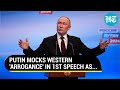
Russian President Vladimir Putin said dialogue with the western countries was possible even as the war in Ukraine continues. “We do not refuse dialogue with Western states. The choice is theirs: do they intend to continue trying to restrain the development of Russia, continue the policy of aggression and relentless pressure that they have pursued for years, or look for a path to cooperation and peace,’ Putin said just after taking oath as Russian President for the fifth time.
Saved Web Pages Review – The News And Times – TheNewsAndTimes.com
Riley Bailey, Christina Harward, Angelica Evans, and George Barros March 30, 2024 The Russian Orthodox Church Moscow Patriarchate (ROC MP), a Kremlin-controlled organization and a known tool within the Russian hybrid warfare toolkit, held the World Russian People’s Council in Moscow on March 27 and 28 and approved an ideological and policy document…
Russian President Vladimir Putin said dialogue with the western countries was possible even as the war in Ukraine continues. “We do not refuse dialogue with Western states. The choice is theirs: do they intend to continue trying to restrain the development of Russia, continue the policy of aggression and relentless pressure that they have pursued for…
This essay is adapted from the 21th Annual Templeton Lecture on Religion and World Affairs delivered on November 7, 2017, at the National Liberty Museum in Philadelphia, Pennsylvania. It is an honor to have been invited to present the twenty-first Templeton Lecture on Religion and World Affairs at the Foreign Policy Research Institute. It is humbling…
There are certain documents that cast a dark, cosmic shadow. We have become used to seeing this in texts issued by various institutions linked to science (global warming), medicine (the pandemic), and the economy (poverty rates). But established Church authorities have tried in various and different ways over the past century to be messengers of hope….
Stay informed with free updatesSimply sign up to the Chinese politics & policy myFT Digest — delivered directly to your inbox.China’s President Xi Jinping has lashed out at Nato over its “flagrant” bombing of the Chinese embassy in Belgrade in 1999 as he tries to cement ties with Serbia ahead of a visit to the Balkan country on Tuesday.Xi, who…
Protesters are demanding the government reach a deal to bring the hostages back from Gaza, for new elections and the resignation of Israeli Prime Minister Benjamin Netanyahu. The demonstration took place as a delegation of the Palestinian militant group Hamas was in Cairo for cease-fire talks with Israel. (AP video by Shlomo Mor) Protesters are…
During a wreath-laying ceremony for Holocaust Remembrance Day on Monday, Israeli Prime Minister Benjamin Netanyahu was heckled by a protester who called on the leader to resign.Video posted online by The Times of Israel shows a man yelling out at Netanyahu to resign moments before he places a wreath down during the ceremony at Yad Vashem, Israel’s…
Unlock the Editor’s Digest for freeRoula Khalaf, Editor of the FT, selects her favourite stories in this weekly newsletter.European intelligence agencies have warned their governments that Russia is plotting violent acts of sabotage across the continent as it commits to a course of permanent conflict with the west. Russia has already begun to more actively…
Hamas says it has accepted a ceasefire deal proposed by Egypt and Qatar which seeks to halt the seven-month war with Israel in Gaza. In a statement Monday, Hamas said the head of its political bureau, Ismail Haniyeh, told the Qatari prime minister and Egyptian intelligence minister…
Пожалуйста, поддержите канал: https://www.donationalerts.com/r/zistorii https://donate.qiwi.com/payin/ZIstorii Версия событий переворота Октября 1917 года от историка Андрея Ильича Фурсова. Его исследование мемуаров и архивных документов привело к выводу, что организаторами переворота в Октябре 1917 года были царские генералы разведывательного…
Just a few months short of a quarter-century as Russia’s leader, Vladimir Putin on Tuesday will put his hand on a copy of the constitution and begin another six-year term as president wielding extraordinary power. Since becoming acting president on the last day of 1999, Putin has shaped Russia into a monolith — crushing political opposition, running…
Published: 01:59 BST, 5 May 2024 | Updated: 02:02 BST, 5 May 2024 President Vladimir Putin appeared withdrawn and downcast in a rare public appearance at an Orthodox Easter Mass in Moscow.The Russian tyrant seemed to stare blankly out towards the congregation as he went through the religious motions during the mass. The 71-year-old’s mood could…
Специально для Крым.Реалии На рубеже II и I веков до нашей эры Крым и Южное Причерноморье были объединены в границах державы Митридата Евпатора. Прошли 1300 лет – и история повторилась, но уже в виде Трапезундской империи. XII век, вероятно, был самым спокойным в средневековой истории Крыма. Возможно, потому, что до нас дошло мало источников этого…
Президент России Владимир Путин 2 мая встретился с Алексеем Дюминым, губернатором Тульской области РФ, связанным с группировкой «ЧВК Вагнер», обращают внимание аналитики американского Института изучения войны (ISW). По их мнению, перед запланированной на 7 мая инаугурацией Путина на новый срок это может свидетельствовать о его стремлении снизить…
Всего два дня осталось до знаменательного события — инаугурации президента РФ Владимира Путина. В этот же день президент, традиционно, примет отставку правительства. Какие кадровые сенсации уже готовят в Кремле, пытаются предсказать аналитики. Самая главная интрига«Любимый генерал президента» возвращается в Москву Самая главная интрига Источник:…
Арест Тимура Иванова имеет негативный эффект также и для политических перспектив Алексея Дюмина, которого начали прочить на место Шойгу и которого патронирует Геннадий Тимченко. Дюмин, как и Иванов, входит в группу Геннадия Тимченко, куда он попал еще в бытность работы адъютантом Владимира Путина, поскольку Тимченко был нужен свой человек рядом с Путиным….
Unlock the Editor’s Digest for freeRoula Khalaf, Editor of the FT, selects her favourite stories in this weekly newsletter.European intelligence agencies have warned their governments that Russia is plotting violent acts of sabotage across the continent as it commits to a course of permanent conflict with the west. Russia has already begun to more actively…
Democratic Rep. Henry Cuellar of Texas and his wife have been charged with accepting nearly $600,000 in bribes from two foreign entities, according to an indictment in federal court in Texas. The alleged scheme took place from late 2014 through at least November 2021, the indictment says….
Rep. Henry Cuellar (D-Tex.) and his wife allegedly accepted $600,000 in bribes from an oil company controlled by the Azerbaijan government and a bank headquartered in Mexico, according to a federal indictment unsealed in Texas on Friday.The 68-year-old congressman and his wife, Imelda Cuellar, are accused of setting up front companies that entered into…
The warlord leader of Chechnya, one of Russian President Vladimir Putin’s main cronies, is reportedly gravely ill with kidney problems, sparking fears that he was poisoned. Ramzan Kadyrov brought the United Arab Emirate’s chief nephrologist, or kidney specialist, to Grozny, Chechnya’s capital, for treatment,…

The News And Times Information Network – Blogs By Michael Novakhov – thenewsandtimes.blogspot.com
Two more Georgian fighters – Davit Ghoghadze and Beso Lomidze – have been killed while fighting in Ukraine, the Georgian combat unit “Black Eagle” reported on May 7. The Georgian Ministry of Foreign Affairs confirmed the information to Civil.ge.
 Davit Ghoghadze and Beso Lomidze; Source: Black Eagle
Both were fighters with the “Black Eagle” combat unit. They were killed in the vicinity of the Ukrainian city of Avdiivka.
The latest casualty brings to 50 the unofficial number of Georgian citizens who have died fighting in Ukraine since Russian invasion on February 24.
Also Read:
- 06/05/2024 – Another Georgian Fighter Killed in Ukraine