
Day: May 7, 2024
 An illustrated portrait of contemporary author Maroush Yeramian, featuring a poem from their work “Steganography (2015). Illustrations by Arpi Krikorian.
it was accepted.
then it became forbidden and familiar
the word kept silent
whatever has passed
it continues in a magnificence, unseen
unforetold
and eventually— we will become
one with the word
as we once were before.
—Maroush Yeramian, from Steganography (2015)
(translation by Dr. Maral Aktokmakyan and me)
I identify as an author. I identify as a woman. I identify as a poet. I write experimentally. I write fantasy. I write concrete poetry. Yes, my writing is in Western Armenian. Yet, according to UNESCO’s online Atlas of Endangered Languages, Western Armenian is categorized as “Danger1” and “definitely endangered.”
Endangered you say? So, then why even write in Western Armenian? Who will read your work? Who will buy your books? Is there a point in writing in a language claimed to be dying? Is there a point when so few can even read what you write? Ah, so the purpose is just preservation then?
People often ask me why I write in Western Armenian—surprised when I express that it is my language of articulation. It is the language I feel at home in, no matter where I have lived or been in the world. It is my language of humor, anger and interpretation—conversing always among and within other languages. It is my first language, even though I was born in the U.S. It is the language people constantly tell me is “dying” or maybe even already “dead.”
But I am writing in it. I am reading its words and teaching them. I am experimenting with it. I am communicating with my friends in it. To me, it is very much alive. To some, it is dispossessed, at a loss and must be saved. For my present, it is redeemable. For others, it may already be elapsed. I am starved for it; others feel deprived of it. I play with it; others tell me not to misuse it—to respect and honor it.
We are constantly reminded that Western Armenian is under threat and commanded to preserve the language through speaking, reading and writing. But what does it mean to “respect” and “honor” a language, if not to celebrate it by creatively engaging with it; to look at the intricacies of the language through its essence, through its calligraphic forms, through its rhymes and verses, and then to craft your own; to honor its place by contributing to its history through your own personal and familial relationship with it? As a writer, I think about how its “endangered” status influences how I approach this language creatively. I do not write to simply preserve the language, but I wonder if this question can even be separated from my artistic thrust. At the same time, I wonder how readers approach these creations and set their expectations. Would my work—especially its experimental form—be received differently if the looming threat of the endangerment of Western Armenian was not at the foreground of each reader’s mind? Does the shadow of endangerment inhibit our ability to fully experience contemporary Western Armenian literature as an imaginative form, rather than as words motivated by preservation?
Western Armenian is both a language of community and a language that has always existed among multiple communities. It is also a language that has helped to build community. As Western Armenian speakers, we are constantly negotiating this language with other languages—and more often than not, with a colonial language. I have thought a lot about how Western Armenian was taught to me in school. I am proud to have attended an Armenian school where I had exposure and instruction in two languages, English and Armenian. In fact, my language and literature classes were my favorite subjects. However, mastering Armenian was something I felt we had to prove excellence in; English was not. Learning Armenian came with a lot of familial and cultural pressure—but we were always taught with the assumption that somehow we would fail, and English, the colonial language of America, would win. We were reminded to speak in Armenian and not switch so quickly to English. We were reminded that both our grandparents and parents’ generation preserved the Armenian language, and this was also our responsibility. We were reminded that we were getting assimilated—a jermag chart, or a white or “silent” genocide, they called it.
When we made mistakes in English, those were easily corrected; we forgave ourselves quickly, not thinking twice about it. We never stuttered when we spoke English. However, each error in Armenian—spelling, conjugation or vocabulary—seemed like a huge betrayal to the language, our ancestors and our teachers. We were made to feel insecure in our own language, for several reasons. One, we were constantly reminded that we were far removed from our ancestors that originally spoke it, and that being in America fated us already to “losing” it. Two, in the constant anxiety over its extinction, we forgot that language was a living and being thing, that it changed, mutated and formed itself through its own spoken vibrations. We didn’t use Western Armenian in ways that were playful, in our everyday mundane discoveries and communication. Western Armenian was presented to us as a language that should be preserved and used in conjunction with high poetry, Armenian history and authors who died in the Genocide. English was our present, and Western Armenian stayed in our past.
The registers in which we were asked to communicate in Western Armenian also attempted to box us in. The anxiety of preservation brought with it anxieties around the purity and perfection of language. We were frequently told to speak in “clean Armenian,” “to avoid English and other foreign words” and “to not corrupt the language of our ancestors.” We experimented in English, learning from music, television and popular media. When we spoke Armenian, our framework became ancient, 19th-century, male, heteronormative and traumatic. We stood upright instead of naturally. We were conscious of performing a language we could never really get close to, that could never fully be made intimate to us. Our lines were delivered as recitations, in ways we hoped our teachers and elders would approve of—and when we stopped acting for them, we secretly turned to English.
I cannot account for the experiences of every Western Armenian speaker and each individual who has formed a relationship with this language. As you see, this relationship is personal and complicated, as all relationships are. This relationship may and can be, for some, very traumatic—an extension of intergenerational trauma and the very struggles the language has endured to sustain, to be created within and in. It is a looming question for those authors, like me, who argue that its endangered status paradoxically may even promote its own presumed essence of being en-danger-ed.
Though these realities existed in the minds of young learners of Armenian, many like me were still drawn to the language. We wanted to speak perfectly. We wanted to express our hearts in Armenian. We wanted to read the great authors, from the ancient to the contemporary, from Khorenatsi to Srpuhi Dousap to Maroush Yeramian. Yet when we force students to read primarily male authors from the 19th-century, who all died tragically either from the “poet’s disease” tuberculosis or as targeted intellectuals in the Armenian Genocide of 1915, how can we expect them to continue to engage with literature produced in Armenian when the underlying message remains trauma, death and hopelessness? Have we paired—or even conditioned ourselves to pair—Western Armenian with a status of “dead”? Have we done this so often that we have already manifested an empty coffin for our language? How can we think of Armenian as living if people keep telling us it is on the brink of death, when students and communities are hardly being introduced to the very few active authors who are composing creatively in the language today, and when young learners and readers of the language are not associating it with their own contemporary realities?
I think about the revolutionary women who carried Western Armenian, an orphaned language, by continuing to compose and publish in it beyond the trauma of the Armenian Genocide. I gain inspiration and strength from the women who sustained the life of this language, fought time and time again to publish its imprints and gave voice to other women in their own mother tongue. I remind myself that they, too, were negotiating the place of Western Armenian alongside a colonial language.
When I contemplate the struggles of being an author in an endangered language, of being a woman who attempts to give voice and expose inequities, to educate in and around this language and raise awareness of its literary history, I often think of my foremothers as my strength. I honor the role of women, both historically and at present, in shaping the place of this literature—how they have kept it breathing and beating, how they continue to resuscitate its life through rhyming and reading. I think about the revolutionary women who carried Western Armenian, an orphaned language, by continuing to compose and publish in it beyond the trauma of the Armenian Genocide. I gain inspiration and strength from the women who sustained the life of this language, fought time and time again to publish its imprints and gave voice to other women in their own mother tongue. I remind myself that they, too, were negotiating the place of Western Armenian alongside a colonial language.
Can someone read an experimental work in Western Armenian today without thinking of its status as endangered? How is this poetry received when it lives anew in the moment its author births its life, while simultaneously decaying at the thought of its endangerment? I often think of how close we can get to images we are told are fleeting—in a language that keeps being presented to us as a mirage. I often wonder how we continue to create without foregrounding our intentions as merely acts of preservation.
Imaginaries exist beyond words—but we need to translate our visions and expressions. I want to empower the belief that there is a future for our people and our language that is healed—that was always meant to thrive despite our traumatic past.
For me, Western Armenian is not dead or dying. It is living. It is living today as its reverberations fill rooms. It is living today as it echoes in halls, dormitories, in nature and through music. It is living every time someone speaks its name—any name, any word. It is not a memory; the language makes memories. And though there are many women whose names have been forgotten, who were the silent advocates of this fight, who have kept this literature alive—while their names may never be known to us, their whispers reach our ears. These women are the biographers of an unhidden truth and an untold history.
I believe Western Armenian will create its own future. I believe Western Armenian will birth a new generation of creatives. I believe the words of the Western Armenian writer Maroush Yeramian when she writes: “eventually— we will become/ one with the word/ as we once were before.”
Author information

Tamar Marie Boyadjian
Tamar Marie Boyadjian is a professor, author, Western Armenian poet, editor, translator and medievalist. She is the first U.S. born author to publish a book of poetry in Western Armenian: ինչ որ է ան է (Yerevan: Andares, 2015). She is also the first writer of Western Armenian to produce a fantasy series in the language (Arpi Publishing, 2024). She is currently the Editor-in-Chief of the Journal of the Society for Armenian Studies. She has also served as the main editor of two out of three extant volumes of contemporary Armenian literature in translation into English: makukachu (Ingnakir, 2017), and unscripted: An Armenian Palimpsest [Absinthe: World Literature in Translation] (University of Michigan Press, 2017). She was the recipient of the Sona Aroyan Book Prize for her monograph, The City Lament: Jerusalem Across the Medieval Mediterranean (Cornell University Press, 2018). Her latest book, Կաթիլ մը կին՝ անանուն, անքերթուած a drop of woman: unnamed, unwritten — will be released in 2024. She currently teaches Western Armenian courses at Stanford University.
|
The post The danger of the “en-danger-ed”: The hope for a Western Armenian imaginary appeared first on The Armenian Weekly.
Karen Khachanov’s European tour has so far come with its own set of ups and downs.
After concluding a duo of North American competitions with a round of 16 Miami Open appearance against Alexander Zverev 1-6, 4-6, the Russian-Armenian tennis star was scheduled for European action. Khachanov’s first competition following his two-set loss to Zverev had him hit the clay courts of Monaco for the Monte-Carlo Masters.
Khachanov finished his 2023 Monte-Carlo Masters campaign with a round of 16 loss to his doubles teammate Andrey Rublev in two sets 6-7, 2-6. He had his eyes on a better finish. The Armenian began his 2024 run in the round of 64 with a showdown against the United Kingdom’s Cameron Norrie on April 8. A two-set win 7-5, 7-6 (4) followed for Khachanov, who also doubled the ace statistic in the matchup 13-2.
Khachanov then competed in the round of 32 against Argentina’s Francisco Cerúndolo, who gave Khachanov something to be mindful of in the early goings of the match. Cerúndolo secured the first set with a 4-6 scoreline, but that was enough of a wake-up call for Khachanov to take the next two sets 6-4 and 6-3, earning a three-set victory.
In the round of 16, Khachanov took on one of his most difficult opponents of 2024. Daniil Medvedev, the fourth-ranked men’s tennis player, was matched up with the current 18th-ranked Khachanov on April 11. However, the final score suggested that those world rankings don’t have much weight attached to them. Khachanov secured a resounding two-set win against one of the best tennis players in the world 6-3, 7-5 to make it to his furthest round of the Monte-Carlo Masters in his career.
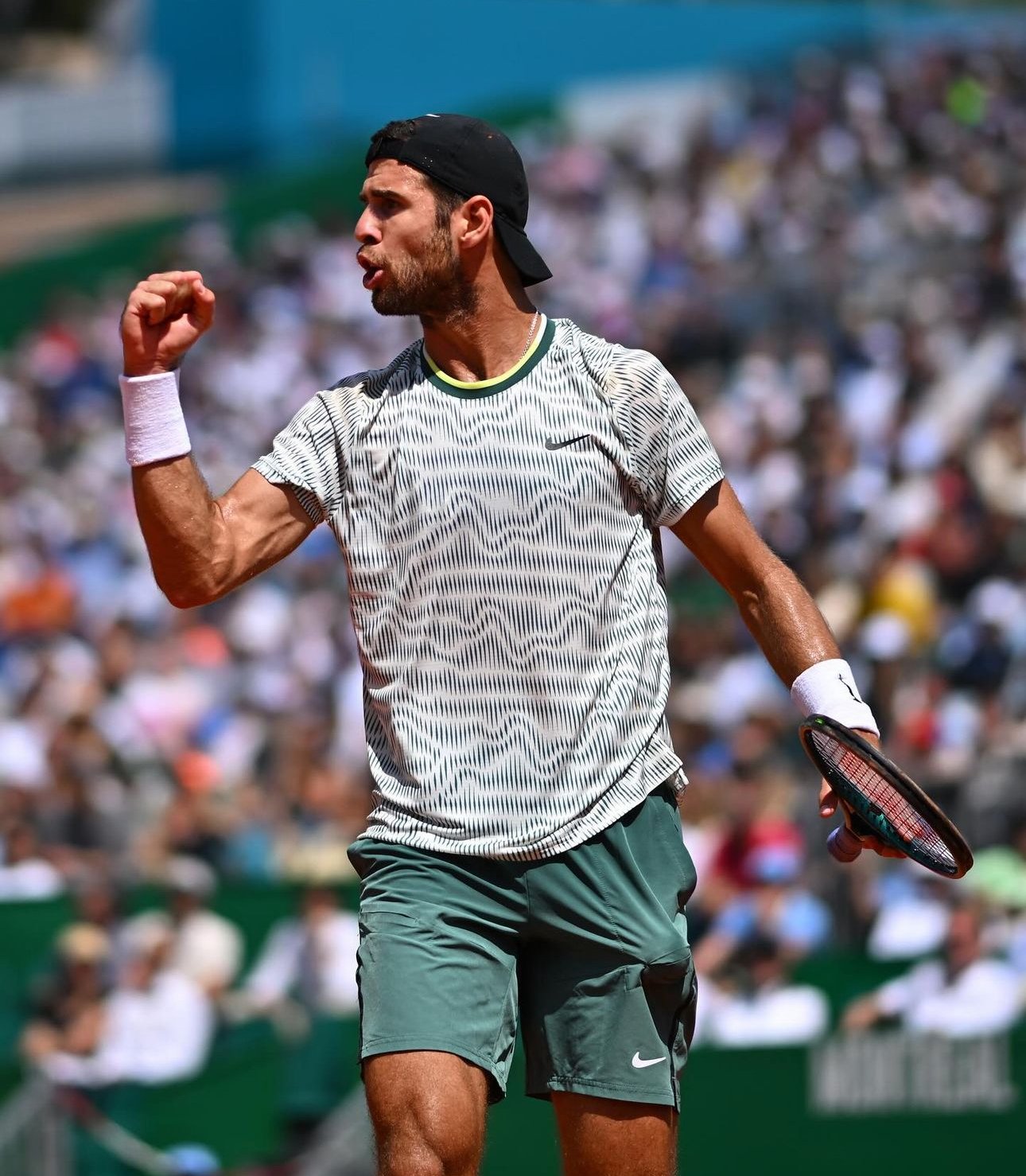 Karen Khachanov
Khachanov’s run in Monaco came to a halt in the quarterfinals after matching up to Greece’s Stefanos Tsitsipas. After dropping only one set throughout his Monte-Carlo Masters run, Tsitsipas ended Khachanov’s time on the clay courts with a 6-4, 6-2 win. Tsitsipas was on such a dominant run in the French Riviera that he ultimately won the Monte-Carlo Masters 6-1, 6-4 against Casper Ruud.
Khachanov’s luck would run out before his next competition, the Barcelona Open. Prior to his opening matchup with Roberto Bautista Agut on April 17, Khachanov made an announcement. On his Instagram story, Khachanov wrote, “Unfortunately I had to withdraw from the ATP500 tournament in Barcelona due to a small injury. Now I am fully committed to the recovery and preparation process with my team. Hopefully I will be ready for the tournament in Madrid. I will see you soon on the courts.”
Ten days after his scheduled opening-round match at the Barcelona Open, Khachanov laced up for the clay courts of the Madrid Open. The opponent waiting for Khachanov in the round of 64 was Roberto Bautista Agut—the same opponent due to face the Armenian in the opening game of the Barcelona Open. Sometimes, it’s just meant to be.
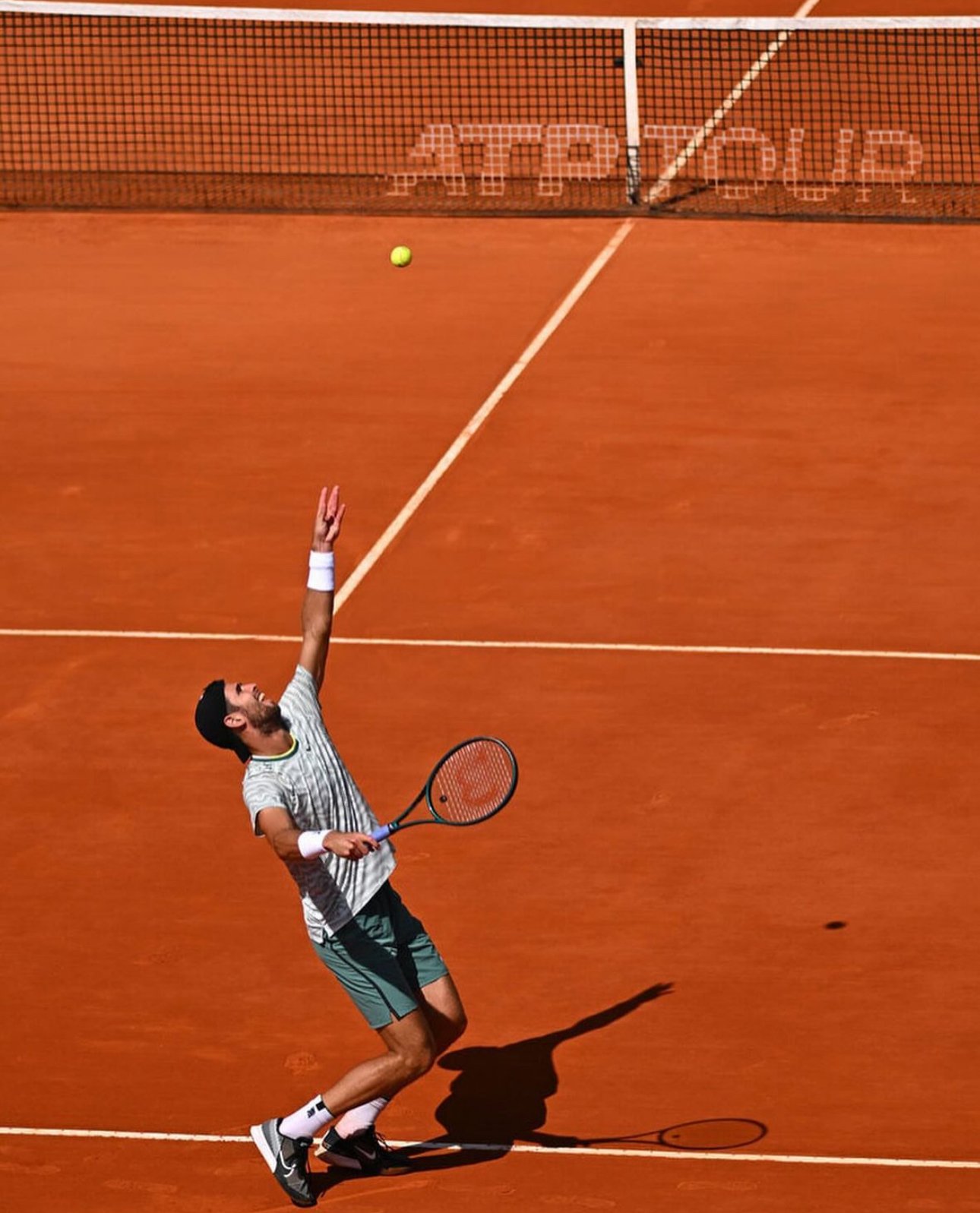 Karen Khachanov
Khachanov stumbled out of the gates dropping the first set before storming back to a three-set victory 3-6, 6-3, 7-5. Two days later, Khachanov pulled out the broomstick to sweep Flavio Cobolli 7-5, 6-4. Khachanov was through to the fourth-round of the Madrid Open with a chance to make it to his second-career quarter finals appearance.
A date with one of the best tennis players was set, yet again, for Khachanov. This time the second-best tennis player in the world, 22-year-old Jannik Sinner, was drawn up to face Khachanov. The Armenian roared out with a 7-5 first set win, but the young mastery of Sinner proved to be too much to overcome, with the Italian ultimately winning in three sets 5-7, 6-3, 6-3. Sinner withdrew from his quarterfinal match against Felix Auger Aliassime, resulting in a walkover. Aliassime reached the Madrid Open final, only to lose to Andrey Rublev in three sets.
What’s next for Khachanov? The tennis player will lace up for the Italian Open with the first serve due for May 10. Khachanov will begin his Italian Open run in the round of 64 with his opponent to be determined.
Author information

Jason Takhtadjian
Jason Takhtadjian is a reporter, producer and weekend anchor at KCAU-TV in Sioux City, Iowa. Takhtadjian began college pursuing Mechanical Engineering with a focus on Aerospace until deciding to pursue a sports broadcast career after one semester at the University of Nevada – Las Vegas. While at UNLV, Takhtadjian worked on his own weekly radio show/podcast covering soccer and basketball, produced his own sports debate show, was part of the university’s weekly sports show “The Rebel Report” and was the play-by-play commentator for UNLV men’s and women’s soccer and basketball, to name a few. When the COVID-19 pandemic started, Jason was graduating college and had to pivot to the world of general news to land a job. Three years after accepting a job in the middle of the United States with no Armenian community, Takhtadjian accepted a reporter position at KSEE in Fresno, California. The 26-year-old also worked as a contributor for Armenian Sports News, helping grow the page by thousands of followers in less than a year of work.
|
The post Tennis star Karen Khachanov hits the courts in Europe in April appeared first on The Armenian Weekly.
DETROIT, Mich.—The Armenian community of Michigan recently came together to commemorate the 109th anniversary of the Armenian Genocide through a series of impactful events.
On April 17, 2024, the Armenian Community of Greater Detroit (ACC), in collaboration with the Livonia Public Library, organized a lecture titled “Armenian Genocide: Then and Now.” Guest speaker Ani Boghigian Kasparian delivered an insightful overview of the Armenian Genocide, spanning from 1894 to the present day. Emphasizing the ongoing genocide perpetrated by Turkey and Azerbaijan, Kasparian’s presentation captivated a diverse audience of Armenian and non-Armenian residents. Following her enlightening talk, Kasparian engaged attendees in a stimulating question and answer session, fostering further dialogue and reflection.
 Ani Boghigian Kasparian presenting “Armenian Genocide: Then and Now”
Continuing the commemoration, the Armenian Genocide Committee of Greater Detroit, comprising 11 Armenian community organizations, gathered on April 20 at the Fordson High School auditorium. The event commenced with a flag ceremony and renditions of the United States, Armenia and Artsakh national anthems, conducted by the Homenetmen of Detroit. Christine Santourian, representing the Tekeyan Cultural Organization, emceed the proceedings, calling for remembrance of the past to prevent future atrocities.
Alex Kurkechian from the Armenian Youth Federation-Youth Organization of the Armenian Revolutionary Federation conveyed a powerful message of youth empowerment, vowing to continue the fight for a free, united and independent Armenia. He stressed the pivotal role of the youth as a beacon of light that shines and gives hope and strength to fight for justice.
Committee chair Raffi Ourlian offered remarks acknowledging the tragic history of the Armenian people while highlighting their resilience and achievements. Ourlian recognized the critical period that Armenia faces but also highlighted the successes Armenians have achieved with their determination and perseverance, such as Operation Nemesis and the first Artsakh War. “Each of you here in this room is a success for our nation; each of you has a unique story of survival, a story of how your family made it past the Genocide and survived,” he concluded.
Congresswoman Rashida Tlaib of Michigan’s 12th district presented a congressional proclamation marking the 109th anniversary of the Armenian Genocide in Congress. Rep. Tlaib reaffirmed her commitment to advocating for the Armenian people, stating, “I will never be shy about speaking truth to power when it comes to what happened to the Armenian people and what continues to happen to the Armenian people. I’m tired of us literally sitting back as a country and allowing refugees to be created and people to be uprooted from their land, denied access to their culture and denied access to their history.”
The first guest speaker of the night, Harut Sassounian, publisher of The California Courier, presented a detailed historical account of the Armenian Genocide and the importance of pursuing reparations from the government of Turkey. He called for shifting focus from recognition to reparations and legal demands from the government of Turkey. “The fact is that commemorative resolutions adopted by various countries and statements made on the Armenian Genocide by world leaders have no force of law and therefore no legal consequence,” he said.
ANCA National Committee board member Dzovinar Hatsakordzian welcomed Gev Iskajyan, director of the Armenian National Committee of Artsakh and ANCA Grassroots Director, who stressed the importance of generational work in preserving Armenian identity and advocating for justice, “because to exist to have an identity is a struggle, it is work, and it is work that has been carried out by this community and many communities in the United States.”
Iskajyan called for continued advocacy for Artsakh, the way that Artsakh Armenians have fought for the rest of the Armenian nation for decades. “It’s important to remember,” Iskajyan said, “but that’s not our goal. Our interest does not lie in candlelight vigils; our interest lies in justice. We are working towards freedom and liberation for the Armenian people. Today, the ANCA, more than ever, is dedicated to this cause.”
The event included beautiful performances of “Desnem Anin” and “Artsakh” by Hamazkayin of Detroit’s dance group. The Homenetmen scouts joined by proudly carrying the flags of the Republics of Armenia and Artsakh, symbolizing unity and resilience.
On April 23, Andre Mirijanian, an ANC of Michigan activist and freshman at Central Michigan University, organized a lecture titled “Hidden Blood: Learn About Armenian Genocide,” shedding light on the historical atrocities and ongoing genocide of the Armenians.
On the occasion of the 109th commemoration of the Armenian Genocide, the Armenian National Committee of Michigan received proclamations from Michigan Governor Gretchen Whitmer and several cities, including Southfield, Livonia and West Bloomfield, in recognition of Armenian Genocide Remembrance Day.
Finally, the Armenian National Committee of Michigan curated displays throughout the month of May at the Livonia Library showcasing books and posters about the Armenian Genocide, continuing their efforts to raise awareness and honor the memory of the victims.
The events served as a testament to the resilience and unity of the Armenian community in Michigan, ensuring that the memory of the Armenian Genocide lives on and inspires action towards justice for Armenia and Artsakh.
Author information

Guest Contributor
Guest contributions to the Armenian Weekly are informative articles or press releases written and submitted by members of the community.
|
The post Michigan community commemorates the Armenian Genocide appeared first on The Armenian Weekly.
Categories