
SOCAR Petroleum SA (SOCAR’s subsidiary in Romania) made a profit of 10.7 million lei ($2.3 million) in 2023, the company said, Report informs citing the Romanian platform Termene.ro.
Day: May 6, 2024
Hərbi vəzifəlilərin təlim toplanışı davam edir – VİDEO

Müdafiə Nazirliyinin 2024-cü il üçün hazırlıq planına əsasən, Səfərbərlik və Hərbi Xidmətə Çağırış üzrə Dövlət Xidməti ilə birgə tədbirlər çərçivəsində hərbi hissələrdə bir qrup hərbi vəzifəlilərlə keçirilən təlim toplanışı davam edir.
Toplanış məntəqəsinin qərargahında müvafiq qeydiyyatdan və həkim müayinəsindən keçən hərbi vəzifəlilər hərbi geyim, həmçinin digər təminat növləri ilə təmin olunurlar.
Hərbi vəzifəlilərlə maarifləndirici söhbətlər aparılır, onlara təhlükəsizlik qaydaları çatdırılır, eləcə də sıra hazırlığı üzrə məşğələlər keçirilir.
Təlim toplanışı çərçivəsində plana uyğun olaraq, hərbi vəzifəlilərin döyüş hazırlığı səviyyəsinin, bilik və bacarıqlarının artırılması, təlim sahəsində praktiki vərdişlərinin təkmilləşdirilməsi məqsədilə müxtəlif tapşırıqlar icra ediləcək.
Hərbi vəzifəlilərin təlim toplanışı davam edir – VİDEO
Продолжаются учебные сборы с военнообязанными – ВИДЕО
В соответствии с планом подготовки Министерства обороны на 2024 год, в рамках совместных мероприятий с Государственной службой по мобилизации и призыву на военную службу, в воинских частях продолжаются учебные сборы с группой военнообязанных.
После прохождения соответствующей регистрации в штабе сборного пункта и врачебного осмотра военнообязанные обеспечиваются военной формой и другими видами обеспечения.
С военнообязанными ведутся просветительские беседы, до их сведения доводятся правила безопасности, проводятся занятия по строевой подготовке.
В соответствии с планом в рамках учебных сборов будут выполнены различные задачи в целях повышения уровня боевой подготовки, знаний и умений военнообязанных, а также совершенствования их практических навыков.
Продолжаются учебные сборы с военнообязанными – ВИДЕО
Reservists#039; training session continues – VIDEO
Under the Ministry of Defense’s training plan for 2024, as part of joint activities with the State Service for Mobilization and Conscription, a training session with a group of reservists in military units proceeds.
Reservists undergoing registration and medical check-up at the assembly point headquarters are provided with military uniforms and other necessary provisions.
Enlightening conversations are conducted with reservists to communicate safety rules, alongside drill training.
As part of the training plan, various tasks will be conducted during the session to enhance the combat readiness, knowledge, and skills of the reservists, while also refining their practical abilities in the field.
Reservists#039; training session continues – VIDEO
In his 2021 annual threat assessment, the director-general of ASIO, the Australian domestic intelligence service, pointed to an active spy ring operating in the country, or what he chose to call a “nest of spies”. The obvious conclusion drawn by information-starved pundits was that the nest was filled with the eggs and fledglings of Chinese intelligence or Russian troublemakers. How awkward then, for the revelations to be focused on another country, one Australia is ingratiatingly disposed to in its efforts to keep China in its place.
At the start of this month, a number of anonymous security sources revealed to various outlets, including The Washington Post, the Sydney Morning Herald and the Australian Broadcasting Corporation, that the spies in question came from the Indian foreign intelligence agency, known rather benignly, even bookishly, as the Research and Analysis Wing (RAW).
The range of their interests were expansive: gathering information on defence projects of a sensitive nature, the state of Australia’s airport security, and classified information covering Australia’s trade relationships. The more sinister aspect of the RAW’s remit, and once it has extended to other countries, was monitoring members of the Indian diaspora, a habit it has fallen into over the years. According to Burgess, “The spies developed targeted relationships with current and former politicians, a foreign embassy and a state police service.” The particular “nest” of agents in question had also cultivated and recruited, with some success, an Australian government security clearance holder with access to “sensitive details of defence technology”.
In details supplied by Burgess, the agents in question, including “a number” of Indian officials, were subsequently removed by the Morrison government of the day. The Washington Post also revealed that two members of the RAW were expelled from Australia in 2020 following a counter-intelligence operation by ASIO.
Given the recent exchanges between the Australian Prime Minister, Anthony Albanese, and India’s Prime Minister, Narendra Modi, all efforts to pursue the sacred cows of prosperity and security, this was something of an embarrassment. But the embarrassment is more profound to Canberra, which continues to prove itself amateurish when it comes to understanding the thuggish inclinations of great powers. Beijing and Moscow are condemned as authoritarian forces in the dark tussle between evil and good, while Washington and New Delhi are democratic, friendlier propositions on the right side of history. Yet all have powerful interests, and Australia, being at best a lowly middle-power annexed to the US imperium, will always be vulnerable to the walkover by friends and adversaries alike.
Grant Wyeth writes with cold clarity on the matter in The Diplomat. “With countries like Australia seeking to court India due to the wealth of opportunities it provides, New Delhi knows that actions like these won’t come with any significant consequences.”
The lamentably defanged responses from Australian government ministers are solid proof of that proposition. “I don’t want to get into these kinds of operational issues in any way,” explained Australia’s Treasurer, Jim Chalmers, to the ABC. “We’ve got a good relationship with India and with other countries in the region, it’s an important economic relationship, it’s become closer in recent years as a consequence of efforts on both sides, and that’s a good thing.”
Operational issues are exactly the sort of thing that should interest Chalmers and other government members. In targeting dissidents and activists, Modi’s BJP government has taken to venturing afar, from proximate Pakistan to a more distant United States, particularly Sikh activists who are accused of demanding, and agitating, for a separate homeland known as Khalistan. The methods used there have not just involved plodding research and cool analysis but outright murder. The Indian PM, far from being a cuddly, statesmanlike sort, is a figure of ethnoreligious fanaticism keen on turning India into an exclusively Hindu state.
In September last year, Canadian Prime Minister Justin Trudeau spoke of “credible allegations” that Indian agents had murdered Hardeep Singh Nijjar, a prominent Khalistan advocate designated in 2020 by New Delhi to be a terrorist. He had been slain in his truck on June 18, 2023 outside the Surrey temple, Guru Nanak Gurdwara. “Any involvement of a foreign government in the killing of a Canadian citizen on Canadian soil,” reasoned Trudeau, “is an unacceptable violation of our sovereignty. It is contrary to the fundamental rules by which free, open and democratic societies conduct themselves.”
This month, the Royal Canadian Mounted Police announced that three Indian citizens resident in Edmonton had been arrested in connection with the killing. “There are separate and distinct investigations,” stated the RCMP assistant commissioner, David Teboul. “These efforts include investigating connections to the government of India.”
Given that Australia has a Sikh population of around 200,000 or so, this should be a point of nail-biting concern. Instead, Canberra’s tepid response is all too familiar, tolerant of violations of a sovereignty it keeps alienating it to the highest bidders. Tellingly, Albanese went so far as to assure Modi during his May visit last year that “strict action” would be taken against Sikh separatist groups in Australia, whatever that entailed. Modi had taken a particular interest in reports of vandalism against Hindu temples in Brisbane, Melbourne and Sydney featuring pro-Khalistan slogans.
Be it Washington’s seduction with its promise of nuclear-powered submarines and a security guarantee against manufactured and exaggerated threats, or India’s sweet undertakings for greater economic and military cooperation, Australia’s political and security cadres have been found wanting. There has even been an open admission by Burgess – expressly made in his 2022 Annual Threat Assessment address – that “espionage is conducted by countries we consider friends – friends with sharp elbows and voracious intelligence requirements.” The ABC similarly reports, citing unnamed government sources, “that friendly nations believed to be particularly active in espionage operations in Australia include Singapore, South Korea, Israel and India.” Something to be proud of.
Fascism became a swear word in the US and UK during the Second World War. It has been ever since, to the point that the content of the term has been drained away completely. It is not a system of political economy but an insult.
If we go back a decade before the war, you find a completely different situation. Read any writings from polite society from 1932 to 1940 or so, and you find a consensus that freedom and democracy, along with Enlightenment-style liberalism of the 18th century, were completely doomed. They should be replaced by some version of what was called the planned society, of which fascism was one option.
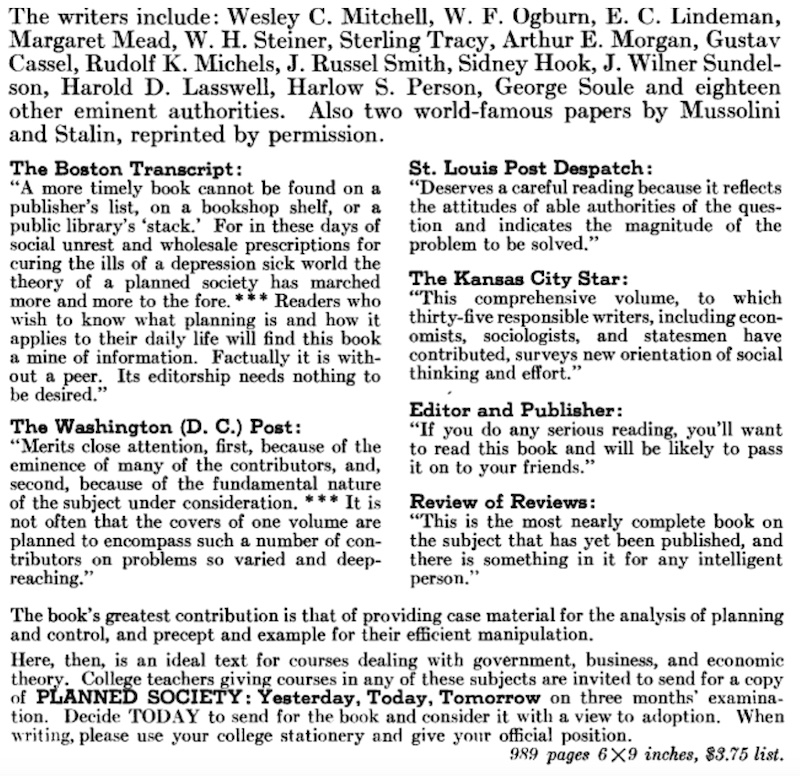
A book by that name appeared in 1937 as published by the prestigious Prentice-Hall, and it included contributions by top academics and high-profile influencers. It was highly praised by all respectable outlets at the time.
 Screenshot
Everyone in the book was explaining how the future would be constructed by the finest minds who would manage whole economies and societies, the best and the brightest with full power. All housing should be provided by government, for example, and food too, but with the cooperation of private corporations. That seems to be the consensus in the book. Fascism was treated as a legitimate path. Even the word totalitarianism was invoked without opprobrium but rather with respect.
The book has been memory-holed of course.
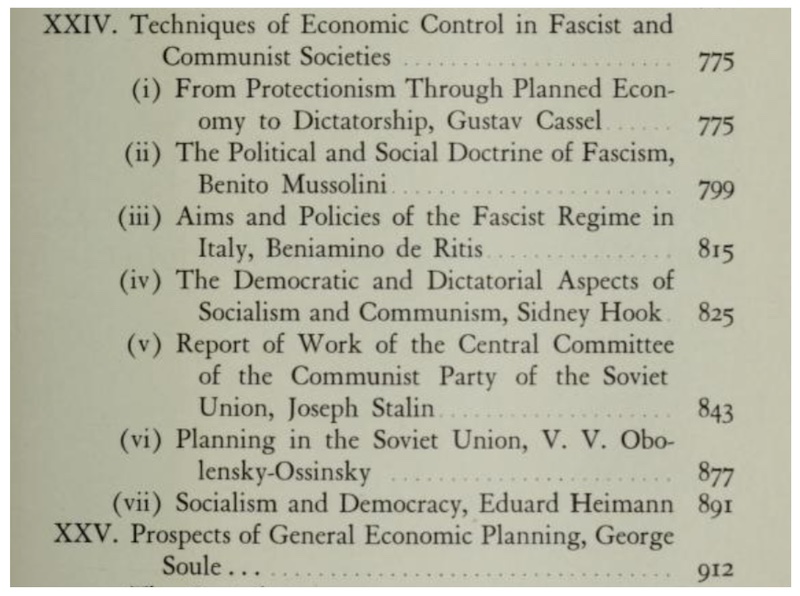
You will notice that the section on economics includes contributions by Benito Mussolini and Joseph Stalin. Yes, their ideas and political rule were part of the prevailing conversation. It is in this essay, likely ghostwritten by Professor Giovanni Gentile, Minister of Public Education, in which Mussolini offered this concise statement: “Fascism is more appropriately called corporatism, for it is the perfect merge of State and corporate power.”
 Screenshot
All of this became rather embarrassing after the war so it was largely forgotten. But the affection on the part of many sectors of the US ruling class had for fascism was still in place. It merely took on new names.
As a result, the lesson of the war, that the US should stand for freedom above all else while wholly rejecting fascism as a system, was largely buried. And generations have been taught to regard fascism as nothing but a quirky and failed system of the past, leaving the word as an insult to fling at in any way deemed reactionary or old-fashioned, which makes no sense.
There is valuable literature on the topic and it bears reading. One book that is particularly insightful is The Vampire Economy by Günter Reimann, a financier in Germany who chronicled the dramatic changes to industrial structures under the Nazis. In a few short years, from 1933 to 1939, a nation of enterprise and small shopkeepers was converted to a corporate-dominated machine that gutted the middle class and cartelized industry in preparation for war.
The book was published in 1939 before the invasion of Poland and the onset of Europe-wide war, and manages to convey the grim reality just before hell broke loose. On a personal note, I spoke to the author (real name: Hans Steinicke) briefly before he died, in order to gain permission to post the book, and he was astonished that anyone cared about it.
“The corruption in fascist countries arises inevitably from the reversal of the roles of the capitalist and the State as wielders of economic power,” wrote Reimann.
The Nazis were not hostile to business as a whole but only opposed traditional, independent, family-owned, small businesses that offered nothing for purposes of nation-building and war planning. The crucial tool to make this happen was establishing the Nazi Party as the central regulator of all enterprises. The large businesses had the resources to comply and the wherewithal to develop good relations with political masters whereas the undercapitalized small businesses were squeezed to the point of extinction. You could make bank under Nazi rules provided you put first things first: regime before customers.
“Most businessmen in a totalitarian economy feel safer if they have a protector in the State or Party bureaucracy,” Reimann writes. “They pay for their protection as did the helpless peasants of feudal days. It is inherent in the present lineup of forces, however, that the official is often sufficiently independent to take the money but fails to provide the protection.”
He wrote of “the decline and ruin of the genuinely independent businessman, who was the master of his enterprise, and exercised his property rights. This type of capitalist is disappearing but another type is prospering. He enriches himself through his Party ties; he himself is a Party member devoted to the Fuehrer, favored by the bureaucracy, entrenched because of family connections and political affiliations. In a number of cases, the wealth of these Party capitalists has been created through the Party’s exercise of naked power. It is to the advantage of these capitalists to strengthen the Party which has strengthened them. Incidentally, it sometimes happens that they become so strong that they constitute a danger to the system, upon which they are liquidated or purged.”
This was particularly true for independent publishers and distributors. Their gradual bankruptcy served to effectively nationalize all surviving media outlets who knew that it was in their interests to echo Nazi Party priorities.
Reimann wrote: “The logical outcome of a fascist system is that all newspapers, news services, and magazines become more or less direct organs of the fascist party and State. They are governmental institutions over which individual capitalists have no control and very little influence except as they are loyal supporters or members of the all-powerful party.”
“Under fascism or any totalitarian regime an editor no longer can act independently,” wrote Reimann. “Opinions are dangerous. He must be willing to print any ‘news’ issued by State propaganda agencies, even when he knows it to be completely at variance with the facts, and he must suppress real news which reflects upon the wisdom of the leader. His editorials can differ from another newspaper’s only in so far as he expresses the same idea in different language. He has no choice between truth and falsehood, for he is merely a State official for whom ‘truth’ and ‘honesty’ do not exist as a moral problem but are identical with the interests of the Party.”
A feature of the policy included aggressive price controls. They did not work to suppress inflation but they were politically useful in other ways. “Under such circumstances nearly every businessman necessarily becomes a potential criminal in the eyes of the Government,” wrote Reimann. “There is scarcely a manufacturer or shopkeeper who, intentionally or unintentionally, has not violated one of the price decrees. This has the effect of lowering the authority of the State; on the other hand, it also makes the State authorities more feared, for no businessman knows when he may be severely penalized.”
From there, Reimann tells many wonderful if chilling stories about, for example, the pig farmer who faced price ceilings on his product and got around them by selling a high-priced dog alongside a low-priced pig, after which the dog was returned. This kind of maneuvering became common.
I can only highly recommend this book as a brilliant inside look at how enterprise functions under a fascist-style regime. The German case was fascism with a racialist and anti-Jewish twist for purposes of political purges. In 1939, it was not entirely obvious how this would end in mass and targeted extermination on a gargantuan scale. The German system in those days bore much resemblance to the Italian case, which was fascism without the ambition of full ethnic cleansing. In that case, it bears examination as a model for how fascism can reveal itself in other contexts.
The best book I’ve seen on the Italian case is John T. Flynn’s 1944 classic As We Go Marching. Flynn was a widely respected journalist, historian, and scholar in the 1930s who was largely forgotten after the war due to his political activities. But his outstanding scholarship stands the test of time. His book deconstructs the history of fascist ideology in Italy from a half-century prior and explains the centralizing ethos of the system, both in politics and economics.
Following an erudite examination of the main theorists, along with Flynn provides a beautiful summary.
Fascism, Flynn writes, is a form of social organization:
1. In which the government acknowledges no restraint upon its powers—totalitarianism.
2. In which this unrestrained government is managed by a dictator—the leadership principle.
3. In which the government is organized to operate the capitalist system and enable it to function under an immense bureaucracy.
4. In which the economic society is organized on the syndicalist model; that is, by producing groups formed into craft and professional categories under supervision of the state.
5. In which the government and the syndicalist organizations operate the capitalist society on the planned, autarchical principle.
6. In which the government holds itself responsible for providing the nation with adequate purchasing power by public spending and borrowing.
7. In which militarism is used as a conscious mechanism of government spending.
8. In which imperialism is included as a policy inevitably flowing from militarism as well as other elements of fascism.
Each point bears longer commentary but let’s focus on number 5 in particular, with its focus on syndicalist organizations. In those days, they were large corporations run with an emphasis on union organization of the workforce. In our own times, these have been replaced by a managerial overclass in tech and pharma that have the ear of government and have developed close ties with the public sector, each depending on the other. Here is where we get the essential bones and meat of why this system is called corporatist.
In today’s polarized political environment, the left continues to worry about unbridled capitalism while the right is forever on the lookout for the enemy of full-blown socialism. Each side has reduced fascistic corporatism to a historical problem on the level of witch burning, fully conquered but useful as a historical reference to form a contemporary insult against the other side.
As a result, and armed with partisan bête noires that bear no resemblance to any really existing threat, hardly anyone who is politically engaged and active is fully aware that there is nothing particularly new about what is called the Great Reset. It is a corporatist model – a combination of the worst of capitalism and socialism without limits – of privileging the elite at the expense of the many, which is why these historical works by Reimann and Flynn seem so familiar to us today.
And yet, for some strange reason, the tactile reality of fascism in practice – not the insult but the historical system – is hardly known either in popular or academic culture. That makes it all the easier to reimplement such a system in our time.
- This article was published at Brownstone Institute
By George Ford Smith
From everything I read you would think we were incapable of solving social problems.
In truth, we find matters only getting worse because the proposed solutions almost always involve the culprit—the state—taking more control over our lives.
The state is a box we desperately need to think outside of if we’re ever going to establish civil relations among people. We would do well to remember that the state is absolutely not in the business of making our lives better. It is an institution appended to the rest of society through force for the purpose of enriching the lives of its members.
Modern welfare states might make this difficult to understand, but it’s no less true. The state is not in the business of producing wealth and then distributing it to the neediest or deserving. It is not the successful entrepreneur turned humanitarian when it dishes out payments to favored beggars, whether they be unemployed workers, corporate cronies, foreign dictators, research facilities, or any other rent seeker. The state is best thought of as a homicidal thief who takes pains to appear as a good guy.
The state is fundamentally a criminal organization and liberty’s greatest enemy. It’s that simple, and that ugly. For starters, see Murray Rothbard’s book Anatomy of the State, Albert Nock’s essay “The Criminality of the State,” and Llewellyn Rockwell’s bookThe Left, the Right, and the State. “Your entire life is at the mercy of the State,” writes Hans-Hermann Hoppe in A Short History of Man.
The state, being criminal and criminally inept, creates the crises that naïve or disingenuous people blame on liberty.
Interventionist mania has been hugely successful but only as a means of bloating the state. Otherwise it achieves the oppositeof its stated aims. Has the state been successful in preventing terrorist attacks? Has it achieved its stated goal of eradicating poverty? Have state regulations in healthcare, which began long before ObamaCare, succeeded in making healthcare better and more affordable? Did its countless financial regulations prevent the recession of 2007–8? How about the job it did following September 11, with George Orwell at home and bloody cakewalks overseas, both of which are running indefinitely? Should we be surprised the state is meddling in Israel-Hamas, Ukraine-Russia, and China-Taiwan? The American state seems bent on pursuing nuclear Armageddon.
School Shootings
Americans are horrified at the wanton nature of school shootings. One occurrence is intolerable, but repeat occurrences are unthinkable in a civilized society. Yet the school in Parkland was preparing for just such a crisis because they had no politically acceptable way of preventing it.
As long as the state is in charge there won’t be a politically acceptable way. What if it decided to outlaw gun ownership? Completely, totally, immediately, no exceptions (other than the usual exceptions: members of the political class and their cronies). Make violators pay with their lives. Aside from it being a human rights nightmare and therefore politically unacceptable to many, it would at least maximize the risk and minimize the likelihood of a crazy person walking into a school and shooting people. But it wouldn’t stop them from killing. Law-abiding murderers would have to find other means to carry out their crimes.
What grade would we give the state for the job it’s done educating our children? Not only are our kids exposed to a creativity-killing environment but they’re forced to sit defenseless in rooms all day, with everyone hoping the next attack doesn’t happen at their school.
Leave it to the state to play Russian roulette with children. Leave it to guileless parents to let the state get away with it.
It might still be argued that since these are state schools, the state should at least be responsible for ensuring the safety of its students.
Not a chance. Parents of the victims can’t expect to sue the government for gross negligence or wrongful death and win. They can try, but governments protect themselves with something its lawyers call sovereign immunity. You can only sue governments if they let you, and since they’re all broke and corrupt the chances of success are nil.
So parents sue people like Alex Jones instead.
It’s one of those fascinating aspects of the institution so many people regard as indispensable—you can’t hold the state responsible for its actions or negligence. You can’t hold it responsible for school slaughters or overseas military murders. You can’t hold it responsible for its endless lies and the damage they cause. You can’t hold it responsible for balancing its budget. You can’t hold it responsible for deliberately debasing the currency.
But in the spirit of double standards, the state, backed by its omnipotent bayonet, can hold you responsible for anything it chooses, especially the payment of tribute. We’ve surrendered our freedom to armed government bureaucrats.
One difference between a prison and a public school is this: you can’t walk into a prison heavily armed and start shooting people, at least not without guards shooting back at you right away. In a public school, killers will enter a world in which a careless student can be suspended for pointing his finger in the shape of a gun. But if an Uber rider pulls up armed with malign intentions, what’s to be done? Tell him to go away? Hope he loses his nerve? The only deterrent is the threat of much-delayed retaliation, though sometimes it’s a brave parent who circumvents authorities and risks confronting the shooter.
I don’t like the thought of any kid attending a public school. Not at all. Neither should you.
In a satirical essay mocking the breathless demands of gun-controllers following a mass shooting, Gary North draws the irresistible conclusion that public schools are too dangerous: “Students in public schools are at risk. Terrible risk. Unacceptable risk. There is no excuse for this any longer. None. The statistics are clear. Students get gunned down only in public schools.”
The solution? He recommends charter schools or homeschooling.
“We must close the public schools forever . . . for the sake of the children.”
I fully agree. But closing dangerous indoctrination centers will never happen as long as the state is in charge of our lives.
- About the author: George Ford Smith is a former mainframe and PC programmer and technology instructor, the author of eight books including a novel about a renegade Fed chairman (Flight of the Barbarous Relic) and a nonfiction book on how money became an instrument of theft (The Jolly Roger Dollar). He welcomes speaking engagements and can be reached at gfs543@icloud.com.
- Source: This article was published by the Mises Institute

In October 2023, the Czechoslovak Group (CSG), of Prague, Czech Republic, entered into a definitive agreement to buy the ammunition brands of Vista Outdoor Inc. for $1.9 billion. Vista is an outdoor sports company that specializes in outdoor products, i.e., camp equipment, and shooting sports, i.e., ammunition.
The deal would give CSG control 70% of the manufacturing capacity for ammunition primers, ownership of ammunition brands Federal, Remington, Speer, CCI, Hevi-Shot, and Alliant Powder, and management of the U.S. Army’s Lake City Army Ammunition Plant. The transaction was criticized by U.S. Senators J.D. Vance and John Kennedy, Representatives Mike Waltz and Clay Higgins, and the National Sheriffs Association. (CSG currently has a 70% stake in Italian munition maker Fiocchi Munizioni which is widely available in the U.S.)
In February, U.S.-based MNC Capital Partners and a private equity partner made their first offer to buy Vista for $35.00 per share in cash for both the outdoor products and ammunition pieces. The offer was rejected by the Vista board in March.)
The senators claim the deal will put a foreign company that has ties to Russia and China in control of primer production, and at the helm of the Lake City Army Ammunition Plant, a government-owned, contractor-operated producer of small arms ammunition for the U.S. government and civilian buyers.
The acquisition must be approved by the Committee on Foreign Investment in the United States (CFIUS) and Senator Kennedy asked Janet Yellen, the Secretary of the Treasury to ensure that CFIUS will “carefully examine national security concerns of the proposed acquisition.”
In response to the legislators, Michal Strnad the CEO of CSG, claimed CSG was a significant supplier to NATO countries, “has never had any ties to Putin’s regime,” only ever exported civilian products to Russia, never broke any embargoes, and has never been sanctioned. Strnad then invited Senator Vance to “visit SG member companies in the U.S. and Europe to experience first-hand who we really are.”
CSG’s American ammunition division CEO David Stepan announced that CSG had “publicly stated our pledge to maintain Vista’s manufacturing operations in the United States, led by the same topflight American management team that runs its operation today.”
“We have no plans,” Stepan added, “to move any employment or production overseas.”
On the other hand, Czech media reports a CSG subsidiary supplied surveillance radars to a Chinese airfield, and, when Michal Strnad’s father, Jaroslav, ran Excalibur Army, a CSG predecessor, the company breached an arms embargo on Azerbaijan, according to Forbes, so CFIUS and its security service partners have some digging to do.
Assuming everyone is being high-minded here, what are next steps?
First, CRIUS must decide on CSG’s fitness as a buyer of Vista, which will mean plumbing the senators’ concerns about Russia and China connections.
The Pentagon has a vote in CFIUS and it has recently revived concerns about lack of competition in the defense sector. In a 2022 report, “State of Competition within the Defense Industrial Base,” the Pentagon identified munitions are one of five “Priority Industrial Base Sectors” and declared “Each M&A [mergers and acquisitions] case should be reviewed carefully for negative effects on competition.”
The Pentagon also reviewed the surety of its supply chains and in another recent report, “Securing Defense-Critical Supply Chains,” the department recommended action to “Mitigate Foreign Ownership, Control, or Influence (FOCI).” Looking at potential conflicts in Europe and Asia, and the ongoing resupply of Israel and Ukraine, the Defense Department may want to ensure as much ammunition production as possible is controlled by American entities.
Then, the shareholders of Vista will vote and, as many of the shareholders, such as Blackrock, are playing with someone else’s money, they won’t rush if they can get a better, all-cash offer that is likely to be approved by the feds. In any case, Vista management understands its duty and told MNC it must improve its revised offer of $37.50 a share in cash for the ammunition and outdoor products brands.
According to Reuters, “While CSG’s proposal pays off Vista’s debt, gives shareholders $750 million in cash, and leaves perhaps $150 million for a special dividend, according to Roth analysts, that only totals up to about $15.50 per share, and investors are left owning a sub-scale outdoor business. MNC’s offer gets them $37.50 per share, cash, and a way out.”
What are some options?
CFIUS can green-light the CSG offer with no conditions, or the U.S. may allow the acquisition to proceed if CSG divests itself of enough of its new holdings that satisfies the government that marketplace competition is preserved. Or, the U.S. may require naming a proxy board to head the new companies, or a Special Security Arrangement to ensure U.S. interests in the Lake City plant are safeguarded.
The U.S. has no beef with foreign buyers. In 2021, Colt’s Manufacturing Company of Hartford, Connecticut, the maker of the military’s M-16 and M-4 rifles, was bought by Prague-based Česká zbrojovka Group (CZ). FN Firearms USA, a supplier to the Pentagon, is owned by Belgian FN Herstal SA. And PMC Ammunition Inc., a supplier to many police agencies, is owned by Korea’s Poongsan Corporation. This deal is foundering on elevated Pentagon and congressional concerns about competition and supply chain integrity, and ongoing resupply commitments to foreign partners.
What is the best deal for the U.S.?
The best deal for the U.S. is a higher offer from MNC so Vista’s American shareholders get more cash, and an invitation to GSG to invest that $1.9 billion in greenfield ammunition plants in the U.S. which, as new facilities, will compete with existing manufacturers and ensure government and private buyers in the U.S. get the best deal. Also investing in the U.S. may turn CSG’s challengers on the Hill into champions if the firm can create jobs in the U.S. while contributing to the robustness of America’s defense industrial base.
- This article was published at Real Clear World
Croatian attempts to calm the Croat-Bosniak war
The representatives of Croatia tried to diplomatically stop the war with recent allies. Thus, on the night of April 24 to 25 in Zagreb, Izetbegović and Boban, in the presence of Tuđman and Owen, signed a joint statement that the body that will be in charge of implementing the Vance-Owen plan “as far as possible considering on the character of the provisions and current circumstances”.
However, this did not happen and on May 9, Muslim forces launched a powerful attack on Mostar. On that day, Sefer Halilović, in command of the 3rd Corps, announced a fierce attack on the Croats in central Bosnia: “The 3rd corps must strengthen its offensive and information operations in Travnik and Lašva valley, Busovača, Vitez, Novi Travnik. The 3rd corps will receive reinforcements when the UN designates demilitarized zones in Eastern Bosnia, then it will be the moment of the final showdown with the Ustasha on this ground and the way to Croatia or under the black earth.”
The next day, the Croatian president sent a letter to Izetbegović and Boban: “I am extremely disturbed and worried about the deepening of the conflict between Croats and Muslims in parts of Bosnia and Herzegovina. I strongly condemn armed conflicts between Croats and Muslims in BiH, regardless of who caused them. I invite you to do everything to stop these conflicts immediately, to ensure cooperation between the Muslim and Croatian armed forces in the joint fight against the Serbian aggressor… I also invite all Croats in BIH not to fall for provocations and to do everything to avoid this harmful conflict.”
On May 18, a meeting of Croatian and Muslim representatives took place in Medjugorje, which was the last attempt to prevent the development of a war between the two nations. Much was expected from the meeting. In addition to the Croatian and Bosnian presidents, co-chairman Owen and chairman of the EC Council of Ministers Niels Helveg Petersen were also present.
The composition of the Coordination Body for the implementation of the Vance-Owen Plan (Izetbegović, Ejup Ganić, Fikret Abdić, Mate Boban, Mile Akmadžić and Franjo Boras) was confirmed, the establishment of the Military Council was announced, and it was agreed that J. Prlić be the president of the joint government. It was agreed to establish provincial governments with seats in Mostar, Travnik and Zenica. In Mostar and Travnik, the governor was supposed to be a Croat, and the deputy a Bosniak, in Zenica it was the other way around. None of that was realized because, even though Prlić did something about that issue, Izetbegović protracted so that the ABIH would take as much territory as possible on the battlefield.
Croats for negotiations, Bosniaks for war
The Croatian side was in favor of a diplomatic solution. At the beginning of May, the HVO had a plan to join the remnants of the HVO in Klis near Konjic with the forces in Rama, which was not carried out due to a ban from the “highest place”, apparently referring to President Tuđman. At the meeting with the brigade commanders of the OZ Northwestern Herzegovina on June 5, Colonel Željko Šiljeg stated: “The plan we were preparing is stopping. During the armistice, the Muslims attacks Bokševica and conquer it. We clear Bokševica in order to ensure communication towards Kostajnica, then Tuđman comes and stop.”
Croatian president was not the initiator of the Croatian-Muslim war. That can be seen from the fact that, at the invitation of Chinese President Jiang Zemin, he traveled to the People’s Republic of China on June 6 for a multi-day visit. It is one of the most important bilateral visits of Tuđman, who already understood the future power of China in 1993. Right at that moment, the major offensive of the ABIH started on Travnik, in which that city was conquered and the Croatian population was expelled. Therefore, Tuđman was forced to cut short his visit and return on June 10 “due to the dramatic deterioration of the situation in Bosnia and Herzegovina in the parts inhabited by the Croatian population”. A politician who creates war sits in a bunker or an isolated place and doesn’t travel to another continent.
At the time of the Owen-Stoltenberg plan on organizing BIH as three national republics, on August 4, Izetbegović sent a letter to Tuđman in which he proposed that the territory that would belong to the Bosnian and Croatian republics in the Union of the Republics of BIH remain a single area with a parity government because it is impossible to divide it. It was an offer of alliance on the condition that the culprits on both sides leave. It is interesting that Izetbegović did not consider himself guilty of the conflicts.
In the letter, Tuđman replied that it was a matter for the representatives of the two nations within Bosnia and that Croatia welcomes the cooperation of Croats and Muslims. He agreed to the proposal on the condition that the attacks of the Muslim troops on the Croats stop immediately and unconditionally. It turned out to be Izetbegović’s diplomatic trick because at the meeting of the ABIH Main Staff in Zenica on August 21 and 22, the main enemy was declared the HVO, not the VRS, and the orientation towards war was emphasized. In Geneva, on September 14, Tuđman and Izetbegović signed a Joint Declaration according to which all conflicts between the Army of Bosnia and Herzegovina and the HVO were to end in four days.
Also, a secret agreement was signed on close relations between the Croatian and Bosnian republics within BIH with the aim of creating a common state that should enter into a confederation with Croatia. That it was a double game by Izetbegović can be seen from the fact that two days later he signed with Momčilo Krajišnik a Joint Declaration on a cease-fire and that within two years after the territorial demarcation, a referendum on the exit of Republika Srpska from the RBIH Union would be held.
Accusations of HV participation in the Croat-Bosniak war
Unfounded accusations about the huge participation of the Croatian army in the Croatian-Muslim war started from the outbreak of the first conflicts in October 1992 and continued later. There are a handful of examples. In a letter to Tuđman on April 21, 1993, Izetbegović wrote that “the world already knows that the HVO in its attempt to create a state within the state has the support of influential circles and individuals from Croatia”, and that he hesitates to disclose this and ask for help from the world.
“People in America, Germany, France, Muslim countries and elsewhere asked why don’t I present the truth and ask for their help. I refrained from doing so,” claimed Izetbegović, “having constant hope that reason will prevail, because I guess it’s obvious that a solid and stable BIH is equally in the Croatian state’s interest and that some short-sighted people will finally understand this unique truth. Unfortunately, that doesn’t happen”.
At the meeting of the Bosnian government on May 13, 1993, one point was dedicated to the HV, which “supported” the HVO attacks: “According to reliable information, the following units of the regular Croatian Army are located on the territory of Bosnia and Herzegovina: the 113th Split Brigade and elements of a brigade from Metković in the region of Buna, Dubrava and Stolac, the 114th Split and 123rd Varaždin brigades in the Lašva region and one tank unit in the Čvrsnica region.” Defense Minister of the Republic of Croatia Gojko Šušak rejected these claims as untrue. After the war, the accusations continued, so today some Bosniak authors mention 4 to 13 HV brigades.
The truth about the participation of the Croatian Army (HV) in the Croat-Bosniak war
The truth is different. The number of HV members in the Croat-Bosniak war was mostly symbolic and of a psychological nature, to show that Croatia supports the HVO in defending the area where the Croats lived for centuries. The first HV unit that joined the Croat-Bosniak war was the Zrinski Battalion from Rakitje, a special unit of the Armed Forces of Croatia. Its composition consisted mainly of BiH Croats. It was partly involved in April 1993 due to the attack of the ABIH on the HVO in Konjic.
A more serious engagement started in July 1993, when the battalion of the 5th Guards Brigade of the HV was engaged on the Mostar battlefield. Later, a volunteer unit of the Military Police of two companies came. After that, members of the HV are directed to the critical Uskoplje-Rama front where the intensity of arrivals was the highest from August to November 1993. The most numerous were members of the 5th Guards Brigade (battalion), 7th Guards Brigade (company), 1st and 2nd Guards Brigade (incomplete companies). Volunteers from different units got involved. Other formations were composed of a platoon up to a reinforced platoon.
At the end of 1993, the 175th brigade of the HV was founded from conscripts and fugitives – Croats from Bosnia. De facto it was a brigade of the HVO. It was sent to the Uskoplje-Rama battlefield. E.g. on January 8, 1994, there were a total of 5,215 Croatian soldiers on the Uskoplje-Rama battlefield, of which 774 were members of the HV: 440 soldiers from the 175th brigade (de facto HVO), 175 guardsmen from the 7th brigade (Puma), 45 from the Matija battalion Vlačić, 38 from the 2nd Guards Brigade (Gromovi), 38 from the 114th Split Brigade and 38 soldiers from the 153rd Velika Gorica Brigade. 6% of the members of the HV if we exclude the members of the 175th brigade and 94% of the members of the HVO.
At the meeting of President Tuđman and international mediators David Owen and Thorvald Stoltenberg held on June 2, 1993, Tuđman proposed that UNPROFOR be deployed on the borders of BIH with Serbia and Montenegro and with Croatia in order to remove the accusations of Croatia’s aggression against Bosnia. Croatia could not officially send several HV brigades because the UN would impose international sanctions.
On the other hand, according to the international law of war, the army can enter 60 km into the territory of another country from which aggression is being waged or threats are being made to the home country. Operations of the ABIH, such as Neretva-93, are an unquestionable threat to Croatian territory, since one of the goals of that operation was conquest of the Port of Ploče. Thus, the HV had the right to enter the territory of Bosnia in an area of 60 km due to the long and narrow Croatian “pretzel”. The small number of soldiers from Croatia who participated in the war with the ABIH shows that their task was primarily defensive (enable the survival of the Croatian people). These forces could only be used for “patching the line of conflict”, not at all for aggression.
Admittedly, the knowledge and experience of the members of the HV was in some cases of great importance because they closed empty and weak lines and restored the lost positions of the HVO in Mostar in Gornji Vakuf-Uskoplje. Croatian soldiers prevented the Muslim penetration on these critical routes. Their number didn’t exceed the strength of one Yugoslav Army (JNA) light infantry brigade with tanks and artillery: 1,400-1,800 soldiers. The last ones remained on the battlefield in Uskoplje until May 1994. Much more numerous were the mujahideen – Islamic volunteers from Muslim countries, who numbered several thousand.
November 1993 – the peace initiative of President Tuđman
At the beginning of November 1993, Tuđman directed the Peace Initiative for three hot spots of the conflict: 1. Proposal for the implementation of the peace plan in the area under the protection of the UN (UNPA zones) in Croatia; 2. Proposal for ending the war and establishing peace in BIH; 3. Proposal of measures for the permanent consolidation of peace. He sent the initiative to the co-chairs of the Peace Conference on the Former Yugoslavia, Owen and Stoltenberg, Austrian President Thomas Klestil, Czech President Vaclav Havel, French President Francois Mitterrand, Italian President Oscar Luigi Scalfaro, Hungarian President Arpad Göncz, German Chancellor Helmut Kohl, Russian President Boris Yeltsin, US President Bill Clinton, Turkish President Suleyman Demirel, British Prime Minister John Major.
Regarding BIH, it is proposed to implement the previous Geneva agreements, unconditionally and immediately stop hostilities, sign a declaration on the acceptance of the Constitutional Agreement on the Union of the Republic of BIH under the auspices of France, Germany, Russia, USA, Turkey and Great Britain. An effective solution can be provided by those countries “by the use of NATO forces, including airstrikes, against anyone who violates the cessation of hostilities”.
In the initiative, Tuđman pointed out: “It is not enough that the world community only cares about one side of the problem at such crucial moments: humanitarian aid to the civilian population who are really suffering terrible hardships. One should ask whether the primary duty of the international community is to stop the horror of war, which continues and even worsens every day, both on the territory of Croatia and Bosnia and Herzegovina… It seems that at the beginning of the crisis, the world was not aware of the complexity of the situation in Bosnia, the possible scale of human tragedies and unbearable suffering that happened… The problem of BIH is a mirror of all the problems that appeared in the former Yugoslavia. The most urgent and shortest summary is the following: if the former Yugoslavia could not be maintained except on the basis of the confederal organization of the community of its equal national states, then BIH, due to the existence of equal problems in a narrowed area, can only be maintained in the form of the Union of the Republics of BIH.”
Tuđman rejected Izetbegović’s offer for the annexation of Herzegovina to Croatia
The then Minister of Foreign Affairs, Mate Granić, revealed that in January 1994, Izetbegović twice offered Tuđman to annex Herzegovina. “At the suggestion of President Izetbegović, and with the mediation of Ambassador Hidajet Biščević, on January 10, 1994 at 11 p.m. on the ground floor of the state residence in Bad Godesberg, Presidents Tuđman and Izetbegović, Silajdžić and I, and Biščević met.
Almost without any preamble, Izetbegović directly proposed to Tuđman: ‘President Tuđman, you give up central Bosnia and leave it to us Bosniaks, and in return we will give you everything south and west from Prozor to the Neretva valley. We will divide Mostar into the left and right banks.’ In this way, the Croats would get practically the whole of Herzegovina. Izetbegović said this calmly, concentrated and very cold. I was used to all kinds of things in war and negotiations, but Izetbegović’s proposal surprised me greatly. I was waiting for what Tuđman would say. The president thought very briefly, and then said: ‘I don’t agree! We cannot do this to Croats in central Bosnia.’ I was very satisfied with President Tuđman’s answer, and Izetbegović then acted as if nothing had happened. The meeting ended very quickly after that. Izetbegović’s second offer to divide BiH came in Geneva on January 19, 1994 at around 5 pm in the UN building. This time, Presidents Tuđman and Izetbegović, Silajdžić and I and Ambassador Miomir Žužul were at the meeting. Izetbegović repeated the previous offer to Tuđman.
He said: ‘Franjo, take everything from below Prozor to the Neretva, let’s divide Mostar into the left and right banks and finish the job!’ Tuđman again rejected his proposal. Silajdžić and I didn’t say a word this time either. The president was clear and decisive in rejecting Izetbegović’s proposal.”
“Tuđman gave up Greater Croatia under international pressure”
One of the most common manipulations of Tuđman’s critics is that he gave up on Greater Croatia only under international pressure at the end of February 1994. Such an interpretation isn’t correct. The Croatian Republic of Herzeg-Bosnia was not part of (Greater) Croatia, but a constitutive confederal unit according to the Owen-Stoltenberg plan of three republics and respected the sovereignty and territorial integrity of BIH.
Admittedly, within that plan there was the possibility of calling a referendum on the separation of a republic from Bosnia if the other two republics gave permission, and if one republic filed an appeal, the decision would ultimately be made by the UN Security Council. Whether such referendums would really take place is questionable, but it is known that Herzeg-Bosnia didn’t go in the direction of secession. It is true that Tuđman gave up Herzeg-Bosnia and accepted the American idea of the Federation of Bosnia and Herzegovina, but it is not true that he did so under the threat of UNSC sanctions.
In the presidential statement of February 3, 1994, the UN Security Council “strongly condemns the Republic of Croatia” for “deploying elements of the Croatian Army” in Bosnia and Herzegovina, and “demands that the Republic of Croatia immediately withdraw all elements of the Croatian Army (HV) together with military equipment and fully respects the territorial integrity of BIH”. The Secretary General of the UN, Boutros Boutros-Ghali, had to submit a report to the UN General Assembly within 14 days whether Croatia complied with the ultimatum or whether economic sanctions would be imposed on it.
According to Tuđman’s critics, such as Josip Manolić and American ambassador Peter Galbraith, that statement scared the Croatian president so much that he changed his policy by 180 degrees and agreed to the American Federation plan. However, on February 17, Boutros-Ghali reported, based on UNPROFOR data, that “there may still be 5,000 members of the Croatian Army in Bosnia and Herzegovina, although neither HV commands nor entire brigades of the Croatian Army have been identified. “After that report of the UN Secretary General, no sanctions were imposed on Croatia and the threat of sanctions was at least temporarily removed from the agenda. Admittedly, the report is not correct because the members of the HV were a maximum of two thousand, as already stated.
On the same day, February 17, a meeting between the special envoy of the US government, Charles Redman and Tuđman was held in the Presidential Palace in Zagreb. Redman came up with the proposal of the Muslim-Croat Federation reduced to 51% of the territory of Bosnia without Republika Srpska, which would have the right to a referendum on secession. In such a federal state of Bosnia, Croats would not have the right to territorial delimitation in relation to Bosniaks (cantons, provinces, republics) and the only guarantee of protection was the proposed confederation of the Federation with Croatia, including a customs and monetary union.
Tuđman rejected the idea of such a Federation and advocated a solution of three republics with the aim of creating a stronger alliance between the Bosniak and Croat republics. Redman didn’t accept the concept of three republics because the American administration was afraid of the establishment of an independent Muslim state in Bosnia, which could become another anti-American outpost. In the following days, a reversal occurred, but not because Tuđman was afraid of sanctions, but because the Americans accepted Croatian proposals on demarcation within the Federation.
On February 18, at the Frankfurt airport, the Croatian delegation led by Granić held talks with Redman and representatives of Great Britain, France and Germany. The Croats insisted on the cantons and confederation of the Federation with Croatia, especially if the Serb Republic leaves Bosnia. On the same day, the Americans relented and Redman said that the idea of a union of cantons in the Federation was acceptable to him and that the Croatian cantons “which do not have to be completely together, have some Croatian identity of their own and be linked by the Croatian Parliament”.
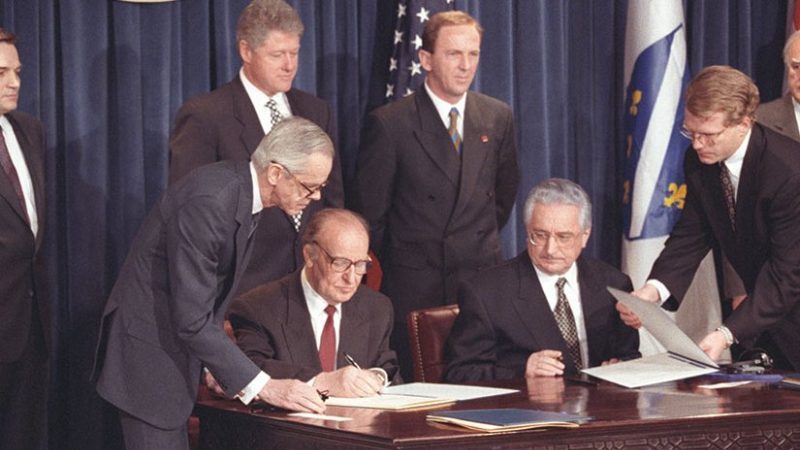
This was followed by conversations between Granić, Krešimir Zubak and Mile Akmadžić with Haris Silajdžić. On February 20, a meeting between Tuđman and the representatives of Herzeg-Bosnia was held in the Presidential Palace, who agreed to the Federation as a union of cantons that would be a protection against the majority of Bosniaks. The following day, at a meeting between Redman and Tuđman, the Federation of Bosnia and Herzegovina was finally agreed upon on a cantonal basis. Apparently, Redman changed his mind when his boss Clinton realized that the Croatian representatives were right: the concept of the Federation was changed from a civil one to a binational Croat-Bosniak community. Further negotiations between the Croats and Bosniaks will result in the preliminary Agreement on the creation of the Federation of Bosnia and Herzegovina on March 1, 1994, and finally the Washington Agreement on March 18, which ended the Croat-Bosniak war, although incidents continued.
9.12% of citizens of Bosnia and Herzegovina were expelled or left the area of Herzeg-Bosnia
During the war, 586,000 Bosniaks and Croats (47.7% of exiles) were expelled or escaped from the territory under the control of the Army of Republika Srpska. 529,000 Serbs and Croats (43.1% of exiles) fled from the territory under the control of the ABIH. 112,000 Serbs and Bosniaks (9.12%) fled or were expelled from the territory controlled by the HVO during the war.
Severe suffering of BiH Croats
The troops of the Army of BiH in central Bosnia exiled 153,000 Croats and killed 1,700 captured Croatian soldiers and civilians. During the war, the Bosniak-Muslim authorities established 331 camps and prisons, in which 14,444 Croats were imprisoned, of which 10,346 were civilians and 4,098 were soldiers. Of that number, 632 inmates and prisoners were killed, and 50 of them were cruelly executed in a ritualistic manner.
That the Muslim ABIH had the task of ethnically cleansing Croats from large parts of Bosnia is confirmed by the report of the Chief of General Staff of ABIH, Rasim Delić, sent to Izetbegović at the end of February 1994: “The HVO was eliminated from the areas of Jablanica, Konjic, Fojnica, Kakanj, Zenica, Travnik and Bugojno. So, one complete province according to the Vance-Owen plan with the headquarters in Travnik.” That statement made at the end of the Croat-Bosniak war reveals the motives and intentions of the creators of that war who were in Sarajevo.
How Croatia saved Bosnia in 1994 and 1995
After the Washington Agreement, Croatian aid to the Bosnia and Herzegovina intensified again, although it never stopped. Croatia continued to send large quantities of food, medicine, oil, gas, as well as weapons and military equipment to the ABIH from various organizations and countries. This aid greatly helped the defense of BIH in the last stage of the war and prevented the Serbs from occupying Sarajevo, Bihać and Maglaj, which were threatened by immediate danger, but also Tuzla, Zenica and other cities because the Serbian threat did not stop.
Despite this help, the VRS occupied the Bosniak enclaves of Srebrenica and Žepa in Operation Krivaja 95 from July 6 to 25. After the resulting genocide in Srebrenica, on July 22, 1995, Presidents Tuđman and Izetbegović signed the “Declaration on the revival of the Washington Agreement, joint defense against Serbian aggression and the achievement of a political solution in accordance with the efforts of the international community”. Only then did the Bosnian leader agree to a joint military alliance between Bosnia and Croatia so that the HV would help defeat the Serbs and force them to negotiate.
From the fall of 1994 to the fall of 1995, Croatian troops liberated about 6,000 square kilometers of BIH (Operations Cincar, Winter 94, Jump 1, Jump 2, Summer-95, Storm, Maestral, Southern Move, etc.) and saved Bihać which was under Serb siege for 1,200 days. New massacre of Bosniaks was prevented. At the end of the war, HVO and HV controlled 26% of the territory of BIH – 13,082 square kilometers. According to the Dayton Agreement, Croatian forces ceded to Serbs 5% of the territory in western Bosnia as part of the territory barter between FBIH and the RS.
Thanks to HVO and HV, that territory was mostly exchanged for Bosniak areas: the unblocking of Sarajevo and the corridor to Goražde, and was not used for the return of Croat areas in Bosnian Posavina. Mostly thanks to Croatia, BIH has survived as a state of two entities and an international protectorate whose status is still far from being resolved even today in 2024. Without Croatian aid from 1992 to 1995, most of BIH would have been part of (Greater) Serbia, and these are facts that are being forgotten.