Categories
Audio Review - South Caucasus News

What Factors Influence Thailand’s Approach To Refugees? – Analysis


What Factors Influence Thailand’s Approach To Refugees? – Analysis

By Fiona Raval 

Thailand is looking at a new wave of refugees and asylum-seekers with the establishment of mandatory military service in Myanmar. The junta in Myanmar has recently activated the country’s conscription law, creating widespread panic and the possibility of an exodus. Those fleeing are likely to seek refuge in Thailand—Myanmar and Thailand share a long, largely non-demarcated and porous land border, and the latter has  generally been a haven of choice for asylum-seekers since the 1980s.

Thailand, however, is not party to international conventions on the treatment of refugees and makes no legal differentiation between refugees, asylum-seekers, and illegal immigrants. It has also been accused of refugee maltreatment. This anticipated inflow of asylum-seekers, in what is the latest episode of Thailand’s enduring tryst with refugees, thus puts the spotlight back on the country’s approach to refugee identification and treatment.

Legislative Hurdles

Over the past few years, Thailand has tried to regulate the migrant/refugee domain by passing several legislations. The practicability and execution of these legislations is however questionable. The National Screening Mechanism (NSM), arguably the most prominent legislation, intends to screen and identify individuals who need protection in Thailand and cannot return to their home countries. While this legislation would strengthen refugee protection by safeguarding them from arbitrary arrest, detentions, and deportations, it hasn’t been implemented yet—despite being passed in 2019. Additionally, even if implemented, NSM has sparked scepticism and outcry among rights groups and asylees as they fear its potential to be used for surveillance: a tool for screening ‘out’ rather than screening ‘in’. 

Another important piece of legislation, in terms of economic protection, is Thailand’s Labour Protection Act, which applies to non-nationals as well. However, refugees are exempt from these protections as they aren’t legally allowed to work. They thus find themselves being part of the informal and unregulated workforce, primarily in the agricultural sector. There is also the Foreigners’ Working Management Emergency Decree B.E.2560. Per Section 63, the legislation can be applied to individuals experiencing circumstances similar to refugees. Its enforcement however requires a cabinet resolution which still hasn’t come through, though the decree was passed in 2017.

Extradition

Successful extradition requests made to Thailand are not necessarily subject to extradition treaties signed with other countries. An individual is extraditable from Thailand as long as the crime in question is punishable in Thailand as well as the requesting country. Therefore, given the strict domestic legal restraints on political dissent, people seeking asylum on grounds of political persecution are particularly vulnerable to forced repatriation or refoulement.

Thailand’s extradition of anti-government Vietnamese journalist Truong Duy Nhat; Cambodian labour activist Sam Sokha; and opposition activists from Myanmar are some examples of such refoulement. Thailand is also notorious for the repression of exiled dissidents, such as the mysterious deaths of three Thai anti-monarchists in Laos and the disappearances of Thai activists who had fled to Vietnam. Such methods depend on the formal and informal cooperation of other countries, leading to arrangements that have often sacrificed the principle of non-refoulement. In a cyclical way, the lack of refugee protections thus further disincentivises official pro-refugee positions.

Domestic Public Sentiment

As per public surveys conducted in certain parts of Thailand, the Thai public have mixed feelings about migrants and asylum-seekers. While most respondents on these surveys were accepting of migrants, they displayed a strong preference for migrant labour over people seeking refuge due to ethno-religious reasons. As per a 2019 International Labour Organization (ILO) report, more than 70 per cent of Thai respondents related high crime rates with migrants, and tended to believe that they threaten the country’s culture and heritage.

These negative outlooks on migrants and asylum-seekers are intensified by the surge in the Malay Muslim insurgency in the south of Thailand where, for years, ethnic Malay Muslims have been at odds with the predominantly Buddhist Thai state. Their long-standing resistance against what they call ‘Thai colonialism’ has led to insurgent violence and demands for a separate state. Due to this conflict, the Buddhist population in the south has dwindled. Notably, while Muslim refugees struggle in most parts of the country, the south accepts them warmly as part of the community. This demographic impact, however, coupled with the steady inflow of Muslim refugees, especially from Myanmar, fuels  negative public sentiment elsewhere in the country. The Thai military has gone as far as accusing the Rohingya of partaking in this insurgent movement and have thus expelleddetained, or pushed back incoming refugees into the sea.

Conclusion

In the face of an escalating crisis in Myanmar, Thailand has come under pressure to adopt a more just and inclusive approach towards refugees and asylum-seekers. Bangkok’s stance on refugees, however, continues to be uncertain due to ambiguous laws and inconsistent enforcement. Moreover, Thai public sentiment by and large tends to reflect hostility toward those seeking refuge. In navigating this challenging policy area, Thailand will hopefully balance domestic complexities with its humanitarian obligations.

  • About the author: Fiona Raval is Research Assistant with IPCS’ South East Asia Research Programme (SEARP).
  • Source: This article was published at IPCS  
Categories
Audio Review - South Caucasus News

Two Sessions Of China 2024 – Analysis


Two Sessions Of China 2024 – Analysis

The delinking of China’s defence budget from the country’s rate of growth means freedom to enhance its military’s capability.

By Lt Gen S L Narasimhan 

The National People’s Congress meeting in China takes place every year in March and this year it was during the week of 4-11 March. It is called Two Sessions (or liang hui in Chinese) as the National People’s Congress and the China People’s Political Consultative Conference take place simultaneously and set the agenda for the year. These are different from the National Congress of the Chinese Party which is held once in five years and is party-centric, electing the committees and approving members of the Politburo.

This year’s Two Sessions saw a couple of departures from the past. One, the premier Li Qiang did not hold the customary press interaction after the Government Work Report (GWR) which he presented on 5 March. Two, the State Organic Law was amended to say that the State Council (the Council of Ministers) will implicitly obey the Communist Party of China (CPC).

The implications of these are important. The premier not interacting with the press may mean that either Li is displaying absolute loyalty to President Xi Jinping, or his importance is being reduced. It will take some time for analysts to figure out which one of them resulted in the skipped media interaction. The State Organic law was amended last in 1982. The present amendment means that the state council will follow the diktat of the CPC and cannot function independently, thereby putting an end to Deng Xiaoping’s policy of separating the state from the party.

These apart, the rest of the meetings were largely as usual. The highlight of the Two Sessions is the Government Work Report which the Premier delivers as a stocktaking of the government’s performance in the past year and sets targets for the coming year.

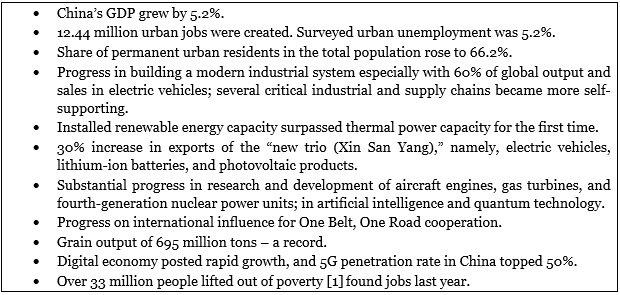
The 2024 GWR claimed the following achievements:

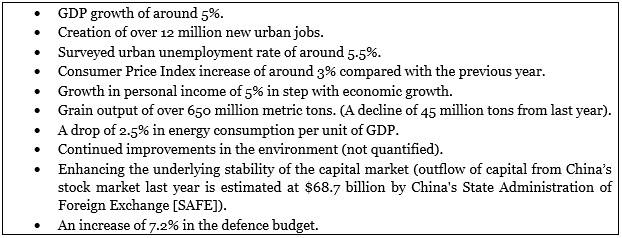
The targets for the year 2024 came next, and they are mostly about maintaining the status quo. They are as follows:

Most Western analysis concentrated on the cancellation of Premier Li’s press interaction and lack of personnel appointments which are customary in the Two Sessions. There was expectation that Admiral Dong Jun, who is the defence minister, would be appointed to the Central Military Commission and made a State Councillor. Liu Jianchao was expected to be made the foreign minister. Neither was announced. The West also concentrated on the economic woes of China, that even 5% GDP growth will be difficult to achieve. There were passing mentions of other issues like innovation, the lack of change in foreign policy, the importance of the Global Development Initiative, Global Security Initiative and the Global Civilisation Initiative; and stasis in economic policy and invariably the lack of the word “peaceful” while mentioning Taiwan’s Reunification with China and the term “New Productive Forces” etc.

Analysis of the Two Sessions from India mainly followed the pattern of analysis from the West. In addition, in these discussions, there was mention of eight delegates voting against the work report and eight abstaining amongst the approximately 3,000 delegates at the Two Sessions. No surprise: in China such opposing votes are generally orchestrated to show that the process is democratic.

However, from an Indian lens, the following 10 observations are significant.

First is innovation. The Work Report has much emphasis on innovation. The word innovation appeared 31 times in the report as against the word Xi which appeared 24 times. This indicates the importance given to technological advances and innovation.

Second is the mention of the term New Productive Forces. This refers to the greenfield industries in critical and emerging technologies. Xi Jinping articulated the New Productive Forces in the three meetings that he addressed after the Two Sessions. This is of significance as investment in those industries will enable China to leapfrog in technological advancement. In contrast, the term Advanced Productive Forces was used by former President Jiang Zemin when he articulated his signature “Three Represents” in early 2000s. That time it implied the leading industries and businesses in China and their inclusion in the political process.

Third, is the admission in the Work Report of the difficulties that the Xi government is facing – which is unlike most governments where such admissions are rare, if not absent. The admissions were made with regard to the drop in external demand; failure to increase domestic consumption; conduct at the workplace which is burdened by pointless formalities, bureaucratism, hedonism and extravagance; and corruption which is still prevalent despite a sustained crackdown on it for the last decade.

Fourth, is the emphasis on global initiatives launched by China. Though it was mentioned only twice in the report, the emphasis on the Global Development Initiative, Global Security Initiative and Global Civilisation Initiative were visible. Interestingly, the Global Initiative on Data Security was absent in the deliberation

Fifth, is the issue of the third plenum. After the Two Sessions are held in March, a third plenum is held in November where the economic policies are given out. The third plenum after the party congress in March 2023 has not been held so far. This is generally seen as an indication of the economic difficulties that China is facing and therefore the stasis on policies for economic revival in China. It is anybody’s guess if the third plenum will be held anytime soon. Simultaneously there was mention in the GWR for 2024 of deepening reforms and opening up across the board to include reducing market access difficulties for foreign companies and revamping of traditional and emerging industries and cultivating future ones. Unemployment figured prominently in the GWR as did the promotion of equipment upgrades and trade-ins of consumer goods to boost domestic consumption.

Sixth, while Made in China 2025, a concept made public in 2015 to boost manufacturing at home to world-class levels in 10 important sectors did not find a mention, the reference to New Productive Forces and revamping of industries obliquely revealed its importance and progress.

Seventh is a point that all analysts missed. That is the development of border areas. This is significant for India that is locked into a face-off with China for the last four years on the Line of Actual Control in Eastern Ladakh. This, combined with a 7.2% increase in defence budget is important to India. The rate of increase in the defence budget has been delinked from the rate of growth of the Chinese economy. This departure from what was the norm till a few years ago is aimed to enhance China’s military capabilities and increase its overseas influence – particularly in the South China Sea, the India-China border, and elsewhere.

Eighth, an effort to foster growth in biomanufacturing, commercial spaceflight, and the low-altitude economy was mentioned in the GWR, through a combination of funding, research, nurturing of talent, and linking academia, industry and government. China is already one of the leaders in drone manufacturing and there seems to be an effort to consolidate the dominant positioning with an increased self-sufficiency in science and technology. This is expected to accelerate the process of derisking, if not decoupling by China from the dependencies on markets for exports and for raw material imports.

Ninth, expanding the reserve facilities for food, water, resource and energy security for China is mentioned, another move in the direction of derisking China’s economy from the West. The effect of China’s increased imports of soya beans in 2020 led to a spike in prices worldwide, and to food inflation. Oil storage may also be increased in China from the four storage facilities that it has on the eastern seacoast.

Finally, is the issue of Taiwan reunification. While the term “peaceful reunification” was not mentioned in the GWR, it was subsequently mentioned by foreign minister Wang Yi in his media interaction at the time. Therefore, there is no major change in China’s stance towards Taiwan, indicating that for now, China does not want to up the ante on this issue. China called for an equal and orderly multipolar world and a new type of international relations. The meaning and manifestation of these terms will slowly emerge.

In essence, the Two Sessions did not throw up any major surprises. Nor may the Third Plenum and next Two Sessions; but both are necessary to watch.

References:

1] “Lifting 800 Million People Out of Poverty – New Report Looks at Lessons from China’s Experience,” World Bank, 1 April 2022, https://www.worldbank.org/en/news/press-release/2022/04/01/lifting-800-million-people-out-of-poverty-new-report-looks-at-lessons-from-china-s-experience.


Categories
Audio Review - South Caucasus News

Can Macron’s Vision Prevent The Death Of Europe? – OpEd


Can Macron’s Vision Prevent The Death Of Europe? – OpEd

By Shairee Malhotra

In 2017, a few months after being elected as France’s President, Emmanuel Macron called for a “sovereign Europe”, that entailed a common defence force alongside the creation of a European strategic culture, in a speech at the Sorbonne University in Paris. On 25 April this year, just ahead of the European elections in June, Macron returned to the Sorbonne touching upon similar themes in a wide-ranging speech, but this time with a greater sense of urgency and solemnness.

In a fundamentally altered global context with multiple economic and geopolitical challenges confronting the European Union (EU), the speech stood out for Macron’s apocalyptic warning, “Europe is mortal; it can die. It only depends on our choices”. Echoing the familiar triad of dependencies that underpinned European prosperity so far, Macron reiterated, “The era of basing our production in China, of delegating our defence to the US, and of getting our energy from Russia is over.”

Key takeaways from Macron’s speech

Russia’s war on Ukraine has lent greater credence to Macron’s ideas on defence, and his fervent push for European strategic autonomy and self-reliance in security. Amongst the most important themes in his two-hour long speech was the core subject of defence—central to Europe in the context of wavering United States (US) support and the daunting prospect of a Donald Trump return to the White House. Macron emphasised Europe’s need to bolster its military preparedness by establishing a credible defence strategy, which entails building “a European defence initiative” and strengthening its anti-missile system. Adopting a “Europe First” approach, the French President asserted his preference for local European manufacturers in purchasing military equipment and boosting the bloc’s defence industry. 

Echoing his controversial remarks on Taiwan during his trip to Beijing last year, Macron once again vowed to script a third path between the US-China great power rivalry. He claimed that Europe would never serve as a vassal for the US and that Europe was not a US priority despite the strength of the transatlantic alliance. 

On trade, Macron accused the US and China of not respecting global rules in the context of increasing subsidies used by the two powers to boost local industry. In October 2023, the EU launched an anti-subsidies probe into Chinese production of electric vehicles that it is now considering widening to other sectors such as solar panels. On the other hand, European firms fear the impact of the US Inflation Reduction Act that provides subsidies to American businesses to accelerate the green transition. In response, Macron called on EU trade policy to undergo a revision, including supporting domestic firms in key sectors such as green energy and tech through greater public investments, while reducing burdensome EU regulation.

Other themes covered in Macron’s speech included French favourites such as nuclear power, in addition to warnings about Europe being “encircled” by regional powers such as Russia and Iran, and critiques of the European Central Bank’s lack of focus on growth. Macron outlined five critical sectors where the EU should become a “world leader” by 2030, including AI, space, biotech, green energy, and quantum computing. He pitched ways to boost EU resources through the EU’s carbon tax and also supported new joint European debt acquisition similar to the EU’s €800 billion pandemic recovery fund. 

A much-needed vision 

Since 2017, Macron’s domestic position has significantly weakened through the loss of his parliamentary majority, which has rendered the passing of important legislation difficult, as was evident in the recently passed immigration law, and long-drawn protests against his pension reforms. Recent polls indicate that less than a third of French voters hold a favourable view of their President. At the EU level too, Opposition leader Marine Le Penn’s far-right Rassemblement National Party has emerged as a frontrunner, challengingMacron’s centrist Renew group, the third-largest bloc in the current European Parliament.

Moreover, the French President has often been accused of grandstanding, while offering less clarity on details and concrete solutions. Some see the speech as a means to cement his political legacy, given that he is ineligible to run for president again in 2027 according to French laws. In addition, French policy trends such as providing less aid to Ukraine compared to other European nations, accommodating less Ukrainian refugees, and not yet fulfilling the 2 percent of GDP NATO spending threshold point to contradictions with Macron’s bold rhetoric. Challenges stand in the path to greater European autonomy, not least in the form of the Eastern flank’s comfort with US strategic dependence, and Franco-German and other divergences within the Union. 

And yet, given geopolitical events that have transpired since Macron’s last speech in 2017, the President’s ideas stand vindicated particularly in the areas of security and defence. Irrespective of caveats, Macron’s vision could be the revolution Europe needs to shake itself out of its complacent bubble, unless it wants to continue moving forward with the security of its 450 million citizens remaining at the behest of American voters. 


  • About the author: Shairee Malhotra is an Associate Fellow at the Observer Research Foundation.
  • Source: This article was published by the Observer Research Foundation

Categories
Audio Review - South Caucasus News

Take National Security Off Auto-Pilot – OpEd


Take National Security Off Auto-Pilot – OpEd

By Andrew Byers 

American foreign policy has been lurching along for decades now, ever since the end of the Cold War, without sufficient clarity. What are our goals as a nation, and how might we best achieve them? There have been times in the course of American history when the nation had genuine strategic clarity, such as when it went to war against the Axis following the attack at Pearl Harbor. In that instance, the United States properly assessed what it wanted to achieve   — the unconditional surrender of the Axis Powers — how it might best go about achieving that end, and proceeded to marshal its resources to ensure success. Clearly, the use of military force is warranted when critical US interests are at stake, such as when an aggressive rival hegemon (like Nazi Germany or Imperial Japan) threatens to dominate a key region, and there are no alternatives to using force. Problems have arisen when the United States has used significant military force in cases when important US interests are not at stake, or in instances when non-military means could have been used.

In his now-famous “Long Telegram” and Foreign Affairs article entitled “The Sources of Soviet Conduct,” American diplomat and strategist George F. Kennan sought to provide similar clarity for the Cold War with the Soviet Union. His notion of “containment” served as the bedrock for US grand strategy for the next forty-five years, though US implementation of containment became far more militaristic and expansive than Kennan’s original conception. Kennan never advocated for military means as a primary means to contain the Soviets, nor did he ever resign himself to an inevitable war with the Soviet Union. Since the end of the Cold War, US foreign policy has been on autopilot, lurching along as though not much had changed since the Soviet Union collapsed — the United States still has almost 170,000 active-duty service members stationed at 750 military bases in 80 countries around the world. We badly need a blueprint for a new American grand strategy that puts American national interests at its center.

During the 1990s, the so-called “Unipolar Moment” when there was no other great power to check the United States, we had the luxury of trying to maintain regional stability and assert US primacy around the world, rather than pulling back from Cold War military deployments and enjoying the peace dividend that the end of the Cold War could have brought. The September 11 attacks ushered in the Global War on Terror, the disastrous wars in Afghanistan and Iraq, and militarized counterterrorism at home and abroad on a global scale. 

We now face increasing calls for a new cold war with China. Do such calls really best serve the nation’s interests? Given that the United States — guarded by vast oceans, a strong nuclear deterrent, and the most powerful and advanced conventional military capabilities in the world — is remarkably safe, what are those national interests? Why is there such a dearth of strategic clarity surrounding what US national interests are and how we might construct a grand strategy and a foreign policy that best serve those interests?

Briefly after the collapse of the Soviet Union, the Clinton administration had a vague desire to strengthen regional stability. After the 9/11 attacks, the Bush administration wanted to end the threat posed by al-Qaeda and international Salafist jihadism. Those are both reactive strategies. In more recent administrations, we have not even had that.

We need something else to replace Kennan’s vision of containment that serves the national interest and does not overreach or require us to vast expenditures (the post-9/11 wars alone have cost over $8 trillion and more than 7,000 American servicemembers’ lives). Most importantly, our actions must not run counter to the nation’s interests.

The most recent National Security Strategy (October 2022) actually defines American national interests cogently: “Our strategy is rooted in our national interests: to protect the security of the American people; to expand economic prosperity and opportunity; and to realize and defend the democratic values at the heart of the American way of life.” This is a simple statement of core national interests that, if followed, would provide a solid bedrock for governing US foreign policy.

The problem is that the US military has been, and continues to be, used to conduct operations that far exceed this statement of national interests; indeed, it seems clear that many activities undertaken by the US military not only far exceed this narrow articulation of national interests but actually run counter to those interests. The invasion of Iraq and subsequent occupation not only was unnecessary and cost vast amounts of treasure and lives, but it also destabilized the region, led to the creation of ISIS, and opened the door for much greater influence by Iran throughout the Shia Crescent (as one glaring example from recent history). US national interests would have been much better served in that case by simply taking no action in 2003 and beyond.

Today, the United States maintains more than 30,000 troops throughout the Middle East. While these deployments have been celebrated as a means for projecting US power, US military outposts are also traps that can be threatened and attacked by adversaries, as demonstrated in Jordan in January 2024. Such vulnerabilities risk drawing the United States further into conflicts that do not serve its interests. Likewise, the United States has sent additional forces to Europe since the start of the war in Ukraine, and recently announced that US forces would be permanently stationed in Taiwan for the first time. It is hard to justify these kinds of military deployments on the grounds that they serve vital national interests, especially given that these forces can be held at risk by enemies, or even precipitate a conflict by their very presence.

And, for the first time in living memory, American largesse to its security dependents has forced it to make significant tradeoffs with the key military systems needed to provide for its own security and others. Recently the United States has had to purchase Patriot missiles from Japan to replenish its supply that has been expended in Ukraine, and is running low on artillery shells and anti-tank munitions. The status quo cannot persist.

The aim of a new strategic vision should be simple: to keep Americans safe at home, preserve and shore up our system of laws and society, and enhance our material abundance and prosperity. We no longer have the luxury of trying to provide security throughout the world, and we have a dismal track record in almost all our attempts. We have squandered our own scarce resources, bred animosity overseas, and frequently made existing conditions and conflicts worse.

The relative wealth of the United States has dwindled post-WWII — it peaked at about 40 percent of global GDP in 1960, fell to 21 percent in 1980, and is now about 15 percent of global GDP — and our fiscal health has certainly declined. We are now $34.4 trillion in debt and our annual deficit has reached $1.6 trillion and is expected to grow substantially into the indefinite future. Annual servicing of the interest on the national debt will soon surpass the already-bloated defense budget. While the United States remains prosperous for now, that status cannot endure forever if nothing is done. The prospect of ever-accelerating defense spending and continued military presence throughout most regions of the world increases the potential for military conflict with China, Russia, Iran, and North Korea, among other states.

We should follow Kennan’s advice: avoid unnecessary wars, defend and maintain our constitutional order, and ensure that every American has the opportunity to achieve economic prosperity. We can do that, placing the national interest at the core of everything we do as a nation, and remain perfectly secure — our vast military capabilities, the deterrent effect of our nuclear arsenal, and the stopping power of the vast oceans that separate us from possible adversaries will ensure that.

The US military must be shifted away from a force structure and posture designed to project US military power over intercontinental distances for nebulous purposes. We must be able to maintain international trade routes, but invading other countries repeatedly over the last three decades has not brought Americans peace and prosperity; quite the opposite. We have wasted our resources and are, ironically, less safe than if we had done nothing. This must end. Before committing US military power and other resources in service of unclear objectives, policymakers must ask themselves, does taking this action serve the national interest, narrowly defined? If not, it might be best to take no action at all.

  • About the author: Andrew Byers is currently a non-resident fellow at the Texas A&M University’s Albritton Center for Grand Strategy. He is a former professor in the history department at Duke University and former director of foreign policy at the Charles Koch Foundation.
  • Source: This article was published by AIER

Categories
South Caucasus News

Road collapse kills dozens in southern China


Categories
(@mikenov) / Twitter

@Sandbagger_01: RT by @mikenov: BBC News – The Russian ‘spy’, the NSA mole and the FBI sting that got him bbc.co.uk/news/world-us-…


Categories
South Caucasus News

Secret tunnels connecting continents discovered


default.jpg


Categories
South Caucasus News

Foreign currencies rates fixed by Central Bank


1 ABŞ dolları

USD


Categories
South Caucasus News

U.S. Says ‘Stands With Georgian People’


The United States on Wednesday strongly condemned the violence against protesters in Georgia, who have been peacefully demonstrating against the Kremlin-inspired law on foreign influence, and made it clear that it’s ‘standing with Georgian people’, TURAN’s Washington correspondent reports.

“We are concerned by the escalating rhetoric and tone directed towards civil society…


Categories
South Caucasus News

Azerbaijan cooperates with int’l partners on Black Sea submarine cable project: Minister – News.Az


Azerbaijan cooperates with int’l partners on Black Sea submarine cable project: Minister  News.Az