
Day: May 1, 2024
Categories
NPR News: 05-01-2024 5PM EDT
washington — The United States on Wednesday accused Russia of violating the international chemical weapons ban by deploying the choking agent chloropicrin against Ukrainian troops and using riot control agents “as a method of warfare” in Ukraine.
“The use of such chemicals is not an isolated incident and is probably driven by Russian forces’ desire to dislodge Ukrainian forces from fortified positions and achieve tactical gains on the battlefield,” the State Department said in a statement.
The Russian Embassy in Washington did not immediately respond to a request for comment.
Chloropicrin is listed as a banned choking agent by the Hague-based Organization for the Prohibition of Chemical Weapons (OPCW), which was created to implement and monitor compliance with the 1993 Chemical Weapons Convention (CWC).
German forces fired the gas against Allied troops during World War I in one of the first uses of a chemical weapon.
Earlier this month, Reuters reported the Ukrainian military as saying Russia has stepped up its illegal of use riot control agents as it presses its biggest advances in eastern Ukraine in more than two years.
In addition to chloropicrin, Russian forces have used grenades loaded with CS and CN gases, the Ukrainian military says. It says at least 500 Ukrainian soldiers have been treated for exposure to toxic substances and one was killed by suffocating on tear gas.
While civilians usually can escape riot control gases during protests, soldiers stuck in trenches without gas masks must either flee under enemy fire or risk suffocating.
The State Department said it was delivering to Congress its determination that Russia’s use of chloropicrin against Ukrainian troops violated the CWC.
Moscow’s use of the gas “comes from the same playbook as its operations to poison” the late opposition leader Alexey Navalny in 2020 and Sergei Skripal and his daughter Yulia in 2018 with the Novichok nerve agent, the statement said.
Russia denied involvement in both cases.
The department also determined that Russia has breached the CWC’s prohibition on the use of riot control agents as a method of warfare, the statement said.
It said it was sanctioning three Russian state entities linked to Moscow’s chemical and biological weapons programs, including a specialized military unit that facilitated the use of chloropicrin against Ukrainian troops.
Four Russian companies that support the three entities were also sanctioned, it said.
The sanctions freeze any U.S. assets belonging to the targeted entities and generally prohibit Americans from doing business with them.
Separately, the U.S. Treasury imposed sanctions on three entities and two individuals involved in purchasing items for Russian military institutes involved in the country’s chemical and biological weapons programs.
The sanctions were among new measures announced by the United States on Wednesday targeting Russia over its 2022 invasion of Ukraine.
The CWC bans the production and use of chemical weapons. It also requires the 193 countries that have ratified the convention, which include Russia and the U.S., to destroy any stocks of banned chemicals.
The State Department was expected to convey its determination that Russia has violated the CWC to the OPCW.
Russia and Ukraine have accused each other of breaching the treaty in OPCW meetings. But the organization says it has not been formally asked to open an investigation into the use of prohibited substances in Ukraine.
Reuters has not been able to independently verify the use of banned chemical substances by either side.
washington — The United States on Wednesday accused Russia of violating the international chemical weapons ban by deploying the choking agent chloropicrin against Ukrainian troops and using riot control agents “as a method of warfare” in Ukraine.
“The use of such chemicals is not an isolated incident and is probably driven by Russian forces’ desire to dislodge Ukrainian forces from fortified positions and achieve tactical gains on the battlefield,” the State Department said in a statement.
The Russian Embassy in Washington did not immediately respond to a request for comment.
Chloropicrin is listed as a banned choking agent by the Hague-based Organization for the Prohibition of Chemical Weapons (OPCW), which was created to implement and monitor compliance with the 1993 Chemical Weapons Convention (CWC).
German forces fired the gas against Allied troops during World War I in one of the first uses of a chemical weapon.
Earlier this month, Reuters reported the Ukrainian military as saying Russia has stepped up its illegal of use riot control agents as it presses its biggest advances in eastern Ukraine in more than two years.
In addition to chloropicrin, Russian forces have used grenades loaded with CS and CN gases, the Ukrainian military says. It says at least 500 Ukrainian soldiers have been treated for exposure to toxic substances and one was killed by suffocating on tear gas.
While civilians usually can escape riot control gases during protests, soldiers stuck in trenches without gas masks must either flee under enemy fire or risk suffocating.
The State Department said it was delivering to Congress its determination that Russia’s use of chloropicrin against Ukrainian troops violated the CWC.
Moscow’s use of the gas “comes from the same playbook as its operations to poison” the late opposition leader Alexey Navalny in 2020 and Sergei Skripal and his daughter Yulia in 2018 with the Novichok nerve agent, the statement said.
Russia denied involvement in both cases.
The department also determined that Russia has breached the CWC’s prohibition on the use of riot control agents as a method of warfare, the statement said.
It said it was sanctioning three Russian state entities linked to Moscow’s chemical and biological weapons programs, including a specialized military unit that facilitated the use of chloropicrin against Ukrainian troops.
Four Russian companies that support the three entities were also sanctioned, it said.
The sanctions freeze any U.S. assets belonging to the targeted entities and generally prohibit Americans from doing business with them.
Separately, the U.S. Treasury imposed sanctions on three entities and two individuals involved in purchasing items for Russian military institutes involved in the country’s chemical and biological weapons programs.
The sanctions were among new measures announced by the United States on Wednesday targeting Russia over its 2022 invasion of Ukraine.
The CWC bans the production and use of chemical weapons. It also requires the 193 countries that have ratified the convention, which include Russia and the U.S., to destroy any stocks of banned chemicals.
The State Department was expected to convey its determination that Russia has violated the CWC to the OPCW.
Russia and Ukraine have accused each other of breaching the treaty in OPCW meetings. But the organization says it has not been formally asked to open an investigation into the use of prohibited substances in Ukraine.
Reuters has not been able to independently verify the use of banned chemical substances by either side.
Georgian police disperse protesters as parliament approves ‘foreign bill’ second reading SWI swissinfo.ch in English
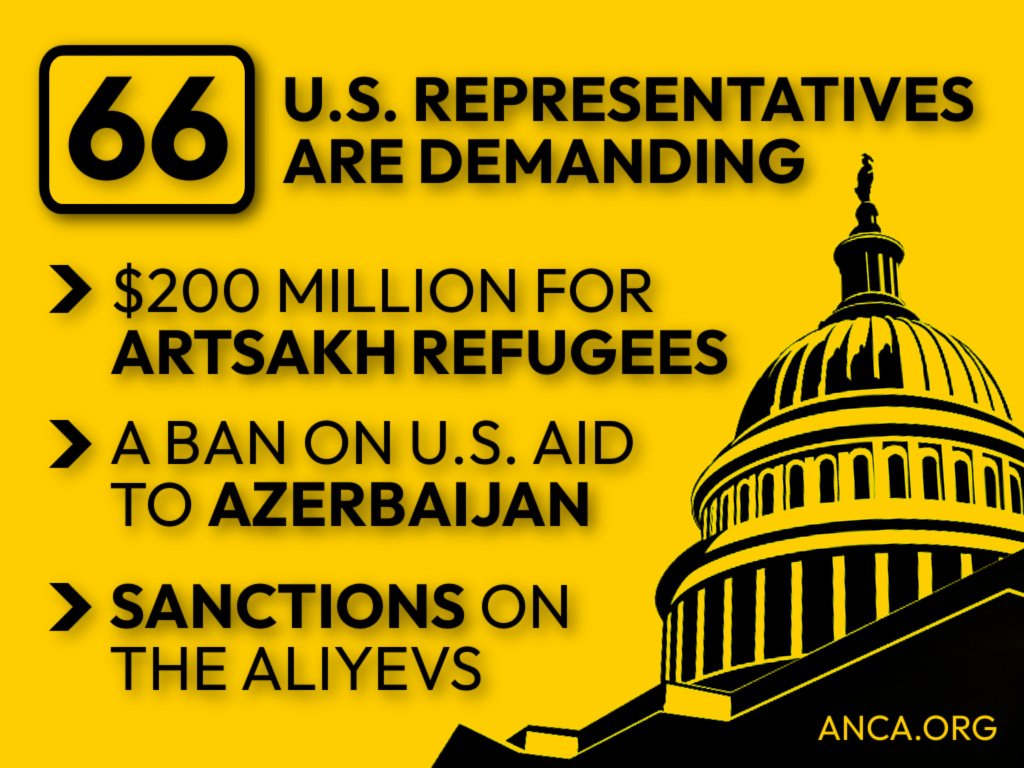 WASHINGTON—Sixty-six U.S. representatives called on U.S. House Appropriations Committee leaders today to allocate $200 million in U.S. assistance for Artsakh refugees, expand U.S. military aid to Armenia, suspend all military and security assistance to Azerbaijan and explore the application of sanctions on Azerbaijani war criminals, reported the Armenian National Committee of America (ANCA).
The ANCA-backed bipartisan letter, led by Congressional Armenian Caucus co-chair Frank Pallone (D-NJ) and sent to Rep. Mario Diaz-Balart, chairman of the House Appropriations Subcommittee on Foreign Operation, and Rep. Barbara Lee (D-CA), Ranking Democrat of that Committee, specifically requests:
– $200 million for refugees from Nagorno-Karabakh in AEECA
– Suspension of all U.S. military and security aid to Azerbaijan and directs the Secretary of State to develop an assessment of potential sanctions against Azerbaijani officials
– $20 million in Foreign Military Financing (FMF) and $10m in International Military Education and Training (IMET) for Armenia
– $10 million for law enforcement reforms in INCLE
– $10 million in democratic reforms under OTI
“We join with the leadership of the Congressional Armenian Caucus and more than 60 of their U.S. House colleagues in demanding a long overdue ban on U.S. military aid to Azerbaijan, sanctions against the Aliyev regime and meaningful levels of U.S. humanitarian aid for Artsakh refugees,” said ANCA Executive Director Aram Hamparian.
“With tens of billions of American dollars being shipped overseas to crisis zones around the world, the less than $20 million that President Biden has set aside – but not yet allocated – for displaced Artsakh Armenians is truly an embarrassment – a sad testament to a President that armed Azerbaijan, aided genocide and abandoned Armenians during our worst crisis since the Armenian Genocide,” concluded Hamparian.
The ANCA ran a nationwide grassroots campaign – anca.org/aid – urging members of Congress to cosign the Armenian Caucus letter.
Joining Armenian Caucus co-chair Frank Pallone (D-NJ) in co-signing the letter are Representatives Alma Adams (D-NC), Gabe Amo (D-RI), Jake Auchincloss (D-MA), Joyce Beatty (D-OH), Don Beyer (D-VA), Nikki Budzinski (D-IL), Salud Carbajal (D-CA), Tony Cardenas (D-CA), Sean Casten (D-IL), Judy Chu (D-CA), Jim Costa (D-CA), Danny Davis (D-IL), Donald Payne (D-NJ), Nanette Diaz Barragan (D-CA), Lloyd Doggett (D-TX), Anna Eshoo (D-CA), Lizzie Fletcher (D-TX), Robert Garcia (D-CA), Dan Goldman (D-NY), Jimmy Gomez (D-CA), Josh Gottheimer (D-NJ), Jim Himes (D-CT), Steven Horsford (D-NV), Jared Huffman (D-CA), Jonathan Jackson (D-IL), Sydney Kamlager-Dove (D-CA), Robin Kelly (D-IL), Ro Khanna (D-CA), Dan Kildee (D-MI), Andy Kim (D-NJ), Raja Krishnamoorthi (D-IL), John Larson (D-CT), Mike Lawler (R-NY), Mike Levin (D-CA), Ted Lieu (D-CA), Zoe Lofgren (D-CA), Stephen Lynch (D-MA), Seth Magaziner (D-RI), Nicole Malliotakis (R-NY), James McGovern (D-MA), Rob Menendez (D-NJ), Kevin Mullin (D-CA), Grace Napolitano (D-CA), Eleanor Holmes Norton (D-DC), Ilhan Omar (D-MN), Chris Pappas (D-NH), Chellie Pingree (D-ME), Katie Porter (D-CA), Jamie Raskin (D-MD), Linda Sanchez (D-CA), John Sarbanes (D-MD), Janice Schakowsky (D-IL), Adam Schiff (D-CA), Brad Schneider (D-IL), Brad Sherman (D-CA), Mikie Sherrill (D-NJ), Darren Soto (D-FL), Abigail Spanberger (D-VA), Haley Stevens (D-MI), Tom Suozzi (D-NY), Eric Swalwell (D-CA), Dina Titus (D-NV), Paul Tonko (D-NY), Lori Trahan (D-MA) and Susan Wild (D-PA).
In calling for $200 million in U.S. aid for forcibly displaced Artsakh refugees, Rep. Pallone and fellow letter co-signers told U.S. House appropriators that the U.S. and international response to Azerbaijan’s genocidal ethnic cleansing of Artsakh has been “wholly insufficient to meet these families’ outstanding needs. Failure to secure their guaranteed right of return to their homeland also remains a black mark on the international diplomatic community.”
Congressional co-signers of the letter expressed specific concern about the Aliyev regime’s intentions to “incite a new war against Armenia.” They argued, “Additional security assistance to Armenia in the form of Foreign Military Financing (FMF) and International Military Education and Training (IMET) is especially important as the Armenian people seek international assistance in protecting their sovereignty in the face of constant Azerbaijani expansionism and potential threats from other authoritarian regimes in the region.”
Members of Congress once again called on appropriators to stop all military and security assistance to Azerbaijan, arguing, “President Aliyev has proven time and again through his genocidal actions that he is not an honest broker for peace in the region, and the United States must not reward his regime with security assistance of any kind.” The lawmakers criticized the State Department and international bodies for their failure to hold the Azerbaijani government accountable for human rights abuses, stating, “It is far past time that the U.S. seriously consider imposing sanctions to make them answer for these violations of international law.”
The full text of the letter is available online and below.
#####
Congressional Armenian Caucus Letter to House Appropriations Subcommittee on Foreign Operations Leaders
April 30, 2024
Chairman Mario Diaz-Balart
Appropriations Subcommittee on State, Foreign Operations, and Related Programs
Room HT-2, The Capitol
Washington, DC 20515
Ranking Member Barbara Lee
Appropriations Subcommittee on State, Foreign Operations, and Related Programs
1036 Longworth House Office Building
Washington, DC 20515
Dear Chairman Diaz-Balart and Ranking Member Lee:
We write to urge the Appropriations Subcommittee on State, Foreign Operations, and Related Programs (SFOPs) to include language in your bill that holds Azerbaijani President Aliyev accountable for the ethnic cleansing of Armenians in Nagorno-Karabakh (Artsakh) in September 2023 and to include robust funding to address the ensuing refugee crisis it caused. We also urge you to provide funding that will enable the Republic of Armenia to protect its territorial integrity, secure its energy independence, support further democratic reforms, and increase cooperation with the United States. These investments will strengthen American interests by supporting one of the few truly democratic countries in the region and helping it to grow as an important partner country.
Armenian Security Assistance
The United States is uniquely positioned to make important diplomatic advances in the South Caucasus. Providing significant assistance to Armenia will help make it more secure, bolster its democracy, and sustain the increase in economic development. Additional security assistance to Armenia in the form of Foreign Military Financing (FMF) and International Military Education and Training (IMET) is especially important as the Armenian people seek international assistance in protecting their sovereignty in the face of constant Azerbaijani expansionism and potential threats from other authoritarian regimes in the region. We are concerned that the Aliyev regime will attempt to take advantage of Russia’s war in Ukraine and other conflicts in the world as well as the upcoming elections in the United States and elsewhere to incite a new war against Armenia. To deter that threat and help Armenia strengthen its borders against future attacks, we request that you include the following provisions in the FMF and IMET accounts:
Of the funds appropriated under this Act, not less than $20,000,000 shall be made available under the heading “Foreign Military Financing” and not less than $10,000,000 shall be made available under the heading “International Military Education and Training” to increase defense cooperation between the United States and the Republic of Armenia.
Robust Funding for Armenian Refugees from Nagorno-Karabakh (Artsakh)
Azerbaijan’s full-scale invasion of Nagorno-Karabakh on September 19, 2023, followed a 10-month genocidal campaign of starvation and depravation of essential goods for 120,000 Armenians living in the region. This ethnic cleansing caused over 80 percent of the region’s population to seek refuge in neighboring Armenia, creating a crisis that requires immediate, large-scale international attention. Unfortunately, assistance from the U.S. and other international actors has been wholly insufficient to meet these families’ outstanding needs. Failure to secure their guaranteed right of return to their homeland also remains a black mark on the international diplomatic community. To address this catastrophe, we ask you to include the following provision in the Assistance to Europe, Eurasia, and Central Asia (AEECA) account:
Of the funds appropriated by this Act, not less than $200,000,000 shall be made available under the heading “Assistance for Europe, Eurasia, and Central Asia” to support victims from Artsakh currently residing in the Republic of Armenia, who were forced to flee their ancestral homeland by Azerbaijan’s genocidal campaign in 2023 and have the right to return to their homes under international guarantees.
Supporting Armenian Government Reforms
The current Armenian government is actively pursuing ambitious reforms in its judiciary, police, education, economy, and public administration in tandem with USAID, U.S. non-governmental organizations, and other international partners. Like U.S. investments in Armenian security assistance, enabling Armenia to establish the Rule of Law and undergo law enforcement reforms will greatly decrease its reliance on other actors in the region for internal security. For instance, the Armenian government recently signaled its intent to expel Russian border guards at the Zvartnots Airport in Yerevan. The United States can encourage further actions to support Armenian security independence by enabling the country to increase its institutional capacities. We ask that you include the following provision in the International Narcotics and Law Enforcement (INCLE) account to assist with this transition:
Of the funds appropriated by this Act, not less than $10,000,000 shall be made available under the heading “International Narcotics and Law Enforcement” to support ongoing law enforcement and internal security reforms in Armenia.
Additionally, Armenia requires assistance in advancing ongoing executive branch reforms, government transparency programs, reducing corruption, and supporting public administration reforms in e-governance. Such reforms will solidify its democratic institutions and give more tools to the Armenian public for government accountability. We urge you to include the following provision in USAID’s Office of Transition Initiatives (OTI) account:
Of the funds appropriated by this Act, not less than $10,000,000 shall be made available under the heading “Office of Transition Initiatives” to support democratic reforms in Armenia.
Prohibition on U.S. Military Aid to Azerbaijan and Sanctions
According to a January 31, 2022, report by the Government Accountability Office (GAO), the State Department likely violated Section 907 of the FREEDOM Support Act by sending security assistance to Azerbaijan from 2014 to 2021, including over $100 million through the Section 333 Building Partner Capacity Program in Fiscal Years 2018 and 2019. They did so by not properly consulting and communicating with Congress on what processes were used to determine if U.S. aid to Azerbaijan could be used for offensive purposes against Armenians in the region. President Aliyev has proven time and again through his genocidal actions that he is not an honest broker for peace in the region, and the United States must not reward his regime with security assistance of any kind.
Additionally, there are well-documented reports on the human rights abuses committed by President Aliyev and members of his regime against Armenians in Artsakh, as well as human rights and pro-democracy activists in Azerbaijan. There is also credible evidence demonstrating the rampant corruption of the Aliyev regime and how it uses these ill-gotten funds for corrupt purposes abroad. The Department of State and other international actors have failed to hold these bad actors accountable, and it is far past time that the U.S. seriously consider imposing sanctions to make them answer for these violations of international law.We request that you include the following provision in the final legislation:
None of the funds appropriated or otherwise made available under this Act may be provided to the Government of Azerbaijan through U.S. military or security assistance programs. To inform the reevaluation of any future security assistance to Azerbaijan, the Secretary of State is directed to provide a report on Azerbaijan’s eligibility for military assistance programs under existing statutes. Additionally, the Secretary of State shall submit to the appropriate congressional committees a report on how the Department of State coordinates with the Department of the Treasury and other relevant Federal departments and agencies to achieve behavioral change through sanctions on individuals from the Republic of Azerbaijan that are involved in corruption, human rights abuses, anti-democratic activities, including challenges to implementation.
Again, thank you for your leadership on the Subcommittee. We appreciate your consideration of these requests.
Sincerely,
Author information
The Armenian National Committee of America (ANCA) is the largest and most influential Armenian-American grassroots organization. Working in coordination with a network of offices, chapters and supporters throughout the United States and affiliated organizations around the world, the ANCA actively advances the concerns of the Armenian American community on a broad range of issues.
| Twitter |
The post 66 U.S. representatives urge congressional appropriators to allocate $200 million for Artsakh genocide victims appeared first on The Armenian Weekly.